The Lumberjack


Students Serving The Cal Poly Humboldt Campus and Community Since 1929

Tag: rabbits

  • Flynn Creek Circus Goes Down the Rabbit Hole

    Flynn Creek Circus Goes Down the Rabbit Hole

    A hot and bothered rabbit and a troop of acrobats highlight the 21+ circus show

    The Rabbit is out of the hat and she wants some action. Animal control is on the scene, face to face with a gang of nihilist bunnies who are ready to pounce. The Flynn Creek Circus was set up in a big, red and white circus tent in the Creamery District of Arcata.

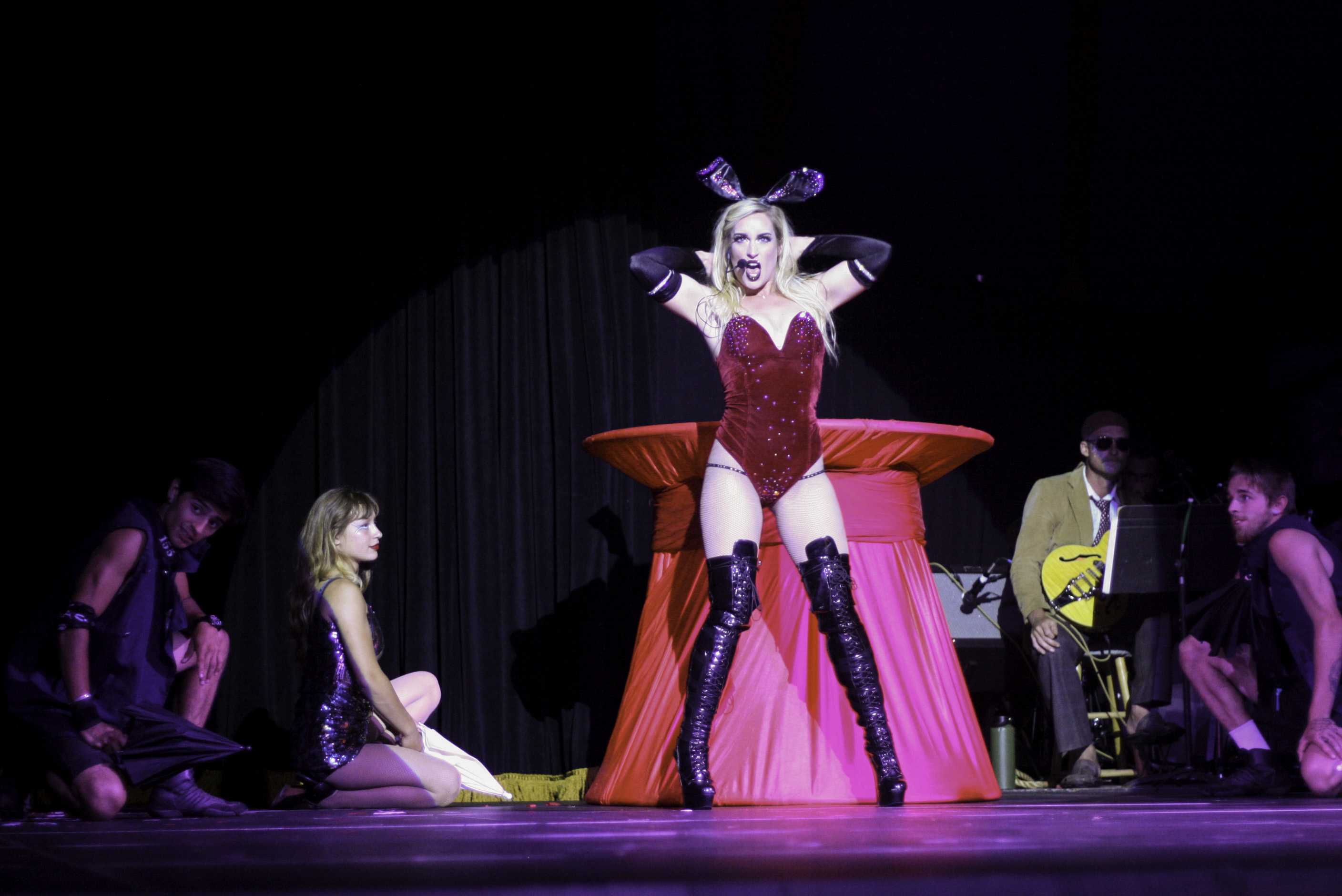
    The inside of the tent was warm. The audience’s voices were loud under the tent’s striped skin. The stage lights glowed a harsh, dull silver. A three person band charged with a buzz of anticipation playing a staccato drum, a perpetual accordion and a melodic guitar. A five-foot tall, eight-foot wide, magnificent red hat sat on the corner of the stage, otherwise known as the the magician’s hat.

    The stage lights flashed and a hush fell over the crowd. After all eyes turned to the stage, the drum roll crescendoed into a crash as the curtains parted. Out came a sharp dressed man in a red suit who held a deck of cards in his hand.

    The Flynn Creek Circus was set up in a red and white striped tent. The ticket booth was the eclectic trailer the left. | Photo by Collin Slavey

    “You know what I am going to say next?” he said to the audience with a smile on his face. “Pick a card.”

    The mix of sleight of hand, bravado and stage magic was just the start of the show. Popcorn and booze were also on the menu. After the magician’s magic act, Grenda the Science Chick made her appearance on stage with a platter ringed in butter shots.

    “The story comes first,” Grenda said. “It’s what makes us different. The art director comes up with a story and makes acts serving the story. It adds a lot to think about. You wonder what’s next and become more invested in the characters.”

    That evening was the 21-and-over show. The story was about the magician’s rabbit who had figured out how to get herself out of his hat. Life in a hat is awfully lonely, and she was desperately tense after a solitary life. She was on a mission to do what rabbits do best: reproduce.

    “I’ve been in that hat for so long,” the Rabbit said. “Do you know how tough it is to be in a hat your whole life? Oh, my god it’s dreadful! I am so pent up. I have got to find me a carrot to chew on.”

    Cue the nihilist bunnies. Animal control was on their tail with malicious intent. The magician’s rabbit was roped into the conflict on stage and the gang decided to make a stand as they whipped out K-bar carrots. Their performance devolved into a harrowing knife act and they were not messing around. The nihilists didn’t have a hare in the world. They made an acrobatic escape, bringing the magician’s bunny with them.

    Nick Harden doubled as animal control and ticket salesman. Here he is grimacing after the credit card reader stopped working. | Photo by Collin Slavey

    Nick and Wendy Harden played classic opponents: animal control and a stray cat. The duo did a unicycle act with acrobatics and headstands. It was a regular game of cat and mouse around the stage, their faces tight in concentration as Nick wheeled around the stage while Wendy maneuvered over his body in an impressive display of poise and balance. Clearly the duo has put years into their act.

    “We were sold out the first night. I hope we can get you a ticket tonight,” Harden said. “Wendy stands on my head during our unicycle act.”

    As the show came to a close, the magician performed his final act. It was an arcane rope act where he hoisted himself up and down, suspended 30 feet off the ground. He tied up the loose ends with his rabbit partner and encouraged her to find herself. The magician’s rabbit concluded the show with a descent into general apathy as the nihilist bunnies welcomed her into their ranks.

    “Nothing really matters,” she said with a wink. “So I’m going to go get what I can get while I can get it. Know what I’m saying?”

    The Flynn Creek Circus is based in Mendocino. The circus tours the North Coast and Oregon during summer, while the weather permits it. The 2019 season is halfway through and August 18 was the final show performed in Arcata this time around. Not to worry though, the next local shows will be in Fortuna on September 5, 6, 7 and 8. Tickets can be bought online or at the door.
  • Sand, wind and poop: a tale of American dune grass’ life troubles

    Sand, wind and poop: a tale of American dune grass’ life troubles

    For undergraduates Elizabeth Nguyen and Sean Thull, their past summer was spent staring at grass.

    “We spent between two to four hours every three weeks, collecting data on Elymus mollis growth patterns at the Ma-l’el and Eel River foredunes,” Thull said.

    Elymus, or American dune grass, is a native plant that can change the foredunes’ landscape.

    Erik Jules, a professor in the Department of Biological Sciences, advised Elizabeth Nguyen, Sean Thull and Steven La Pointe on the project.

    “Foredunes are dunes’ regions closest to the ocean. They often become eroded from crashing ocean waves or by wind,” Jules said. “U.S. Fish and Wildlife wants to keep foredunes from being eroded too fast and improve their resilience in the face of rising sea levels.”

    Growing Elymus on foredunes is known to help the foredunes withstand heavy waves.

    While Elymus growth at some of the region’s foredunes, such as Lanphere and Ma-le’l dunes, was healthy, Elymus grown at the Eel River foredunes suffered another fate.

    “We wanted to know whether Elymus deaths were due to soil differences between these dunes and Lanphere dunes,” Thull said.

    To answer this question, Nguyen, Thull and La Pointe observed the growth of Elymus from Lanphere dunes that were transplanted into Eel River and Ma-le’l soil.

    HSU biology students Sean Thull (left) and Steven La Pointe collecting data on American dune grass growth at the Ma-le’l dunes. Photo and caption by Dr. Erik Jules.

    A hundred Elymus were planted at each dune and an additional 41 plants were grown in the greenhouse.

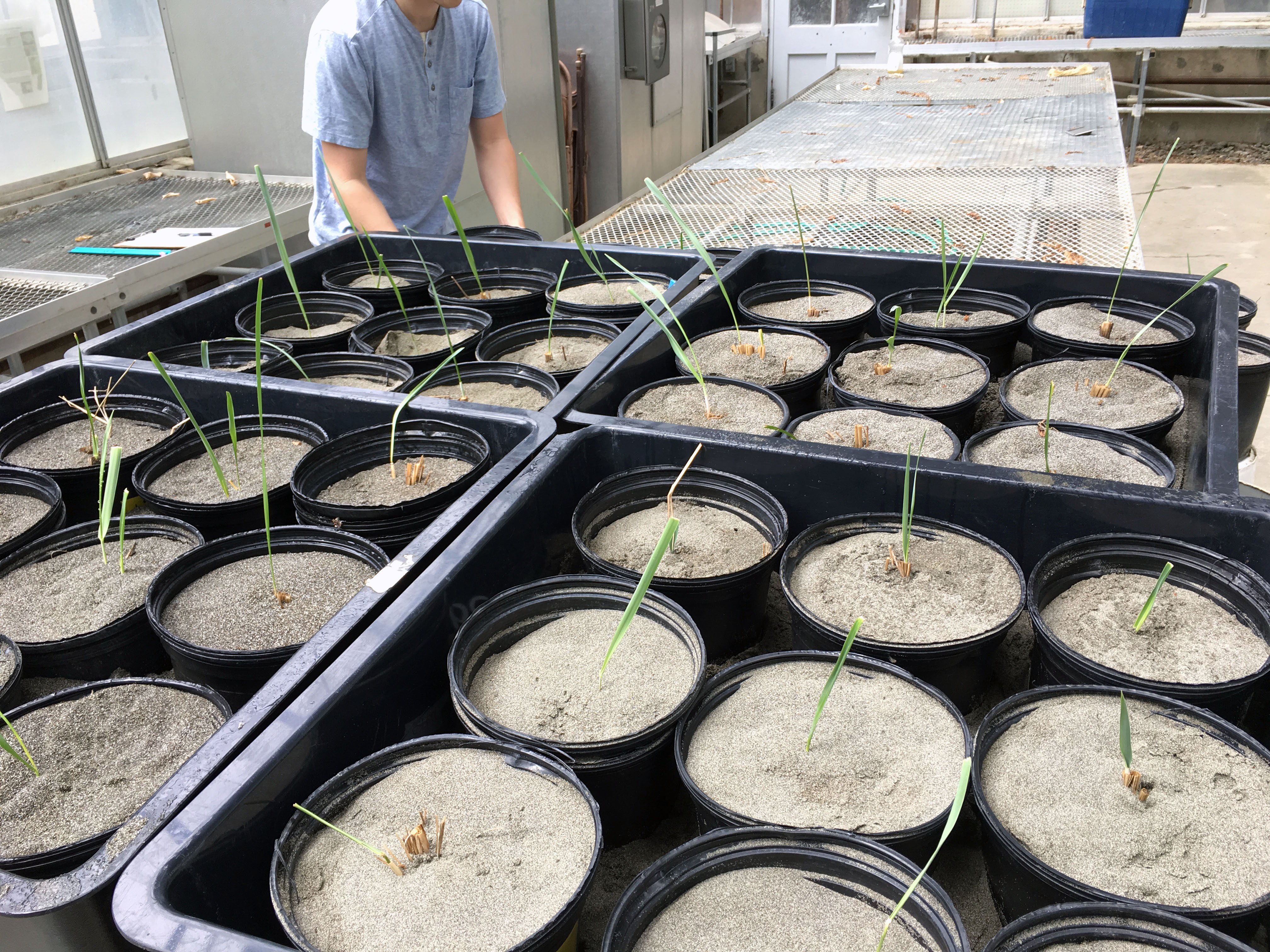
    “In the greenhouse, we cut the Elymus down to their base, giving them the same start point,” Thull said. “We watered them three times a week, rotated them to evenly distribute the sunlight and measured their longest leaf lengths.”

    While the Elymus planted at Eel River had high mortality rates, the greenhouse Elymus grew strong. The longest leaf lengths in both soil types were not significantly different from each other.

    “This showed that the soil at Ma-le’l and Eel River could supplement the plants just fine,” Thull said, “but something else in the environment is causing the plants to die.”

    Unexpectedly, Elymus planted at Ma-le’l for this study also died.

    “Because the Elymus in our experiment were planted at the same time that the winds at Ma-le’l was strong, this could have caused them to be buried by the sand and affected their growth,” Nguyen said.

    “There were Elymus planted closer to the water, and planted when the winds were not as strong,” Thull said. “These plants were growing better comparing to our plants. If Elymus planting at Ma-le’l begins at the right season and Elymus is planted from the water inward, then maybe the plants could stabilize each other as they grow to alleviate the wind impacts.”

    At the Eel River site, Nguyen and Thull found something different.

    “We found rabbit scats in our Eel River’s Elymus plot,” Nguyen said. “Because there were lots of non-native, thick European beach grass near the plot, we think that the rabbits hide from predators in the beach grass, then come out to the Elymus plot to eat.”

    A large patch of the invasive European beachgrass on the local dunes (left) adjacent to native dune mat vegetation (right). There is growing evidence that dense beachgrass patches harbor more rabbits, and that these rabbits then venture out to consume the native vegetation. Photo and caption by Dr. Erik Jules.

    Nguyen and Thull’s observation made way for another project in Jules’ lab.

    “Currently, I have a master student studying what rabbits eat out in the dunes and how that would impact the vegetation,” Jules said.

    If rabbits are found to be the culprit of stunted Elymus’ growth, removing the invasive European beach grass from Eel River dunes could make them more prone to predators. This would cause the rabbit population at Eel River to decrease, giving Elymus a better chance to grow.

    “Growing another plant species that could both restructure the dunes and deter the rabbits would be difficult,” Jules said. “Not many can tolerate the high salt soil of the dunes like Elymus.”

    “Understanding how to help Elymus grow will usher in the growth of other native plants in the area, which could contribute to further dunes stabilization,” Nguyen said.

    During this project, Thull and Nguyen gained the necessary skills to prepare them for a scientific career.

    “We learned how to analyze our data with statistics and how to design an experiment based on what statistical methods should be employed,” Nguyen said.

    “We’re also writing a report on this project,” Thull said, “and we’re learning that our experimental methodology are also used by professionals.”

    Nguyen and Thull attributed their growth as researchers to Jules’ confidence in letting them work independently. This growth also transferred to their academic experience.

    “We find the materials in our classes more exciting, because we see their applicability to our work,” Thull said. “This really makes us feel excited to eventually enter Ph.D programs.”