Editor’s note: members of The Lumberjack staff have been and are currently part of KRFH, including the current KRFH student station manager. The author of this story had no previous affiliation with KRFH, but our coverage is inevitably biased by this crossover.
Students expressed a range of emotions in response to a recent slip-up from their radio production teacher, Cliff Berkowitz.
In a conversation that followed an interview with the Times Standard for his then-upcoming election for the First District Board of Supervisors, Berkowitz said the N-word in a comment he thought was off the record.
When asked to chime in on the conversation surrounding a racist joke that had been made by his opponent in the election, Berkowitz did a Richard Pryor impersonation using the N-word—but he said the complete N-word. Berkowitz requested the reporters not print his slip-up, but they were well within their rights to do so.
In the wake of the interview, Berkowitz lost his primary election by a landslide, although it’s not clear what impact the interview had. Berkowitz issued a public apology to the press that he also read to his students.
“There are words that are so steeped in hate and racism, that they inflame our community when uttered; I am grateful to live somewhere that holds people accountable for what they say and do,” Berkowitz said. “While I did not wield that word as a weapon nor did I direct it at anyone, it does not remove the harm of saying the word. Nothing excuses what I said. There are people who have trusted me and for them this is a betrayal.”
Mikayla Moore-Bastide, first-semester KRFH student, described her experience at the station leading up to Berkowitz’s remark as a welcoming family environment.
“Whether he was on record or not, I still don’t understand why he felt he even had the right to say it anyways,” Moore-Bastide said. “Like, I’m a black person. I don’t even say it. I don’t even say the word at all. Anybody who knows me knows I don’t even say it, ’cause of the history behind it.”
Moore-Bastide intends to return for another semester of KRFH in the fall, not because she forgives Berkowitz, but because of her passion for radio.
“I don’t think I really forgive him yet,” Moore-Bastide said. “It’s gonna take a long while for me to forgive anyone who would just say the N-word around people who feel comfortable to say it.”
“If I’m being totally honest, I was super hurt.”
Delaney Duarte
Moving forward, Moore-Bastide believed Berkowitz has done all he can to repair the damage his statement caused.
“He knows what he did wrong, he knows that he hurt people, he’s not oblivious to that fact—he’s very aware,” said Moore-Bastide. “It’s one of those things where you kind of have to just put it behind you and then just kind of realize that people are probably gonna remember you for that, and you kinda have to accept it.”
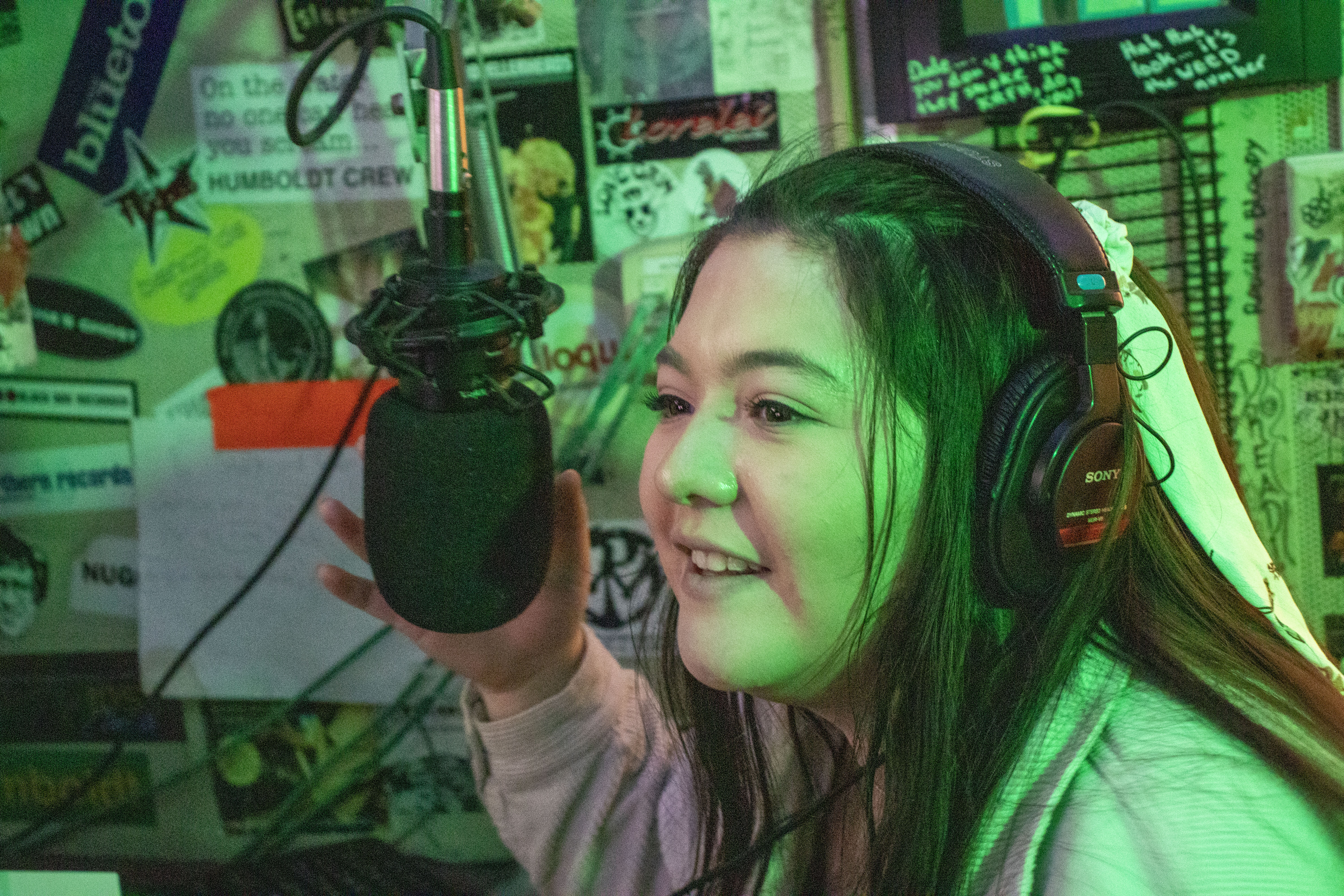
Delaney Duarte, manager of KRFH’s TALX program, has been at the station for three semesters.
“If I’m being totally honest, I was super hurt,” Duarte said. “The whole day when I found out I was just like, I don’t know, I couldn’t wrap my mind around someone who I look up to so much to say that.”
Duarte wanted it to be made clear that KRFH is a student-run radio program, and that Berkowitz’s role does not go beyond instruction in the classroom.
“His apology in my opinion was just complete crap, if I’m being totally honest,” Duarte said. “It just seemed like he’s just saying sorry cause he has to. He got caught. You have to say sorry.”
Duarte expressed sympathy and concern for the African-American students in class, feeling a great deal of pain, herself, as a Latinx student.
“I wouldn’t blame them if they didn’t want to join because of that,” Duarte said. “Because, I mean, who wants to be taught by someone who doesn’t respect their students?”
It’s not just the students of color that feel uncomfortable in the classroom.
“People in our group, they’re just like really uncomfortable even going to the booth, like knowing that he’s either upstairs teaching his class, or like, his office is literally in the radio station,” Duarte said. “So it’s kinda hard to not run into him.”
“You have to take into account the perspective of the people that would potentially be offended by these kinds of statements in that regard.”
Elliott Portillo
Elliott Portillo has been a part of KRFH for three semesters, and doesn’t think this single incident should overshadow the good Berkowitz has done for students and the community.
“I think the joke was in bad taste,” Portillo said. “I think it came from more of a position of ignorance rather than of blatant hatred. I don’t think Cliff is a racist in any way, just based on the interactions he’s had with students and his passion for students.”
Portillo pointed out that his perspective should be taken with a grain of salt, as a self-described “white-washed” Mexican.
“You have to take into account the perspective of the people that would potentially be offended by these kinds of statements in that regard,” Portillo said. “But in my personal preference, I think he’s done so much that it’s hard for me to warrant lasting damage or lasting punishment.”
Duarte said students have come forward to request Berkowitz’s replacement because of an unsafe learning environment.
“As much as it hurts to say—I’ve always looked up to Cliff—but now at this point I’m kinda just bummed out and really hurt,” Duarte said. “So, I’d probably want to see a replacement. Someone who’s more respectable to our students of color.”
Entire Statement from Cliff Berkowitz:
I am writing this to formally apologize. I am truly contrite that my words caused pain or anyone to feel less than. I was wrong, it was stupid, and I should not have done it. We all commit harm, and when we do, it is only right to both apologize and work to make things better. I know I harmed people. I am sorry.
I have been asked over and over again about my opponent’s racist comment, which he has attributed to a Cheech and Chong joke. While that may be true, it is still unacceptable. I foolishly compared that to quoting Richard Pryor, trying to make the point that even quoting someone saying the wrong thing is unacceptable, and in making my example, I too said the unacceptable.
There are words that are so steeped in hate and racism, that they enflame our community when uttered; I am grateful to live somewhere that holds people accountable for what they say and do. While I did not wield that word as a weapon nor did I direct it at anyone, it does not remove the harm of saying the word. Nothing excuses what I said. There are people who have trusted me and for them this is a betrayal.
I have spent the past decades of my life trying to facilitate conversations that include rather than exclude. I have used my position to try to give voice to those who often don’t get to talk about their lived experiences. However, that is not enough. I formally, and contritely apologize. I apologize to all those hurt by my words, my friends, my family, the community, and my students. My past actions to help People of Color do not absolve me for the harm I committed. I still said that word. It is still not okay.
As I continue to reflect on how I have harmed people by saying that word, I will work towards a more just society. I will not stop activism or working to dismantle racism, and I will continue to interrogate how racist ideology has worked its way into my own mind. I will continue to work to make things better. I will uphold my promise to make sure all voices are heard and that there will be a place at the table for everyone, especially People of Color.
I am deeply grateful to those people in my life who have held me accountable and shared their personal experiences and knowledge about racism. Thank you to the community for also holding me accountable.