The Lumberjack


Students Serving The Cal Poly Humboldt Campus and Community Since 1929

Tag: Radio

  • KRFH: The true DIY of college radio 

    KRFH: The true DIY of college radio 

    by Carlina Grillo and Kianna Znika

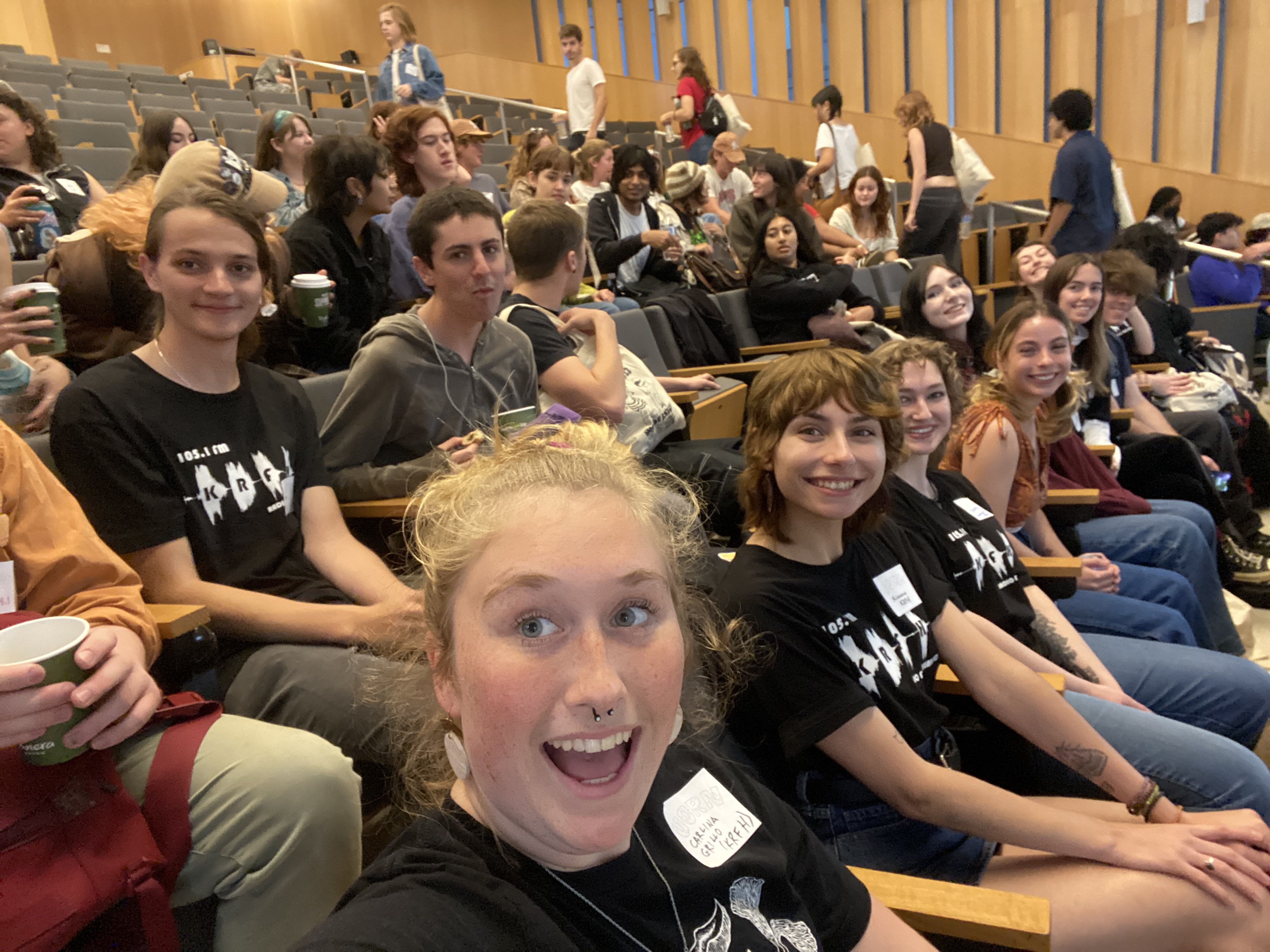
    This past weekend, KRFH DJ’s made the journey down to Los Angeles to attend the University of California Radio Network Conference held on Nov. 4 by KXLU at Loyola Marymount University. The day consisted of three sessions, where students could choose between workshops and panels like creating DIY promotional materials, developing an on-air persona, staff training protocol, life after college radio, and more. Students especially interested in play-by-play sports broadcasting and news casting were given the opportunity to attend a journalism seminar also held at LMU featuring professional broadcast journalists.

    Outside of the panels, workshops, and seminars we attended, this conference proved to us how hard-working and committed KRFH DJs are; the kind of people who would drive 12 hours on a Friday to attend a 10-hour event on Saturday, just to drive the 12 hours back the very next day. 

    Although the conference seemed to be targeted towards UC’s and private schools, we’re grateful that we committed to the voyage because it genuinely left us feeling inspired and validated as DJ’s, and station managers, for a student-run radio station. Being compared to almost 10 other bigger stations, where there is paid staff, we learned that there is something so special about Humboldt and our student-run station. KRFH is full of real, passionate, small town DIY DJ’s. No amount of money could buy what we have, which makes sense because as a class and a club, open to only students, we are responsible for raising the majority of our funds. 

    We’ve hosted three 24-hour live radio events, featuring live radio dramas such as “War of the Worlds” and “Coraline”, something other college radio stations absolutely aren’t doing. We brought back our Local LIXX, featuring local bands live from our station, and brought back KRFH News, offering the community weekly news in an audible format.

    And, for the first time in our KRFH career, we not only got 15 DJ’s to make the trip down to LA, we also got them fed, sheltered and inspired.

    One of the most eye-opening realizations during the conference was the fact that most, if not all, leadership positions at other college radio stations are paid, but at KRFH, we do everything solely out of passion for college radio.

    KRFH is so much more important than Cal Poly Humboldt gives us credit for. Upon a Google search, you can see KRFH is one of the most popular stations in the county, and as we grow, every day we become more and more of a community resource. In places such as Berkeley, eccentric radio is seen as a necessity for local commuters. A question we asked ourselves was: Why is KRFH seen as anything different?

    The truth is, KRFH will never be like KALX or KXLU, other big college radio stations with lots of funding. However, that’s kind of the beauty of our station. KRFH is entirely student-run, and although it’s difficult sometimes, this weekend has shined a light on how beautiful, important and rewarding the work we do actually is. Despite coming from higher-funded, and arguably more organized stations, students from other stations at the conference vocalized the way our small town aesthetic and methods have inspired them. 

    KRFH deserves to be celebrated and recognized for all that we do. We aren’t simply a group of journalism and communication majors who like to spin vinyls late at night. In reality, KRFH is made up of students from many different majors coming together for the love of music, community, and most of all, college radio. 

    As registration for Spring 2024 opens, we highly encourage any student who’s interested in being a part of our community to enroll in JMC 154 and JMC 155, the classes that will teach you about audio editing and get you in our station. For most of us, college radio isn’t forever, college radio is right now, a time in our lives where we, like many other college radio alums, will look back on very fondly. Our hope, as the 2023 KRFH station managers, is for anyone who feels compelled to radio gets to experience the beauty of KRFH.
  • Humboldt Hot Air takes over local radio airwaves

    by Eddie Carpenter

    Nearly four years ago, Cal Poly Humboldt decided to abandon local-based programming for KHSU. This heartbreaking decision left local radio personalities with no creative outlet to broadcast from. Recently, some of those same people were able to redeem themselves on a radio station known as Humboldt Hot Air. In its humble beginnings, the station began as a simple recording studio. Any content that was created would be sent to a community-based radio station known as KZZH. In October 2021, station manager Neroli Devaney had set up a live streaming service, which gave rise to an underdog known as Humboldt Hot Air.

    “We are an online internet radio station,” Devaney said. “We are based in the Arcata Playhouse. We are very eclectic and diverse in our programming. We have talk shows [and] lots of music shows. We program every other day of the week except for Tuesdays.”

    Devaney made it clear that she was not the one who founded Humboldt Hot Air. However, the 24-year-old manager also shared what inspired her to take on this role.

    “I did four years of radio at UC Santa Cruz. When I was there, I worked at KZSC, which is the radio station on campus there,” Devaney said. “When I was there, I did a bunch of different stuff, I was also a hip-hop director through a bunch of events, I just found myself really into radio and really passionate about it. I am from Arcata and when I graduated from UC Santa Cruz, I came back to Arcata. When I was in high school, I used to volunteer with the Arcata Playhouse with their teen program, which is called Apprentice Entertainment. Jackie Dandeneau, who is executive director of the Arcata Playhouse reached out to me. [She] said that she started this project called Humboldt Hot Air. They were recording audio and they had this goal of eventually having a live stream…She asked if I wanted to get involved and I said yes. [I] thought it sounded really fun.”

    Devaney also explained how the former KHSU audience had become her most avid listeners.

    “When we started a lot of people felt that there was this need for community radio in Arcata. A lot of the DJs saw that we were doing Humboldt Hot Air and I started getting a couple old KHSU DJs,” Devaney said.

    “We’re still kind of attracting that crowd, which has been really awesome, especially for our own publicity,” Devaney said. “KHSU had this huge fanbase in the community, so to be able to bring DJs back and have them do their shows again– a lot of the community has had a positive response to that, those are our most popular shows, people will be like, ‘oh my god I listened to that show for thirty years and it’s back, that’s so amazing! It’s the same DJ.’ It’s just been really fun.”

    Humboldt Hot Air strives to one day become an FM station.

  • Student-Run Radio Programs are Back on Air

    Student-Run Radio Programs are Back on Air

    Jam out to your local, community neighbors

    Editor’s note: members of the editorial staff of The Lumberjack are part of and have been part of KRFH. The author of this article had no previous affiliation with KRFH.

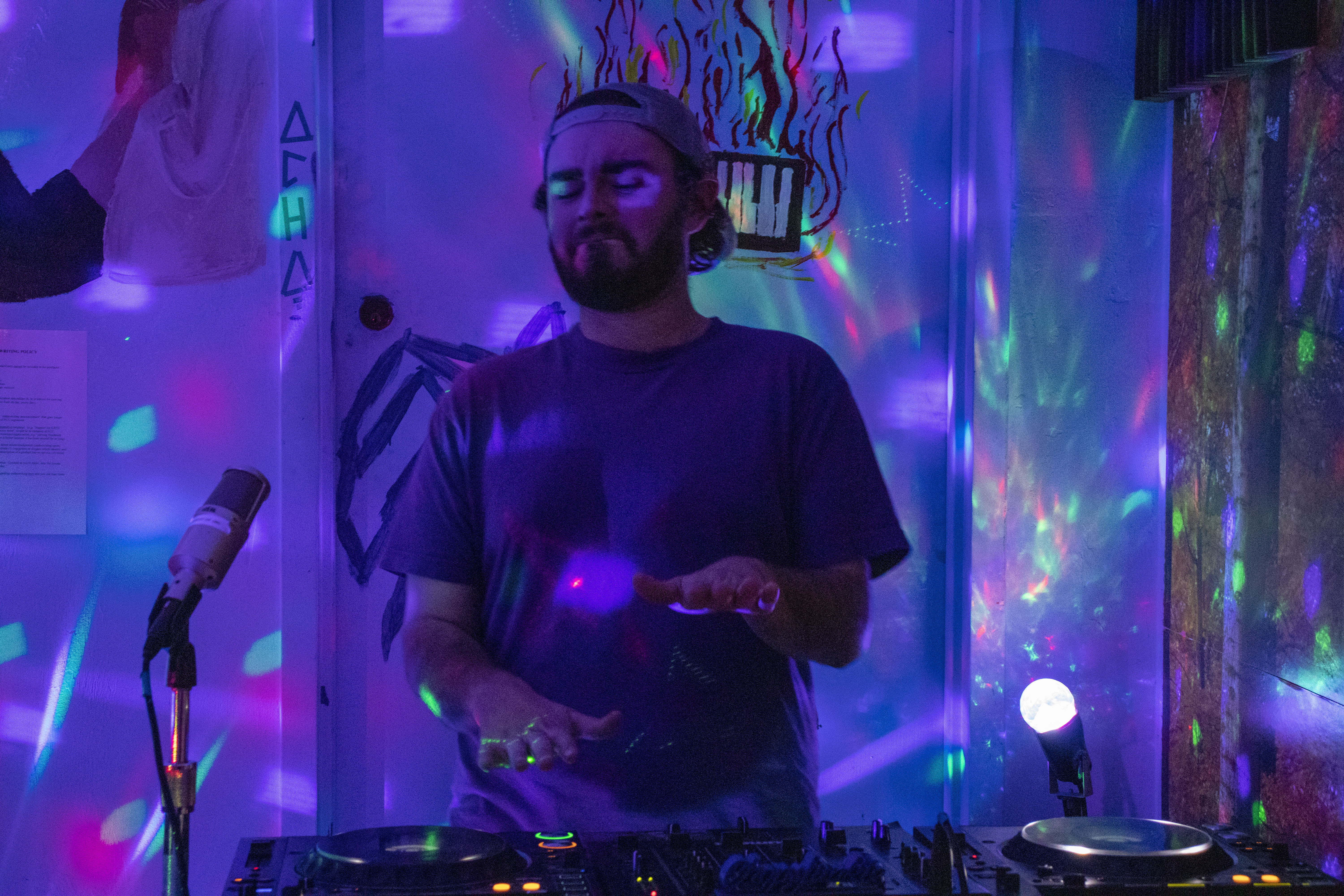
    Following winter break, KRFH has returned with its entirely student-staffed programs, TALX, MIXX and Local LIXX. Each of the programs bring on guests to participate in their show, providing a platform for community members to show off their skills and speak their mind.

    Local LIXX, the longest running program at KRFH, invites local artists to display their talent live on the radio.

    Co-Manager of LIXX, Michael Freire first became part of the program in 2017.

    “It’s like a really, really cool special thing to have a fully student-run radio station that is promoting a local music scene in a town that has a surprising number of good musicians per capita,” Freire said.

    One of the main focuses at LIXX is to create a diverse program that speaks to all music genres and tastes.

    “One of the few limitations is that I obviously only have a view on the part of the music scene that I’m familiar with,” Freire said. “So I also try to like reach out to as many friends as possible for suggestions of places I can go, ’cause I don’t want to just put one genre of music or one group of friends on the radio.”

    To scout talent for LIXX, Freire attends as many shows as he can, searching for sounds that he feels are a proper fit for the program.

    Quentin Wall and his band, Quentin Wall of Sound, were the first guests of the spring semester. This was Wall’s second appearance on the program, but his first with the new band.

    “Playing on air is fun,” Wall said. “It’s scary because anything you do, there’s no take-backs. But it’s fun because anyone can listen, and it’s a lot of people that I would never meet.”

    Not to be mistaken for LIXX, the MIXX program currently abides by a first come, first serve policy. This allows the platform to seek out the hungriest, most enthusiastic artists first.

    MIXX Manager Alejandro Zepeda is currently in his sixth semester with the radio program.

    “It’s really fun to watch the different DJs and their different techniques and how they’re doing it,” Zepeda said. “It’s a really great learning opportunity for myself and anyone else on the MIXX crew if they’re interested in DJing, just because you don’t really get to be this close to the performer usually when you’re out at an event, and you know there’s all sorts of other stuff going on.”

    TALX is the odd man out of the programs. Instead of placing the focus of an entire show on a single guest act, TALX incorporates their guests as part of a larger conversation. Unlike MIXX and LIXX, TALX doesn’t require a guest in order for the show to go on. Instead, students are given direct control of the content they create.

    Delaney Duarte is currently in her second semester as manager of the TALX program.

    “When you’re in there you’re gonna meet a bunch of other people, and then you kinda create like this bond with everyone,” Duarte said. “Everyone knows you and it’s like a really good community. I love the radio community a lot here on campus.”

    KRFH is one of the last student-run free-from radio stations. Students are given complete creative control over their content, so long as they conform to Federal Communications Commission regulations. KRFH programs provide an opportunity, not only for community members to showcase their talents, but for students to express, explore and share their identities.

    “There’s just something about being in the booth, something about being in this radio station,” Zepeda said. “It’s calming for me despite all the crazy things that happen, and there’s always something ridiculous happening. It’s my happy place, and I’d like to continue that for other people that need to find something like this in their lives.”

  • OPINION: Former KHSU intern speaks up

    OPINION: Former KHSU intern speaks up

    A student’s perspective on the gutting of KHSU

    This shit is insane.

    I’m not sure how else to describe the shuttering of KHSU in the last month of my education.

    Interning for KHSU has been rocky from the day I signed the paperwork. I began in the summer of 2018. Katie Whiteside, the beloved program director, hired me and on my first day of work she was unexpectedly fired. We have since bumped into one another, but I was unsure of how to proceed when the only string we had tying us together had been broken so quickly. Now we have a lot more in common…

    The station also had a physical shift in my first days. The studios were moved from the top floor of the Theater Arts Building to the sunny, albeit noisy, Feuerwerker House.

    I mention these abrupt changes to point out that my time at KHSU has been anything but stable. I’ve come to expect some level of shaky ground, but not like this…this felt off the Richter scale.

    I finally felt this internship was paying off. Literally. I began getting paid for my work for the first time and I had my first solo-produced audio feature run on the station two weeks ago. It felt fitting that the culmination of my work at HSU would be disseminated professionally the day before I turned 30 and just a month before I graduate. I was already excitedly working on my next piece and I made plans to stay for the summer. This was Wednesday, April 3.

    Tuesday, April 9 KHSU held a going away party for HSU alum Michael Roccaforte at Richard’s Goat. We ate tacos, drank beers and espoused the success of (and waking up for) the pledge drive that had concluded just two days prior. Nobody had any idea it would be a going away party for all of us. I’m partially glad for that, because it was a blast.

    Wednesday, April 10 would be the last full day of KHSU as we knew it.

    Thursday morning KHSU was gutted of nearly all its employees. Two remained, but not for long. My only indication anything was amiss that day were the cop cars parked on either side of the studios. Nothing was said prior to myself or any other intern. We learned at the same time as everybody else, standing in the rain in front of the studio. Later that afternoon I read a story on the Lost Coast Outpost with a quote which vaguely informed me that I, as a student, might still have a job. Why was I reading the status of my employment through a news outlet instead of being told directly?

    Myself and the two other interns, Damian Jimenez and Destiny Hill-Brekke, received a generic email at 5:35 p.m. apologizing for the the silence on the university’s end, saying that it was an “oversight.”

    KHSU was shut down because it had “drifted” from the interest of the students. Which students? Hypothetical students? Because I’m a real student and I still had a deep interest in finishing my internship. I had an interest in the connections not to mention references I was gaining. I had an interest in the paycheck I counted on. I had an interest in having the last month (and summer) to fill out my portfolio with professional audio journalism, the thing I came to school for in the first place.

    KHSU wasn’t the first community institution to get cut by an ax-wielding budget committee and it likely won’t be the last, but I feel cheated. At least the football team got to finish their season before they got cut…

    To KHSU: You’ll be sorely missed by more than just me. From the bottom of my heart, thanks for experience and thanks for all the laughs.

    Megan “Midge” Martin

  • KHSU protest in the plaza

    KHSU protest in the plaza

    The last remaining KSHU staff members resign, join a peaceful gathering of a few dozen held during weekly farmers market

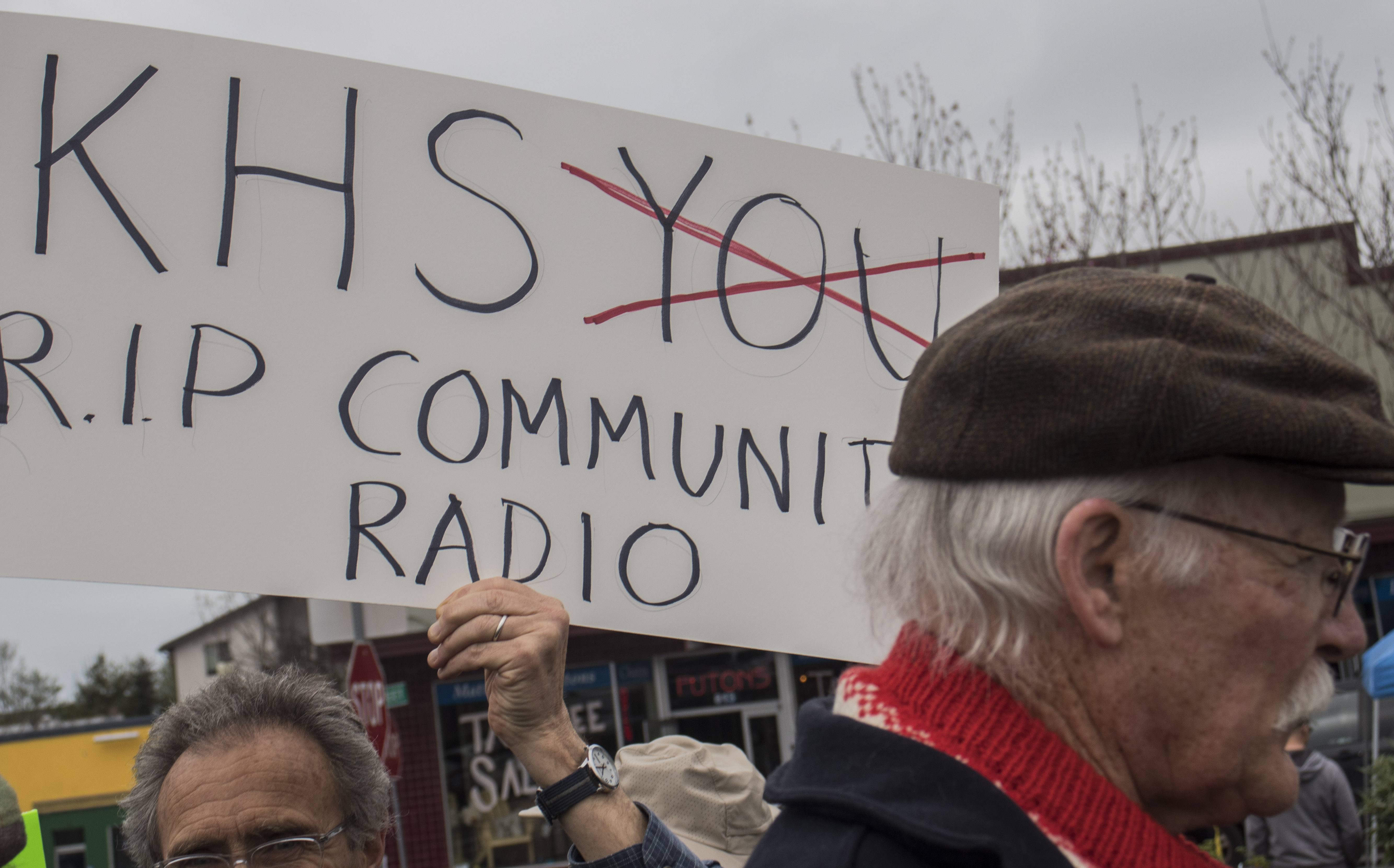
    Forty-eight hours after the artery of the community was severed, a few dozen KHSU supporters took to the plaza in protest during the weekly farmers market.

    Natalya Estrada resigned her position this afternoon as the last remaining paid staff member of KHSU. Estrada’s resignation came after administrators at Humboldt State University decided to fire all volunteers and terminate all but two paid positions at KHSU on April 11. David Reed was the second of the two remaining employees but resigned on Friday, April 12.

    Estrada was at the protest to show support and said staying in the position would not only compromise her career in journalism but affect her overall health.

    “There comes a time in life when you need to make a decision in life and I made that decision,” Estrada said. “I knew what I was going to do but I needed to know how and when.”

    IMG_0041.jpg
    Local artist Lisa Enge holds a sign in support for KHSU during a peaceful protest at the weekly Arcata plaza farmer’s market on Saturday April 13. | Photo by T.William Wallin

    After Reed resigned Estrada was the last staff member running the station. Estrada said when the California Report came on she put on Caroline King and cried at her desk.

    “It was very lonely being the last person left,” Estrada said. “It felt like 48 hours on the 405 during rush hour traffic.”

    Tom Cairns was one of the volunteers to be let go during the dismantling of KHSU, but he isn’t just any volunteer. Cairns has been with KHSU for 47 years, making him the longest running volunteer at the station.

    IMG_0046.jpg
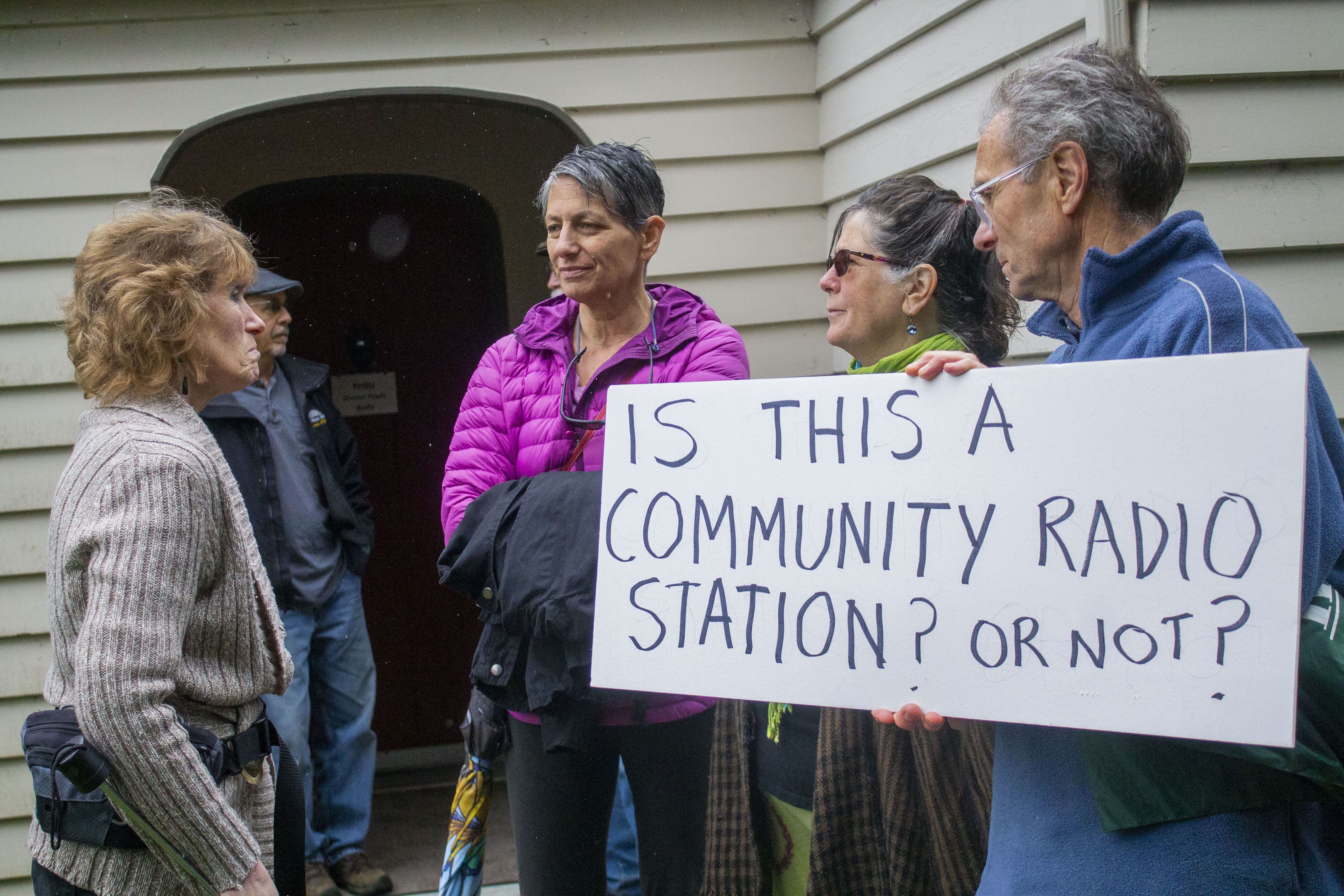
    Community member, Carrie Slack, and former host of Jazz with a Groove, Rob Enge, hold signs in support for KHSU during a peaceful protest at the weekly Arcata plaza farmer’s market on Saturday April 13. | Photo by T.William Wallin

    Cairns was at the protest because he felt the way everyone was fired was wicked and shameful. Cairns felt the audit report done on KHSU was just an excuse for firing everybody and HSU administrators were planning this even before then.

    “The way they handled it was bold face lies,” Cairns said. “They had checks written out already even before the meeting. They had it all planned.”

    In the 47 years as a volunteer Cairns has seen KHSU have its ups and downs but “it’s always continued and was never shut off the air.” Cairns said the unfortunate thing about the station now is it has become a typical NPR station with all news and very little music.

    “Basically it’s just another McDonald’s public radio station,” Cairns said.

    IMG_0066.jpg
    Public citizens, Mark Mueller and Lisa Hockaday, hold signs in support for KHSU during a peaceful protest at the weekly Arcata plaza farmer’s market on Saturday April 13. | Photo by T.William Wallin

    When asked what he felt the biggest loss was Cairns said the community of the station. Cairns said those that work with KHSU are very active in the larger northwest community and engaged in the arts, food, and news.

    “The music, public affairs, and local programming is what made KHSU unique and a viable source for the community,” Cairns said.

    IMG_0074.jpg
    A few dozen protesters gathered with signs during the Saturday farmer’s market at Arcata Plaza to show support for KHSU on April 13. | Photo by T.William Wallin

    Rob Enge, former host of Jazz with a Groove, was a member and sustainer with KHSU for 25 years and agreed with Cairns. Enge said this has been a loss of a community forum where connection was made.

    “This was a good place for people to put their energy,” Enge said.

    Enge moved to Humboldt in 1992 and the first thing he did was get connected with the local radio station. Enge was an avid listener of KPFK in southern California and said public radio stations are an important way in getting connected with community.

    “This has been an erosion of community,” Enge said. “This isn’t social media from out of the community, this is real people talking locally and when we lose that its a shame.”

    IMG_0048.jpg
    Community members show support for KHSU during a peaceful protest at the weekly Arcata plaza farmer’s market on Saturday April 13. | Photo by T.William Wallin

    Local artist Lisa Enge has also been a supporter of KHSU since 1992 and felt the loss of KHSU was like losing a friend. She said KHSU was a treasure in the community and it was a cruel way that it was cut.

    “Cutting volunteer and staff is unconscionable, shameful really,” Lisa Enge said.

    IMG_0069.jpg
    Jax Stuber (left) has been listening to KHSU everyday for the last six years and said she will miss all the music and diverse programming. | Photo by T.William Wallin

    Lisa Enge said once general manager Peter Fretwell fired KHSU program director, Katie Whiteside, the love for KHSU waned. She said as an artist the radio kept her company while she worked and she didn’t feel so lonely.

    “The people, DJs, and programmers became friends,” Lisa Enge said. “It’s like losing a friend, or a family member really.”

  • Radio silence

    Radio silence

    Abrupt firings at KHSU send shockwaves, not sound waves, throughout the community

    In a blow to the local community, administrators at Humboldt State decided to fire all volunteers and terminate all but two paid positions at the local NPR affiliate, KHSU, on April 11. The firings, and other reorganizations, came after months of tense back and forths with the administration and the KHSU Community Advisory Board. Some in the community felt that the hostile tensions were behind and that future broadcasting was no longer in jeopardy.

    “This is fraud. KHSU is community radio. You just don’t knock the community out like that.”

    Joyce Houston

    Last week Joyce Houston volunteered during the KHSU fund drive and donated money to the future of the station. Houston said she has volunteered and donated money to the station for the last 30 years and felt that she was scammed given the administration’s decision for the firings.

    “This is fraud,” Houston said. “KHSU is community radio. You just don’t knock the community out like that.”

    According to a press release from HSU, changes to station include the elimination of five staff positions, the General Manager and Chief Engineer positions and an “indefinite suspension of volunteer-run programs.”

    The press release mentions the administration will look into allowing students to take on a more active role at KHSU, however there is already a student-run radio program at HSU. Amy Berkowitz, KRFH radio news faculty advisor, said she has been contacted numerous times by the administration asking for students to be more involved at KHSU but said that was not necessary because of the student run station.

    “KRFH is for students, by students,” Berkowitz said. “KHSU is for the community. Our area relies on the radio for emergencies. Having this gone is a loss to the safety of our community.”

    Berkowitz said that the loss of the community programs is why it is such a blow. Some of the programs that were broadcast on KHSU had been on air for over 30 years, according to Berkowitz.

    “Right now, they are just rebroadcasting out of Chico,” Berkowitz said. “We can all just ask our smartphones to play NPR, but that is not why we listen to KHSU.”

    Some of the programs currently cut from the air are the KHSU magazine, The Race Beat hosted by Lorna Bryant, the Thursday Night Talk with Eric Kirk, and Immigrant Voices hosted by James Floss.

    Lisa Rossbacher, president of Humboldt State University, said the reasoning for the abrupt firings was because of budget reasons, a realignment of the mission between KHSU and the university, and an advisory review from the CSU chancellor’s office that she received on “Monday or Tuesday of this week.”

    “People think of volunteers of not costing anything, but in fact it takes two to three hours of paid staff time to support every hour of programming that is generated by volunteers,” Rossbacher said.

    When questioned on how much oversight and time that paid staff have to give to volunteers who have been part of KHSU for over 30 years, Rossbacher acknowledged she didn’t know the exact details of the matter.

    “I can’t speak to the details of how that programming gets produced, but it requires staff involvement to support them,” Rossbacher said.

    On the future of KHSU, Rossbacher said the university is looking for partners to collaborate with and could not speak of the details of what that collaboration would look like or who it would involve.

    [perfectpullquote align=”right” bordertop=”false” cite=”Cliff Berkowitz” link=”” color=”” class=”” size=”17″]“I understand budget concerns, but one of the main jobs of being president is trying to strike a balance. Cutting a vital part of the community is foolish.”[/perfectpullquote]

    “We still want to have local programming,” Rossbacher said. “We still have to cover it within our budget and so I can’t tell you right now exactly what that looks like. If any of the volunteers ask to be able to take any of the programs that they have already produced with them, we are absolutely cool with that. Some of what has appeared in the past may show up again through other media, but I don’t know exactly what the future is going to hold.”

    During Rossbacher’s five-year term at HSU she has oversaw the closing of the HSU Third Street Art Gallery, the cutting of the football program, and now the massive firing and change of direction at KHSU—all integral components of the Humboldt community. When asked about the reasoning on why she made these decisions Rossbacher said it had to deal with shortfalls in money.

    “My goal is to get to a balanced budget,” Rossbacher said. “There have been some difficult choices in the process of getting there. Over the last two years the university overall has managed to reduce spending by about $9 million, with another million dollars we need to find in the next year.”

    Cliff Berkowitz, husband of Amy Berkowitz and fellow KRFH faculty member, felt that the abrupt firings were a betrayal of the community and noted that KHSU has been an integral part of the Humboldt community for over 50 years.

    “I understand budget concerns, but one of the main jobs of being president is trying to strike a balance,” Cliff Berkowitz said. “Cutting a vital part of the community is foolish.”

    Cliff Berkowitz has been teaching at HSU for 11 years and said that the announcement of the KHSU firings was a “gut punch.”

    “The most telling example of how sinister this is, is evident in the letting go of the volunteers,” Cliff Berkowitz said. “Their shows and their connection to the community are the reason why the underwriters have contributed. And it is gone.”

  • KHSU shutdown, plans moving forward vague at best

    KHSU shutdown, plans moving forward vague at best

    KHSU, 90.5 FM, has been abruptly shut down this morning with little to no notice given to the employees and volunteers. Currently University Police are inside the station and only granting access to individuals with the explicit approval of Craig Wruck, Vice President for University Advancement and Executive Director of the HSU Advancement Foundation. Ryan Lee, a station volunteer and radio host since 1990, was standing in the rain outside of the station confused and upset about the abrupt closure.

    Michael Fennell, who volunteered for KHSU, carries out a basket of CD’s from Feuerwerker House where the station has been on Humboldt State campus on April 11. | Photo by Thomas Lal

    “The station is shut down, everybody is fired, all the volunteers have been let go,” Lee said. “All accounts for current staff have been locked. We have been denied access to Wagner House without an escort. We have no plans for programming. There may be nothing.”

    Lee said that he came to the station this morning at 8 a.m. and his keycard worked at the time but when he tried hours nothing happened. 

    “Jeff Demark noted that [KHSU] just had a pledge drive and that everybody that pledged their money should be refunded,” Lee said. “Maybe because it was gotten under false pretenses. We all knew that there was something coming down the pipe, but nobody knew it was going to be like this.”

    David Montoya, Associate Vice President of Human Resources, answered the door at the KHSU headquarters but declined to comment on the situation. 

    The press release reads as follows:

    Humboldt State University is reorganizing and streamlining operations at its public radio station, KHSU, with the goal of preserving quality programming for the North Coast.
    The changes are intended to address operational challenges at KHSU, prevent further negative impact to the University’s budget, and better align HSU’s financial support with its mission and with opportunities for students. 
    Station employees were told of the changes earlier today. Because the reorganization and budget reductions include the elimination of positions, a number of individuals will no longer be employed at HSU. The University is working to provide clear information to them, and to ensure they receive any benefits they are entitled to.
    The steps taken today include:
    Elimination of HSU’s direct payroll support, including the General Manager position and Chief Engineer position, saving the University more than $250,000 annually.
    Elimination of five other staff positions, generating significant savings in the portion of KHSU’s budget that comes from government support, underwriting, and listener contributions.
    Appointment of an Interim Station Director, to be supported through non-HSU funding.
    Consolidating all KHSU operations in Feuerwerker House, reducing the inefficiency of having two separate spaces.
    Indefinite suspension of volunteer-run programs. The University will evaluate how students can return to a more substantial on-air role at KHSU.
    Actively pursuing collaboration with other public radio stations and seeking CPB funding to support this effort.
    The decision to realign the station reflects a comprehensive assessment. Factors included the station’s increasing cost to the University; KHSU’s limited capacity for additional fundraising and underwriting; challenges identified by the CSU Office of Audit and Advisory Services; feedback from listeners and volunteers; the University’s commitment to public service; and the appropriate role of student involvement in station operations and programming. 
    The report from the CSU Office of Audit and Advisory Services (pdf), which was recently received by HSU, includes an in-depth program review of the station that identified a number of issues with operations and administration. It was initiated at the request of HSU President Lisa Rossbacher, and she shared it yesterday with KHSU’s Community Advisory Board.
    In addition to issues identified in the report, there are serious budget issues at the station. KHSU is heavily subsidized by the HSU general fund, and the station’s budget deficits have continued to worsen. At the end of the 2017-18 year, HSU had to cover a budget deficit of nearly $135,000 beyond its regular subsidy, and this year’s projected budget deficit is even larger.
    KHSU’s budget challenge largely reflects increases in payroll costs. In addition, community support has been flat or declining, with underwriting revenue down approximately 14 percent for the year and listener support down approximately 17 percent. And while volunteers create a great deal of local programming, their efforts also come at a cost, requiring significant support by paid staff. 
    The budget challenges at KHSU come as HSU has been working to address an overall structural deficit as well as funding declines related to an enrollment drop. The University has reduced its spending by $9 million over the last two years, and is making nearly $1 million in additional reductions for the coming year.
    For context, over the last year HSU has funded nearly half the cost of KHSU. Listener support provided about 22 percent, corporate underwriting 17 percent, and government grants 12 percent. HSU directly paid more than $265,000 in salary, covered at least $250,000 for space and utilities, and spent at least $80,000 receiving and processing contributions to the station.
    Even with the changes at KHSU, listeners will continue to have access to high-quality national programming and news. The most recent audience data reaffirm this is, by far, the station’s most popular programming.

    This story is ongoing and has been updated here.

  • HSU announces clean up of KHSU

    HSU announces clean up of KHSU

    Earlier this morning, Humboldt State issued a press release regarding their NPR affiliate KHSU. The radio station will be undergoing drastic changes including the removal of all but two staff members.

    Now former volunteers and station supporters meet outside of Feuerwerker House after hearing about the elimination of jobs and volunteer positions at KHSU on April 11. | Photo by Thomas Lal

    HSU press release is as follows:

    Humboldt State University is reorganizing and streamlining operations at its public radio station, KHSU, with the goal of preserving quality programming for the North Coast.

    The changes are intended to address operational challenges at KHSU, prevent further negative impact to the University’s budget, and better align HSU’s financial support with its mission and with opportunities for students. 

    Station employees were told of the changes earlier today. Because the reorganization and budget reductions include the elimination of positions, a number of individuals will no longer be employed at HSU. The University is working to provide clear information to them, and to ensure they receive any benefits they are entitled to.

    The steps taken today include:

    • Elimination of HSU’s direct payroll support, including the General Manager position and Chief Engineer position, saving the University more than $250,000 annually.
    • Elimination of five other staff positions, generating significant savings in the portion of KHSU’s budget that comes from government support, underwriting, and listener contributions.
    • Appointment of an Interim Station Director, to be supported through non-HSU funding.
    • Consolidating all KHSU operations in Feuerwerker House, reducing the inefficiency of having two separate spaces.
    • Indefinite suspension of volunteer-run programs. The University will evaluate how students can return to a more substantial on-air role at KHSU.
    • Actively pursuing collaboration with other public radio stations and seeking CPB funding to support this effort.

    The decision to realign the station reflects a comprehensive assessment. Factors included the station’s increasing cost to the University; KHSU’s limited capacity for additional fundraising and underwriting; challenges identified by the CSU Office of Audit and Advisory Services; feedback from listeners and volunteers; the University’s commitment to public service; and the appropriate role of student involvement in station operations and programming. 

    The report from the CSU Office of Audit and Advisory Services (pdf), which was recently received by HSU, includes an in-depth program review of the station that identified a number of issues with operations and administration. It was initiated at the request of HSU President Lisa Rossbacher, and she shared it yesterday with KHSU’s Community Advisory Board.

    In addition to issues identified in the report, there are serious budget issues at the station. KHSU is heavily subsidized by the HSU general fund, and the station’s budget deficits have continued to worsen. At the end of the 2017-18 year, HSU had to cover a budget deficit of nearly $135,000 beyond its regular subsidy, and this year’s projected budget deficit is even larger.

    KHSU’s budget challenge largely reflects increases in payroll costs. In addition, community support has been flat or declining, with underwriting revenue down approximately 14 percent for the year and listener support down approximately 17 percent. And while volunteers create a great deal of local programming, their efforts also come at a cost, requiring significant support by paid staff. 

    The budget challenges at KHSU come as HSU has been working to address an overall structural deficit as well as funding declines related to an enrollment drop. The University has reduced its spending by $9 million over the last two years, and is making nearly $1 million in additional reductions for the coming year.

    For context, over the last year HSU has funded nearly half the cost of KHSU. Listener support provided about 22 percent, corporate underwriting 17 percent, and government grants 12 percent. HSU directly paid more than $265,000 in salary, covered at least $250,000 for space and utilities, and spent at least $80,000 receiving and processing contributions to the station.

    Even with the changes at KHSU, listeners will continue to have access to high-quality national programming and news. The most recent audience data reaffirm this is, by far, the station’s most popular programming.

    Updates to come.

  • KHSU must find a new temporary home

    KHSU must find a new temporary home

    By Geneva Peppars

    Local radio station KHSU is set to temporarily relocate from its broadcasting station in the Theatre Arts Building. The building is undergoing construction to make sure it is fit to stand an earthquake. A staggering $7.6 million will be allocated from bond and CSU funding to start the project this summer. The Theater Arts building will operate normally through the end of this semester and work will begin this summer, according to Jarad Petroske HSU public affair specialist. HSU is still in the process of sorting out where classes will move, but for the rest of the semester it’s business as usual.

    However, the third floor of the Theatre Arts Building has been home to KHSU since 1960. KHSU is a noncommercial public radio station licensed to Humboldt State. Unlike classes, there is no summer vacation for KHSU.  All day, seven days a week, KHSU is broadcasting to about 135,000 listeners. David Reed, KHSU Development Director & Interim Station Manager, explained that he has been told the project may take up to a year, but that won’t stop the airwaves from broadcasting from the radio station, it just may be from a few different locations.

    “It will be hard, it will be fun, it will be an adventure,” Reed said.

    Reed said the station will transition from three studios in the Theater Arts building to two temporary studios in Gist Hall and Wagner House.

    Vinyls, satellite equipment and what Reed called the “brains of the studio”will stay on the third floor. The “brains” are the racks of equipment the station needs to be able to receive audio signals by satellite from NPR, automate local programming and stream over the internet. One of the biggest challenges of the transition is finding a home for the 25,000 cds in their music library that is accessible at all times to the over 90 staff, students interns and community volunteers.

    Kevin Sanders, chief engineer for KHSU, explains that consolidating three studios to just two smaller ones could potentially affect scheduling issues. Although he is still waiting on the final word from facilities management, he does know that one studio will always be on air and the other will be strictly for production purposes. The way the studios are set up now, broadcasters are able to switch all studios from production to on air, which creates lots of space to pre-record and automate late night shows.

    The new studios may not block outside noise as well as the old one, but Reed doesn’t believe listeners will notice a change in sound. “You know they might hear an occasional leaf blower,” Reed said. “But I am keeping happy thoughts.”

    The current projected move date for the radio station is June 1. , two weeks before the KHSU June Pledge drive. Although the details have yet to be finalized, one thing is for certain KHSU will remain across the airwaves throughout Northwest California and Southern Oregon.