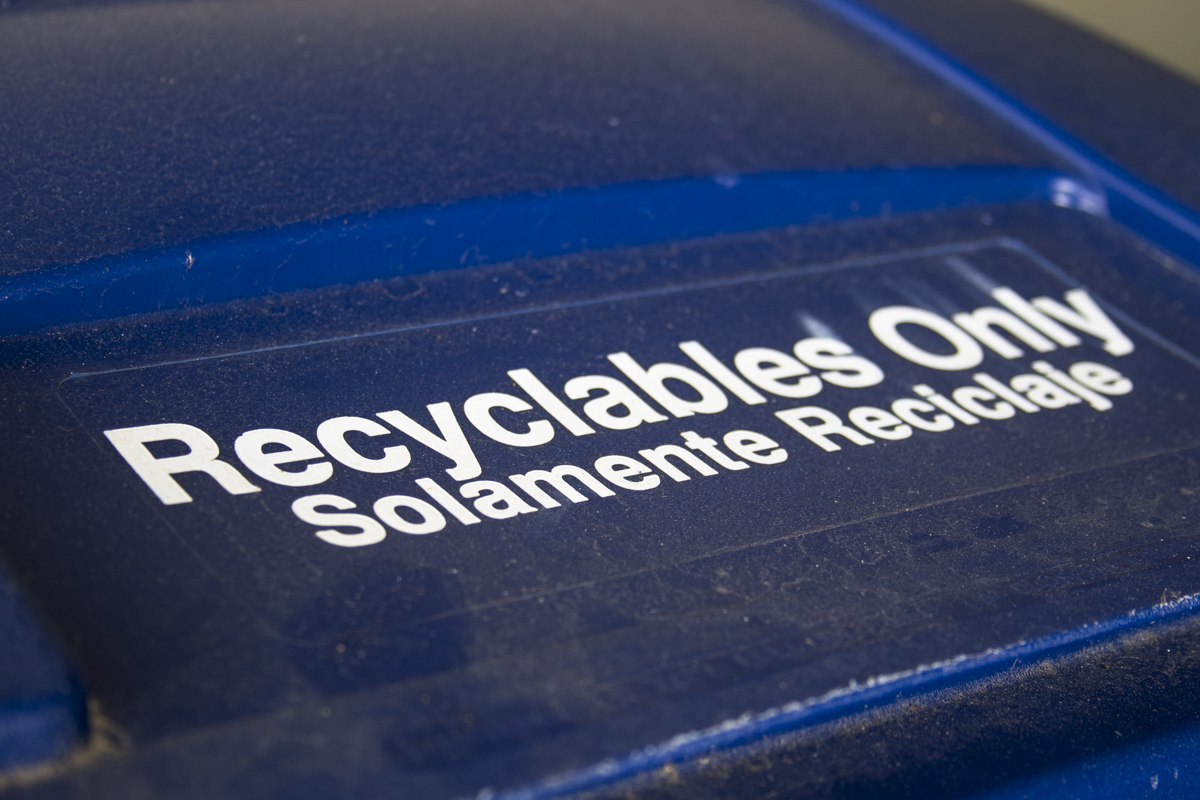
Earn money. Many recycling plants in California offer trade-in programs where you can redeem money from the cash refund value (CRV) of plastic, glass and aluminum cans. The CRV amount for aluminum cans under 24 ounces and for glass and plastic bottles is $0.05. Containers larger than 24 ounces are redeemable for $0.10. Here in Humboldt you can take your bottles and cans to Humboldt Sanitation & Recycling in McKinleyville or the Eureka Recycling Center.
Make something new. There are so much things that can be reused and transformed into something new. Milk cartons can become bird feeders and trash can become artwork. Locally, Scrap Humboldt offers hundreds upon thousands of recycled, slightly used and new items for sale to let your creativity soar. They host creation tutorials to show people how to turn something discarded into something useful again. You can also donate your clean recyclables to their Arcata location to add to their collection of items for repurposing.
Clean them. Clean your recyclables before you toss them. Be mindful of the journey your recycling has yet to take in this consumerist chain. Besides knowing what is appropriate to recycle, it’s also important to properly prepare items before you recycle them. Cans should be rinsed clean, plastic caps should be discarded and wrappers should be torn off of containers.
Compost. Compost what you can. Paper materials like cardboard and newsprint are great materials for creating new flower and produce beds. These items don’t have to end up in the trash or even the recycling bin. Paper is great for reducing decomposition stench from compost bins and the carbon in paper can help facilitate the breakdown of waste. Just be sure the paper you use in your compost doesn’t have glossy inks like magazine paper.
Throw away the rest. You might be recycling things that aren’t recyclable. Plastics numbered with 3, 4 or 7 are sometimes not accepted by curbside recycling programs. Check your local recycling plant’s policies on what materials they accept and what they reject. Things like pizza boxes, aerosol cans, batteries and styrofoam are not recyclable. Throw items like these away or find a proper disposal. Here on campus there are several recycling hubs which offer bins for proper disposal of batteries, computer products and cellphones.
More than six weeks worth of compost went to a landfill. That’s after the composting contract HSU had with the Local Worm Guy ended and wasn’t renewed. All compost materials which ends up in the compost BiobiN vessel will be sent to landfill, as there is no alternative in sight.
HSU bio bin located near the Jolly Giants Commons. | Ahmed Al-Sakkaf
Last year, the university signed a $14 thousand contract with The Local Worm Guy farm to divert all the food waste the campus generates. All campus-generated compostable material is deposited to the 20-cubic-yard composting bio bin that was installed a year ago near the Jolly Giant Commons. When the bin is close to full, it’s then hauled away by Recology Arcata to be dumped at the worm farm. The university pays Recology around $80 per haul.
Last August, the owner of the worm farm Lloyd Barker informed HSU that he wouldn’t renew the contract with the university.
“It’s probably one of the harder decisions that we’ve had to make as a business,” Barker said. “With the challenges we faced last year we’ve had to take a step back and look at exactly what we need in terms of our business development to be able to offer that service again.”
The volume and the type of material that is generated on campus is challenging from a composting perspective. The challenges his business was facing from the university’s material didn’t leave him an option.
Organic food wastes inside the bio bin. | Ahmed Al-Sakkaf
“HSU is really a big feather in someone’s cap, it’s a really important customer for us, but right now it’s really hard to offer them the service we want to be able to offer them,” Barker said.
The university has a small scale composting facility called the Earth Tub. The Earth Tub is run by Waste-Reduction & Resource Awareness Program. WRRAP compost food waste they collect from student-run coffee tables, departmental break rooms and zero waste events, food waste that is not sent to the biobin where the majority of the organic waste ends up.
For organic waste to compost, it requires a consistent balance of carbon to nitrogen ratio. The ratio is around 25 to 30 parts of carbon to every one part of nitrogen. The compost material generated on campus mainly consists of heavily water saturated food type materials with very little carbon. Besides the imbalanced ratio of carbon to nitrogen, the university’s compost material tends to have a lot of garbage in it, such as F’real milkshake cubs and other noncompostable plastic bags from dining kitchens.
Organic food wastes inside the bio bin. | Ahmed Al-Sakkaf
“We end up with a lot of those pre-made milkshakes in a little plastic cups. We end up with probably 50 of those milkshake containers, and up to 150 pieces of recycles and garbage from the cafeteria per load,” Barker said. “We’ll also end up with big bags of stuff from the back of the house. It caused us a lot of problems and issues along the way.”
Last year alone, the worm farm composted over 200 cubic yards of HSU’s material that weighed about 97 tons. The university paid a total of $64 per cubic yard to divert this food waste from landfill to compost.
HSU is mandated by California’s AB 1826 law to compost. The law currently requires businesses that generate four cubic yards or more of organic waste per week to arrange for organic waste recycling services. Organic waste includes green waste, landscape pruning and wood waste. The university generates over seven cubic yards of organic waste per week.
“We are a state agency. We need to be compliant with this law,” said Morgan King HSU’s Sustainability and Climate Action Analyst.
Neither the university nor the county has the infrastructure or the appropriate facilities to compost large amounts of organic waste. Until the county builds a facility that can accept HSU’s food wastes, the university has no option but to try to work with the local worm farmer to resume their agreement.
Katherine Rodriguez scraping off leftover food into a compost bucket. | Ahmed Al-Sakkaf
“We’re kinda stuck. We need to haul it out to someone else who is a professional and can compost it,” said King. “He [Barker] can’t take our stuff and there’s no one locally besides him that would take this amount of food waste.”
Both the university and The Local Worm Guy view this as a temporary setback until they are all ready to resume their cooperation and resume their work.
“The Local Worm Guy is working on his side to be in a better position to take our food waste, and on our side, we are working on making our material more acceptable,” said King.
Prior to signing this contract with the local worm farmer, HSU didn’t have a large-scale composting program in place. Madi Whaley, the WRRAP program manager, said that before last year parts of the food waste generated on campus was diverted to a local hog farmer for pigs to eat.
“It is unfortunate,” said Whaley. “It’s a real shame that the compost is going to the landfill instead of being diverted to a composting facility.”
HSU prides itself on having a great food recovery system. This past summer, HSU won the Innovative Waste Reduction Award at the California Higher Education Sustainability Conference. The composting program HSU had in place partnering with Barker was a significant factor in winning the award. A factor that isn’t in place now.
Recycling is not as sustainable as you might think. It has become a wasteful movement that was beneficial during the early stages of the environmental movement. Now the cost outweighs the satisfaction we get out of recycling.
“Recycling has been relentlessly promoted as a goal in and of itself: an unalloyed public good and private virtue that is indoctrinated in students from kindergarten through college,” wrote John Tierney, journalist and self-described “contrarian” for the New York Times. “As a result, otherwise well-informed and educated people have no idea of the relative costs and benefits.”
To put it in another way, most recycling advocates are unaware of the cost of transportation, labor and production of renewable materials that ultimately defeats the purpose of saving the planet.
Recyclers are validated by the collective consciousness of fellow believers. They don’t realize the wastefulness that occurs after rolling the recycling bin to the curb. Why did things get worse? The short answer is the success of an ongoing marketing campaign that resonates with a growing population of millennials and aging liberals.
Since the advent of the “Reduce, Reuse, Recycle” idea, recycling received the most attention. Why? Because there’s barely any money in reducing or reusing. If you think about it, recycling starts its capitalistic cycle from our wallets to the bins or recycling centers, then to the manufacturing plants, the businesses and back to burning a hole in our pockets.
So, there you have it, reduce consumption and reuse your renewable materials. Buy used products and learn how to repair them if they break. Borrow, rent or share if you can. The point is to reduce the disadvantages of recycling that is practiced by too many people and apply smarter solutions to climate change. If enough of us consume less and reuse more, the act of recycling can reclaim its integrity. It’s all about balance.
2500 degrees fahrenheit. That’s the heat it takes to perfectly mold glass into the shape your heart desires.
Fire and Light is a local company in Arcata that hand crafts an array of colored glass tableware. This local company puts on Hot Glass Tours that allows you to be up close to watch the process it takes to make these fascinating pieces. An employee of Fire and Light getting melted glass from their furnace. Photo credit: Juan Herrera
John McClurg, the president of Fire and Light, discusses the tour and some about his product.
“These tours give people a small sense of how long and hard the process is to making hand crafted objects,” McClurg said. “It also brings light to how much we actually do recycle when making our products.”
Some of the many finished products that Fire and Light hand crafts. Photo credit: Juan Herrera
The tours take place Monday through Friday, at 10 a.m., 12 p.m., and at 2 p.m.. According to McClurg the tours have been great for his company as well as to the community members.
Fire and Light purchase their used glass from the Arcata Community Recycling Center to make everything made out of the community’s glass. According to McClurg they are the first glass company to use all recycle objects to make their product in the United States.
Kelli Welch, an employee of Fire and Light, discussed her role in the business and about some of her favorite hand made pieces.
“I pretty much help wherever needs to be helped, but mostly I set up the display store and help costumers here,” Welch said. “Helping here in the store makes it hard to narrow down a favorite, but I have a special liking to the foot bowls we make.” An employee of Fire and Light getting ready to mold a cup with melted glass Photo credit: Juan Herrera
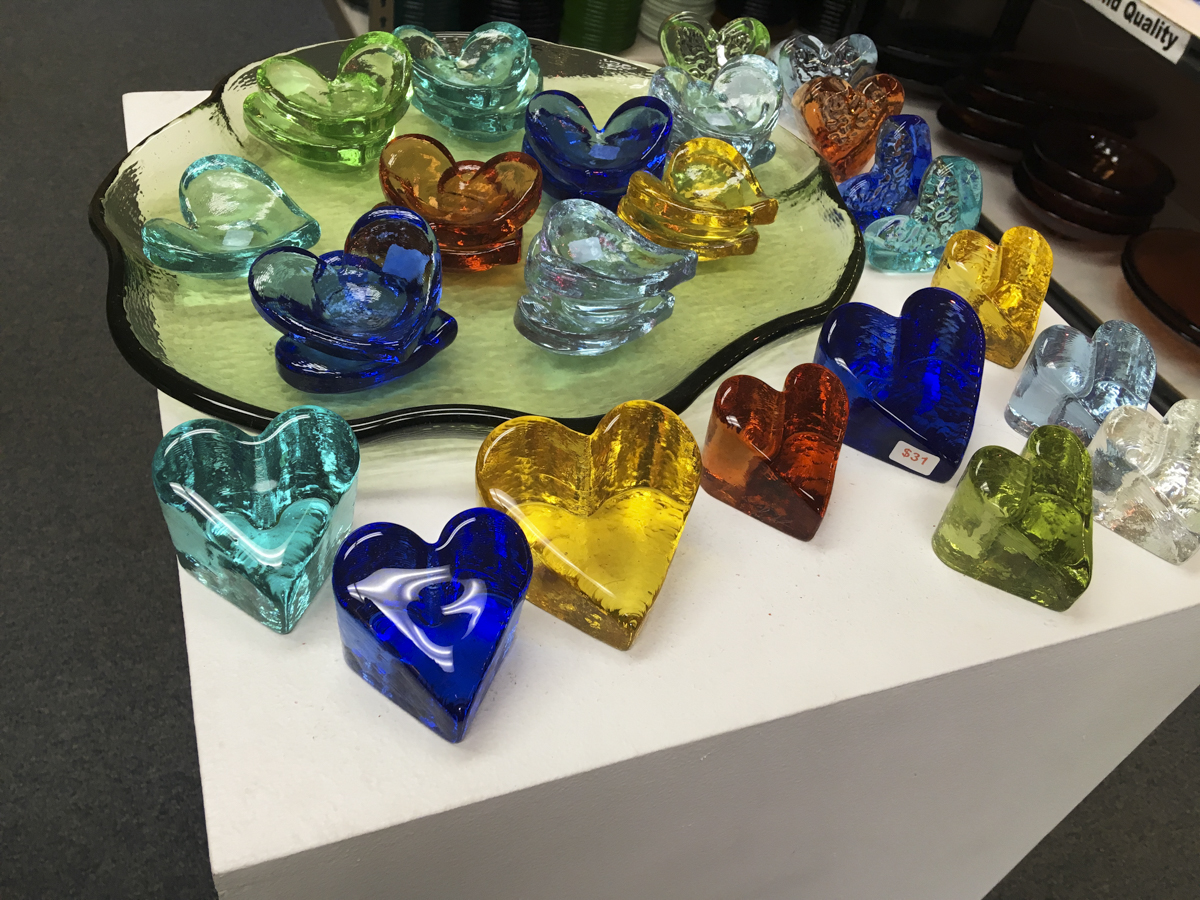
According to Welch the ideas of what to make come from the community and shows they attend out of the state. Welch mentioned how she came up with a heart shaped design glass that they now create. Fire and Light’s showroom is open Monday through Friday from 9 a.m. to 5 p.m., located at 100 Ericson Ct, Suite 100A in Arcata.
During the tour Humboldt State graduate, Lorea Euskadi, said how this was not her first time on the tour and describes her top three favorite pieces.
“I’ve been living here for about 5 years now. This is my fourth time touring this place, and the products just keep getting better and better,” Euskadi said. “It’s so hard to pin point favorites here but if I had to only keep three they would be my dogs custom bowl, my favorite soup bowl and lastly my crazy multi-colored vase.”
According to Euskadi, if you haven’t been to the Fire and Light tour or store, you are severely missing out on an awesome art form.
“I honestly look forward to it every year and encourage more people to come on down and join in on the action,” Euskadi said.
This website uses cookies to improve your experience. We'll assume you're ok with this, but you can opt-out if you wish. Cookie settingsACCEPT
Privacy & Cookies Policy
Privacy Overview
This website uses cookies to improve your experience while you navigate through the website. Out of these cookies, the cookies that are categorized as necessary are stored on your browser as they are essential for the working of basic functionalities of the website. We also use third-party cookies that help us analyze and understand how you use this website. These cookies will be stored in your browser only with your consent. You also have the option to opt-out of these cookies. But opting out of some of these cookies may have an effect on your browsing experience.
Necessary cookies are absolutely essential for the website to function properly. This category only includes cookies that ensures basic functionalities and security features of the website. These cookies do not store any personal information.
Any cookies that may not be particularly necessary for the website to function and is used specifically to collect user personal data via analytics, ads, other embedded contents are termed as non-necessary cookies. It is mandatory to procure user consent prior to running these cookies on your website.