The Lumberjack


Students Serving The Cal Poly Humboldt Campus and Community Since 1929

Tag: redwood

  • Students Stressed and Frustrated Going into Somber Spring Break

    Students Stressed and Frustrated Going into Somber Spring Break

    Students react to in-person class cancellations due to global pandemic

    As spring break arrived and the COVID-19 pandemic continued its tear across the globe, many Humboldt State University students wondered what to do as HSU canceled face-to-face instruction until at least April 17. Some students stuck around while others went home. The pandemic, directly or not, has affected all students.

    “I feel like it’s a very serious outbreak and people need to take it seriously. I do think it’s getting blown out of proportion in some ways and people are panicking before they need to, but it’s just something I’m kind of trying to roll with, essentially.”

    Ashley Bailey, molecular biology major

    Ashley Bailey, a junior molecular biology major, planned to travel home. She admitted feeling stressed.

    “I feel like it’s a very serious outbreak and people need to take it seriously,” Bailey said. “I do think it’s getting blown out of proportion in some ways and people are panicking before they need to, but it’s just something I’m kind of trying to roll with, essentially.”

    Kiera Price, a junior journalism major, also said she would travel home. She thought both academic and national leaders should be more vigilant.

    “I feel like instead of limiting social interaction, they should do more to prepare for it,” Price said. “Like, for example, the fact that there isn’t more of a stricter way to limit survivors from coming in.”

    Price recognized there isn’t a lot to be done, but still expressed a longing for something more.

    Tim Arceneaux, a senior English major, looked forward to staying in Humboldt. With a sigh, Arceneaux said he understood the measures taken by HSU.

    “I think the precautions that the University is taking here and all around the country make sense, but at the same time, I find them to be really frustrating,” Arceneaux said. “I hope that this issue will bring the global community together and allow people to realize the importance of universal healthcare.”

    Arceneaux said there was one key thing HSU could do to mitigate the spread of the novel coronavirus.

    “They could try to alert students more about the health resources on campus,” Arceneaux said. “Because I feel like at this point, it’s almost an inevitability that someone is going to contract the coronavirus, and I’m not sure exactly what health resources are going to be available to students that contract the disease.”

    Norbert Rodriguez, a junior film major, had planned to travel to Southern California to visit family, but decided to stick around once the coronavirus broke out. He said he thought HSU took too long to respond to the pandemic compared to other universities.

    “At the moment, there aren’t any test kits [in Humboldt], so there’s really no way of knowing that there are any confirmed cases,” Rodriguez said. “I feel like it should’ve been a bit more proactive.”

    Editor’s note: St. Joseph and Redwood Memorial Hospitals have set up screening tents for patients with COVID-19 symptoms.
  • Redwoods Growing at Remarkable Rates

    Redwoods Growing at Remarkable Rates

    Some coastal redwoods are growing faster than expected and scientists aren’t certain why

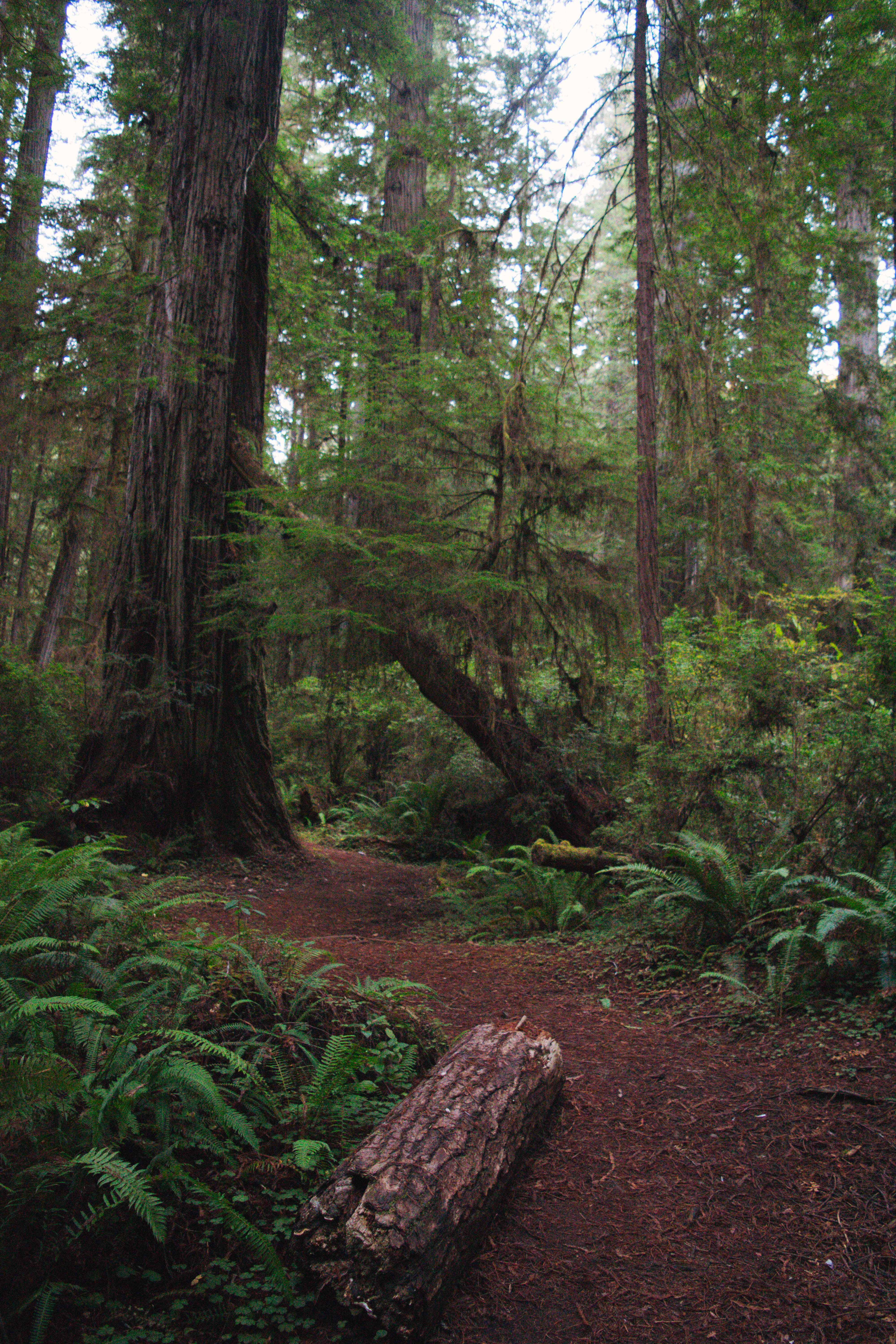
    Many redwoods in Northern California are growing at unexpected—even record-breaking—rates. While redwoods only remain in a tiny portion of the world, they appear to be in good health.

    “People talk about saving the redwoods,” Humboldt State University Professor of Forest Ecology Steve Sillett said. “The redwoods, as long as we don’t cut them down, are doing just fine. The question is, can they help save us?”

    The answer is complicated.

    “The Redwoods and Climate Change Initiative found that one Del Norte County redwood put on 2,811 pounds in 2014, a record-breaking annual growth.”

    Many coastal redwoods are growing faster today than they have in the last thousand years, according to a 2019 report from the ongoing Redwoods and Climate Change Initiative.

    The RCCI, a research partnership studying redwood health since 2013, found surprising growth in redwoods located away from dry forest fringes or recent fires.

    By estimating tree weight based on the tree’s measured width, height and volume, the RCCI found one Del Norte County redwood put on 2,811 pounds in 2014, a record-breaking annual growth.

    The cause of the increased growth is uncertain. Sillett, who sat in his lab beside tree rings which he used to measure age and growth, said climate change may or may not play a role in the increased growth. Sillett said the Clean Air Act of 1970 may have cleaned the air enough to allow more sunlight on the trees.

    “What happened is, the air cleared,” Sillett said. “And with clear air, you get more light, and so it could very well be that this increase in growth rate that we see very strikingly in some of these trees, starting in the late 60s and early 70s to present, is just because of increasing air quality.”

    Beyond climate and air quality, Sillett said multiple factors likely contribute to increased growth. Sillett also said the growth won’t necessarily last.

    “I think that there’s very much a limit to what redwoods or any vegetation can achieve,” Sillett said.

    A redwood tree ring in HSU Professor Stephen Sillett’s lab Aug. 28. | Photo by James Wilde

    A sudden spread of redwood forest also seems unlikely, Lucy Kerhoulas, an assistant professor of forest physiology, said. Kerhoulas said redwoods already have to work hard to reproduce via seed. Climate change might make reproduction even more difficult.

    “Successful seedling germination and establishment might be really challenging under a warming and drying climate,” Kerhoulas said.

    In other words, redwoods are doing well, but they’re not about to reclaim their lost forests.

    Sillett emphasized that many living redwoods are maintaining their normal growth despite less successful reproduction.

    “It’s not the case that they’re responding uniformly,” Sillett said. “But what we do see is that in the prime parts of their range, which is, say, north of San Francisco and relatively close to the coast, the rates of wood production are higher than they were in the not-too-distant past.”

    Redwoods store large amounts of carbon, especially in their prime ranges, but Sillett said that won’t offset the carbon dioxide produced by humans.

    “There’s not enough land in the world to plant with redwood forest,” Sillett said, “that would allow them to save us from what we’re doing to the atmosphere’s chemistry.”

  • Restoring the Largest Old Growth Forest in the World

    Restoring the Largest Old Growth Forest in the World

    By Kelly Bessem

    Portions of the Prairie Creek Watershed, one hour north of Arcata, are still being restored 50 years after being clearcut. Proposed restoration plans by the National Park Service (NPS) will make this region into the largest remaining old growth redwood forest in the world. This will be done by connecting 14,000 acres of old growth redwood patches. This designation is currently held by the 10,000 acre Rockefeller forest in Humboldt Redwoods State Park.

    Map showing future Prairie Creek Watershed restoration plans that will connect old growth redwood forest. Map | National Park System

    The Berry Glen cut area that’s next in line is will see an estimated 45,000 cubic yards of total mud and gravel removed from the stream channel. That’s equal to approximately 18,750 average US cars. All of this sediment washed down from the hillsides there post clearcutting in 1964.

    Berry Glen played a pivotal role in the original formation of a Redwood National and State Park. According to NPS, this startling clear cut in full view from Highway 101 spurred enough criticism from travelers to warrant the finalization of protections there.

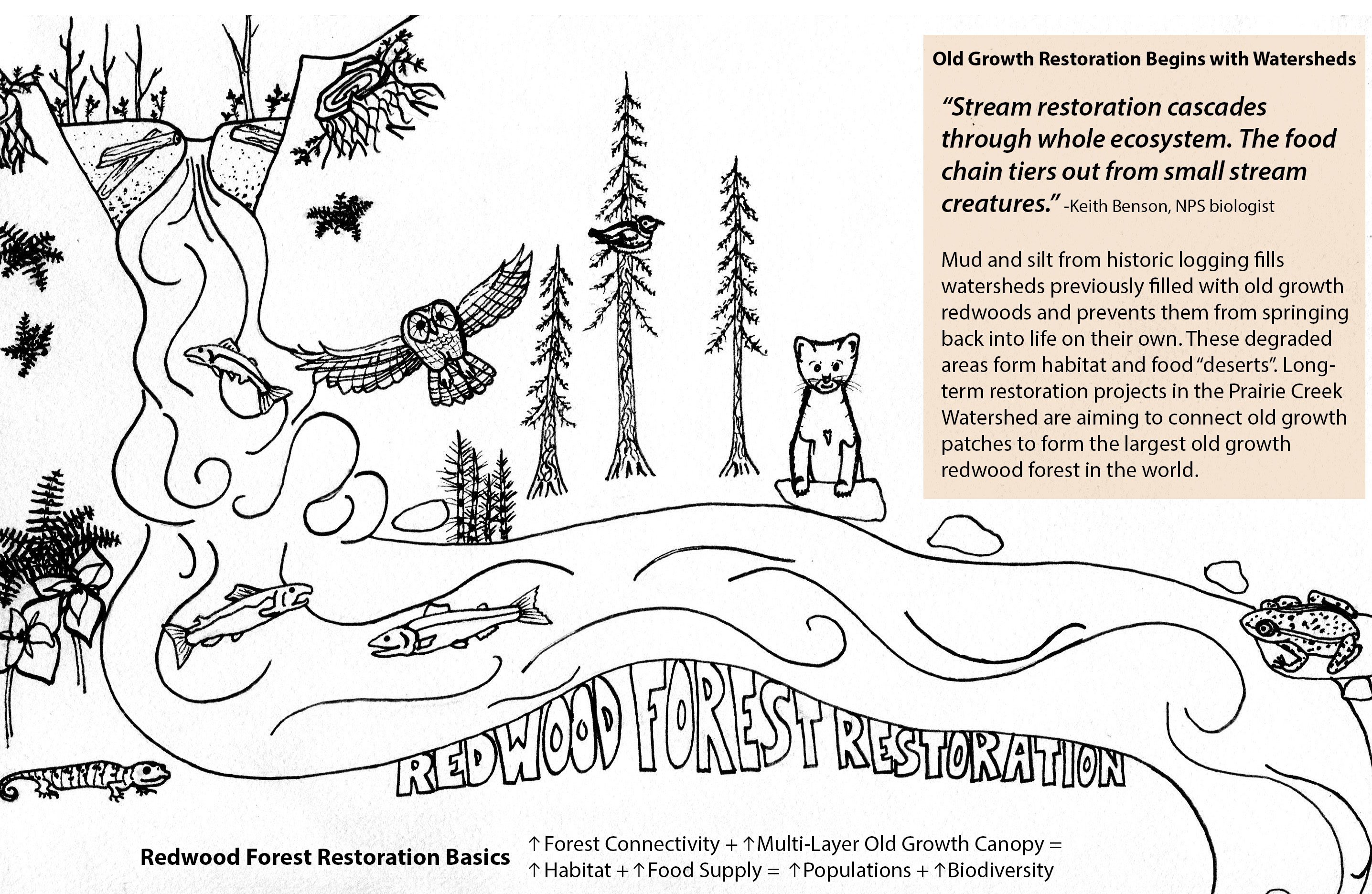
    Removing mud and gravel that chokes stream channels, such as Berry Glen, allows the ecosystem to breathe new life. Thinning the even-age stands of second growth so that light can reach the forest floor is also part of the restoration process. Keith Benson, an NPS biologist of the Orick, California area, explained that freeing watersheds in this way allows restoration to cascade through the whole ecosystem of an area.

    “The food chain cascades out from small stream creatures,” Benson said. “Restoration resets what the area has evolved to in the past, complex redwood forests. Then species composition can restore itself.”

    Benson likened a restored redwood forest to a Costco warehouse for species in the region, versus a uniform second-growth forest to a 7-Eleven convenience store.

    The basics of the ecology behind redwood forest restoration can be understood with a simple equation:

    ↑ Forest Connectivity + ↑ Multi-Layer Old Growth Canopy = ↑ Habitat + ↑ Food Supply = ↑ Higher Populations + ↑ Diversity

    Forest connectivity provides protection for prey while simultaneously providing more hunting abundance for predators. It also allows for easier gene-sharing among species as traveling between areas becomes safer. Increased gene variety creates more resilient species as better traits surface among diverse populations. Having Multi-layer old growth canopy instead of one uniform layer for trees lets in sunlight and increases a forest’s 3D space. This increases the availability of Habitat and Food Supply, resulting in Higher Populations and Diversity since both predators and prey have what they need in the ecosystem to thrive.