The Lumberjack


Students Serving The Cal Poly Humboldt Campus and Community Since 1929

Tag: S.T.E.M.

  • Diversity and inclusion through STEM

    Diversity and inclusion through STEM

    Humboldt State University was one of 24 institutions nationwide to be selected for a $1 million STEM grant by the Howard Hughes Medical Institute.

    The grant is part of HHMI’s program, Inclusive Excellence, which is designed to cultivate inclusion and diversity within the STEM community.

    By funding STEM programs throughout the nation, HHMI Inclusive Excellence strives to enable science education capacity in four-year institutions to provide opportunities for all students to succeed in the field.

    At HSU, this means developing better ways to serve incoming STEM students.

    Matt Johnson, Ph.D. and Wildlife professor said this includes development of student involvement programs, as well as faculty training.

    Johnson, along with Biology professor Amy Sprowles founded an integrative, place-based learning community called “Klamath Connection.” The direct field experience is one of the two current STEM place-based learning communities.

    Through these diverse programs, STEM students are integrated into the field through hands-on learning in the local environment.

    “These feelings help students feel a sense of belonging and community.” Johnson said. “With an approximate 6 percent of HSU students coming from Humboldt County, it is important to introduce incoming students to their new geographical, environmental and cultural environment.”

    Additionally, the grant will allow university faculty to participate in workshops and training opportunities to learn and utilize how to create a culturally inclusive environment.

    David Asai, senior director for science education at HHMI, says it is important to acknowledge that good ideas can originate anywhere. Asai said that often, a person’s success in science been a reflection of where they come from, not where they want to go, causing growing disparities in science education.

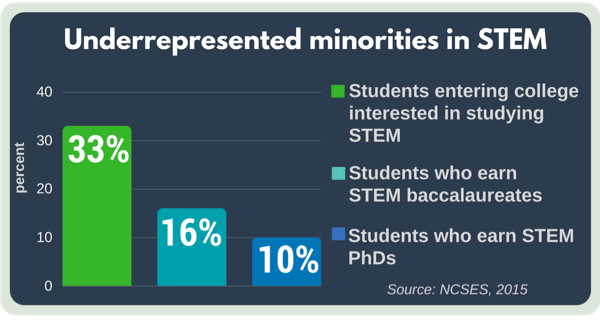
    Underrepresented incoming STEM scholars have significantly lower retention rates than their Caucasian or Asian counterparts.

    According to a 2015 report by the National Center for Science and Engineering Statistics, the percentage of students who receive STEM bachelor’s degrees is nearly half of the students who initially enrolled in science higher education.

    STEMgrantinfo.png


    Laura Carlos, a 22-year-old senior studying Zoology, said she did not feel prepared and included when she first started her science education at HSU. Carlos said that not all students are given the same opportunities in high school, which makes it difficult for students to have the same starting point in college.

    “Without proper resources and tools, underrepresented students can only dream of what it’s actually like to be a STEM student.” Carlos said.
  • This Week In STEM Sept. 14

    This Week In STEM Sept. 14


    Researchers at the International Monetary Fund and Georgetown University announced that more than 90 percent of all passenger vehicles in developed nations could be electric by 2040. Only two million out of more than one billion registered vehicles are electric today, with one million of those being in China. If this prediction proves true, it could reduce oil use by 21 million barrels a day and cut carbon dioxide emissions by 3.2 billion tons a year. That’s equivalent to 60 percent of total U.S. emissions today.

    Source: National Geographic

    Embed from Getty Images As many as one in three parasite species may face extinction in the next century. Researchers from University of California, Berkeley found that global warming will raise the planet’s temperature causing many species to lose territory in which they can survive. Parasites make up the majority of biomass in many ecosystems, and can outweigh predators sharing the environment by 20 to 1. The extinction of parasites may affect entire food webs, which would drastically affect human health in turn. Colin J. Carlson, the lead author of the study, said that parasites control the amount of diseases in wildlife, which indirectly helps humans as well. The estimated extinction of as many as one third of all parasite species would have dire effects.

    Source: New York Times

    Embed from Getty Images An oil tanker sank off the shore of Athens, Greece on Sunday, coating the entire bay in crude oil. Greek officials are calling it an environmental disaster as it’s turning the bay black and affecting the local wildlife. The spill is polluting the waters in a 1.5 km stretch around the island Salamis and will likely take four months to clean. Residents are outraged, coastal businesses have closed and fishermen have been advised to avoid the area. The captain and chief engineer of the oil tanker have been charged with negligence and released on bail. It’s still not clear exactly why the tanker sank.

    Source: BBC

    Beryllium hydride is now the largest molecule a quantum computer has simulated, generating new hope for future drug discoveries. According to Ryan Babbush, the researcher who led the hydrogen molecule simulation for Google, the accomplishment “represents solid progress towards an incredibly important goal.” For practical purposes, however, beryllium hydride is still a tiny molecule, so there is still much research to be done. Many scientists believe that revealing new drugs and materials will be the first significant application of future quantum computers, which are being developed at universities and companies around the world.

    Source: Science Magazine