The Lumberjack


Students Serving The Cal Poly Humboldt Campus and Community Since 1929

Tag: Sam Papavasiliou

  • Corporations and Vaccinations

    Corporations and Vaccinations

    I spent most of last Monday refreshing the CVS website. The site showed seven days of potential vaccination appointments and four of them were already greyed out. So naturally, I clicked one of the remaining three and then clicked again to schedule a time, except it wouldn’t show any available times. It did this for all three days. One of my coworkers had apparently got in after repeatedly reloading it, so I did the same. After three hours of trying, the site showed only one day left. In my frustration I cursed CVS and their website, but it got me thinking. Why was I making this appointment on CVS’ website to begin with?

    Back in October 2020, the Trump administration announced that they had brokered a deal with CVS and Walgreens to distribute the vaccine to seniors in long term care facilities. This deal later expanded to include in-store vaccinations.

    Around the same time, the federal government released its guidance on who was going to be first to get the vaccine and in what order the people would follow. This was passed on to county health departments with the understanding that each county would modify it based on their population and who was most at risk. With that being the majority of the guidance counties received, the message from on high seems to be, “Do whatever you think is best, except you must work with CVS or Walgreens.” But what if you don’t think working with a private company is the best way to accomplish a public goal?

    Companies exist to make a profit. While they may accomplish other things along the way, the end goal is still to make the most money possible. The vaccine may be free at a CVS or Walgreens, but when you go for your vaccination, you’re still a body through their doors. You could go and only get your vaccine with no additional purchases and that would still be a win for them. In fact, that’s exactly what they’re counting on. From that day forward, that’s no longer just another chain pharmacy location, that’s the CVS where you got your COVID-19 vaccination!

    In Walgreen’s case, you have to create a Walgreens account to even schedule an appointment. If you don’t already know sorry to ruin it for you, but store rewards programs exist to track your purchasing habits. That data is then sold to advertisers.

    It would then stand to reason that it’s in these companies best interest to get as many doses of the vaccine as possible. With the limited numbers being produced, they’re in direct competition with the county health departments. Private companies don’t pick locations for how they will best serve populations, they pick them for how they will best reach people willing to pay. They don’t structure their stores around getting people in and out, they structure their stores to sell products. At every step of the way profit is the number one motive. If you think that will change because of a global pandemic, you’re sorely mistaken.

    This purpose built less efficient profit machine is being pitted against our actual health services and the profit machines are much better at competing. Even if you think your county health department sucks, the way to fix it is not by giving it competition. Maybe in the next global pandemic I can struggle to schedule a vaccination with a government website, knowing that at least the government won’t give me a 4 foot string of coupons with my vaccine.

  • New Covid Strain Touches Down in Humboldt

    New Covid Strain Touches Down in Humboldt

    Humboldt County is one of the most isolated counties in California. From this came low numbers of coronavirus cases, a luxury that other counties in the state didn’t have. That has all changed recently. Cases have shot up in every county in California and now there is a new coronavirus strain making its way around.

    Known as L452R, this variant largely remains a mystery to local health officials and there has only been one confirmed case for this new strain in Humboldt County as of publication.

    Humboldt County Health Officer Dr. Ian Hoffman believes that while the new variant may be unique, it is not necessarily more dangerous than other current strains.

    “I think from just knowing about the other variants, symptomatology should be the same. The UK variant doesn’t show any worse outcomes, it’s just more transmissible,” Hoffman said in a video interview with the Humboldt County Department of Human Health and Services.

    Clairissa Keesey, an HSU senior and a studio art and business marketing double major, is on edge about possibly contracting the new coronavirus strain given her job.

    “I’m a healthcare worker, I work with direct patient contact as a caregiver, so it definitely makes me nervous,” Keesey said. “But I just got the vaccine so I’m hoping it works.”

    The guidelines and practices surrounding coronavirus in Humboldt County remain steadfast.

    HSU’s Campus COVID Safety Coordinator Jennifer Sanford outlined some of the ways that HSU is readying itself for the onset of the L452R variant.

    “The campus emergency team, and advance planning team both meet twice weekly and continue to be responsive to new developments in terms of campus plans,” Sanford said in an email interview. “We are keeping an eye on the new strain and other happenings and these will be considered in plans concerning the current semester, summer, and fall.”

    On a county-wide level, Dr. Ian Hoffman doesn’t foresee any new rules being enacted, even with the arrival of this new strain.

    “There should be no change in our practices because the things that we do to prevent the new strains are the exact same things we do to prevent the old strains,” Hoffman said. “So that would be: distancing, masking, avoiding gathering, washing hands.”

    For Sanford and her group, the landscape of the situation is constantly evolving and thus they need to be ready for anything.

    “In a nutshell, plans adapt as new information comes to light,” Sanford said in an email interview. “Lots of on-campus testing will continue moving forward and we are looking now at how to get the vaccine out to the campus community in an efficient manner as soon as it is available.”

  • The vaccine rollout creates more controversy

    The vaccine rollout creates more controversy

    Following the tireless debate that we began to witness in March over wearing masks and the continued misuse of the social distancing mandates, we should not be surprised that continuing to adhere to these guidelines post-vaccination is questionable to some.

    Yes, according to the Center for Disease Control, the Pfizer-BioNTech vaccine is 95% effective, but that doesn’t mean you should throw away social distancing measures just yet. Although it is highly effective, the vaccine is not perfect and health care professionals remain uncomfortable with “returning to normal” after the first couple rounds of vaccines have been distributed. Dr. Michael Saag, professor of medicine at the University of Alabama, compared the pandemic to a wildfire, saying the vaccines take fuel out of the fire.

    The small chance of getting COVID-19 after receiving the vaccination continues to grow as cases are still on the surge within many counties, especially Humboldt. On Jan. 26, in a virtual meeting of the Humboldt County Board of Supervisors, they indicated that although the state has lifted stay-at-home orders, Humboldt County is still in the purple tier and is expected to stay there for several weeks.

    In a new model released by the CDC, we see that around 60% of new COVID-19 cases have been linked to asymptomatic spread. The concern of scientists is that those who have been vaccinated could potentially still have the ability to spread the virus, even if they are not likely to get sick themselves. The common misconception is that once you are vaccinated, you are immune to the virus, but there is not enough evidence that suggests this to be true.

    “If they were asymptomatic but equally contagious, then that’s going to have quite an impact on the epidemic,” said Richard Menzies, an epidemiologist who directs the McGill International TB Centre in light of the new CDC model addressing asymptomatic spread. Dr. David Ho, a virologist working on developing monoclonal antibody therapies for COVID-19 at Columbia University added that it sometimes takes up to one month, or slightly longer, for protective immunity to set in after vaccination.

    It is especially important during this time that those who’ve been vaccinated continue to wear a mask and adhere to social distancing guidelines. As we move through the following weeks, to ensure the effectiveness of newer vaccinations, those who are already vaccinated have an important role.

    Since vaccine distribution began in the U.S. on Dec. 4, the CDC’s daily data tracker shows that we have administered more than 30 million doses as of Monday, Feb. 1. In order to achieve herd immunity through vaccinations, experts believe 75-80% of the population or more would have to be vaccinated.

    Vaccinations are massively important in combating COVID-19, but simply administering doses to the public is not going to be enough in ending the pandemic. The best way to ensure that we are doing our part for our community is to continue adhering to mandatory state guidelines: wear a mask, wash your hands and keep your distance.

  • Bidding Farewell to Hip Hop’s Masked Villain

    Bidding Farewell to Hip Hop’s Masked Villain

    On Thursday December 31, the music world was stunned by the unforeseen announcement that one of hip hop’s most interesting figures, MF DOOM, had passed away earlier in the year at the age of 49.

    The announcement came via social media post on the artist’s official Instagram profile. It included a picture of the famed rapper posing while boasting a white New York Knicks jersey, camouflage printed cargo pants and trademark gladiator mask that he became infamous for throughout his career. Along with this photo was a short message addressed to DOOM by his wife Jasmine, in which she thanked her late husband for the lifelong lessons and memories she had acquired during their time together.

    Underneath the heartfelt message read “Transitioned October 31, 2020,” two entire months before the world was made aware of his passing. To the unbeknown music novice this may seem odd or at the very least peculiar, but to MF DOOM fans across the world, it fit the allure the legendary rapper garnered over the last 20 years.

    DOOM’s public image has always been shrouded in mystery and mystique. Choosing to don a medieval gladiator mask in practically all appearances in public, he set out to create a conceptual experience for his audience that spanned further than himself. Over the years his albums released with no particular scheduling pattern compared to other artists, only dropping new projects when he felt the world was ready.

    There are many documented accounts where concert goers who paid to see the artist perform were subjected to an “imposter” who recited his songs, until the MC eventually appeared on stage. For the outsider looking in, this would be a dishonest way to coerce fans out hard-earned money, but to DOOM this furthered the brilliance of the enigma he created.

    Born Daniel Dumile, MF DOOM was one of three different alter egos (the other two being Viktor Vaughn and King Geedorah) Dumile created during his illustrious career as a producer and MC. MF DOOM, the most popular of Dumile’s three personas, rose to prominence as a staple in the underground hip-hop community in the late 1990’s and early 2000’s.

    Equipped with lyrical content that strayed far left of the status quo, and blending it with beats that were framed around sample snippets of old cartoons and songs that were not typical in hip-hop production, his debut album “Operation Doomsday” pushed the creative envelope like no other album at the time. Past his initial success, he gained notoriety as one half of the revered hip-hop coalition Madvillain along side producer Madlib. Their 2004 album “Madvillainy” is regarded as being one of hip-hop’s most influential albums in history, also procuring DOOM the moniker of “your favorite rapper’s favorite rapper.”

    As the news of his untimely passing spread quickly on New Year’s Eve, fans and fellow artists alike took to the internet to show gratitude for the late rapper’s contributions to hip-hop culture. Leaving a catalog full of innovative sounds and rhymes for lifelong fans to enjoy and new fans to discover, DOOM’s legacy will be revered for generations to come. A legacy that will be forever spelled in ALL CAPS.

    RIP MF DOOM.

  • Half-Life: Alyx Makes VR Worthwhile

    Half-Life: Alyx Makes VR Worthwhile

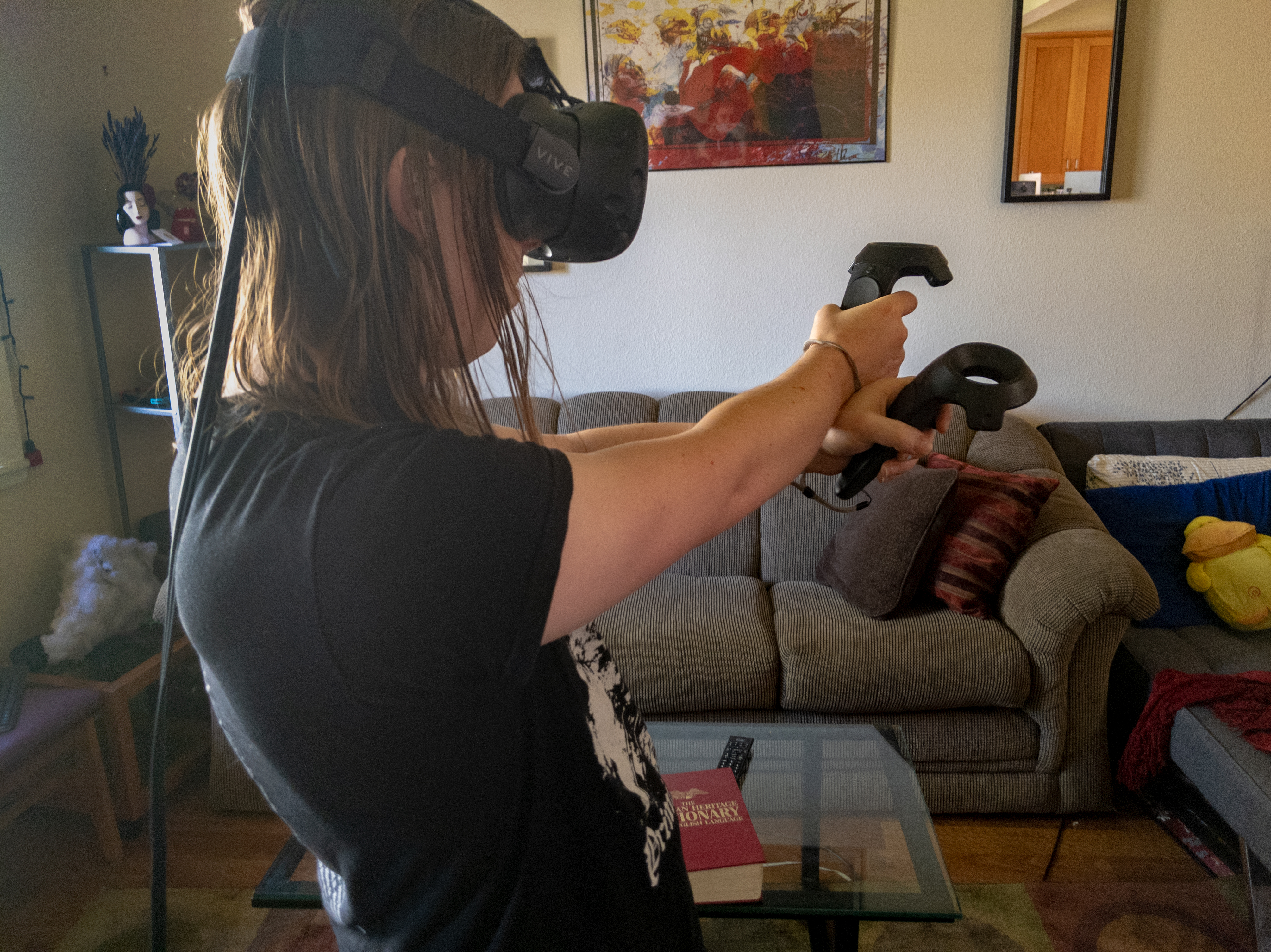
    Half-Life: Alyx is the first properly high budget virtual reality effort from a major studio

    The previous game in the Half-Life series ended on a cliffhanger, and since then, the franchise sat in limbo for over a decade. By the time Half-Life: Alyx was announced, most had given up hope of a sequel. The inflated expectations for a new Half Life game made constructing a sequel too daunting a task for developer Valve to ever release anything, but now they have. Does it live up to the hype?

    For the most part, yes.

    With the majority of people currently stuck inside, virtual reality is one of the best ways to pretend you’re not. The problem is the high price point. Currently the barrier for entry for a VR headset is a minimum of $400, and that doesn’t include a gaming PC that meets the hefty requirements of VR. Those PCs generally start at $600. Up to this point, small-scale games made up the majority of the VR catalog. VR lacked a system seller to justify the high price point.

    The game’s story is excellent, but can feel sparse at times. Some chapters should have more dialogue than they do, but the writing and performances that are there are excellent.

    Luckily, Half-Life: Alyx is an incredible game. It takes what made the older Half-Life games great on a 2D screen and translates them to the 3D space with an incredible amount of polish.

    In Half-Life 2, your main method of interacting with the world was the gravity gun, the weapon that could pick up and manipulate nearly any object in the world around you. In Half-Life: Alyx you have gravity gloves.

    These gloves let you aim your hands at nearly any object, press the grab button and flick your wrist to bring that item towards you. It’s an action so simple and satisfying to perform that since playing I have on several occasions found myself with the urge to perform it in my day-to-day life.

    The game’s story is excellent, but can feel sparse at times. Some chapters should have more dialogue than they do, but the writing and performances that are there are excellent.

    During those few encounters with human characters I was in awe at how life-like they were. If there’s anything about the game that is a disappointment, it would have to be the lack of melee weapons. You can pick up almost anything in the environment, but none of it can actually harm enemies. Half-Life is known for having the crowbar as a weapon, so it’s weird to not have that in this game.

    These are all nitpicks though. Half-Life: Alyx is proof that VR as a medium can work. It’s proof that virtual reality can be its own storytelling medium, with its own stories and experiences and that gets me excited for the future of gaming.

  • The Lumberjack in Print: March 11, 2020

    The Lumberjack in Print: March 11, 2020

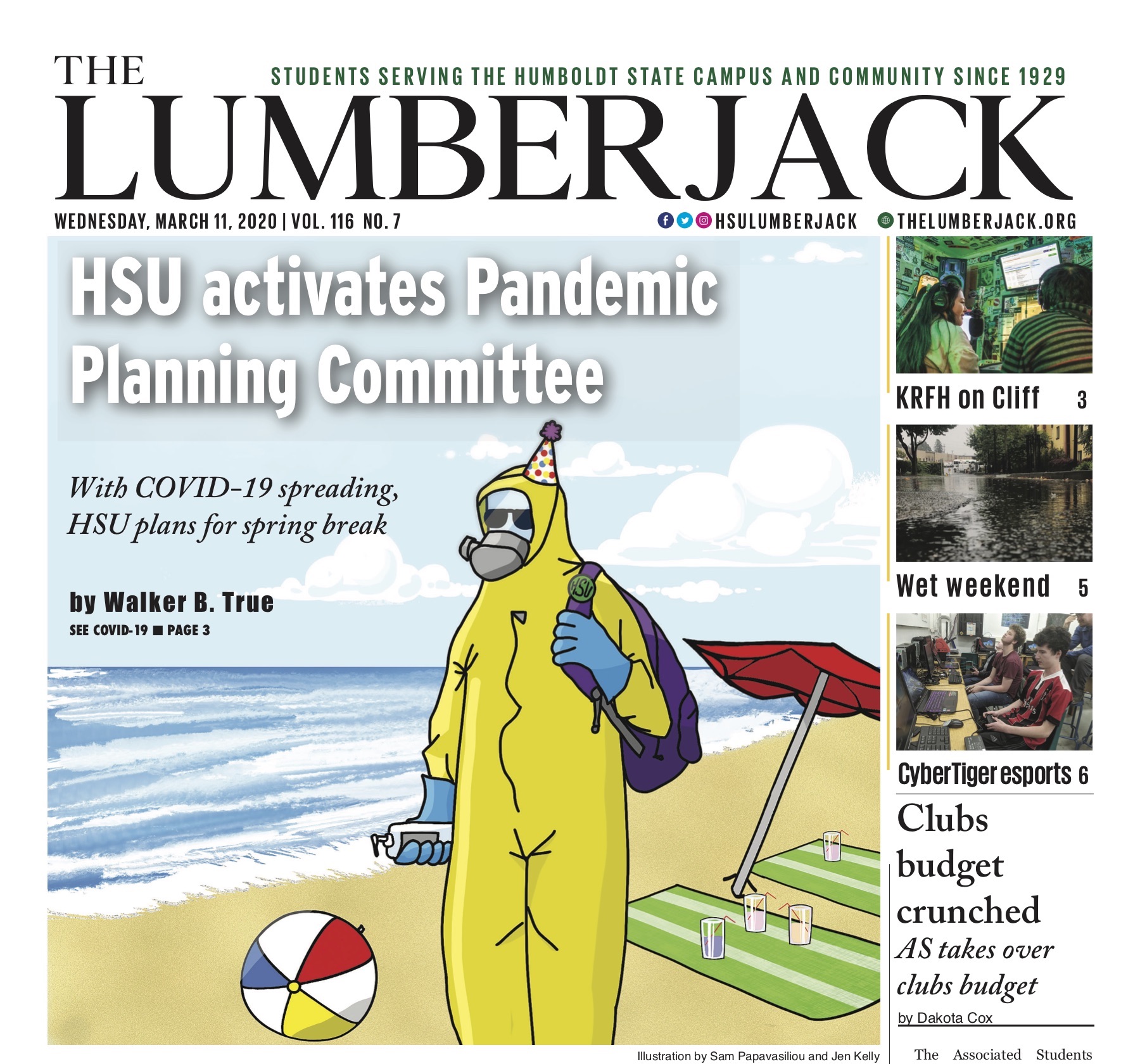
    The seventh issue of The Lumberjack for the spring 2020 semester

  • Parking Pisses Me Off

    Parking Pisses Me Off

    The trials and tribulations of finding parking on campus

    Parking on campus sucks. And I’m not the only one that thinks so.

    I try my best to walk or take the bus whenever I can. Sometimes I’m just too slow in the morning and have to drive to avoid being late. The problem is that between the hours of 9 a.m. and 3 p.m. it’s ridiculously hard to find an open parking spot on campus.

    Usually I end up parking on a residential street nearby. To put that into perspective, my apartment is a 21-minute walk from campus according to Google Maps. From where I usually end up parking, it’s an 11-minute walk to get to class. When I add the four minutes it takes to drive there, I only end up getting to class six minutes faster. Sometimes, that’s exactly what I need to make it to class on time.

    “If people have to pay even more for parking permits there HAVE TO BE SPOTS AVAILABLE FOR THEM TO PARK IN.”

    Parking Survey Response

    A 2018 study by Walker Consultants included an anonymous survey on the state of parking on campus. The full results of this study are available, and boy, a lot of people were mad about parking.

    “Prices as they are, are already ridiculous. One should not have to pay $315 a year to only find parking between 7:00-8:00 a.m and after 5:00 p.m.,” one person wrote.

    The survey had multiple respondents to the parking issue.

    “If people have to pay even more for parking permits there HAVE TO BE SPOTS AVAILABLE FOR THEM TO PARK IN,” another person wrote.

    In addition to the sentiments behind these two comments, a large number of the comments suggested building both on-campus parking structures and off-campus parking with shuttles to campus.

    One question on the survey struck a nerve with many respondents when it suggested the cost of parking passes may have to be raised in order to meet the demand. Many of the answers to this question were filled with colorful language.

    “What in the world do you do with all the money that you are unable to sustain the program without raising prices again?” one of the less expletive-prone respondents wrote.

    Another respondent offered to try and get the extra funds themselves.

    “Perhaps we can lobby the state for funds? I’ll go to talk to Jerry on behalf of HSU. Dunno if he’ll see me, but I’ll go,” wrote the hopeful respondent.

    Unfortunately, Jerry Brown is no longer our governor, so if this respondent had it in with Jerry Brown, that won’t work anymore. Even more unfortunate is that this is an issue that is going to take a lot of work from the school if it’s going to be fixed. It’s also likely that even if it is fixed, it’ll take longer than many of our students will be here. In the meantime, it’s still a great excuse for being late to class.

  • Artificial Intelligence Generates Real Jokes on Twitter

    Artificial Intelligence Generates Real Jokes on Twitter

    Creators say we shouldn’t worry about being replaced yet

    There is a new breed of bot accounts coming to Twitter, but these aren’t put there by Russia or the CIA or whoever else is trying to influence an election. They’re novelty accounts, posting large quantities of tweets that mimic the style of existing users.

    Twitter user @kingdomakrillic runs one of these accounts. He asked to only be referenced by his Twitter account. His parody account, @dril_gpt2, sends out a new tweet in the style of @dril several times a day. @dril is a somewhat mysterious, absurdist comedy account that posts their jokes from behind the pseudo-anonymity of a profile image of an incredibly blurry Jack Nicholson. @kingdomakrillic explains their reasoning for choosing @dril to imitate.

    “I wanted to do a GPT-2 bot of someone who was both famous and whose voice on Twitter was near-exclusively comedic,” he says. “If I did, say, a Trump bot, the only humor would come from the novelty of a bot generating Trump-like tweets.”

    These imitation @dril tweets can be shockingly on-brand yet original at times. It’s not uncommon to see replies wondering if the tweets from the account are still created by a bot.

    @kingdomakrillic assures me the tweets are bot-written but hand-selected.

    “Curating the tweets is like DJing. I pace the content out, placing tweets I’m sure are funny next to ones I’m more uncertain about,” @kingdomakrillic says. “Sometimes I screw up. It’s a skill, not 1/10th of the skill that goes into actually writing tweets like dril’s, but it’s still something I need to improve on. There’s no excuse to post duds when you can output infinite text.”

    That infinite text doesn’t come from nowhere. It comes from GPT-2, a language model created by OpenAI, a research group with a focus on machine learning.

    Sherrene Bogle is a computer science professor at HSU with experience using machine learning. Conceptually, teaching an algorithm how to do something is a lot like teaching a person. Bogle uses the example of teaching an algorithm to recognize whether a bird is in the foreground or the background of an image. First the algorithm is given a set of bird pictures that are already labeled as to whether the bird is in the foreground or background, allowing it to figure out the differences. Then it’s given unlabeled bird images, where it looks for those same differences. The difference between a human in a machine doing this task is that the machine doesn’t actually understand what it’s doing. The machine simply recognizes patterns.

    Instead of looking for where birds are in pictures, GPT-2 looks for patterns in text. It’s job is to predict not just the next word, but the next couple paragraphs. GPT-2 is so good at this task that it can make paragraphs of human-readable text after being given only a handful of words. The output text can be about anything, but in order to generate text that mimics the style of a Twitter user, programmers need to retrain the model.

    “The potential for harm is less than current human bad actors.”

    Max woolf

    @kingdomakrilic says he retrained GPT-2 on 9,500 tweets, totaling about 750 kilobytes. This focuses the original GPT-2 training data, consisting of almost 40 gigabytes of data, to accomplish a more simple task. The more simple a task, the better an AI can imitate it. Imitating tweets is simple, and with GPT-2’s vast capabilities, imitation yields good results.

    There is also @kingdomakrilic’s curation, which gives many of his followers the impression that the AI is better than it really is.

    Max Woolf is a data scientist at BuzzFeed, and the person responsible for making these twitter bots so easy to create. He built a tool, called GPT-2 Simple, to easily retrain GPT-2 with any new data—tweets—and wrote an accompanying tutorial. Some people think AI is a threat to humanity, but Woolf says otherwise.

    “The potential for harm is less than current human bad actors,” Woolf says.

    @kingdomakrilic agrees with this sentiment.

    “Some people get freaked out at the fact that GPT-2 can produce sentences that have humanlike coherence, but are made with no meaning or intent on the bot’s part besides to imitate how humans write,” he says. “Markov chains, Madlibs, autocompletors, esquisite corpses—they’re also capable of creating coherent text with the illusion of intent. They’re just not mysterious black box programs like GPT-2.”