
The Lumberjack


Students Serving The Cal Poly Humboldt Campus and Community Since 1929

Tag: Sarah Ray

  • Students Bused Back to HSU Met with Mixed Messages

    Students Bused Back to HSU Met with Mixed Messages

    Locals react to HSU students bused back to Humboldt from coronavirus-afflicted areas

    A bus chartered by the Humboldt State Homeward Bound program picked up 31 HSU students March 21 from San Francisco and Los Angeles—two cities where the coronavirus has become more and more prominent—and brought the students back to Humboldt.

    Lost Coast Outpost posted an article about the bus March 24. The Facebook post for the story has 433 comments as of March 29, many of which are critical of HSU.

    “This is beyond irresponsible of HSU,” one comment reads.

    “And one more reason we feel GREAT about not sending our kids to HSU,” reads another.

    Sarah Ray, an environmental studies professor, defended the students.

    “Quite a few of our students live here and have moved here and have their lives here and they were visiting family,” Ray said. “So, just like we would expect and hope that kids and students who are from Arcata and the area—we would fully respect and appreciate that they would want to come home and be home with their families once their classes got cancelled in this really frightening moment—it’s reasonable that students would want to go where they’re most comfortable and feel at home.”

    She went on:

    “There’s also a lot of research out there about how many students across the nation going through this exact problem are not safe at home, and this might be a safer place for them,” Ray said.

    “I feel like it’s not a simple solution to just say, ‘Go back there,’ because many of these students live here.”

    Xochitl Andrade, HSU English and biology major

    Grant Scott-Goforth, communications specialist for HSU, explained the precautions implemented on the buses returning to HSU.

    “The buses were partially full so that people could have social distancing on the buses while they rode,” Scott-Goforth said. “And then, obviously when they return, we’re asking everyone to shelter-in-place, to quarantine if you’ve been exposed or been to an area with exposure, and to contact the Student Health Center or hospitals with concerns about health.”

    As much as HSU wished it could’ve been in command over which students came and which students left Humboldt, there was no way to do that. Of course, as Scott-Goforth asserted, the coronavirus situation is nothing to sneeze at.

    “I think it’s terribly unfortunate and I’m very sad for them and I feel very protective of students because it’s what I do.”

    Sarah Ray, HSU environmental studies professor

    Xochitl Andrade, an HSU senior majoring in English and biology, said the situation is complicated.

    “I feel like it’s not a simple solution to just say, ‘Go back there,’ because many of these students live here,” Andrade said. “They may have no where else to go if they were told to go back. We don’t know if they were just visiting friends or family. And for those who don’t have any family to go back to, what are they supposed to do?”

    While Andrade agrees that the students should be quarantined, she said she thought HSU knows what it’s doing.

    Ray hoped the harsh words toward HSU students from the Lost Coast Outpost article weren’t representative of the Arcata community.

    “I think it’s terribly unfortunate and I’m very sad for them and I feel very protective of students because it’s what I do,” Ray said. “I would like to think that it’s only an extreme, fringed, vocal, internet types of social media people who are saying those kinds of things. The vast majority of the university, especially the community and many people in the community—that’s not the kind of sentiment I see.”
  • Sarah Ray keeps emotions and knowledge together in her teachings

    Sarah Ray keeps emotions and knowledge together in her teachings

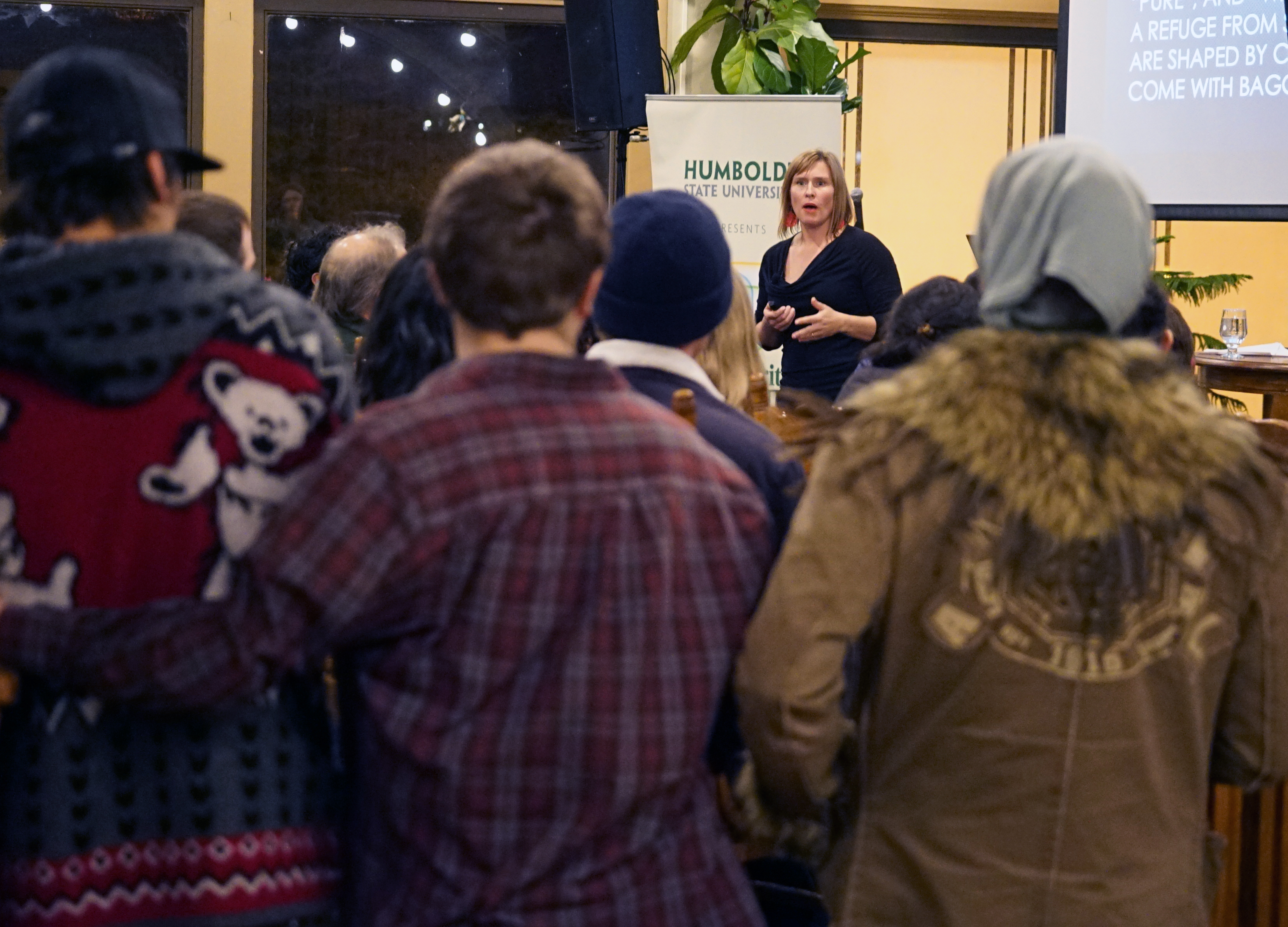
    Sarah Ray inspires students and faculty at Humboldt State. During her lecture, “Coming of Age at the End of the World: Eco-Grief, College Students, and Teaching Climate Change,” she inspires community members as well.

    Sarah Ray, environmental studies professor at Humboldt State, spoke as part of the “My Favorite Lecture” series at the Plaza Grill in Arcata on March 8.

    The lecture discussed ways to be empathetic to students’ emotions and the methods Ray uses to inspire her students, all while acknowledging the grim realities of past environmental decisions.

    “Emotions take on a life of their own in the classroom,” Ray said.

    When Ray took the position to lead the environmental studies program at HSU in 2013, there were 11 environmental studies majors in her program. As of 2018, there are 150 environmental studies majors at HSU.

    Ray says that humans emotions play a big role in environmental studies.

    “Not surprisingly, guilt, despair and negative news do not inspire students to [take] action,” Ray said. “It creates apathy and nihilism. There is a lot of research that shows this is not an effective tool.”

    Over time, students’ emotional responses became overwhelming for Ray herself. Out of self-preservation, and for the success of her students, Ray has come up with new teaching strategies for environmental studies.

    Ray believes these strategies will be beneficial to everyone who questions the importance of their own environmental role.

    “Teaching students environmental content is going to have a negative affect on them,” Ray said. “If the affects can be anticipated, the more effective the curriculum will be.”

    As a professor, Ray has watched many environmental studies students learn that their college journey is not what they expected.

    Faced with intractable, unsolvable problems, students become incapacitated. Ray calls this “getting the rug pulled out from underneath you.”

    After watching students repeatedly get the rug pulled out from underneath them, Ray realized these students need emotional support to deal with the curriculum.

    Brooke Holdren, a biology major at HSU, attended Ray’s talk and thinks ethics should be part of science.

    “There needs to be more critical scientists,” Holdren said. “Science is political as fuck.”

    Ray utilizes inclusive pedagogy to promote not only a students academic success, but their social, cultural and physical success.

    Inclusive pedagogy is a way of teaching that uses varying learning techniques, multicultural content and multiple means of assessment.

    Going off of Bell Hooks teachings, Ray said, “We have to make the personal political and we have to make content relevant to students.”

    Ray also uses social movement theory in her teaching.

    “The outcome of social movement theory is to give students a sense of belonging in a larger community. They are not isolated against the tidal wave of society,” Ray said. “Students are involved in a bigger group of people working towards the same goals.”

    Ecopsychology uses both ecological and psychological ideas to study the relationship between human beings and the natural world. Ecopsychology includes theories about emotional responses to climate change and has become useful in Ray’s teaching, showing how environmental change causes emotional distress.

    Last semester, Ray tried a change-vision-action workshop with her students. Ray had students list how they would like to see changes in the world, and make a personal action plan. Students have put these ideas into actions. This has given Ray inspiration to improve and instill greater lessons onto her students.

    Ray doesn’t simply tell her students how to fix the current environmental issues. Instead, she gives them the information and emotional support they need to come to their own conclusions.

    “Efficacy is better than hope,” Ray said.

    Efficacy is the ability to produce a desired result. Students envision new ways of living with their outcomes.

    “Sometimes the outcomes are hopeful and lead to resiliency, while other times outcomes are negative,” Ray said. “These workshops are not monolithic. They can go in many different directions.”

    HSU alumnus Larry Goldberg, who started the Campus Center for Appropriate Technologies at HSU in 1978, attended Ray’s lecture.

    “You can’t get incapacitated by fear and depression. Get off your ass. You got to do something,” Goldberg, said.

    The changes and theories Ray has implemented in her classroom have inspired her to write a book on emotions in the classroom. Ray’s book will look at different aspects to the emotional consequences of climate change. She plans to write the book on her sabbatical next year.

    “You have to come up with your own reasons and solutions to our problems, because self-righteousness is not enough,” Ray said.