The Lumberjack


Students Serving The Cal Poly Humboldt Campus and Community Since 1929

Tag: small business

  • The Humboldt Hustle: Students and their small businesses

    The Humboldt Hustle: Students and their small businesses

    by Zack Mink

    The life of a student is jam-packed with endless homework assignments and quickly approaching deadlines, all while trying to stay afloat financially. Some students work on campus, some work multiple jobs and others have turned their skills into profitable businesses.

    Brianna Juarez, a queer, Mexican-American, first-generation student is a senior majoring in philosophy with a minor in comparative ethnic studies. Aside from her hectic schedule, she creates maximalist polymer clay jewelry as The Crafty Bee Co, @thecraftybee.co on Instagram, and sells her art as a vendor at local events all over Humboldt County. 

    Photo courtesy of Will Suiter of Humboldt Made | Brianna Juarez at the Friday Night Market in August

    Juarez officially started her business in January of 2021 after finding a place where she, as a queer person of color, felt comfortable taking up space. That along with managing her chaotic school schedule and finding a balance between school, work, and self-care are the biggest struggles she faces as a small business owner. 

    “As a small business owner, you play all of the roles. You’re your own boss, and I think being a student is also in some aspect being your own boss,” Juarez said.

    Being a student and a business owner work together well, according to Juarez.

    “Being a student has helped me be a better business owner,” said Juarez, “and being a business owner has helped me be a better student.” 

    Photo by Zack Mink | Tonin Olsen at the Festival of Dreams, Aug. 26

    Tonin Olsen, owner of Orange Skies, @orange.skies._ on Instagram, is a senior majoring in studio art. Olsen creates charm earrings and necklaces, as well as hand-designing stickers that bring a new level of confidence to other students, locals, and even themself. 

    “I just wanted to create something that I could wear and feel better in my own body,” Olsen said.

    Their business began almost two years ago and constantly expands into new ventures with the support and resources they have in the studio art department. Despite feeling support from their peers, Olsen hopes for more support from the institution itself. Some ideas they would like to see come to fruition would be more events on campus, and free transportation to off-campus events to help create a larger, more supportive community for students with small businesses.

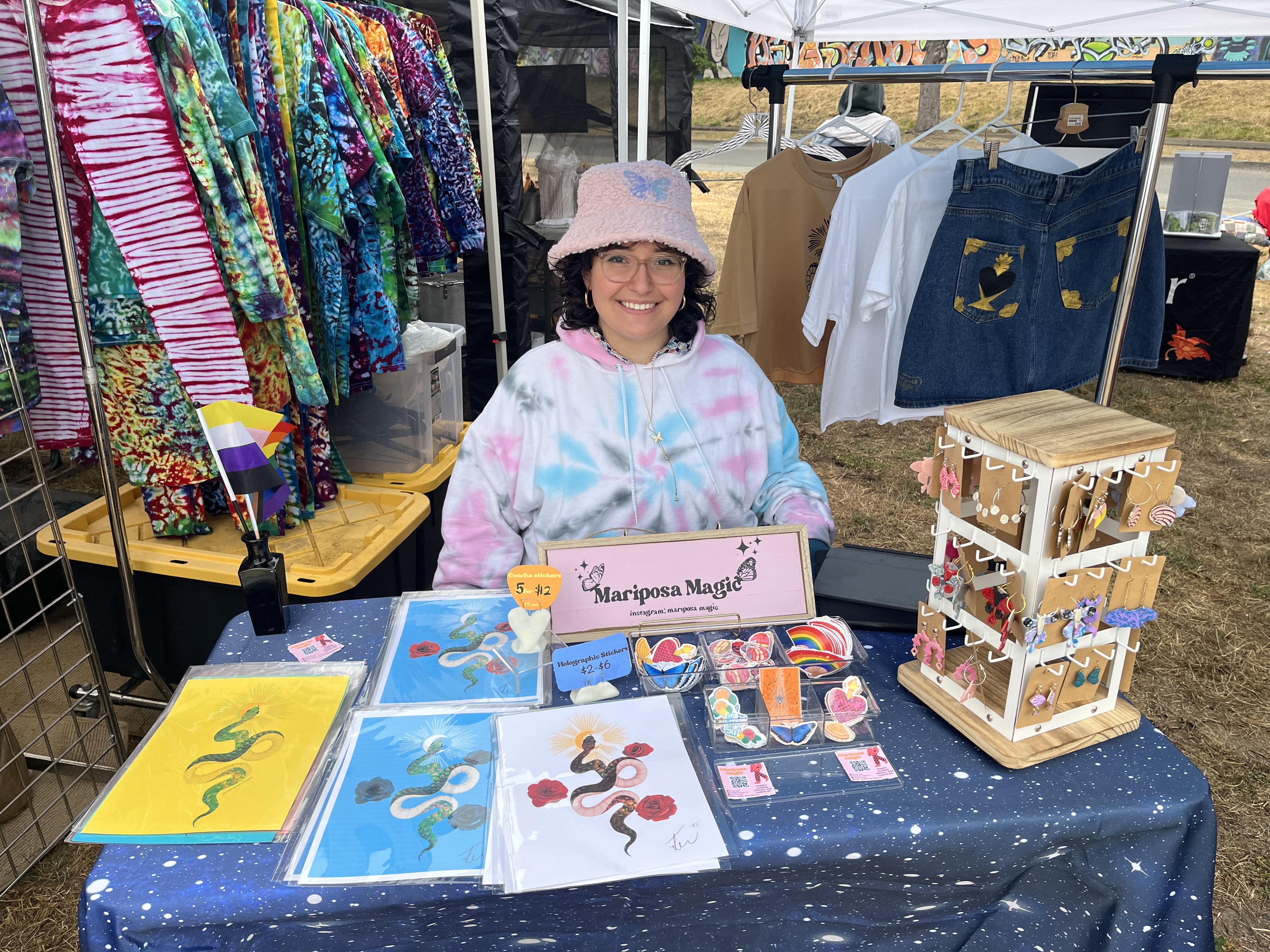
    Jesse Beacham Grijalva Prieto, an Indigenous, Latinx, Black, genderqueer/non-conforming student in their fourth year as a psychology major, is the owner of Mariposa Magic, @mariposa.magic on Instagram. Beacham creates all kinds of handmade art inspired by their diverse ethnic background and their queer identity. Wearing all of the hats as a business owner, balancing two other jobs, and being a full-time student are Beacham’s biggest challenges. Despite their full schedule, Mariposa Magic is still a priority.

    Although it can be hard to balance the life of being a business owner and student, people in this community make an effort to get everything done and still come out on top. To them, it is a matter of personal success, both mentally and in the physical form.

    “My business is so much more than a business,” Beacham said. “It’s part of my emotional healing.”

  • Shopping online saves lives and kills local business

    Shopping online saves lives and kills local business

    As our collective shopping behaviors change to accommodate the COVID-19 pandemic, Amazon feasts on the misfortune of millions of Americans struggling to pay their rent and keep food on the table.

    According to data gathered by Yelp, approximately 60% of businesses registered with the app that shut down when the pandemic first reached the United States will never re-open. Only including the 5.3 million active, claimed local businesses registered with the app, as of August 2020, nearly 100,000 American businesses have been forced to permanently close their doors.

    Many corporations have also experienced varying degrees of drowning during the pandemic, with retail chains closing over 8,700 stores in America in 2020 according to the Coresight Research report. This number comes in just shy of 2019’s record breaking 9,300 closures that’s predicted to be broken in 2021, with over 2,000 closures already in the first month alone.

    This downward trend of brick and mortar retail is an ongoing result of the 2008 real estate bubble burst. Combining a struggling economy with a rise in popularity of e-commerce – allowing customers to seek out the best possible deal through a variety of providers at the click of a button – brick and mortar retailers were forced to significantly discount their prices in order to convince an especially stingy consumer base to buy. With shoppers becoming accustomed to the new prices, retailers were forced to adjust or disappear. This phenomenon has gone on to become infamously known as the “retail apocalypse,” claiming over 1.3 million American retail jobs in the last decade alone.

    The enormous gap in the market created by the retail apocalypse has been seamlessly filled in by e-commerce. While tens of thousands of brick and mortar stores have closed over the past decade the internet’s online shopping Goliath, Amazon, has massively multiplied in size, increasing their 2010 net income by a factor of almost 10 in 2018 and growing their employees by a factor of nearly 20 in that same amount of time. To meet the increased demand for online shopping created by the COVID-19 pandemic, Amazon hired over 400,000 new employees in 2020 alone, bringing their total employee count over 1 million.

    Amazon has achieved such massive growth so quickly as the result of a business model that is essentially built around one core concept Jeff Bezos refers to as “customer obsession.” Amazon’s ultimate goal is to create loyal customers that won’t just return once, but hundreds and thousands of times. They do this with the assistance of a website the company has collectively invested billions of dollars and man hours into, in order to connect customers with as many possible items they’re interested in, in as few clicks as possible.

    Providing additional incentive for customers to spend even more money and time engaging with the brand, Amazon’s Prime membership includes free shipping on all items and access to Amazon’s video and music streaming services for the price of $119 per year – a number small enough for almost one in three Americans to justify the purchase and large enough that they will be especially inclined to get their money’s worth out of their subscriptions. Combining the perks of membership with a consistent and vast stream of products that appeal to the consumer and a pricing model specifically designed to undercut the competition, they become unstoppable.

    In order to consistently provide the best prices for a vast variety of products on the internet, Amazon trades off especially low net profits on sales for the increased business their prices attract. In fact, the majority of the corporation’s income is actually generated by the Amazon Web Services. Essentially, this means that Amazon has been reducing businesses to rubble left and right for the past decade, all so they could eventually capitalize on their popularity and finally make a decent profit from a virtual cloud.

    With the pandemic stoking the fire of the retail apocalypse, as is the case with climate change, we are fast approaching a point of no return. While faceless retail corporations will continue to exist in some capacity for those who refuse to conform to the online platform, private businesses will someday become a thing of the past if we can’t collectively escape the “every man for himself” attitude our society has adopted.

    We need to look past the immediate future and understand that helping others ultimately helps everyone in the long run. So, instead of outsourcing your next purchase for a cheaper price, whatever it may be, invest in a business from your local community. Take pride in watching your wealth spread, rather than sulking in the shame of knowing you’re feeding the beast that intends to devour the businesses your neighbors have devoted their lives to.

    Author’s Note: This righteous rant brought to you by a shameless Amazon Prime member. Do as I say, not as I do and together we can save the small business.