The Lumberjack


Students Serving The Cal Poly Humboldt Campus and Community Since 1929

Tag: smoke

  • How the wildfires of California are impacting Arcata

    How the wildfires of California are impacting Arcata

    What life is like as climate change begins to worsen

    Waking up in Arcata, CA on Sept. 9, 2020 was similar to an apocalyptic movie. The sky was as orange as street lamps. Cars had their brights on and were dusted in ash. Air quality numbers began to rise.

    Air quality states how polluted the air is to the public, measured by the air quality index, or AQI.

    AQI levels range from good to hazardous, based on numbers from 0-500. As the number rises, the health risks worsen. Any number above 500 is considered beyond hazardous.

    As wildfires continue to rage across California, the air quality has been majorly impacted. California has seen AQI’s above 500 during this wildfire season. In Arcata, despite being 100+ miles away from the nearest wildfire, the skies that were once full of fog are now full of smoke.

    According to AirNow, a site that tracks AQI around the globe, by 12 a.m. on Sept. 11 Arcata had hit a peak AQI of 269.

    The AQI states that air quality above 201 is considered very unhealthy and above 301 is considered hazardous: “Health warnings of emergency conditions. The entire population is more likely to be affected.”

    The HSU campus closed due to the condition of the air. Students were told outdoor activities could not be moved inside due to COVID-19. “Air quality has worsened to very unhealthy levels since Thursday,” said Humboldt State University in an email to its students. “Please note those levels may fluctuate throughout the day.”

    They also warned students to stay indoors with closed windows, use a portable air purifier if possible and wear a mask that filters air rather than just cloth if they must go outside.

    Despite being advised to wear a mask for filtration, most students are wearing cloth masks. HSU freshman, Dev Lebhar, wore a gas mask when they went outside. They had two other gas masks and two respiratory masks in their dorm.

    “The combination of the respiratory disease and the smoke outside means if your lungs get damaged by the smoke and you get COVID, you’re in big trouble,” Lebhar said.

    They claimed they haven’t felt any effects from the smoke, but do struggle to breathe while wearing the gas mask due to its layered filtration.

    According to the CDC, going out in such unsafe conditions can result in similar symptoms to COVID-19, like cough and difficulty breathing. It can be especially bad for those in high risk groups. Other side effects can result in stinging eyes and throat, increased heartbeat, chest pain, irritate respiratory systems and worsen existing heart and lung diseases. Wildfire smoke can even make you more prone to catching the virus COVID-19.

    According to Berkeley Earth, a nonprofit organization on environmental science, China experiences some of the worst air quality, claiming “on bad days the health effects of air pollution are comparable to the harm done smoking three packs per day (60 cigarettes) by every man, woman, and child.” A typical day in China is equivalent to 2.4 cigarettes. “1 cigarette is equivalent to an air pollution of 22 μg/m3 for one day.”

    On September 11 Arcata’s average AQI was 243, according to AirNow. That means the average air quality if you were breathing it all day was about equal to smoking 8.7 cigarettes. These hazardous conditions exist all across California, including areas like Arcata that aren’t necessarily close to a fire.

    The best way to protect yourself is to stay inside. Any exposure to the smoke can damage your health, especially if large amounts of time are spent outside or if you have other existing health conditions.

  • Reject the smoking ban

    Reject the smoking ban

    By | Phil Santos

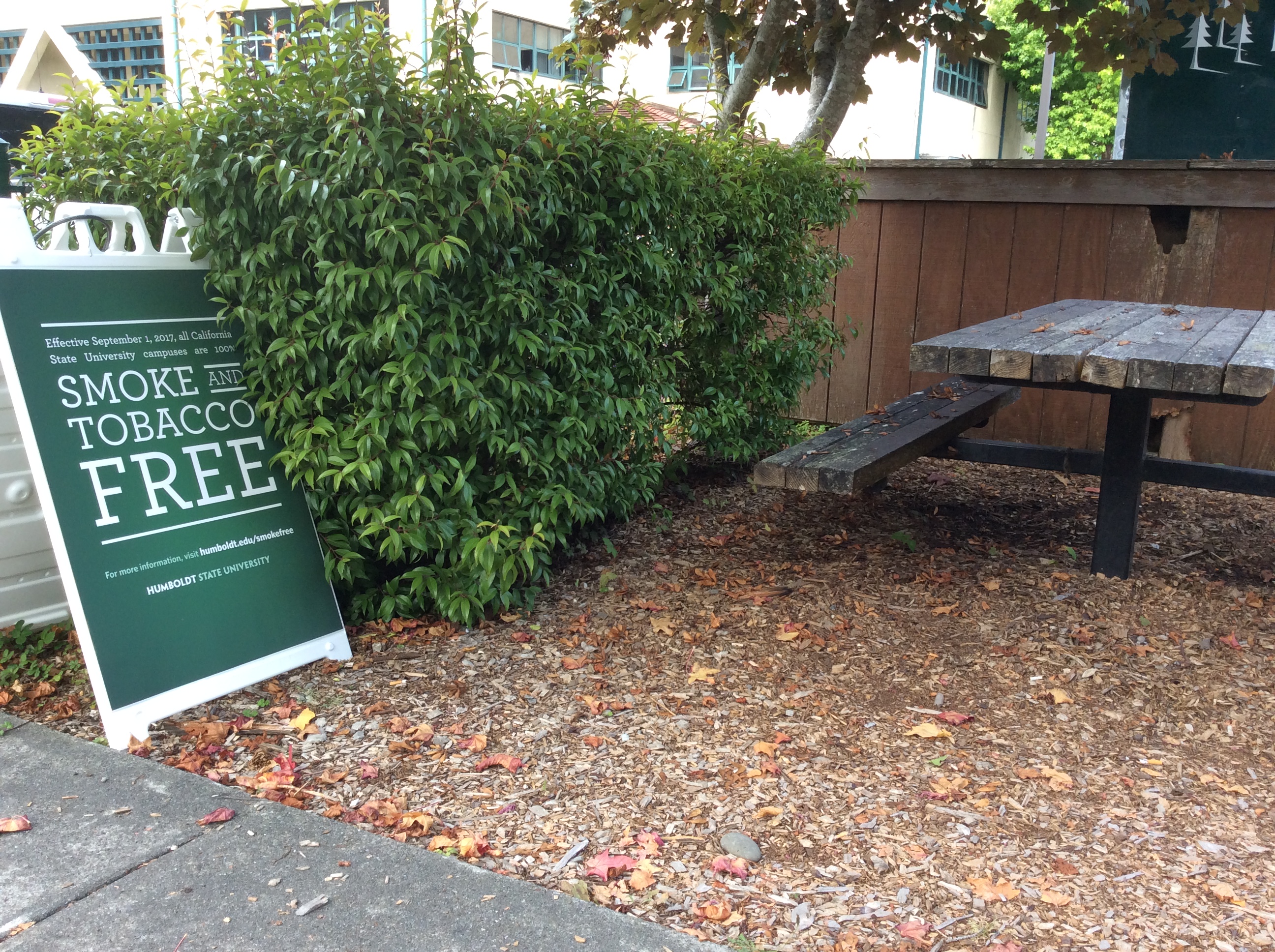
    HSU students should take the campus tobacco ban, roll it up and smoke it. The ban prohibits any tobacco products from being used on campus property. This ban intends to promote air quality and general health, but that comes at a cost.

    The ban means that smokers have to travel long distances to be compliant with city and campus policies.

    HSU student Michael Erickson said, “The campus police say to go about a mile into the community forest, because that’s where it becomes city, not university property.”

    Let’s think about the implications of this from a smoker’s perspective in a hypothetical situation.

    It’s late at night and you’re in your dorm craving a smoke. Instead of heading down to the well-lit gazebo to smoke, you now have to traipse a mile into the community forest. So you suit up, pray the charge on your phone will light your way and head out for a late night hike into the forest alone. This sounds like the beginning of a horror movie!

    “Being by yourself can be kind of sketchy with some of the people out there,” said Erickson. “There are definitely safety concerns.”

    A smoking ban that forces smokers into vulnerable situations like solo night hikes must be revised.

    I can just see the headline now, “HSU student assaulted in community forest while smoking.”

    This is only one unintended consequence of the blanket ban on tobacco. And if there is one unintended consequence, there are certainly others.

    Another consequence of the ban is an increase in loose cigarette butts.

    “People are going to smoke no matter what you do,” said HSU student Marek Halaj. “But now there are cigarette butts all over the place, because people no longer give a shit.”

    This is because without designated smoking areas, smokers have resorted to unconventional locations.

    When asked about the impact of loose cigarette butts, Erickson, who is an environmental science and management major, said “the big thing would be water pollution.”

    Cigarette butts contain concentrations of various chemicals like arsenic, lead, acetone, ammonia and so on. They eventually wash into our waterways after they’ve been flicked on the ground. Those chemicals are then leached from the butts into the water. Let’s be real here, Halaj is right when he says that people are going to smoke no matter what you do. So if we don’t want people putting these chemicals in our lungs, why pass a policy that puts them in our water?

    Where else are students putting their butts?

    “In trash cans,” said Erickson. “There’s more of a fire risk now.”

    All it takes is one cigarette left unextinguished for a campus fire to break out. Additionally, if students need to disguise their smoking, chances are they’ll look for well-covered areas, which means places where a fire could be started. When it’s peak fire season, do we really want students sneaking into the trees where a dropped ember could mean a forest fire?

    So what are the alternatives? The CSU policy is a full smoking ban, so there are none. This means all of these issues will continue to be a reality. Erickson and Halaj both agree that designated smoking areas are a must.

    “Properly placed smoking sections away from major areas shouldn’t be a problem” said Erickson.

    This would ensure that asthmatic students or otherwise have greatly reduced their exposure to smoke while satisfying smokers with designated areas. How we can make that happen is a hard call as the CSU is likely firm on the smoking ban. But I’m a fan of civil disobedience, which speaks loudly. My suggestion? To hell with it. Smoke ’em if you got ’em!


  • Smoke on the water

    Smoke on the water

    The worst of the smoke is over and Humboldt can breathe a little easier.

    “We just put out a public service announcement. The Humboldt Bay Air Basin is in good condition over this weekend,” Chrystal Ales, a representative for the North Coast Air Quality Management District said.

    “Monday’s forecast indicate that smoke conditions will be improving. This weekend is predicted to have cleaner air.”


    The cleaner air is welcome, as the smoky conditions have made many students sick.


    IMG_1099.JPG
    “I’ve been pretty sick the last couple of days, and I don’t know how much the fires been contained. I know it’s all up and down the West Coast, its bad. I’m sure they’re doing all they can but I wish they would maybe try and figure out how to help with the ash because it’s really been bothering me for the last 4-5 days.”
    -Michelle St


    IMG_1100.jpg
    “I think that the wildfire itself is terrible and I don’t like the forest burning, but as far as the smoke goes, I don’t really mind the smoky air or anything. You know, some people talk about the terrible air quality and all that, but I honestly haven’t really noticed or anything. The sun and the moon look pretty cool.”
    -Peter Blickensderfer


    IMG_1098.JPG
    “I know it [the smoke] definitely had an effect on how hot it was on that one weekend where it reached up to 90 I think, which is ridiculous. Actually, it kind of hurt to be outside. One of my roommates is getting headaches, but it might have just been sickness, I’m not sure. I’m not used to this sort of thing, I’m used to volcano smog or fog. Not an actual blanketing of smoke, which is ridiculous to be in, and kind of scary.”
    -Kairos Pacheco