The Lumberjack


Students Serving The Cal Poly Humboldt Campus and Community Since 1929

Tag: spring semester

  • Red Rhododendrons rustle in Spring breeze

    Red Rhododendrons rustle in Spring breeze

    by Nina Hufman

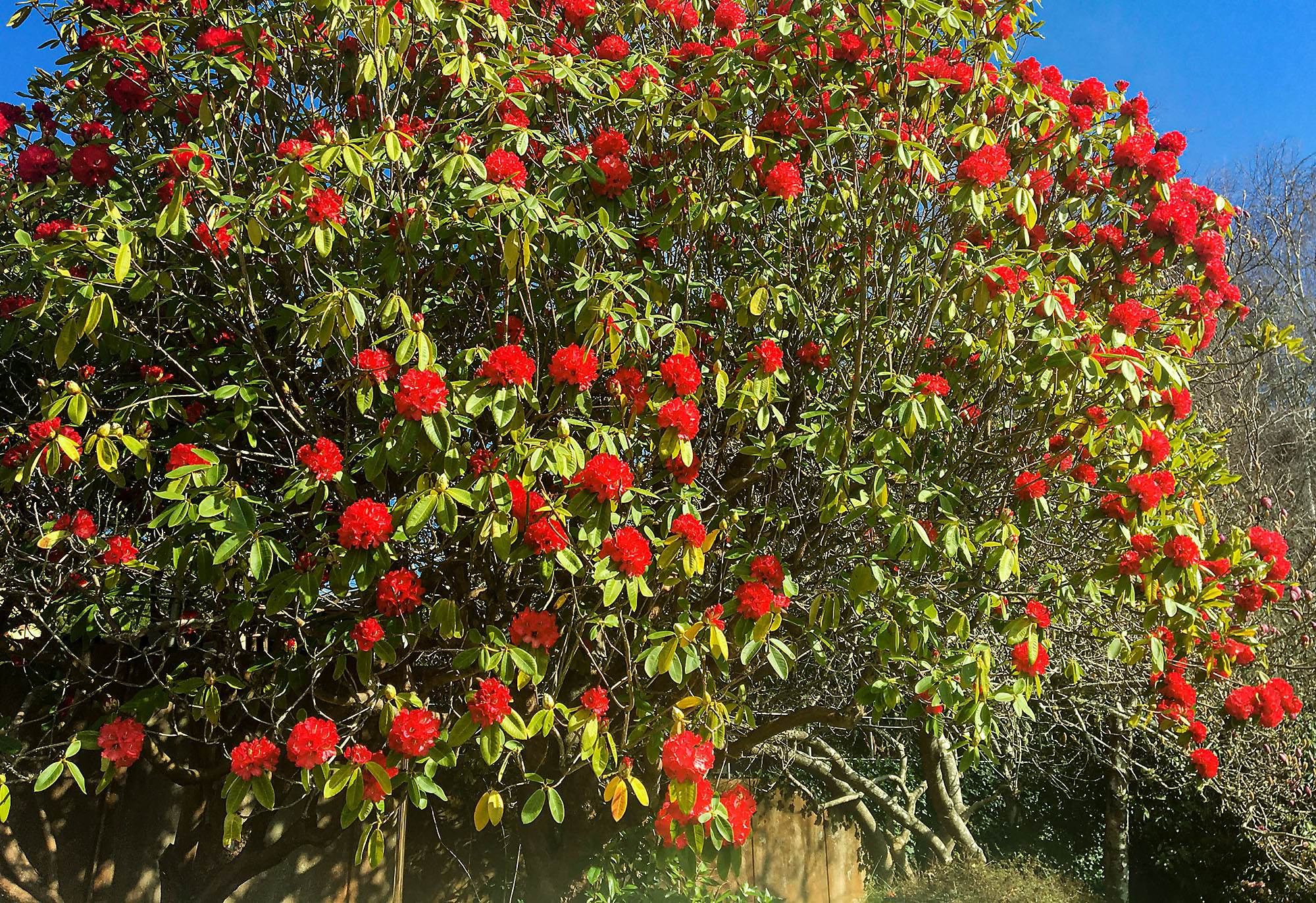
    One of the most noticeable flowers on the beautiful CPH campus is the Rhododendron. The scientific name of this particular species is Rhododendron delavayi. According to the American Rhododendron society, the plants are native to India, Burma, China, Thailand, and other regions of Eastern Asia. This species of tree is identifiable by its bright red blossoms and elliptical-shaped leaves.

    Dense indumentum, or hairlike structures, cover the underside of the plant’s leaves. These help the plant to absorb water and discourage predation by insects.

    Photo by Nina Hufman. Bright red Rhododendron blossoms on the tree between the theatre and art buildings on Feb. 15, 2022.

    Rhododendrons are members of the Ericaceae, an expansive family which also encompasses cranberries, blueberries, and huckleberries.

    Despite the inclusion of these common edible fruits, many other members of this family are known to contain toxic compounds. According to the study ‘Phytochemicals and Biological Activities of Poisonous Genera of Ericaceae in China,’ “the toxic ingredients in the poisonous genera are mainly tetracyclic diterpenes, which exhibit toxic effects on the digestive, cardiovascular and nervous systems.”

    The study also states that these poisonous plants’ traditional use in Chinese medicine makes them a good candidate for further scientific study.

    According to the National Capital Poison Center, honey produced by bees from rhododendron nectar can concentrate the various toxic chemicals. The effects of poisoning by this method include disorientation, mouth irritation, nausea, and vomiting, leading to it’s colloquial name, “Mad Honey.”

    Rhododendron trees can be seen in multiple places on the Cal Poly Humboldt campus including the area between the theater and art buildings, where the above photos were taken. They are considered early bloomers, usually producing flowers from late February to May. Go out while they’re still blooming and enjoy the beautiful, bright red rhododendron.

  • New schedule for spring semester classes

    A look at the spring semester schedule for online and in-person classes

    On Nov. 2, Humboldt State University informed the student body on how classes were going to be conducted in the spring 2021 semester. Classes will start online and move in-person up until spring break, where classes will switch back to online for two weeks before going back to in-person for the rest of the year.

    HSU Provost Jenn Capps says this is essentially the same type of schedule as last year.

    “We landed at probably the same amount of face-to-face time for students, but what we did is that there is probably more hybrid courses that have a little face-to-face component versus more limited full face-to-face classes,” said Capps.

    The biggest challenge was working around spring break in the middle of the semester and planning for the return of students from the break.

    “Folks are gonna wanna go home for spring break and come back and how do we have safe reentry back to campus,” said Capps.

    A question was brought about possible moving spring break to a different time or completely removing it and ending a week early.

    “So I did actually take that question to Senate and to Associated Students and asked their perspective, as well as faculty and staff,” said Capps. “That feedback informed that we should not move it, that we should just leave it where it was. Maybe the only consensus was, please don’t take our spring break away, which I totally understand.”

    Students were uncertain about the schedule but enjoyed some of the safety aspects factored into the decision to start online. Kyra Cherry, a biology major at HSU, is one of those students who appreciated the safety precaution.

    “I think that in the beginning having virtual instruction only, is pretty good especially since we don’t know where everyone is coming from, who all they’ve been around,” said Cherry. “So, I think that’s important.”

    After spring break, the on and off switching between virtual and in-person instruction forces students to adjust for two weeks and switch again.

    “I also think that it’s a pretty decent window of time before the face-to-face instruction,” Cherry said. “But I think that after that, since it starts switching back and forth between virtual and face-to-face, that’s kind of an issue with scheduling with certain students.”

    For Cherry, changes in class schedules as a result of switching between face-to-face and virtual threw off her personal schedule.

    “I had a class where some unfortunate things happened and the course got switched up quite a bit and I had to reevaluate what I was doing for my class, cause I already had my weekly schedule of when I would do what for each class set,” said Cherry.

    Environmental studies major, August Andrews, prefers face-to-face learning and an in-person, social environment.

    “To be honest, I prefer in-person stuff. It’s just the connections you can make and the learning style,” said Andrews. “Personally I’m managing with online classes, they’re not terrible, but at the same time it’s not nearly as preferable in my opinion to in person classes or even some kind of hybrid class.”

    He does have concerns regarding COVID-19 and how it would fare in the winter months.

    “The only concern I share is that, at least from what we know from the Coronavirus that it thrives more in the winter months, but other than that I’m actually really excited about [the schedule] and I do miss the partial face-to-face classes,” said Andrews.

    There are university policies set to catch COVID-19 cases early when students return for the spring semester.

    “Students living on-campus will be required to be tested and students residing off-campus will be encouraged to seek testing if they are returning to Humboldt county for spring (from home that was outside of the county) or if they fail their self-wellness check,” said Capps in an email.

    Capps is very happy with how students have stepped up during this semester and continued to wear masks and socially distance.

    “I’m really proud of how we did and hats go off to our students and our faculty and our staff,” said Capps.
  • Students contemplate not returning for spring semester

    Students contemplate not returning for spring semester

    HSU exclusively reverts back to online instruction on Nov. 9 and students aren’t happy

    As Humboldt State University transitions back to exclusively utilizing online instruction starting Nov. 9, students return home for the holiday season. Traveling students are faced with the difficult decision to return to campus for the spring semester.

    Diego Celis is a cellular molecular biology major with two semesters left until graduation. Celis has off-campus housing and a kitchen job in Humboldt. He expects to return for next semester after spending the holidays with family.

    “I think my biggest incentive [to come back] is definitely just to have my freedom up here,” Celis said. “I do have family back home, but I can’t move back home because I have a dog and my family is all split up, so there’s not really anywhere that I can move back to.”

    Online instruction had a significant impact on Celis’ education which reflected most prominently in his grades. He felt online learning created a disconnect between lecturers, students and information retention.

    “I hate it. I hate it so much,” Celis said. “It’s not immersive. It’s pretty disconnected. They’re just sending you information and your absorbing it all as best you can, kind of teaching yourself.”

    Judith Escobar, a zoology major, originally decided to come to HSU because of its positive reputation regarding hands-on learning. Escobar has found online learning especially obstructive to her education and lab work.

    “I can’t really learn how to work with the tools and the instruments correctly,” Escobar said. “Right now, for chemistry and biology I’m just looking at my professors doing the lab and it doesn’t really do me any justice.”

    Diego Naranjo, freshman at HSU, lives in the dorms. Naranjo feels the greatest impact from online learning on the lack of social interaction with classmates.

    “Online has been pretty tough,” Naranjo said. “I think socially, I kind of depend on going in class and having a different setting, so that’s been really difficult.”

    Without any in-person classes this semester, Naranjo feels disappointed in the college experience currently offered by HSU.

    “I kind of thought there would still be activities that are encouraged,” Naranjo said. “I just wish there was more stuff going on.”

    Despite the experience falling short of Naranjo’s expectations, the times he spends mingling with like-minded learners, makes him grateful he choose to come to Humboldt.

    “My head space has changed and my mentality towards school has changed a lot,” Naranjo said. “Being up here has definitely changed my perspective on a lot of stuff that I don’t think I would’ve had, had I stayed in my hometown.”

    Naranjo plans to return to Humboldt in the spring, after heading home for the holidays.

    “[Learning online] really taught me how valuable in-person stuff is and human connection is,” Naranjo said. “I don’t think this is gonna end any time soon, so I just hope that the school gets better at moving with it, rather than kind of waiting it out for things to go back to normal, which it seems like is happening right now.”

  • International students first few days in the U.S.

    International students first few days in the U.S.

    As the spring semester approached, Humboldt State University welcomed new foreign exchange students. Archana Nihalani from Pakistan and Gereon Ploenes from Germany are two of the new incoming students. Nihalani came from Hyderabad, a city located in the Sindh province of Pakistan, and Ploenes came from Nijmegen, a city in the Dutch province of Gelderland where he resides. Both had stories to tell about their first few days in the U.S. before the spring semester started.

    Nihalani thinks that people are too polite.

    Archana Nihalani from Pakistan. Photo by Ahmed Al Sakkaf

    “People here say thank you a lot and sorry a lot,” Nihalani said. “A lot of times and I’m not used for this.”

    Saying thank you and sorry too much is considered a very formal behavior in Pakistan, according to Nihalani. It may mean that a person has too many boundaries.

    “Here [U.S.], if you don’t say ‘thank you’ or ‘sorry,’ it’s rude,’ Nihalani said. “But there [Pakistan], it’s rude if you say ‘thank you’ and ‘sorry’ all the time, because it means that you’re being too much formal.”

    Nihalani described food to be her worst struggle. She thinks the food here is too plain and lacks flavor.

    “Food here is plain,” Nihalani said. “I’m not used to eating plain food with no flavors… it’s too plain. In Pakistan, we put so such spices in food, so many flavors.”

    Nihalani thinks that people here in the U.S. have more personal space than their counterparts in Pakistan. She also notices that people here are easily offended.

    “People here [U.S.] have so much personal space and there [Pakistan] we don’t have so much personal space,” Nihalani said. “Everything here offends people I don’t know why? They get offended very easily.”

    Ploenes from Germany residing in the Netherlands. Photo by Ahmed Al Sakkaf

    “The first impression I had of the U.S. [is] that it’s exactly like the movies,” Ploenes said. “The J cafeteria and how it works… it’s really like the High School Musical.”

    To save money on his flight, Ploenes flew to San Francisco International Airport and took the Greyhound bus to Arcata. He was surprised when a Greyhound worker asked him several times if he is carrying any guns in his oversized backpack.

    “The guy working in the Greyhound asked me five times if I carry guns in my big backpack,” Ploenes said. “It’s not normal to carry any guns in Europe. You’re not allowed to. But in America, guns are normal.”

    Ploenes was also surprised by the amount of “big cars” and pickups he found in the streets here.

    “I’m not used to seeing a lot of pickups and a lot of big cars. Why [do] people need these big cars?” Ploenes said.

    Ploenes noticed that the toilets here in the U.S uses a lot of water to flush and they have a lot more water in their bowls too.

    “Toilets are totally different here,” Pioenes said. “You use a lot of water to flush.”

    Both Ploenes and Nihalani think that people here are very kind.

    “I was surprised with how friendly the people are,” Ploenes said.

    “People are really nice here,” Nihalani said. “They’re very helpful.”


  • Word on the Street: What students look forward to this semester

    Word on the Street: What students look forward to this semester

    Name: Dalvin Jamal-Milton

    Major: Psychology

    Standing: Sophomore

    “One thing that I’m looking forward to is this rugby season. Our rugby team looks pretty good this year, and I think we have some really good chemistry… we have all the means to do well.”

    ——

    Name: Seth Velasco

    Major: Kinesiology

    Standing: Freshman

    “I’m looking forward to starting off a little better than I did last semester now that I know what I’m doing. I struggled a bit in the beginning of last semester. Now that I know what I messed up on last semester, I can fix it.”

    ——

    Name: Rebecca Bantum

    Major: Psychology

    Standing: Freshman

    “I’m looking forward to taking different classes that I didn’t take in high school. Here in HSU, there’s a lot of options. I’m looking forward to pick what I want to take.”

    —–

    Name: Cailyn Lien

    Major: Cellular Biology

    Standing: Freshman

    “I’m looking forward to learning more stuff about my major. I’m probably going to start working at a blood bank and hospitals to learn more about human biology.”

    —–

    Name: Mei Shimizu

    Major: Child Development

    Standing: New transfer student from Japan

    “I’m excited to take classes about child development. This is what I wanted to learn from before.”

    —–

    Name: Akane Yajima

    Major: Francophone Studies

    Standing: New transfer student from Japan

    “I’m excited to learn about Francophone studies in the English language.”