The Lumberjack


Students Serving The Cal Poly Humboldt Campus and Community Since 1929

Tag: SQE

  • Students and faculty rally against tuition hike 

    Students and faculty rally against tuition hike 

    by Jake Hyslop

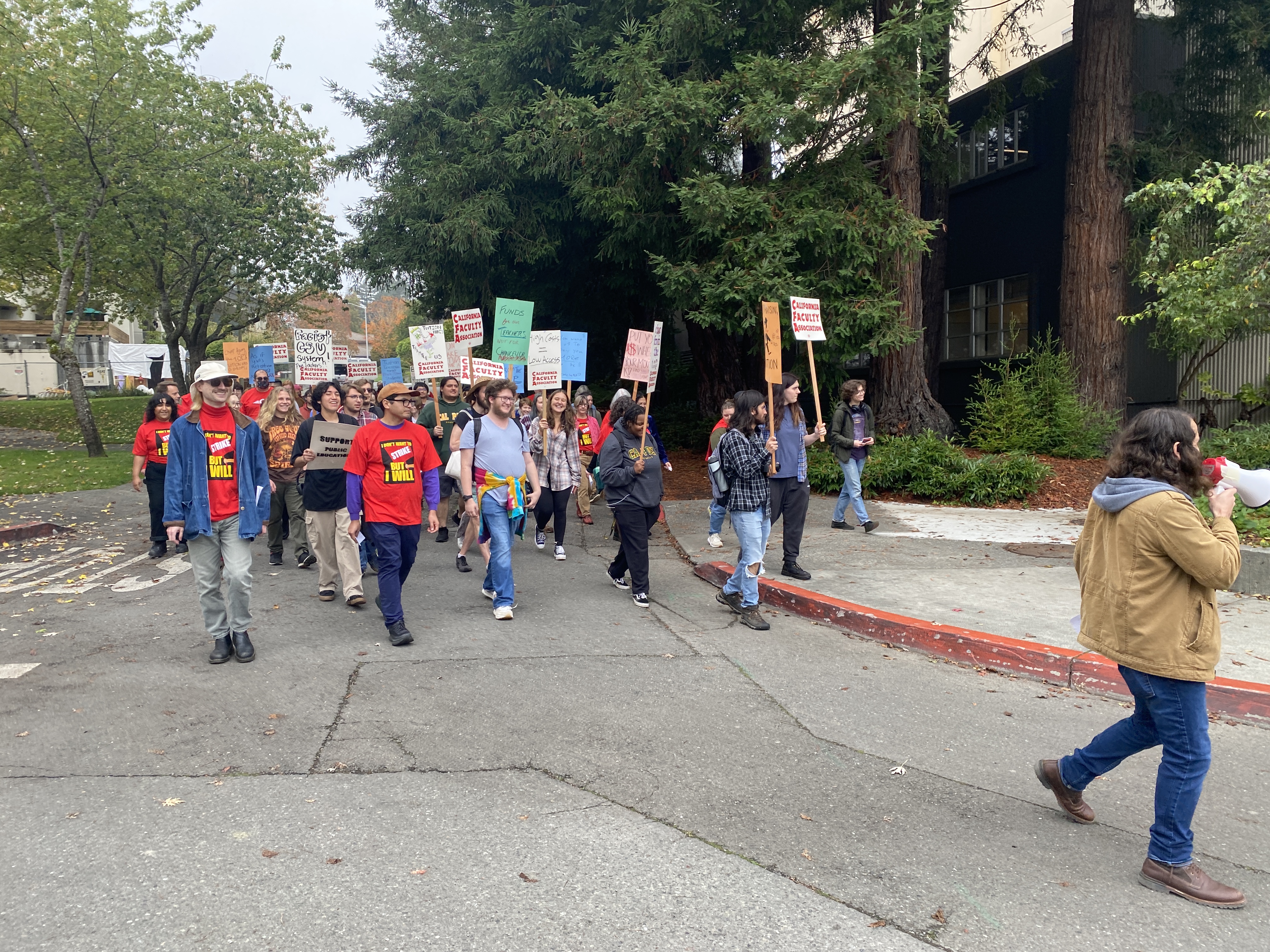
    On an otherwise unremarkable foggy Thursday morning, students and faculty alike met on the main Quad at Cal Poly Humboldt in order to protest the vote to raise tuition by the CSU Board of Trustees. Signs adorned with, “don’t make students your ATM” and “stop targeting education,” were taped to walls and held by protesters. 

    As the weather began to heat up, so too did the rally. Cries of, “chop from the top” and “education is a right,” rang out across the campus. 

    The event was organized by the Students for Quality Education (SQE) and the California Faculty Association (CFA), as well as by the Students for a Democratic Society (SDS). Other groups showed up to speak, including the Critical Race, Gender, and Sexuality (CRGS) Club and the CSU Employees Union (CSUEU). 

    The rally was held in response to the Sept. 13 vote by the Board of Trustees to raise tuition 6% every year for the next five years. CSU defended the vote by pointing to inflation increases and a relative lack of tuition rate increases; the Board of Trustees deemed it a necessity. 

    “We know [administration] can pull from their own salaries and they have reserves they can pull from,” Zoe Reed, a third-year CRGS student and intern for SQE said. “But instead, they’re putting that on us, the people who work here and are learning here, who can’t afford that.” 

    Many speakers at the protest, including Mary Mangubat, a third-year environmental studies student and SQE intern, called for the CSU to rely on the reserve money they have to account for inflation and rising costs rather than taking it out of the students’ pockets. 

    “The CSU has $8.8 billion in reserves that they do not want to touch because they said that they only pull out that money when there’s financial uncertainty in time,” Mangubat said. “What the hell are we in right now?” 

    Mangubat cited the pandemic and the student organizations struggling under the recent Associated Students budget cuts due to low enrollment numbers as criteria befitting a time of uncertainty. 

    Another common complaint was the amount of money CSU administrators were paid relative to the income and costs suffered by students and faculty. President of the CFA Humboldt Chapter Marisol Ruiz weighed in and called for the current Board of Trustees to be fired. 

    “I think it’s just terrible that we have faculty here that make as much as someone’s housing and car allowances,” Ruiz said. “We need equity, and we need people that are responsible to the people to be part of the Board of Trustees.”

    Rick Toledo, an environmental science major and one of the main organizers of the event as a representative of SDS, led many of the chants at the rally before providing a speech of his own. 

    “Think about the weight of a billion dollars,” Toledo said. “They have over 12 of those in their budget. Yet they can’t pay faculty and staff? Yet they have to use students as their ATM? I call BS.” 

    Toledo explained how the administration has sewn a narrative of discord between faculty and students, pitting them against each other to cover for themselves. He went on to say that the CSU is lying in their reasoning for not using the reserves available to them. 

    “In reality, the reserves have been built up to boost their credit so they can borrow more money for more capital investments on projects,” Toledo said. “They’re basically turning the entire thing into a hedge fund with education as the front.” 

    Some students expressed skepticism over the success of holding a rally. Gavin Martin, a theater arts student, questioned how successful a protest against administration sanctioned by administration can be. He likened it to the housing protests during the Spring 2023 semester. 

    “After the protest, we all went to look for homes individually,” Martin said. “We were supposed to be in this together.”

    Mangubat announced the rally’s list of demands for the CSU through a megaphone. The first was to end the tuition hike and take money from the reserves. The second was for the administration to stop relying on students to fund student programs. The third demand called for higher wages for faculty, staff and student workers. The fourth demand called for funding for programs that provide resources for basic needs such as housing, food and mental health resources. Sufficient funding for cultural centers for marginalized communities was the final demand. 

    ‘If we are not heard, we will continue making noise,” Toledo said. “We will continue to be loud until we are heard.”
  • CFA gets the word out on the quad, announces rally

    CFA gets the word out on the quad, announces rally

    by Hank Wicklund

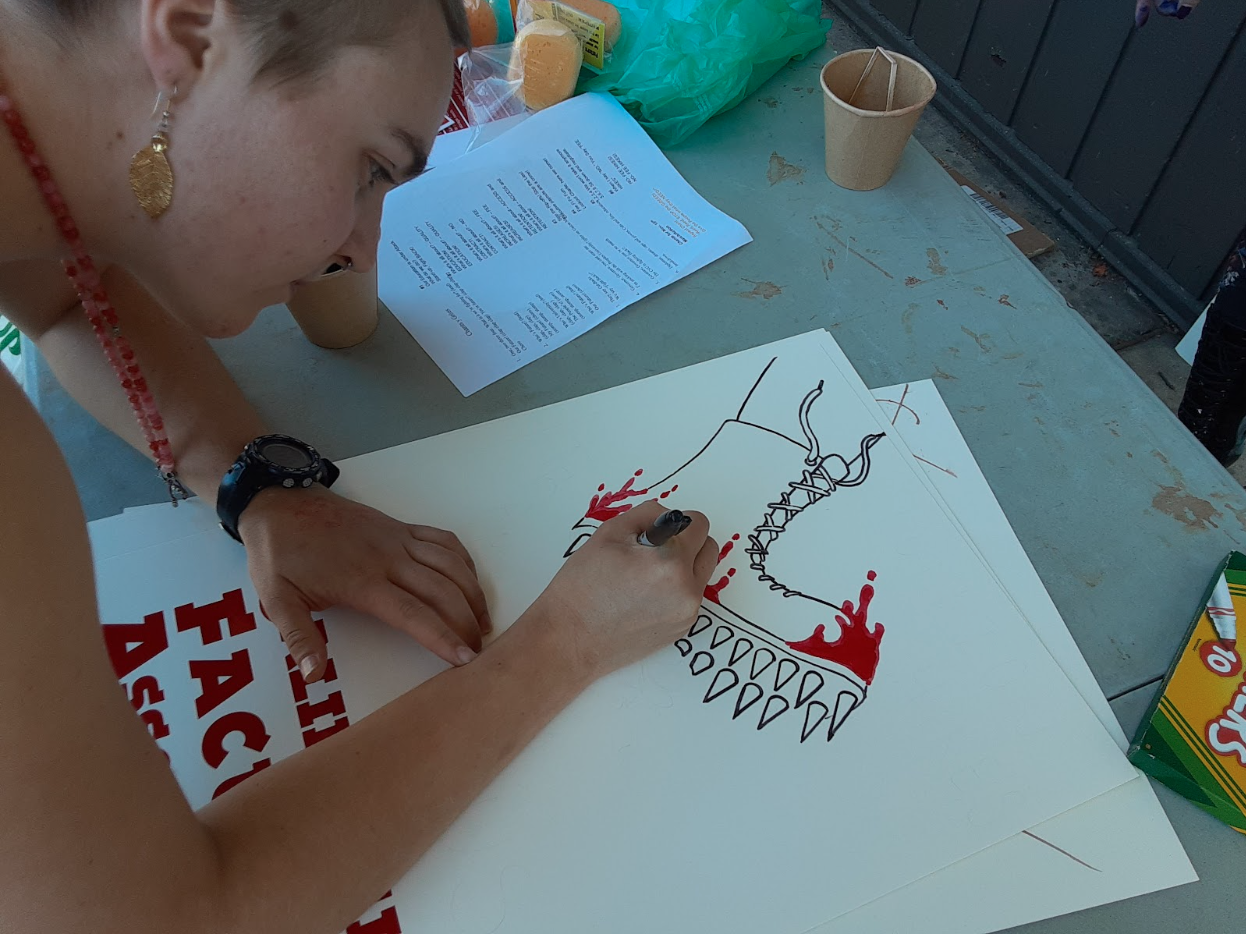
    At midday on Thursday Oct. 5, a student hunched over a table, drawing a spiked boot splattered with blood, the front of Art B plastered with posters behind her. Phrases like, “Don’t make students your ATM,” and “Shame on you, CSU,” stood in stark contrast with the dark wall. A clear voice rang across the quad below, calling out to passersby. The air buzzed with the day’s unusual heat, becoming charged with urgent words and the smell of free coffee, drawing the eyes and noses of students to three folding tables, specifically the people behind them. 

    These were organizers from the California Faculty Association – the labor union for CSU faculty –  and the Students for Quality Education, a student-led organization for education rights across the CSU system. They were there in response to the CSU Board of Trustees’ vote to raise tuition. This demonstration was also intended to promote the CFA’s upcoming rally on Oct. 19, where they plan to protest further. People were encouraged to enjoy refreshments, grab union merch and help make posters. Among the organizers present was Humboldt CFA President Marisol Ruiz.

    “We’re forgetting that this is a public university, publicly funded. It’s not a private institution and we need to stop treating it like a private institution,” said Ruiz.

    Ruiz explained that the CFA’s goals are a halt on tuition hikes as well as better pay and working conditions for faculty. This protest comes on the heels of long-standing grievances regarding what the CFA says is inequitable pay for faculty. According to Ruiz, the CSU has the money to fund education and pay its employees fairly without the need for tuition hikes, yet has strayed from the path of education as a public good. 

    A board bearing the words, “How Much Do You Owe?” was propped up against a planter in front of the tables. Students had scrawled their answers, the numbers going as high as $100,000.

    Also present behind the tables was SQE chapter head Mary Mangubat. According to Mangubat, outreach by the SQE has been quite successful this semester at getting people engaged, because the tuition hike affects not only students but the entire CSU ecosystem.

    “When they hear our admin makes a million a year, but students are in 100k debt,” said Mangubat. “They’re gonna want to be involved.”

    SQE was founded in 2008 as part of the CFA and holds weekly meetings Fridays at 4 p.m. in Nelson Hall. Mangubat described them as fighting for an equitable, accessible education that is free from discrimination and debt.

    Making a poster at one of the tables was Erika Ospenson, an environmental science and management major. Ospenson only found out about the outcome of the Board’s vote that morning from a friend in SQE and is now left with doubts about the cost of her education. She plans on attending the rally on Oct. 19 and is interested in getting more involved with SQE.

    “Something I learned today is that I will get halfway through a degree and then not know if I can actually finish it because of the tuition hikes,” said Ospenson. “I’m already barely making ends meet and [only] able to pay my rent in a rent-controlled situation.”

    The tuition hike has rattled the CSU system here and across California, but chapter president Ruiz believes that students and faculty are in this together.

    “Working conditions equal better student conditions, student conditions equal better working conditions,” Ruiz said.

  • CSU Unions bargain with Chancellor’s Office; California Faculty Association considers going on strike

    CSU Unions bargain with Chancellor’s Office; California Faculty Association considers going on strike

    by Andres Felix Romero and Emma Wilson

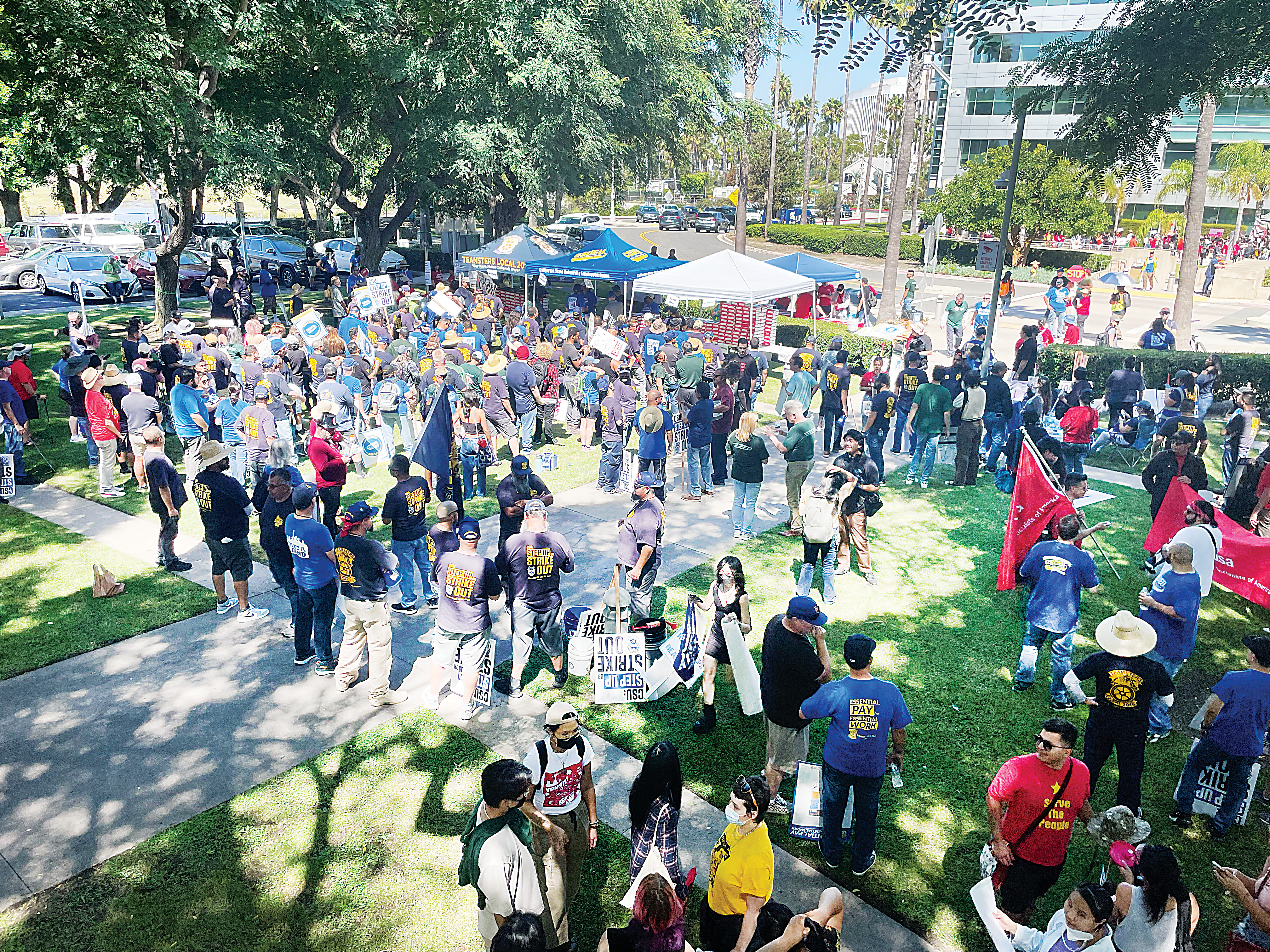
    Hundreds of miles from Humboldt county in Long Beach, dozens of people are rallying against the decisions of the Chancellor’s and the Board of Trustees that hold the fate of our communities’ future outside of the headquarters of the California State University (CSU).  

    What the CFA is fighting for

    The California Faculty Association (CFA) is one of six CSU Unions present across the 23 campuses. The CFA focuses their support on staff that work directly with students such as lecturers, coaches, and counselors. 

    The other unions are the CSU Employees Union (CSUEU) who support staff that provide essential services to students such as those in admin, the Union of American Physicians and Dentists, Teamsters Local 2010 that supports skilled trade workers such as painters and carpenters, the student union UAW 4123 and finally, the Academic Professionals of California (APC) which provides support to campus staff that work with students outside of the classroom such as financial aid and residence life.

    Currently, the unions are collectively bargaining, and they are fighting for many of the same things. The CFA is campaigning on two main fronts, better wages and financial compensation, as well as better workloads and support to faculty

    Wages

    The CFA is asking for a 12% general salary increase. Cal Poly Pomona CFA member and associate professor of Political Science Marc Scarcelli reasons that although a 12% increase may seem like a lot, it’s essential to keep wages fair as the inflation rates increased 8% since the last bargaining session between the CFA and the CSU.

    “If your wage increases don’t keep up with inflation, your wages are actually going down,” said Scarcelli, “and so if you think about it, we have to threaten the strike just to break even if we’re not actually fighting for more. We’re fighting just to break even. We [got a 3% pay raise] at a time when inflation was over 8%. What we got is effectively a pay cut.” 

    The CFA is also hoping to raise the salary floor for lecturers. Chief Steward of the Humboldt APC Chapter Tania Marin-Zeldin feels that this proposal is needed to help faculty with their standard of living.

    “To hear that some of our members have two jobs because they can’t afford to have a decent living and provide for their families, that’s the sad part,” Said Marin-Zeldin. “We shouldn’t have to have two jobs. We shouldn’t have to be barely living, paycheck to paycheck.”

    Freshman Evaluator and Union Representative of the APC Sierra Farmer hopes that having more competitive wages could help with retention of workers within the CSU system. She explains that because of what feels like unfair wages, many CSU workers, including alumni, leave because they can’t live comfortably with the wages provided.

    “We lose good employees in the Cal State system,”  Said Farmer. “We have lower wages than the UC’s and the community colleges. So we lose really good people to the other systems all the time because they don’t make a living wage.”

    Another financial goal to increase fair wages and combat inflation resulting in pay cuts, is the unions fighting for yearly step-raises within the CSU system.

    Better support for staff and faculty

    To also help with retention rates for faculty and staff, especially counselors, Professor and CFA President of the Humboldt Chapter Marisol Ruiz notes that better policies surrounding tenure and more long-term contracts can help with the feeling of stability for employees.

    “We want [counselors] to get three year contracts,” said Ruiz. “When you’re in a [year-long contract], you’re in a precarious situation. You don’t know if you’re getting your job back or not, so people sometimes don’t want to stay. We’ve had a hard time getting good counselors to stay. We need to offer them better [contracts], where they will be more likely to stay due to better conditions.”

    On top of contracts, the unions want there to be more fair workloads for faculty, as well as better ratios between students and faculty. Ruiz remarks on the importance of a healthy ratio between students and faculty.

    “We want to give [students] more attention,” said Ruiz. “We want to lower class sizes, and focus on [student’s work]. But the [CSU] just wants to cram everybody in. The more care that we have for our students, the better they will do in their classes and the more effective they will be as [learners] and we want that. ”

    Beyond workloads and wages, the unions are also wanting to ensure more gender equity on campuses by providing bathrooms and changing facilities that people can feel safe with no matter their gender. They also want better paid parental leave and more lactation stations for parents across campuses. 

    Process of Union Bargaining and Current State of Negotiations

    Every few years, each of the unions on the CSU campuses reopen their contracts with the CSU to bargain. This year’s cycle is unique as it was delayed due to COVID, and instead of bargaining in a staggered way, every union is negotiating their contracts at once. As of the writing of this article, every union aside from the CFA is still at the bargaining table. The CFA has declared an impasse with the CSU since they did not come anywhere close to an agreement, and has moved onto the fact-finding stage. Faculty Rights Chair for the CFA Humboldt Chapter and Lecturer in the Philosophy Department Loren Cannon explains the process

    “Fact finding is where [the CFA] and [the CSU] produce information and argumentation as to why our proposals are good. [The CSU] will probably try to produce information that says, ‘Oh, we just can’t afford it.’ [The CFA] will produce information that says, ‘well, actually, you can.’ We could go back to bargaining somewhere in the middle here, but if we don’t have any agreement at that point, there might be collective action.”

    If the mediation following the fact finding stage again fails, the union can then vote on to take action, such as a strike. If the CFA does decide to strike, it will likely be in early November as of the time of writing this article. Scarcelli notes that a few within the CFA are looking forward to a chance to strike.

    “In terms of willingness to strike, I talked to a lot of my colleagues and honestly, they’re not just willing, they’re eager,” said Scarcelli. “Colleagues all over the place are chomping at the bit like, ‘when do we get to strike,’ because they’re pissed. They’re just furious. You know, when our incomes are effectively going down. And then we keep seeing that they give appalling raises to university presidents and the Chancellor.” 

    CSU Response

    In a video message and written statement from interim Chancellor Jolene Koester, she affirmed that the CSU is committed to fair pay and compensation for faculty and staff. The CSU has proposed a salary step structure for faculty and staff in the CSU’s to reach 12% over three years, however the increase will be 5% in the first year. The CFA has rejected this and declared impasse following the offer. The CSU leadership say they will be challenged to meet the proposals of the CFA and other unions throughout the CSU.

    CFA flyer

    Why Faculty are Fighting

    With the CSU rejecting some of the union’s requests, many within the union are becoming more frustrated, especially with the wages that the CSU higher-ups and presidents are making. Ruiz notes that on average, after the average CSU president’s salary and allowances for their car and housing, they generate more income than the governor of California.

    “I do not think it is acceptable for us to have a housing allowance for anybody who’s making $300,000. it’s not right, when our students are homeless and are living in cars, and we don’t even pay a living wage to lecturers,” said Ruiz. “ How [is the CSU] getting all this money for car allowances? How are you getting a housing allowance? How are [CSU presidents] being provided for? And our students are not? Your job is not as important as the governor of California, let’s put back the money where it needs to go.”

    Farmer also notes that her yearly wage barely compares to Humboldt President Jacskon’s yearly housing allowance

    Overall, the unions and their members such as Scarcelli are working towards better compensation and working environments to continue supporting students in their journey of creating a better future for themselves.

    “We do what we do because we love education,” said Scarcelli. “We love our students. It would pain me to skip classes, but I will, and I find most students are very receptive to our cause.”

  • Students for Quality Education statewide Abolitionist Meeting

    Students from different CSU locations demanded changes and ideas on how to accomplish them

    Hosted on Zoom Fri., Nov. 13 by Faith Garcia from California State University San Marcos, SQE held a statewide abolitionist meeting.

    The meeting consisted of 65 students from different locations within the CSU system. The meeting began by going over the Key Principles of Freire to discuss popular education, including learning from social realities to make actual change, the importance of respect and dialogue and actually committing to change.

    Adela Gutierrez-Diaz, a CSU student leader, expressed the need to be aware of an injustice and the call to action.

    “Start with issues that carry fear, anger, sorrow, hope,” said Gutierrez-Diaz.

    The discussion examined how to build a new future, to make a difference and accept that emotions will come into play. For this reason, dialogue is even more important and needs to stay open and available.

    “Everyone can learn from each other,” Gutierrez-Diaz said. “Folks have different perspectives rather than more knowledge.”

    Students should search for solutions considering both fact and emotion, as well as reflecting on what had occurred and what could be learned and made better.

    “Use what you learn to change the world because we truly have no choice at this point,” Gutierrez-Diaz said.

    The discussion began with things students had seen from police within their own lives, or through others, and why they hated them.

    They shared instances of mistreatment of the LGBTQ+ community, watching family being unfairly treated or killed, or the way police profile and target communities differently.

    “They treat people like they’re straight up above everyone,” said Andy Aleman-Alvarez from CSU Los Angeles.

    This led to other issues, such as problems within their own communities. Many expressed homelessness as a main problem. Arcata and the HSU community also consistently struggle with homelessness.

    Students mentioned getting School Resource Officer’s out of schools, the access to healthcare and its expenses, prison and unfair treatment, and student debt.

    “I already have debt for my graduate degree,” said Silvia Angulo from CSU Los Angeles.

    Students were not just speaking about issues but finding ways to address problems and plan to do something about it, talking specifically about the risks associated with being outspoken.

    “You need to be willing to lose something,” said Louise Barros from CSU Stanislaus.

    Reforming institutions founded on white supremacy was a heavily discussed topic. The goal moving forward is creating alternative systems and finding other ways for the people to do it themselves.

    “Power can come from all of us supporting one another,” said Nia de Jesus from CSU Stanislaus.

    Led again by Guterriez-Diaz, students engaged in group grounding exercises to calm down after the discussion. Instructed to put their feet on the ground, relax their jaw. loosen their shoulders and breathe in peace, breathe out justice.

    “These conversations can make you very tense very fast,” Guterriez-Diaz said.

    After the grounding exercise, three breakout rooms were created where students could reach out to the Campus Contact, CSU Board of Trustees or State and Local Governments. Contact information and scripts were provided to aid students, as well as access to graphics that could be posted on their social media.

  • Letter to the Editors

    Letter to the Editors

    SQE students demand disarming campus police as part of statewide campaign at Board of Trustees

    Starting at 10:00 am on March 19th, members of the Students for Quality Education will be advocating for disarming campus police and security along their peers at the Board of Trustees meeting at the Office of the Chancellor in Long Beach, California as part of their “No Harm, Disarm!” campaign. The demand is one of many to address student safety on campus, which also includes working to create community-led crisis intervention and response teams, investing in more mental health counselors and supports, investing in Black resource centers and other cultural centers, mandatory de-escalation and unconscious bias training for all campus police and security, and more.

    Members of the campus and local news media are invited to attend:

    Board of Trustees meeting/March 19th at 10:00am

    Office of the Chancellor/Long Beach

    Office map with parking information: https://www2.calstate.edu/maps-and-directions-to-chancellors-office

    Members of the Students for Quality Education will be at the meeting.

    Following the meeting, SQE students will be available to speak to media and reporters.

    BACKGROUND

    We want ALL students to feel safe on our campus. Instead of funding more firearms and officers on our campuses, our CSU’s should be investing in proactive and preventative solutions, like more mental health counselors and cultural centers for students.

    Regardless of how students react to police, campus police officers should undergo mandatory de-escalation and unconscious bias training to adequately deal with situations regarding all students. We recognize the over-policing of black and brown students and demand our CSU work with communities to explore alternatives to police and find solutions to police and student disparities. We want our schools to start adopting restorative justice practices to redefine what justice looks like in our communities, focusing less on punishment, and more on healing and repairing harm.

    More information about our “No Harm, Disarm!” campaign and our demands can be found here: http://csusqe.org/noharmdisarm/

    ABOUT STUDENTS FOR QUALITY EDUCATION (SQE): Students for Quality Education was formed in the 2007-2008 academic year by students in the California State University (CSU) system to build the student movement for educational rights in public higher education. They are assisted in their efforts by the California Faculty Association. For more information about SQE and information about chapters, go to http://csusqe.org.

    For more information contact: ealcantar@calfac.org