The Lumberjack


Students Serving The Cal Poly Humboldt Campus and Community Since 1929

Tag: Student Health Center

  • HSU Health Center Remains Open

    HSU Health Center Remains Open

    Students on campus can still reach out to medical services

    The Humboldt State University campus is closed to the public, but the Student Health Center expects to remain open for the remainder of the semester to help any students remaining on campus. The health center is limiting face-to-face contact as much as possible, but is still helping students without physical appointments when possible.

    “We’re doing everything we can to help minimize the risk of exposure for students and Student Health and Counseling staff by limiting as much face-to-face contact as possible,” HSU Director of News and Information Aileen Yoo said. “For emotional support, for instance, students can talk to a CAPS counselor over the phone and, in most cases, if preferred, Zoom.”

    The Health Center is still offering other essential services like prescription refills and COVID-19 testing.

    “For those who are sick or suspect they have COVID-19, we have urged them to call before visiting the health center,” Yoo said. “When it comes to COVID-19, our main focus is assessing the student and collecting swab samples if we think that’s necessary.”

    “It is normal to have ebbs and flows with your mood and productivity levels but if you get “stuck” in a dark space for an uncomfortably long time, consider reaching out to get help such as from a counselor at CAPS.”

    Jennifer Sanford, director of Counseling and Psychological Services and associate director of student health and wellbeing

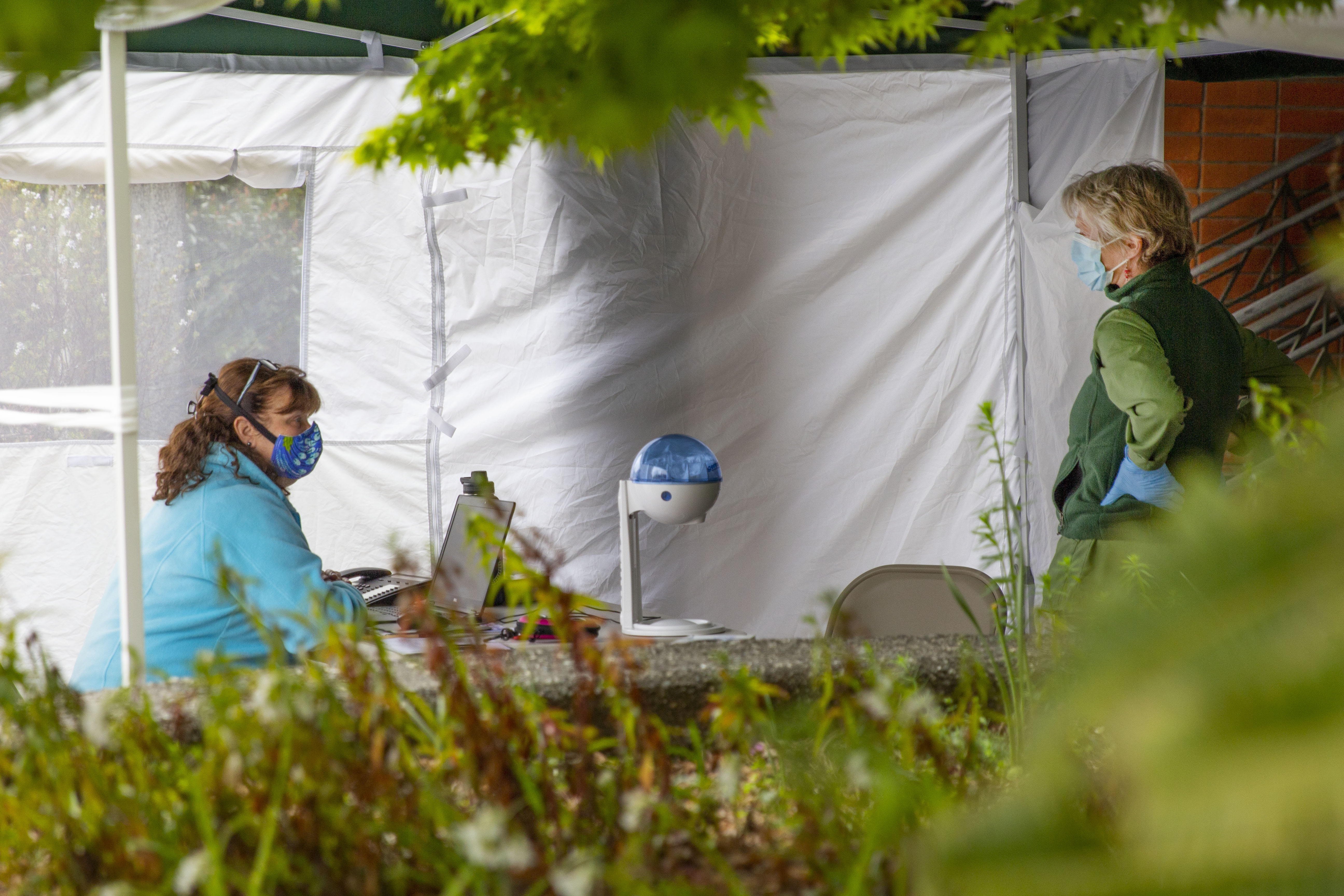
    The Health Center set up white triage tents in front of the building to help students check in and get assessed. If a student tests positive for COVID-19, the Health Center will work with county health services to make sure the student gets the treatment they need.

    During a pandemic, the disease itself isn’t the only medical problem facing students. The Center for Disease Control warns the stress of a pandemic can cause or worsen mental health problems, and recommends calling a health care provider if symptoms persist.

    The Director of Counseling and Psychological Services and Associate Director of Student Health and Wellbeing Jennifer Sanford asked students to consider reaching out to Counseling and Psychological Services if they feel their mental health is deteriorating.

    “Pay attention to how your thoughts and attitudes in any given moment are impacting your mood and overall wellbeing,” Sanford said. “Talk with others, connect. It is normal to have ebbs and flows with your mood and productivity levels but if you get “stuck” in a dark space for an uncomfortably long time, consider reaching out to get help such as from a counselor at CAPS.”

    Sanford said that this can be an uncertain time, but it’s important to see social distancing as community care.

    “The reality is that in our physical distancing, we are displaying compassion and care for our elderly and medically compromised,” Sanford said. “We are allowing our healthcare system to better manage the flow and care of patients, and we are caring for ourselves by lessening our own risk.”
  • Telehealth Looks to Fill Gaps Left by Pandemic

    Telehealth Looks to Fill Gaps Left by Pandemic

    Telehealth has a chance to make a name for itself in the US

    Many physicians and patients aren’t likely to want to or be able to do face-to-face appointments for now and into the foreseeable future. In the midst of this, a potential solution lies in telehealth.

    Telehealth—also known as telemedicine—involves the interaction of medical practitioners and patients through virtual means. Doctors and other physicians can attend to more serious matters in-person while remotely prescribing and treating other, less critical patients.

    “I think people are gonna be more and more open to going to the doctor full-time via telehealth if not doing a follow-up visit. I think that we’ve made more progress in the last six months than we have in the last six years and I think it’s only gonna go this way forward.”

    Jacob Horn

    Jacob Horn is the managing director at Vivo HealthStaff in Dublin, California. A Humboldt State University graduate, Horn now contracts with various medical clinics and offers immediate telehealth solutions for more rural communities. He projected a lot of growth for telehealth.

    “Before this COVID-19, it was very meager, to say the least—it was underutilized,” Horn said in a phone interview. “I think people are gonna be more and more open to going to the doctor full-time via telehealth if not doing a follow-up visit. I think that we’ve made more progress in the last six months than we have in the last six years and I think it’s only gonna go this way forward.”

    Horn detailed what he sees to be the benefits of telehealth.

    “I think it will address provider burnout,” he said. “I think it will increase patient satisfaction because now they have a wider access of care. I think it will also make the insurance companies happy because follow-up visits might not cost them as much. But also, the patients will see, hopefully, a savings by seeing their doctors at home for low-acuity visits.”

    Kate Schiff, a physician assistant in the HSU Student Health Center, is trying to incorporate telehealth into her practice in a multitude of ways.

    “For the most part, we are utilizing the phone for triage, evaluation of new problems, and management of existing problems and conditions,” Schiff wrote via email. “We are also managing most of our medication refill requests this way.”

    Schiff also uses Zoom video calls to conduct business.

    “We do have the capability to have Zoom visits which we are primarily using for mental health visits at this time,” she wrote. “Counseling and Psychological Services is using the phone and Zoom to provide individual and group therapy for students.”

    Dr. Caroline Connor, a local physician, wasn’t sure how regular telehealth would become in the future.

    “I think it’s gonna bring more accessibility to healthcare, especially for seniors, in Humboldt County but also to the HSU students.”

    Jacob Horn

    “The question is—how regular it’s going to be—is gonna be a very interesting story that has not yet been written,” Dr. Connor said. “If I was still in practice, how many of my patients would still be coming in? Now, most patients, if they had the choice, would rather see you in person, I think. But you wonder—busy millennials, if they want to get an appointment, will they just start making telemedicine appointments? And how is that gonna be incorporated into the daily life of a physician? I have no idea.”

    Speaking of busy millennials, HSU students are no stranger to the lack of healthcare in Humboldt County. Horn said telehealth could help fight that shortage.

    “I think it’s gonna bring more accessibility to healthcare, especially for seniors, in Humboldt County but also to the HSU students,” he said. “We have a massive shortage, we have long waitlists and a lot of people are leaving the county for certain specialty care. I think in the next year, that will switch up—you’ll be able to have more resources at your disposal in Humboldt County due to telehealth.”

    Connor said nursing students in HSU’s revitalized program could take advantage of telehealth to connect with remote specialists.

    “Let’s say somebody is going through nursing school and they have to learn a little about the intensive care unit—there might not be enough educators in Humboldt County about nursing intensive care units,” Connor said. “So, maybe they’ll have telemedicine education.”