The Lumberjack


Students Serving The Cal Poly Humboldt Campus and Community Since 1929

Tag: Students for Quality Education

  • Students frustrated with Title IX assault case handling

    by Angel Barker

    Cal Poly Humboldt’s students, organizations, and community are unhappy with the Title IX office as well as President Tom Jackson after recent speeches and handling of cases.

    Title IX is the law adopted in 1972 that stipulates, “no person in the United States shall, on the basis of sex, be excluded from participation in, be denied the benefits of, or be subjected to discrimination under any educational program or activity receiving federal financial assistance.” (From Cal Poly Humboldt’s Title IX & Discrimination, Harassment, & Retaliation Prevention website). Title IX is also intended to protect students against sexual misconduct including harassment and assault.

    Female student Jane Doe (whose name has been changed for privacy reasons) reported an assault to Humboldt’s Title IX office in June. It is now September, and from her perspective, not much has been done. At one point in the summer, her case was lost.

    “This whole summer I went through without having responses,” Doe said. “I get there are multiple things they have to deal with, but how do you tell a victim…that you flat out lost her case [and message thread],” referencing an email she received from David Hickcox apologizing for the delayed response.  Hickcox is the Coordinator of the Cal Poly Humboldt Title IX office.

    Doe says due to rumors surrounding the university’s handling of Title IX reports, she did not want to file a report.

    “I didn’t want to go in the first place because I had heard of people putting multiple complaints in and nothing being done,” Doe said. “So I went in with [the mindset of] ‘we’ll see where it goes’.”

    The Title IX office told her they could do two things for her. First, she could get the support she might need, like withdrawing from classes, and having them monitor her academic progress. The other option was to go through a formal reporting process that leads to a thorough investigation of everything that happened. This choice could have led to getting her assailant expelled from campus, through the Student Conduct office. Doe chose the support option.

    “They didn’t make me comfortable to come clean about everything so I took the safer route,” Doe said. “I chose that one because I don’t want him to know what I have against him. That kind of defeats the purpose of having a Title IX.” Doe was told that if she took the investigation route, her assailant would be made aware of her accusation.

    Doe was assaulted in a campus housing dorm room, and now she doesn’t feel safe on campus. “I get a sinking feeling in my stomach. I see him everywhere,” Doe said.

    Students also feel like the Title IX office is not timely enough and that the process takes too long.

    “I think it just takes way too long for students to get the help they need,” said Iman Jackson, a senior who was sexually assaulted at an off-campus party. 

    “It is just a long process,” Jackson said. “Maybe if they warned people that it is a long process it might be better, but if you can’t do it in a timely manner, at least have a plan.”

    Jackson does not think that the process is meaningful enough. “I feel like they kind of fall short in regards to helping men who have been sexually assualted or harrassed,” he said. “I feel like if they want to change the rhetoric of being supportive and inclusive to all, I think they probably change how their procedure goes.”

    Students have taken to social media to express grievances against the Title IX reporting process. Student commenter Lexi Holloman commented on a Humboldt Poly Confessions Instagram post that her report was lost and that she had to file more than once.

    “I contacted Title IX and they said they have been handling the reports of [assailant’s name] in the ways that they can, and so I made another report because they didn’t even have my original report,” Holloman commented.

    When asked to respond to student accusations of lost cases and lack of response, Hickcox said that he was unaware of any lost cases but “encourages them to contact [his] office.”

    In response to feedback on social media, Hickcox said, “I’m aware of the [Humboldt Confessions page] and there is this perception that we do nothing.”

    “I looked at Humboldt Confessions today and I can tell you what I saw on there today is not an accurate representation of what Title IX is doing,” Hickcox said. “It makes Title IX’s job a lot harder when people don’t believe in the process.”

    Recently, President Jackson implied in a speech that it would be better to keep Title IX reports out of the media.

    “I hate being in the news, because we have so many positive things happening on our campus,” Jackson said. He also stated that the Title IX process is designed to resolve cases “behind the doors in a meaningful amicable way.”

    This speech damaged Doe’s opinion on the president and campus’ Title IX handling.

    “I was offended. Although I had no say in the media aspect of my assaulter, it made me shy away from going to the office and tainted my self esteem walking into my appointment,” Doe said. 

    Hickcox views the President’s remarks differently.

    “I understand that people are upset because they are inferring that he is saying to not report to Title IX,” Hickcox said. “I think the President is expressing frustration that when sensitive confidential Title IX details get into the media that it lowers the credibility of the process.”

    Students and student organizations like Students for Quality Education are calling on the university to take responsibility and make a better Title IX process. The following is a comment from Students for Quality Education.

    “We as Students for Quality Education denounce the words and actions done by President Jackson. He has furthered harm toward victims and survivors on campus and is an active perpetuator of rape culture. As the leader of a public university you’d expect his comments to be more in line with 2022 rather than the 1950s and you cannot expect systems and institutions of oppression to be fixed by whispers and behind closed doors. It took little to no courage for a man in power to say such things about victims and survivors as if we are still in the past. Secrets do not fix harm. President Jackson has failed to protect students, staff and faculty. Cal Poly Humboldt and the CSU as a whole needs to reform Title IX and continue to support and build on programs focused on supporting and bringing justice for victims and survivors rather than protecting a public image and defending institutions of harm.”
  • Students for Quality Education statewide Abolitionist Meeting

    Students from different CSU locations demanded changes and ideas on how to accomplish them

    Hosted on Zoom Fri., Nov. 13 by Faith Garcia from California State University San Marcos, SQE held a statewide abolitionist meeting.

    The meeting consisted of 65 students from different locations within the CSU system. The meeting began by going over the Key Principles of Freire to discuss popular education, including learning from social realities to make actual change, the importance of respect and dialogue and actually committing to change.

    Adela Gutierrez-Diaz, a CSU student leader, expressed the need to be aware of an injustice and the call to action.

    “Start with issues that carry fear, anger, sorrow, hope,” said Gutierrez-Diaz.

    The discussion examined how to build a new future, to make a difference and accept that emotions will come into play. For this reason, dialogue is even more important and needs to stay open and available.

    “Everyone can learn from each other,” Gutierrez-Diaz said. “Folks have different perspectives rather than more knowledge.”

    Students should search for solutions considering both fact and emotion, as well as reflecting on what had occurred and what could be learned and made better.

    “Use what you learn to change the world because we truly have no choice at this point,” Gutierrez-Diaz said.

    The discussion began with things students had seen from police within their own lives, or through others, and why they hated them.

    They shared instances of mistreatment of the LGBTQ+ community, watching family being unfairly treated or killed, or the way police profile and target communities differently.

    “They treat people like they’re straight up above everyone,” said Andy Aleman-Alvarez from CSU Los Angeles.

    This led to other issues, such as problems within their own communities. Many expressed homelessness as a main problem. Arcata and the HSU community also consistently struggle with homelessness.

    Students mentioned getting School Resource Officer’s out of schools, the access to healthcare and its expenses, prison and unfair treatment, and student debt.

    “I already have debt for my graduate degree,” said Silvia Angulo from CSU Los Angeles.

    Students were not just speaking about issues but finding ways to address problems and plan to do something about it, talking specifically about the risks associated with being outspoken.

    “You need to be willing to lose something,” said Louise Barros from CSU Stanislaus.

    Reforming institutions founded on white supremacy was a heavily discussed topic. The goal moving forward is creating alternative systems and finding other ways for the people to do it themselves.

    “Power can come from all of us supporting one another,” said Nia de Jesus from CSU Stanislaus.

    Led again by Guterriez-Diaz, students engaged in group grounding exercises to calm down after the discussion. Instructed to put their feet on the ground, relax their jaw. loosen their shoulders and breathe in peace, breathe out justice.

    “These conversations can make you very tense very fast,” Guterriez-Diaz said.

    After the grounding exercise, three breakout rooms were created where students could reach out to the Campus Contact, CSU Board of Trustees or State and Local Governments. Contact information and scripts were provided to aid students, as well as access to graphics that could be posted on their social media.

  • Protestors seek to defund HSUPD

    Protestors seek to defund HSUPD

    Two local, activist organizations work together to stage a sit-in against Humboldt State’s police department.

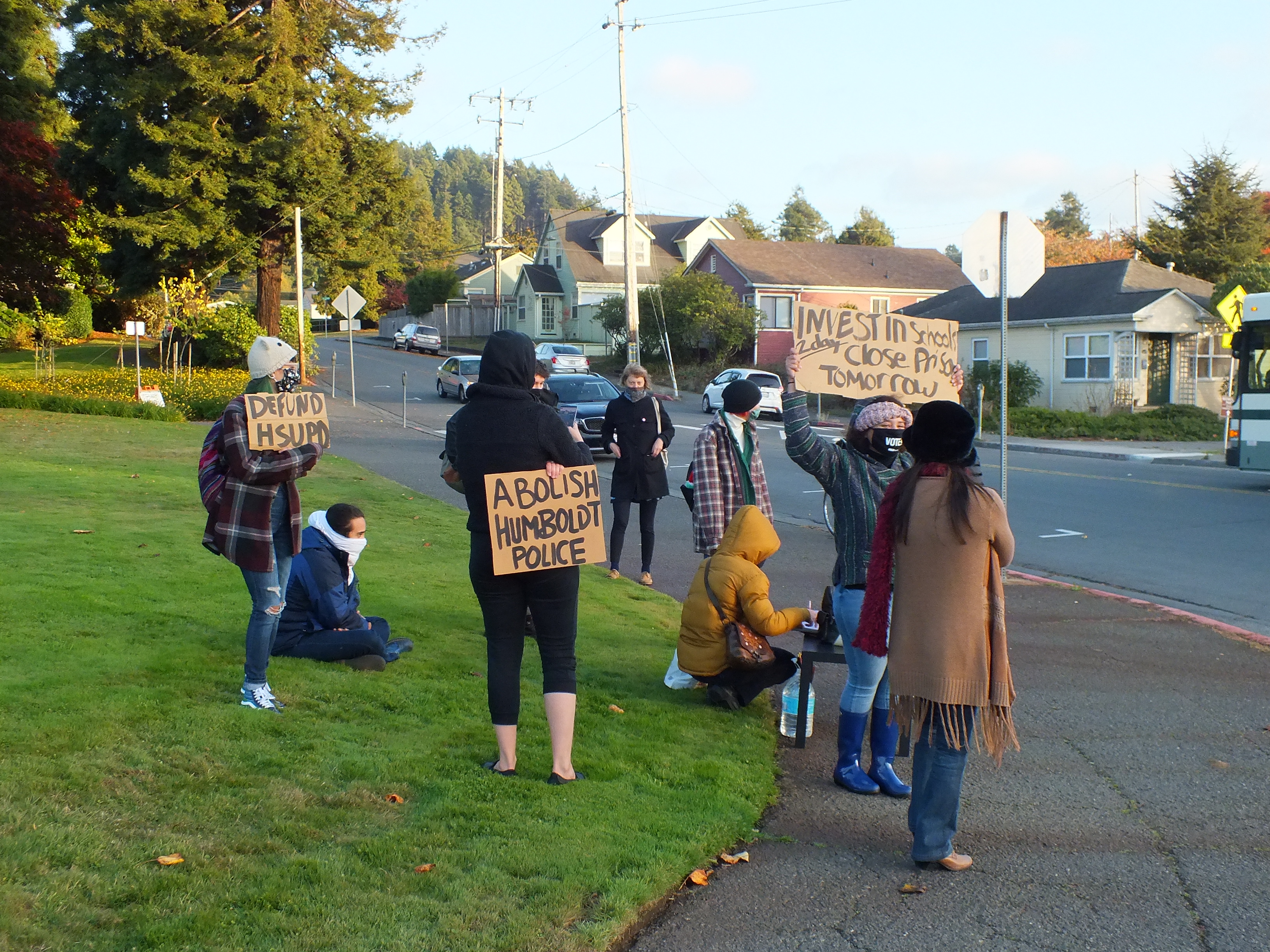
    A small group of concerned students and community members gathered outside Humboldt State University on Nov. 7 to protest the University Police Department.

    The two day protest was organized by Abolish Humboldt Police and Students for Quality Education groups. The two labeled it online as an information sharing session regarding the history of the UPD and Interim Chief of Police Scott VanScoy. VanScoy is the second interim chief that HSU has had this year.

    The UPD Chief position has not been permanently filled since the retirement of former chief Donn Peterson, who retired in May of this year. Peterson faced allegations from his fellow officers of creating a hostile work environment and making racially motivated statements. A independent investigation concluded that there was not enough evidence to either exonerate Peterson or to sustain the complaint.

    Two candidates for the position were recently turned down, with a campus wide email stating that both “…did not demonstrate the leadership needed for our campus.”

    A leader of the Abolish Humboldt Police group, who wish to only identify themselves as an alumni of the school for their safety, said that they seek change in all departments within the county but chose UPD as a jumping off point due to events within the past year.

    “They are adding more psychological load and heaviness to [students] trying to go to class and learn,” the Abolish Humboldt Police organizer said. “That is what the police do in order to keep you from learning, and we do not want that on our campus.”

    Irritation within HSUPD further imploded in the earlier parts of the year when Black Lives Matter protests exposed police brutality specifically targeted on the Black community. Campuses across the nation started questioning the need for campus law enforcement.

    “They have been going on for too long and they have damaged too many people’s lives,” the organizer said. “I didn’t like seeing them as a student here, I don’t like seeing them as an alumni.”

    On the Instagram page for the activist group, the SQE listed the demands they wish to be met if UPD were to be defunded. The demands included the removal of firearms from campus, establishing “a student and faculty run, mutual aid based, program for the emergency/blue lights,” and the creation of a system to address virtual harassment.

    Outside of UPD reform, the group seeks better funding for BIPOC organizations on campus and better protection for LGBTQ+ members of the community.

    Kei Chow was an incoming freshman when they heard about the investigation. Chow was proud to see groups like Abolish Humboldt Police and SQE in the area, sharing the discontent for UPD.

    “I saw their Instagram page when I first came here and I didn’t realize that the school had a defund the police movement,” Chow said. “I think that’s really important, especially since I’ve seen what the campus police spend their time doing.”

    Jasmine Martin, a marine biology major, helped organize the Abolish Humboldt Police event after being directed by other activist organizations in the area.

    “Being white, I have a lot more safety and privilege than a lot of other people do to speak my mind,” Martin said. “I felt it was important to use my privilege to hep the BIPOC members of the group feel safe and encourage other white allies to show up and listen.”

    As cars drove by, some honked their horns in support or gave a thumbs up as the protestors held up signs calling for the abolition or defunding of UPD. At one point a driver expressed their support for the protest by dropping off a carload full of coffee.

    For Chow, the decision to join the Saturday night protest came after witnessing an impactful and resonating event of officers flashing their dominative power.

    “Seeing a group of six squad cars pull up to my residence hall and have a picnic,” Chow said. “They were all in their uniforms and they were in their squad cars. It’s one thing to do it when they’re not on duty and having a lunch, but to do it on campus in their uniform with their cars, I don’t think that is right.”

    While they have plans for future protests on their social media, members of both Abolish Humboldt Police and SQE at the protest said they plan to continue to voice their demands and concerns against HSUPD.