The Lumberjack


Students Serving The Cal Poly Humboldt Campus and Community Since 1929

Tag: sustainable energy

  • Wind Farm Under Scrutiny

    Wind Farm Under Scrutiny

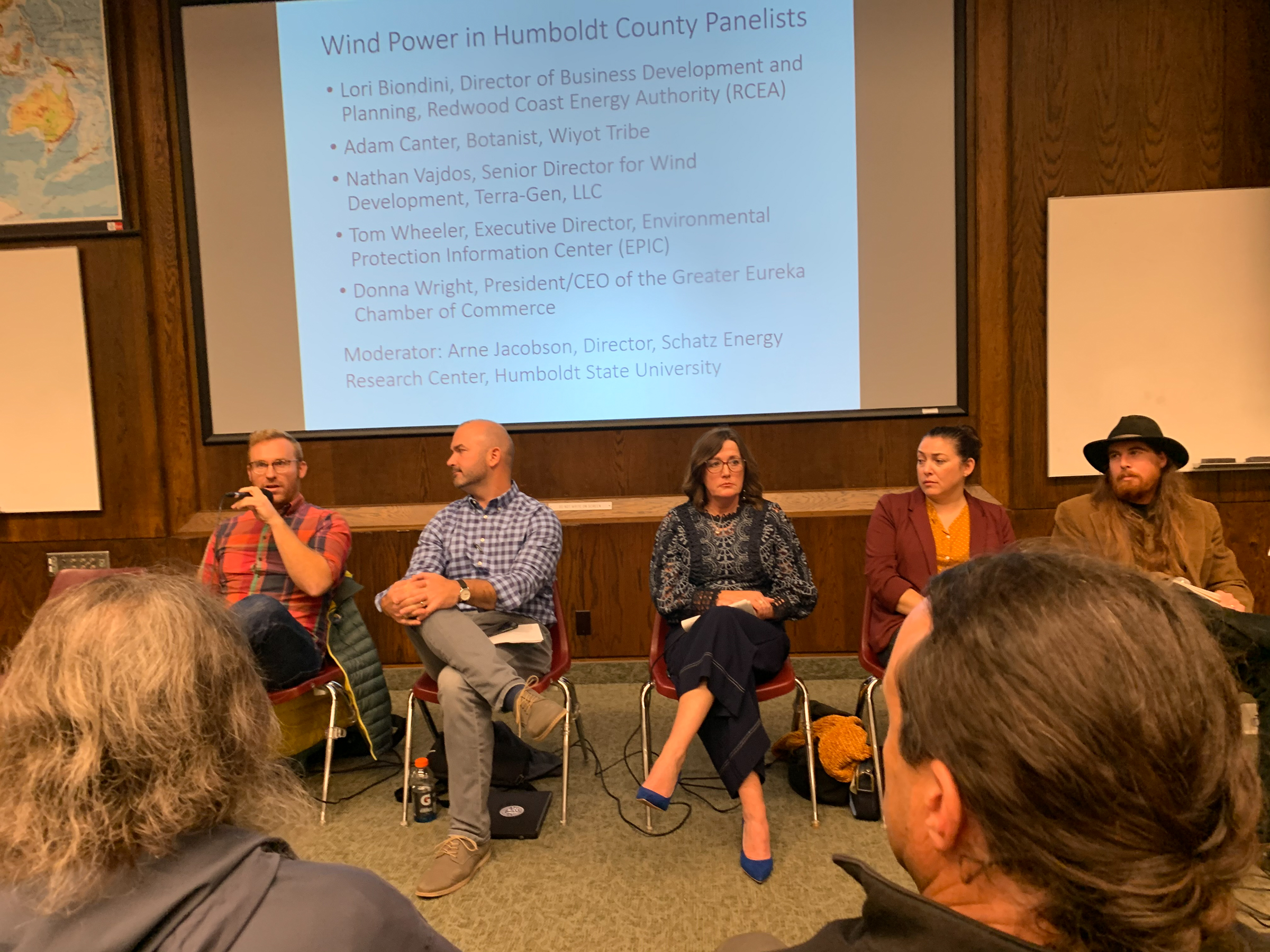
    A panel at Humboldt State University’s Sustainable Speakers Series weigh the pros and cons of the Humboldt Wind Energy Project

    As the global concern to act against climate change increases, Humboldt County is in a position to capitalize on an opportunity to establish a significant renewable resource.

    On Thursday, the Humboldt County Planning Commission votes on the wind energy farm developed by Terra-Gen. Terra-Gen, a Manhattan-based energy company, has proposed a wind farm to be built near Bear River, on Monument Ridge, above the city of Scotia.

    The Terra-Gen wind farm carries controversy for numerous reasons. The project will help achieve carbon emission-reduction goals and provide two million dollars in annual tax revenue for the county, but will impact wildlife, forest ecosystems and the Wiyot prayer site Tsakiyuwit.

    Arne Jacobson, director for Shatz Energy Research Center, said the proposed turbines will produce about 100 times less CO2 than burning fossil fuels.

    “From a climate change perspective, wind looks pretty good,” Jacobson said. “Whatever perspective we have on this particular project, I think one question we should be asking ourselves is what we want to do with that opportunity, because I think it’s there and I think we have the local ethic and the local talent to make that happen.”

    Lori Biondini, director of Redwood Coast Energy Authority, said the Terra-Gen wind project could be part of a solution to address RCEA’s goal of 100% renewable electricity in Humboldt County by 2025.

    “The Terra-Gen project is part of one scenario to reach our goals,” Biondini. “If it doesn’t get built, then we will come up with another scenario.”

    RCEA administers the community choice energy program, a program which allows communities to decide where their electricity comes from. It prioritizes local energy generation and generally more clean energy.

    “I think that one of the promises of community choice energy is that we get to make choices that are good to our entire community.” Biondini said. “Not further marginalize those that might not otherwise have had a seat at the table.”

    A crowd waits for Sustainable Speakers panel to begin. | Photo by Michael Weber

    Adam Canter, a botanist and representative of the Wiyot tribal council, defended the preservation of the land and disapproved of the Terra-Gen project. Canter cites ethnobotanical resources and culturally significant sites as reasons not to move forward with this project.

    “When we first heard about this project, there was this big pit that just kind of fell into our stomachs,” Canter said. “We thought when Shell came 10 years ago that no other company would come back and try to build a project here. But we were wrong.”

    Canter pointed out the cultural resource report for the site bound in a green, four-inch binder.

    “The representation of cultural diversity on this ridge is pretty magnificent,” Canter said. “We’re seeing evidence of Athabaskan peoples and the Wiyot-Algonquin peoples and really it should be listed on the National Register of Historic Places.”

    According to Canter, the area is also a high prayer site; a place where a large expanse of Wiyot ancestral territory is visible. Like the turbines obscuring the view, the Wiyot cultural heritage could be obscured too.

    Tom Wheeler, director for the Environmental Protection Information Center, said the proposed site is a questionable area to build a wind farm.

    “The representation of cultural diversity on this ridge is pretty magnificent. We’re seeing evidence of Athabaskan peoples and the Wiyot-Algonquin peoples and really it should be listed on the National Register of Historic Places.”

    Adam Canter

    According to guidelines set by the California Energy Commission and the California Department of Fish and Wildlife, the proposed site is “pristine.” Wheeler said the site has several rare and endangered species, including the rare Horay bat.

    Wheeler is still hopeful to keep the project, and said there is technology that can reduce some of the wildlife impacts. This, however, is only one mitigation measure to the several unavoidable cultural, environmental and wildlife impacts of the project.

    “I want this to be a better project and it’s not there,” Wheeler said. “At least not yet.”

    On Thursday, the final vote by Humboldt County’s Planning Commission will weigh impacts to Native American culture and environmental quality to the people’s interest in local, reliable energy.

    Aside from the benefit of reducing carbon emissions, allowing Terra-Gen to build the wind farm also comes with an economic and infrastructure benefit.

    Senior Director in Wind Development for Terra-Gen Nathan Vajdos said the company would be the second-largest taxpayer in the county, and could fund $14 million to Humboldt’s reliability network upgrades, with $1.3 million to the Humboldt substation.

    “As we charge our iPhones, we fill up our cars with gas, we’re having impacts.” Vajdos said. “Whether this project is built or not, we are having an impact in this room.”

  • Miscommunications and Misdirection

    Miscommunications and Misdirection

    Hold PG&E accountable for its reckless and unprofessional behavior

    During the most recent Public Safety Power Shutoffs, the Pacific Gas & Electric Company’s communication with its customers was awful.

    The first time the utility shutoff power in Humboldt County was on Oct. 9. The county had less than 12 hours of notice for residents to prepare for a possible four-day outage. Humboldt was the only county in California to lose all power and initially wasn’t even on the list of affected counties.

    After the outage, Michael Lewis, PG&E’s senior vice president of electric operations, said that Humboldt County shouldn’t have lost power in the first place. Although extreme weather and fire risk were at play in other counties’ outages, Humboldt went dark because of scheduled maintenance on one of the transmission lines coming into the county.

    On Saturday, Oct. 26, reports from PG&E said only about 2,000 customers in Humboldt would be affected. Several hours later, PG&E corrected itself and acknowledged that all Humboldt residents would be hit with the outage.

    During the most recent PSPS, the utility released news that another outage would likely hit Humboldt early Tuesday morning. Additional updates said that while many residents would regain power, it was possible that residents still without it may continue to be in the dark through to Tuesday’s outage.

    When Tuesday morning came and went, locals wondered when the outage would hit. Those who regained power the day previous still had it, and conflicting reports from PG&E, the Redwood Coast Energy Authority and the Humboldt County Office of Emergency Services led to mass uncertainty about when –and if– the power would go out again.

    For those PG&E customers who tuned in to one of the company’s many streamed press conferences, they were forced to wade through jargon including “operational event,” “incident commander,” and the terribly-named “Public Safety Power Shutoffs.”

    Late Monday night, the Redwood Coast Energy Authority posted on Facebook that PG&E said that power in Northern Humboldt wouldn’t go out until 9 p.m. That same night, OES made its own Facebook post stating that PG&E said power was still planned to go out early in the morning.

    On Tuesday morning, OES continued to stand by what it had learned from PG&E.

    PG&E’s own updates from Tuesday morning listed the outage time for Northern Humboldt as 9 p.m., and as the day went on, that seemed to be likely.

    Humboldt State University had no better idea of when the power would go out, as it noted in its update on Tuesday morning.

    “HSU is seeking clarity from PG&E regarding the timing of a possible power shutdown,” HSU’s update said. “There has been conflicting information from the company, and in local news reports, over the last 24 hours.”

    PG&E later updated its estimated timing to 7 p.m., and then, around 5 p.m., it called off any PSPS for Humboldt at all. On Facebook, OES said PG&E had given it inaccurate information.

    “PG&E has provided the Humboldt County Office of Emergency Services (OES) inaccurate information regarding times of de-energization in our County,” OES said.

    Communication is everything. PG&E changing times of planned outages makes sense, especially since the outages are primarily based around weather patterns. But failing to provide accurate information to emergency services and county officials is ludicrous. The company’s communication strategies are unacceptable.

    As a community and state we need to hold PG&E accountable and remove ourselves from its firm corporate grip. These blackouts should be the push California needs to turn toward alternative energy and municipal utility boards, ridding the state of monopolized power once and for all.

  • How HSU Handled Its Second Blackout

    How HSU Handled Its Second Blackout

    For the second outage to affect Humboldt in less than a month, students and staff were better prepared for the darkness and the subsequent time off

    After Humboldt County’s first Public Safety Power Shutoff, students and staff at Humboldt State University were better prepared when the latest outage hit the county the night of Saturday, Oct. 26.

    Marine biology sophomore Tyler Nagle spent his Sunday at a beach in Trinidad with friends.

    “I went to the beach, got a campfire going, roasted some s’mores and looked at the stars,” Nagle said.

    While Nagle said he’s learned how to prepare for these outages, he did have concerns about the outages’ impact on classes.

    “I definitely think this has taken a hit on my learning,” Nagle said. “But I hope these will be more few and far in between.”

    Vice President for Administration and Finance and HSU Emergency Operations Center Director Douglas Dawes said it’s too early to make any calls about how the outages will affect the semester’s class schedule, but he said HSU will be in touch with its academic accreditor.

    Otherwise, Dawes said he’s proud of the way the campus has handled the outages.

    “There have been some hiccups, but we’re getting through it,” Dawes said.

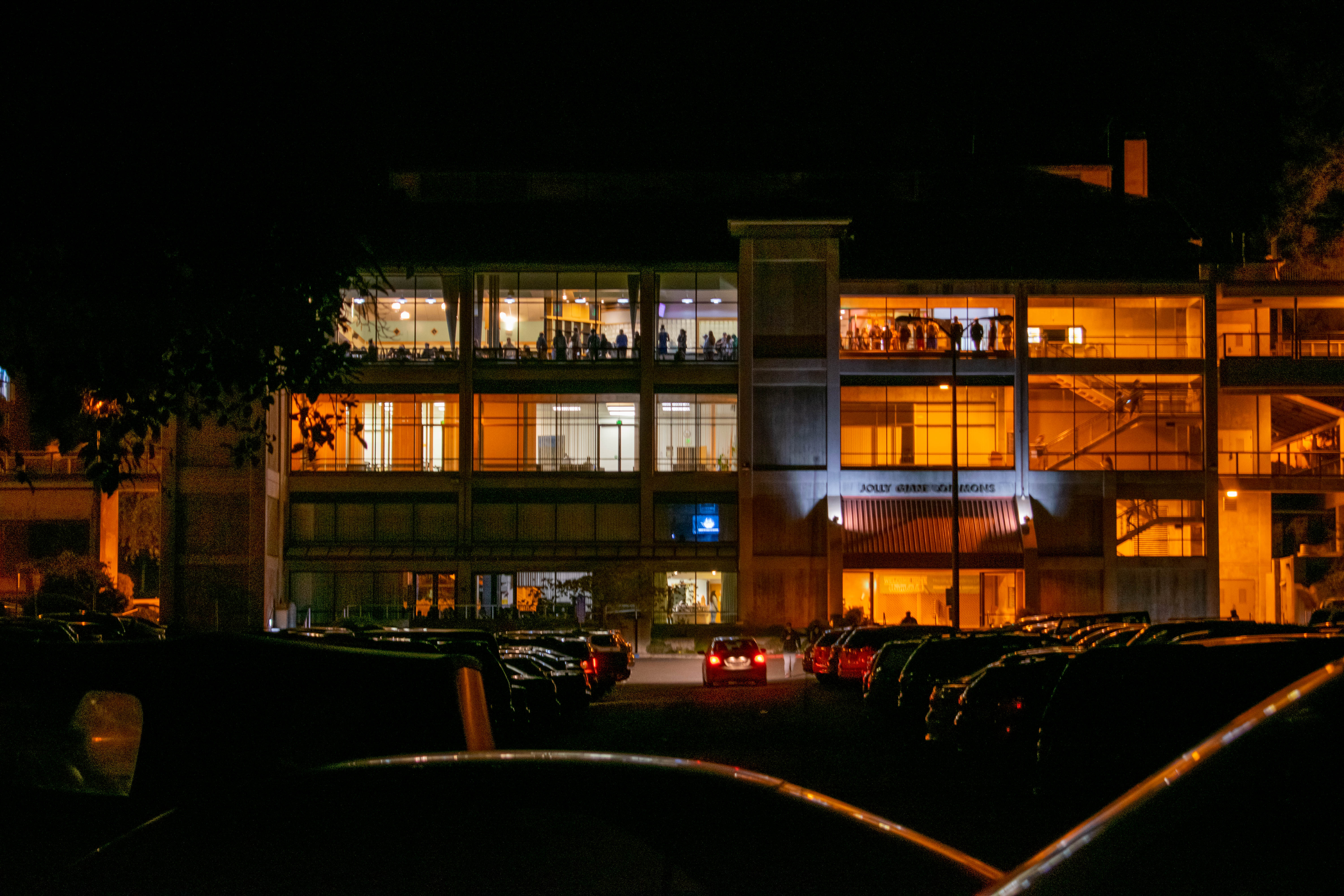
    Dawes said one generator failed over the weekend, but Facilities Management quickly moved around generators to keep providing power to the most essential buildings on campus including the Jolly Giant Commons, Student Recreations Center and residence halls.

    “They’ve been champions,” Dawes said. “Our facilities team has been keeping everything together.”

    Daniel Valencia, a sophomore kinesiology major, normally works at The Depot. During the outage, Valencia helped out at The J. When not working, Valencia said he enjoyed his hobbies.

    “I picked up skating more,” Valencia said. “And I’ve been looking into hobbies like reading and painting.”

    Zane Eddy, a master’s student in the environmental science and management program, came from an undergraduate program at the University of Oregon. Eddy said he was surprised by the outages.

    “It’s really odd having these power outages,” Eddy said.

    Eddy spent his free time going to Clam Beach and picking chanterelle mushrooms. Eddy said he believes the outages will make people understand their dependence on others for power.

    “We’re part of a larger system and we’re part of a larger environment,” Eddy said.

    While preparing for the outages on Friday, Interim Vice President of Enrollment Management Jason Meriwether echoed Dawes and said he was proud of how HSU handled the first outage.

    “That was a positive thing that we responded to the power outage in that way,” Meriwether said. “Now, in my opinion, that’s how it should always be and that’s how it will be. But I think students were happy to know we took that approach.”

    Dawes said HSU served 4,400 meals on Sunday. While he admitted that HSU incurred some significant costs in diesel and food, he said a percentage of those costs can be covered by disaster funds.

    On Tuesday, HSU uploaded a response page for students wondering why classes are cancelled during the outage. The page noted concerns over safety, non-functioning technology and a focus on personal wellbeing. The page also explained why it takes time to reopen campus even once power is restored.

    “It takes a great deal of time to safely re-open the campus, including powering down and disconnecting generators, resetting locks, and ensuring fire suppression systems are working,” HSU’s post said.

    As of Tuesday afternoon, HSU classes are set to resume on Thursday, Oct. 31.

    In the future, Dawes said HSU will likely look toward generating more of its own power.

    “Having more generation for the campus would be a huge help,” Dawes said. “So we’ll be looking into doing that.”

    For now, Dawes wanted to thank staff, faculty and students for restoring his faith and hope in humanity.

    “We’ve got really good students that want to provide for others,” Dawes said. “And staff that really care about providing for students as well.”

  • PSPS Events Showcase Reliance on Fossil Fuels

    PSPS Events Showcase Reliance on Fossil Fuels

    With the recent Public Safety Power Shutoffs, blackouts may be a big push toward renewable energy

    Public Safety Power Shutoff, blackouts could aid the push toward renewable energy. Solar micro-grids, local offshore wind farms or more well maintained power lines could be the answer to back-to-back outages. 

    Pacific Gas and Electric Company’s PSPS events are triggered by environmental conditions that threaten parts of their power grid. For example, a third consecutive power shutoff was originally scheduled for Tuesday morning, but changing weather patterns pushed back the timing. On Tuesday at 5:22 p.m. the county was removed from the PSPS affected counties list.

    PG&E’s PSPS events are triggered by environmental conditions that threaten parts of their power grid.

    “Due to diminished weather conditions, Humboldt County is no longer in the scope for a Public Safety Power Shutoff tonight and power will remain on,” said Humboldt OES in an email alert. “There are still communities without power but PG&E advises they hope to have those areas re-energized tonight.”

    The nature of the power grid in Northern California renders Arcata and Eureka subject to power outages if other areas of the grid are at risk. The energy used in Northern Humboldt is imported through transmission lines to the Eureka Humboldt Bay Generating Plant, where it’s amplified for local use. If energy stops flowing through the lines to Humboldt, there is no source of energy and therefore, no electricity. 

    Terra-Gen, a Manhattan-based wind power company, has proposed a wind generation project for the Monument and Bear River Ridges that could provide nearly half of Humboldt’s energy. A panel discussion on the project will be held Nov. 6 at 5:30 p.m. in Founders Hall 118.

    “Anticipated project features include a significant contribution to North Coast renewable energy generation and to California’s clean energy mandate,” the panel flyer says.

    According to Terra-Gen, benefits of the project could include the creation of local green jobs and Humboldt Bay development. However, some local community members see the project as more consequential than not. 

    As California’s dry and windy seasons become the new normal, power shutoffs will likely become common occurrence.

    The proposed area of development, Monument and Bear River Ridges, sit on Wiyot territory. According to the Wiyot Tribe and the California Department of Fish and Wildlife, the Monument and Bear River Ridges aren’t appropriate for wind development. The turbines could harm or destroy some of the rare and protected species that call the area home.

    “Concerns raised include impacts on bat and bird deaths; tree removal; effects on sites with cultural and ecological significance to Native American Tribes; erosion and sedimentation from sub-river drilling and road expansion; visual impacts; light and noise pollution; and traffic congestion,” the flyer says.

    The upcoming panel lists some of these concerns as additional talking points, but it is unclear if the company or the county have come to a conclusion on how to proceed with this particular option of alternative energy. 

    Alternatively, PG&E maintains that shutoffs are necessary to prevent dangerous wildfires like the Camp Fire of 2018. Any at-risk transmission line can be shut off. As California’s dry and windy seasons become the new normal, power shutoffs will likely become common occurrence. However, some individuals are taking advantage of the winds, rather than suffering from them. 

    Blue Lake Rancheria has tested local energy generation since 2011. The Rancheria has yet to be seriously impacted by the power shutoffs because they have solar electricity and battery storage, forming a microgrid

    Their microgrid works as a system of solar panels which power the Casino and other buildings during the day while also charging up a bank of Tesla batteries for the night. The grid can be connected or disconnected from PG&E’s grid as needed, making them sustainable without any power from the utility.

    The primary barrier to building offshore wind turbines and micro grids or improving PG&E’s transmission lines is cost. Alternative energy projects cost significantly more upfront that traditional fossil fuels. The economic costs of the recent power shutoffs, however, may be enough to kickstart real conversations about alternatives.