The Lumberjack


Students Serving The Cal Poly Humboldt Campus and Community Since 1929

Tag: Take Back the Night

  • Take Back the Night coordinators raise concerns about event speaker

    Take Back the Night coordinators raise concerns about event speaker

    by Matthew Taylor

    Corrections: The event was not hosted by CAT or the North Coast Rape Crisis Team but instead the Women’s Center at CPH, they were important guests and coordinators there.

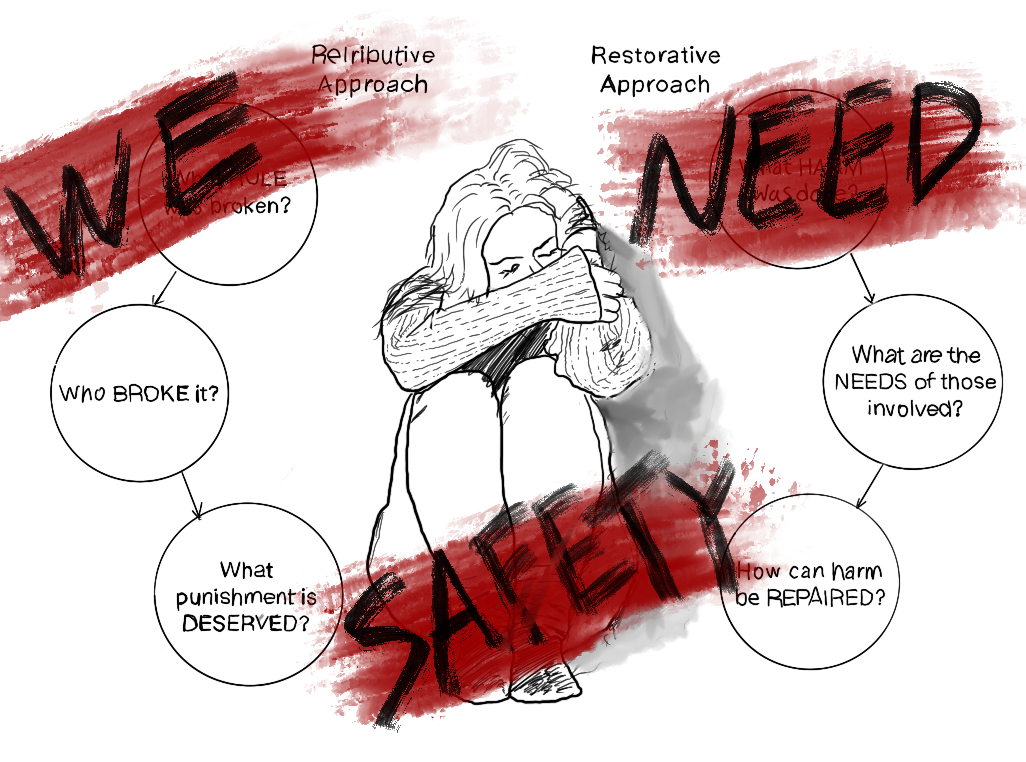
    Cal Poly Humboldt’s Campus Advocacy Team (CAT), along with the help of the North Coast Rape Crisis Center, hosted the annual international event known as Take Back the Night last Friday. This college campus-focused event looks to empower women and other vulnerable minorities. This year’s event began with a presentation by Dr. Rachel King, a specialist in issues of sexual misconduct within higher education. Her presentation explored the usage of restorative justice in situations of sexual assault on college campuses.

    Restorative justice focuses on the rehabilitation of offenders through reconciliation with their victim(s) and the community at-large. The framework often assumes that the offender committed their crime due to a perceived need in their life that wasn’t being met or a lack of knowledge towards the harm they inflicted. Proponents say that restorative justice has the capability to be incredibly effective and healing to all parties involved in a crime. However, should we assume sexual assault falls into this category of effectiveness?

    An hour into the presentation, many participants were disheartened, disgusted, and frustrated. At multiple points in the Zoom-based presentation, King implied that many perpetrators of sexual assault did so based on a simple ignorance or misunderstanding of the situation. While this could be true for a minority of cases, statistically, the vast majority of sexual assaults are done with the explicit understanding that these actions were unwanted.

    “It’s not about ignorance, it’s about power and control,” an event coordinator said after the presentation.

    Many of the event coordinators present refused to speak on the record regarding their feelings on the hour-long speech. Their reasons ranged from the sensitivity of the topic to a perceived backlash from the administration.

    “I personally have a very hard time with restorative justice as a survivor myself, working as an advocate, and hearing survivors on a daily basis,” another event coordinator said. “I’m not saying that the normal system is [made] to protect the survivors in any way. It’s not. The traditional justice system is very re-victimizing and very re-traumatizing for survivors, but the model that was shown today could also be set up for survivors to be re-victimized and re-traumatized.”

    Whether intentional or not, restorative justice processes can put the offender and the victim on equal levels of legitimacy. In the case of sexual assault, this makes little to no sense. As advocates in this area, the members of CAT and the North Coast Rape Crisis Center know that these actions predominantly come from an abuse of power or a complete apathy towards the victim, not due to innocent miscommunication.

    “I feel like this presentation weighed a bit too heavily on the perpetrator and their choices,” a coordinator said. “It just wasn’t all that comfortable for me to hear, it’s like ‘if they get this little bit of accountability, then they’ll never do it again’ when we know that that’s not true.”

    The event ended four hours earlier than its intended conclusion, in part due to the extremely low turnout. It is unknown if CAT and the North Coast Rape Crisis Center will continue to use Rachel King as a resource for sexual assault trainings, especially in light of the negative reaction towards her presentation.

    Both teams stand firm in their mission to empower survivors on campus, whether they wish to take a restorative justice approach or a traditionally retributive one. Their concern lies solely with the victims and their personal well being.

    The Campus Advocate Team runs a 24 hour anonymous support line for any and all student victims of sexual assault that can be reached at (707) 445-5881.
  • Out of the darkness comes light

    Out of the darkness comes light

    Survivors of sexual violence share their experiences through the events of Take Back the Night

    Take Back the Night delivers the message that domestic partner violence, intimate partner violence and other types of violence will not be tolerated.

    Xochitl Cabrera runs the Humboldt State’s Women’s Resource Center, which hosts Take Back the Night every year.

    “Sometimes people don’t need you to help them, you may need to take a step back. Some people just need to heal themselves,” Cabrera said.

    The Women’s Resource Center is a campus resource for people who need a safe place to study or find the help you need for survivors of sexual violence experiences.

    “The Women’s Resource Center knows that sexual violence and domestic violence happen all of the time, but it is up to the survivor to reach out to the Women’s Resource Center,” Cabrera said. “Take Back the Night is not for everyone. People tend to avoid the trauma it brings up.”

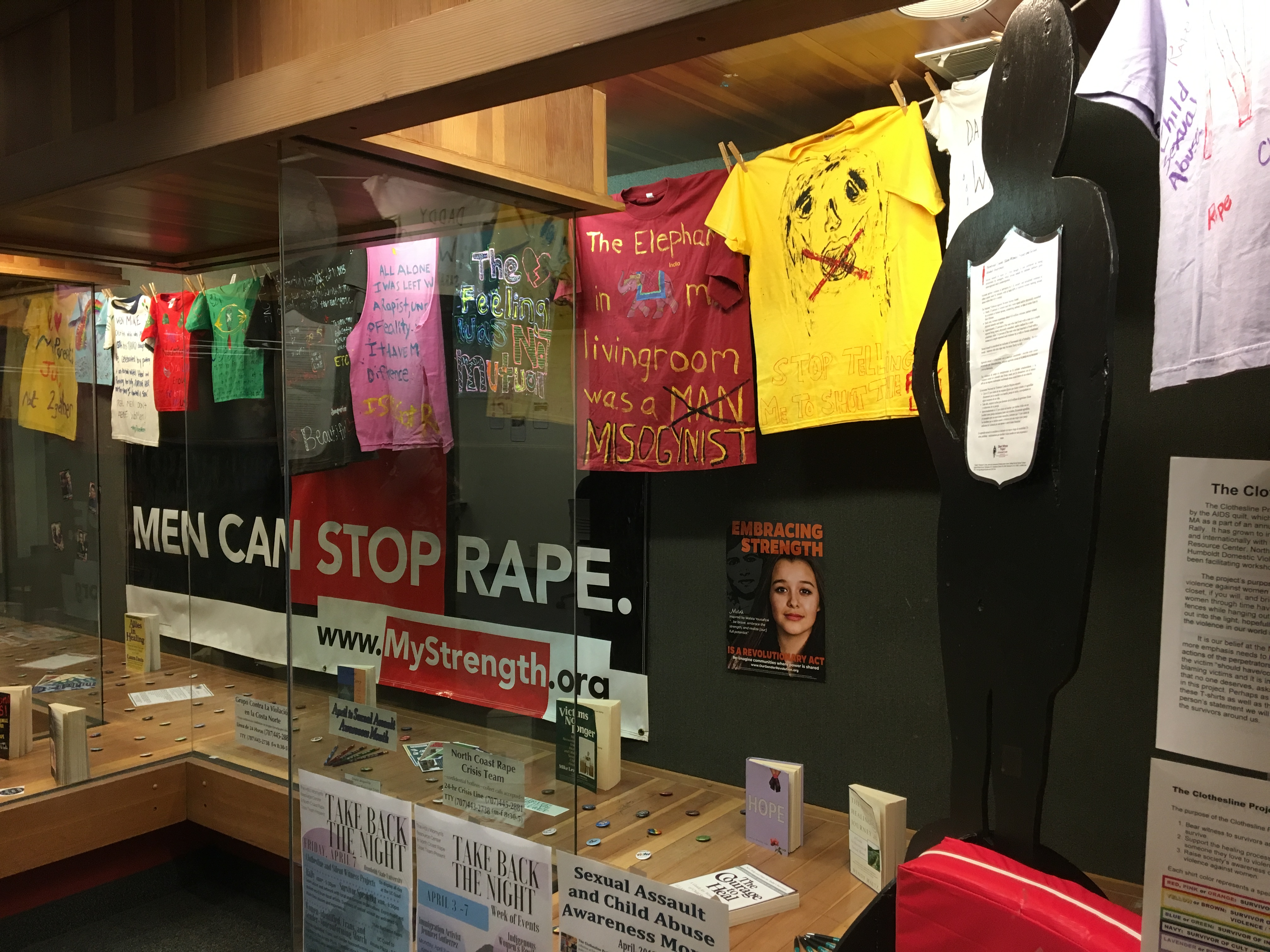
    Hanging on the walls of the Kate Buchanan Room are T-shirts from survivors of sexualized violence and friends of people who died from sexualized or domestic violence. The T-shirts had messages written telling of horrible acts of sexualized violence from family members, friends and others.

    “The T-shirts are difficult to look at, but their story needs to be heard. They are not nice. It is painful but necessary,” Jodie Huerta, HSU sociology major, said.

    Messages written on T-shirts decorating the walls of the KBR. Photo by Ahmed Al-Sakkaf.

    Assistant professor of Native American studies Cutcha Risling-Baldy was the guest speaker for Take Back the Night. Risling-Baldy’s talk was based on systemic violence toward people of color. Before her talk on missing and murdered indigenous women, Risling-Baldy acknowledged the death of HSU student David Josiah Lawson.

    “If David Josiah Lawson were not a person of color, his death would be on the news every day,” Risling-Baldy said.

    The Native Americans view domestic violence differently.

    “In an interview with a Wiyot woman, the anthropologist asks what happens if a man rapes a woman,” Risling-Baldy said. “The Wiyot woman replies, ‘That never happens.’ Asked why it never happens, the Wiyot woman said, ‘Because that person would be killed.’”

    Speaking out can trigger traumatic experiences for people.

    “People choose to come if they feel comfortable speaking on their testimony, and they choose not to come because they don’t feel comfortable speaking on their testimony,” Cabrera said.

    Some of the speak-out testimonies were about sexual violence that occurred during childhood and adolescence, while some of the testimonies were about sexual violence that happened at HSU. Sexual violence happens to HSU students, for which most of us are unaware.

    “Everybody knows that sexual violence is happening, but nobody is doing anything about it. It is just getting swept under the rug,” Grace Lamanna, HSU recreation major, said.

    People tend to restrain themselves from being in these spaces, because of the trauma it brings to them.

    “Some folks don’t feel safe in this space, because they don’t identify with domestic violence and sexual assault. People feel like they are taking up space and say, maybe this isn’t the space for me, I’ll take a step back,” Cabrera said. “That’s totally fine, because we want to prioritize those individuals that have experienced sexual assault and sexual violence at some point in their lives. That is what this space is mainly for.”

    Students hold hands in a circle behind the McKinley statue on the Plaza. Photo by Ahmed Al-Sakkaf.

    HSU sociology major Omar Miranda helped as a monitor for the Take Back the Night march as part of his class.

    “I feel like I made a difference. Big or small. Something small to me could make the biggest difference to the survivors,” Miranda said.

    The survivors gathered after the speak-out for the Take Back the Night march. Marchers wore orange safety vests, gathered in groups of five and were assigned a monitor. Monitors had received tactical training for this march and could protect the group if some danger presented itself.

    The marchers left school chanting, “Hey! Ho! The patriarchy has got to go!”

    The marchers went from school to the plaza downtown and were heckled by a few passersby in cars, as well as people along the route.

    On the plaza, the Take Back the Night members and public in attendance gathered in a memorial for the people who have died from sexualized and domestic violence. In silence, the less fortunate victims of this violence were honored.

    As the Take Back the Night march left the plaza, the declarative chanting could be heard echoing off buildings and down alleyways.

    “Take back the moon, take back the stars, take back the night because the night is ours!”

  • HSU takes back the night

    HSU takes back the night

    By Charlotte Rutigliano

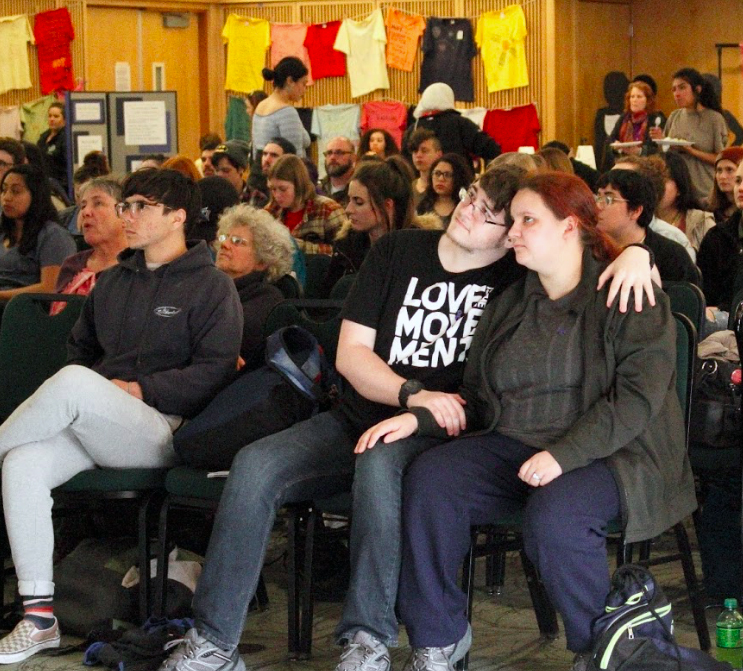
    Students, faculty and members of the community came out to the Kate Buchanan Room this past Friday to show their support for survivors of sexualized violence.

    One student who came out to show support was graduate student Irene Vasquez.

    “I think it’s wonderful that the university cares about the students and is spreading awareness like this,”  Vasquez said.

    The university has been the host of the take back the night events since the mid-1980’s. Take Back the Night was co-sponsored by the North Coast Rape Crisis team and the Women’s Resource Center.

    Paula Arrowsmith-Jones, Community Outreach Coordinator for the North Coast Rape Crisis Team,  said that these events have been going on since the 1970s but have been held on and off campus since the mid-1980s.

    “Back in the 70s women were told not to go certain places at night without a male chaperone,” Arrowsmith-Jones said. “Because if something happened it fell on the women. These events were created to reclaim everyone’s right to go somewhere and not get hurt.”

    According to Arrowsmith-Jones, it’s important for the university to hold events like this because there is so much shame, secrecy and denial that surrounds sexualized violence, it’s about raising awareness for those who don’t think it happens. CFR69 - TBTN 1

    Take back the night student coordinator and graduate student Ariel Fishkin said we are living in a rape supported society, where individuals are taught that “rape culture” is okay and where victim blaming is too common.

    “I have experience with sharing,” Fishkin said. “People don’t realize that it’s a systemic thing that’s why we have these events.”

    Take Back the Night was part of a week long event to let survivors know that they are believed. The week long event took place during sexual assault awareness month.

    “Sexual violence is so prevalent,” Arrowsmith-Jones said “we want to show people affected that they are supported, we have counselors at all the events to help.”

    The university does have a lot of student activism with Check It, Peer Health Education, and the Women’s Resource Center. Fishkin hopes to continue to bring awareness to this issue as a campus to the community.  

    Sophomore zoology major Katie Marks said it is amazing that the university is doing this because she knows people who have experienced sexualized violence and she wants to be a part of the change for a world without violence.

    “Hopefully this will inspire other universities and communities to change too,” Marks said.