The Lumberjack


Students Serving The Cal Poly Humboldt Campus and Community Since 1929

Tag: thanksgiving

  • Thanksgiving leftovers? No thanks!

    Thanksgiving leftovers? No thanks!

    by Zack Mink

    Thanksgiving, although controversial, is still widely celebrated in the United States. According to statista.com, 83% of Americans were projected to be celebrating the holiday in 2021 and almost 90 million tons of food waste was generated (ReFED.org). No, you don’t need to eat dry turkey for weeks after or scrape the stuffing off of a tray to limit your waste. Instead, you can repurpose your food scraps to create new and certainly improved meals that you will look forward to.

    “The Moist-Maker”

    The most famous Thanksgiving leftover that is widely recognized is “The Moist-Maker” from Friends. This is a sandwich filled with turkey, cranberry sauce, stuffing, and other Thanksgiving classics. To make it moist, a gravy soaked piece of bread is layered in the middle of the sandwich. This method of simply putting leftovers between two pieces of bread or wrapping them up in a large tortilla might be delicious but can also get quite boring after eating the same things for days in a row. 

    Turkey Pot Pie

    Rather than making a Thanksgiving sandwich or what is essentially a Thanksgiving crunch wrap supreme, experiment with your cooking skills and make something like a turkey pot pie. With this, all you need to do is combine some of your turkey leftovers, whatever vegetables you have, mix in your gravy and some extra stock of any kind. Finally, top it with some buttery puff pastry because puff pastry really does make everything taste better and bake it at whatever temperature seems appropriate. With only a couple minutes of preparation and 30-45 minutes in the oven, you now have a not so Thanksgiving pot pie.

    Turkey Stock

    Aside from excessive amounts of leftovers adding to the tons of food waste, scraps from food prep also have a huge impact on the waste produced each year. Rather than filling up garbage bags with vegetable scraps or a giant turkey carcass, save all of these nutrient full foods to create a homemade turkey stock. This is a classic one pot recipe where you put all of your scraps into one pot, top it off with water, and let it simmer for hours. This process extracts the flavor from the vegetables and the collagen from the turkey bones creating a lucious and flavorful stock. With stock, you have endless options of meals to choose from. You can add this stock to your turkey pot pie or even make something like a turkey pho with some aromatics like lemongrass, ginger, and pho seasoning packets. 

    Utilizing food scraps not only pushes you to experiment and try new foods, but also contributes to minimizing food waste on a day that produces excessive amounts of it. If you are lazy and want to enjoy a classic Thanksgiving sandwich, go ahead! If you want to be a little extra, take the time to make a turkey stock using the entire turkey carcass and save that stock for future recipes. No need to toss out your leftovers, stretch your culinary limits and practice food sustainability even on Thanksgiving.
  • Turkey Doomsday

    Turkey Doomsday

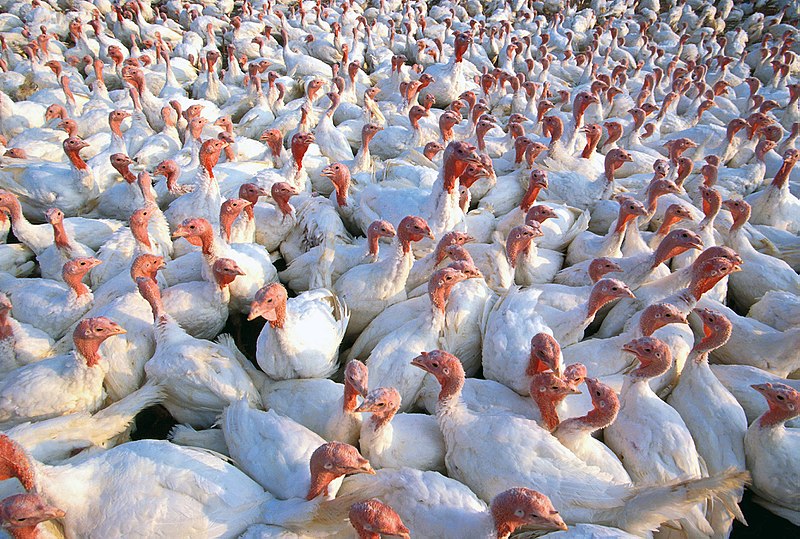
    Investigations have found that many large-scale poultry farms keep their birds intentionally overweight and injected with hormones

    Turkey Day is tomorrow, but people don’t always take the time to think about the farm to table process that leads to the birds ending up on our dinner plates.

    According to The American Society for the Prevention of Cruelty to Animals, “95% of farm animals in the U.S. are raised in factory farms,” with other sources, such as the Huffington Post, claiming numbers to be up to 99%.

    Factory farming has proven to be a profitable business, with the United States Department of Agriculture stating that there are approximately 2 million farms in operation.

    Poultry makes up a significant size of the income from animals, second only to calves and cattle.

    “Cash receipts for animals and animal products totaled 176.5 billion in 2018,” the USDA’s site says. “Cattle/calf receipts accounted for 38 percent of that total, while poultry/egg receipts accounted for 26 percent and dairy receipts 20 percent.”

    Some of the problems associated with factory farming include the health of the animals and their living arrangements.

    Investigations have found that many large-scale poultry farms keep their birds intentionally overweight and injected with hormones, only to be forced into tight cages until they are killed.

    “Due to selective breeding, commercial male turkeys rapidly grow to a weight 3 times larger than wild male turkeys in only 4 months,” Farm Sanctuary, an animal protections agency formed in 1986, states on their website. “Rapid growth and resulting heavy body weight can lead to heart problems and painful leg issues, which can eventually lead to crippling.”

    In 2017, The New York Times’ Editorial Board took a stand against factory-farmed poultry.

    “No animals raised on factory farms are kept and killed under worse conditions than turkeys and chickens, which make up most of the animals raised for food in the U.S.,” the editorial said. “Nearly 9 billion chickens are slaughtered each year for food. And because poultry is exempt from the federal Humane Methods of Slaughter Act, which the U.S. Department of Agriculture enforces, there are not even minimum federal standards governing how they live or die.”

    The Times continued their editorial, detailing how the “so-called broiler chickens” are genetically bred to grow fast, due to the demand for breast meat. According to the Times, these chickens grow so large that they can barely walk, suffering from painful skeletal disorders and deformities before they are killed.

    “The vast majority spend their short lives (about 47 days for chickens) in artificially lit, windowless, barren warehouse barns,” the editorial said. “So that turkeys won’t peck one another in these crowded barns, their beaks are painfully trimmed.”

    In Humboldt County, if you’re looking to avoid commercial, warehouse-raised poultry, one option is the Shakefork Community Farm. The farm raises small batches of turkeys every summer and fall.

    According to their site, Shakefork’s poultry is raised and slaughtered sustainably; raising their birds in open ranges as opposed to tight cages, believing in a more humane approach to raising animals.

    “We provide certified organic laying feed, but our hens provide for much of their own nutrition by foraging for seeds, bugs, and pasture,” the site says. “Our healthy and contented birds make for some of the best eating ever.”