
The Lumberjack


Students Serving The Cal Poly Humboldt Campus and Community Since 1929

Tag: trans

  • Newly assembled trans task force takes shape

    Newly assembled trans task force takes shape

    With campus’s shift to almost pure online learning since the spring semester of 2020, new and concerning problems have arisen for the transgender population of HSU.

    “Don’t feel gaslighted into thinking this is the best you get,” AM Hueber, member and HSU undergraduate, said for transgender students at HSU.

    Canvas and Zoom class spaces, compared to in-person classes, often have a more painstaking process of correction towards the offender. These struggles join the decades-long “whisper culture” on campus regarding where safe spaces and faculty members for transgender students reside.

    Inspired by HSU student and AS Board Member Roman Sotomayor, in a presentation he held the fall semester of last year, the task force began as a small group of impassioned students and professors alike driven to change the social climate and resource accessibility for their trans peers. Now under the formal name of the Transgender, Nonbinary, and Gender Non-Conforming Task Force, members have begun the steps in helping facilitate and provide for the goals of this already over 30 members strong organization.

    Hueber hopes to see the many plans coming out of the group come into fruition along with the future of a strong physical space presence after the effects of the COVID-19 pandemic are over. They expressed that the university has a long road ahead if it hopes to regain its 2012 title of being “one of the most LGBT+ inclusive universities in California.”

    Jenn Capps, Provost in Academic Affairs, expressed how the group has already begun to host faculty training for many of the departments at HSU. Many members of faculty were willing and wanting to learn how to provide properly for their transgender student but often lacked the knowledge and know-how to do so. Other resources the group is currently working to provide include the possibility of legal name-change workshops, trans support hotlines, advocacy reach teams, and a database of trans literature accessible to all students.

    “At HSU we aspire to be an open and welcoming space for our students. Specifically for transgender, nonbinary, and gender non-conforming students. You are important and this is important and near and dear to my heart,” Capps said with a nod of agreement from fellow member Elias Pence.

    “You are not alone,” Pence said. “We are everywhere. We are students, we’re staff, and we are faculty.”
  • Q-Fest celebrates queer and trans people of color in the arts

    Q-Fest celebrates queer and trans people of color in the arts

    Humboldt State senior Jonathan Salinas is no stranger to discrimination in this community. Salinas was even told once to move out of Humboldt by a community member. Though moments like this dishearten Salinas, helping organize events like Q-Fest inspires him.

    “It lights the fire in me again,” events director for the Eric Rofes Multicultural Queer Resource Center Salinas said.

    Students of the Eric Rofes Center and the Multicultural Center organized Q-Fest at Humboldt State University from April 16-20. This year’s celebration focused on queer and trans people of color in the visual and performing arts.

    “Because of a lot of the tension that’s been going on in the community around issues of race, we wanted to focus on people of color,” Salinas said.

    Q-Fest started out nine years ago as a queer film festival. It has now expanded into a series of events including a film showing of “Pick Up the Mic,” workshops with Arisa White, a QTPOC panel, QTPOC self-care and zine making workshop, a student showcase and more.

    Eric Rofes Center fiscal director, Neesh Wells, became involved in Q-Fest for the first time this year. Wells said they wanted to expand to include queer artists and students this year, because there is not always a lot of respect paid to them.

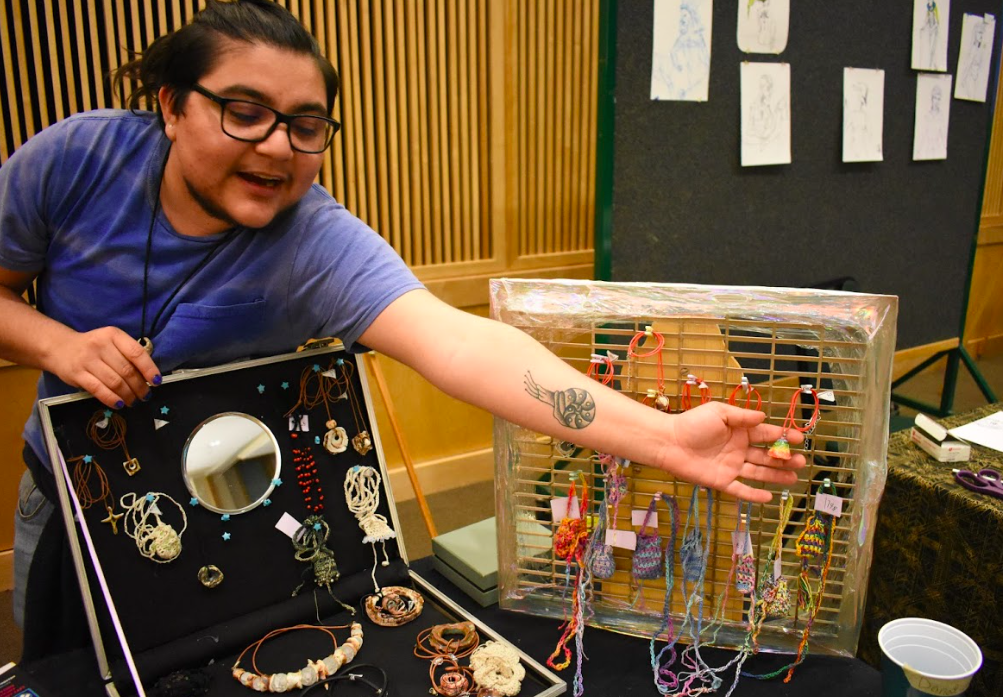
    Wells helped organized the self-care and zine making workshops as a space for queer folks to help develop their words and identities.

    “A lot of our allies don’t acknowledge that there are many facets of our identity,” Wells said.

    Wells defined self-care as “providing the time for one’s self and engaging in activities that help prevent exhaustion,” and said it can be as simple as checking in with yourself, making sure you eat and drink enough water.

    Wells finds creating spaces like this to be especially important, not only at Humboldt State, but in the community as a whole where there aren’t as many resources for queer folks and people of color as there are in big cities.

    Photo by Megan Bender.

    “The biggest difference for me, being in Humboldt, is a lot of the spaces have been spaces I’ve had to make on my own. It can be very difficult. There’s not only a lack of resources, but a lack of funding,” Wells said. “I don’t feel compelled to seek out a community outside of HSU and I think that’s very telling.”

    Wells is not the only person who feels there is a lack of resources for queer folks in the community. The Eric Rofes Center and Q-Fest aim to provide that needed support.

    “We just want to put out resources for students who feel like they don’t have anything,” volunteer and resources director for ERC Belen Flores said. “We don’t want them to be scared. We want to show them that it’s going to be ok and that we’re here to help.”

    Flores contacted this year’s keynote speaker for Q-Fest, poet and writer Arisa White. White and fellow poet Europa Grace hosted a workshop on Thursday afternoon and a poetry reading and talk on Thursday night.

    Q-Fest ended with the student showcase, a gallery and performance featuring work by queer artists. The event included tables with queer literature, information on safe sex and an array of student art.

    Luciano Duran, a 23-year-old HSU art major, displayed portrait photographs and an original zine.

    “[It’s] to address the theme of being gay and coming out and owning your identity,” Duran said. “Art is a coping mechanism for a lot of us.”

    Salinas was please with the turnout of Q-Fest, which increased since last year. Salinas said it is the hard work and passion of the students that make events like this possible.

    “These are some of the most dedicated students you will ever see,” Salinas said. “Fuck administrators. Because they’re not going to do it. So we’re going to do it.”

  • Let’s talk about gender pronouns

    The transgender community has more important things to worry about than correcting common misconceptions about their personal identity. Violent hate crimes and discrimination in healthcare and employment are just a few examples of the problems transgender people face. If you want to be an ally to transgender people, start by using their preferred pronouns.

    If you want to ask which pronouns people prefer, “don’t ask questions out of nowhere,” said Kai Lassen, a 21-year-old Theatre Arts student at HSU.

    The better thing to do is to listen. If they don’t reveal their pronouns and the topic of conversation is not relevant to gender identity, there’s no point in asking.

    A well-intentioned mistake people often make is assuming that all transgender women prefer the pronouns “she,” “her” or “hers.” The same assumption applies to transgender men for “he,” “his” or “him.” Some transgender men and women prefer the singular “they,” “them” or “theirs.”

    “If you’re unsure… it’s polite to use ‘they’ or ‘them’ than to hazard a guess and being rude,” said Wren Broekema, a 22-year-old Psychology student at HSU.

    Also, if a trans person corrects your assumption about their identity, don’t take it personally. Remember that their identity is more important than your ego.

    It’s also worth noting that not all transgender people are comfortable with disclosing their gender identity. If necessary, ask them which pronouns they prefer to use in private.

    Gay & Lesbian Alliance Against Defamation (GLAAD) says that publicly “outing” a transgender person can have a negative impact on their “… jobs, housing, friends, or even their lives when other people find out about their gender history.”

    On a final note, your friends are more than just their gender. You wouldn’t introduce a friend to someone by mentioning their ethnicity. You would just say their name. You also wouldn’t say things like “my best friend is [fill in ethnicity].” That would make you smug, not holier-than-thou. The same idea applies to introducing or referencing transgender people.