The big corporations want the politicians to turn higher education into a factory that produces blue and white collar workers because the corporations need individuals that are trainable. But there is more to it!
Programs like Humanities and Social Sciences are under attack by politicians like Marco Rubio, the person that said: “we need more welders and less philosophers.”
The underlining message is that public schools should teach us less about the world and more about the working world.
Donald Trump’s most recent presidential memorandum to the Secretary of Education will also reassure you that “it is critical that we educate and train our future workforce to compete and excel in lucrative and important STEM fields.”
Read between the lines! Trump is trying to manage public school programs that teach students how to be obedient workers.
In other words, the Trump administration is steering the working people away from courses that focus on critically thinking. They want to make sure that the 1% does all the thinking for us.
To be fair, STEM students do have more career opportunities than students in other programs. But that should not make the other programs inferior to science, technology, engineering and math. It would be like comparing apples to oranges.
These “soft” or interdisciplinary programs are just as important because they cultivate leaders with ethical decision-making abilities. But this notion would bring empowerment to the working class that would threaten the 1%.
Knowledge is power. When the people become educated, they are more inclined to be critical of their surroundings, the public discourse and their history. As a result, the people start making impressive egalitarian changes in society.
A perfect example of that is the current transformation of Columbus Day to Indigenous Peoples’ Day.
Hopefully, you can see why the few people at the top would want to make sure that our education does not get out of line. Emphasizing STEM programs is a smart tactic on their part to deter us from gaining social consciousness.
There is more to Trump’s job growth rhetoric and it is not just about increasing our nation’s gross domestic product. It is harder for politicians to manipulate the people when the people start thinking outside the box. With that said, I leave you with this question: Is Trump’s education plan undermining your intellectual autonomy?
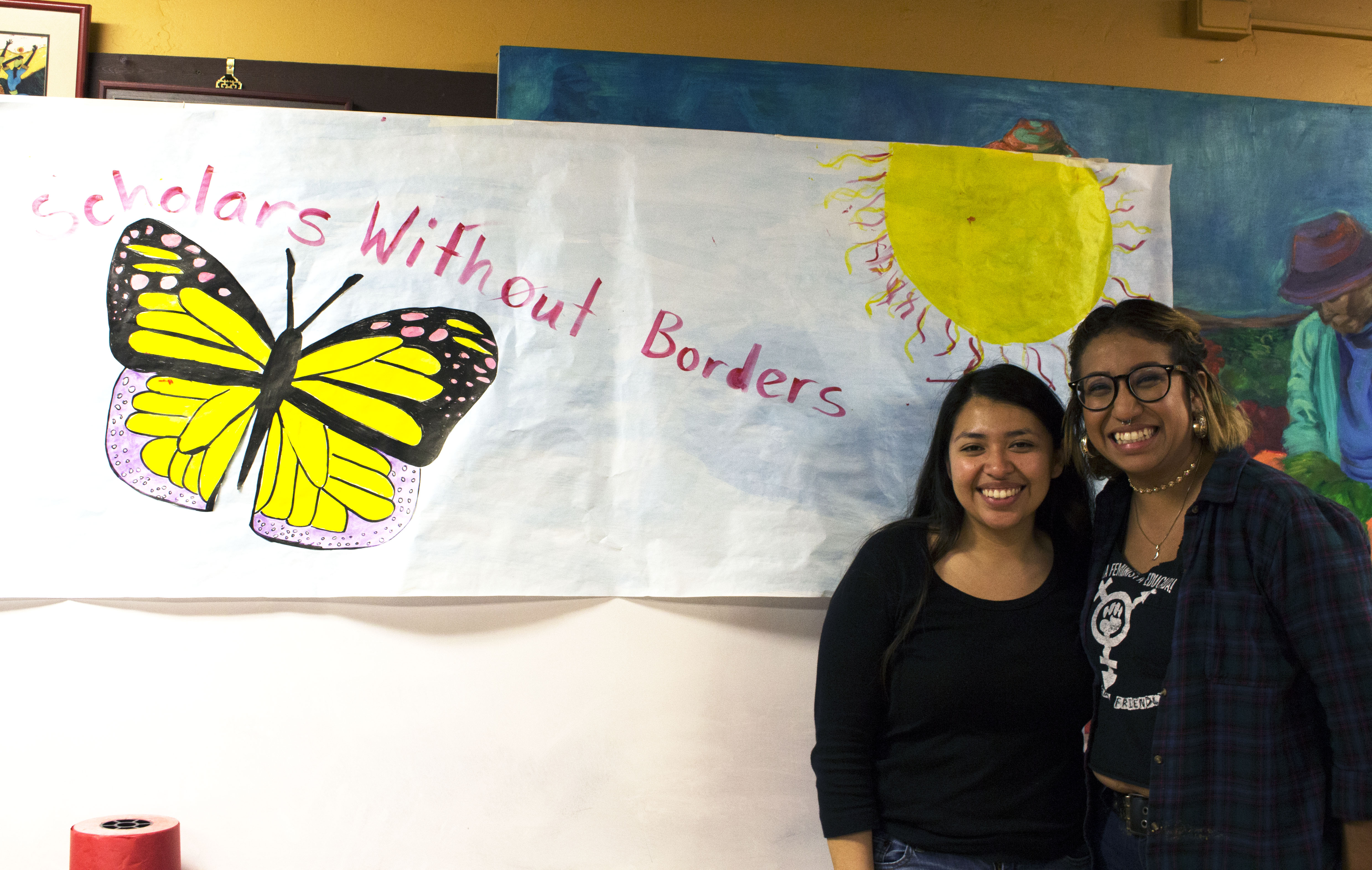
April 11 marked the opening of a new center for undocumented students called Scholars Without Borders Center for Academic Excellence located at the MultiCultural Center.
The students of the club F.R.E.E (Finding Resources and Empowerment through Education) have been determined to enact change and create a safe space for all undocumented students at Humboldt State, creating a more welcoming campus for future undocumented scholars.
Cesar Abarca, advisor of F.R.E.E. and professor of the social work department speaking to students. | Photo by Sarahi Apaez
Karla Sanchez, senior psychology major and president of F.R.E.E. has been working on creating this center since her freshman year in 2013.
The idea for this center has been in progress since F.R.E.E. established itself on this campus seven years ago.
F.R.E.E. founders were affected by their peers undocumented status and the roadblocks they faced and felt it was important to help them in any way they could according to Sanchez.
Sanchez said that there were many people working on this project way before it got passed down to her.
“I wish they were here to see this happen,” Sanchez said. “Because they fought tooth and nail for this.”
Sanchez herself felt that working hard on this was worth it for the people who would come after her and who would benefit from this.
HSU has 68 undocumented students currently attending the university. However, Sanchez said this number could be higher due to students not wishing to disclose their citizenship status.
“We are small as an undocumented community,” Sanchez said.
The center will help navigate students through school, and direct them to the instructors that will help them with what they need.
César Abarca, professor of social work and the advisor of F.R.E.E. has been the biggest help in Sanchez’s opinion. She acknowledges Abarca who has helped her and F.R.E.E. even when it was not his paid job to do so.
HSU student singing and playing guitar while students ate. | Photo by Sarahi Apaez
After so much change within the center’s presidency, students have been working on their own to make this center a reality.
Sanchez describes her experience as one of struggle to find resources and figure everything out on her own.
Sanchez has held a job since her freshman year and hasn’t had the privilege of living on campus or to go on as many outings as she would like. These are the privileges of being a citizen that she does not experience, the privileges of having financial aid, Sanchez said. She wants to make people aware of these privileges. She has had many roadblocks in her university experience regarding travel and financial difficulties.
Financial barriers have been one of the most significant barriers for undocumented students. Anayeli Auza, is undocumented student at HSU. Her passion for the center stems from her fear that she wouldn’t get enough support financially to graduate.
Scholars without borders will be a central place for undocumented students to receive legal help, emotional support and other resources. According to Auza, undocumented students do not have it easy when it comes to getting help. Students often have to go to different offices around campus to receive different services. Offices like EOP can only serve some of these students, and the other academic centers on campus don’t provide enough information for specific undocumented students needs.
The center will also serve to educate more students about the differences between undocumented students, the Deferred Action for Childhood Arrivals program, also known as DACA, and AB-540.
DACA is an executive order signed by former President Obama that gives undocumented immigrants the ability to receive work permits and driver’s licenses in addition to allocating some federal funding to support higher education. AB-540 is a 2001 state law that allows in-state tuition for anyone who attends a California high school for three years, among other requirements.
President Donald Trump has threatened to cancel Deferred Action for Childhood Arrivals during campaign speeches in the past. Recently, President Trump told the Associated Press that undocumented immigrants brought here as children can “rest easy.”
Although cabinet members say that undocumented immigrants who were brought to the country as children are not at risk for deportation, a 23 year old under DACA is currently having to sue the Trump Administration for being illegally deported. The 23-year-old sued after not seeing any documentation that explained why he was deported according to the New York Times.
CSU Chancellor Timothy White issued a statement about the CSU system’s stance on undocumented students. White did not outline an overall concrete stance but instead allowed each campus to create their own policy due to the diversity of the universities. HSU President Lisa Rossbacher joined more than 400 other university presidents in December 2016 to continue, uphold, and expand the DACA program.
The center is only being supported by the campus for a year, and they will need ongoing support after, according to Abarca.
“In the meantime they have to prove that this center will recruit, retain and graduate more students,” Abarca said.
$20,000 has been approved for the center to run for a year. Initially the center was granted $17,000.
“$3,000 has made a huge difference,” Auza said.
Once up and running, the center will be open 8 a.m. to 5 p.m. Monday through Friday.
Sanchez hopes that having a centralized space will make it so that people listen to the needs of undocumented students.
“Not put us on a pedestal,” Sanchez said. “But we’re equal.”
This website uses cookies to improve your experience. We'll assume you're ok with this, but you can opt-out if you wish. Cookie settingsACCEPT
Privacy & Cookies Policy
Privacy Overview
This website uses cookies to improve your experience while you navigate through the website. Out of these cookies, the cookies that are categorized as necessary are stored on your browser as they are essential for the working of basic functionalities of the website. We also use third-party cookies that help us analyze and understand how you use this website. These cookies will be stored in your browser only with your consent. You also have the option to opt-out of these cookies. But opting out of some of these cookies may have an effect on your browsing experience.
Necessary cookies are absolutely essential for the website to function properly. This category only includes cookies that ensures basic functionalities and security features of the website. These cookies do not store any personal information.
Any cookies that may not be particularly necessary for the website to function and is used specifically to collect user personal data via analytics, ads, other embedded contents are termed as non-necessary cookies. It is mandatory to procure user consent prior to running these cookies on your website.