The Lumberjack


Students Serving The Cal Poly Humboldt Campus and Community Since 1929

Tag: UC

  • Proposed state assembly bill gives van lifers hope

    Proposed state assembly bill gives van lifers hope

    By Eli Farrington

    On Oct. 25, 2023, Cal Poly Humboldt sent out an email to the entire student body detailing a list of new parking regulations that were going to be enforced effective immediately. However, none of the new regulations actually pertained to the majority of the on-campus community, but rather to a much smaller and more vulnerable one: the van lifers. 

    Jan. 11, 2024, Assembly member Corey Jackson introduced bill AB 1818 into the state legislature. If passed, all California State Universities and California Community Colleges would be required, and all UC campuses requested, to allow students that live in their vehicles to park on campus overnight as long as they possess a valid parking pass issued from their institution. 

    A humble community of vehicle-dwelling college students, the van lifers lived comfortably and peacefully in the parking lots of Cal Poly Humboldt for many years before the university finally decided to crack down on them. After the university claimed that their presence in the parking lots created ‘unsafe and unsanitary conditions,’ the van lifers were forced to leave the campus and look for overnight parking elsewhere. 

    Caleb Chen, a first-year Cal Poly Humboldt masters student in the public sociology program, was one of the students who were forced to leave. At the time, he was living in his vehicle, and the uncertainty of not knowing where he was going to sleep that night took its toll on him. 

    “In November, when we all had to move, it scattered us all to different places, and some of us ended up at the Arcata Community Center,” Chen said. “It definitely felt less safe there. It caused a lot of [stress] at the end of the semester that got in the way of schoolwork and the research assistantship that I’d come to this school for. Cops locking the gate to the community center at night meant if I needed to drive off all of a sudden in the middle of the night due to a break-in attempt, I’d be stuck in that parking lot. That wasn’t ever a concern at the school parking lot.” 

    At the beginning of 2024, Chen’s vehicle broke down. He couldn’t afford to fix it, so he ditched the van life and moved into an apartment with his significant other. Regardless of his new living situation, Chen was still impressed with the opportune timing of AB 1818’s proposal. 

    “It’s very timely, and whoever introduced it must have had their finger to the pulse, because this isn’t only happening at Cal Poly Humboldt,” Chen said. “It just speaks to the widespreadness of this and the fact that students at Humboldt are really just a drop in the pond, so to speak, of people that are affected by this situation.”

    In contrast to Chen, junior Hannah Barrett and sophomore Joshua Tarman left their overpriced one bedroom apartment at the beginning of the new year and moved into a camper together for a more favorable living situation. Barrett is a psychology major, while Tarman attends College of the Redwoods with a focus on early childhood education. 

    The couple originally planned to park their camper on Cal Poly Humboldt’s campus overnight, but when the Oct. 25 email was sent out they were forced to make other arrangements, including parking in areas of Samoa and Manila Dunes. 

    “I think that secure parking is something that should be a given for students,” Tarman said. “[Students are] paying to be in an environment where they’re supposed to learn, and so if a school wants to be able to provide all the facets for students to learn, they should definitely have a priority over their safety and their emotions. Students can’t learn when they’re just figuring out how to live in the first place.”

    While Barrett and Tarman are doing well enough with their vehicle parked off campus, they would definitely prefer the safety and security of an on-campus parking spot if AB 1818 were to pass. 

    “I just think that if you’re able to park here overnight with a parking pass, it is a little silly that you just can’t physically be inside your vehicle,” Barrett said. “It’s like at that point, [the university] is just trying to make it more difficult for people, because there’s [nobody] – at least I didn’t see – being unsanitary or dumping anything.” 

    The unsafe and unsanitary accusations have rubbed many of the van lifers the wrong way, including junior and mechanical engineering major, Derek Beatty. 

    “That was a smear campaign,” said Beatty. “It was, I guess, the only way that they could find to try to make other students feel like, ‘Oh I guess that’s why they’re getting kicked out.’ It was like they needed to give some reason so that there wasn’t as much outrage, but obviously, I don’t think many people believed those claims, and I think that even made people a little more upset on our behalf. But yeah… it’s kinda bullshit that they said that and then didn’t have any evidence to back it up other than a picture of a rainwater collection bucket.”

    The Lumberjacks request for complaints against van life students resulted in a total of two back-to-back complaints made by two anonymous people. Otherwise, no complaints were found. 

    Beatty is hopeful that AB 1818 will pass soon, so that he and others can park on campus again. He misses the safety net and the sense of community that on-campus parking provided for the van lifers, and having to park off-campus every night has taken that away. 

    One of the primary benefits of on-campus overnight parking is consistency. Having a dependable place to call home, even if it’s just a place to park a van or camper, can make all the difference in the world to the van lifers, one of Cal Poly Humboldt’s most at-risk communities. 

    “I spend all my time in this same parking spot,” Beatty said. “It’s just now for some reason I have to not be here from 10:00 p.m. to 7:00 a.m., when I could just stay parked here, not have to move all the time, and just have a consistent spot.”

    Carrie White, a Cal Poly Humboldt senior and biology major, lived on campus in her camper starting in 2021, but it recently broke down and has been stuck at a mechanic shop for several weeks. Since then, White’s living situation has been volatile, sleeping sometimes with friends, and at other times on the floor at one of her places of work. She hopes that AB 1818 will pass, to give low-income, displaced, immigrant students like herself a safe and secure location for alternative living. 

    “I think that passing the California Assembly Bill AB 1818 is the bare minimum a multi-million dollar institution affiliated with the CSU organization owes to its students,” White said. “In general, folks living in their vehicles are amongst the most vulnerable students. We know from thousands of studies that homelessness is a risk factor for mental and physical health pathologies, increased loneliness and isolation, decreased academic performance, decreased quality of life, and suicide. Passing a bill allowing homeless students to stay on-campus, in their vehicles, with a valid permit shouldn’t be a discussion – it should be a glaringly obvious choice. This is a social crisis, a public health crisis, a humanitarian crisis – and it is here, on our campus.”

    Student homelessness is a problem that plagues practically every college campus in California, and Cal Poly Humboldt is no exception. Cal Poly Humboldt students are still prohibited from sleeping in their vehicles on campus, but if AB 1818 passes, they can come back and the van life community can rebuild in a safe environment. 

    “I felt safer staying on-campus up until I was forced to leave,” White said. “In the act that I believe was an attempt to shame homeless students off campus – cue gross Cal Poly Humboldt email accusing homeless students of being ‘unsafe and unsanitary’ – the trust I have in this institution is null and void. Having said this, I would absolutely move back to campus if Bill AB 1818 passed; proud, in a state of activism, and don’t worry – safe and most definitely sanitary.”
  • A University Center hidden on campus

    A University Center hidden on campus

    by Matthew Taylor

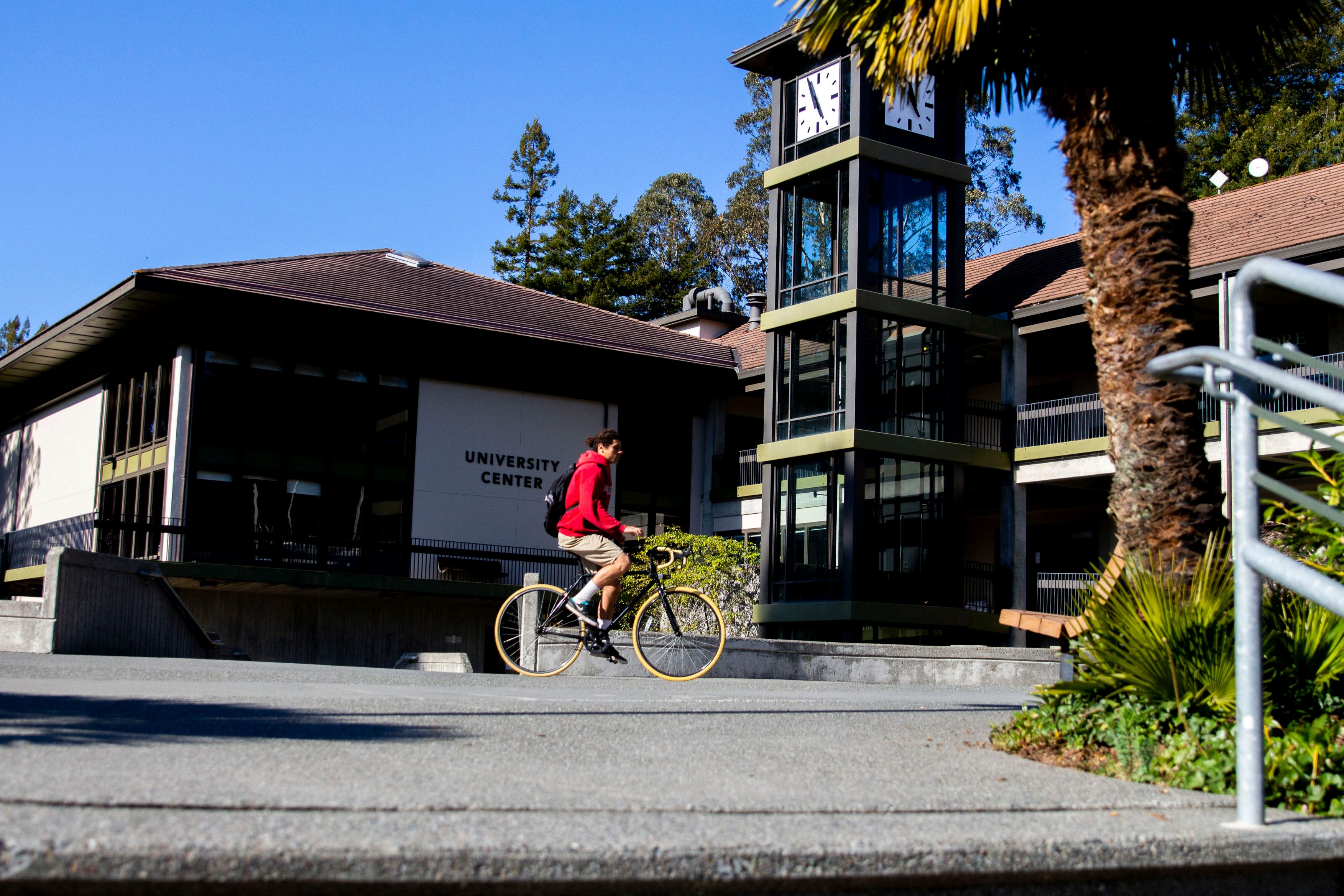
    The University Center (UC) is a husk of what it used to be since its contract was terminated by Cal Poly Humboldt’s administration back in December of 2020. Before then it was an auxiliary organization to the university in charge of many student events and activities. Many members had been left hurt, with most refusing to speak on the record due to a fear of legal or social reprimand by the university. A majority of the UC’s responsibilities have been transferred to the Student Activity Center. In its current state, the UC exists to provide pensions to its retirees and use reserve funds for various student programs. There are some members, however, who see its end as a bittersweet conclusion.

    “In my position, I see both sides,” said Wendy Sotomayor, UC Executive Director and Student Activity Center Director, the bittersweet sadness in her voice apparent throughout the interview. “I’m excited but I’m also sad. The UC was very valuable and did a lot of good for the students here. In the end, though, I think the students are getting a better package.”

    She expressed, along with many of her colleagues, that she still saw the letter of termination as the administrations ‘means to an end’, but also saw the validity in the problems stated within it. In some ways, the UC’s own response to the administration may have further solidified its decision to end the contract.

    “Our response didn’t really include any [tangible] changes to the actual administration’s complaints,” Sotomayor said.

    Much of the mistakes made by the UC at the time, referenced in the letter of termination, were based simply on miscommunication and misunderstanding. Certain allegations, such as that of fraud, were later confirmed to be completely unfounded. Still, legitimate mistakes existed and deserved to be fixed. The financial risk of loaning the Arcata Community Pool $300,000 was huge in hindsight of the COVID-19 pandemic, and due to its distant relationship to the university didn’t qualify well under “its mission”. Steps were made to fix these problems before termination, but in the eyes of the university’s administration that wasn’t enough.

    “We couldn’t fix it after the fact,” Sotomayor said.

    The introduction of lawyers to the mix didn’t make the situation any better in her eyes either. Instead of coming to the table it became only lawyers talking to lawyers. In the end, lawyers on each side may have convinced them that each was totally in the right.

    “[Many UC members] wholeheartedly believed they did nothing wrong,” Sotomayor said, expressing that at the time even she felt similarly.

    Since the termination, the administration has given most of UC’s previous tasks to the Student Activity Center. The program controls Center Arts, General Operations as well as a new program called Conference and Event Services (CES). Center Activities is now under Athletics and is located at the Student Recreation Center (SRC).

    “So much personal feelings got involved,” Sotomayor said. “And [I’m] not sure we could have gotten [to where the SAC currently is ourselves].”

  • HSU cancelling contract for University Center

    HSU cancelling contract for University Center

    Disagreements between the UC Board and HSU administration reaches a new point of contention

    Humboldt State University served a notice of termination to their contract with the University Center group, citing a series of breaches between the two organizations.

    In the campus wide email, President Tom Jackson states that the UC, which provides student facing services like the dining services and the Humboldt Bay Aquatic Center, has 90 days to correct the six breaches. With the notice sent on Sept. 24, the UC has until Dec. 24 to make the corrections.

    President Jackson stated in the email that the decision came after discussions with CSU Chancellor Timothy White, the university plans to take over some responsibilities “…ensuring students still have employment opportunities and that services supporting students are continued…” while the board attempts to make corrections.

    “The UC professional staff and student employees who work hard for our campus, community, and students each day are outstanding, and resolution of issues at the executive and fiduciary level should not disrupt them as they continue to serve and support HSU students,” Jackson said in the email.

    No word was given on what would happen to services run by the UC if the termination were to be finalized.

    Members of the UC Board were not told ahead of time of the termination and learned of the notice the same time the campus and media were told. 

    In a statement made by UC Faculty Representatives Steve Martin, Ph.D, Mark Rizzardi, Ph.D, and Armeda Reitzel, Ph.D, the board expressed their disapproval with the move.

    “Unfortunately, we find ourselves in an environment where authority seems to outweigh collaboration,” the statement said. “A memo was sent to the UC, at the same time as to the media and the public, of a termination of contract notice. We can’t help but wonder if there were ulterior reasons to motivate such a disproportionate response.”

    Of the six breaches that the notice brings forward, three of them included the business relationship between the North Humboldt Recreation and Park District, focusing in particular on the Arcata Community Pool.

    According to the notice, the UC Board opened a $300,000 line of credit for the NHRPD in Aug. of this year, as well as transferring $100,000 and $50,ooo to them in Feb. and July respectively. These actions, according to the president’s statement, violate Executive Order 1059 which states that  “Campus auxiliary organizations are . . . operated solely for the benefit of the campus.”

    In a separate email, Martin said “Everything the University Center did with respect to the line of credit we extended to the Arcata Community Pool was done above-board, in public, and even the University Controller recommended it and voted in favor of it, as did administrator Dean of Students Dr. Eboni Turnbow.

    “For the President to pull the termination trigger on our operating agreement is akin to using a nuclear bomb to respond to a mosquito bite,” Martin said.

    Dean Turnbow was also not one of the administrative team members mentioned in the notice of termination, which included Vice President for Administration & Finance Sherie Gordon and Vice President for Enrollment Management Jason Meriwether.

    Gracie Oliva, a student employee of the HBAC, expressed her concerns during a September interview about administration’s decisions, calling it a slap in the face to the entire student body.

    “I want students to know that if Center Activities or HBAC are affected, it would be a detrimental change,” Olivia said. “The Recreation Administration program is held up by these programs. Without them, I feel like it would crumble.”

  • Tension and Fear Among the Board of Directors

    Tension and Fear Among the Board of Directors

    A tense emergency Board of Directors reveals conflict between faculty and Administration.

    Tempers flared when an emergency Zoom meeting by the University Board of Directors turned into verbal arguments and accusations between several members on the call.

    The Aug. 28 meeting held by the University Center Board of Directors and open to the public originally set forth to tackle various agenda items and approve of new members.

    The two items that took up a majority of the meeting, however, where the firing of the UC’s legal counsel and changes the administration has made that affect facilities managed by the group.

    When the meeting was opened to public comment, student employees of the Humboldt Bay Aquatic Center stated that they were being asked by HSU to leave their offices. Center Activities Manager Bridget Hand confirmed this information, stating that employees were given little notice to clear their offices.

    Vice President of Enrollment Management Jason Meriwether and Acting Executive Director Todd Larson stated that the reason for departure was so that the building could prepare for renovations. Meriwether said that the space may be used for other departments in the meantime.

    Gracie Olivia, a student employee at HBAC, said that the job offered leadership roles and was a vital part of the community.

    “I want the board and everyone attending this meeting to understand the importance of the Center,” said Olivia.

    “Why are wholesale changes being made before the program review? The loss of HBAC as a public facility is a real loss to the community.”

    Financial Officer Gregg Foster

    With no office to operate out of, both Olivia and Hand noted that they would not be able to offer equipment rentals.

    Faculty Representative Steve Martin and Financial Officer Gregg Foster expressed confusion and anger at the circumstances. According to them, the UC board was uninformed of the entire situation.

    “Why are wholesale changes being made before the program review?” said Foster in the Zoom chat. “The loss of HBAC as a public facility is a real loss to the community.”

    In an email, Martin continued to express his frustration at the situation.

    “I’m concerned that employees of HBAC say that they can’t provide services to students safely and effectively because of the changes that were implemented over the summer, said Martin. “Changes that were implemented without first consulting the University Center Board.”

    Meriwether expressed his surprise with the board, stating that proper written notice was provided to former UC Executive Director Dave Nakamura. Martin said during the call that Nakamura was fired by the administration before being able to properly brief the UC Board.

    Further complicating the matter was the lack of legal representation for the UC Board regarding these actions, as the attorney for the group had been let go by Larson.

    The attorney from Erikson Law Firm, which had represented the UC Board of Directors since 2017, had refused to help draft a proposal with Larson to present to the Board. Larson also said the attorney had also violated a written contract agreed upon by the two, which to Larson “raised some red flags.”

    Foster, Martin and other members of the Board said that this was a decision that should have been run solely by the Board itself.

    Martin said that even if the action was legal, it raised moral and ethical flags about Larson and his actions put the board in a state of unease.

    These actions have created a fear among faculty members outside the board as well, that discouraged faculty members from speaking up.

    “Like everyone else in my position, we fear retaliation from an administration that is overreaching and abusing their power,” said one source close to the situation, who wished to remain anonymous. “If you are receiving PC responses from others, it’s because we are all very worried about what we are witnessing. We have been given specific language to use when speaking with the media and that language only reflects that of the administration’s story.”

    The next UC Board meeting is scheduled for Sept. 10.