The Lumberjack


Students Serving The Cal Poly Humboldt Campus and Community Since 1929

Tag: ukraine crisis

  • Sharing is caring… unless it’s propaganda: The Russia-Ukraine Crisis

    by Kris Nagel

    Everyone has an impact on someone’s perspective of the world. Almost anything we do or say affects someone in some way. The same holds true for the things we post on social media. We are all influenced by the people around us. When the subject of our virtual discourse is something as poignant as international conflict, our sympathies can be weaponized without us even knowing it.

    Roughly half of Americans regularly get their news from social media, according to a 2021 study from the Pew Research Center. The information we share online can challenge our belief system but oftentimes reinforces it. Al Tompkins, a journalist with the Poynter Institute, says that truth gets little consideration when the content we share aligns with our worldview.

    “We tend to support those things that agree with your position on anything,” Tompkins said. “Whether it’s the designated hitter in baseball or invading Ukraine, we tend to repeat and share things that we agree with.”

    The internet has changed the way information is spread through society. It’s easier than ever to produce fake information.

    “The other piece of it is this,” Tompkins said. “Disinformation is a very powerful weapon. The Russians know it but, let’s face it, the Americans know it too. The American government, particularly through the CIA, has done lots of disinformation over the years. You would expect that they do, it’s kind of part of what they do.”

    Understanding that misleading content is built into our news feed requires us to take a critical look at what we share before we share it. Tompkins’ approach asks four questions:

    What do I know?

    What do I need to know?

    How does that source know what that source claims to know?

    And is there any other way to look at this other than the way that source is telling me?

    Vicky Sama saw the real-time effects of media coverage and propaganda in the several wars she covered during her career at CNN. Sama is now the department chair for Cal Poly Humboldt’s journalism and mass communications program.

    “So there’s two parts of war, usually,” Sama said. “You have the war, the actual war with fighting and then you have the information war, the propaganda war, and that is an essential part of what happens in war as well.”

    When we see things happening live, there isn’t an editing process that we can rely on to verify what we see. Live television, live broadcasting, and live streaming allow for that to happen. Now that consumers are a part of the distribution process, Sama argues they also need to be part of the editing process.

    “If everybody’s going to start considering themselves a journalist just because they have a cell phone, then they need to start doing the work of a journalist and start verifying the information before they put it out there as well,” Sama said.

    However, verifying everything we see is seldom an intuitive process. Kirby Moss, a Cal Poly Humboldt professor in the journalism department, teaches a range of media analysis classes. Moss said that the fundamental way to verify information is to look for other sources reporting on the subject.

    “I tell students, if you find some information that you’re researching on, try to cross-check it with at least three sources if you can,” Moss said. “And then they find out sometimes like, ‘Well I went to one source but the other source says something else, the other says something else,’ and so then they begin to question that message.”

    It takes familiarity to be confident that the information you get is credible. That is not to say that there aren’t tools we can use to check the things we share. Vicky Sama is working on adding a media literacy course for freshmen to the department catalog. In the meantime, JMC 309: Analyzing Mass Media Messages will be open for registration near the end of the semester. Online courses on media literacy are also available to everyone through the Poynter Institute.

    [DISCLAIMER: The Lumberjack rarely uses journalism department faculty as sources for stories. However, an exception was made for this story due to the expertise our professors have on this particular subject. Vicky Sama and Kirby Moss do not exercise editorial oversight on the content The Lumberjack publishes.]
  • Humboldt professors speak in ‘Ukraine in Crisis’ forum

    Humboldt professors speak in ‘Ukraine in Crisis’ forum

    by Liam Gwynn

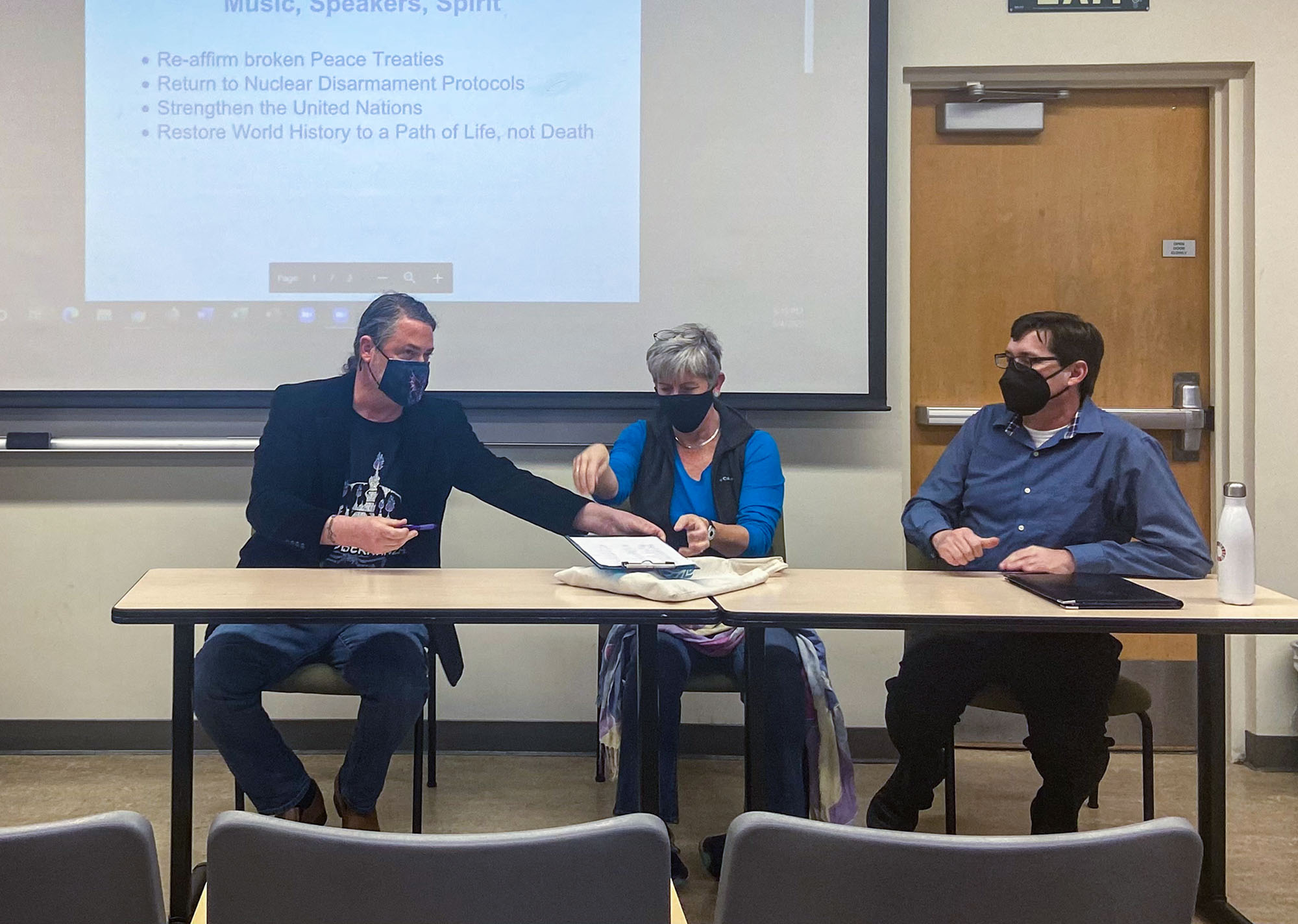
    Professors addressed the complex and multifaceted nature of the Ukraine invasion during an event hosted by the political science department on Friday. They addressed the situation from three different angles with professors breaking down the topic relevant to their expertise.

    Dr. Robert Cliver is a history professor at Cal Poly Humboldt. Cliver gave historical context for the war in Ukraine and explained how the situation is not black and white in his mind. Between the corrupt Ukrainian white nationalist oligarchs and Ukraine’s tentative alliance with the west, Cliver doesn’t think Ukraine is as innocent as they are being painted by the media at large.

    Cliver drew criticism after claiming there were no heroes or villains in war. In his eyes, all of the world leaders are villains fighting over power and resources.

    “I’m against war, period. I think if you’re resorting to violence to achieve your ends you’re not a hero,” said Cliver.

    Cliver warned students against glamorizing and glorifying political figures like Ukrainian president Volodymyr Zelenskyy. Cliver supports the Ukrainian people, but thinks people need to look into the historical context of situations and understand that their perspective may have been altered by nationalistic rhetoric they have been exposed to.

    “It’s very difficult to find heroes and villains historically and when people do, it’s usually for nationalistic reasons and I’m very skeptical of that,” said Cliver.

    After Cliver’s talk, Noah Zerbe from the political science department gave a thorough breakdown of the international relations situation currently unfolding between Russia and the rest of the world. In particular, he explained how the sanctions put in place by NATO would affect both Russia and the global economy.

    “Russia and Ukraine account for about 20% of the world’s corn exports and about 30% of the world’s wheat exports,” said Zerbe, continuing. “So cutting that off from global markets is going to have a huge impact on food prices.”

    Zerbe went on to explain how Russia also accounts for about 20% of the world’s fertilizer so not having that on the global market will impact many types of agriculture on top of the ones previously mentioned.

    Allison Holmes from the international studies department took over after Zerbe. Holmes gave an urgent speech about the importance of fact-checking what you read online and the unreliability of news in the era of social media.

    Holmes explained how social media has changed the way people digest information which has, in turn, made times of crisis like this even more disorientating.

    “Everyone became their own spokesperson, nobody needed to wait for the official statement, nobody waited for a press officer to tell you what was happening out there, the feeds from Twitter, Facebook, TikTok, went straight to the news headlines,” said Holmes.

    She explained how this massive change has resulted in a repetitive news cycle where the most TV-ready looking civilians are asked the same questions over and over and other important developments are pushed to the side.

    “This has produced hours and hours of interviews with young women, most of whom happen to be lovely blondes who all speak perhaps halted but excellent English with at least one if not preferably two children sitting on a train platform going they know not where,” said Holmes.

    Holmes did not want to downplay the situation in Russia, but she does think it is being overplayed by the media, especially in comparison to how other conflicts outside of Europe are covered.

    “I’ve lost the number of times I’ve heard ‘we haven’t seen this since world war II’ which is simply not true,” Holmes said, continuing. “What about Yugoslavia, what about Syria’s impact on Europe and the estimated 13 million refugees or displaced people who are still not home?”637 words

  • Dear Mr. Putin

    by Cheyenne Wise

    In March 2020, Gal Gadot released the infamous “Imagine” video on her Instagram page, an asinine attempt to convey solidarity with a world being ravaged by COVID-19. The rich and famous banded together to imagine a world with “no possessions” while people around the country suffered a social, health and economic crisis wasn’t what the world needed at the time.

    The whole thing was cringy and overall tone-deaf. Step aside, Gal Gadot, because a new savior is here to stop the Ukraine crisis. Actress AnnaLynne McCord, self-proclaimed human rights activist and anti-human trafficking ambassador, released a slam poem video in an attempt to make Russian President Vladimir Putin stop and feel the love. McCord’s over 2-minute long video implies she might have been able to change the Russian leader had she had been his mother.

    Don’t worry Ukraine and everyone else, another white American has once again stepped up to the plate to put a stop to this devastation.

    “Dear President Vladimir Putin: I’m so sorry that I was not your mother. If I was your mother, you would have been so loved,” chanted McCord.

    Putin should be on his knees sobbing at the realization that all he needed was love, right? McCord continued, lamenting that if she was his mother, she would have died to make him warm, to protect him from the unjust, violence, terror, and uncertainty, and to “give you life.”

    If you aren’t convinced that American influencers can save the day, you need to look again. John ‘You Can’t See Me!’ Cena tweeted out, “If I could somehow summon the powers of a real life #Peacemaker I think this would be a great time to do so.” Cena wished upon a star that his DC character Peacemaker was real so he can help, making sure to tag the marketing account for the show.

    All that’s missing from this A-Team is our girl Kendall Jenner with her can of Pepsi to take the front lines.

    Watching the atrocities in Ukraine unfold on top of dealing with the savior complex of these influencers is just disgusting. These influencers are so sincere in thinking that they are uplifting the masses, when in reality they are doing the absolute least. The last time a group of influencers gathered together and actually created change was in the 80s, when “We Are the World” raised millions of dollars in aid of Africa.

    The performative activism of celebrities during these times is unneeded and repugnant. To them I say: keep your slam poetry and songs to yourself. The world doesn’t need cheering up, especially from people like you.