The Lumberjack


Students Serving The Cal Poly Humboldt Campus and Community Since 1929

Tag: University Police Department

  • Breaking the stigma

    by Savana Robinson

    On Feb. 25, 2023, I was transported to Mad River Hospital after Sergeant Andy Martin of Cal Poly Humboldt University Police expressed concern for me. I had lost my phone at the Student Activity Center, and after I got it back I told him and other officers that someone had bugged my phone, people were following me and there were recording devices in my dorm room. Because of Martin’s commitment to helping, I was later given a diagnosis that answered so many questions: schizophrenia and bipolar I. If it weren’t for Sergeant Martin, I don’t know what would have happened, or where I would be.

    Martin knew me before the incident because he had picked up my knocked-over motorcycle for me. I brought him and the dispatcher, Jennifer Gomes, Harley-Davidson keychains and candy as a thank-you gift. Martin and Gomes knew that something was wrong with me because they knew me as a confident, Harley-riding girl – not a scared, paranoid kid.

    “Law enforcement’s role in mental health is complicated, to say the least,” said Martin. “Mental [illness] is not a crime.”

    Because my paranoia was high, the emergency room and the hospital in general was a scary place to be.

    “Some of the [hospital] staff and I have had conversations. They know that it’s not the ideal,” said Martin.

     Following the Lanterman-Petris-Short Act, those under 5150 hold must be taken to a facility designated by the county, which is either the emergency room or county mental health, which has only been taking voluntary patients since COVID. To me, this is a shame. I strongly believe that they should be transported to an inpatient facility for those in immediate mental crisis.

    “It’s designed for medical care, not psychiatric care,” said Martin, referring to the hospital. He recognized that there could be some overlap in the type of care needed for patients. In my case, my second hospital stay warranted medical care because I ran three miles barefoot thinking my hometown was littered with explosives, which tore my feet up. This happened the night after I was released from Mad River to my dad, who took me home to Redwood Valley.

    College is a time in life in which mental illness often manifests. The American Psychiatric Association states that 75% of mental illnesses start by the age of 24. 

    “We see more than our fair share of it,” said Martin. I was given my diagnosis at the age of 22, which is right in that sweet spot for when such illnesses surface.

    5150, also known as the Welfare and Institutions Code, is what allows police to detain a person if they are deemed a danger to themself or others.

    “Those are actually very strict criteria, the idea being that law enforcement shouldn’t be able to detain somebody without good cause,” said Martin.

    The way it works is that if an officer is concerned about someone, they’ll express their concern and give two options, voluntary admission to the hospital or 5150 if the case is severe enough. I was technically voluntarily admitted and I just learned after the fact that I could have left if I wanted to, but hospital staff repeatedly told me that I couldn’t leave.

    If someone refuses admission to the hospital, UPD can put them in contact with an on-campus counselor or county crisis. UPD also works with the Office of Students Rights and Responsibilities (OSRR), who work with Counseling and Psychological Services (CAPS)  and Campus Assistance, Response and Engagement (CARE).

    I have a great support system, and I’ve been told that by several people, including Sergeant Martin. I consider him and all of UPD to be part of my support system. I’m very blessed to have so many compassionate and caring people in my life.

    If you are concerned about yourself or another student, please fill out “Reporting Students of Concern” at deanofstudents.humboldt.edu/CARE or call UPD at 707-826-5555. If it’s an emergency, call 911.

  • UPD still doesn’t have a police chief

    UPD still doesn’t have a police chief

    by Brad Butterfield

    After a spring semester that saw The University Police Department’s force spread so thin that single-officer patrols were a norm, they have recently hired two new dispatchers, promoted an officer to sergeant, and hired one new officer. While slightly better than before, the department’s staffing issues have forced many members of its small team to still work long hours with few days off. Despite the successful recent hirings, the department remains without a permanent police chief and ever-cautious in its search for a new one. The still understaffed force has had to rely on its committed team working overtime to remain functional.

    As many students will have been made aware of through the UPD’s advisory emails, it has been a hectic start to the fall semester. The last two weeks have seen an uncharacteristic barrage of criminal activity on our typically peaceful campus among the redwoods. From “Suspicious Bags Found in Wildlife & Fisheries Building” to “Trespassing Arrest at the Children’s Center” and a tragic “Collision That Injured Student” at one of the campus’s few intersections which left a student in critical condition, this has been an unusually chaotic start to the semester. 

    Throughout this spring semester, Lieutenant Peter Cress filled the role of police chief in addition to his normal duties as lieutenant. Currently, Fernando Solozano, a retired police chief from Long Beach, has stepped in as interim chief until a permanent one is finally hired. 

    Unfortunately, a timeline for the hiring of a permanent chief is difficult to nail down with so many factors at play. Even if the perfect candidate showed up on Harpst street tomorrow, they’d still need to go through a full background check, potential recertifications and additional police academy training (depending on where they transferred from). So, it will likely be exactly a while-longer before Cal Poly Humboldt has a permanent police chief.

    On top of all that, hiring a police chief for a university – especially one as unique as Cal Poly Humboldt – has a number of additional hurdles as compared to your average city police department. Most notably are the Clery Act and Title IX federal civil rights, which affect police operations on a university campus distinctly from those at a typical city police department.

    Moreover, the bureaucracy of a college campus means that a very unique skillset and experience is necessary to perform the job tactfully.

    “The CSU system has its own challenges in different ways. It’s not just a police department in a town where you can go to your mayor and say, ‘Hey, what’s going on?’ We have our presidents and we have our chancellor, so we have lots of different steps… What would be nice is if we had somebody who is familiar with the CSU system, who is eager to grow a police department, and comes in with knowledge, all those things,” Martin said before adding, “we’re not looking for a unicorn, but I mean, kind of we’re looking for somebody who can do all of that.”

    The chief of the police sets the tone for the entire department, Martin explained. They look fifteen years down the line and act as captain of the ship, adjusting course towards innovation and progress. The fact that the department has been absent a chief for so many months and remains not only functional but reliable, serves as testament to the unwavering dedication of each member of the department. Importantly, though the search for a permanent police chief remains a top priority for the department, they are not rushing the process and will not pull the trigger unless the fit is perfect.

     “Our VP [Sherie Gordon] has a very set criteria of what she wants to hire. She just doesn’t want to settle. She wants somebody who’s going to do justice to the police department and our campus,” Martin said.

    Martin’s explanation for the still vacant chief position hinted that perhaps having no police chief is better than having the wrong police chief. 

    “It’s about finding somebody who wants to be here, who is willing to put in the work,” Martin said before continuing, “Somebody who’s progressive, understands what we’re trying to do here. And we’ve struggled at finding a very qualified person that can slide into that role and help our police department grow.”

    This spring saw the lean department frequently functioning with only one officer on duty at any given time. 

    The recent new hires have eased that strain slightly but they’re currently still running some single person patrols, as they are having trouble finding qualified officers. 

    Aware of the mounting need for more personnel, the UPD have put together an incentive package and have hired a firm to recruit nationwide to find fitting candidates. A common theme in talking about the difficulties in hiring was UPD’s emphasis on hiring the right candidate. They are not interested in hiring just anybody so that they have additional boots on the ground. They’ve got to be the right boots. And of course, this is Humboldt – they’ve got to have the right vibe.

    “We are not just filling boxes and trying to put a cop in a seat just because I need a number. I’ve got people who are willing to come here,” Martin said. “We just want people who are going to be a positive addition to the police department and how they interact with our community and how they’re willing to change and how they’re willing to grow.” 

    “We are looking for the right people to be a part of that police department as we grow,” Martin emphasized. 

    Remaining a community based police force appears to be a top priority for the department when considering new hires.

    “Our community as a whole is more laid back,” Martin said. “100% we want to be able to be part of that culture.”

    The understaffed department has relied on its indomitable staff to keep the peace on campus. 

    “It’s been the staff. The staff is really the reason that we’re still moving forward and getting stuff done,” Martin said. “A lot of overtime for different people, a lot of hours are being put in and everybody’s just still getting the work done.”

    Martin put in about thirty hours of overtime last month, with this month’s overtime hours quickly racking up. Impressive as that is, dispatcher Jennifer Gomes’ work schedule borders on super-human.

    “I have, technically, one full day off this month. My normal schedule is day-shift Sunday through Wednesday,” Gomes said. “But I’m covering graves for the second half of the week right now, and then my one day off for the week is the day that I rotate back to day shift. So, I sleep all day to try to accommodate coming back to day-shift.” 

    With two new dispatch trainees set to complete their training in October, respite is on the way. The dispatch ‘family’ will be back to three days off per week with just one dispatcher role left to fill. An unsung hero of Humboldt, Gomes explained her reasoning for weathering the recent tough times at the UPD. 

    “Everybody’s pulled their weight, come together kind of as a family and just pushed through the staffing issues,” said Gomes. “Just push through the hard times here, we’re all coming out of it.”

    With millions upon millions being put toward Cal Poly Humboldt’s expansion, it seems the unstoppable force of dollar-driven change is also working overtime here in Humboldt county. Change is a comin’. 

    “As our faculty and our staff grow, there are gonna be different expectations as we modernize our campus and in the directions that we had. So, we’re also gonna have to keep up,” Martin said. “We want to maintain that same service that we’ve had, we want to be able to have these conversations. We want to be able to play pool with our students and whatever events and be accessible and always there. And that’s one of the things we look for when we’re trying to hire people.”

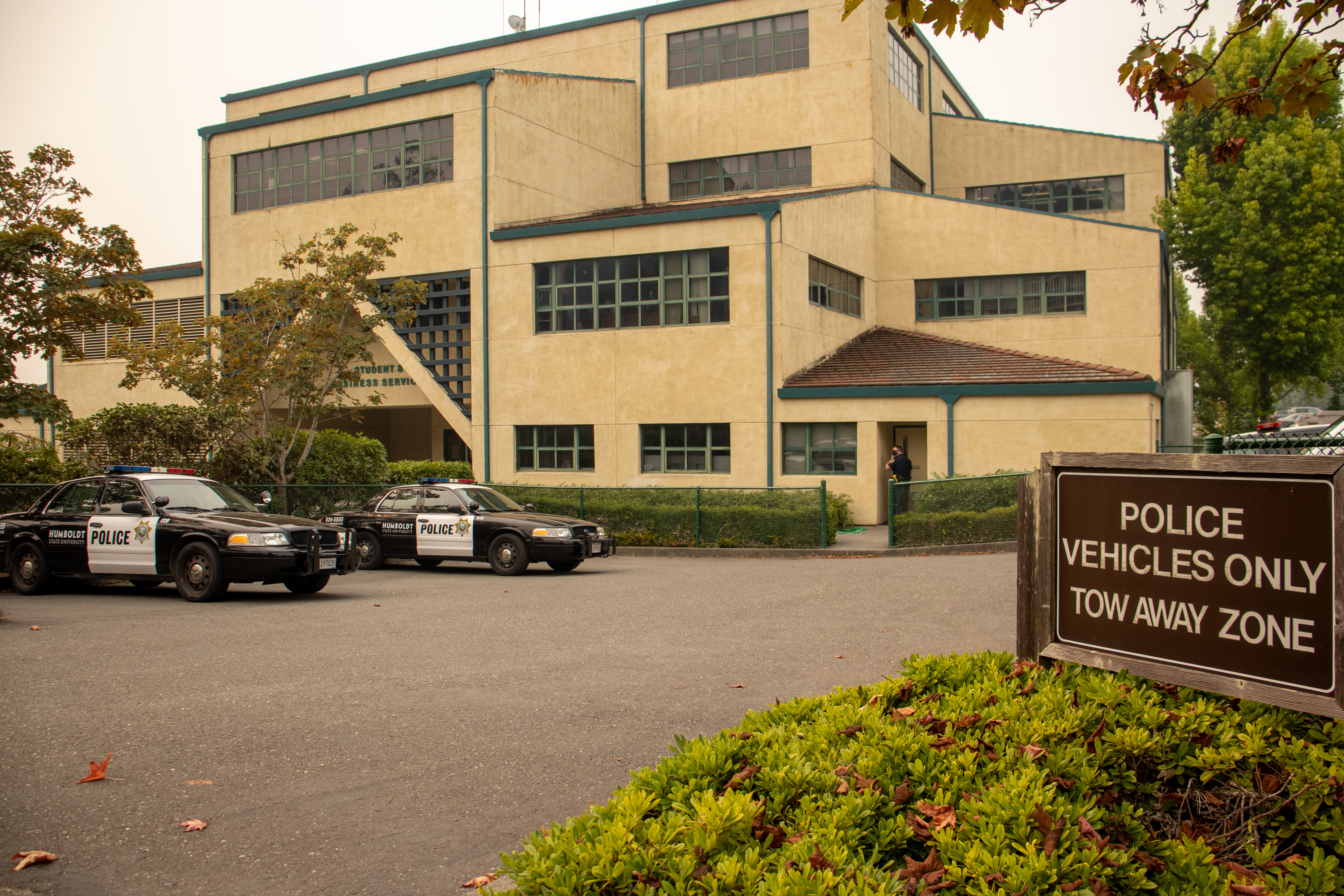
  • The UPD is still understaffed and without a police chief – but not desperate

    by Brad Butterfield

    Originally printed May 3, 2023

    An expected 2,000 additional students are anticipated for the Fall ‘23 semester, threatening to strain an already understaffed police department at Cal Poly Humboldt. The UPD is currently absent a police chief and shorthanded in both dispatchers and officers. Since early March, the number of new hires onto the force has not increased—not for lack of effort. Despite working long hours to compensate for the lack of personnel, Sergeant Andy Martin remains optimistic.

     In early March a candidate for police chief, Kevin H. Williams, was interviewed by the hiring committee. Williams, a former LAPD lieutenant with a long resume as a public servant in many departments, filed a lawsuit against the City of Los Angeles in 1999. The suit claimed racial discrimination and cited that Williams suffered from pseudofolliculitis-barbae, which allegedly prevented him from shaving his beard and commonly afflicts Black men. A federal district court would later dismiss the case. Martin, who serves on the hiring committee for the department, couldn’t divulge the reasons Williams was not hired onto the UPD force. With extensive medical tests, background checks, psychological evaluation and training required in the hiring of any officer, Martin explained that it is unlikely CPH will have a police chief come the Fall ‘23 semester.

    “I would be shocked if it all happens before fall semester starts, but things happen. I’ve been surprised before, but I don’t think so,” said Martin.

    Although short staffed, the department is not rushing the hiring process. 

    “Our Vice President [Dr. Jenn Capps] puts a lot of expectations and weight behind the police chief and so, she’s made it clear – she’s not just going to hire anybody. She wants to make sure she’s hiring the right person for the job and what we need on campus,” Martin said.

    While scrupulous hiring is partly to blame for the lack of personnel on the force, it is far from the only force at play here. The very features of Humboldt county which attract many residents often work against the UPD’s effort in enticing new officers to join the force. 

    “The county tends to be a little behind the rest of the country in some aspects. You know, the night life completely shuts off at a certain hour. It’s a quiet place,” Martin said. “We don’t have the fast food chains. We don’t have what you would expect in some of the bigger cities. That can be a detriment for us sometimes because we are asking somebody to come to a more remote and isolated spot.”

    Martin further explained that being behind the ‘Redwood Curtain’ filters out many potential officers. 

    “It’s just hard to convince somebody to come work up here in a smaller department… It’s intimidating for a lot of people if they’ve never been here,” Martin said.

    Just as in March, dispatcher Jennifer Gomes is still working long hours as one of only two full time dispatchers employed by the UPD. Two potential hires for dispatcher are being considered currently, but even if both are hired, “they’ll probably still be in training as the next semester gets going,” Martin said. Additionally, one officer is currently going through the hiring process. 

    “I am optimistic that they will be here before this next semester,” said Martin.

    Evidently on the backfoot, the likely addition of two dispatchers and one officer will still leave the UPD undermanned. Lack of officers means that there is often just one officer on duty. In anticipation of the rapidly expanding new polytechnic university, the UPD will be hiring another sergeant and a couple more officers. 

    “That process is just getting started,” Martin said. “So I expect that some of them will start mid [fall] semester at some point.” 

    Regarding the massive influx of students coming to Arcata for the fall semester, Martin is confident that the department will be ready.  “Our staff is incredible. You can tell by the hours people put in and the heart that they give to this department,” Martin said before adding, “It would be a little more comfortable if we had more people though.”

  • HSU Considers UPD chief candidate: Jason Wade

    HSU Considers UPD chief candidate: Jason Wade

    Captain of the University of Oregon police department, Jason Wade, puts his hat in the ring for UPD chief at HSU.

    Following the retirement of former chief, Donn Peterson, in the end of May, the University Police Department has begun its official search for a new chief. Current captain of the University of Oregon Police Department, Jason Wade, is one of the two candidates currently in contention for the position.

    Wade has more than 20 years of experience in law enforcement, working primarily for the University of Colorado, Boulder Police Department and for the past six years with the UOPD. In his time with the UOPD, Wade has served as an instructor and director for their cadet academy, developed their body camera program and served as the internal affairs investigator managing the background process for new employees.

    In today’s atmosphere of nation-wide calls for radical change regarding the country’s law enforcement system, Wade believes that rather than defund police departments, we need to re-think them.

    “The police in the past were seen as the catch all. You know, if you have a problem you call them,” Wade said. “And the expectation was that they were able to respond and serve equally no matter what.”

    Wade is of the mind, not every call for service requires the response of a police officer and that many non-violent calls would be better handled by mental health professionals.

    “The police still are responsible for enforcing the laws and keeping people safe but how can we better address those issues,” Wade said. “That’s one of the largest levels of police reform, is the calls for service and how we respond with what we respond with.”

    According to Wade, the benefit of having a campus police department, in specific, is the collaboration with the university that wouldn’t take place with a city department.

    “The campus police department can be brought forward to help the campus,” Wade said. “We can be trained. We can work with the campus to develop the department that the campus needs.”

    Campus police departments can also be held to a higher level of accountability by the university. Given the job, Wade plans to implement the policy work groups system currently in place at the UOPD.

    The system involves reading every new policy or change in policy at the UPD to a community panel made up of students, staff and faculty of the university who are given the opportunity to weigh in on each policy.

    “At some level there has to be oversight that allows the community to see what occurs behind the walls of a department,” Wade said. “So, they know that if a complaint, an allegation of misconduct or something is going on inside the department, that it’s being handled and handled appropriately – and if there is misconduct, that we’re taking measures to not let it happen again.”

    When Wade started as a young police officer, he said it was all about how many tickets he would write, how fast he could drive and the fancy gadgets he got to play with.

    “That was the mindset back in the late 90’s,” Wade said. “There were problems then, but we didn’t address them. We didn’t have the concepts of implicit bias training or crisis intervention training. I’ve seen change occur, but we’re not there, where we need to be, yet.”

    Ultimately, Wade believes, rather than acting in the interest of whoever is in power, a UPD has to hold the best interest of the entire community above all, in order to succeed in creating a safe learning environment for students.

    “This should never be the ‘Jason Wade’ Police Department,” Wade said. “Because that will not be successful.”