The Lumberjack


Students Serving The Cal Poly Humboldt Campus and Community Since 1929

Tag: Veterans

  • Veterans find healing through the arts

    Veterans find healing through the arts

    by Andrés Felix Romero

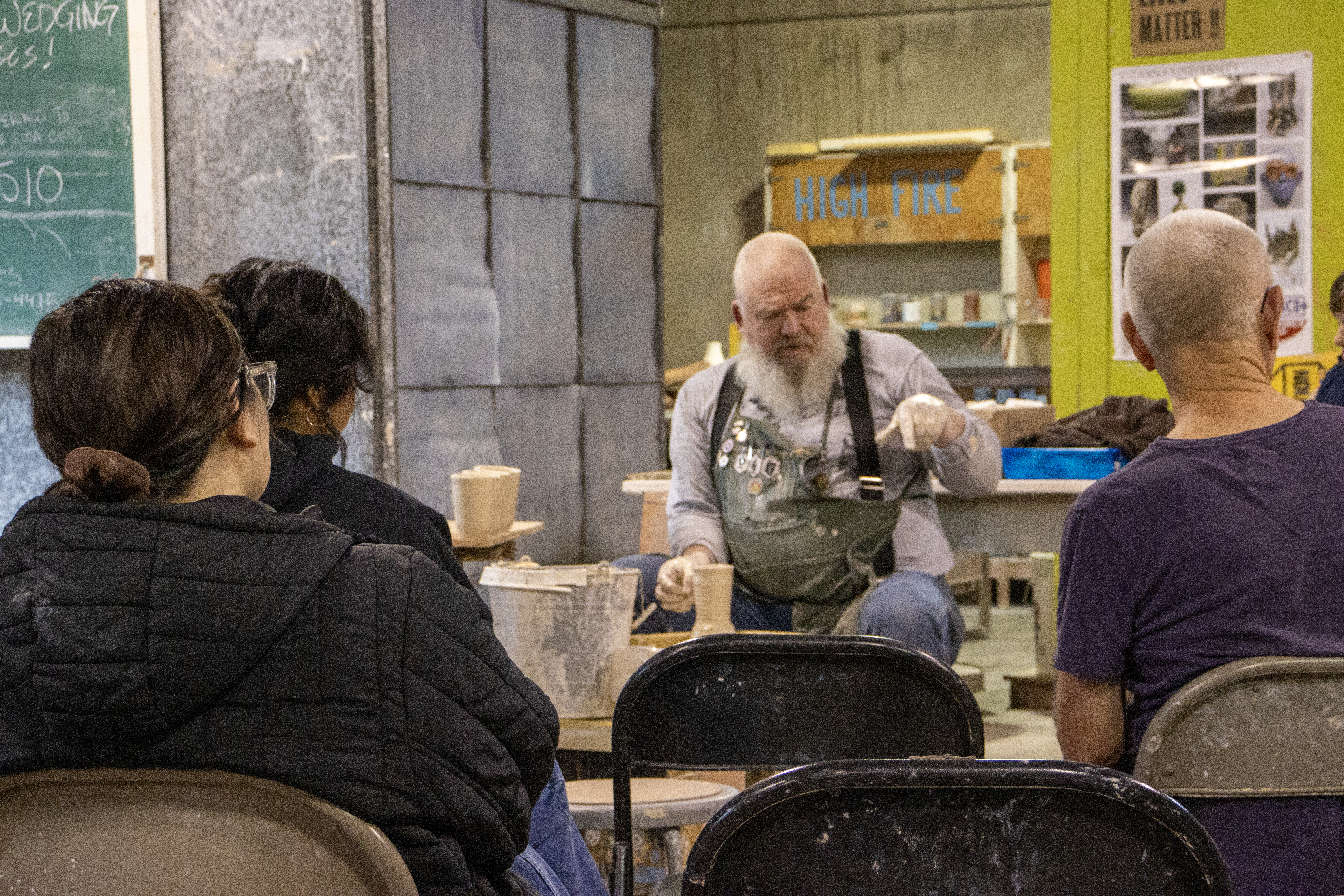
    On a gloomy Thursday afternoon, a Gulf War Marine Corps Veteran brought a warm energy to the ceramics studio, nicknamed, “The Laundry.” The veteran, Ehren Tool, is the senior laboratory technician for the ceramics studio at UC Berkeley, and has created and given away over 26,000 ceramic cups. Tool’s art documents the pains that military veterans struggle with after their service. Tool smiled behind his bushy beard and told stories about his healing journey, from his time as a Marine to his time as an artist. Tool expressed how his ceramic cups convey aspects of military culture that are difficult to openly discuss.

    “The cups are an opportunity to talk about unspeakable things,” Tool said. “War is murder, and military sexual trauma is rape, that happens in the civilian world too. Where can you talk about that? Where in polite society do we talk about these things that happen with too many people and the effects they have on their lives?”

    Ceramic students in attendance to Tool’s demonstration, such as Jack McCann, were inspired by how veterans have found ways to express the grief they feel. 

    “I really felt like in the art there’s a lot of pain, every piece is almost like mourning,” McCann said. “It’s helpful to see people grow even after experiencing something like war.”

    The class that Tool was a guest instructor for was part of a weekend-long veteran’s day celebration, organized by Humboldt College Corps, Cal Poly Humboldt’s College of Arts, Humanities and Social Sciences and College of the Redwoods. The events aimed to focus on how veterans can heal from their traumas in the military. Part of the weekend events was a dinner and panel by veterans at the Arcata Veterans Hall on Nov. 9. Tool was part of the panel alongside Air Force veteran Mark Walker. Walker is the East Bay Deputy Director for the veteran’s support non-profit, Swords to Plowshares. Walker and his wife Lynn were in attendance at Tool’s demonstration in The Laundry. Lynn Walker hopes that the arts can help veterans similar to how ceramics have helped Tool. 

    “For me, [art] allows you to open up [feelings] that are suppressing you, to things that you don’t want to say,” Lynn Walker said. “[Art] opens up your being to where there’s a healing process as you identify [your emotions] through art.” 

    Alongside Tool and Walker for the Nov. 9 panel were Air Force Veteran Joe Fox, Marine Corps Veteran Ryan Jensen, Veterans Affairs Health Nurse Ella Price, and U.S. Army veteran and Dean of Arts, Humanities, and Social Sciences Jeff Crane. Crane shared his experiences on how education in his college has supported veterans.

    “I’ve thought about this in my own work,” Crane said. “Arts and Humanities have a critical role to play in veteran’s transition, in supporting veterans, and in educating people about the role of the military in American life and in the world.”

    Panelist Joe Fox is an interdisciplinary studies major at Cal Poly Humboldt and also facilitates a veteran’s ceramics class at College of the Redwoods

    “I found healing in significant ways through playing with clay,” Fox said. “My only plan in all of this [art] is that somehow I’ll be able to connect some resources in our community, and there will be space for other people to find [healing].”

    The main event was the 3rd annual Veteran’s Day at McKay Community Forest in Eureka, CA on Nov. 11. There was a five and ten kilometer walk/run, as well as free barbeque, music, and painting. There was an opportunity for attendees to decorate their own ceramic mugs to be completed later. On Nov. 13 and 14, there was another ceramic demonstration at College of the Redwoods by Jessica Putnam-Phillps.

    No matter how veterans try to overcome their traumas and suffering, Mark Walker holds onto hope that his fellow vets will find whatever sustainable means available to find their healing, art or otherwise.

    “Different veterans find different things of purpose, inspiration, and therapy,” Walker said. “Whether it’s formal or informal therapy. It’s just about what veterans find to be healthy, get healthy, and stay healthy.”
  • Connections Between Veterans Propel Academic Success

    Connections Between Veterans Propel Academic Success

    Student veterans make connections and have access to resources with help from VETS

    Humboldt State University has about 500 veteran-affiliated students, according to HSU Veterans Enrollment and Transition Services.

    James Lamping, the outreach coordinator at the VETS office and a veteran himself, works to connect veterans by giving them a place to talk, seek therapy and find friends.

    “Every vet comes from a different background, and it’s an interesting community,” Lamping said. “Even though there is a lot of diversity between us, we all share a culture tying us together.”

    Nov. 11 is the anniversary of the signing of the armistice, which ended World War I. The day honors former and current military service people and is observed as a federal holiday, Veterans Day. HSU students and faculty have the day off.

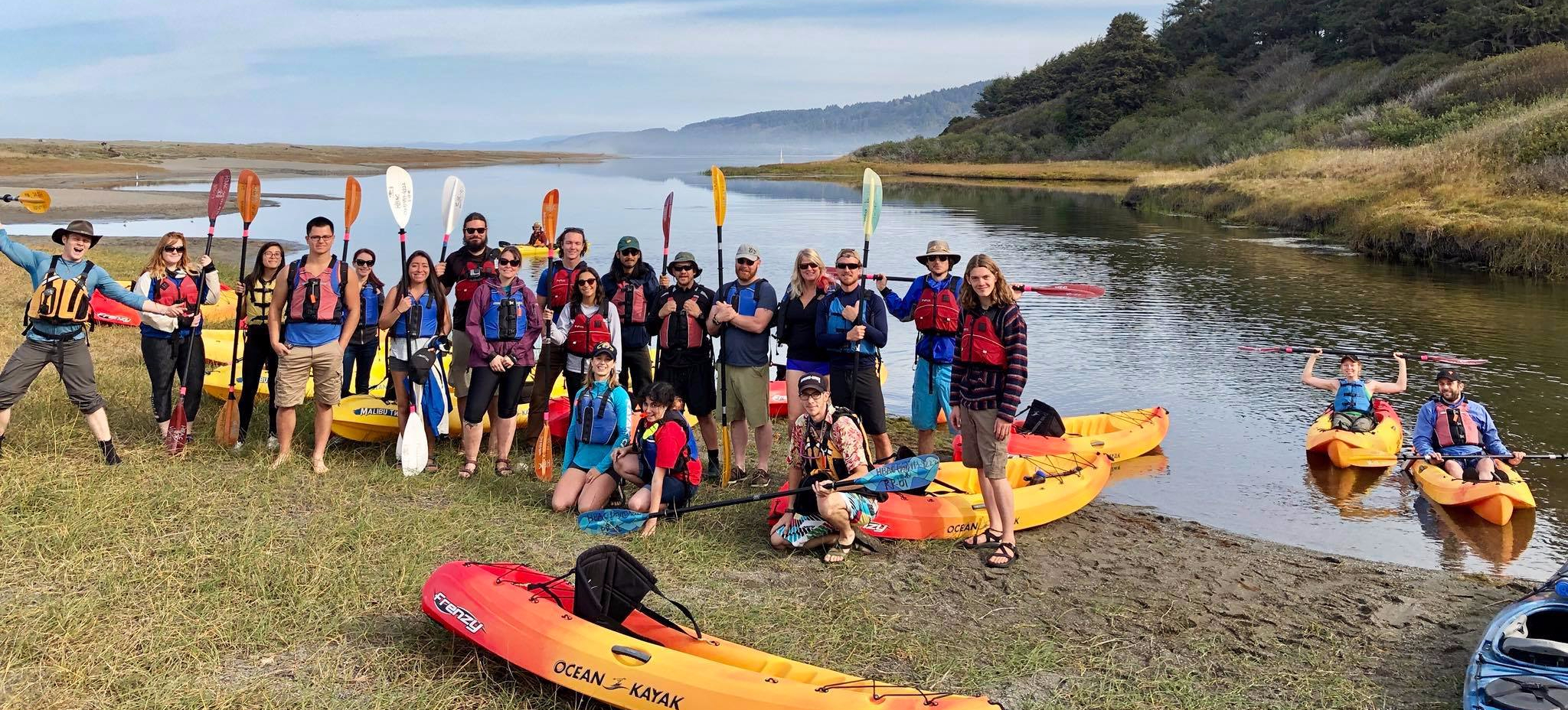
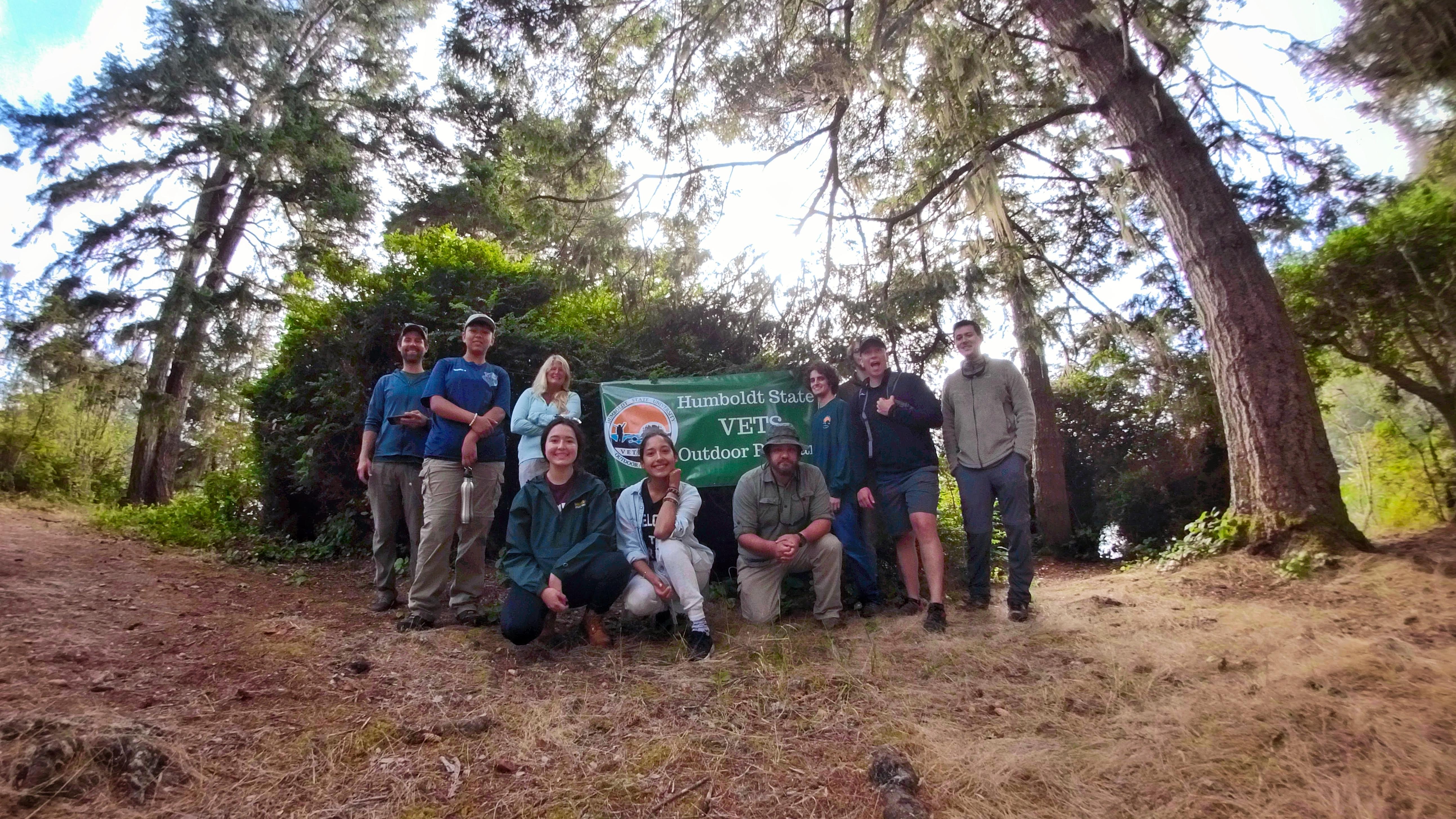
    One way the veterans at HSU connect is through the Outdoor Sports Program facilitated by the VETS office. Year-round, a group of veterans partake in several outdoor sports activities like hiking, kayaking and snowboarding.

    James Lamping (left) and John Biggs. | Photo courtesy HSU VETS

    John Biggs, a student veteran majoring in marine biology, went on one of the outdoor trips when he moved to Humboldt State in the spring of 2015. He was able to familiarize himself with other students and build relationships.

    “We did a big hiking trip up in the Trinities, a rafting trip,” Biggs said. “All the people I met on that trip were my core group of friends when I started here.”

    Biggs said that having friends and familiar faces in his classes helps him focus on learning. It had been six years since the last time he took an algebra class.

    “I feel like I’m more successful taking classes when I know somebody and have someone to talk to and study with than just myself,” Biggs said. “I’m not someone who asks questions. That’s just my personality.”

    Lamping said veterans are one of the more successful populations on campus, partly due to the structured lifestyle that is familiar to military life. Having something to do every day provides a daily purpose.

    “Having the structure is nice,” Biggs said. “To have something to do rather than figuring it out on your own.”

    The VETS office provides help and academic services for veterans. VETS connected Biggs with the Student Disability Resource Center to help him in the Learning Center.

    “I’m not a big test taker, so that was fun,” Biggs said. “That was really helpful.”

    Kim Hall, veterans program administrator for HSU, was one of the people who helped Biggs get back into the flow of school. Hall started the outdoors program and also started the North Coast Veterans Stand Down, a three-day event that provides food for homeless veterans at the county fairgrounds in Ferndale.

    In celebration, HSU VETS is hosting a dinner event this Friday, Nov. 15 at 6:30 p.m in the Green and Gold Room on HSU’s campus. The Veterans Day Celebration is free for veterans and their families.

  • Backpacking not Ruck marching

    Backpacking not Ruck marching

    Outdoor program creates community for HSU veteran students

    Driving back to Humboldt County after the Lightning in a Bottle music festival, Sean Dent found out his roommate kicked him out for no reason. Immediately after hearing the news he got into a car accident. Fresh out of the military and brand new to Humboldt State University, Dent felt lost in 2016. After weighing out his options he went straight to the VETS Office’s outdoor program and went on his first hiking trip with other veterans. The trip changed his life forever.

    [perfectpullquote align=”right” bordertop=”false” cite=”Sean Dent” link=”” color=”” class=”” size=”18″]”I lived in my car a few months while looking for a place. It wasn’t until I found a community here that helped my mindset. That community was other vets.”[/perfectpullquote]

    “It was my first trip and my favorite trip,” Dent said. “I was foreign to California and recently out of the Army. The hike was beautiful. A mentor brought me in and gave me strength. He physically reached out because it helped him in the past.”

    Dent is an environmental science and management major with an emphasis in ecological restoration. Originally from Virginia, Dent enlisted in the Army “out of necessity” because that was his best option. While enlisted in the military from 2012-2015, Dent was stationed in Louisiana until he was deployed to Afghanistan.

    “It was a hard transition into college,” Dent said. “I lived in my car a few months while looking for a place. It wasn’t until I found a community here that helped my mindset. That community was other vets.”

    IMG_9699.jpg The Veteran’s Office gives out free pint glasses for veterans. | Photo by T.William Wallin

    Environmental resource engineer Paulo Martin had a similar experience when first enrolling at HSU. Martin was born in the Philippines and was stationed in South Korea from 2009-2013. He now handles the VETS Office’s social media and promotes the positive events they’e doing, such as the outdoor program. Martin said the VETS Office takes care of soldiers transitioning into students but would like to see more vets coming in.

    “It’s weird coming from a soldier training for war or getting gassed everyday,” Martin said. “We are told what to think everyday and as a student it isn’t like that, we are told to think for ourselves. The outdoor program helps with that transition.”

    Both Dent and Martin didn’t think they would like backpacking or hiking because of all the ruck marching they had to do in the military. But as civilians Martin said his favorite trip is the hiking trip. Through the outdoor program HSU veterans take multi day trips to places like the Trinity Alps or for the upcoming spring break, Mt. Bachelor, for snowboarding. After a three day hike they will end the trip with white water rafting.

    “At first if you tell someone in the army you’re going hiking they roll their eyes,” Martin said. “But being able to hike without a weapon and a 50 lbs. bag has made me love hiking.”

    Coming from a military background Martin is used to being with a squad and the outdoor program creates a similar community for him. Martin said vets have more pitfalls and rough personalities, having a platform to go out in nature that is different than the toxic state of the army is refreshing.

    “I don’t like to talk to regular citizens about my military experience,” Martin said. “But with other vets we’re on the same plane and can relate with one another. Some people freak out about my stories.”

    IMG_9700.jpg Kim Hall founded the HSU’s veteran’s resource center over 30 years ago and started the outdoor program in 2009 as a therapeutic program for soldiers transitioning into students. | Photo by T.William Wallin

    Veteran program administrator Kim Hall created the outdoor program in 2009 through Outward Bound. The program was created as a wilderness therapy to support veterans transitioning as HSU students. Hall also established the HSU VETS in 1990, the veterans resource center on campus. It was one of the first in the state as well as being one of the largest today, serving around 500 military affiliated students.

    “At the time there was a lot of vets coming in trying to navigate the CSU system,” Hall said. “I was working in administration and saw the need for more. I liked working with them better than traditional students. What keeps me coming back to campus are the vet students.”

    Dent said the outdoor program has brought a lot vets who are new to the area together and life long friendships have bonded. Dent said he has met his best friends in the outdoor program, like Paulo Martin.

    “I can’t even explain what the outdoor program has done for me,” Dent said. “We’re always looking for a challenge. Going through a challenge together like hiking or snowboarding builds camaraderie deeper than normal friendships because we’re going through the same things. I now have life long friends.”

    Next Veterans meeting is at E&O bowling in Blue Lake on March 8 at 7:30 p.m.

  • Living with PTSD

    Living with PTSD

    By | Bryan Donoghue

    Walking down a street of their hometown, a veteran smells the essence of diesel emitted from a nearby gas station. Their brain remembers it as the same smell from when they were riding into combat. Immediately, their body goes into a fight-or-flight response and reacts as if their life is on the line. Although this is a hypothetical situation, it is all too real for numerous veterans afflicted with post-traumatic stress disorder, or PTSD.

    The US National Library of Medicine’s National Institutes of Health stated that 500,000 American troops who served in wars over the past 13 years have been diagnosed with PTSD, and even more, it affects about eight million American adults annually. About 7 to 8 percent of the population will have PTSD at some point in their lives.

    For the Director of the Eureka Veteran’s Center, Deborah Reeves, it’s a condition that’s occurred throughout her family.

    “I personally choose to work with veterans because I have a family system that’s been impacted by military trauma for many generations.” Reeves said. “My grandfather had post traumatic stress disorder, my father has post traumatic stress disorder, my siblings have post traumatic stress disorder, my husband has post traumatic stress disorder— all from various different experiences at different times.”

    Reeves devotion to helping veterans is an influence for her to educate herself on PTSD, and other topics pertaining to veteran care.

    “The first thing that people need to understand if they’re looking at it from an uneducated perspective is to get educated.” Reeves said.

    The sentiment is shared by Rob Hepburn, a 70-year-old Vietnam War veteran and local gardener for the Veteran Memorial Park between G street and F street in Arcata. He was in the war part of 1966, all of 1967, and part of 1968. Within his 13 months of service, he participated in the Tet Offensive, which was one of the most crucial battles of the Vietnam War.

    “Most people, the only thing they get to hear about vets is what they read in the papers or on social media, so most people don’t even know a vet personally.” Hepburn said. “You get pigeon-holed by a lot of people right away, they have this stereotype of what you are.”

    Education is necessary to understanding the topic of PTSD, and according to the United States Department of Veteran Affairs, there are four types of symptoms when reviewing whether someone is afflicted by the disorder.

    First, an individual re-experiences the event almost like they’re re-living it. Each person with PTSD has triggers, which is when they sense something that causes them to have flashbacks and nightmares.

    “Post traumatic is pretty hard to define in and of itself, it’s an experiencing type of disorder.” Reeves said. “It’s an external event that has happened that has caused lingering internal experiences.”

    Flashbacks or nightmares can be triggered by anything. It all depends on the individual as PTSD varies between people.

    “I’ve had flashbacks, luckily i haven’t had a flashback in a couple years, but you’re always thinking something really bad is going to happen.” Hepburn said.

    Sight, smell, and sound are all components of what can trigger a person’s flashbacks. Triggers are about how external variables effect someone internally.

    “I can’t stand to hear anything crying, I mean a lot of people get upset when they hear crying, but for me, I totally freak. If a cat’s meowing, I have to get away, or a dog when it barks.” Hepburn said. “Anything like that just triggers something in me. So you imagine those things happen everyday to people, but to me with PTSD, everyday is kind of a challenge to keep my cool.”

    The trigger is like the body’s natural way of protecting itself, flashbacks happen as a response to a need for safety.

    “It is a diagnosis that any and everyone can get by experiencing an external situation that causes them to fear for their safety or someone else’s.” Reeves said.

    Secondly, people with PTSD may avoid situations that remind them of the trauma. For veterans, that could mean anything. To help himself avoid those kind of situations, Hepburn tends to his garden.

    “Gardening is my meditation. I mellow out.” Hepburn said. “I have a service dog that I usually have with me, I don’t have him right now. He helps me stay mellow and grounded, just holding him and carrying him around.”

    Along with gardening and his dog, Hepburn goes out into to nature as a way to help himself. He takes walks in the community forest and goes to the beach. When it comes to taking medication to help him with his condition, he decides to take as little as a possible.

    “They just make me feel like a zombie.” Hepburn said.

  • Iraq to Humboldt

    Iraq to Humboldt

    By | Andre Hascall

    Being in the military and being in college share a few similarities, according to Marine Combat Veteran Emilio Pena. However, as he said, it is still impossible to compare.

    “In boot camp you get used to being in close quarters with everyone, like the dorms,” Pena said. “You create those bonds with people, being close with them and going about your whole day with them.”

    Pena, better known as ‘E’ to his friends, graduated High school in 2004 and almost immediately enlisted into the United States Marine Corps. Yet his contributions to the USMC were halted for a year when he broke his collarbone shortly after enlisting.

    “I could tell that my recruiter thought that I was faking to get out of what i signed up for,” Pena said. “But once I healed up they sent me to boot camp in San Diego a couple weeks after.”

    Pena says that his favorite food are corndogs. He refers to himself as “super basic” because of this. “We didn’t have full kitchens in the barracks,” Pena said. “So I’m used to eating frozen foods.”

    Spending time at boot camp in San Diego led to Pena getting even more training, this time in North Carolina going to school for the USMC.

    After school, Pena got his first taste of being overseas when he was sent to Japan for two years. “Japan was crazy. It was fun. It was crazy fun,” Pena said.

    Pena spent his time in Japan at an age where many people start their college careers. Pena said it was Japan where he did most of his growth, from a boy to a man.

    “There were plenty of people that were college aged, out and about,” Pena said. “It was great, I was the same age as them but without the homework.”

    Whenever Pena had some free time he made the most of it. Pena said that Japan nightlife is a huge party, every night.

    When specifically talking about Japan, where Pena spent most of his time as an active member of the USMC. Pena says that he made friends for life out there.

    “Once you leave that Environment there is nothing else like that,” Pena said. “I guess it would be similar to being on a sports team.”

    Pena is a fan of sports. ” I like the Sharks, the Yankees and the Raiders,” Pena said. “I love basketball too much to pick a team, I enjoyed watching Charles Barkley play, but I’m a Kevin Garnett fan for life.”

    After his stint in Japan, Pena went back to boot camp in San Diego for a few months, and shortly after spent nine months overseas in Iraq. Tours usually last six months, but Pena left the US early and stayed in Iraq late.

    “I left early and stayed later because of the money, that part made it worth it,” Pena said. “Overseas i got to work with expensive equipment too, so I was constantly flying over Iraq.”

    Fast forwarding to 2014, when Pena started his journey at Humboldt State. The Student Veteran Association was able to help Pena out right away.

    “I was living in my car when I got up here, Kim who runs the SVA saved me” Pena said. “Kim Hall helped me get a place to stay Fall 2014, I still live there now.”

    E even recalled other times when he was able to call on Kim Hall for help, and she delivered. Specifically noting a time that she helped E stay in school, despite Academic Probation.

    “She helped me a couple times,” Pena said.

    Aside from the SVA, Pena used other outlets to get acclimated to the college life. He joined the Kappa Sigma fraternity and has retained relationships through them. But he says most friends he has were made on the court.

    “I started balling at 11 when I got cut from my football team,” Pena said. “Now I play intramural ball on Tuesday nights, as well as Thursdays and Fridays.”

    In his 30’s, Pena says that basketball is the best way for him to get himself to workout. Playing against younger people help out with that.

    “I got 20 years of experience,” Pena said. ” I don’t got the same moves as I used to, but when you know where to be and what to do, you can still put it down.”

    Pena is finished with his bachelors degree in Psychology, but he is staying in Humboldt for a while longer as he works on his GPA. Pena is contemplating going to Grad school, but he will take on these tasks as they come.

    “Hey I’ll try to get my PhD if they let me,” Pena said with a chuckle. “But after that I hope to be a Combat Veteran counselor, and help make a difference.”

    *Emilio Pena and Andre Hascall are both members of Kappa Sigma fraternity

  • A veteran community at HSU

    A veteran community at HSU

    By | Charlotte Rutigliano

    With a strong sense of community, the Student Veterans Association (SVA) have been helping student veterans since 2008.

    SVA President James Lamping said that the club is about creating an atmosphere and peer to peer support for veterans, dependents, and active service members on campus.

    “We having monthly meetings to help create a community on campus for veterans,” Lamping said. “This kind of club can help with a veterans transitions back to civilian life.”

    Navy veteran and Environmental Science major Heather Navle-Stierley said that when she got out of the military in August of 2015, she had very little support.

    “The SVA has helped me transition into student life,” Navle-Stierley said. “Military life was all I had ever known since I was 18 years old.”

    Navle-Stierley, who is also acting SVA vice-president said that she has always felt welcomed and not judged for being a combat veteran with little civilian life experience.

    According to Kim Hall, Veterans Coordinator as of Fall 2017, there are around 740 veteran affiliated students on campus, ranging from veterans, dependents, and active service members.

    “We have around 180 veterans, 585 dependents, and a handful of active duty service members,” Hall said.

    Air Force veteran and marketing major Myra Hallman is one of 22 registered members of the SVA. She said that being apart of SVA gives her a way to contribute to the community in different ways, and it helps polish her leadership and time management skills.

    According to Hallman, the SVA recently ran a supply drive to help the families in need down in Puerto Rico and the Virgin Islands.

    “It’s a small way to help those in need,” Hallman said.

    Hallman said that she feels very fortunate to have an opportunity to work with some of the best and brightest student veterans at HSU through the SVA.

    According to Lamping, the club here on campus is part of a larger national organization called Student Veterans of America.

    “Student Veterans of America helps campuses nationwide create community resource centers,” Lamping said. “We’re opening up one here in Library Room 55, within the next few weeks or so.”

    According to Lamping, the SVA will be going to San Antonio, Texas during the winter break for the Student Veterans of America conference, which brings together thousands of student veterans from across the country.

    “We’ll being driving an RV there and back,” Lamping said. “The RV is gonna have a big HSU and SVA logo on the sides.”

    Lamping and Hallman said that they will be documenting the entire trip and sharing the clubs journey on social media as part of a marketing campaign for Student Veterans of America.

    “We’ve been talking to the marketing and communications team about taking over the Instagram page for the trip,” Lamping said.

  • Student Veterans gains larger community space

    Student Veterans gains larger community space

    By | Lauren Shea

    The community space for student veterans has grown as the support for student veterans continues.

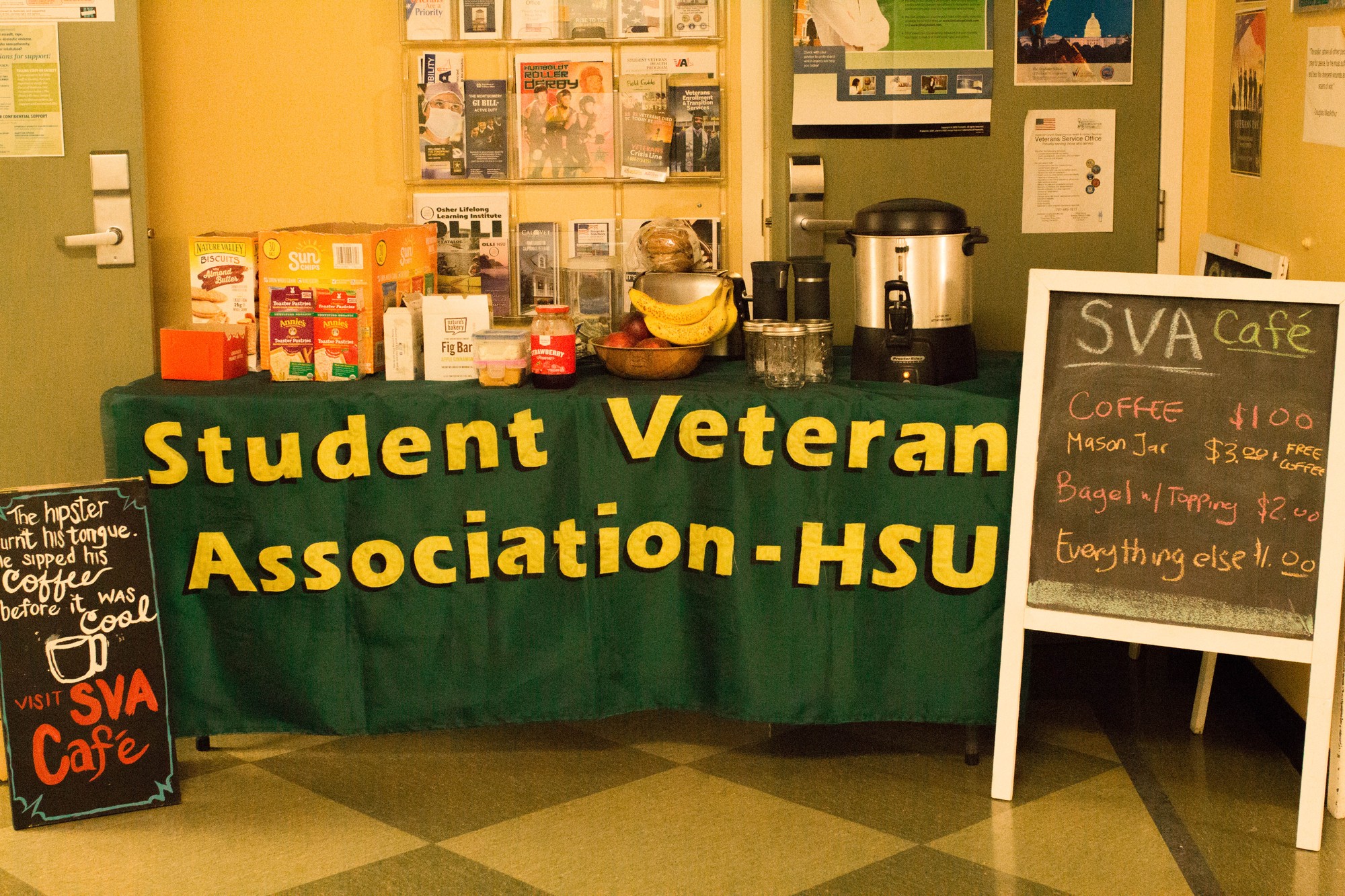
    The Student Veterans Association cafe is up and running again. The café helps fund activities and events for student veterans. The café resides outside the Veterans office on the lower level of the library.

    The food ranges from coffee to organic food and gluten free options. James Lamping, Forestry Major, talked about the type of food they have at the cafe.

    LSSVA2
    Mural inside the Veterans Office in the Lower Library room 58. Photo credit: Lauren Shea

    “We usually try to have healthier options,” Lamping said. “Once we move into the larger community space, we would like to try to create SVA mason jars for students.”

    Lamping is a U.S. Navy veteran where he spent six years in the service.

    “The biggest off-putting factor of going back to school after the military is the huge age gap,” Lamping said. “Being 28 in college with people much younger than me was tough. It helps to find a common ground with people.”

    The Student Veterans Association not only provides resources for student veterans, but a space to build relationships in a familiar community. They’re closely linked with the Student Veterans Association on the national level. They help to represent student veterans with programs such as the GI Bill and their healthcare and give them the opportunity to be heard and represented as a military population in the government but on a school level.

    “The organization really puts a huge effort into creating awareness of the challenges that veterans go through when transitioning back into civilian life,” Lamping said.

    Lamping had the support of the Veterans Resource Center at his community college.

    “The transition wasn’t that insane to me, but I know people that have come out with PTSD and other mental trauma,” Lamping said. “It’s really important to have that community space where you can talk with people about it.”

    One of their main goals is to create and have a community space for veterans to build a support system in a familiar community. They plan to have a soft opening of the space soon and hope to get grant money in the future to furnish it.

    Some of the activities that the Student Veterans Association have are intramural sports. Last year, they played Dodgeball. This year they’re playing Volleyball. Their team is named the Blue Falcons.

    Myra Hallman, the scribe for the association helps plan some of the events for the student veterans. She is also involved with planning activities in the Outdoor Program.

    “The Outdoor Program really helps vets with getting them outdoors and decompressing,” Hallman said. “We’ve done quite a few different activities. Some of the activities we have are hiking, rafting, kayaking and snowboarding.”

    Kim Hall, the Veterans Program Administrator, helps veterans transition, get enrolled and provide resources for their start at HSU.

    “The program is run mainly by student veterans in the program,” Hall said. “We provide them with the sense of community for people transitioning into civilian life.”

    The Student Veterans Association and the Veterans Transition services are closely tied with the Veterans Resource Center in Eureka.

    “I think the support for veterans is important and the program helps bring awareness to community,” Hall said.

    HSU veterans and students in the community will come together on Veterans Day to honor their services.