The Lumberjack


Students Serving The Cal Poly Humboldt Campus and Community Since 1929

Tag: voting

  • What you need to know about voting in the primaries

    What you need to know about voting in the primaries

    by Carlina Grillo

    This year marks a milestone for some Cal Poly Humboldt students: their first time voting in a presidential election. Besides potential presidential candidates, the ballot will include important propositions, like Proposition 1, a state-wide measure regarding funding within the mental health system.

    Polls open for California’s Presidential Primary Election on March 5 and vote-by-mail ballots have already begun mailing out. To participate in any election, voters must be registered in their state. In California, that means registering no later than 15 days beforehand.

    In order to vote in the primaries, the last day to register is Feb. 20. As a California resident, voting registration can be filed online at registertovote.ca.gov or by mail. 

    Paper applications can be found at County Registration Offices, Department of Motor Vehicles, public libraries, government offices and select post offices. Paperwork should be sent to the mailing address: Secretary of State Elections Division 1500 11th Street, 5th Floor Sacramento, CA 95814.

    If registered with a political party, that party’s political candidates will show up on the ballot. To update party affiliations, a new registration form will need to be submitted. 

    16 and 17-year-olds are eligible to pre-register to vote and will automatically be registered upon turning 18. 

    Alongside the new wave of voters across the nation is a new wave of Humboldt County residents. To vote locally, or in the case of an address change, an updated registration form must be completed. Luckily, the process is quick and easy. 

    For more information visit the Cal Poly Humboldt legal lounge website for voting (studentlegallounge.humboldt.edu/voting) or call (800) 345-VOTE (8683). 

  • Power does not come from the vote

    by Carlos Pedraza

    Another election and another vote for the soul of the country ends in a practical tie between Democrats and Republicans that hardly feels like a victory. In 2020, I canvassed for Bernie Sanders and was a believer in ‘voting blue no matter who.’ I was an election believer; I wanted to remove Trump and Republicans from power to stop the gutting of the EPA and welfare programs. But now I don’t see the point.

    While media pundits and people in my classes tell me of the dangers of Republican fascism and oppression, the question I want to ask people is, “What do you want?” 

    What I want is better welfare programs, but Democrats won’t pass those. Build Back Better was stopped by two Democratic senators, who went rogue by voting with Republicans. I want the working class to control its own fate. When the ruling rich raise rent and the cost of living while keeping wages low and conditions bad, the workers could challenge them through voting if a party spoke for them. But the Democrats are not and have never been a working class party. 

    Workers need to remember that our power comes not from a vote but in our numbers, words, and ability to strike. We got social security, minimum wage, and medicare not from virtuous moral politicians but from a militant working class movement organized through the parties and unions. 

    Our numbers will always be greater than the rich as capital is consolidated into fewer and fewer hands. We can demand power whenever we choose; we only need organization. In 2011 the Occupy movement was the first time in decades that wealth inequality became a political issue, but the energy died out without an organization to sustain it. Without a charismatic leader like Sanders or an economic crisis, working class issues are ignored. The only way to keep them in the political conversation is to have our own organization independent of the Democrats and Republicans.

    Anything you think you get from a Democratic government was won by a party that does not exist anymore. The party today is passive and only wants stability so capital can continue to profit; how they profit does not matter to Democrats. Democratic leaders like Pelosi and Schumer always advocate for compromise and moderation when we all know it is time for radical change. Just look at the cost of living; rent is high, food and gas prices are soaring. Why would voting for them again change anything? 

    This is why I can’t vote for Democrats anymore. Nothing changes, life gets harder and they don’t care. I had a lot of emotional energy invested in the Sanders campaign, and how that election played out was a big hit to my faith. I have heard people say to get back into the fight again, but I think elections are a dead end. 

    What about propositions? The way that they are written is meant to confuse the general public. How is a normal person supposed to know how to vote? I can’t spend hours reading 40 articles on props and tracking their supporters and funders. Our political system was made for rich landowners who did not have to work, and I think modern props reflect this. They were introduced as a progressive reform for direct democratic participation, but are now so confusing that they alienate working class voters.

    Politics does not have to begin and end at the ballot box. Participate in a union drive, join an organization independent of the two parties, most importantly develop a class consciousness. Class consciousness arises from experiences of working to pay off loans or rent. Think about how your boss and landlord profit from your labor, and who keeps the vast majority of the money you make. Talk to your co-workers and see how your interests align.

  • It’s your responsibility to vote

    by Cash Rion

    With the midterm elections ending and the votes being counted, many people are breathing sighs of relief that it’s over for the time being. It’s exhausting trying to keep up with the 24 hour news cycle and be informed about political candidates, I understand that. We see races that come down to choosing the lesser of two evils, and it feels like our vote doesn’t count. Why spend all this energy trying to be informed if it feels like we can’t make a difference?

    But voting is so incredibly important; the smaller the election, the more power your vote has! While national elections are determined by tens of thousands of votes, local elections sometimes determine the winner by single votes. The smaller the election, the smaller the voting population, and the more control you have over the issues. 

    Voter suppression efforts are alive and in full swing across the country. Use your vote for the disenfranchised; use your voting privilege to make things better. Republicans are so terrified of marginalized people voting that they are doing anything they can to silence their vote. If voting doesn’t matter, why are they trying so hard to stop it? It’s because Republicans know what we can accomplish with our hard-won voting rights. From gerrymandering to flat-out election denial and Jan. 6, Republicans are trying to call into question the validity of the electoral process.

    Voting is one of the most effective ways of making the views of the masses heard by those in power. By voting, you respect history and the sacrifices made by those who came before you, as well as activists today who continue to fight. If you believe ACAB, vote! Felons are another group who can’t vote, and a big reason for a lack of prison reform is that those who have experienced the issues are often banned from voting to change it. 

    Being informed is hard. Looking at four page ballots of names of people you’ve likely never heard of, for positions you don’t understand is daunting. But you don’t have to do it alone! Get your friends, roommates, family together and make an event out of it! Get snacks and some drinks for that salty and sugary brain energy. A word of advice? Always have a copper camel when you vote, but never have more than one copper camel when you vote! (Don’t know what that is? It’s a drink that can make voting more fun!)

    Split up the ballot: each person takes some names to research so as to not get overwhelmed, and the cheery atmosphere makes it not feel like a chore! Who knows, maybe you’ll find some particularly funny tidbits about candidates – my roommates and I discovered that one of the candidates on this past ballot has some choice poetry online! I think more candidates should write poetry, no matter how good or bad it is.

  • Prop 27 explained

    by Tucker Caraway and Camille Delany

    Proposition 27, on the ballot this November, would legalize online and mobile sports betting outside tribal lands. Despite record spending on the campaigns for and against the proposition, widespread advertisements do not make this clear. 

    Yes on 27, funded by online gaming companies, claims that the proposition is primarily a “solution” to “California’s homelessness and mental health crises.” No on 27, funded by tribal organizations, counters those claims and asserts that the proposition puts more Californians at risk for gambling addiction and infringes on tribal sovereignty. 

    The Yes on 27 campaign ads vary widely in their messaging. “Vote yes on online sports betting, and protect tribal sovereignty, and help Californians that need help the most,” one video promoting Prop 27 states, a wide-ranging claim. 

    Cal Poly Humboldt political science professor Dr. Stephanie Burkhalter describes the Prop 27 ads as “very sophisticated.” She said that she has overheard students expressing confusion about their messaging. According to Burkhalter, “Their inclination is to support tribal sovereignty,” but the mixed messages from the advertisements don’t make it clear whether supporting or opposing the proposition is the best way to do so. 

    The situation is made more confusing for voters by the fact that there are two different initiatives on the ballot this November to legalize sports betting in California. Prop 26 would legalize sports betting only at tribal casinos and California’s four horse racetracks, and is less contentious than 27. Many tribes oppose or remain neutral on Prop 26, while Prop 27 is firmly opposed by the majority of tribes. 

    Burkhalter explained that if Prop 27 passes, not just any online gambling would be legal in California. For a company to offer online betting under Prop 27, it must pay $100 million for a license, and must partner with a tribe that holds a tribal-state gambling compact. 

    “Because [online gambling licenses] can only be offered through federally recognized tribes, the sponsors [of Prop 27] had to partner with certain tribes,” Burkhalter said. “So those tribes, while supportive, are a small minority of all the tribes in California.” 

    CPH Native American Studies (NAS) and Critical Race, Gender, & Sexualiy Studies (CRGS) professor Dr. Rain Marshall explained that each tribe has a different, confidential contract with the state of California for revenue profit sharing. If Prop 26 were to pass, it would require tribes to renegotiate these contracts, a long and arduous process that many mistrust. 

    “Negotiating a new contract is timely and costly,” Marshall said. “The tribes are probably like, ‘You know what, we’re good how we are, it took us forever to negotiate this contract with the state.’” 

    Additionally, the $100 million necessary to secure a license guarantees that the online gaming companies that will benefit from Prop 27’s passage are already large and well-funded, with many headquartered out-of-state. Prop 26 doesn’t involve the corporations that support Prop 27, which is a reason why it’s preferred by some, including certain tribes. 

    “By far Prop 26 would support native sovereignty because it doesn’t involve these corporate conglomerates,” Marshall said. But it has still failed to gain resounding support from tribes, with many still remaining neutral or saying “No” on 26.

  • Dismal democracy

    Dismal democracy

    The Lumberjack editorial staff comments on America’s flawed electoral system

    As the world watches the United States 2020 election results, waiting for our pseudodemocratic process to churn out a new president, historically unprecedented voting methods misrepresents the reported Election Day results.

    A common misconception surrounding the democratic voting process is that a casted ballot directly counts toward and impacts the presidential election. However, the reality is that every individual’s vote doesn’t hold the same amount of power or equitable value.

    The power and value behind your vote is entirely dependent on where you live. Because the electoral college ultimately chooses the president, not the people, the real value of your vote is determined by the ratio of individual votes to electoral votes in each state. 

    For example, California has a population of about 39.5 million. We have 55 electoral votes, one for each of our congressional representatives. That works out to about 718,000 people per electoral vote. Wyoming has a population of about 579,000. They have three electoral votes. Only one from their representative in the house, but two from their representatives in the senate like every other state. That works out to about 193,000 people per electoral vote. If you’re from California, a Wyoming presidential vote is worth 3.7 times the amount of yours. The story is the same for many of the less populated states.

    The voting process falsely validates casted ballots and ultimately undermines votes through the electoral college’s overriding casted vote. Ultimately, you’re not directly voting for a presidential candidate, you’re informing the decision of the electors who do. 

    Within battleground states, Democrats are sending in more mail-in ballots than their Republican counterparts. The New York Times estimates that 64 million mail in ballots were cast in this election, nearly three times the amount cast in the 2016 election. While COVID-19 played a significant factor in the disparity, pushes came from Democratic candidates across the nation to gain momentum moving into Election Day.

    Due to mail-in ballots accounting anywhere from 20-50 percent of the votes in different states, we may not know actual election results until days after election night. States, such as North Carolina, are planning to accept ballots postmarked on election night until Nov. 12. Some states have relatively small margins of difference, which could result in swing states prolonging the definitive results of the election.

    Additionally, the United States leaves self-declared territories, for example Guam and the Dominican Republic, neglected in the political process and without influence in the choice of US president. The same could be said for the millions of American citizens who have been deprived of their right to vote because of the criminal justice system. This imbalance significantly alters the demographic of voting participants, therefore not valuing or accounting for every community’s perspective. 

    This disparity leads to presidents with less votes defeating their opponents, or candidates never getting a clear majority. 

    While the Lumberjack staff believes the US’s democratic process is deceitful in terms of transparency, we do not agree or echo any of Trump’s sentiments that discredit voting. Instead, we believe his spewing of misinformation contributes to the detriment of the country’s Democratic Republic status. 

    The US glamorizes its democratic facade as legitimate, straight forward and for the people, however, systemic strategies have displaced and deprived American citizens of their Constitutional right to vote. Between systemic imbalance of the electoral college, active voter suppression and unequal voter representation, our democracy is rooted in unequal representation. 

  • Students speak honestly on voting in 2020 the elections

    Students speak honestly on voting in 2020 the elections

    Students look toward an uncertain future while factoring in the past four years.

    Students at Humboldt State University took the steps to cast their ballots in the 2020 presidential election.

    For some, like Alejandra Sanchez, it was the first election she could vote in. Sanchez, a criminology major, was not optimistic about what a second term for President Trump would mean.

    “Being a woman and being brown, four more years…four more years would not be the best for me,” Sanchez said.

    Sanchez felt especially disappointed in the Democratic party candidates. She believed the Democratic party could have done better.

    “In my eyes, we were settling for Biden,” Sanchez said. “It’s just like horrible and slightly less horrible, either way you vote it’s not that great. I’m sure there will be little differences that do help.”

    The 2020 election painted Biden as a candidate voters settled for, or defensively voted for in strong dissent of a reelection.

    Maia Nguyen, a wildlife major, believed Biden is not the strongest or most ideal Democratic party candidate. In comparison to Trump, Biden offers more promising initiatives like environmental advocacy.

    “We definitely settled for him as democrats, but I would feel better with him as a president,” said Nguyen. “Someone who takes clean energy and the environment more seriously than Trump does.”

    While Nguyen was not old enough to vote in 2016, she made sure to cast her vote early for the 2020 election. Nguyen emphasized how the past presidential term has been difficult to witness.

    “As a wildlife major, it meant a lot of disappointment overall,” Nguyen said. “You can see terrible things happening and people not listening to scientists. Just a disappointment overall, I would say.”

    On the subject of the 2020 election, Nguyen looked at how future presidents would affect her fields of study. She mentioned the discrediting effects a less science focused presidency could bring.

    “Honestly, I’ve been thinking about that a lot, and I would say that it would be harder in my field,” said Nguyen. “Our funding comes from government funding so if we had pushback, my work would be affected, and a lot of pushback for us because people wouldn’t want to work with scientists.”

    Tayler Reedy, a child development major, voted in 2016 but felt a personal need to vote in the 2020 election and defend communities Trump harms.

    “Well for me personally, with everything that Trump has done with immigration and everything he has said, as someone who is a bisexual woman and person of color it’s a little scary to see how he treated everyone in those categories,” Reedy said.

    Reedy echoed the overarching assumption that a vote for Biden was simply a defensive vote against a Trump reelection.

    “I feel like Biden is more accepting of people like that. He’s not my favorite,” Reedy said. “I was more about Elizabeth Warren at the time, but I feel like he’ll do a better job than Trump.”

    California polls close at 8 p.m., with the state historically leaning Democratic. While initial election results may be called on Nov. 3, the New York Times states that approximately nine of the 50 states will have final results in by noon the day after the election.

  • Dobby’s proposition opinions

    Haven’t voted yet? Well, you’re running out of time. Here’s a quick rundown of California’s propositions on the ballot this year

    Prop 14

    Proposition 14 would allow the state to sell bonds to fund stem cell research. Stem cells are cells that have not yet chosen an organ to major in. They can be injected into a liver, heart or other organ of your choice. They are regeneration cells, and have the potential to treat diseases including Alzheimer’s, HIV/AIDS, diabetes and cancer. Stem cells are most effective when harvested from fertilized human eggs that are four to five days old, causing some controversy in people who care about that sort of thing. Vote yes to authorize the state to sell bonds to raise money for this research, or no to not fund the research.

    Prop 15

    This is a tax bill that will increase taxes for corporations, cut taxes for home-based business and raise money for schools. Vote yes.

    Prop 16

    Affirmative action is legal in 42 states, but was voted out of California in the 90s. Enrollment of minorities at competitive universities dropped as a result. The recent murders of George Floyd, Breonna Taylor, Atatiana Jefferson and many lost Black lives have brought racial inequalities into a starker light, making affirmative action more appealing. Opponents say California is already doing enough and that it would be “reverse racism,” which is not a thing. Vote yes to approve affirmative action.

    Prop 17

    Restores voting rights for people on parole. Currently, a person who is in jail or has completed their sentence and related parole can vote. Felons in state prison or on parole cannot. People on parole have committed serious crimes, such as murder, rape, robbery, arson, or kidnapping. After their prison term, they are assigned a parole officer and must follow strict rules. This bill will also allow parolees to run for office if they haven’t been convicted of perjury or bribery. Vote yes to restore voting rights or no to keep restrictions.

    Prop 18

    Vote yes to grant 17-year-olds the right to vote in primary elections if they turn 18 in the next general election. This does not mean that a 17-year-old will be able to vote in the general election, but if they turn 18 on or before election day, they can vote in the primary before the general election.

    Prop 19

    A property tax that increases the tax rate on inherited properties if the person inheriting it does not live there. It would also expand moving for seniors by allowing them to transfer the lower tax rate of their old homes into a new place up to three times throughout the state. Currently, they can only move once within the same county to keep the tax rate of the first property when they bought it. It would generate a few million dollars per year, 75 percent of which would go to fund fire protection. Vote yes to increase taxes on wealthy families.

    Prop 20

    This would revive tough-on-crime by reclassifying property crimes as ‘wobblers’ that are either misdemeanors or felonies. It would boost penalties for parole violations, and require DNA samples for misdemeanor property crimes. It would also create a new list of offenses that deny eligibility for early parole, including domestic violence, which isn’t currently classified as a violent crime. That is a problem. I don’t blame you if you skip this one, but vote no to not be tough-on-crime, or yes to be tough-on-crime.

    Prop 21

    This would repeal parts of the Costa-Hawkins Act, which limited local rent control laws across California. A yes vote would allow cities to enact stronger rent control laws on most properties older than 15 years, and cap rent increases for new tenants at 15 percent with no increase for three years. A no vote would maintain current rent control laws.

    Prop 22

    VOTE NO. Proposition 22 would classify app-based drivers as independent contractors, who are only paid while driving, but not while waiting. They do not have full health insurance. Uber, Lyft, DoorDash and Instacart have spent $170 million to back this because they profit from not classifying their employees as such. A no vote would force the state to classify drivers as a special category, neither independent contractors nor regular employees.

    Prop 23

    Would add more requirements for dialysis clinics, including having at least one physician on-site, report infection data, have state approval before closing and prohibit insurance discrimination. Vote yes for more requirements or no to not add requirements.

    Prop 24

    Amends data protection laws and establishes a new state agency to enforce them. Critics say this would keep the current system, where a consumer has to opt out to protect their data. An alternative would be setting ‘don’t sell my data’ as the default, and companies would have to ask them to opt-in. Vote yes to amend the current data protection laws, or no to keep the current data protection system.

    Prop 25

    Vote yes to replace cash bail with risk assessment based on public safety and flight risk. Defendants who can’t pay bail are nine times more likely to plead guilty despite innocence. Opponents say that the risk assessment tool can be overridden by a judge, who may be in favor of locking more people up, especially if they are Black. The Public Policy Institute Of California predicts that 142,000 people per year would spend less time in jail under Prop 25.

    Measure F

    Vote yes to raise fire protection funds. The funds would pay to unfreeze eight firefighting positions and reopen a third fire station. It would address aging equipment as needed. Paid for by renewing the three percent Utility Users Tax.

  • Corporations buy out propositions

    In a series of general and misleading advertisements, corporate backers of Propositions 22 and 23 show their grubby hands

    If you’ve been on the internet over the past two or three weeks you have seen a Yes on Prop 22 ad. These ads provide vague promises of “guaranteed earnings, healthcare benefits, and personal protections” while also touting the freedom of schedule that being an independent contractor would provide.

    This proposition comes at the perfect time for Uber and Lyft as California’s Assembly Bill 5 in 2019, drivers for those companies will be treated as employees. Uber & Lyft attempted to overturn the bill but it was upheld last Thurs., Oct. 22.

    If Proposition 22 passes, Uber and Lyft will be able to continue to treat their workers as independent contractors rather than employees.

    Before 2019, Uber and Lyft were able to classify their workers as independent contractors by arguing that they were not a transportation company, but merely a tech platform. This means that the drivers for Uber are merely partners with the app and are not required to be classified as employees like they would be if they worked for any other transportation company.

    The healthcare benefits guaranteed by Proposition 22 come under the condition that drivers have 25 hours of “engaged time” a week. “Engaged time” is defined as the period of time from when the driver accepts a ride until they complete the ride.

    At first glance this would provide benefits for a little over 25 hours of work but according to some rideshare drivers, over half of the time they spend using the app is actually spent waiting for a ride. It would be very likely that drivers would have to work more than 40 hours a week for these benefits.

    Advertisements also quote that “If drivers are forced to become employees, up to 90 percent of app-based driving jobs could disappear.” This statistic was not sourced. If a company is not able to provide their employees the minimum wage and benefits, required by California labor laws, then they are not a viable company.

    Proposition 23 requires that a physician, nurse practitioner or physician assistant be on site during dialysis treatment. Additionally, it prohibits clinics from reducing services without state approval, and from refusing to treat patients based on payment source.

    As it currently stands, any complications that come up have to be sent to the ER and handled offsite, lengthening the amount of time it takes for a patient to get care and complicating treatment.

    Advertisements have stated that Prop 23’s enactment would threaten to close many dialysis centers. Written directly into Prop 23 is that clinics cannot reduce services without state approval. There are provisions that allow for clinics to hire nurse practitioners or physicians’ assistants in the event of shortages of doctors. Currently, all dialysis clinics are required to have a doctor on staff to be the medical director, but they do not have to be onsite.

    Dialysis clinics in California boast an annual revenue of more than $3 billion. This booming industry is not one that would be destroyed by higher standards of care and more providers. Rather, this highlights the way that their ad campaigns utilize fear tactics about closing clinics and rising costs to justify putting patient safety at risk to line their own pockets.

  • Humboldt Election Forums Are Going Virtual

    Humboldt Election Forums Are Going Virtual

    In order to keep up community involvement, Eureka and Arcata city councils go online.

    There are 32 local races and nine measures that Humboldt County residents will be voting on this year.

    With so many decisions to make, it’s important to educate ourselves as much as possible. One easy way to get informed is through forums, which are all online this year. Forums are meetings where people discuss ideas and views on a specific or various issues.

    There are 15 community organizations who have come together to host a series of forums, Humboldt Candidate Forum. One of the organizations is Coalition for Responsible Transportation Priorities. Its Executive Director, Colin Fiske, said, “these forums are important because local elected officials make decisions that can deeply affect people’s everyday lives and our collective futures, but there is relatively little information available to voters in local elections.”

    President of Affordable Homeless Housing Alternatives, Inc. (AHHA), Nezzie Wade said, “The main goal of these candidate forums is to provide a platform so that the voters and our community can learn about the people running for office and their thoughts on issues or solutions.”

    Wade added, “The topic AHHA chose to cover with the candidates includes whether they are willing to work with non profits on non traditional options or alternatives for shelter and housing.”

    Two forums have passed and both can be found on Access Humboldt’s YouTube channel. The first forum, held on Sept. 18, featured the nine candidates running for two wards for the Eureka City Council. The second forum was held on Sept. 25 and included the 10 candidates running for the Arcata City Council.

    The final one will be held on Fri., Oct. 2, at 6 p.m. for candidates from McKinleyville and Humboldt Community Services Districts. The organizations will be asking the candidates questions on various topics. It will be broadcast on YouTube, television Channel 11, radio station KZZH, and Humboldt Candidate Forum’s Facebook page.

    David Cobb from Cooperation Humboldt spoke on the significance of this forum, stating “The most important thing about this candidate forum is that it brings together a diverse group of social change agents…who are engaging the electoral process to ensure that our voices are heard.”

    To learn more about the candidates running in Eureka and Arcata City Councils and ask any questions, visit Lost Coast Outpost’s General Election Page. You can also read previous questions and answers there and even register to vote.

    Information on the nine measures being proposed can be found Humboldt County’s Official, Local Measures page. You can read an impartial analysis for each, as well as arguments in favor of and against. Some include Measure F, a special tax to support the Arcata Fire Department, and Measure B, which would increase the total number of affordable housing units in Arcata, and more.

    “We won’t have a voting location on the HSU campus this year, due to COVID, it’s a closed campus,” according to the Humboldt County Clerk, Recorder, Kelly Sanders. Voting Assistant Centers and Ballot Drop Box Locations are still being finalized, and updated information can be found on the Humboldt County official website.

    “All registered voters in Humboldt County will be mailed a Vote by Mail ballot to ensure a safe and accessible voting option during the COVID 19 pandemic,” said Sanders “Mailing of Vote by Mail ballots will begin on October 5.”

    With the Coronavirus still prevalent, mailing your ballot is the easiest way to vote this year.

    Sanders recommended students refer to Humboldt County Qualified Candidates Presidential General Election Page for a complete list of races and the Local Measures page for all measures happening in Humboldt County.

    If you are 18 and older and haven’t registered to vote yet, make sure to do so on the official Humboldt County website.

    “While national elections get the most attention, local elections are also really important. I hope everyone tunes into the forums, educates themselves on the candidates and the issues, and votes,” Fiske said.

  • Sanders Wins California Primary

    Sanders Wins California Primary

    Sanders takes over 40 percent of Humboldt vote

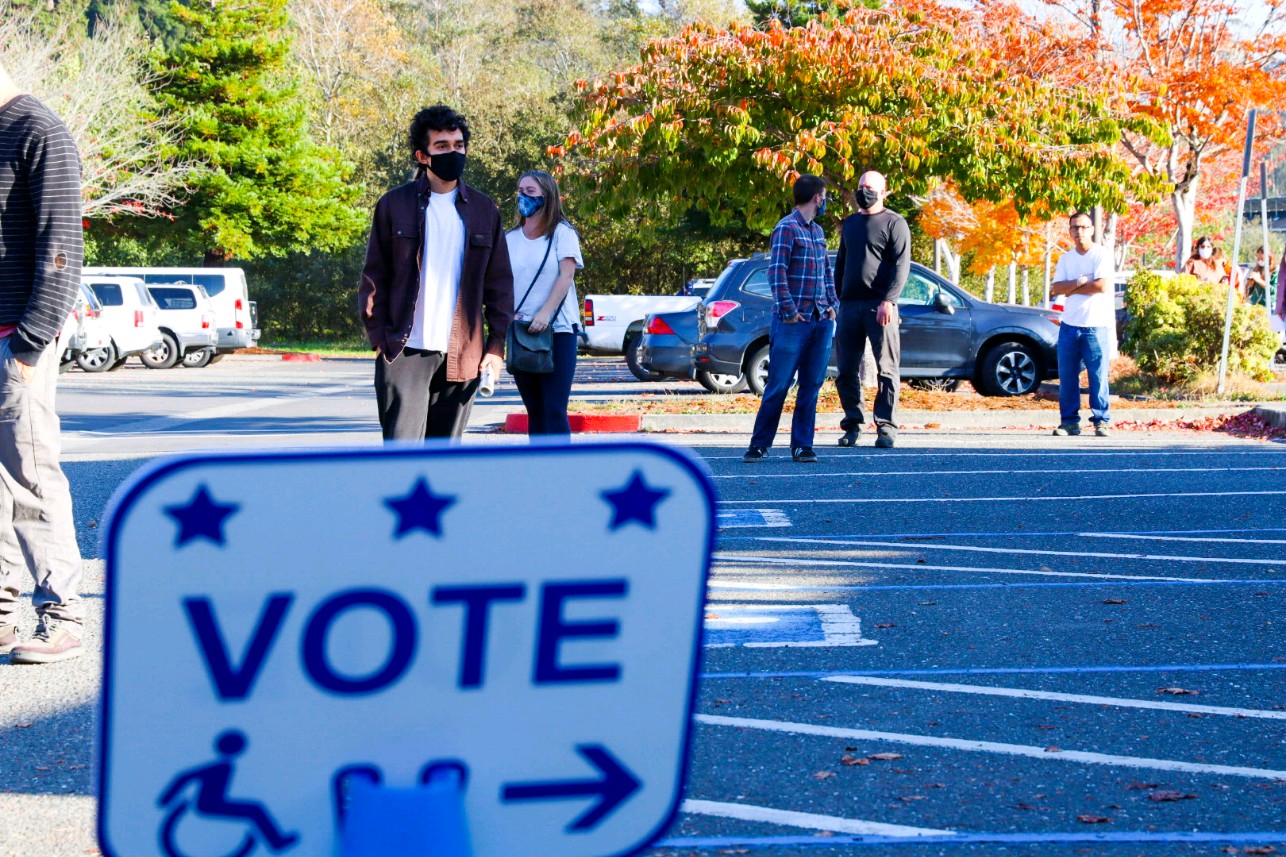
    Vermont Senator Bernie Sanders won the California primary. With more than 400 delegates up for grabs, Sanders consistently polled higher for California Democrats leading up to the primary. Sanders’ progressive platform drew a coalition of voters and strong support from unions across the country.

    Tuesday night marked the biggest event in the primary season. Fourteen states plus American Samoa held primaries Tuesday, with 1,357 delegates to be allocated. That is just over a third of the delegate total needed to win the Democratic nomination.

    Humboldt County overwhelmingly voted for Sanders. Part of California’s second congressional district, Humboldt voters choose six delegates to send to the Democratic National Convention in July. Tuesday night reports around 9:30 p.m. showed Sanders leading Humboldt with 42.4% of the vote, followed by Massachusetts Senator Elizabeth Warren with 14.5%.

    Sanders led California overall with 28.7% of the vote. Michael Bloomberg was second with 18.8%. Biden was third at 17.2%.

    Biden had a surprising surge in support in other states. Biden is running as a moderate, citing the need to beat President Donald Trump in the general election. Though Sanders draws support from demographics with generally low-voter turnout, Biden’s campaign claims a candidate running too far to the left will discourage many potential Democratic voters from showing up in November.

    “I believe that Sanders is still going to be the delegate leader. And he has the enthusiastic base needed to beat Trump.”

    Billy Cook

    This boost in support may be a result of the recent dropouts of Indiana Mayor Pete Buttigieg and Minnesota Senator Amy Klobuchar. Both candidates were running moderate campaigns similar to Biden’s. Sanders had been accumulating significant momentum in the early primary states. Before Tuesday, many viewed Biden’s campaign as an insignificant challenge to Sanders’ campaign.

    One of Humboldt County for Bernie 2020’s lead organizers, Billy Cook, remained hopeful that Sanders will win the nomination.

    “I believe that Sanders is still going to be the delegate leader,” Cook said. “And he has the enthusiastic base needed to beat Trump.”

    Since 2016, Sanders has drawn support around his long-standing progressive platform. His main campaign points are Medicare for All and the Green New Deal. Many Humboldt residents cited these policies as the main draw to support Sanders.

    Sanders supporters in Humboldt County have been hard at work campaigning to get residents to vote for Sanders. They have regularly sent crews to canvass Arcata, Eureka, McKinleyville and Blue Lake. One of their strategies is to reach out to voters face-to-face. A few members of the group have also set up tables with voting and candidate information in pedestrian areas around Humboldt as well.

    Another organizer for Sanders-supporters in Humboldt, Evan T. Nixon, said Super Tuesday made the race more complicated. Nixon said that the strategy for organizers in Humboldt is going to change. Their focus will shift to states that have not yet voted in the primary, like Oregon and Arizona.

    “We need,” Nixon said, “to just hit the phones.”

  • Students Test Out the Voting Waters

    Students Test Out the Voting Waters

    Mock election prepares HSU students for local issues on ballot

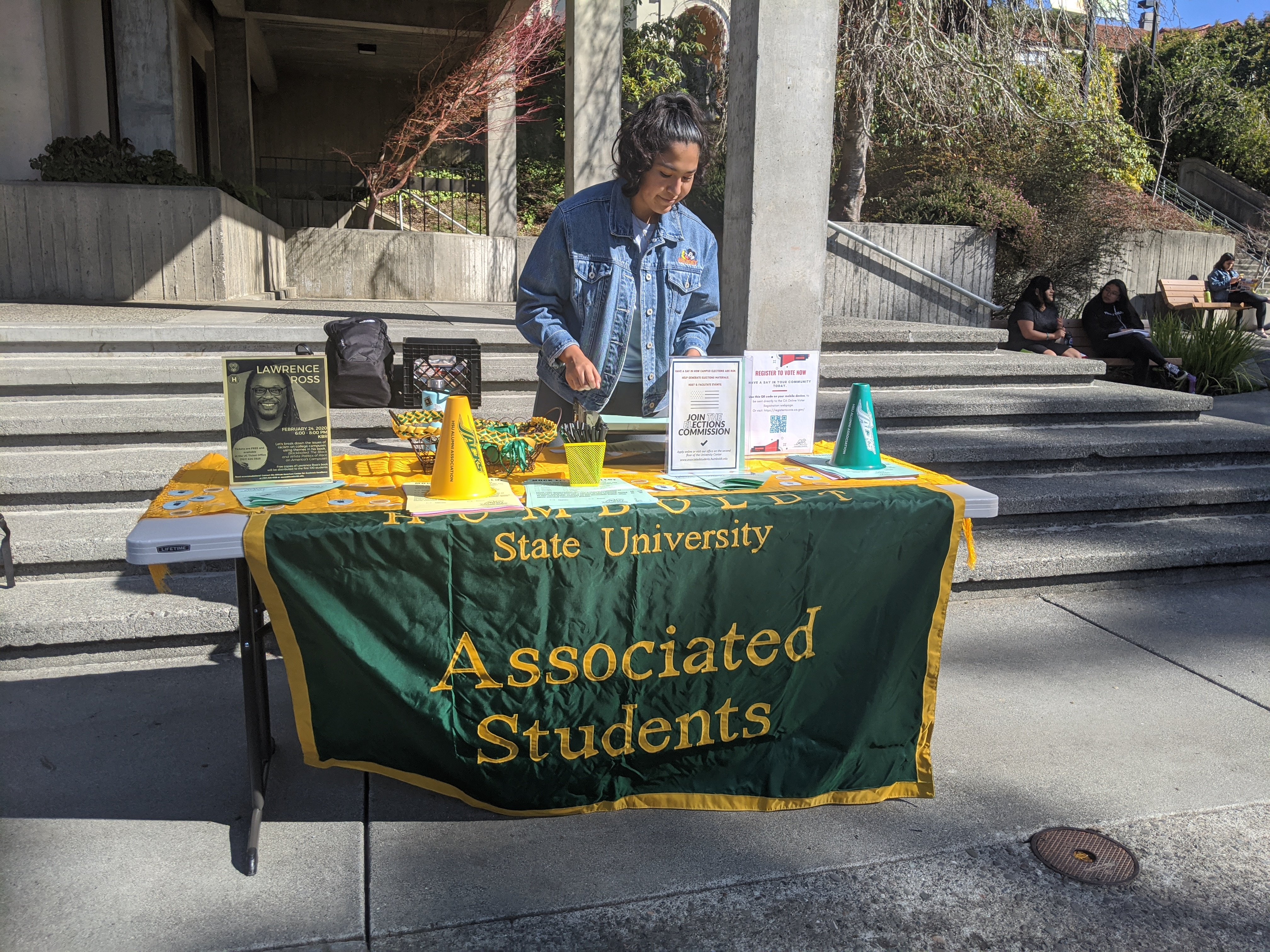
    Humboldt State University’s Associated Students held a mock election with the help of the Politics Club Feb. 24 in the University Center Quad. On the ballot were candidates for both the Democratic and Republican primaries, as well as local election measures.

    “We’re gathering data from the student population about what would happen if we held the election today,” Legislative Vice President of Associated Students Jeremiah Finley said.

    The mock election gave students the opportunity to take a closer look at which candidates were on the ballot. When the results are released, students can gain a new insight into the perspectives of other students.

    “Some of the measures that were posted—I was like, ‘What is this?’”

    Tashenea Young

    “We’re trying to make sure our students at HSU are more educated about the decisions that they’re making,” Finley said. “This will give the students the opportunity to go back in and really investigate.”

    Tashenea Young is a computer science and math education major who felt more informed about the upcoming election because she participated in the mock elections.

    “Some of the measures that were posted—I was like, ‘What is this?’” Young said.

    Young said mock elections like the one on Monday are a step in the right direction for helping to inform the student body, but events like the mock election need more publicity to reach more people.

    “It’s better than nothing,” Young said.

    Real measures weren’t the only questions on the ballot. It also included a mock referendum on fluoridated water.

    Paul Hilton, an HSU politics major and member of the Politics Club, helped organize the mock election. He was curious about how students would vote concerning fluoride. He said that although there wouldn’t be a referendum on fluoridated water on the ballot in March, it was close to being on the ballot in November.

    “It was a step away from Arcata putting it on the Arcata ballot,” Hilton said. “After a whole lot of community city hall meetings and discussions, it was a 3-2 vote to not put it on the ballot.”

    Hilton hoped the mock election would help professors as well as students.

    “One of the questions was, ‘What day of the week is worst for you when it comes to nighttime deadlines?’” Hilton said. “So, one of those actually has informative results that we’ll tally up that might be able to go to professors.”

    Although Hilton was glad for the mock election, he thought there was room for improvement. The ballots were printed on colored paper and didn’t resemble voting material. Hilton said this may have discouraged potential voters.

    “People are more likely to pick up a pamphlet,” Hilton said. “If I was just going by, I’d be like, ‘What’s this kid’s construction paper kind of stuff just hanging out? I’m not interested in this.’”

    California votes Tuesday, March 3. Associated Students are now more experienced for their real elections, and students can take more knowledge on local issues to the polls.

  • Ballot Burning for the Modern Meddler

    Ballot Burning for the Modern Meddler

    Why we need to stick with physical ballots

    In 1960, the Kennedys tried to steal the White House. A Kennedy ended up living in the White House, so they may have succeeded. Maybe they stole the election, maybe they didn’t. But because we have the physical ballots, no one can dispute that they tried. In the modern world of voting machines and election apps, we might never know who tries in the future.

    If you wanted to rig an election in 1960, you needed a plan, a large team, a smokey basement in Chicago and a lot of money. You needed someone to go to a graveyard and register corpses to vote. You needed to catalog abandoned houses and figure out how many dead or fake people you could put in each one. You needed to physically go out and beat up a few voters—possibly even commit a murder or 20. You needed a large operation full of trusted members willing to do all of this. And perhaps most importantly, you needed to be fine with everyone knowing that you just tried to rig an election.

    Stealing an election was incredibly difficult, dangerous, obvious and almost completely ineffective if one candidate had a significant lead. Voting with a paper ballot clearly isn’t a perfect system, but the attempted rigging of the 1960 election is almost common knowledge. We have the paper to prove it.

    We know what paper is. We hold it in our hands almost every day. Casting a ballot is an anonymous and easily-understandable physical action. It’s traceable at every step of the way, and we can tell if the ballots don’t make it to their destination.

    Conspiracy with physical ballots is possible, even probable, but not effective on a large scale. Certainly, physical ballots aren’t perfect, but they are hard to mess with in a way that will significantly affect an election. There are doubts that, even with all the tampering and violence, the attempted rigging of the 1960 election even changed the result.

    Electronic voting, on the other hand, is vulnerable in ways paper voting is not. When you stand in front of a voting machine, there are some questions you probably have.

    The most important part of getting people to vote is the trust that the vote goes somewhere. It’s counted. The vote is verifiable, and the process is easily understandable.

    Who made the voting machine? Who paid for it? When you press a virtual button on a screen, how do you know the machine tallies it, or gives it to the right candidate? How do you know it reaches a database where it will be counted? Do you know what the software being used is, how it works, if it’s secure, how to tell if it has been tampered with, if the machine is connected to the internet — as many inexplicably are— or if it has been calibrated properly?

    The odds are that you don’t. I don’t. Nobody does. Nobody besides the people who managed to remotely change a voting machine’s final tally. Nobody besides interested parties in our own system who might want the election to turn out a certain way. Voting machines are incredibly vulnerable. They are outdated upon release, not tested properly, easy to manipulate and often connected to the internet for some reason.

    You don’t have to call on the crime syndicates of the country anymore. You don’t have to organize a massive conspiracy. All you need to rig an election is to know how to hack a virtually-undefended voting machine.

    The most important part of getting people to vote is the trust that the vote goes somewhere. It’s counted. The vote is verifiable, and the process is easily understandable.

    Electronic voting doesn’t just open our system up to attacks from malicious parties. It erodes the trust between the voter and the system. This would be true even if everything was perfect—even if there was no one meddling. But there is someone meddling. We know there is. There always has been and there always will be. It wasn’t just 1960 and it wasn’t just Democrats. The question isn’t, “Who would rig an election?” It’s, “Who wouldn’t rig an election?”

    If someone’s going to attempt to rig the 2020 election in the same way as the 1960 election—and they possibly already have—I want them to have to work for it. I want them to have to go out to graveyards, get their hands dirty and threaten some grandmas. I was disappointed by the Iowa caucuses. These days it’s hard to tell the difference between epic, mind-blowing incompetence and election theft. If these elections are going to be a complete farce, ditch the apps and voting machines. If there’s going to be ballot burning, I want to see the flames.

  • Who Students are Supporting in the Upcoming Elections

    Who Students are Supporting in the Upcoming Elections

    What students think of the 2020 presidential candidates on offer

    The 2020 presidential campaign season has been in full swing for months. Candidates have risen and fallen. Media coverage of the race has been pervasive. Scandals, conspiracy theories and online warfare have all grabbed media attention. Headlines are filled with heart attacks, race-faking and corruption allegations. Voting begins in earnest this February with the Iowa caucuses. So, who will Humboldt State University students support going into election season?

    “I really have no idea what’s going on right now,” HSU student and competitive rower Travis Wills-Pendley said.

    The Lumberjack’s presidential poll from Oct. 2019.

    Wills-Pendley is one of the many students choosing to let the dust settle before making any decisions. Californians don’t vote until March 3, so students will have a chance to see how candidates perform in other states before voting.

    Although most students stayed away from the chaotic primary coverage, the majority said they would likely vote for the more left-wing candidates. Vermont Senator Bernie Sanders was frequently mentioned, along with Massachusetts Senator Elizabeth Warren and Hawaii Rep. Tulsi Gabbard.

    “I care a lot about education. I have a bunch of younger cousins and I really want to make sure they get a good education.”

    Elise Guerrero

    Elise Guerrero is a wildlife major who focuses on climate change policy and progressive advancement in education.

    “Currently I’m definitely voting for either Bernie Sanders or Elizabeth Warren,” Guerrero said. “I care a lot about education. I have a bunch of younger cousins and I really want to make sure they get a good education.”

    Meanwhile, biology major Nathan Johle thinks there is a lack of effective climate policy among the democratic candidates.

    “I care a lot about environmental policies,” Johle said.

    “This will be the first time I can vote in a presidential election, so I might as well use my right.”

    Nathan Johle

    Johle previously supported the climate action-focused campaign of Washington Gov. Jay Inslee. However, Inslee dropped out of the race in August 2019.

    “If I’m going to support a politician it’ll be Tulsi Gabbard,” Johle said. “This will be the first time I can vote in a presidential election, so I might as well use my right.”

    Johle doesn’t identify with a certain political party. Instead, he chooses candidates based on their individual positions.

    “I have beliefs,” Johle said. “I don’t like to put them between two labels.”

    He expressed concern that students vote for candidates without doing their research, a sentiment echoed by fellow student Kitty Quintrell.

    “I don’t like making a conclusion until I’ve got my own research,” Quintrell said. “That’s one of the main things I’m going to be doing before I submit my vote.”

    In the short time before California votes, some states will have already decided. The popularity of the candidates will be much clearer. Momentum will be gained by some and lost by others. Due to the shifting field of the democratic primary, students are resorting to a tried and true method—waiting until the last minute to cram.

  • Ready, set, vote!

    Ready, set, vote!

    National Voter Registration Day hits HSU

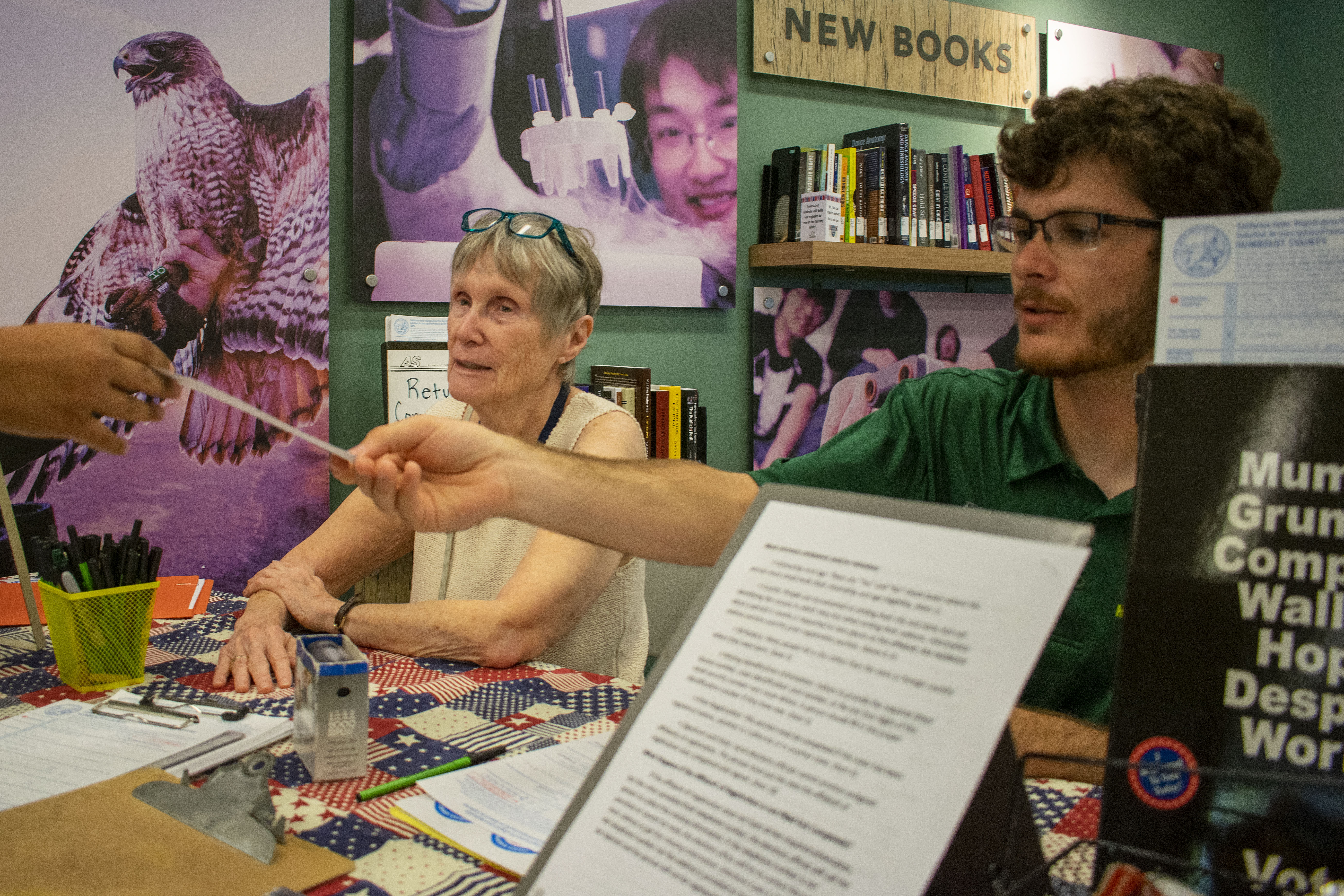
    Representatives working with Humboldt’s League of Women Voters tabled at the Humboldt State University library on Tuesday for National Voter Registration Day.

    With national elections just around the corner, Vincent Thomas, environmental resources engineering senior and receptionist for Associated Students, urged library visitors to register.

    “Voting gives you the right to complain about what’s going on,” Thomas said. “If you don’t vote, you can’t complain.”

    Beside Thomas sat Margaret Augustine, a 20-year-old Eureka resident and member of the League of Women Voters. Augustine simply wanted to provide students with information on how to vote.

    “It’s non-partisan,” Augustine said. “We just get people to vote and express their opinion.”

    According to National Voter Registration Day’s website, the holiday has been held on the fourth Tuesday of every September since 2012. The holiday’s goal is simple: get people to vote. According to the site, 800,000 people registered to vote on the holiday in 2018.

    The U.S. Census’ website also reports that 61.3% of U.S. citizens registered to vote in 2018, and 49% actually did so.

    The lowest voter turnout in 2018 came from citizens between the ages of 18 and 24, at 30.1%. Voter turnout increased with age, with the highest voter turnout from citizens between 65 and 74, at 65.6%.

    Thomas emphasized that voting gives citizens a voice.

    “Just getting people to register to vote so they have that option to vote if they need to is very important,” Thomas said. “We want to get as many people to have their voices heard as possible.”

    At midday on Tuesday, Thomas said around a dozen individuals had registered.

    “Most of the students who have come by said, ‘yeah, they’ve already got it done,’ which is pretty good,” Thomas said.

    Thomas said registering only takes about five minutes. Outside of National Voter Registration Day, a prospective voter can register at their local election office or online at Vote.gov, an official website of the U.S. government that helps people figure out how to register. The nearest election office to HSU resides in Eureka at 2426 6th St.

  • Letters to the Editor: No On M

    Letters to the Editor: No On M

    This veteran will vote No on Measure M, here’s why

    I’m a combat veteran of the Vietnam war that witnessed atrocities committed against Vietnamese civilians by some U.S. troops.

    The Philippine-American war that was initiated by President McKinley with his annexation of the Philippines was a ‘model’ for the later war in Vietnam. This included the massacre of civilians, burning of crops, killing of farm animals, herding of civilians into ‘detention camps,’ designation of certain areas where anyone could be killed (later in Vietnam called “free fire zones”) and the systematic use of torture.

    The Philippine-American war and insurrection lasted from 1898 to 1913 and the estimates of Filipinos killed range from 500,000 to 1.4 million. In Nov. 1901, the Manila correspondent for the Philadelphia Ledger reported: “Our men have been relentless, have killed to exterminate men, women, children, prisoners, and captives, active insurgents and suspected people from lads of ten up, the idea prevailing that the Filipino as such was little better than a dog.”

    It was in this war that the racist label ‘gook’ was first used against the Filipinos which made it easier for some U.S. troops to commit atrocities against them, later ‘gook’ was used in the Korean and Vietnam wars to the same effect. While McKinley was assassinated in 1901, the war and insurrection he started by the annexation of the Philippines lasted long after his death.

    The writer Samuel Clemens (Mark Twain) was a fierce critic of ‘U.S. Imperialism’ and McKinley’s annexations of Hawaii, Cuba, Puerto Rico, Guam, Samoa and the Philippines. In 1906, he described the massacre of an indigenous Filipino group called the ‘Moros’ by U.S. occupation forces.

    I paraphrase:

    600 Moros men, women and children had sought shelter at the bottom of a volcano and when the U.S. military found out that they were there, they brought troops and artillery up to the rim of the volcano and shot downward, slaughtering everyone, including babies in their mother’s arms.

    This reminds me of another massacre called Mylai in Vietnam where around 500 Vietnamese civilians, including babies clinging to their mothers, were summarily executed.

    This is what I think of when I walk by the statue of McKinley, and this is why I want it removed from the Arcata plaza.

    Sincerely,

    Robert J. Hepburn