by Harrison Smith
Originally printed March 1, 2023
For millions of years, beavers have been the stewards of North American watersheds. Over a hundred million used to ply the streams of the continent. Hunting and habitat loss since colonization have reduced their numbers to somewhere between 10 and 15 million, and many ecosystems which historically relied on beaver stewardship are now absent of the aquatic rodents. In 1941, there were just 1,300 beavers in California. Symbiotic Restoration, founded in 2018 by CPH alumnus Garrett Costello, is a company which seeks to reverse this loss of habitat.
“Our mission is to improve stream and meadow conditions to bring back the beaver,” Costello said, who graduated from Humboldt with a BS in environmental protection and management.
Founded in 2018, Symbiotic Restoration (SR) has carried out all of their restoration projects in Northeastern California. Costello, who recently moved back to the county, hopes to partner with local Humboldt organizations to carry out restoration projects in the future.
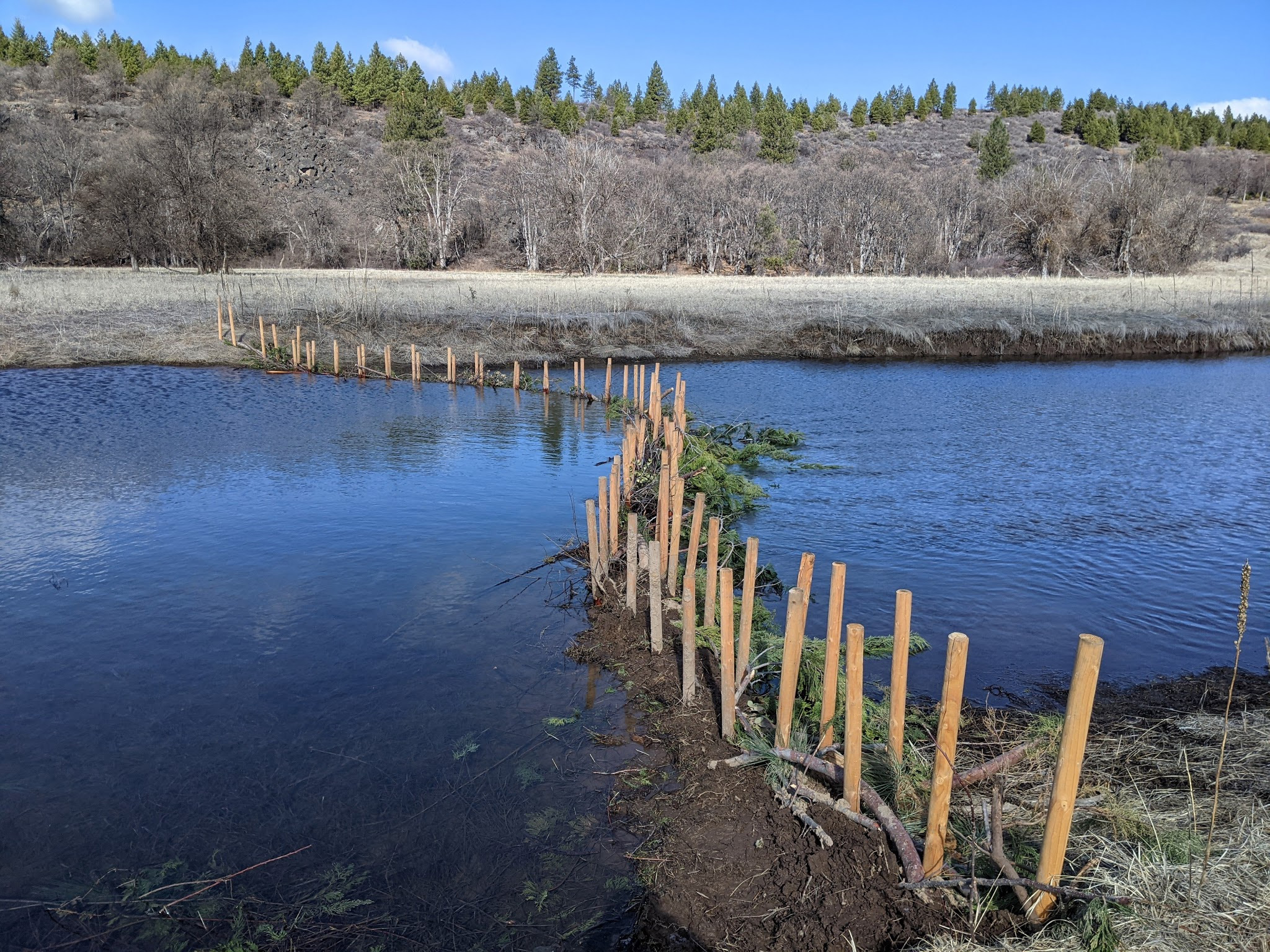
The vast majority of SR’s restoration projects involve the building of beaver dam analogs, or BDAs. BDAs come in many forms depending on the size and condition of the stream, but they’re usually built as a short, unobtrusive lattice of maple limbs which act to trap sediment and slow the stream. Human activities, especially road construction and agriculture, cause interruptions to stream flow and increase bank erosion.
“Let’s just think about cattle for a moment. They cross the same place every time. They are going to soften that soil and they are also going to punch it down a little bit,” Costello said. “Once the water starts falling into the drop, that fall of the water is what causes the erosion and then will continue to unzip.”
BDAs are constructed at points in the stream where flow has been interrupted by a head cut, acting to fill the depression and preventing erosion from continuing upstream.
“As water hits that pond, it slows down and drops and that will slowly build sediment behind the structure, which then strengthens the structure and then it helps reconnect the floodplain because now we don’t have this incision,” Costello said.
Once the stream has been reconnected to the floodplain, the stream is able to meander more widely around. This turns a stream flowing quickly through a deeply cut channel into one which supports a wide, dense belt of riparian vegetation with its lazy flow.
Most of SR’s project sites are in places too remote for construction vehicles, where their use would undermine restoration efforts. Costello and his crew carry out their work the old fashioned way— with sweat, shovels, and axes.
“We’re not out there with heavy equipment, huge amounts of diesel, coming down into the meadow and potentially causing soil compaction, some disturbance to the vegetation,” Costello said. “We’re on foot and I have sleds. I don’t use wheelbarrows because the tires can cause little ruts, so we’re pulling everything on these duck hunting sleds.”
SR has worked closely with the Natural Resource Conservation Service, a subagency of the Department of Agriculture, which provides funding to ranchers and farmers on the condition that they meet certain restoration requirements.
“The program is to incentivize private landowners to do conservation efforts on their land,” Costello said.
One goal of SR is to involve the communities in which they work as stewards of the land, fostering a bottom up approach to conservation.
“Last year, we partnered with Point Blue Conservation Science… we had 50 kids a day come from local elementary through high school to build beaver dams and plant willows with us,” said Costello. For the children, it was fun to build beaver dams in their community creeks.
“And all these kids were so stoked,” Costello said. “‘Oh yeah, go in the woods around here.’ Or, ‘Yeah, my parents work for the timber company in the town. We go hunting out here’. They have that sense of place,”
Even though much of SR’s work is still focused in Northeastern California, Costello hopes to make connections with local Humboldt community organizations in the future. He recently spoke to students in a capstone restoration course, and hopes to form a dedicated Humboldt crew to work on restoration projects in the county.
“Volunteers come from all over too, so not only local communities, which we want to target to get that sense of place and stewardship.” Costello said. “Folks are coming from all over California that are interested in this because it’s really fun. We’re like kids playing in a creek.”
Disclaimer: This article was not paid for or endorsed by Symbiotic Restoration.