The Lumberjack


Students Serving The Cal Poly Humboldt Campus and Community Since 1929

Tag: weightlifting

  • The weightlifting club returns to Cal Poly Humboldt campus

    by Jazmin Pacheco

    For anyone that has a passion for fitness and lifting weights, I have exciting news for you. There is a semi-new weightlifting club that will return to campus. It’s a club that was around a few years ago when the football program was around. Shortly after the last football game in 2018, the club was discontinued because many members either moved away or graduated. 

    “We’re trying to restart that but different,” club vice president/treasurer Ian Blank said, referring to the previous club. “There’s still posters around the school, especially the gym, that say Lumberjack Iron.”

    A few students who shared a love for fitness recently came together and were inspired to start the club back again. Josh Ting, who is currently the president of the club, along with Blank, took on the responsibility to initiate the club and informed their friends and other gym fanatics about the club. 

    “I wanted to do something that would create that community and help people like me, who were beginners, and wanted to feel more confident in themselves going to the gym,” Blank said.

    To preserve some of the club’s history they have decided to keep the original club name: Lumberjack Iron. 

    Although the new board members have decided to keep the original club name, they are open and flexible to new ideas from current and any new members for the club itself. They are accepting of any new changes that will make a positive impact to the fitness community. 

    Brianna Reynolds, secretary of the new Lumberjack Iron club, mentioned she’s happy to be part of the club because she likes the idea of having a community, where people with any level of expertise can hangout and workout together. 

      “As a beginner at the gym it’s really scary,” Reynolds said. “I think it’s important to have a community where you feel safe and when you are trying something new like that.”

    Reynolds recently started weightlifting. She mentioned some of the reasons she turned to fitness was she wanted to feel stronger, healthier, and more confident.

    “My experience with lifting, it was also a scary experience,” Blank said. “I remember when I first started going to the gym, I would have mini anxiety attacks as I was driving to the gym.”

    Similar to Reynolds, Blank also said he wanted to feel more confident, going to the gym and the experience he developed through weightlifting has helped him. That’s another reason he wanted to create that supportive community on campus.

    There currently isn’t a limit to how many members can join Lumberjack Iron. The club welcomes anyone who is interested and passionate about weight lifting. Even to those who have never worked out but would love to start. All fitness levels are welcome to join.

    The club plans to meet about two times a month, so those with busy schedules won’t have to worry about an intense commitment level as a member. 

    “We’ll definitely do other things like making sure we’re talking to people in the club and asking if they have any questions,” Alexa Hellman, secretary of the Lumberjack Iron, said. “For example, is there anything you want input on? Do you want a spotter? Do you want us to check your form?”

    Hellman said communication amongst all members in the club is important because it allows each individual to get the support they need. 

    “It’s a good way to connect and share each other’s fitness journey,” Hellman said. “I think a lot of people workout when they are experiencing depression because I’ve also experienced that. I’ve realized that exercising has helped me a lot to fight depressive symptoms.”

    Other reasons she feels that the weightlifting club can be beneficial for others is to help them feel more productive, gain more energy throughout the day, and give them a reason to get out of bed on those days that they don’t feel like it.

    “I think it’s helped us all, in terms of our mental health,” Hellman said. 

    Gaining confidence, increasing knowledge of lifting, and making people feel more comfortable at the gym are also things Hellman hopes others can get from being a part of the club. 

    Overall the vision for the club is to empower, support, uplift others, and help others feel more confident.
  • Raising the Barbell

    Raising the Barbell

    For these three athletes, weightlifting is more than just exercise, it’s a lifestyle

    While many people are still sleeping or barely getting ready at 8 a.m. on a Saturday morning, powerlifter Lecsi Prince opens the doors of Arcata Health Sport and walks towards the weightlifting cage.

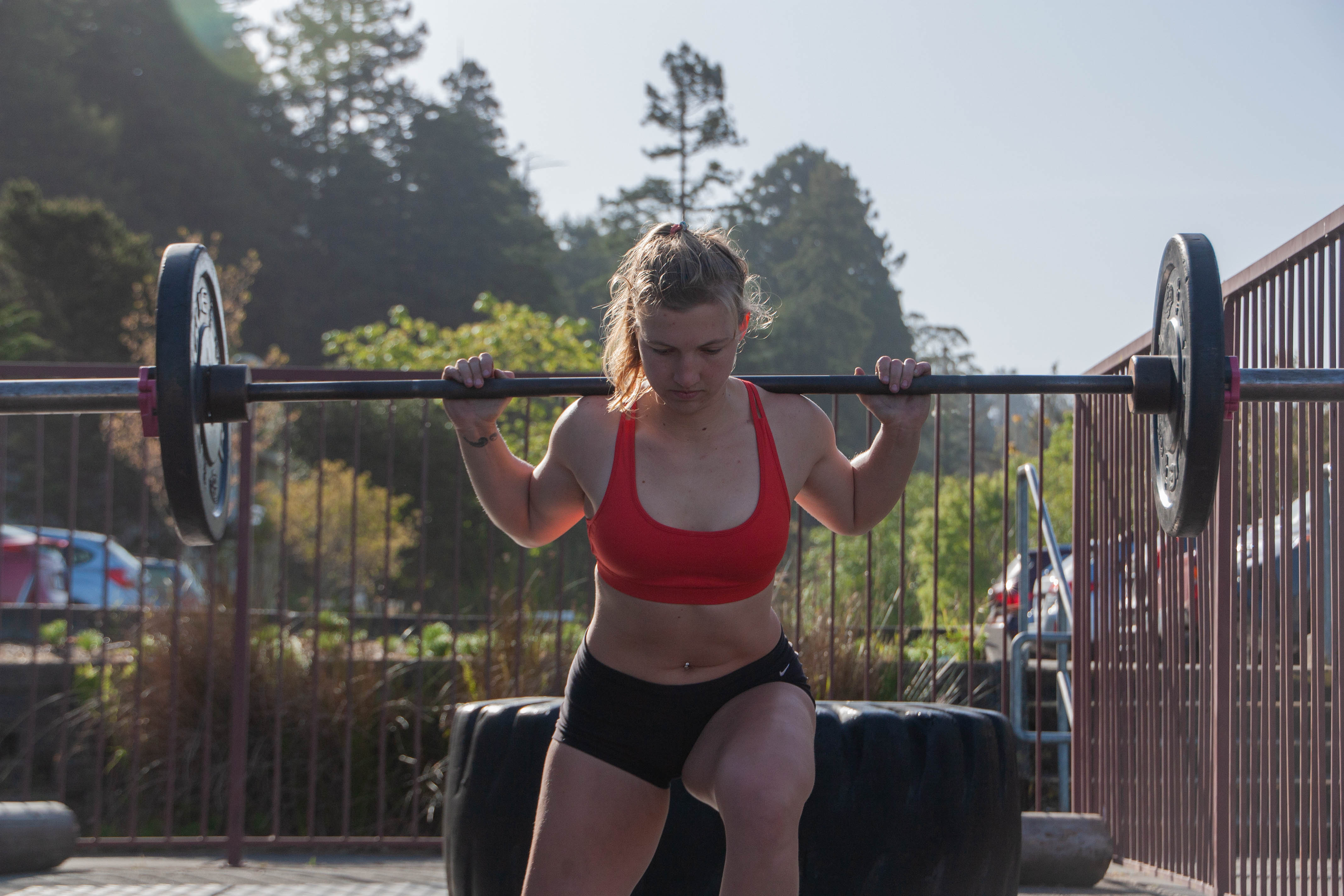
    Prince warms up in the open-air weightlifting area and slides four 45 pound plates, two 25 pound plates and two 10 pound plates onto a bar. She pauses in front of the bar now loaded with 295 pounds. Prince clears her mind, sucks in a deep breath, bounces on her toes, quickly leans in and heaves the weight up onto her shoulders. Keeping her legs stable and her toes pointed out, Prince dips down slowly and up again. After three reps, Prince sets the bar down and exhales.

    Kinseology major Lecsi Prince prepares for her morning workout at HealthSport at 8 a.m. Prince is a powerlifter and has osteoarthritis with a dream of changing the lives of people through exercise. | Photo by Jose Herrera

    Twenty-three-year-old Humboldt State University student and kinesiology major Prince has four years of powerlifting experience. At 14, doctors diagnosed her with rheumatoid arthritis, a chronic autoimmune disease that affects the joints. It didn’t stop her from playing tennis in high school, and it doesn’t stop her now.

    “I’ll have arthritis flares that will make it hard for me to even hold the bars,” Prince said. “So I’ve hit points where I go to the gym into a bench day and I can’t even wrap my fingers around the bar.”

    When her joints are in too much pain and she’s unsure whether to take painkillers, Prince said she decides to not train for a day. Instead, she finds other activities that benefit her health; sometimes she hikes and other times she goes to the sauna as a means of heat therapy.

    “On those days, it’s all a mental game,” Prince said. “My thoughts are that I’m so frustrated and I can’t do anything. It’s this draining helplessness. I’m not able to lift, but I can do something else healthy.”

    Like Prince, Olympic weightlifter Luis Ruiz and women’s strength and conditioning coach Sierra Lathe are no strangers to overcoming their bodies’ barriers.

    The three weightlifters have conditions and injuries they constantly work through to improve their form and records. Ruiz deals with recurring pinched nerves and Lathe has pre-existing injuries she sustained while playing sports in high school. Their injuries become more prevalent if they are not as cautious.

    Sierra Lathe, the stength and conditioning coach for womens and mens crew teams, snatches 95 lbs while in the Student Recreation Center at Humboldt State University. Lathe graduated HSU in spring 2019 and now finds herself as a coach teaching athletes how to perform and train well. | Photo by Jose Herrera

    Twenty-two-year-old Lathe works as a staff member for the Student Recreation Center at HSU. She graduated spring 2019 with a major in psychology and minor in child development. Lathe has a combined eight years of powerlifting and Olympic weightlifting experience.

    As a former HSU athlete, Lathe now finds herself on the other side as the strength and conditioning coach for the men’s and women’s club crew teams.

    “I still lift, but not as much because I don’t have time,” Lathe said. “Coaching is a whole other ball game. It’s definitely more fun teaching people how to do it now because I’ve done it for so long.”

    She explains that Olympic lifting is more precise movements that use different parts of powerlifting together while powerlifting is “getting real big and strong” through three main exercises: squatting, deadlifting and benching. This is something Ruiz knows all too well.

    Ruiz, 24, competes in national Olympic weightlifting competitions such as the USA Weightlifting Nationals, USA Weightlifting American Open and University Nationals. Ruiz placed second at the 2019 University National & placed fifth at the Under 25 championship in March. He can back squat 615 pounds and can do Olympic weightlifting movements like the snatch with 319 pounds and the clean and jerk with 405 pounds.

    He says the pinched nerves are something that his body deals with on its own.

    “I won’t be able to do everything that I need to and I definitely can tell in my body,” Ruiz said. “Part of it is that doing this for five years, ten years, or however long you do it, it definitely will take a toll on your body.”

    Injury and pain is something Ruiz knew would be part of the bodybuilding process, but if given the opportunity, Ruiz wouldn’t change a thing.

    “My mom thinks it’s a dangerous sport and she wishes that I wouldn’t put my body through what I do put it through,” Ruiz said. “But they’ve never told me that I needed something else to do. They understand that this is how I stay active and happens to be something I’m good at and so I compete in it.”

    Prince and Lathe said they experience different issues as women athletes.

    “You have all these expectations as a woman,” Lathe said. “If you’re too strong, it’s too much. And if you’re too nice, it’s not enough. So, being able to be an athlete for so long feels pretty good.”

    Lathe said people, generally men, stare when she trains, but that she’s used to it as a woman in sports.

    “Especially if you’re someone who knows what you are doing,” Lathe said. “You’re either judged or not taken very seriously even though you know what you’re talking about.”

    There are also moments where men approach Lathe about random things, sometimes assuming she needs help or to make comments that aren’t appropriate for a conversation with a stranger.

    But looking past those moments, Lathe says there’s a lot of community and support in the gym environment, especially from women. And Ruiz says that although weightlifting is an individual act, there’s a lot of teamwork behind the scenes from the coaching and competitive aspect of training partners.

    “I think it’s super important to have people that you train with because it pushes you to have friendly competitions within training,” Ruiz said. “To have someone who’s in your same level and train with you, I feel like you benefit more because of the little competition that you guys have.”

    If anything, I’d give up free time outside of school and my job to be able to train than to have a social experience. Because the gym at this point has become where I met a lot of my friends.

    Luis Ruiz, Olympic Powerlifter

    Lathe and Prince share the same sentiment as Ruiz and agree that the people you train with and spend time working with to achieve similar goals become your greatest allies.

    “If anything, I’d give up free time outside of school and my job to be able to train than to have a social experience,” Ruiz said. “Because the gym at this point has become where I met a lot of my friends.”

    HSU Athletics strength and conditioning coach and kinesiology lecturer Drew Peterson works with a variety of students with different skill levels who come through the Student Recreation Center.

    Peterson said that Prince, Ruiz and Lathe achieve great feats of strength and he believes physical strength is the key to activity and fitness.

    “Anybody can get stronger and change your physique and increase your physical capacity,” Peterson said. “It just takes getting in here and doing a good job being consistent and staying on a structured program.”

    Weightlifting comes with a set of drawbacks just like any other sport, but it remains a therapeutic process for Prince, Ruiz and Lathe. And the next day the three of them do what any average weightlifter does to get better – train again.

    “I have a different perspective than most because my body does limit me,” Prince says. “For me it’s more of a therapy. It’s more of that I can push my body to this and nothing else in the world matters other than me just in the moment doing what I love.”