The Lumberjack


Students Serving The Cal Poly Humboldt Campus and Community Since 1929

Tag: wind energy

  • Schatz Lab researches local wind energy opportunities

    Schatz Lab researches local wind energy opportunities

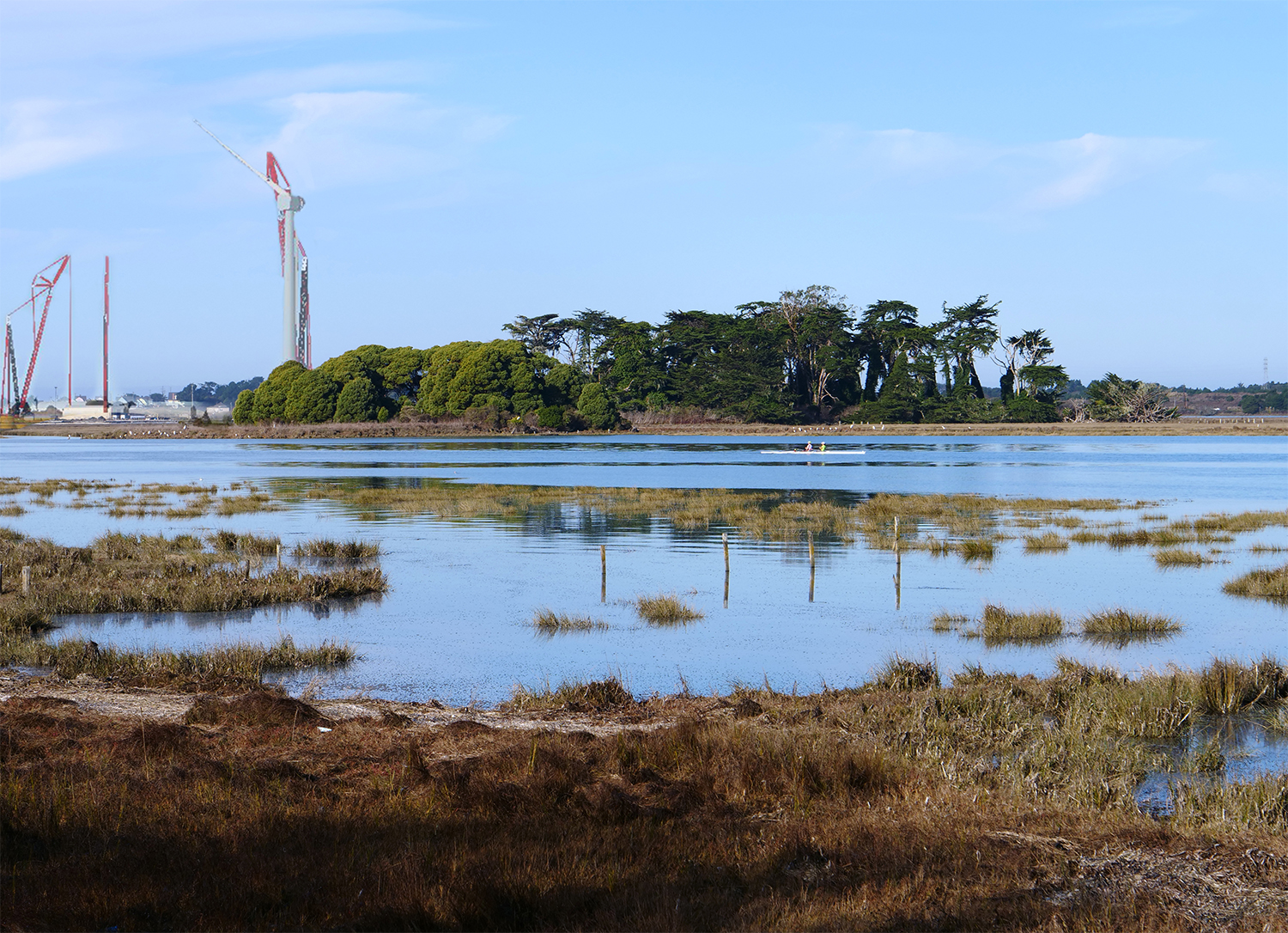
    On a clear night someday in the future, you might look out across the ocean from Trinidad or Clam Beach and see small points of light way out in the distance. And the source for those points of light could be supplying all your electricity.

    The Schatz Energy Research Lab is an affiliate of HSU’s Environmental Resources Engineering program which seeks to study and educate the public about clean energy. They are in the process of investigating a possible offshore wind energy project.

    “We have the best wind resource in the United States,” said Maia Cheli, the communications and outreach manager for the Schatz Energy Research Lab.

    A possible wind energy project could have wide reaching ramifications for both Humboldt County and California as a whole.

    “There are so many reasons to support the development of clean, renewable energy: so that we can breathe healthy air, drink clean water, restore ecosystems, and slow climate change,” Cheli said. “But our critical energy questions don’t stop at how we generate energy – they also include who has access to electricity, how reliable that electricity is, how much it costs, and how well it supports communities. Bringing these outlooks together is the only way for us to build responsible, equitable energy systems.”

    The U.S. Bureau of Ocean Energy Management designated a region 20-30 miles off Humboldt Bay a possible site for an offshore wind farm. The farm would look like a number of floating wind turbines anchored with mooring lines. These turbines would convert wind energy to electrical energy.

    “You have the tower, you have the nacelle, and you have the blades, and so the wind blows on the blades and the blades are converting that in through the generator into electrical energy which then passes back down through the tower and connects in with some kind of a cabling system,” Cheli said.

    A possible project couldn’t just be a set of wind turbines, it would have to include upgrades to Humboldt’s current infrastructure, from our marine ports to current transmission capabilities.

    A wind farm that would produce enough energy to be cost effective would produce more energy than we could use, so it would have to be exported out of the area.

    “What we know of the system is that whether we develop medium or large-scale generation, it will require significant upgrades to the local transmission system,” said Marco Rios, the transmission system planning manager at PG&E. “And that really is because the current grid in this region was not designed to export generation outside of the area.”

    There are more variables like the possible environmental impact of the construction, regular function, and maintenance of the wind turbines.

    The data needed to predict environmental impacts of a wind farm doesn’t exist in full yet, and that’s what the Schatz Lab is working on.

    “There’s not a lot of people that far offshore sitting there and counting seabirds all the time, so we’re working on that right now with the seabird 3D study,” Cheli said.

    But those possible consequences have to be balanced with the consequences of a failure to reach emissions goals.

    Garry George, the clean energy director at the National Audubon Society, spoke about the possible impact on birds at the offshore wind energy webinar.

    “Our science team revealed in a study released last year that three degrees of warming will likely drive 389 species of North American birds to extinction because they’ll lose their wintering and breeding territories due to climate change,” George said. “So it is exciting to have a new resource, a new technology to add to our quiver of climate arrows here in California, like offshore wind, to get us to 100% clean and net zero emissions. This is critical for birds and it’s critical for people.”

    A large-scale project would also have larger social implications. Some of the possible new infrastructure may need to be built on Wiyot land.

    “In general, the Wiyot Tribe has long supported renewable energy development that is well sited, and are open minded and excited about the potential for offshore wind on the north coast,” Wiyot Natural Resource Specialist Adam Canter said at a public offshore wind energy webinar. “Especially the community-based approach and stakeholder involvement that this group of partners is taking early on during the planning process.”

    For now, the feasibility of an offshore wind farm is still being studied. Community input is still being gathered, and nothing is set in stone.

    “The Schatz Center is not committed to any trajectory. We are committed to providing good information so that good decisions can be made,” Cheli said. “I think the more that people can become informed about, you know, the impacts on the opportunities of any particular pursuit related to energy, the better decisions we can make for ourselves and for the planet as a whole.”
  • Wind Farm Under Scrutiny

    Wind Farm Under Scrutiny

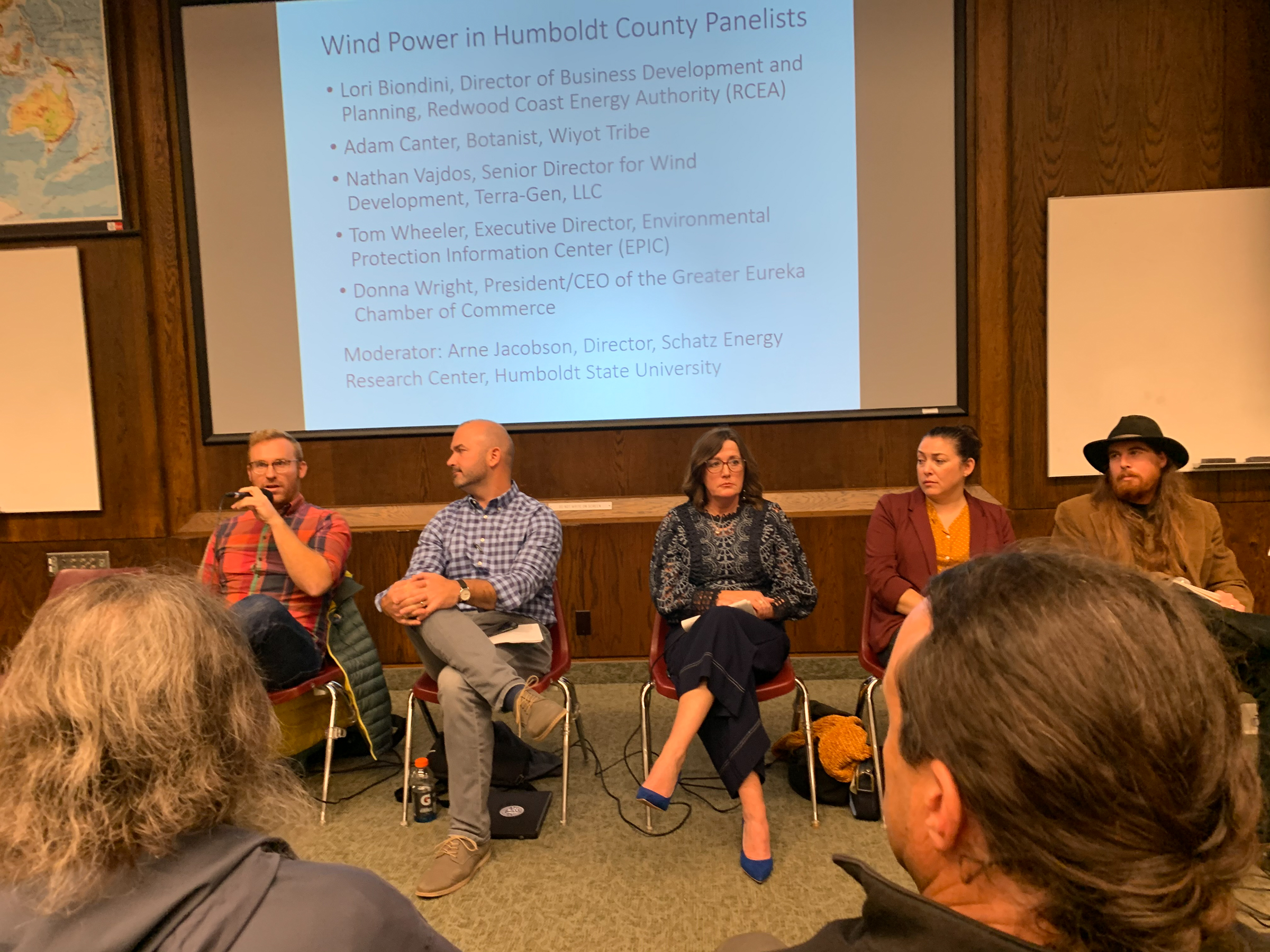
    A panel at Humboldt State University’s Sustainable Speakers Series weigh the pros and cons of the Humboldt Wind Energy Project

    As the global concern to act against climate change increases, Humboldt County is in a position to capitalize on an opportunity to establish a significant renewable resource.

    On Thursday, the Humboldt County Planning Commission votes on the wind energy farm developed by Terra-Gen. Terra-Gen, a Manhattan-based energy company, has proposed a wind farm to be built near Bear River, on Monument Ridge, above the city of Scotia.

    The Terra-Gen wind farm carries controversy for numerous reasons. The project will help achieve carbon emission-reduction goals and provide two million dollars in annual tax revenue for the county, but will impact wildlife, forest ecosystems and the Wiyot prayer site Tsakiyuwit.

    Arne Jacobson, director for Shatz Energy Research Center, said the proposed turbines will produce about 100 times less CO2 than burning fossil fuels.

    “From a climate change perspective, wind looks pretty good,” Jacobson said. “Whatever perspective we have on this particular project, I think one question we should be asking ourselves is what we want to do with that opportunity, because I think it’s there and I think we have the local ethic and the local talent to make that happen.”

    Lori Biondini, director of Redwood Coast Energy Authority, said the Terra-Gen wind project could be part of a solution to address RCEA’s goal of 100% renewable electricity in Humboldt County by 2025.

    “The Terra-Gen project is part of one scenario to reach our goals,” Biondini. “If it doesn’t get built, then we will come up with another scenario.”

    RCEA administers the community choice energy program, a program which allows communities to decide where their electricity comes from. It prioritizes local energy generation and generally more clean energy.

    “I think that one of the promises of community choice energy is that we get to make choices that are good to our entire community.” Biondini said. “Not further marginalize those that might not otherwise have had a seat at the table.”

    A crowd waits for Sustainable Speakers panel to begin. | Photo by Michael Weber

    Adam Canter, a botanist and representative of the Wiyot tribal council, defended the preservation of the land and disapproved of the Terra-Gen project. Canter cites ethnobotanical resources and culturally significant sites as reasons not to move forward with this project.

    “When we first heard about this project, there was this big pit that just kind of fell into our stomachs,” Canter said. “We thought when Shell came 10 years ago that no other company would come back and try to build a project here. But we were wrong.”

    Canter pointed out the cultural resource report for the site bound in a green, four-inch binder.

    “The representation of cultural diversity on this ridge is pretty magnificent,” Canter said. “We’re seeing evidence of Athabaskan peoples and the Wiyot-Algonquin peoples and really it should be listed on the National Register of Historic Places.”

    According to Canter, the area is also a high prayer site; a place where a large expanse of Wiyot ancestral territory is visible. Like the turbines obscuring the view, the Wiyot cultural heritage could be obscured too.

    Tom Wheeler, director for the Environmental Protection Information Center, said the proposed site is a questionable area to build a wind farm.

    “The representation of cultural diversity on this ridge is pretty magnificent. We’re seeing evidence of Athabaskan peoples and the Wiyot-Algonquin peoples and really it should be listed on the National Register of Historic Places.”

    Adam Canter

    According to guidelines set by the California Energy Commission and the California Department of Fish and Wildlife, the proposed site is “pristine.” Wheeler said the site has several rare and endangered species, including the rare Horay bat.

    Wheeler is still hopeful to keep the project, and said there is technology that can reduce some of the wildlife impacts. This, however, is only one mitigation measure to the several unavoidable cultural, environmental and wildlife impacts of the project.

    “I want this to be a better project and it’s not there,” Wheeler said. “At least not yet.”

    On Thursday, the final vote by Humboldt County’s Planning Commission will weigh impacts to Native American culture and environmental quality to the people’s interest in local, reliable energy.

    Aside from the benefit of reducing carbon emissions, allowing Terra-Gen to build the wind farm also comes with an economic and infrastructure benefit.

    Senior Director in Wind Development for Terra-Gen Nathan Vajdos said the company would be the second-largest taxpayer in the county, and could fund $14 million to Humboldt’s reliability network upgrades, with $1.3 million to the Humboldt substation.

    “As we charge our iPhones, we fill up our cars with gas, we’re having impacts.” Vajdos said. “Whether this project is built or not, we are having an impact in this room.”