CSU officials are now deciding whether student workers should be allowed to unionize, after students petitioned the California Public Employment Relations Board (PERB) on April 17 for the right to take a union vote. This was accompanied by around 4,300 signatures from CSU student workers.
Daniel Chaidez is a student assistant at CPH, working for the university’s Waste Reduction Resource Awareness (WRRAP) Program. He says that the Let Us Vote campaign will hopefully give students a better foothold for bargaining with the university.
“It would just make things a little more equitable and bring a little more awareness to the issues that student workers are currently facing,” Chaidez said.
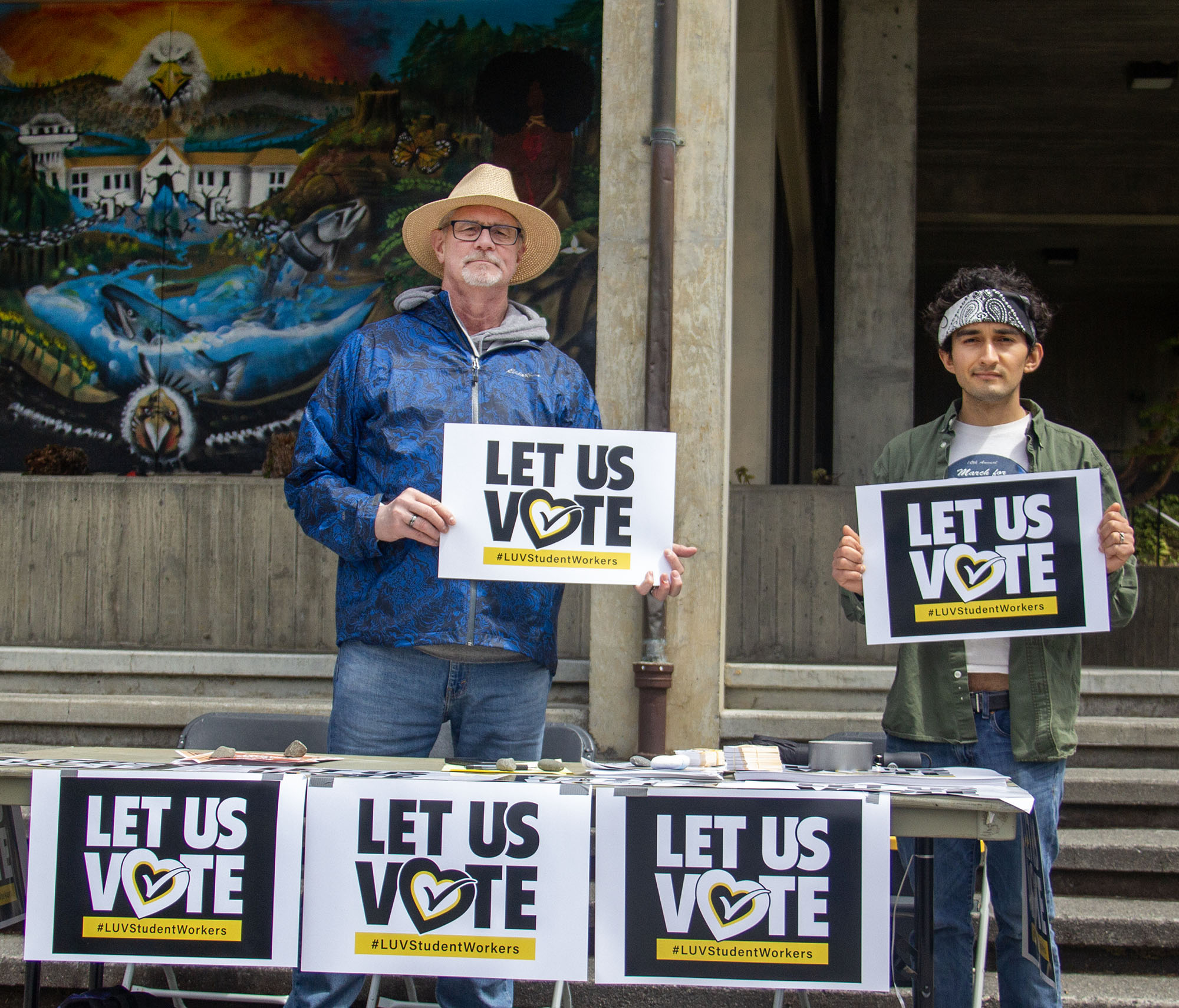
Chaidez tabled on the UC Quad on April 18 along with Stephen Green, a labor relations representative for CSUEU, the CSU employees union. The CSUEU is taking an active role in supporting students working for unionization.
“When hiring a lot of student assistants it’s very unorganized in a lot of ways,” Chaidez said. “It feels like it’s just a way for the school to get easy labor from students.”
“[Student Workers are] a pretty significant part of the workforce that keeps this campus running, or the system running,” Green said. “And they don’t get treated with a lot of respect. They get abused, and they have no voice at all in their working conditions.”
Chaidez thinks that better parking infrastructure for student workers would be a good first step, either with subsidized/discounted parking passes or reserved spaces. Another concern for Chaidez is the weekly hours caps for student workers.
“A lot of students are cut off at 6 or 7 hours a week,” Chaidez said. “And that’s not really working for a lot of people.”
Many student assistants and employees are paid minimum wage, and at 6 or 7 hours a week, this forces them to supplement with second or even third jobs to make ends meet. More jobs means less time for students to study, let alone relax.
Some CSU student workers are even paid less than the minimum wage in their area. This is because the CSU only pays state-wide minimum wage as a state-wide organization, as reported by CalMatters.
If the board approves this request, workers at CSU universities will have the opportunity to organize, something which is automatically given to non-student workers.
“It’s kinda a new thing for students to have a union on campuses,” Chaidez said.
Other universities and university systems have had high-profile unionization processes recently, including the University of Oregon and the UC system, according to Green. If the request to unionize at the CSU is approved and the students vote to unionize, the resulting organization would be the largest student employee union.
“Generally, the PERB is pretty worker-friendly,” Green said. “I think we have a pretty good case, that we’ve submitted a sufficient amount of legitimate signatures.”
In the meantime, advocates continue to gather support, hoping to apply pressure to the PERB.
Student workers who wish to join the unionization effort can contact the CSUEU to sign a union card, and to add their signature to the PERB petition.
“You don’t want to assume these things, so we’re still gathering more signatures,” Green said.
For Amber Chung, sustainability is everything. As an environmental science management major and the student leader of Cal Poly Humboldt’s Green Campus Team, Chung says she has been in love with the environment since she was a kid.
She said watching and reading “The Lorax” by Dr. Seuss opened her eyes as a child to the need for sustainability.
“I really saw for the first time like wow, like what we do literally does matter. It can change the whole environment like it did there,” Chung said. “Now that I’ve gotten older, I’ve realized that sustainability is such a wide concept, it has to be in everything for everything else to work. If you don’t center sustainability, you’re not really going to get anywhere with anything else, because it’s not going to last long term.”
As a branch of the Office of Sustainability, the Green Campus Team is an organization that consists of five student employees and one staff advisor. Their goal is to encourage everyone on campus to center sustainability in everything they do.
The team provides educational materials and advice for groups on campus on how to be as sustainable as possible while still having fun. In the coming months the team will hold a “Trashion” show where students can create outfits out of trash or other items that were about to be thrown away and a “Weigh the Waste” event to educate the campus community about the effects of food waste.
This semester the Green Campus Team will also relaunch the Green Workplace Assessment Program, including a new sub-program called the Peer To Peer Education Program. Advocates will talk to campus departments and educate them on sustainable practices so they can properly educate their peers.
They will also launch a student version of this program called Equal Reps, recruiting students that live on campus to educate others about living green.
“It would be great if students, before doing any sort of action, just considered the question and the idea of ‘how can what I’m doing be more sustainable?’” Chung said. “How can I do this in a different way?”
Chung said this could mean many different things and will look different for everyone.
“It could mean completely changing what you’re doing. It could be evaluating if you have the capacity to do more sustainable actions because sometimes there just simply isn’t a possibility with other things you have going on,” Chung said.
The Waste Reduction and Resource Awareness Program has brought back the paper towel composting project this semester. WRRAP also gives out composting buckets for on-campus residents, as well as finished compost to anyone who wants it.
“Students should keep an eye out for signs in the restrooms marking which bin is for paper towels and which is for other waste,” WRRAP said in an email to the Lumberjack. “This is a great help when we go to do our final sorting before placing the paper towels in the on-campus industrial composter.”
Chung explained that when planning events the campus should account for sustainability rather than making adjustments later. Chung suggested that the administration should foster an open dialogue with the Office of Sustainability to ensure that they are making the best decisions for the school long-term.
“I think continuing to make sure that [the administration is] keeping sustainability at a forefront rather than an afterthought would be really important for the school,” Chung said. “Especially as we’re making so many big decisions with the new Cal Poly change.”
The Green Campus Team has compiled the Zero Waste Event Certification Checklist of different things to keep in mind when planning an event on campus. The checklist includes helpful sustainability tips, like serving food buffet style in reusable containers and ensuring promotional or advertising materials and decorations are reusable, recyclable or compostable.
The Green Campus Team is currently looking for another student employee as well as experiential interns and volunteers. To learn more follow the Green Campus Team on Instagram @greencampus_humboldt.
Associated Students do not stand nor condone any kind of disrespect. We value everyone’s thoughts, opinions, and presence within AS.
We are aware of an unsettling situation that occurred during our Executive cabinet meeting on Feb. 4 concerning members of the Associated Students and members of AS Core Programs at Cal Poly Humboldt.
During the meeting, President Jeremiah Finley was uncooperative with fellow board members and had cut the meeting short. During this meeting, the WRRAP’s R.O.S.E branch team was expecting a response from the board, but would not move forward due to solely wanting in-person attendance.
In addition to this, President Finley neglected his team by failing to acknowledge the presence of appointed members who joined through Zoom, assuming that, “they only joined through Zoom simply because they didn’t want to be in attendance in person,” though this was not the case.
First and foremost, we, the Associated Students do not accept or tolerate the sort of behavior that was presented on that evening. We understand the concern, the anger, and the feelings of disrespect. You are heard and your feelings matter.
Next, we find it critical, to be honest with our student body and with each other. Unfortunately, there has been an unhealthy power dynamic within AS. There have been many issues regarding communication, equality, and access to opportunities. These are issues AS members have been dealing with but have managed to persevere through while keeping our student body and AS Core Programs at the top of their priority list. We are actively working towards community building and furthering our relationships with our staff and student leaders.
Due to the continuous amounts of disrespect and unacceptable behavior, AS will be moving forward with the impeachment process.
Associated Students stands for the purpose to educate, empower, and most importantly elevate all student voices.
HSU’s eco awareness program continues providing support to campus during the pandemic
Humboldt State University’s Waste-Reduction and Resource Awareness Program team will be hosting seminars and workshops online, raising awareness of environmental justice, local resources, the zero-waste lifestyle and providing eco-friendly DIY techniques, like making your own deodorant.
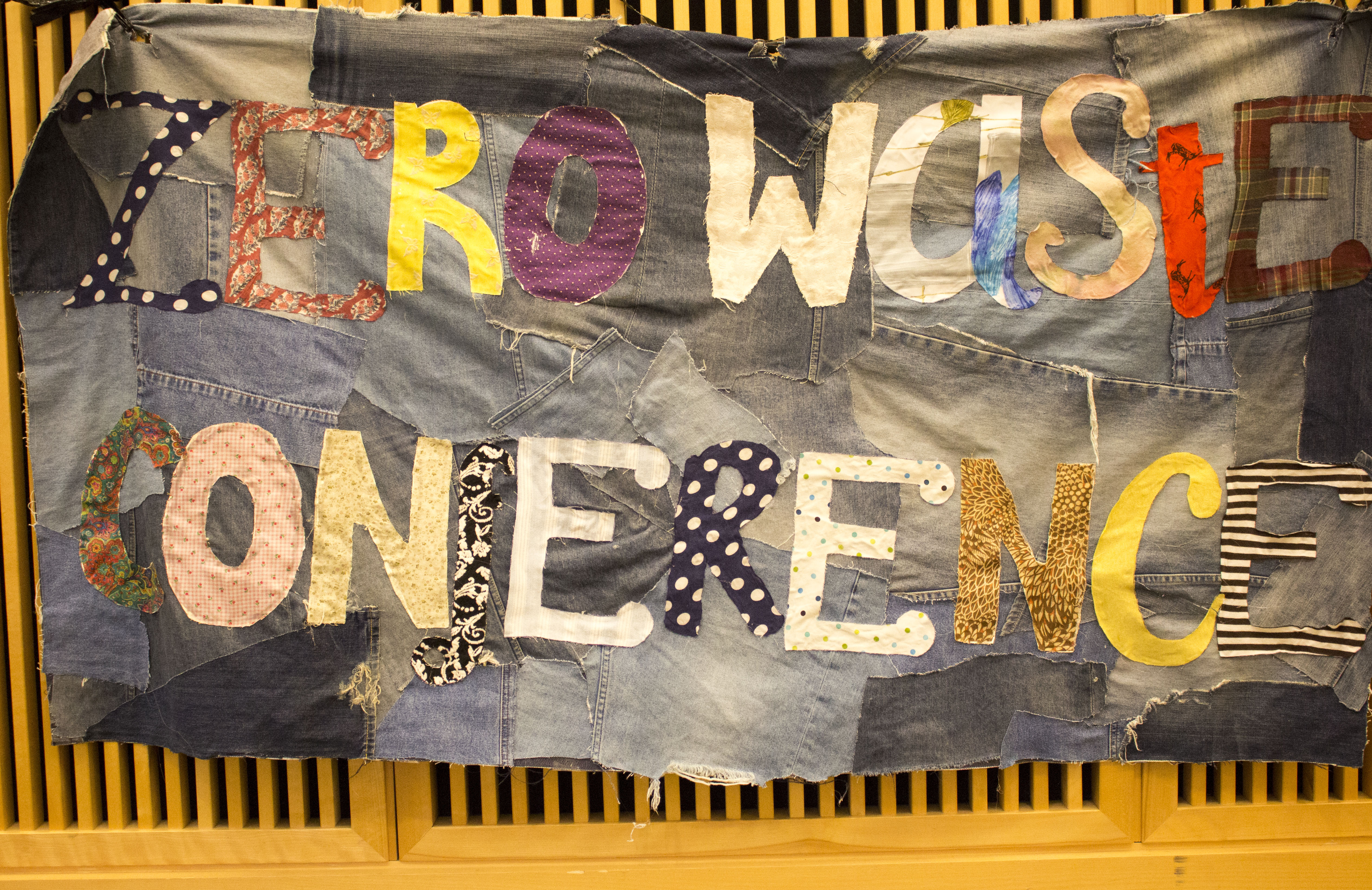
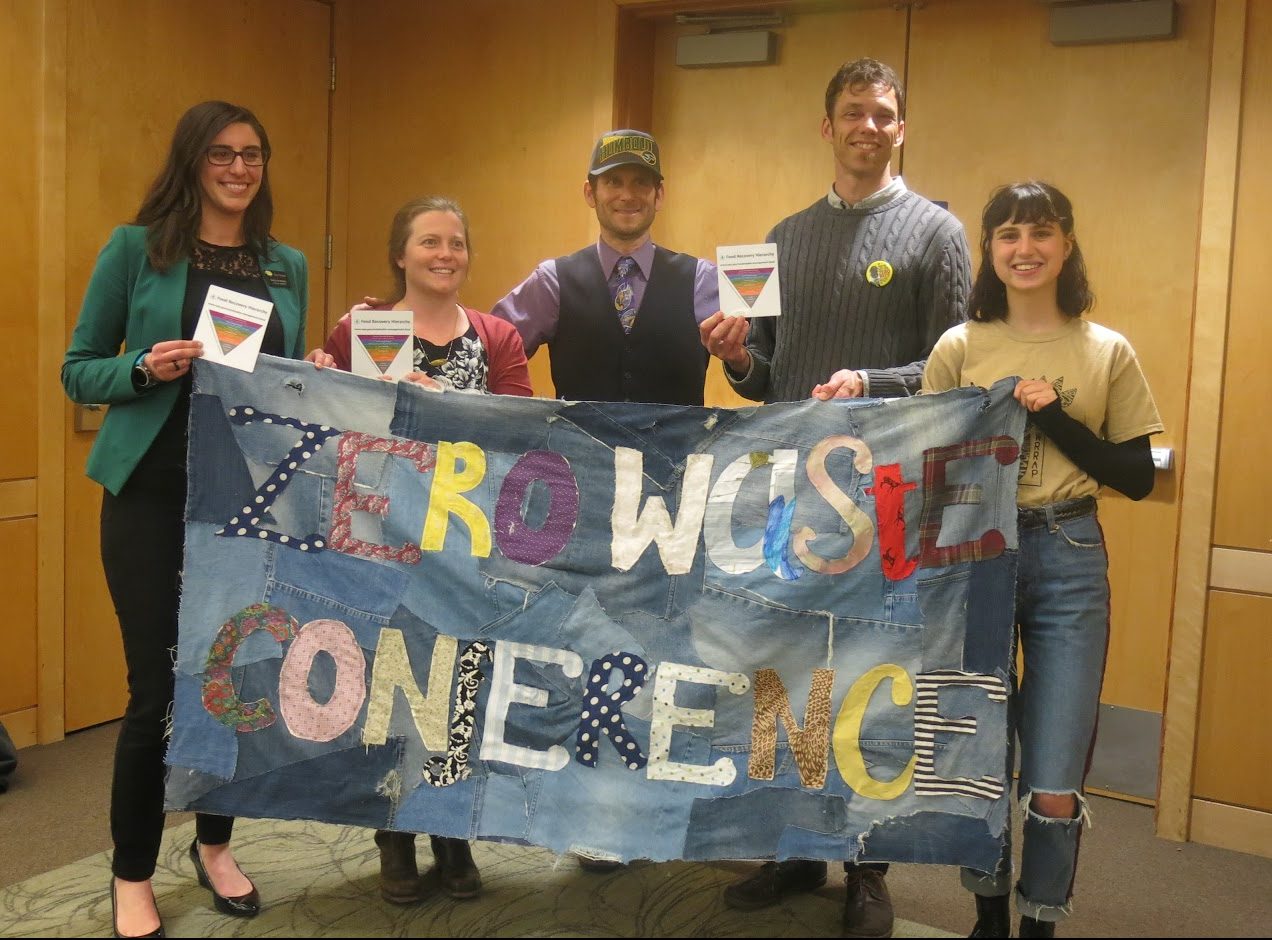
This year Oct. 19-23, WRRAP will be holding its annual Zero Waste Conference virtually.
The virtual setting grants more accessibility for speakers to attend. Beyond the clothing swaps and physical demonstrations, WRRAP sacrificed the semester for the safety of students. The new policies come at the cost of student interaction.
Amanda McDonald, WRRAP’s program manager, said the biggest obstacle in their path this semester is reaching students.
“Typically, there’s multiple table events that we work throughout the semester that really get students engaged in waste reduction just by walking through the quad,” McDonald said. “That kind of interaction is so much harder with students being online.”
The WRRAP staff is smaller this semester, they are still provide students on campus with resources through the Reusable Office Supply Exchange program, the Bicycle Learning Center and the campus compost project.
The ROSE program simultaneously reduces waste and provides students with free access to school supplies donated by the community and former students.
Sam Kelly, director of ROSE, said the program is operating as usual with extra precautions and shorter hours of operation.
“We definitely have more stuff in here right now than past semesters,” Kelly said. “Just because we don’t have a lot of people coming in and taking it.”
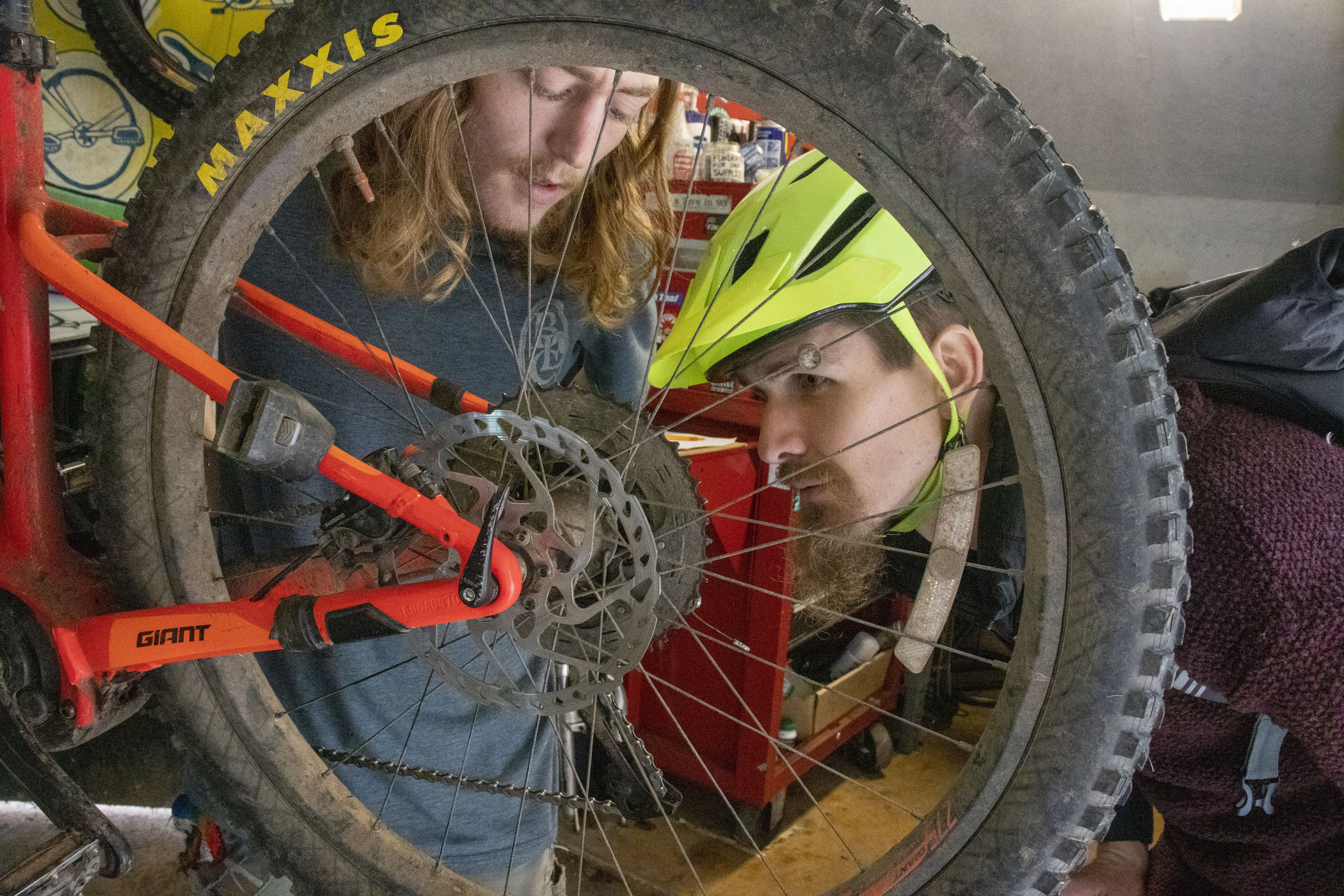
The BLC, located on the eastern end of the Redwood Bowl, is offering free bike repairs to students, staff and faculty. Service differences include wearing masks and social distancing during repairs.
COVID-19 restrictions currently forbid the BLC from allowing volunteers, which has forced them to cut back their hours.
Justin Delgado, a BLC instructor, said it has also made the days a lot longer without someone else in the shop.
“Typically we get about one person, at least when I’m here, per day right now,” Delgado said. “It used to be prolly five or six.”
The compost team continues providing campus with their weekly services, however with a fraction of the employees present, their load is significantly lighter.
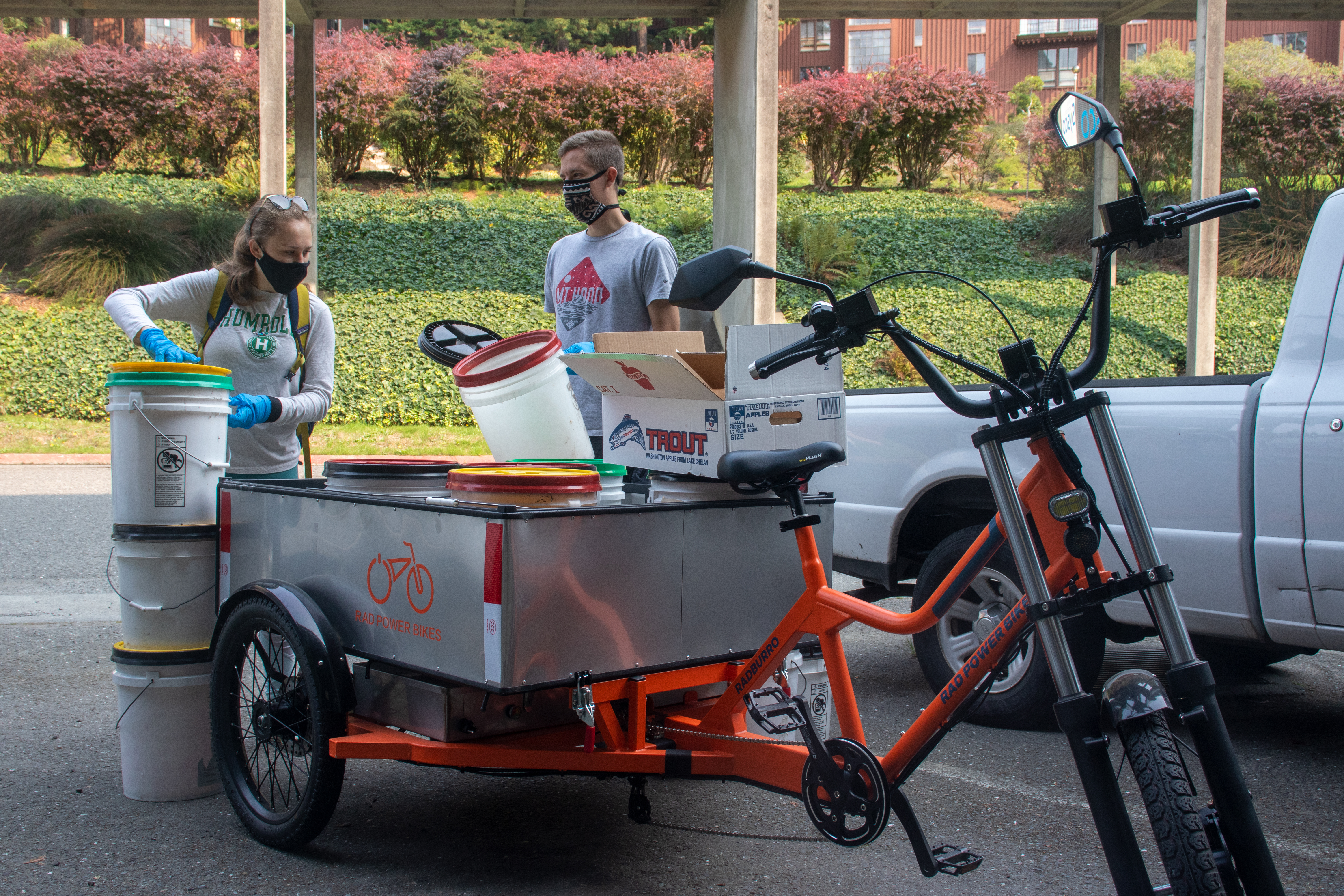
The team recently made the switch to an electric mountain bike this semester for compost collections. While much more energy efficient than the electric facilities vehicles they used in the past, in its current state, the trailer they’re hauling behind the E-bike can only hold a fraction of the buckets.
WRRAP’s compost collection process has switched over from electric facility vehicles to an electric mountain bike for energy efficiency. The downside to the switch, is the trailer the bike pulls behind it can only hold a fraction of the compost buckets.
Krissi Fiebig, the director of the compost branch of WRRAP, said they intend to team up with the BLC and modify the trailer possibly into a tower to fit more buckets.
“I don’t know how aerodynamic that would be,” Fiebig said. “But it would get the job done.”
The compost team is beginning a new partnership with the Campus Center for Appropriate Technology, allowing students access to properly dispose of their food waste. Additionally, providing free fertilizer towards the end of the semester, to any students who show up.
McDonald expresses concern in the programs future with several of the student staff members expecting to graduate in the spring. Finding replacements will be challenging given the virtual format that’s currently planned for the rest of the academic year.
“I’m just nervous that it’s going to harm the integrity of the program,” McDonald said. “When we do hire new people, I want them to understand the history of this program and the legacy that they’re stepping into and carrying on.”
Though they can’t currently accept casual volunteers, the WRRAP team currently has intern positions available and leadership positions opening soon for students interested in the future of our planet.
“Being one of the people on the WRRAP branches really helps to remind me to reduce my own waste,” Fiebig said. “And just to be more conscious than I already was of the things I consume and what I do about my life.”
Saving money and the planet at the HSU Bicycle Learning Center
Humboldt State University’s Bicycle Learning Center made the transition in September 2018 from a student club to an Associated Students program umbrellaed under HSU’s Waste Reduction and Resource Awareness Program.
Steven Sperling volunteers at the BLC while pursuing his master’s in business administration.
“Bicycles are the most efficient form of transportation there is for human beings,” Sperling said. “Bicycles can and should save the world, period.”
Originally founded in 1992, HSU’s entirely student-staffed Bicycle Learning Center is a free resource available to all HSU students in need of bike repairs. The transition opened up two part-time instructor positions, paid for with student fees, that are currently split between three students.
“Probably the biggest thing that I’m working on here is how to share my bicycle knowledge efficiently,” Sperling said. “Learning how to teach is one of the things that I’m most excited about learning while I’m here.”
BLC Director Julian Palmisano scours the donated pins bin on Jan. 29. | Photo by Dakota Cox
Colton Trent hard at work at the BLC on Jan. 29. | Photo by Dakota Cox
Current Director Julian Palmisano has been a member of the BLC since he transferred to HSU from Santa Barbara City College in 2017.
“We all started as volunteers at the shop to serve and build community, utilize the resources and gain experience,” Palmisano said.
The BLC does its best to provide all of the tools necessary for maintaining a well-conditioned bicycle, along with as many consumable parts that they can get their hands on. With a budget of only $800 provided by WRRAP, the majority of parts that cycle through the BLC are donations.
“Sometimes we just don’t have stuff and we have to tell people like, sorry we can’t help. Which is a real bummer.”
Colton trent
Colton Trent is an instructor entering his third semester volunteering for the BLC.
“The budget provides a buffer in case we run out of stuff,” Trent said. “But for the most part we can function pretty well trying to up-cycle and recycle things.”
As a result of their small budget, the BLC can only provide a finite number of students with bicycle maintenance.
“Sometimes we just don’t have stuff and we have to tell people like, sorry we can’t help,” Trent said. “Which is a real bummer.”
The BLC encourages donations in the form of tools, bicycle parts and old bikes that will be refurbished and donated to a student-rider in need. All cash donations that the BLC receives go directly into the shop’s spare parts fund.
In the fall semester of 2019, the BLC saw over 180 documented student visits, totaling over 100 hours of bicycle maintenance. By spreading the trend of using bicycles as a primary-method of transportation, the BLC is promoting a healthier lifestyle with a significantly smaller carbon footprint.
Located in the eastern tunnel by the Redwood Bowl, the BLC is open 10 a.m. to 2 p.m. Monday through Friday, with instructors and volunteers standing by to assist and educate students in bicycle repair.
Waste Reduction & Resource Awareness Program hosts environmental event and educates community
The Humboldt State Zero Waste Conference, hosted by the campus’ Waste Reduction Resource Awareness Program, taught students and community members how to reduce the amount of waste they produce in their daily lives. The week ended in a city proclamation that Nov. 15 would forever be Zero Waste Day.
“WRAPP is all about serving students and providing students resources to make lifestyle changes,” Program Manager Amanda McDonald said. “It’s a slow and gradual process where it’s not like you can get rid of every plastic thing in your house at once, but you have to be committed to doing this over time.”
A week of influential guest speakers, engaging activities and exciting happenings kept students active and engaged in reducing waste. These included a moving speech by Tedd Ward, the authority on Del Norte solid waste, Tinkertime on the quad and the extravagant Green Campus Trashion Show.
The clothing industry is so detrimental. Fast fashion, in my opinion, is one of the worst industries for the environment. It not only deteriorates sense of commitment, but it also withholds your own sense of style. It’s good to upcycle clothes for a new purpose instead of sending them straight to the landfill.
The Zero Waste Conference began with a banquet which set the tone for the rest of the week. A keynote speech by Alec Cooley shared the story about the origins of the Humboldt Campus Recycling Program, following closely by the Trashion Show.
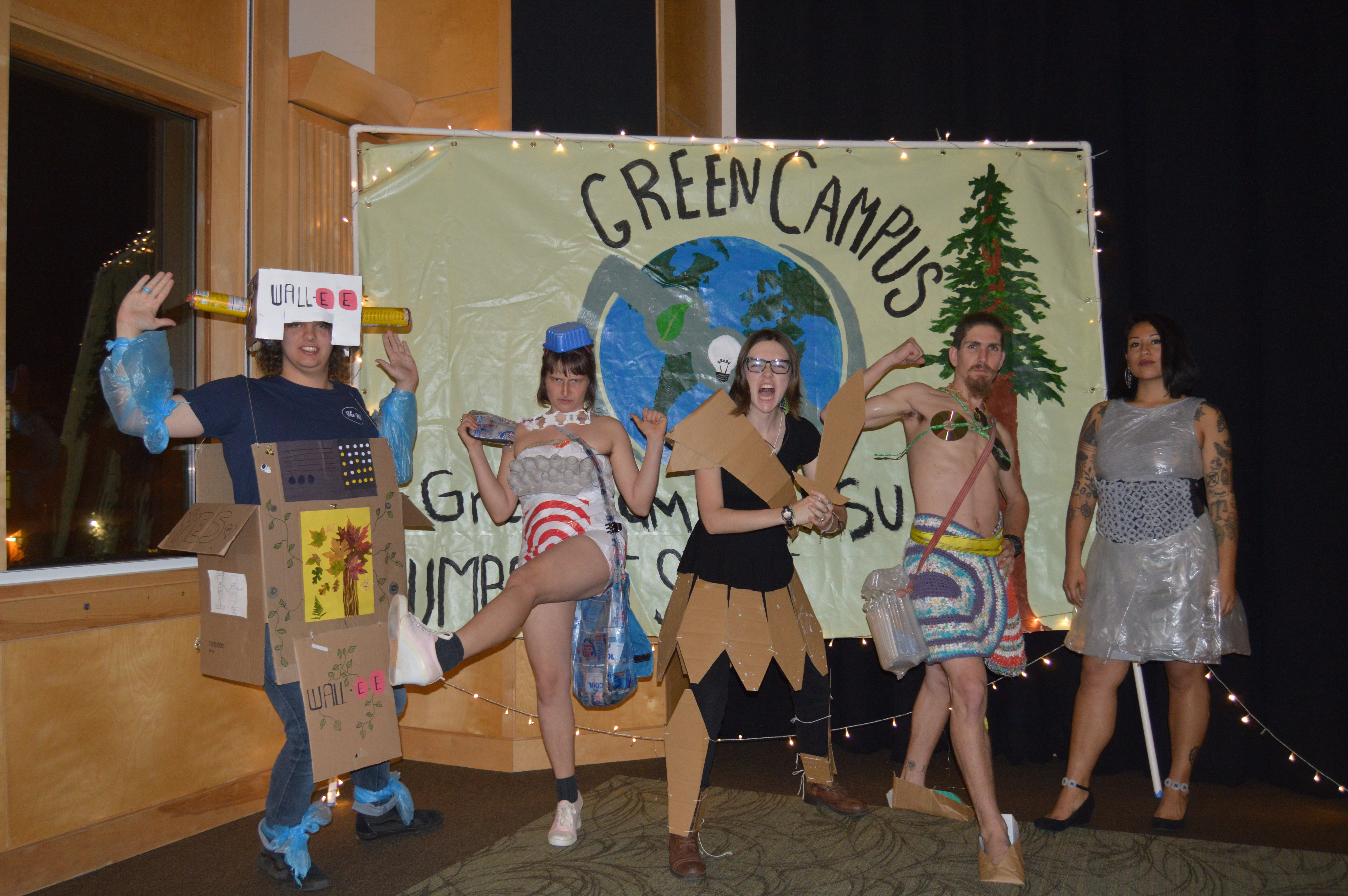
Eight students built magnificent costumes out of household waste. There was a Rob-box, sword wielding cardboard centurion, and the CD bikini-rocking Julian Palmisano. They each strut their stuff across the stage to show off what they made.
“I think my grandma would be proud,” Palmisano said. “I did it for fun. It’s kind of a joke, really, and it’s a way to bring attention to the unprecedented degree of waste that is in this world.”
In pursuit of constructive solutions, the following day was Tinker Time. WRRAP, CCAT and Green Campus showed students how to reduce their waste by upcycling recyclable items. Upcycling is the “reuse” part of the reduce, reuse, recycle phrase.
During Tinker Time, WRRAP showed students how to upcycle their clothes into mason jar coozies and grocery bags. The Campus Center for Appropriate Technologies upcycled wood waste and oyster shells into wind chimes. At the coozie table, WRAPP Compost Site Intern Krissi Fiebig taught students how to cut up old clothes and sew them together for a more beneficial use.
“The clothing industry is so detrimental,” Fiebig said. “Fast fashion, in my opinion, is one of the worst industries for the environment. It not only deteriorates sense of commitment, but it also withholds your own sense of style. It’s good to upcycle clothes for a new purpose instead of sending them straight to the landfill.”
In 1964 the first plastic bag was made, and it was the beginning of this. One half of all of all plastic produced has been produced in the last thirteen years. Recycling is ineffective… It was not our decision which led to this. It was fractional distillation and oil refining.
Finally, Ted Ward’s speech was a somber reminder of the modern state of the world. He said he felt as though he had failed as a waste manager. He reminisced about the day the first plastic bag was created and commented on how we ought to rename our modern era the “Plastocene,” cynically addressing the volume of plastic waste we produce.
“We should coin this era the Plastocene instead of the Holocene because that is our legacy,” Ward said. “In 1964 the first plastic bag was made, and it was the beginning of this. One half of all of all plastic produced has been produced in the last thirteen years. Recycling is ineffective… It was not our decision which led to this. It was fractional distillation and oil refining.”
The Zero Waste Conference finished up with Humboldt officially declaring Nov. 15 Zero Waste Day. The official proclamation reflects Humboldt County, the City of Arcata and our local community’s progress towards zero waste.
“Now be it resolved that the Humboldt County Board of Supervisors joins Humboldt cities and business groups to recognize November 15, 2019 as Zero Waste Day,” the proclamation said. “A day each year we acknowledge the County’s waste reduction progress and urge residents to recommit efforts toward Zero Waste.”
In spite of the successful campaign to phase out single-use water bottles, Humboldt State has yet to remove plastic bottled beverages from campus
Almost 10 years have come and gone since Humboldt State University took back the tap and did away with single-use water bottles on campus.
Overall HSU is known to lead the way in sustainability across the California State University system. In spite of being further ahead in the sustainability game than most campuses, HSU still offers a variety of beverages for sale packaged in single-use plastic.
HSU Dining Services Director Ron Rudebock said they have gotten a fair number of comments over the last couple of years regarding plastic products and on phasing out plastics completely.
“We have been working with vendors to obtain their products in a reusable or compostable or recyclable package and vendors are changing their package materials,” Rudebock said.
Four of the five campus responsibilities listed under the policy have set deadlines.
The first is the elimination of single-use plastic water bottles by Jan. 1, 2023. HSU met this requirement in 2011. The second is the elimination of plastic straws no later than Jan. 1, 2019. HSU eliminated plastic straws during the fall 2017 semester.
The third responsibility listed, also set for January of this year, was the elimination of single-use plastic carryout bags. HSU stopped using plastic bags back in March 2014. The fourth deadline, and last with a time requirement, was the elimination of single-use polystyrene (e.g. STYROFOAM™) food service items no later than Jan. 1, 2021. HSU eliminated Styrofoam to-go containers over 10 years ago and the campus is working to eliminate it in any pre-packaged items.
The final goal of replacing single-use plastic items with materials that are reusable, locally compostable and/or recyclable doesn’t list a specific deadline.
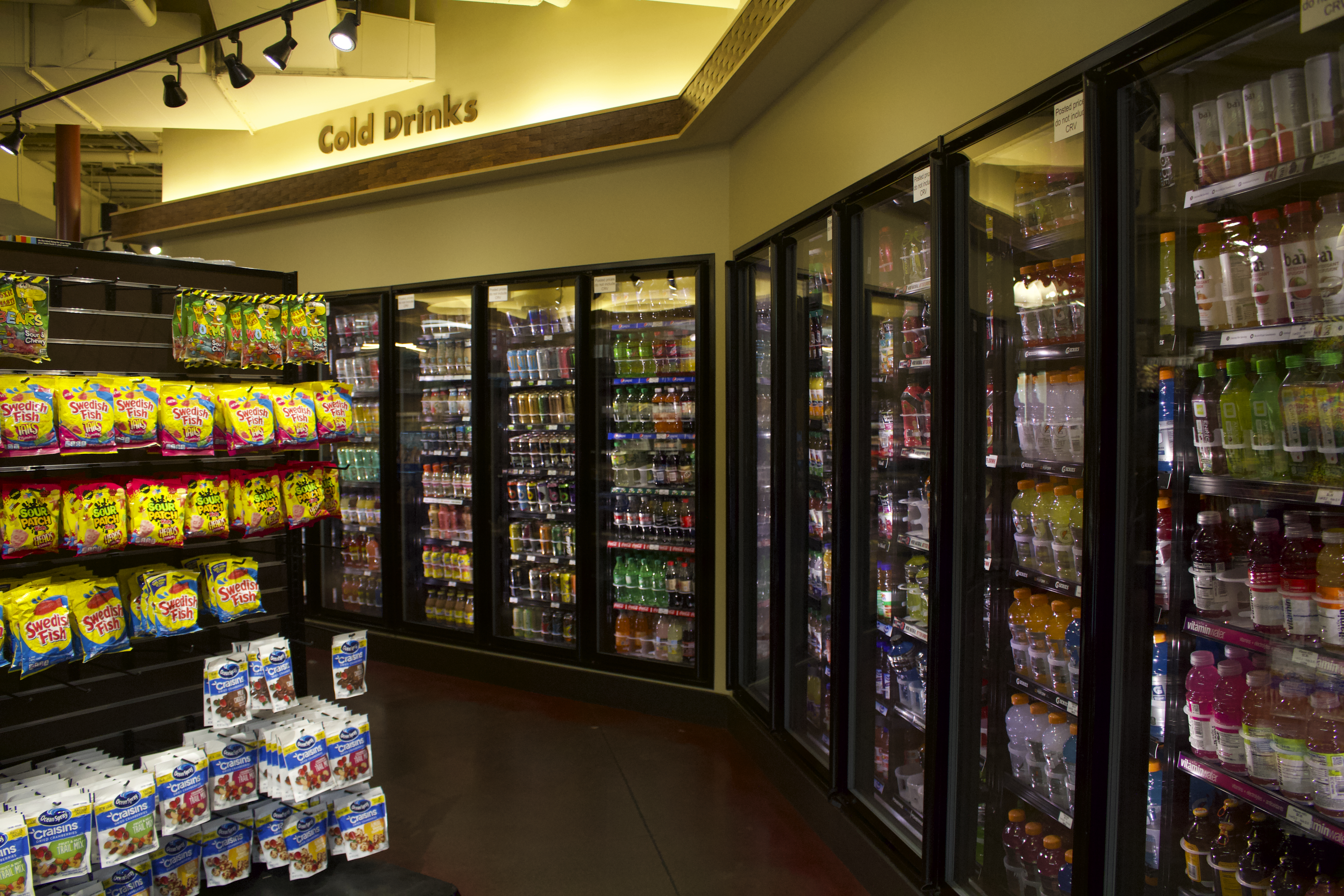
A variety of some of the single-use plastic bottled beverages offered. According to Rudebock, much of the decision to continue to sell single-use plastic drinks is because of consumer choice. | Photo by Megan Bender
Rudebock said this specific change is a challenge. The Depot, the College Creek Marketplace, the Cupboard and vending machines still offer plastic bottled beverages on campus.
“We would like to see a faster adaption but with this guideline having no deadline and with the current collapse in the recycling market I do not see this becoming feasible in the next year,” Rudebock said.
Dining services has made some efforts in providing more glass or aluminum options. The J, for example, has a beverage cooler that is all aluminum and glass, has eliminated single use plastic containers and has single-use packaging that is compostable or recyclable.
However, other locations haven’t been able to make the same change as effectively because of the demand for products that happen to also be in plastic bottles.
“We’ve been working with a lot of our vendors and pushing, trying to get more either glass or aluminum containers.” he said.
Rudebock said Dining Services also goes out of their way to order aluminum and glass alternatives whenever possible from specific companies and brands like Coke or Pepsi.
“It kind of comes down to consumer’s choice,” he said. “Consumers can help by purchasing products that are in reusable, compostable or recyclable packaging and not requesting products that are not in reusable, compostable or recyclable packaging.”
Students have pushed back against the university in the past, questioning its dedication to environmental responsibility over their business ties with PepsiCo.
As reported in the Lumberjack and the North Coast Journal, in 2017 HSU made efforts to meet student’s demands to closer align with its dedication to social, economic and environmental issues by re-evaluating a 40-year-long partnership with PepsiCo.
Under the contract PepsiCo funded HSU with around $58,000 worth of athletic scholarships in exchange for pouring rights. Pouring rights allowed PepsiCo to reserve 80% of HSU shelf space for their products.
Students also made the argument the set up was not fair to local businesses.
In spite of being in a budget deficit and the loss of scholarship funding, HSU did not renew the pouring rights contract and let it expire at the end of June 2017.
HSU was the first California public university and third national public university to phase out water bottles.
The University Center and Dining Services stepped into to help with some of the lost resources.
Rudebock said they managed to fund a majority of the lost scholarship money but leaves the decision of how the scholarships are dispersed up to the school. This way the UC and Dining Services are not directly funding athletics or any specific department.
The university still does business with PepsiCo but under different rebate-based agreements. Dining services also stopped carrying Aquafina water bottles, a brand owned by PepsiCo as a result of the nationally recognized Take Back the Tap campaign.
Under the Waste Reduction & Resource Awareness Program, students began efforts to Take Back the Tap at HSU starting in 2009. The student lead group and Dining Services worked to phase out the sale of single-use water bottles in 2011 as is the primary focus of the campaign.
As a result, HSU became the first California public university and third national public university to phase out water bottles. Dining Services initially explored an alternative by offering boxed water.
“At first we thought they were upset with the plastic water bottles, but they said ‘No no, just the water,’” Rudebock said. “It was more about the idea of selling packaged water.”
Before HSU removed water bottles on campus, TBTT calculated that HSU’s annual bottled water demand “required approximately 43 barrels of oil per academic year” and in turn was “releasing 35,000 pounds of carbon dioxide into the atmosphere.”
HSU now owns two Hydration Stations and has 16 water fill stations on campus.
Environmental Science & Management Professor James Graham and his geospatial students created an interactive map of HSU that includes where to find water fill stations on-campus as well as other resources.
The locations of all water stations on HSU’s campus according to the Sustainability project. These locations include the two Hydration Stations.
Sustainability Director Morgan King said Facilities Management worked with students help create the map.
“We worked with [Graham’s] students to develop layers for sustainability attributes,” King said. “Including water filling station locations, bike parking locations, recycling and compost bin locations.”
Anyone can access the map by visiting HSU’s sustainability website. The map key is listed in a drop down menu that offers different types of resources on campus. Under the sustainability option, users can check the box of the information they’re looking for.
Rudebock said Dining Services remains attentive to the needs of the students and the possibility of selling less plastic-bottled products.
“Every journey begins with a step,” Rudebock said. “The less plastic containers that students buy helps change the need for that product.”
The California State University system’s single-use plastic policy passed in December 2018 includes four policy changes that have deadlines, but the fifth and final goal of the policy doesn’t list a deadline.
Eliminate single-use plastic water bottles by January 1, 2023. HSU has already met this requirement as of 2011.
Eliminate plastic straws no later than January 1, 2019. HSU eliminated plastic straws during the fall 2017 semester.
Eliminate single-use plastic carryout bags no later than January 1, 2019. HSU eliminated plastic bags in March 2014.
Eliminate single-use polystyrene (e.g. STYROFOAM™) food service items no later than January 1, 2021. HSU eliminated Styrofoam to-go containers over 10 years ago and are working to eliminate it in any pre-packaged item
Replace single-use plastic items with materials that are reusable, locally compostable and/or recyclable.
To find out more about HSU’s Zero-Waste Initiatives, WRRAP and TBTT visit the WRRAP homepage.
Everyone eats. You’re either buying food or you’re growing it. This past weekend, the Humboldt Permaculture Guild hosted their annual Seed and Plant Exchange, a collaborative event that brings together students and members of the community over a share gardening knowledge, materials and resources.
Organizations on and off campus are working to make growing food more accessible for students and community members.
Student volunteers at the Humboldt Permaculture Guild’s booth during the Seed and Plant Exchange on March 31. Photo by Emily Owen.
WRRAP and CCAT tabled at the event, providing information on composting and Humboldt State University’s other zero waste initiatives.
Isabel Sanchez, a Humboldt State senior and a co-director at CCAT, the Campus Center for Appropriate Technology, recognizes the need for coalition building in gardening and food justice. She thinks this event offers a chance to cultivate an open space for everyone to learn.
“CCAT is a place to pass down ancestral knowledge,” Sanchez said. “[The seed exchange] creates a space to engage with that information and the community.”
Karina Coronado, a HSU environmental studies major and librarian at CCAT, wants to provide access to seeds and make gardening available to all people.
“CCAT is an always active, continuous space to learn, follow up and further knowledge,” Coronado said. “It is the forever seed exchange.”
Isabelle Sanchez and Karina Coronado explaining CCAT’s mission to community members at the Humboldt Permaculture Guild’s annual Seed Exchange. Photo by Emily Owen.
Permaculture comes from the concept of permanent agriculture and is based on the belief that we can align ourselves with nature’s own rules.
It is the idea that we can build sustainable, regenerative human settlements that benefit people and the natural world. Permaculture works to minimize our impact on earth and maximize the efficiency of how we consume natural resources.
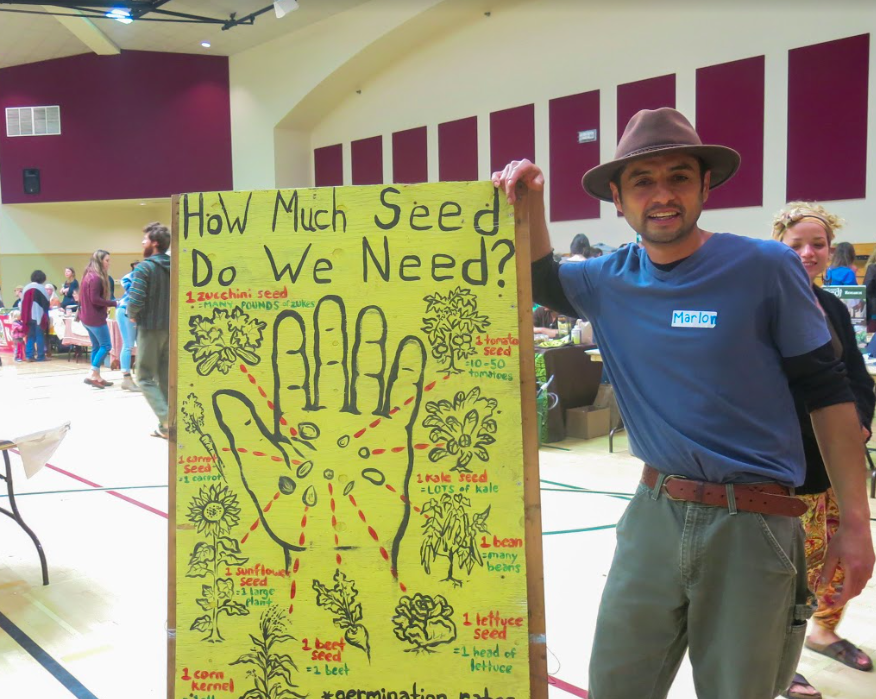
Marlon Gil is a HSU wildlife graduate, gardener, natural builder and self-proclaimed “permie.” He believes permaculture concepts can be applied to all situations.
“We have a moral obligation to share the excess we have,” Gil said. “Permaculture is a way to do that. It’s about balance. Take the time now to learn it and then live it.”
Every April, HSU’s Oh Snap! offers a series of gardening workshops hosted in association with WRRAP and CCAT. Irán Ortiz is the sustainability coordinator for Oh Snap! and she has organized the programs to prepare even the most inexperienced gardener to take back their power.
“It is empowering to grow your own food,” Ortiz said. “There is a big problem with our current food system, mainly in distribution, and this really affects students. So this is a way to take advantage of the resources provided.”
The gardening workshops will culminate on April 19 from 5-9:30 p.m., with a seed bank on campus.
The event will feature a banquet and showing of Seed: The Untold Story. It will provide students with almost all of the resources they need to start their own personal gardens.
Humboldt State University’s WRRAP hosted their second annual Zero Waste Conference on Feb. 9 and Feb 10.
The conference aimed to focus on the way we’re redirecting waste in our community, as well as the barriers that come with it.
The two-day conference kicked off on Feb. 9 with DIY workshops focusing on waste reduction in the Humboldt community.
There was also a banquet with keynote speakers followed by a documentary screening of Wasted Away.
There was an all-day event of panelist discussions, a compost workshop and speakers on Feb. 10.
One of the speakers was Dr. Melanie McCavour, lecturer for environmental science and management at HSU.
McCavour’s presentation went over some common definitions and misconceptions of the terms biofuel, biomass and much more.
“There’s no one answer to the question ‘Are biofuels sustainable?’,” McCavour said. “They’re not always bad and they’re not always sustainable. It depends on the situation.”
McCavour expected to see more people in attendance. However, she said that one cannot judge success by the amount of people who turned out, and that it’s better judged by how much those learn from it.
WRRAP education director Shanti Belaustegui believes this conference is an amazing opportunity to have a dialogue in our community about solutions and to get inspired by things that are happening.
“I personally am leaving feeling very inspired,” Belaustegui said. “The people that did show up left with their minds nourished. That’s all we could’ve asked for, to create dialogue with the community and start this.”
Ciera Wilbur, zero waste director for WRRAP, hopes that the Zero Waste Conference becomes a permanent event at HSU for people who don’t quite know about sustainability and zero waste.
“The way I see sustainability is like the capacity to continue to exist,” Wilbur said. “We’re trying to protect our resources for future generations not just our current gratification.”
Wilbur described zero waste as something that should bring us away from the current idealism, which is convenience and single-use products. She tries to bring forth the idea that what you use can be reused.
“… we’re looking to create a circle,” Wilbur said.
When it comes to sustainability and zero waste, there are barriers that people face. Wilbur said our biggest barrier is accessibility.
“There’s a lack of education and sharing knowledge of how we can be more sustainable in an easy way,” Wilbur said.
The theme of the Zero Waste Conference held this past weekend on the Humboldt State campus was “beyond barriers.”
Hosted by the Waste Reduction & Resource Awareness Program, or WRRAP, their goal is to help make sustainability accessible to everyone.
The event featured different panels during its two-day run.
Friday started with tinker time, where there was a clothing swap and different stations for students to learn how to sew, make their own deodorant or fix a flat bike tire. Later that night, WRRAP hosted a free vegan banquet for students and the community. It featured two keynote speakers.
The mayor of Arcata explained her 10-step plan to transition into a zero waste city. The second speaker was André Villaseñor, an environmental protection specialist for the EPA, who spoke about his specialty of reducing food waste. The night finished with a showing of Anthony Bourdain’s film, “Wasted! The Story of Food Waste.”
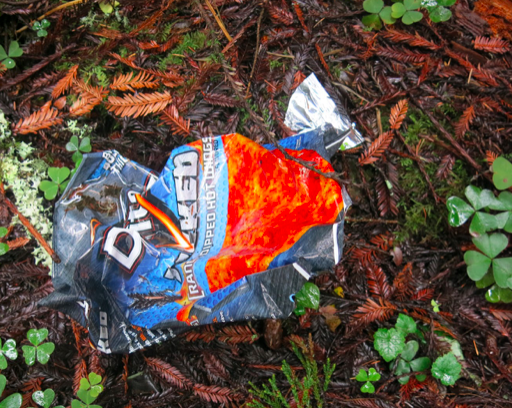
We are socialized not to throw garbage on the ground and are ingrained with anti-littering campaigns throughout our entire lives. However, it’s clear that these catchy slogans didn’t stick.
Everyone knows not to litter, but somehow there’s still trash all over Humboldt’s natural spaces.
These photos were taken over a series of days in three different locations throughout Humboldt County: The Arcata Community Forest, Mad River Beach and Strawberry Rock in Trinidad.
Most of the trash seen is either recyclable or compostable.
Samantha Stone, compost director at HSU’s WRRAP, explains that orange peels and other organic waste do not naturally break down in a forest environment.
“It definitely breaks down slower than if it were in a compost bin that generates heat and has other green and brown wastes,” Stone said. “There’s also the thing of food scraps inviting nonnative critters into the woods.”
A natural space is not designed to properly decompose our trash. In fact, most of what is littered will never actually break down.
The U.S. National Park Service says that it can take five years for a cigarette butt to biodegrade, up to 40 for clothes, a million years for a glass bottle to disappear and a styrofoam cup will be around forever.
Reagan Hester, recreation administration major at HSU, described how disappointed she feels seeing trash in our national parks.
“Properly disposing of trash is such an incredibly easy thing to do,” Hester said. “Even the littlest scrap creates a distraction from the natural beauty of a national park… this is entirely unnecessary. Not to mention the depressive effects on the wildlife and their natural habitat.”
Anjelica Yee, wildlife major at HSU, thinks a huge part of it is the hierarchy of man versus nature that Western culture emphasizes.
“It feels as though people disregard the fact that this is habitat for hundreds of different native species,” Yee said. “Humans act superior to other animals and by throwing our trash in their home, it just shows that blatant disrespect of nature.”
Waste Reduction and Resource Awareness Program’s Zero-Waste Conference is a reflection of the effort the community and students put toward goals of engaging, expanding, sharing and moving forward.
Shanti Belaustegui Pockell, an environmental studies major at Humboldt State University, is the education director for WRRAP on campus.
Belaustegui Pockell said WRRAP hopes to grow in the future by working more with students on campus, as well as other programs to form coalitions and strengthen relationships.
WRRAP is hosting the Zero-Waste Conference throughout the day on Friday, Feb. 9 and Saturday, Feb. 10.
Belaustegui Pokell said the event will focus on intersectionality, social justice issues and institutionalizing sustainability practices of evolving and shaping policy.
Multiple speakers will be attending the event to discuss community challenges.
Sofia Pereira, the mayor of Arcata, will speak on making Arcata a zero-waste city on Friday and Andre Villasenor, a United States Environmental Protection Agency Sustainable Management of Food program representative, will speak on institutionalizing sustainable materials.
Ceria Wilbur, an environmental science and management major at HSU, has been the zero-waste director at WRRAP for the past year.
The conference and banquet at 5:30 p.m. on Friday is new this year and works to extend the message of a sustainable future.
“It’s just a way for us to connect with our campus community, bring our peers together with a number of different inputs and experiences,” Wilbur said. “This year our theme is Beyond Barriers, Imagining a Zero-Waste Future.”
Community members are encouraged to attend the event. Vegetarian and vegan options will be available.
There are activities on Friday from 11:00 a.m. to 4:00 p.m. at the UC Quad that include crafting with Tinker Time and a clothing swap, along with demonstrations from the Campus Center for Appropriate Technology, or CCAT.
Tinker Time are local and on-campus programs that have workshops for gardening and crafting body care products.
Campus sustainability groups that are also participating in the zero-waste event are Green Campus, Humboldt Energy Independence Fund, with speakers from local officials, academic departments and the Office of Sustainability.
WRAAP will host the second half of the Zero-Waste Conference in the Kate Buchanan Room on Saturday, covering topics such as the role of compost in carbon sequestration, biomass and the Yurok tribe.
Jason Martinez, outreach coordinator for CCAT, will attend the Zero-Waste Conference.
“Help is always welcome at CCAT, and for folks that come through, there is a lot they can learn, a lot they can experience,” Martinez said.
Martinez is excited to introduce CCAT to students who don’t know about the house on campus.
“I love seeing how the projects get started, how they are going to see how CCAT continuously is growing,” Martinez said. “Whether it’s the physical space itself or just the people, I think that is the piece I love seeing.”
WRRAP’s Zero-Waste Conference is meant to bring together students, faculty and community members to discuss real issues the environment is facing due to human impact.
Armed with their usual commitment to sustainability and an updated mission statement, the Waste Reduction and Resource Awareness Program (WRRAP) is starting to integrate intersectionality into their brand of environmentalism.
WRRAP started as an on-campus recycling program in 1989. Their goal has always been to reduce waste coming from HSU through environmental education. Since its inception, the organization has expanded into compost diversion, water quality assurance and a reusable office supply exchange.
This semester, the organization is attempting to bring together two important fields of activism by designing this semester’s projects with inclusive sustainability in mind.
“Environmentalist” is a label that comes with a dark history of eugenics, exclusivity and barriers that WRRAP is attempting to dismantle on a local level. The campus-based organization WRRAP recently hired an environmental justice intern with the intention of making sustainability more accessible for all HSU students.
Lauren Wardle, the newly hired environmental justice intern, has experience running an intersectional feminist club and wants to bring those concepts to her position.
“Social issues go hand in hand with environmental problems,” Wardle said. “Environmental justice and intersectionality will bring in the voices of the communities that are most affected.”
The program’s main goal is to ensure that HSU students are using their available resources to the fullest extent. WRRAP’s first environmental justice project will be a campus-wide survey to assess students’ access and understanding of sustainability.
Shanti Belaustegui Pockell, an environmental studies major, WRRAP’s education director and intern coordinator, hopes the internship will help shift environmentalism into something more accommodating for everyone.
“Instead of trying to get more people into this little space we have created, we want to expand the circle,” Pockell said. “We are reimagining what sustainability can look like, because a lot of people are living sustainably, just without the label.”
Irán Ortiz, environmental studies major and director of the student-led campaign Take Back the Tap, credits WRRAP’s leadership and innovations for social justice.
“We need to bring together the communities that are affected, but ignored,” Ortiz said. “I hope this new position helps address the problems we see in our institution by creating a new perspective and understanding of intersectionality.”
When environmentalism is executed with an intersectional lens, social and environmental issues are looked at as one. To put it another way, it is the understanding that all oppressions exist under the same hegemonic systems.
Ryan Sendejas, environmental studies major and community garden coordinator at Campus Center for Appropriate Technology, realizes the importance of incorporating environmental justice into an institution.
“In society and bureaucracies specifically, we tend to compartmentalize everything in an attempt to understand it,” Sendejas said. “Nothing is truly singular. So, we need to start thinking in terms of interconnectedness.”
WRRAP will be hosting a Zero Waste Conference on Feb. 9 and 10. Look out for flyers around campus for more details!
For more information about WRRAP, visit their website HERE.
A map showing where compost bins, water refill stations, electronics recycling and the WRRAP office are located on campus. Data from Humboldt State University and WRRAP, Map by Kelly Bessem.
School can be a mental and monetary struggle, but doing your part to reduce waste on campus doesn’t have to be. If you haven’t yet happened upon it, WRRAP is Humboldt State’s student-run Waste Reduction and Resource Awareness Program that’s been in operation for almost 30 years.
The campus services they maintain are free to all students. These services include campus compost bins, water refill stations, zero waste supplies, events such as the clothing swap and the ROSE [Reuseable Office Supply Exchange] House, where students can find 100 percent free school supplies such as notebooks and writing utensils.
Environmental science major Crystal Singletari was glad to find out that the ROSE House was there to provide an option other than paying expensive prices for new school supplies.
“The first two weeks of school I didn’t have enough binders to reuse and was super unorganized so I went to the bookstore, but they’re so expensive,” Singletari said.
Rangeland resources major Ishmael Guerrero believes helping to reduce waste is good but it is often difficult to keep track of waste reduction programs on campus.
“I’m usually focused on school, work or sports,” Guerrero said.
WRRAP is set up to direct students toward reducing waste on campus, and in the rest of their lives, in simple ways rather than having to figure it out alone. Isabel Sanchez, a business major and natural resources minor who has been working for WRRAP for more than two years, explained how WRRAP can make waste reduction easier for students to understand.
“It’s a network that allows for exchanges of waste reduction methods,” Sanchez said.
Need some encouragement to live a less-wasteful campus lifestyle? According to a 2015 estimation, Humboldt State University students collectively dispose of 266,314 pounds of waste on campus each year. That’s about the mass of four humpback whales. Though HSU students always seem to strive for improvement, there is still a whale of a problem.
Humboldt State University student waste disposal totals. Data from CalRecycle, Graph by Kelly Bessem.
Check out WRRAP’s website at http://www.humboldt.edu/wrrap or email their student staff at wrrap@humboldt.edu. The program is there so that reducing waste doesn’t become another daunting school task on your checklist.
This website uses cookies to improve your experience. We'll assume you're ok with this, but you can opt-out if you wish. Cookie settingsACCEPT
Privacy & Cookies Policy
Privacy Overview
This website uses cookies to improve your experience while you navigate through the website. Out of these cookies, the cookies that are categorized as necessary are stored on your browser as they are essential for the working of basic functionalities of the website. We also use third-party cookies that help us analyze and understand how you use this website. These cookies will be stored in your browser only with your consent. You also have the option to opt-out of these cookies. But opting out of some of these cookies may have an effect on your browsing experience.
Necessary cookies are absolutely essential for the website to function properly. This category only includes cookies that ensures basic functionalities and security features of the website. These cookies do not store any personal information.
Any cookies that may not be particularly necessary for the website to function and is used specifically to collect user personal data via analytics, ads, other embedded contents are termed as non-necessary cookies. It is mandatory to procure user consent prior to running these cookies on your website.