The Lumberjack


Students Serving The Cal Poly Humboldt Campus and Community Since 1929

Day: February 13, 2025

  • Trump bans transgender athletes in the U.S. What does this mean?

    Trump bans transgender athletes in the U.S. What does this mean?

    By Nick Escalada

    President Trump signed an executive order signaling the Department of Education to withhold federal funding from schools that support transgender athletes on Feb. 5. This legislation was a campaign promise made months prior to eliminate the perceived unfairness of biological males competing in women’s sports. It was enacted on the basis of Title IX, which prohibits sex-based discrimination in all federally supported institutions. This belongs to a series of executive orders regarding transgender rights that Trump has authorized in his first few weeks in office, with one banning trans soldiers in the military and another banning gender-affirming care for people under the age of 19.

    In a nation with a long history of LGBTQIA+ movements and social progress, this policy decision was heavily contested, but people opposed to the order do not actually expect much to change under its enforcement. According to National Collegiate Athletic Association (NCAA) president Charlie Baker, there are fewer than 10 openly trans athletes currently competing in college sports. Trans rights advocates are instead citing this as unnecessary bullying that sets a concerning precedent for how trans people may be viewed and treated moving forward. 

    Gender has been a concept interwoven with sports since their inception — with biological distinctions between men and women inhibiting their ability to compete with one another for millenia. Today, the grounds for separating our competitions more closely resembles the scientific notion of sex, with gender drifting apart in its etymology to describe what is now considered a social construct. However, men and women are still the foundational terms for the division in sports worldwide and the adhesion of gender to athletics has remained one of the most interesting constants in human history.

    For most of the recorded past, only men had been permitted to set foot in recreational athletic contests. Up until the 19th century, western society employed the archaic belief first voiced by Aristotle that women were ruled by their reproductive systems and that excessive physical or mental exertion would lead to infertility. It wasn’t until the end of the first wave of the feminist movement in 1920 where a separate version of the Olympic Games was established for women to compete.

    The rising women’s sports scene was inevitably enveloped by racial segregation in the United States, but that did not stop Black communities from excelling in mixed-race track and basketball meets. In the heat of World War II, the All-American Girls Professional Baseball League was founded, offering escapist entertainment for the distressed American homefront. Despite the performative nature of leagues like these, wartime offered women an opportunity for empowerment in sports, which was withdrawn immediately by 1945 in place of traditional gender roles until the next feminist wave in the late 60s and 70s. 

    Relative to their treatment in the 20th century, it might seem like the two genders recognized in modern sports are just about as equal as they can get. This is a dangerous assumption to make and it ignores the countless instances of sexist injustice in athletics that still linger from its bigoted past. For instance, finding a social media platform that does not offer a video compilation of male journalists pressing visibly uncomfortable female athletes about their body types, sex lives, or revealing uniforms, may seem impossible. It may not be as opaque today as referring to Olympic-level competitors as “girls,” but gender roles are still at large and are being imposed upon people who simply want to prove their skills to the world.

    This recent executive order will still allow transgender athletes to compete in the division of the gender they were assigned at birth. While this might make sense in an industry where biological traits are paramount, it may also speak to the level of legitimacy our society is willing to grant the chosen genders of these contestants. Above all, whether or not you think gender has a place in athletics, one can only hope for a world where professional tennis players like Eugenie Bouchard are not asked to give their interviewers a twirl for the camera.


  • Top 10 movies that will make you fall head-over-heels on Valentine’s Day

    by Julia Kelm and Kimberly Madrigal

    Dirty Dancing (1987)
    Dirty Dancing is a romance film set in 1960s upstate New York, in the Catskills summer resort. Frances ‘Baby,’ played by Jennifer Grey, is there with her family, and expects the trip to be nothing special. That is until she stumbles upon a bunch of the resort’s employees, including soon-to-be love interest Johnny Castle — Patrick Swayze — dancing dirty in secret. One thing leads to another, and Baby offers to cover for a dancer, Penny Johnson, and must train with Johnny.

    If you have not already seen Dirty Dancing, Valentine’s Day is the perfect excuse to see it. There’s a scene where Baby and Johnny are fooling around in this dance studio as Love Is Strange plays in the background that actually altered my brain chemistry when I saw it for the first time.

    Desert Hearts (1985)
    Desert Hearts is set in the 1950s, and Vivian Bell played by Helen Shaver comes to Reno, Nevada to file for her divorce. However, she finds herself attracted by a carefree, and spirited woman named Cay Rivvers — Patricia Charbonneau — and they have a slow burn romance. It can be difficult to find LGBTQ+ films that are good and also have a happy ending.

    I wouldn’t say this film has the happiest ending in the world, but hey, at least this one doesn’t have the “bury-your-gays” trope. I watched this for the first time earlier this year, and definitely think it’s a great choice for Valentine’s Day — especially if you have a special lesbian in your life.

    I Love You Phillip Morris (2009)
    I Love You Phillip Morris is about a former police officer named Steven Russell — Jim Carrey — who becomes a conman after coming out as gay. Steven gets caught in one of his schemes, and goes to jail. There he meets the love of his life, Phillip Morris, played by Ewan McGregor.

    For this one, I wanted to pick a more outside-the-box option — something that was a little more of a comedy, and something less people were likely to have already seen. Unfortunately, for how funny certain parts of this film are, there are also a few tear-jerker moments. However, if you wanna cuddle up to something a little more unorthodox, this may be the pick for you this Valentine’s.

    My Beautiful Laundrette (1985)
    My Beautiful Laundrette is set in 1980s London. Omar, a young Pakistani man played by Gordon Warnecke, is given a dilapidated laundromat by his uncle — Saeed Jaffrey — who hopes to turn it into a successful business. Soon after, Omar is attacked by a group of racist punks, but the situation defuses when he realizes their leader is his former lover, Johnny, played by Daniel Day-Lewis.

    I’ll be honest with you, for how exciting I made that teaser sound, this movie is a tad boring. However, it was pretty revolutionary for its time; not only did it center around a same-sex couple during the 80s, but it also talked about the serious racial issues against Pakistani immigrants in London at the time. This is a film to give you the excuse to talk about the political and economic state of the world with your film nerd partner this Valentine’s Day.

    Hairspray (2007)
    Hairspray is set in 1960s Baltimore. Tracy Turnblad — Nikki Blonsky — is obsessed with the teen dance show, “The Corny Collins Show.” Upon hearing there’s an open spot on the show, she auditions for a spot on and secures it. She becomes an overnight celebrity, and a trendsetter for the show. Through her newfound fame, she becomes determined to help her friends and end the racial segregation that has been a staple of the show.

    I don’t know if I’ve made my opinions on musicals clear before, but they usually are not my thing. However, Hairspray might be the greatest movie musical I’ve ever seen. John Travolta and Christopher Walken play Tracy’s parents, and they did make me believe in true love if that at all inspires you to watch Hairspray this Valentine’s.

    10 Things I Hate About You (1999)
    Such an iconic movie, with so many niche references, such a dope cast, plot and soundtrack. The “promposal” scene is the reason my standards are so high. I love this movie so much.

    13 Going On 30 (1999)
    This movie is literally my entire childhood. It’s based around a geeky 13-year-old in the 80s who manifests jumping into her cooler 30-year-old self’s timeline. She lives in New York City in the early 2000s, where she is, “thrifty, flirty and thriving,” and an editor for her favorite fashion magazine, Poise, while dating her school’s most popular and cutest jock-turned-pro-athlete. She finds herself unhappy with the adult she’s become, so she uses her 13-year-old self’s creativity, compassion and 80s influence to help become a better her while crossing paths with people from her childhood in the city.

    50 First Dates (2004)
    Adam Sandler and Drew Barrymore… already iconic right? This movie follows Henry, a local veterinarian infamous for being a playboy with tourist women. One day, he meets and is wooed by Lucy, a local, and both of them are unaware Lucy has short-term memory loss. Lucy’s family replays the day she lost her memory everyday to not scare her. Henry must meet and woo her again and again to prove to her loved ones that he’s serious about pursuing her.

    Starstruck (2010)
    This movie is responsible for my “she’s different” main character complex. A teen girl from Michigan goes to LA to visit her grandparents and accidentally meets LA’s biggest male pop star at the time, Christopher Wilde — a Justin Bieber dupe — who everyone, including her older sister, is obsessed with. However, she doesn’t see the hype. The film follows them as he shows her around LA. Will her perception of the pop star change?

    Monte Carlo (2011)
    Grace, a recent high school graduate and waitress from Texas, saves up to fulfill her lifelong dream of visiting Paris, along with her older, diva best friend Emma, and her uptight unbearable step-sister, Meg. They accidentally get left at the Eiffel Tower by their rushed,
    budget-friendly tour group and fall down on their luck, until Grace is mistaken for British Socialite Cordelia Winthrop Scott.

    Before you know it, they’re wheels up on a private jet to Monte Carlo, Monaco — a luxurious, all-expenses paid trip to attend a charity gala in the socialite’s honor — which she decided to ditch, to rebel and hang with friends instead. This movie is truly so amazing because we get a first-hand look into the world of the one percent through the eyes of three young and unique Texan women.

  • Bush is back – why Gen Z is choosing to go au naturel and embrace autonomy

    Bush is back – why Gen Z is choosing to go au naturel and embrace autonomy

    By Mia Costales

    Say goodbye to hot wax, lasers and razors. Forget spending hours in the shower trying to get that perfect landing strip — you can finally stop shaving your bikini line raw everytime you want to wear a bathing suit. Instead, allow me to present: full bush in a bikini, the newest TikTok trend amongst Gen-Z creators. 

    The trending phrase started after TikTok creator, Sujindah, uploaded a video of them chanting “full bush in a bikini” with increasing excitement. They went on to explain that they were radicalized by an Etsy review of a woman sporting a ‘full bush’ in a bikini. The video currently has over 15 million views and has sparked a new pubic hair trend in Gen-Z favoring a more au-naturel look. 

    This trend has presumably picked up some traction in response to Trump’s return to office, in an attempt to advocate for bodily autonomy and subvert traditional beauty standards. Brooke Stafford, a junior geology student at Cal Poly Humboldt, weighed in on this trend.

    “The times I did shave, it was never for me. It was always as a service to whoever I was with. I don’t think I fully understood that I wasn’t doing it for me, and when I did, I stopped shaving,” Stafford said. “I think shaving culture is quite harmful. Hair is there for a reason and removing it can potentially cause negative health effects.” 

    Stafford also attributed her decision to keep her hair to her belief that you shouldn’t conform to your partner’s preferences.   

    “I also think it’s slightly strange that some people have a preference for hairless partners. Humans naturally have hair and to have an issue with that is, in my opinion, questionable,” Stafford said. “Not shaving has been awesome, it has helped me accept who I am, not who others want me to be.” 

    A prominent reason in feminist circles for keeping body hair is the refusal to participate in harmful patriarchal practices, such as the infantilization of women. Many feminist scholars have theorized that pornography plays a large part in pubic hair trends and helps determine what an attractive, sexually desirable woman looks like at a specific moment in time. Unfortunately, there is a disturbing correlation between sexually desirable traits in a woman and that of prepubescent children, namely submission, higher-pitched voices, and hairlessness. 

    “If the choice to remove body hair is to serve the needs and expectations of anyone else except for the individual’s choice, then it can contribute to ideas like infantilization,” Paul Michael Leonardo Atienza, assistant professor in the department of critical race, gender & sexuality studies said. “Infantilization relates to seeing a person like a child, unable to make their own responsible choices about their bodies. To be sex-positive, we must value all the different forms of bodies in the world, and reflect on how our wants and desires are informed through systems that police and surveil each other.” 

    However, we are starting to see this beauty standard get turned on its head as the decision to keep body hair is getting more and more popular. In a recent poll by Substack author, Jessica Defino, 50 percent of men out of over 14,000 people reported to have no preference for their partner’s pubic hair. Over 71 percent of men reported that they had never been turned off by their partner’s pubic hair. While these percentages may be an assurance to let it grow, most have stopped shaving for themselves.  

    “I used to hate my body hair because I was taught from a young age that it was bad to have body hair, especially while I was swimming competitively,” Valeria Reggi, a senior environmental science major said. “The pandemic hit and cut the last few months of my season short and I decided I was gonna see how long my shit could grow.. It’s also helped me out a lot in exploring my gender fluidity. I learned that I actually didn’t hate my body hair, it was just everyone else that did.” 

  • Gas stations, back seats and arcades, oh my! The best and worst of first dates

    Gas stations, back seats and arcades, oh my! The best and worst of first dates

    By Eli Farrington and Noah Pond

    Dimly lit fluorescent lights hung from the ceiling as the unromantic scent of beans and gasoline wafted through the air. It was Valentine’s Day, and sophomore mechanical engineering major Jaimie Lerma was on her first date with her highschool boyfriend. 

    “I wanna say I was like 16 or 17,” Lerma said. I got taken to a burrito place next to a gas station, and his mom gave him money to pay for the both of us, and then he made me pay for myself so that he could keep the extra change. We also got Build-A-Bears afterwards and I had to pay for both of them.” 

    Lerma’s first date gone wrong resulted in a three year high school relationship, but despite her underwhelming past with Valentine’s Day, her experiences have not all been bad. 

    Nowadays, Lerma is in a happy relationship with her current boyfriend, who she describes as very sweet. Her favorite Valentine’s Day memories include beachside picnics and fun adventures with him. 

    Some folks don’t have a particularly bad date to look back on, but instead a lack thereof. The dean of arts, humanities, and social studies, Jeff Crane is in this boat. 

    “Does having multiple lonely valentines without a girlfriend or partner count?” Crane said. “Many sad lonely valentines.”

    Luckily for Crane, he has happily spent the past 30 Valentine’s Days with his wife, and won’t have to go through one of those lonely days ever again. 

    Like Crane’s, some stories start off slow and build towards a happy ending, but for one Cal Poly Humboldt student who requested to be referred to as Alex, his experience was the complete opposite. 

    Alex’s date started off strong, with a trip to the beach, ice cream, a pit-stop at an arcade, and then a nice dinner. 

    “It was like a triple date. Honestly, it was on its way to being the best first date.”

    The date began to take a turn for the worst when the pair decided to go on grinder together as a joke and look at other people in their vicinity. 

    “I was on, you know, Grinder next to him and he was [too]. We were talking to each other, like, as a joke, and then someone pops up zero feet away, and we’re like ‘Sure, what the hell.’” 

    The trio wound up in Alex’s car, with Alex sitting in the driver’s seat and his date sitting in the back with their new addition. 

    “So I invite this man into my car,” Alex said. “And I was not feeling it, and I thought, you know, he would maybe take the hint, but you know what — he [Alex’s date] just ended up getting fingered in the back seat of my car while I was scrolling on TikTok. The other guy didn’t wanna finger [my date] with his own spit because he didn’t have any lube or whatever. I was like ‘whatever’ and then I went and got lotion out of my bag just so that he could finish and I could get the other guy out of my car.”

    Some first dates are so bad that they just can’t seem to end soon enough. This was the case for Alex. Even though he and his date never saw each other again, they still send each other Instagram Reels. 

    Eli Farrington is the opinion editor, and Noah Pond is the managing editor for The Lumberjack. In their free time, they like to encourage and support each other in becoming the intelligent, creative, and passionate men of tomorrow.

  • Sex positive & student friendly: Good Relations provides a safe space for pleasure and education

    Sex positive & student friendly: Good Relations provides a safe space for pleasure and education

    By Ursula Newman

    For the last four decades, Good Relations has been more than just a place to buy sex toys and lingerie. Founded by former Humboldt State University professor and clinical psychologist Dr. Melinda Meyers, the space has been a trusted community resource, chock-full of sex education, body positivity and inclusivity. 

    As a student at Humboldt, Meyers attended a home-based pleasure party — like a Tupperware party, but with toys — at a friend’s house. The presenter, Susan Anderson, was a nurse practitioner and women’s health specialist. Meyers was surprised by how educational the experience was, and soon began working at the company with Anderson. Within just a few months, she realized people needed lingerie. 

    “The most affirming sex-positive thing for everybody is not the same thing, and I wanted to have a broader range,” Meyers said. “So, I started my own company in 1983.” 

    A collection of stickers in a wooden display case meant to resemble various body parts with food and animal motifs.
    Photo by Ursula Newman | A collection of stickers sold at Good Relations in Eureka.

    After two thousand successful parties, she opened the first Good Relations store in Arcata. In 1994, she began teaching in the psychology and critical race and gender studies departments at Humboldt, and did so for 25 years. Meyers also worked as a licensed clinical psychologist for 16 years before retiring in 2021. During the pandemic, much of her time went into planning and designing the current location of Good Relations. In Nov. 2023, the store moved down the road and into the new space located at 329 2nd St. Today, it continues to serve the community by providing a welcoming, judgement-free space to explore pleasure, wellness and self expression. 

    Meyers and her small team fill the store with care, looking out for products and brands that are sustainable, gender and size-inclusive, made in the United States and BIPOC, LGBTQ+ or women-owned. By being intentional when bringing products into the store, they are able to cater to all bodies and gender expressions. 

    “I think people dress in ways that feel sexy to them, and or affirming to them,” Meyers said. “And sometimes feeling sexy is affirming, and sometimes the other way around. Part of feeling affirmed is being able to feel sexy. Our store definitely skews fem, but I have plenty of masc stuff, and fem and masc things that fit pretty much all bodies.” 

    Because of her background, and with help from the store’s code of conduct, Meyers has a strong relationship with customers and values their discretion. When you enter the shop, a sign reads: ‘Good Relations is an anti-racist, anti-sexist, LGBT+, and sex-positive business that celebrates diversity and aims to create a safe and comfortable place for everyone to shop.’ Their code of conduct is outlined stating: ‘Do not touch, comment about, or make sexual advances to anyone in our store. Shaming someone’s interest you don’t understand is disrespectful. This is a store for adults. Please act like one.’ 

    “People’s business is people’s business,” Meyers said. “Especially right now, it has to be discreet — it just has to be.”

    In a small town, being a trusted business is important. Meyers stressed that a lot of work has gone into establishing that Good Relations is there as a resource.

    “We work to stay within what our community is comfortable with,” Meyers said. “The store goes mild to wild. If you’re walking by with grandma and the kids, you’re not seeing anything in the back. We do that intentionally, and as a result we’ve never had any issue.”

    Good Relations focuses on providing an enjoyable shopping experience for all. To stay accessible, there is a range of price points —with good, better, and best in every category. 

    “I’ll always have 5 for $25 panties,” Meyers said. “Some of the panties in there will work on people who are tucking. There’s organic cotton in there when I can get it —that’s how we try to meet college students’ and other lower-income people’s needs.” 

    Talia Block, a sophomore at Cal Poly studying psychology, noted the reasonable prices and supportive atmosphere. 

    “I had a great experience there, they are so helpful,” Block said. “I went there the first time that I wanted to buy a sex toy, and they were so informative, kind, and helpful.”

    When Good Relations started, advertising methods were much different. Meyers used advertisements on broadcast TV around 1996 that showcased and celebrated different bodies, and promoted inclusivity. The messaging of the store was unique. It was the only sex & body positive, education-focused store that Meyers knew of. 

    “41 years into this, I still love it,” Meyers said. “I think now, contributing to that is the fact that I’m not alone anymore.”

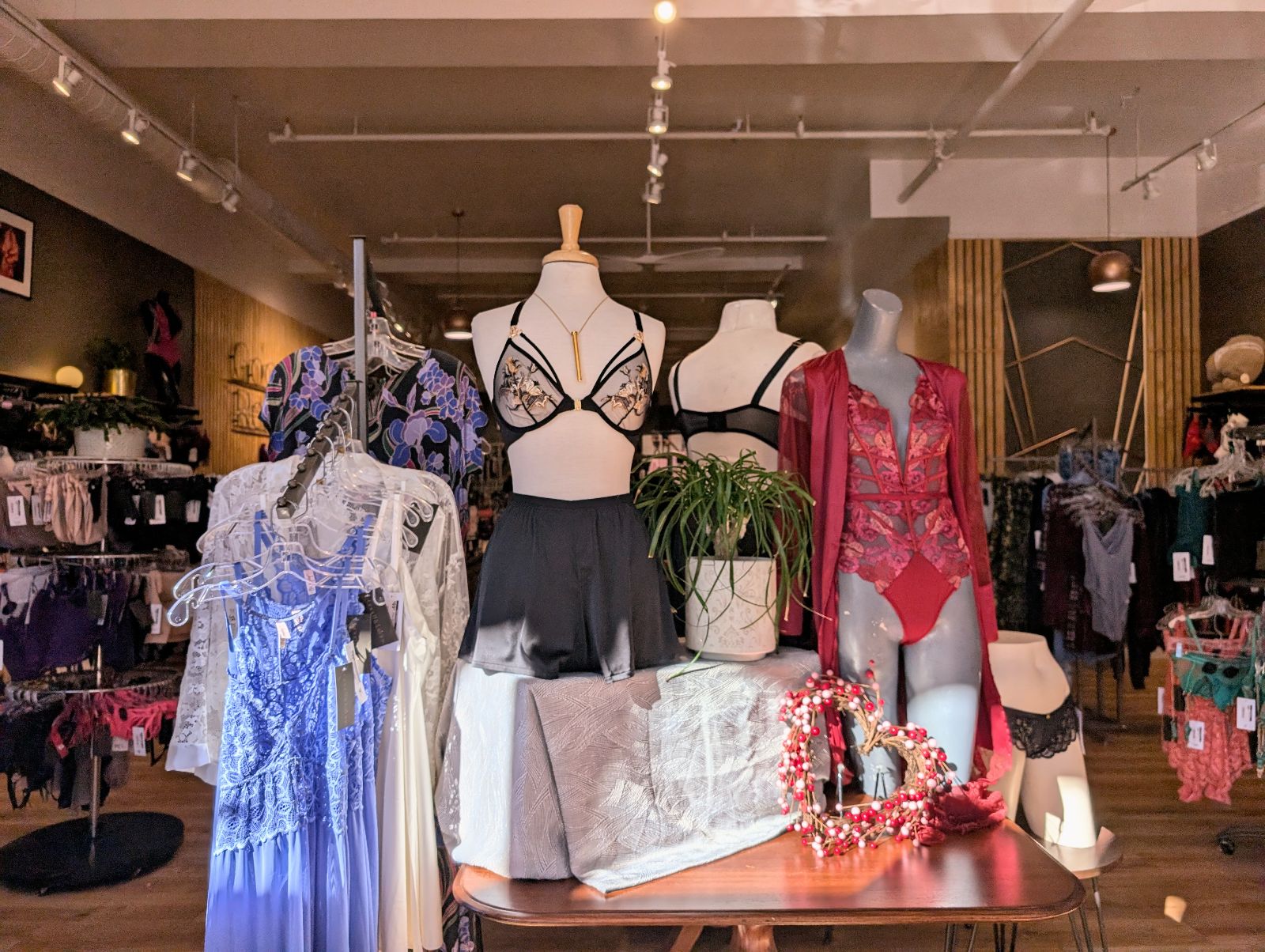
    A section of a store with various sex toys, lingerie, and other gear.
    Photo by Tara Shapiro | A selection of toys and lingerie available at Good Relations.

    Meyers offered a few suggestions to those who’ve never visited a sex shop before. Bringing a friend might help if you’re nervous, or check on Google and see when the shop is less busy. On the opposite side, come out during Arts Alive! on the first Saturday of every month. Blend in with the crowds, look at the monthly art on the walls, and browse the store. 

    Good Relations strives to uphold its commitment to normalizing discussions on pleasure and wellness. Its doors are open to everyone, every day of the week.

    “Don’t be afraid and don’t be ashamed to say, ‘yes I want this,’ and ‘no, I don’t want that,’” Meyers said. “You get to like whatever you want — you’re not hurting somebody else, you don’t have to earn the right to pleasure. Sex is healthy and pleasure is good for you.”

  • STIs are normal – breaking the sex health stigma with Peer Health Education

    By Jess Carey

    College students have sex. People have sex. With sex comes sexually transmitted infections (STIs). In 2021, the CDC estimated that on any given day, 1 in 5 people in the U.S. have an STI, and that 85% of sexually people will get HPV at some point in their lifetime. Despite their prevalence, there is often a stigma that STIs are embarrassing, or dirty, creating shame and confusion. This shame often spirals into spreading misinformation, or pressure to be dishonest with partners. But the truth is, honesty and education are the solution, and pave the way to a healthier life. 

    Peer Health Education (PHE) is a student-led organization at Cal Poly Humboldt, funded by the Student Health Center (SHC), that aims to reduce barriers to health education. It is the place to get free condoms and get answers in a supportive and safe environment. Student employees are trained in topics of mental health, sexual health, body wellness, and their intersections. During their office hours, anyone can stop by to ask health-related questions and obtain safe sex and harm reduction supplies.

    Sydney Isaac, a psychology major and mental health educator at PHE, commented on the culture of Peer Health. 

    “It’s a very non-judgemental space,” Isaac said. “No question is dumb, no question is weird. Nothing is weird! We want to meet people where they are at.” 

    Isaac also talked about the stigma around STIs and sexual health in general. 

    “Shame is a big barrier [to education],” Isaac said. “If you come from the world of abstinence culture, once you get to college, it’s scary, and people will obviously be having sex.” 

    Isaac stressed the importance of education for reducing stigma and creating bodily autonomy.

    “Sexual health comes from a place of comfortability with yourself and your partner,” Issac said. 

    STI testing and other reproductive care services are available at the SHC and other medical facilities in the area such as Planned Parenthood. 

    “At the SHC and Planned Parenthood, you can sign a thing to say you want to bring a friend, and you can hold hands if there’s any treatment or anything and you want some support.” Isaac said. “You can also request a female or male provider.” 

    To make an appointment for STI testing, you can call or stop by the student health building. STI testing is as simple as swabbing yourself, putting it in a cup, and moving on with your day. LJ Ferris is a studio art major and the sexual health educator at PHE. He recommends that sexually active people get tested regularly, and especially if you have a new partner or if someone you are seeing has a new partner. It is important to get tested even if there are no symptoms, or if you were told by partners that they did not have an STI. The truth is, you never really know, and getting tested and taking your sexual health seriously can only benefit you.

    “Getting tested [for STIs] is harm reduction for yourself and for others,” Ferris said. “It is really necessary to take these steps now and getting in the habit can lead to better knowledge overall with STIs.”

    Jess Carey is a senior at Cal Poly Humboldt, majoring in biology and double minoring in botany and journalism, and the science editor for The Lumberjack. They are passionate about telling stories that are relevant to the community, branching their interests in science, music, and the arts.

    GET TESTED. Make an appointment with the SHC: (707) 826-3146
  • LGBTQIA+ students embrace authenticity and community through queer joy

    By Griffin Mancuso

    A couple stands in front of two flags --- the bisexual flag with a blue, purple, and pink stripe, and the lesbian flag with stripes in shades of red and pink. The person on the left has dark skin and short pink hair and is wearing a blue hoodie. The person on the right has olive skin, green chin-length hair, and is wearing a black hoodie.
    Photo by Griffin Mancuso | Arlo Purnell and Jade Hisamoto pose together at the Queer Joy event.

    EDIT: Information regarding the groups who responded to the Turning Point table has been edited for accuracy. While the group playing music had students who are members of The Marching Lumberjacks, it was not an officially organized event.

    Turning Point USA, an organization that advocates for right-wing policies and ideologies, set up a booth at Cal Poly Humboldt in the GSAC quad this past Thursday, Feb. 6. Conservative activist Chloe Cole — who opposes gender-affirming care for minors — joined their tabling that day. 

    In response, dozens of students and faculty gathered with pride flags and pamphlets, and a group arrived to play music. On the same day, the Humboldt Peer Health Educators and Check It decided to host a queer joy event for LGBTQIA+ students and their allies to gather and socialize. Several students at this event shared their experiences with queer joy and how they connect with their community.

    “The way I would see queer joy is [through] love, community, and safety. I think queer joy is walking down the street with your partner and not having people look at you strangely, or weird side eyes or double takes.”

    A man with fair skin and blonde hair wearing a light pink shirt with a pink inverted triangle stands in front of a rainbow flag.
    Photo by Griffin Mancuso | Leo Alley stands in front of a pride flag.

    Arlo Purnell
    Junior, psychology major and minor in studio art

    “I’m in a queer relationship, so being able to be with my partner and be out in public and walk around with them, and being able to love publicly, I feel like, is queer joy to me.”

    Jade Hisamoto
    Junior, studio art major

    “We need [queer joy] now more than ever, so just do what you can instead of spiraling into a depression about everything that’s going on. Focus on uplifting yourself and making the impact that you can in your community before you worry about trying to change the world.”

    Leo Alley
    Junior, wildlife major

    “You deserve [queer joy]; every queer person deserves to have joy in their life. Everyone’s trying to take that away from us, and I think it’s easy for those voices to get in people’s heads, and I just want everybody to know that you deserve to be joyful in your queerness.”

    LJ Ferris
    Senior, studio arts major

    A person with light skin wearing glasses with curly brown hair, a beanie, and a blue sweater smiles while standing in front of the transgender flag with blue, pink, and white stripes.
    Photo by Griffin Mancuso | LJ Ferris smiles while standing in front of the trans flag.