The Lumberjack


Students Serving The Cal Poly Humboldt Campus and Community Since 1929

Author: Gabe Kim

  • HSU Bookstore Being Moved Off-Campus

    HSU Bookstore Being Moved Off-Campus

    It’s five minutes until your class starts in Founder’s Hall. You have a big test that you forgot a scantron for and you are rushing. But then you remember — the HSU bookstore is right on the way to Founder’s Hall and carries scantrons, among other things.

    But then you wake up and realize it was all a dream and the bookstore is nowhere to be found on campus. It is fall of 2021 and you, like many other students, are left without a centralized location to grab school supplies and attire. Come July, this will be the reality for Humboldt State. The university has been cleared to move its bookstore to a new location adjacent to the Arcata Plaza.

    Anisa Benamira-Dod is a student frustrated with the decision to move the bookstore off-campus. A junior communication major, she is concerned that the bookstore’s on-campus absence will impact students in more ways than one. More specifically, she is concerned that students will not be able to access the bookstore as easily due to its vicinity.

    I know a lot of people that don’t have cars. And so walking from Creekview all the way down to Arcata — the Arcata Plaza — it would just make it a day trip,” Benamira-Dod said. “Not many people would want to go to the bookstore just for like a few books or something like that if they don’t have a car.”

    While it is great to appeal to the off-campus community, Benamira-Dod feels that a separation will occur.

    “It’s starting to create a distance between like people who live on campus and people who live off campus,” Benamira-Dod said.

    Aaron Ostrom is the founder and co-owner of Pacific Outfitters, a retail chain in Humboldt County with locations in Arcata, Eureka, and Ukiah. The Arcata location will be the future home of the HSU bookstore. For him, it wasn’t sustainable to continue on with his Arcata store due to a number of factors.

    When COVID shut everything down last year, Arcata, in his words, turned into a “ghost town.” It wasn’t just the town itself that got shut down. Shipping and manufacturing also got shut down and that really threw a wrench into everything. Faced with this adversity, Ostrom decided that he could turn his Arcata branch into a warehouse for the other two stores that were deemed essential, unlike the Arcata location.

    But then the Arcata store ran out of merchandise. Between that and Humboldt State limiting the number of students on campus, things were not looking good.

    “It was hard to really justify investing in a bunch of inventory to fill a store back up,” Ostrom said. “I gotta pay the bill for all those goods in like 60 days after making that investment.”

    When HSU came knocking inquiring about the vacant space, Ostrom answered the call with open arms. Now Humboldt State will rent the former Pacific Outfitters location from the local chain. Ostrom is glad to have a local institution taking the place of his old store and feels that there are economic benefits to be gained for both sides in this deal.

    “Every single day, we would get people asking about HSU gear and HSU students, of course, showing up, HSU students bring their families, Ostrom said. “So, I think having a bookstore in town will be great for HSU merchandise that they want to sell.”

    Todd Larsen is the director of housing operations and one of the main individuals involved in the bookstore’s relocation to downtown Arcata. From his perspective, there are a few key reasons behind the shift.

    “Students have been asking us for more student activity space, student lounge space, and creating a student center which we don’t have, as you know, on campus,” Larsen said. “It’s giving the bookstore more accessibility. Two-thirds of our students live off campus and also parking — people that come to campus here they can’t even get to the bookstore right in a normal year there’s no parking.”

    Larsen and his team plan to turn the bookstore’s old space into a recreational space.

    “We’re looking at an opportunity to maybe bring in Stars restaurant in the old Windows space,” Larsen said. “And really just providing a lot of fun and a central place on campus where students can go. And we don’t have that now and it’s hurting us.”

    HSU students will be able to buy Scantrons at the College Creek Marketplace in addition to the off-campus new bookstore. Additonal items are being considered for the Marketplace, too.

  • New HSU police chief in town

    On Feb. 15, Anthony Morgan began his first shift as the new police chief at Humboldt State. He is a decorated chief, bringing with him more than 15 years in the police force in different states around the country.

    Seeing that his children were getting older, Morgan realized that he wanted to provide opportunities for them educationally, and being a university police chief seemed like the natural next move for that. He is satisfied with the university that he settled on, particularly the transparency that it has provided over the years with different ordeals.

    “Given my skill set, there was an opportunity there for me to come into this space and work with everyone to improve transparency, improve safety on campus, work with a team of professionals in my department, and serve the student body,” Morgan said.

    One of the people involved in the selection process for the new police chief was Sherie Gordon, interim vice president for administration and finance. For her, she was glad to know that everything worked out regarding how everyone from the search committee to the greater campus community was unified in liking Chief Morgan.

    “In this case, the stars aligned and I will tell you after his first eight or nine days on the job, it’s actually been really refreshing,” Gordon said. “So it just reaffirmed that what the campus thought, the committee thought, and even myself in making that decision and appointing Chief Morgan that he’s the right fit for us in where we are at this juncture at Humboldt State.”

    Gordon recognized the fact that Morgan is the first Black police chief at HSU and is thankful for the combined efforts of her colleagues in creating a diverse working environment.

    “I think it’s a testament of the work that collectively, this institution has made with putting in strategies around emphasizing recruitment of diverse candidates and not just limited to a person of color but women and diverse backgrounds,” Gordon said. “We are checking biases in these meetings and we’re open to new thoughts and perspective and leaders, whether it’s their gender, their professional affiliation, or just the depth and breadth of experience.”

    A major factor in Morgan’s decision to enter the world of policing was when he was a kid and witnessed a DARE officer that was oddly enough also a Black man named Anthony Morgan.

    “It was amazing for me to see a black officer in his uniform like that interacting that way,” Morgan said. “And I hope, to some extent, I can do that for others.”

    Being the new police chief, Morgan has an agenda. One of the first items on his list is a firm commitment to community service, specifically within his own department.

    “One of the first goals that I want to get implemented here is ensuring that both internally and externally, we’re treating everyone with dignity and respect,” Morgan said. “And from a culture standpoint inside the organization, we’re getting back to being a team, and so from an internal perspective, really working on the team dynamic that we have.”

    A second major goal for Morgan is ensuring that the product or service that is being delivered by his men and women meets student needs.

    “A little bit of that is collaborating with the Associated Students on what this new restructuring within the organization that we’re working on is going to look like,” Morgan said. “Working through the process of implementing 21st-century policing, pillars within the foundation of the organization, improving technology within the organization.”

    Josefina Barrantes is a senior finishing up her undergraduate degree in political science and also in the environment and community master’s program. A member of Associated Students, she is hopeful that the arrival of Chief Morgan will breathe new life into UPD, but still has reservations about the police department as a whole due to a current officer remaining on the job even after clearly displaying police brutality several years ago.

    “I would like to see Officer Delmar Tompkins fired and I would like to see that set a precedent for hiring and who they hire on the police force if UPD is to exist,” Barrantes said. “More than that, I would like to see them being schooled on decolonization and multiple other areas of intersectionality.”

  • HSU Students Return to In-Person Activities

    HSU Students Return to In-Person Activities

    For many majors across campus, in-person engagement has been a pipe dream. Yet for some majors, particularly ones in science, technology, engineering, and mathematics-related fields, the experience of seeing classmates and professors in a physical classroom or lab setting is now a reality. Lasting until the end of the semester, these courses and activities are being offered on a limited basis.

    Ayse Macknight is a senior oceanography major and a scientific diving minor. Macknight is a teaching assistant for the scientific diving program and assists where she can. The diving program meets once a week in-person to do exercises in the HSU pool.

    “I’m helping mainly with skills,” Macknight said. “I’m helping out with all the other diving classes.”

    Macknight is satisfied with the way that the diving program is handling all of this with major coronavirus safety measures being enacted.

    “When the students first arrive, they meet outside and they brief and then they go into the pool through one door and they pick up their gear and they put it down, and then they go outdoors,” Macknight said. “It’s kind of like a circle — everyone’s always going one direction so it’s like minimize chances of running into each other. Afterward, we disinfect all gear that anyone’s put their mouth on or anything.”

    Senior forestry major Sarah McGee is involved in more hands-on classes. She is doing both individual and group activities.

    “For my soil fertility class, we’re doing experiments in the forestry greenhouse and so we’ve been assigned two to three 30 minute time slots a week where we can go into the greenhouse by ourselves and conduct our own experiment that’s soil fertility-related,” McGee said. “For my soil microbiology class, we are doing some algae experiments in the soil lab.”

    McGee is excited to be back in person doing things rather than staying at home sitting in front of a screen all day.

    “It’s a lot more motivating and it’s a lot easier to stay on task and be accountable when you’re meeting up and doing things in person, I think,” McGee said.

    Not all in-person classes and labs are STEM-focused. A few other majors like film are also conducting face-to-face instruction. Kylie Holub is a junior and a film major currently in Film 2 where she is learning about lighting and audio. She reiterated the significance of being in-person for film projects.

    “Seeing the equipment and being able to have different students have the ability to check out the equipment and then test it out and things like that and to learn about it,” Holub said. “So it’s definitely, I think, very important to have these face-to-face opportunities, plus film is super collaborative so like getting to know your classmates and just like vibing with people is kind of important.”

  • Connecting cute cats with caring companions

    Connecting cute cats with caring companions

    Cats are no strangers to the Humboldt County streets. They can be found roaming around but not all of them are tamed. Oftentimes, these animals are stray and even pregnant, in some cases. They are usually brought to shelters like the Humboldt Animal Rescue Team in Eureka.

    Accepting cats from a variety of different circumstances, this volunteer-based group aims to nurture them until they can be adopted.

    It is standard procedure at the shelter to isolate the newer, more frazzled cats upstairs where they can acclimate to their new environment without worrying about interacting with any people. But getting them to actually come out of their shells is where HSU students factor in.

    Many of the cats that are brought into the shelter are shy and not sociable enough to be adopted by anyone yet. Rose Kessler is a lead volunteer that oversees the other HSU student volunteers. She is very in-tune with how the cats evolve emotionally over time during their stays at the shelter.

    “When they first come in, a lot of these cats are angry,” Kessler said.

    Kessler is extremely grateful for the Humboldt State students that come in every week and help care for the cats that could not otherwise volunteer at other shelters around the county.

    “Right now, a lot of the rescues, from what I hear, they’re not accepting volunteers right now because of COVID,” Kessler said. “And we are.”

    Jesse Morales is a fourth-year communication major. They are very experienced with cats and have been regularly volunteering at the shelter since 2019. Now, it is virtually second-nature to them interacting with the cats to the extent that they do.

    “We just kind of come in and show that people aren’t gonna hurt them and get them used to us.”

    Volunteers begin the process of getting the new cats comfortable by first sitting in a room with the cat. From there, they gradually try to physically engage the cats more and until the cats warm up to them enough that they can be moved downstairs.

    Lexi Cortez is a sophomore and one of the newest volunteers at the Humboldt Animal Rescue Shelter. An avid cat lover, Cortez has always enjoyed working at shelters with cats.

    “I’ve always wanted to work at shelters and stuff — just being able to help them,” Cortez said, “I’m glad I get to do it now.”

    Kessler has been working with Cortez and from what she has seen, is impressed with the work Cortez has done.

    “They don’t know her, so they’re a little bit shy,” Kessler said. “I can tell they like her but they’re watching her.”

    One of the cats that found a home, albeit temporary, is Oliver. Morales is currently fostering him but it took a lot of patience to ground him in the confines of the shelter and then eventually in their home.

    “He definitely was not the nicest cat here and he did not get along with other cats,” Morales said. “And I just steadily worked at him, continuously, until a couple months when I started fostering him.”

  • Covid Vaccinations Available for HSU Student and Professional Staff

    Covid Vaccinations Available for HSU Student and Professional Staff

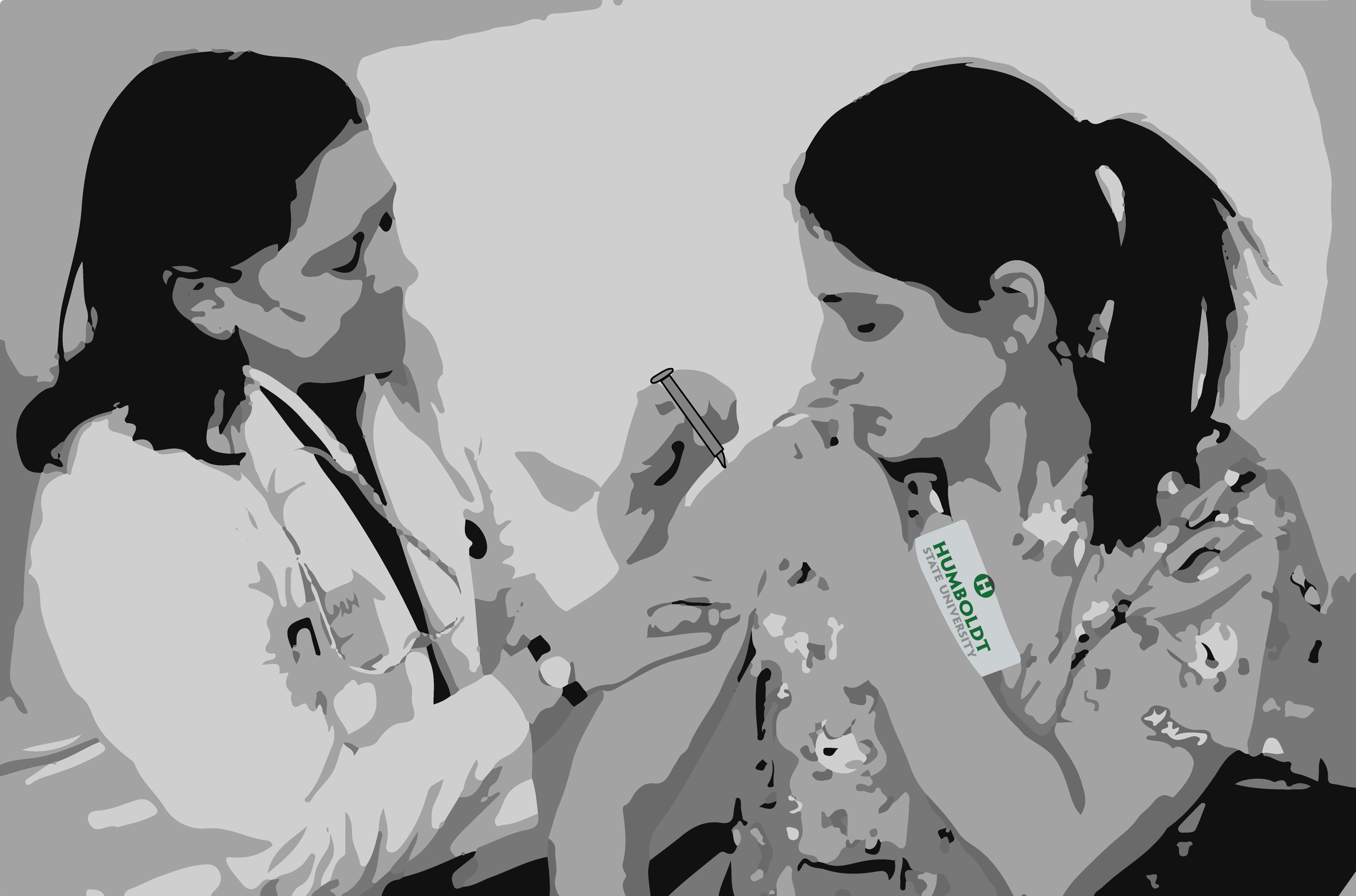
    Recently, the Pfizer vaccine has been doled out to different groups and communities around the world. Now, HSU is joining in and offering the vaccine to employees that are cleared to work on-campus and are considered higher risk.

    According to Cris Koczera, interim director of Risk Management and Safety Services at HSU, an estimated 637 doses are going to be picked up and distributed to HSU staff and faculty in the coming week.

    “What we get is highly dependant on what’s available through the county,” Koczera said. “We find out pretty much the Thursday before how many we’ll have to pick up the following Monday.”

    For Koczera, it is pleasing to see the fruits of her and her colleague’s collective labors regarding getting the vaccine center up and running at HSU.

    “It was a lot of coordination with the county because we are functioning as a closed pod unlike a lot of the other sites throughout the county,” Koczera said. “So, our pod is really intended just for HSU staff and faculty at this time and then once we are able to open it up to the wider student population, that will be the plan.”

    Among those who are eligible are student employees who work in “auxiliaries” like housing and dining services. Montel Floyd is a senior who is majoring in critical, race, and gender studies with a concentration in ethnic studies. He works for Housing as a resident advisor in the dorms and is appreciative of the fact that he and his fellow RA’s are able to receive the vaccine considering their importance to the university.

    “We are the ground workers for residents right now,” Floyd said. “We have the contact with them — daily basis, on our rounds — and if issues arise, we have to have contact with them — sometimes like knocking on doors.”

    Even so, Floyd is a bit skeptical of getting the vaccine due to what he has heard about what has happened to some people that have gotten it. Still, he believes that the vaccine will do more good than harm.

    “I know it’s important to getting it, I have grandparents that I will be going home to soon,” Floyd said. “And also just got into grad school in Georgia and also going to be working for housing there as well, so I think it’s very important to protect myself with the vaccination.”

    Rae Robison is a professor in the department of theatre, film, and dance who is going to get the vaccine on March 10. Doing so is especially important to her because her father recently passed away from COVID-19 complications and her mother tested positive for COVID-19.

    “I’m an only child,” Robison said. “He was my person. And right now, I literally just got off the phone with my mother. She’s 77 and they don’t have enough vaccines for her in Arizona.”

    Her determination to get the vaccine is fueled by reasons other than the fact that her parents contracted COVID.

    “My partner works for St. Joes and we are very aware that if you get it, you can get it again,” Robison said. “The longer my mom and my aunts are not immunized, the more stress I have.”

    Robison is humbled by the fact that all of the staff at HSU will get vaccinated.

    “Almost all of the staff and faculty and support folks and everyone that works at HSU are older, and in that bracket” Robison said. “I will feel better when the majority of us can get vaccinated.”

  • Trailblazing into the future of HSU

    Trailblazing into the future of HSU

    Humboldt State is a small university in a small town. The idea of safety would seemingly be a given in such a tight-knit community but the truth is that for many HSU students, safety is the number one thing they are worried about when walking around the streets of Arcata.

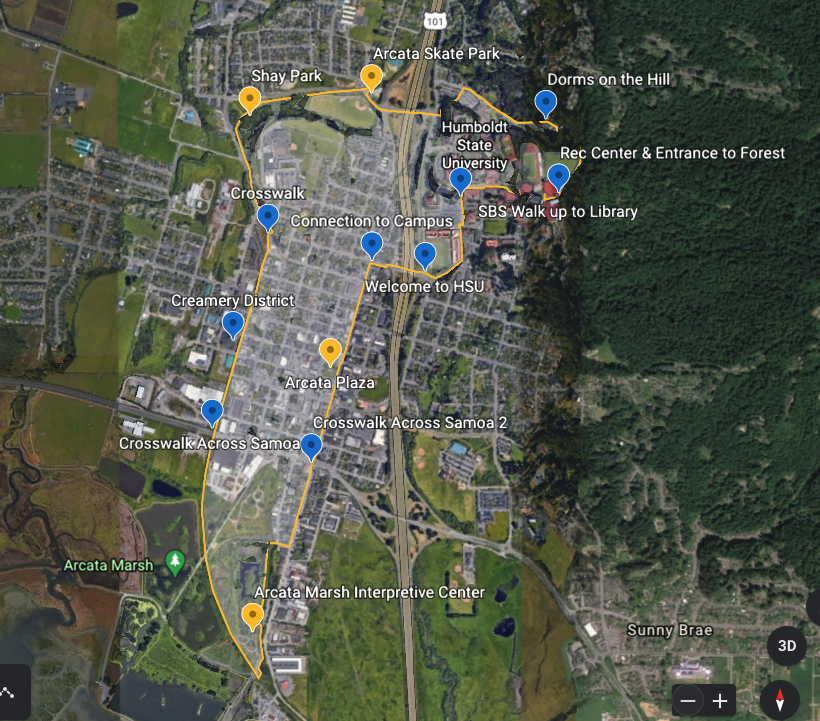
    Through a recent grant from HSU, a group of students and professors from two different disciplines united to initiate the Wayfinder Project. This project, in collaboration with the City of Arcata, looks to establish routes between HSU and the surrounding community of Arcata using signage with the ultimate goal of enhancing student safety both on and off-campus.

    Whitney Ogle is an assistant professor in the kinesiology department and is looking forward to seeing students take advantage of the new trails.

    “I want students to engage with the community and feel safe doing so,” Ogle said. “I hear stories — anecdotal stories — from students who have never been to the marsh or haven’t been to the plaza or haven’t been into the community forest. And then other students who drive everywhere and it’s like this is a pretty small community that you can walk.”

    The proposed routes are slated to start near the Sunset Blvd. overpass, go through the Creamery District, circle around the Arcata Marsh area, barrel through the Plaza and then end back on the HSU campus.

    Ogle hopes that maybe the Wayfinder Project paths could turn into competitive endeavors for students, who might want to brag about how quickly they were able to traverse them.

    Coming at the project from another angle is HSU Recreation Administration Professor Ara Pachmayer. Having a background in the tourism industry, Pachmayer is glad to support her students in the novel work that they are doing.

    “I haven’t worked on a project like this before, but I had done a lot of tourism-related projects,” Pachmayer said. “So it’s interesting because we’re learning a lot as we go along with it as well just because it’s so new to me.”

    Ogle is confident that the community of Arcata will benefit from this project. To her, the more students getting out and about around town, the better because they will be spending more money and giving back to a city that is special to her in many ways.

    “That’s what makes our community so unique and really great,” Ogle said. “I think, to show students that they’re welcome here, that this town wouldn’t really exist if it wasn’t for HSU.”

    Mandy Hackney is a senior and a recreation administration student who is working on the Wayfinder Project. She is excited to be encouraging physical activity for herself and others in a time where we are all mostly stuck indoors.

    “Being outside and actually installing the signs on the trails — that’s what I’m really looking forward to,” Hackney said. “Like doing something in person outdoors.”

    Ogle and her team also plan to create orientation material for incoming freshmen this upcoming fall. These orientation-related packets will include resources for physical and mental health alongside a map of all the trails from the Wayfinder Project.

  • HSU community petitions to Push Pause on projected cuts

    HSU community petitions to Push Pause on projected cuts

    The California Faculty Association has received more than 3,000 signatures pushing for Humboldt State to hold off on making budget cuts during the current pandemic. The petition has grabbed the attention of many among the greater HSU community. On Feb 18, a meeting organized by the HSU chapter of the CFA was held over Zoom to discuss the ramifications of the class and faculty job cuts including the impacts that they would have on both students and faculty.

    Nicola Walters, a lecturer in the politics department and the organizing chair of the Humboldt CFA, spoke on her experiences over the years as both a student and now a faculty member at HSU. Frightened by what she is witnessing all around her, she wants to fight for what is right.

    “I’ve also sat in countless department meetings and watched the people who taught me, who I look up to, who make this university a place worth attending left bewildered and broken by administrative agendas that herald shared governance, but instead demand cuts to programs, classes, and jobs,” Walters said. “I’ve listened to my colleagues describe feeling disposable, exhausted, terrified, and traumatized while we grapple with overhauls to our campus.”

    Walters remarked on the contrast of HSU receiving lots of federal funding as of late against HSU slashing jobs and classes.

    “Putting profit over people’s jobs doesn’t fit with our university or our community,” Walters said. “Our campus isn’t adverse to change, it’s adverse to practices that violate trust and perpetuate cuts against our campus community. Implementing changes while faculty are unable to protect their interests is an administrative strategy and is not the way forward.

    Another key speaker was Dr. Cutcha Risling Brady, an associate professor and department chair in the Native American Studies department. Brady talked about the impact that any additional cuts would have on students. More specifically, she introduced the idea that students are feeling out of control because they are already dealing with family deaths and other hardships during the pandemic but to see faculty and staff that they rely on for support is next level unacceptable.

    One of these students, senior communication major Anastasia Tejada, is concerned that one of the closest allies in her department, lecturer Leslie Rossman, could very well have her position cut in due time. Rossman helped Tejada get into a graduate school at the University of Nevada, Reno, and secure funding for it.

    “That would not have happened without her support and guidance,” Tejada said. “I would not know where to start and in all honesty, I probably wouldn’t be headed into higher education if it was not for her.”

    Tejada was not surprised that HSU president Tom Jackson was not in attendance for the Push Pause meeting and thinks it is reflective of his entourage as a collective.

    “He has been very silent this entire time he has been missing,” Tejada said. “From almost every important conversation, the fact that he couldn’t even show up to listen just proves the point that the administration does not care about its lectures or faculty.”

  • HSU Students and Professors Plunge Into Peruvian Water Project

    HSU Students and Professors Plunge Into Peruvian Water Project

    Zurite, Peru — a tiny town nestled in between ginormous mountains in the heart of Peru. For many in this agriculture-based community, getting water on a regular basis had been a struggle due to constant landslides and other factors out of their control. Bonanza en Los Andes sought to fill that void.

    A several-year-long project that wrapped up funding in December of 2020 involving students and professors from the College of Natural Resources and Sciences at HSU. The group was twenty members strong and helped plan, design, and build irrigation canals connecting the mountains to Zurite. The project wrapped up funding in December of 2020. One of these students, geology graduate student Wyeth Wunderlich, helped oversee the technical side of things.

    “Our goal is to say ‘Okay — this is an agrarian town that relies heavily on agriculture,” Wunderlich said. “So how do we connect the water resource availability upstream basically up in this watershed with what the water resource demands are in the community?”

    Wunderlich explained that around the world, water resources are incapacitated to an extent and there is not a lot of knowledge on how these hydrological systems operate. For him, this is where his wheelhouse comes into play but he did not want to be too aggressive.

    “We don’t want to tell anyone what to do, but if we can develop good quantitative estimates of what happens when and where in the landscape water is coming from,” Wunderlich said. “Then hopefully it can help inform management decisions for Zurite and other communities like Zurite.”

    Wunderlich would like to take what he learned from Bonanza en Los Andes to future endeavors.

    “I hope to bring the same skill set that I’ve used here in the project with Zurite and the Ramuschaka watershed to our local water and groundwater-surface water systems here in Humboldt and the California coast,” Wunderlich said.

    Jasper Oshun, a geology professor, was the principal investigator for this project. He emphasized the value of forming bonds across cultural boundaries.

    “It’s important to foster these types of relationships between college and younger students in terms of providing the opportunity for students to travel in see the similarities and differences in different parts of the world,” Oshun said.

    Staying on the same topic, Oshun appreciated the collision of different disciplines at HSU when it came to this project.

    “These types of environmental issues — issues of water, issues of water quality and quantity or land management — they all require a diverse set of viewpoints in terms of the stakeholders involved in the differences of science,” Oshun said. “And people need to come together on the same page and there’s a lot of value in having different perspectives.”

    As someone who wrote the grant for this project, Oshun is frustrated that there aren’t more opportunities for his students in the College of Natural Resources and Sciences to travel abroad.

    “I think it’s not necessarily on the radar of students in CNRS that there is an opportunity for them to travel abroad,” Oshun said. “And that their skills are valued or their skills could be immediately applied in a way that could benefit a community.”

    Nolan Marshall, a senior and geology major, was a major force in Bonanza en los Andes. In addition to drafting geologic maps, taking stream discharge measurements, cataloging soil samples and testing them in his critical zone lab for water content, Marshall also created 2-dimensional cross-sections of peatlands. He is grateful to have had the opportunity to take part in a bridge-building project with the local Peruvians.

    “They were not only a joy to be around but local professionals and students contributed so much to the project — it wasn’t possible without them, ” Marshall said in an email interview. “One of my favorite work days was when I logged core with the all Peruvian drill crew. I’ll never forget it. “

  • Kinesiology department teaches students about at-home ergonomics

    Kinesiology department teaches students about at-home ergonomics

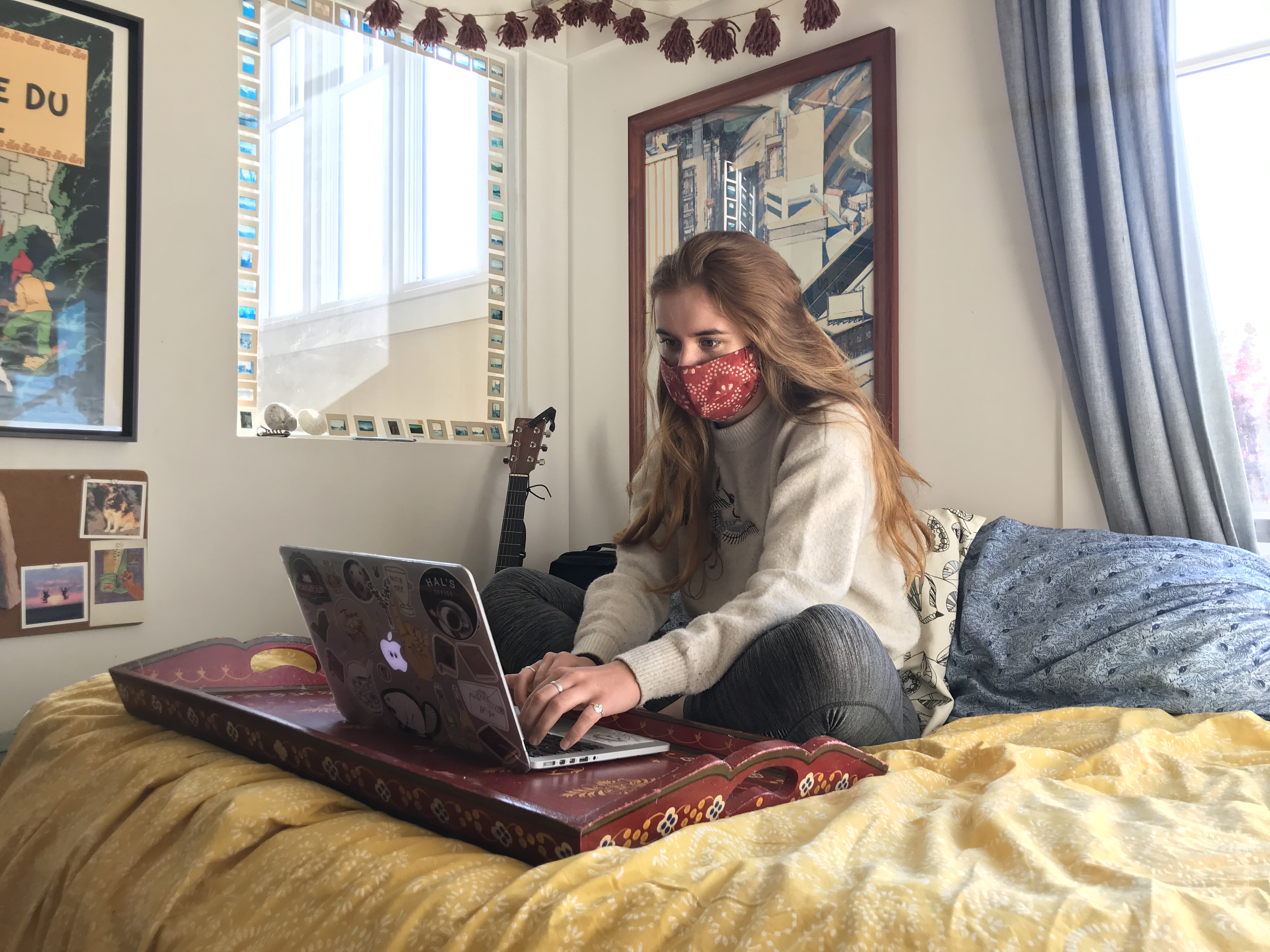
    Since the transition to a mainly virtual learning environment, people nationwide have felt the physical and mental tolls of it. Humboldt State students and faculty are no exceptions to this matter. A recent study by Dr. Whitney Ogle, a professor in the kinesiology department, found that HSU students were rating their mental health and physical wellbeings a three out of five or lower.

    But Ogle has done more than that — she and her kinesiology students have been making a series of short videos that inform on different ergonomic practices centered around working at home. It all grew from Ogle’s desire to find an adequate physical working space to make it so her body would not be aching all the time.

    Between switching out desk chairs and trying to work from different locations around her house, Ogle was doing everything she could to make her life more comfortable in a time where nobody could work in-person. But then it dawned on her — maybe she could turn her experiences into educational content.

    “I knew that since everyone was going to working from home, everyone’s ergonomic workspace was going to be totally different and I didn’t know that there was anyone on campus who was able to actually evaluate people’s home life,” Ogle said. “So I thought ‘Gosh, like I have a little bit of this experience and I’m part of the biomechanics lab’ and so I was like ‘All right — we could probably help out the university somehow with their understanding of the human body.’”

    Ricardo Sanchez is one of the students recruited by Dr. Ogle to help with this project. A first-year graduate student in the kinesiology program, he was tasked with coming up with a plan for executing such an endeavor.

    “I was like ‘Everyone goes on social media. That’s one thing that people kind of have a hard time putting down so if anything wouldn’t that’d be pretty cool to spread information through there,’” Sanchez said. “It’s quick, it’s easy, and you can get a good amount of information in a little bit of time.”

    Sanchez realized that creating informative videos to post on social media was the way to go. After presenting it to Ogle, he began working on the videos with other undergraduate kinesiology students like senior Lacey Bruhy-Jimenez, who most notably produced a video showcasing mini-resistance bands for your fingers.

    “It helps to build up the muscles in your hands, because when you’re typing and stuff and when you’re constantly holding a pen or something, your muscles — they stay in that same place all the time, so they’re not experiencing the other movements that they can do,” Bruhy-Jimenez said. “These things just kind of help with those muscles that aren’t being used all the time to help build them up so that way they don’t get weak and you can have them for longer.”

    Ogle stressed the importance of stretching your mind and body beyond the confines of a work station.

    “We need to get ourselves out of the positions that we’re typically in all the time, so if we’re at a computer we’re like kind of leaning forward all the time,” Ogle said. “So like thinking about how can we get out into this plane, how can we go into more extension anytime that we’re out at the desk.”

  • Updates on Testing and Vaccinations for COVID-19 at HSU

    Updates on Testing and Vaccinations for COVID-19 at HSU

    Coronavirus testing will be available for all HSU students and employees in a matter of days. Here are some details on testing and vaccinations for students at HSU.

    Testing

    Beginning this month, Humboldt State, in cooperation with HealthQuest, will be offering free coronavirus tests on campus for all HSU staff, faculty, and auxiliary employees. An HSU ID will be needed when it comes time to take the test but HealthQuest will only bill insurance directly, so there is no need to worry about paying up-front.

    Students who are residing on campus will be tested when they move in and then again seven to 10 days later. These students will be contacted by Housing regarding arranging testing appointments.

    Athletes will be frequently tested as mandated by NCAA and County Public Health protocols.

    Vaccinations

    The University is currently working with County Public Health on plans to give out the vaccine to all HSU staff, faculty, and employees who would like to receive the vaccine when available. HSU aims to administer vaccinations to students when allowable based on state and county prioritization and vaccine availability.

    Additionally, all Humboldt County residents who want to be given the COVID-19 vaccine are able to submit their contact information through an online interest form to be alerted when doses are available for their tier.

  • New Covid Strain Touches Down in Humboldt

    New Covid Strain Touches Down in Humboldt

    Humboldt County is one of the most isolated counties in California. From this came low numbers of coronavirus cases, a luxury that other counties in the state didn’t have. That has all changed recently. Cases have shot up in every county in California and now there is a new coronavirus strain making its way around.

    Known as L452R, this variant largely remains a mystery to local health officials and there has only been one confirmed case for this new strain in Humboldt County as of publication.

    Humboldt County Health Officer Dr. Ian Hoffman believes that while the new variant may be unique, it is not necessarily more dangerous than other current strains.

    “I think from just knowing about the other variants, symptomatology should be the same. The UK variant doesn’t show any worse outcomes, it’s just more transmissible,” Hoffman said in a video interview with the Humboldt County Department of Human Health and Services.

    Clairissa Keesey, an HSU senior and a studio art and business marketing double major, is on edge about possibly contracting the new coronavirus strain given her job.

    “I’m a healthcare worker, I work with direct patient contact as a caregiver, so it definitely makes me nervous,” Keesey said. “But I just got the vaccine so I’m hoping it works.”

    The guidelines and practices surrounding coronavirus in Humboldt County remain steadfast.

    HSU’s Campus COVID Safety Coordinator Jennifer Sanford outlined some of the ways that HSU is readying itself for the onset of the L452R variant.

    “The campus emergency team, and advance planning team both meet twice weekly and continue to be responsive to new developments in terms of campus plans,” Sanford said in an email interview. “We are keeping an eye on the new strain and other happenings and these will be considered in plans concerning the current semester, summer, and fall.”

    On a county-wide level, Dr. Ian Hoffman doesn’t foresee any new rules being enacted, even with the arrival of this new strain.

    “There should be no change in our practices because the things that we do to prevent the new strains are the exact same things we do to prevent the old strains,” Hoffman said. “So that would be: distancing, masking, avoiding gathering, washing hands.”

    For Sanford and her group, the landscape of the situation is constantly evolving and thus they need to be ready for anything.

    “In a nutshell, plans adapt as new information comes to light,” Sanford said in an email interview. “Lots of on-campus testing will continue moving forward and we are looking now at how to get the vaccine out to the campus community in an efficient manner as soon as it is available.”

  • MLK day of service zoom event

    MLK day of service zoom event

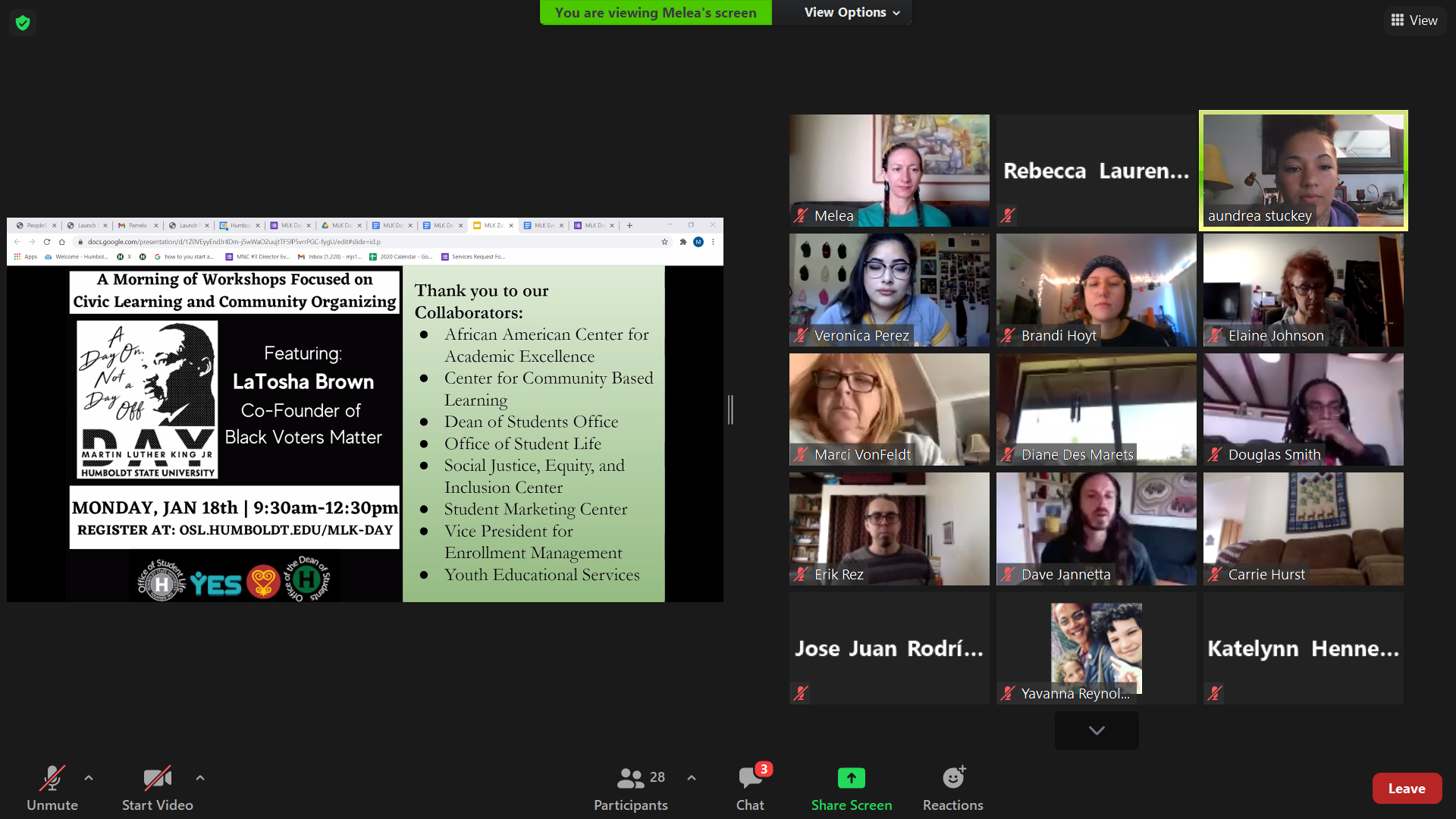
    MLK day of service is a national initiative. This year at HSU there was an event hosted via Zoom for Martin Luther King Jr. that began with a keynote speaker, LaTosha Brown and continued into two breakout rooms with workshops such as Art and Community Activism by Aundrea Stuckey from Youth Art Will Succeed (YAWS).

    Prior to the event, Molly Kresl, the student life coordinator, was excited about the event still going on regardless of not being able to host it in person due to the pandemic protocols.

    “Last year we did MLK day of service and we had three different volunteer sets and over a hundred people to volunteer and eighty participated,” Kresl said. “It was totally successful and we were so happy.”

    Kresl wanted to continue the event virtually to allow the community to be able to participate in the event from the safety of their home and still get a meaningful experience.

    “Us being in a virtual semester, we wanted to continue the tradition because it is a brand new tradition, we think it is a really valuable and important event,” Kresl said. “So we had to kinda reinvent what it looked like.”

    Towards the end of introductions, a slide was dedicated to labor and land recognition such as native land in Humboldt county and acknowledging the labor that built this country.

    LaTosha Brown was the first keynote speaker and spoke about what MLK day means, the work she has done for Black Voters Matters, experience, and motivating the audience. In the beginning, she sang a song and spoke on the impact of the song.

    “A song in their heart, they had hope,” Brown said.

    Brown’s speech related to addressing those who have been affected by COVID-19 and this year in general.

    Within the break, there was an option to join breakout groups composed of participants and main speaker interactions through the chat and aloud. Most of the content of the breakout rooms was back and forth conversation and understanding the importance of MLK day.

    Stuckey’s breakout room focused on subjects within the art community and involvement with POC artwork in Humboldt county.

    “Where do you see black art? Black people?” Stuckey said.

    The second breakout room was dedicated to discussion between participants and main speaker Ron White from the Humboldt Area Foundation discussing his presentation “The Salvation of Democracy: Civic Engagement of the Dispossessed.” Sarah Hammoudi, a senior bachelor’s social work major, attended the second breakout session with White and was a participant for the event.

    “I then attended the workshop held by Ron White on civic engagement and it was an amazing opportunity,” Hammoudi said. “I was even able to speak in a small breakout group with him which gave me even more insight and inspiration.”

    Overall the end of the event ended with questions from participants to the main coordinators and speakers and leveled into a deep discussion.

    “LaTosha Brown, the keynote speaker, was absolutely inspiring and provided amazing insight,” Hammoundi said. “ She said ‘we are called to evolve’ which makes me remember despite how unpredictable the past year’s circumstances have been, we surely can be a piece to making real change one day.”

    Hammoundi was inspired not only by Brown but also the event, the other speakers, and the meaning behind the day itself.

    “MLK day to me definitely is a reminder to do good for others as you wish to receive,” Hammoudi said.

  • HSU students support science with Spanish

    HSU students support science with Spanish

    A bilingual HSU program encourages students to pursue the STEM field

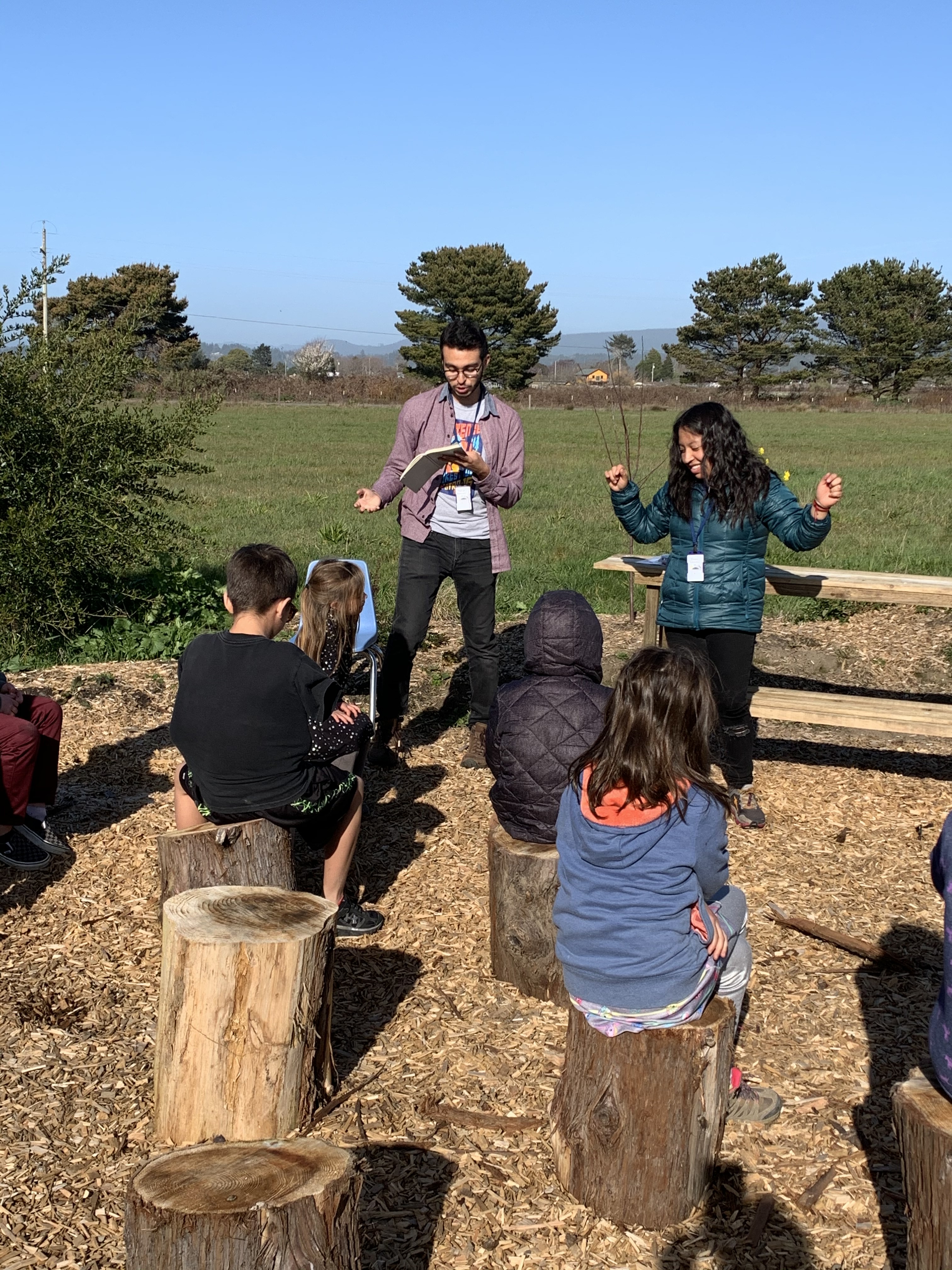
    Ciencia Para Todos, known as “Science for All,” is a Humboldt State University program that hopes to bridge the gap between younger, grade-school students and Science, Technology, Engineering and Mathematics careers through teaching English and Spanish in conjunction with local elementary schools like Fuente Nueva Charter School.

    Christian Trujillo, a senior environmental science and management major, is the founder of Ciencia Para Todos. He strives to elevate youth whose first language is Spanish.

    “We’re trying to destigmatize that idea,” Trujillo said. “Be like, ‘We are people who are bilingual, we’re in STEM, we want you to do that when you grow older, and hopefully you could become a scientist and also use your abilities and cultural lens to really help the science community.’”

    Ciencia Para Todos came from a desire to create an environment for budding Latinx STEM students. Feeling ostracized from many of the spaces on campus, Trujillo and his fellow Latinx classmates communicate in Spanish as a means of escape.

    An already-established refuge named Indian Natural Resource Science and Engineering Program for marginalized science students on campus, inspired them to create a refuge of their own.

    “We need to make our own space on campus since no one else is really going to do it for us, so we have to do it for ourselves,” Trujillo said. “And we’re like, ‘Oh, now that we’re doing this for ourselves, why don’t we do it for our communities.’”

    Different cultural centers at HSU have gotten their budgets slashed, Trujillo worked to combat the problem with student retention.

    “The stuff we do I think is very important to keeping student retention,” Trujillo said. “Because I’m one of those students that stayed here because of the centers and if it wasn’t because of centers, I would have been gone.”

    Odalis Avalos is an environmental science and management major and senior. She works as the liaison for Ciencia Para Todos and conducts outreach. Avalos is glad to have a space where she can flourish alongside Latinx STEM students, an opportunity she didn’t have growing up.

    “I’m really grateful that there is a program out there that’s able to provide this resource specifically for sciences,” Avalos said. “It’s a very lax subject within the Latinx community, so it’s not really normalized to pursue these types of careers.”

    Building off that, Avalos is glad to be able to feel a sense of community not only with the students she teaches, but also with her colleagues like Trujillo.

    “It means a lot that they’ve created the sense of community for me,” Avalos said. “So we sit together and we come together and we collaborate and we have a common mission and even with that, we also have common experiences together.”

    Diana Martinez recently graduated from HSU but continues to work for Ciencia Para Todos. Responsible for translating entire lessons between English and Spanish and managing the Instagram account for the program, Martinez has become more confident and optimistic in her future endeavors.

    “And I used to do English and Spanish, but then when I go up in Humboldt, it was just English,” Martinez said. “So I almost feel like my Spanish was just blocked, and having met this group of people, it was just like ‘Oh, I could just talk in Spanglish or I could talk in English and in Spanish fifty-fifty.’”

    Martinez is inspired by the children she’s worked with for Ciencia Para Todos and feels accomplished with what she has done for them.

    “Once you see the kids, especially the native kids that only speak Spanish, when you speak in the same language, there’s a huge happy face in their face and it’s hard to describe,” Martinez said. “But knowing that they’re able to communicate just fine and the fact that you know that you’re helping them and supporting them and empowering them, that makes me feel great as an educator, too.”

  • Humboldt State reconsiders spring break

    Humboldt State reconsiders spring break

    Proposal to move spring break to a later date generates controversy

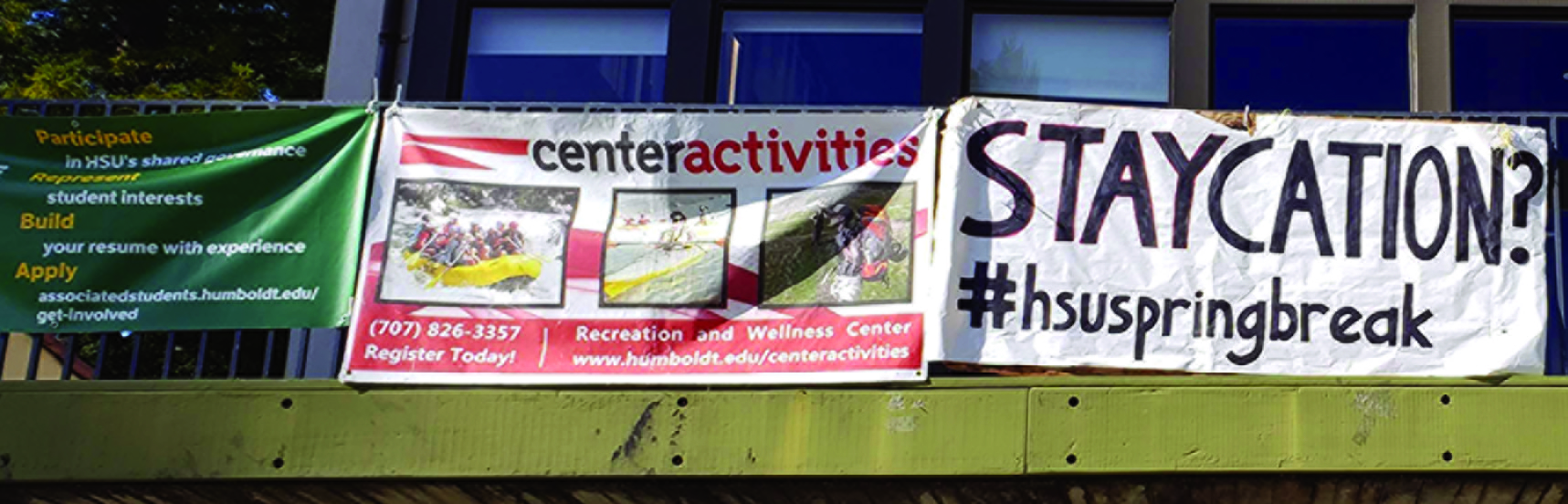
    On Sep. 29, Humboldt State University’s administration announced an idea to move spring break for this academic year from Mar. 15-19 to Apr. 5-9, 2021.

    In the meeting, Jen Capps, Provost and Vice President for Academic Affairs, explained the student and community health argument behind delaying spring break.

    “We face some challenges around making sure that our faculty, our students, staff, et cetera are safe, and how to bring folks from out of county into county, quarantine them, provide face-to-face instruction,” Capps said. “And then if they leave for spring break, what I’m hearing from facilities and different folks is they just don’t have the capacity to then require students to quarantine again.”

    A few suggestions for how to maneuver the situation were made by University Senate members including Cindy Moyer, an HSU music professor.

    Moyer pitched the idea to have break or rest days spread throughout the academic year to divert students from traveling and returning home.

    “Five carefully strategically spaced days off spread out over the weeks in the middle of the semester,” Moyer said. “So that students are getting some time off, but not getting enough time off that they will go home.”

    Monty Mola, HSU physics and astronomy professor, argued that spring break should begin a week later. The decision to move around spring break would have ripple effects on the greater HSU community.

    Giovanni Guerrero, a fourth-year environmental science management major, believes moving spring break to early April would be too much of an adjustment for students and faculty.

    “There’s a lot of stress on my back as a student, and I’m sure a lot of stress on the backs of teachers as well [as] our professors to meet deadlines and to carry out our rigorous university expectations,” Guerrero said.

    Guerrero added that the spring break would give everyone a chance to emerge from isolation and take a breather from responsibilities.

    “I think there’s a direct correlation with mental health. Right now we’re in a different sort of situation, virtual learning,” Guerrero said. “Sitting here at my desk inside my room for six hours a day, doing homework, attending classes and then doing my work with Associated Students. I have very little breathing room. Having a break, like a week break, where I don’t have to stay inside my room all day is super beneficial.”

    Rich Alvarez, the Diving and Safety Officer in the HSU Scuba Diving program, is less concerned about the psychological impacts of a later spring break and more concerned about the practical implications.

    For his diving certification program, Alvarez typically takes his students to Mendocino for open water dives where the diving conditions are more stable than anywhere in Humboldt. However with COVID-19 restrictions, he is only able to travel within the confines of the county.

    “Traditionally, Trinidad doesn’t really get to the point where we would feel safe taking students into the water there until April and sometimes even late April,” Alvarez said. “So if they shift spring break to the fifth through the 12th, the question becomes, can we meet with them after spring break? And it kind of sounds like a no.”

    If Alvarez can’t meet with his students after break to finish their diving certification, they will be unable to partake in open water dives.

    “That takes that whole month of April out of contention, and then we were looking at trying to, either way, putting students into water conditions that may not necessarily be safe for what we’re trying to do, or having to get people most of the way through their certification, but not able to do the open water dives.”

  • House Hunting in the heat of COVID-19

    House Hunting in the heat of COVID-19

    Housing struggles at Humboldt State continue to be a problem for students

    Homelessness at Humboldt State University is a major issue. The mess is only becoming more muddled and students are left to fend for themselves.

    Senior at HSU majoring in history, Alfred Silva, is mostly living out of his car. His housing search has been limited because he owns a dog and because he’s a single male, which according to Silva is unattractive to landlords. Not having an address has proven particularly challenging for him.

    “I need to take medication all the time,” Silva said. “Now I don’t have anywhere for my medication to be mailed to my house. So, I gotta figure out other ways to get it. I gotta go to the doctor’s office and bug them there and it’s kind of hard.”

    Silva has been looking for alternative methods of living including camping, but hasn’t had any luck.

    “I can’t find anywhere to camp,” Silvia said. “The only place I found that will allow me to sleep is the back of the HSU parking lot.”

    If anything, Silva believes COVID-19 has attracted more people to Humboldt than in past years, and that’s become a big roadblock for him when it comes to finding a home.

    “I think the influx of people coming into town right now is just ridiculous,” Silva said. “It’s like you got people that are not even students – many, many, many people that are not even students – they’re just flooding the place right now.”

    On the flipside, Silva believes the landlords are as equally guilty in manufacturing the housing crisis in Humboldt County.

    “It kind of hurt their wallets a lot because they’re relying on HSU students to pay rent all this time and then when they took off and that happened, it really hurt them,” Silva said. “So now they’re just trying to survive like everyone else but charging rent. When one person’s drowning, they’ll do anything to survive. They’ll even drown another person.”

    In a similar situation, HSU senior and biology major Grace Rhoades, moved back up to Humboldt because of a job opportunity they got working for one of the labs at HSU. Landing secure housing has been difficult, but they’re grateful to be subletting a friend’s house until the end of the month.

    “There’s just a lot of applying for things, application fees,” Rhoades said. “With COVID, you don’t even really get to see anything or meet anybody in person, you just pay the fee and then like maybe a third of the time they get back to you about the status of your application.”

    Even with a roof over their head, Rhoades is still feeling the anxiety of not knowing where they’ll live next month.

    “I’m definitely a homebody, I like to know that I have a place,” Rhoades said. “I’ve kind of moved away from home and that’s not really much of an option anymore.”

    HSU Off-Campus Housing Coordinator Chant’e Catt recognizes how students are being affected by COVID-19 and finding housing.

    “What’s been really hard is students who moved out of town needing people to take over their leases and landlords not being really flexible sometimes with that,” Catt said.

    For Catt, another issue that arises is between roommates because of disputes over the extent to which they will abide by COVID-19 rules while sharing a communal living environment.

    “People have wanted to break their leases because their roommates don’t respect the restrictions around COVID,” Catt said. “Which puts them in precarious situations where they have to find a new place to live or find somebody to replace their roommate, which could put them into situations where they can’t pay rent.”

    Catt has her doubts surrounding the idea that COVID-19 contributed to homelessness at HSU.

    “I don’t know if COVID changed anything,” Catt said. “I feel like it’s all the same and that’s because it’s always been so bad.”

  • HSU Seaweed Farm sets sail

    HSU Seaweed Farm sets sail

    The first commercially-approved seaweed farm in California will be on the map.

    Humboldt State University is known for its cutting-edge science projects. One of these projects is an upcoming commercial seaweed farm in Humboldt Bay. A trailblazer in its own right, this project was spearheaded by HSU natural resource grad student Erika Thalman.

    “I went into grad school originally wanting to do fish pathology, so this was something different for me, but I also really love algae,” Thalman said. “I was like ‘I also really kind of want a farm of my own someday.’ And I was like ‘Oh! Algae! Farm!’ so I was excited to be able to say ‘I’m a seaweed farmer.’”

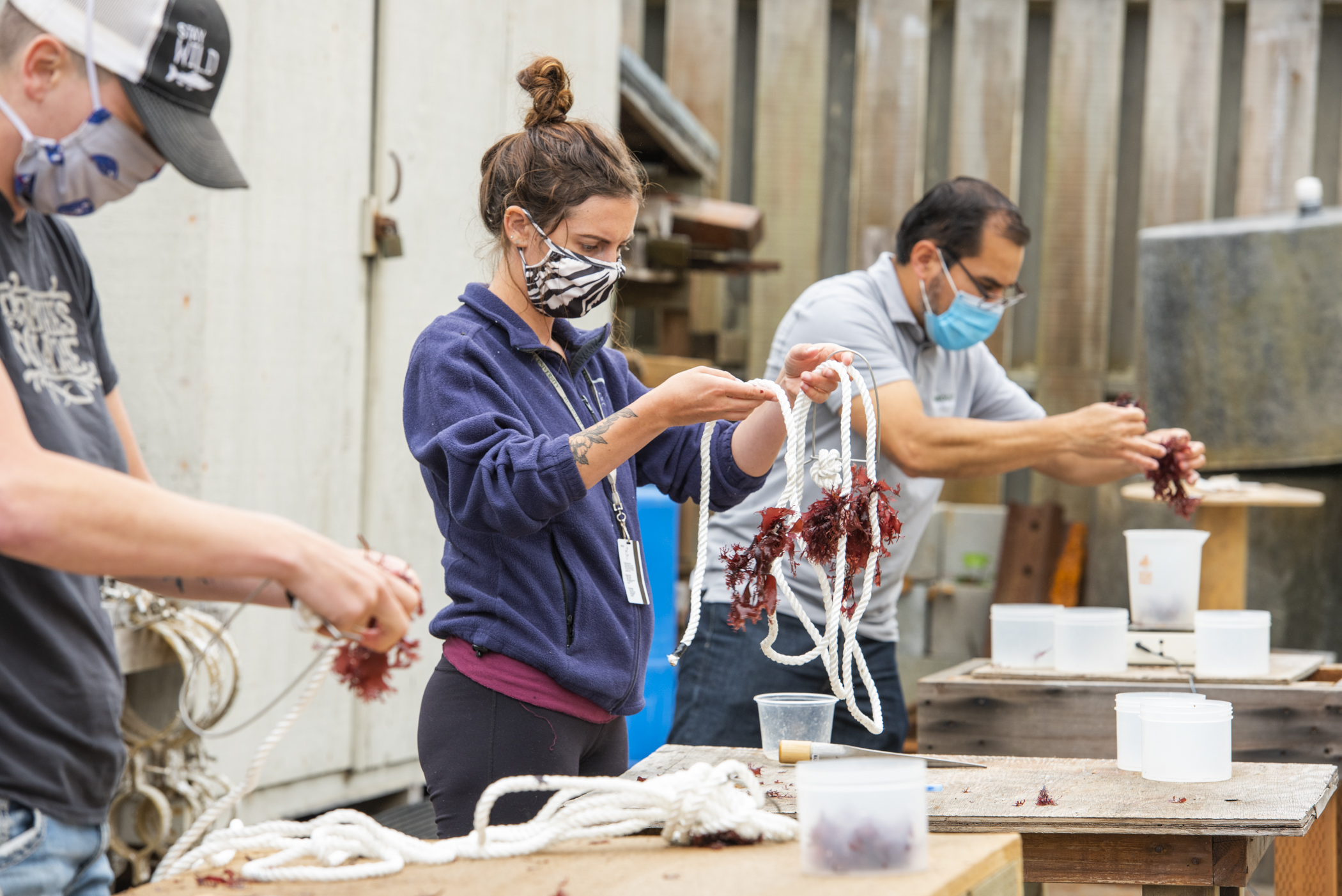
    Thalman has been growing seaweed at the HSU Marine Lab in Trinidad for the past year. This seaweed incubation process begins with sablefish, at the top of the food chain. The sablefish eat food from lower on the food chain and then produce feces that act as nutrients for the seaweed, which absorb them in turn.

    “The seaweeds act as part of a bio-filter, which then sends less nutrient-dense water back to the fish,” Thalman said.

    This bio-filter acts as kind of a recycling system with different levels of the food chain helping each other out.

    Bren Smith is the executive director of Greenwave, a nonprofit that assists with training environmentally-focused farmers, and is a big proponent of the seaweed farm. Smith is excited about the future of regenerative agriculture among the oceans in a world already seeing the effects of climate change.

    “There needs to be a transition in the oceans,” Smith said. “But what’s exciting about that is we get these opportunities to learn from the mistakes of land-based farming and the mistakes of industrial agriculture and really do it the right away. It’s all hands on deck.”

    Thalman would like to put her seaweed to good use, whether that be food for consumption or fertilizer for gardens. The grade of seaweed dictates what it will be used for. If the seaweed is a lower grade, it can only be used for fertilizer and fodder, but if it has a high enough grade where it is deemed edible for humans, then it can be commercially sold.

    Unfortunately, due to permitting issues, the seaweed is currently unable to be sold in any capacity, but when the time comes to sell the seaweed, Thalman plans to donate all the profits.

    Smith is mindful of the extent to which the farm is financially sustainable.

    “And the key from a farming perspective is how much grows — what volume do you get per meter,” Smith. “Because if you don’t get enough volume, then it is not a profitable farm.”

    Before anyone could even worry about making money from the project, they had to worry about finding the money to fund it first.

    Dr. Rafael Cuevas Uribe, an assistant professor in the fisheries biology department at Humboldt State, is another driving force behind the seaweed farm as he was the one that wrote the grant that helped fund the project. As Uribe explained, within the California State University system, there are a number of campuses that do agricultural research and subsequently get grants called the Agricultural Research Institute Grants to fund agricultural-related projects. Because HSU is one of the CSU campuses that is in that boat, it receives said grants, which are managed by Sponsored Programs.

    Uribe tried to get one of these grants but ran into a major roadblock along the way. As it turns out, he had to monetarily match 50 percent of the requested amount of funding.

    “And that was kind of an issue in our project and we thought that we had everything figured out and at the last day when the project was due, we found out that we did not have the match to do this project,” Uribe said. “And we were almost dropping the ball right there.”

    Also stepping in are a growing number of people and agencies interested in getting into the seaweed farming industry. However, as Thalman noted, there are a lot of heads being scratched.

    “People don’t know what to do,” Thalman said. “They don’t know how to get permit regulations, so we’re kind of the guinea pigs. They’re watching what we do and then they’re going to use what we learned to set up their farms in the future.”

  • Graduating Into Uncharted Waters

    Graduating Into Uncharted Waters

    HSU graduates attempt to navigate a world turned upside-down by COVID-19

    In May, Humboldt State University graduated hundreds of students, as it does every year. Unlike past years, graduates didn’t get to shake hands with their respective dean and receive a diploma on-stage in front of their friends and family. Instead, the class of 2020 was graduated over a mass-Zoom call.

    Claire Matulis graduated last May with a degree in psychology. She recalls the graduation experience as passable but regrets not witnessing it firsthand.

    “It was interesting to have the Zoom graduation,” Matulis said. “I still had my family on, we had a Zoom going on watching the slideshow and there was a part of me that kind of wished I had the in-person graduation.”

    For former HSU film major, Will Schorn, this was only the beginning of a long and winding road to finding a job. Schorn had an internship with the HSU football team as a videographer but got axed when the program was cut. He’s since gotten back on the market, looking for similar positions.

    “With COVID impacting so many sports, especially if you’re not playing at the top level – if it’s not professional sports – it’s been really difficult to find a job filming sports right now,” Schorn said.

    “It’s difficult for people to feel like they’re building community now because, like, I’m sitting here in my room by myself talking to a screen and even though I know I’m communicating to a person, there’s a different feeling to communicating this way than it would be sitting face-to-face.”

    Madison Hazen

    Other students have had less trouble finding work, even if it is remote work. Madison Hazen is one recent graduate who fits that bill. An anthropology and religious studies double-major, Hazen was able to land a job in English-language learning support and reading intervention support for elementary school students, through the AmeriCorps company. While Hazen feels very fortunate to have found a job at all, she’s not too fond of working in a virtual setting.

    “At the school I’m at, I’m going to have like forty-plus coworkers, who are people I’m not going to see face-to-face at all,” Hazen said. “I think it’s difficult to feel kind of like you’re fully becoming integrated into that work environment.”

    Although Hazen remains optimistic for the future of former students but admits that she misses interacting with other people in a physical space.

    “I definitely took it for granted as a student and having the physical community taken away or being removed from the physical community really helped me appreciate it,” Hazen said. “It’s difficult for people to feel like they’re building community now because, like, I’m sitting here in my room by myself talking to a screen and even though I know I’m communicating to a person, there’s a different feeling to communicating this way than it would be sitting face-to-face.”

    Like Hazen, Matulis was able to find a job in her field. Working as a child and family specialist for a non-profit called Evolve Youth Services, Matulis acts both as a mentor and a therapist for adopted kids. Unlike the others, Matulis is remaining in Humboldt for the time being.

    “I love Humboldt and I’m actually really grateful that I’m here in the time of the pandemic,” Matulis said. “My family is in much more populated areas in L.A. and Riverside and Ventura. Here out on the trail, I don’t have to worry about there being as many people and I feel like everybody is very conscious of wearing their masks and keeping their distance, so I feel grateful to be here.”

  • HSU Cultural Center Budget Slashed

    HSU Cultural Center Budget Slashed

    Associated Students leaves student body devastated after significant reductions in cultural center’s budget.

    Two months ago, Associated Students released its proposed budget for the 2020-21 school year at Humboldt State University. Included in this budget were major budget cuts to on-campus cultural centers such as the Multicultural Center and the Eric Rofes Multicultural Queer Center.

    For the budgeting process to begin, A.S. applications are submitted by various campus-based clubs to the A.S. Finance Committee, previously known as the Board of Finance. From there, the committee reviews all the incoming applications and after holding public appeals, creates a Recommended Budget that is sent over the A.S. Board of Directors, a mix of A.S. elected representatives and faculty advisers. The Board of Directors then holds another round of public appeals, drafts a revised Recommended Budget and sends it over the A.S. president, who promptly turns it over to the campus president for official approval.

    David Lopez, the Associative Vice President of A.S. and a sophomore at HSU, emphasized that he still greatly values the cultural centers but they will be funded differently.

    “We really appreciate them for the work they do,” Lopez said. “So to make sure that they continue to do that work still because we’re not funding them, we’re doing it through the clubs grant, and we’re forming this grant process to be as neutral as possible with funding student organization needs.”

    Lopez is personally leading the charge for these new clubs grants, which aim to support student organizations like the Asian Desi Pacific Islander Collective and the Women’s Resource Center in a reduced capacity.

    One thing that factored into the decision by Associated Students to sever the cultural centers’ funding was the Apodaca v. White lawsuit that took place between a pro-life student organization at CSU San Marcos and CSU San Marcos’s Associated Students. The pro-life student organization claimed that it was being discriminated against by CSU San Marcos because requested funding for a pro-life speaker was denied while other groups were recieiving the same funding. The final ruling by a federal court was in favor of the student organization, arguing that the funds that come from student fees need to be allocated in the most viewpoint neutral way possible. The CSU Chancellor’s office has yet to clarify what this means.

    For Lopez, this new funding procedure is radical but also necessary given the circumstances.

    “We’re supporting the greatest amount of viewpoints and opinions possible,” Lopez said. “The plan for this club grant is to further diversify the opinions on campus per Apodaca v White and to err on the side of caution while awaiting the Chancellor’s interpretation of Apodaca v White.”

    Lopez recognized that he and his staff are working with a limited financial capacity and therefore need to distribute funding in a way that will keep clubs satisfied and avoid a lawsuit of their own.

    “What’s happening is we’re being faced with the choice of either becoming a club or becoming absorbed into an administrative or academic department.”

    Amanda Huebner

    “Our total budget is less than eight hundred thousand dollars,” Lopez said. “Meaning that by not funding in a viewpoint neutral manner, we are potentially risking over a fourth of our budget, a fourth of student fees that could go to things like our Club Grants Committee or that could go to other campus resources if we were to risk not funding in a most neutral way possible.”

    Celene Gonzalez is an HSU grad student in the psychology program and an El Centro employee. She has worked closely with the cultural centers and has seen their collective downfall over the years.

    “What gives me hope in what I had seen in that time is that students were getting really connected with each other,” Gonzalez said. “They were finding their communities. It is not shocking to me that the school felt the need to kind of push that down a little bit.”

    Gonzalez is disheartened by the disconnect that has been formed between her and these students through said budget cuts.

    “I feel like our work gave us a way to connect with one another and I feel like our activism gave us a way to connect with one another,” Gonzalez said. “That it’s going to be hard to maintain and it’s going to be hard to ask of them when I know that they aren’t being compensated for that work.”

    The Eric Rofes Multicultural Queer Resource Center is getting hit hard by the extreme budget cuts. Concerned about the future of her cultural center, Amanda Huebner, a rangeland and social sciences senior and an employee at the ERC, wants to see it remain in the state that it’s in already.

    “What’s happening is we’re being faced with the choice of either becoming a club or becoming absorbed into an administrative or academic department,” Huebner said. “So I think there has been dialogue by students in the past that this would be a bad move being absorbed by a department or by an administrative department because it would make the group not be as student-run.”

    In other words, the absorption of the ERC into another department would be ill-advised because there would be more faculty interference in how it would be managed, and that wouldn’t align with the goal of this cultural center of being a student-led one.

    Student leaders like Katherine Nguyen who work in the cultural centers are frustrated with the fallout from all of this. Nguyen doesn’t feel like the administration cares about its marginalized students.

    “Are you going to be supporting your cultural centers, are you going to be supporting your students?” Nguyen said. “I’m not confident about that and I’m tired of just being told by admin, like: ‘Oh, you got it wrong, like we actually care about you. We’re going to figure out a way,’ but it’s like if you did, why didn’t you make a plan? Show that you’re invested in students.”

    When it comes to the shrinking budgets for the various cultural centers, neither the students nor the administration can be totally satisfied. After the Fall 2020 census, the A.S. cumulative budget will be reevaluated.

  • Humboldt State Students Stand Up And Stand Out Against Racism

    Humboldt State Students Stand Up And Stand Out Against Racism

    Actions are being taken to bring about change in a country dominated by racism and police brutality

    Fueled by the Josiah Lawson case and the George Floyd murder, Humboldt State University students are taking to the internet and the streets in protest of systemic racism. Students and community members alike are actively displaying their pent-up anger and fear surrounding being marginalized.

    Kiara Mixon, a fourth-year psychology student, has been trying to educate herself and those around her about what’s going on. Namely, she has been sharing different resources with people who are unaware of the Black Lives Matter movement and watching documentaries about racism to get a deeper insight into it.

    While she hasn’t really been going out in the streets and protesting, she has still seen both sides of the movement.

    “I see people who are of color protesting and, truthfully, it means a lot that those people are standing up when it’s an issue for them as well,” Mixon said. “But I’ve also had people who aren’t really speaking up or haven’t said anything or don’t really have a personal opinion on the matter and that makes me a little bit uncomfortable because you never know where they’re standing.”

    Senior psychology major Edwin Rosales has become more outspoken and animated in the wake of the revamped BLM movement. He lives with his mother’s side of the family and has gone back and forth with them about everything going on.

    “After talking with them, it’s kind of difficult to talk to them about it because they’re very, you know, still in the olden ways and are very ignorant about it,” Rosales said. “So, I’ve had to be outspoken about it and be like ‘You know what? You’re not understanding the cause’ or having to explain to them what it is.”

    Rosales has carried his new-found, forthright persona around racism into the land of social media as well.

    “I never really posted about that stuff,” Rosales said. “I’m not helping if I don’t say anything, and so if I am posting about something, maybe someone will read it and maybe someone will help in some way.”

    Julianne Blandford is a senior majoring in child development. She is feeling a lot of mixed emotions in the midst of the string of racist events that have occurred from the George Floyd murder to the leaked video of three HSU students making racist taunts toward Black people. She is attending protests and doing everything she can to move the conversation about racism along.

    “It is my time to sit down and listen and also stand up for those who can’t speak,” Blandford said.

    Blandford recognizes her own status but also wants to work with those who are being suppressed.

    “I’m seeing it as an opportunity to continue to create change, create a more peaceful place to live, create new systems that aren’t founded upon racism, and a world where no-one has to live in fear,” Blandford said.

    “We need to redistribute resources and really build communities.”

    Dr. Ramona J.J. Bell

    Dr. Ramona J.J. Bell, a critical race and gender studies professor, believes that there are a number of factors to look at that are feeding into a racist America.

    “We’re a country where we put so much money into our military, but there’s people without health care, so we concentrate on, you know, defending the country,” Bell said. “But we have to reconfigure and reimagine what that really means to defend the country, to defend America.”

    Bell emphasized the importance of unifying communities in a country where the opposite is happening at the hands of the police.

    “We need to redistribute resources and really build communities,” Bell said. “When you are killing black folks in communities and the police are killing us, that’s not building our community — that’s killing our community. So we have to look at ways in which we can build America because our country was built off the backs of Black people, particularly during the Holocaust of enslavement.”

    Bell recognized a need for change in America when it comes to race and embraced the protests that have spawned from it.

    “We have to revisit America’s notion of belonging and we have to revisit race in America,” Bell said. “There’s never been a real conversation about race and racism in America. And I think the protests going on all over the country, all over the world are telling us something’s wrong and it needs to be fixed.”

    More than anything, Bell emphasized that we are all in this fight together, no matter the color of your skin.

    “That’s part of the fight. That’s part of the struggle to get people to understand that Black lives matter,” Bell said. “It’s about letting us be free to live lives like America has promised.”

  • Humboldt State’s Hybrid Instruction Request Approved for Fall Semester

    Humboldt State’s Hybrid Instruction Request Approved for Fall Semester

    On May 21, Humboldt State University sent out an email announcing that it would be submitting a proposal to the CSU system requesting for a hybrid learning environment where there would be a mixture of face-to-face and online instruction. June 6, another email was sent out confirming that HSU would be able to operate virtually and in-person as needed.

    According to the official HSU email, “the University’s academic program has perhaps the highest proportion of courses with a hands-on component in the CSU.”

    About a quarter of all HSU courses involve labs and other activities and experiences that can’t really translate online and half of those course sections are able to be taught in-person this upcoming fall.

    Regarding all other courses that involve less tangible experiences, like lectures and seminars, they will continue to operate online.

    Following the acceptance by the CSU system, HSU can now ramp up its thorough planning process beginning this summer. HSU is also considering a return to a fully online learning environment if things worsen. For now, it will be a hybrid of face-to-face and online instruction.

    As for the details of HSU’s plan for the fall semester:

    Health and Safety

    Steps will be taken to ensure the health and safety of people on campus like limiting capacity and mandating face coverings for all who step foot on HSU turf.

    Social Responsibility

    Students and faculty will be expected to be socially responsible when returning to campus and remain vigilant in keeping themselves safe.

    Schedule

    Courses taught in a face-to-face manner will start and finish with virtual interactions to go over safety measures, and all face-to-face parts of courses will start after the initial virtual interaction and end on Nov 6. just in time for the second virtual interaction.

    Housing

    The combined capacity in HSU’s residence halls will not exceed 1000 students and students will be placed in single-occupancy rooms. Dates and times for moving in will be spread out.

    Dining

    Dining services will not be as frequent on campus. Takeout and food-delivery will be available to students but buffet-style and self-serve food will not be.

    Faculty and Staff

    A majority of employees will continue to telecommute. Workers deemed essential will come back to campus to work more regular hours. Employees over the age of 65 will continue to telecommute as well.

    Athletics and Recreational Activities

    HSU will enact a four-stage plan intended to gradually allow student-athletes and related staff to come back to campus. The availability of recreational activities will increase in conjunction with the availability of recreational activities in the county.

  • Telehealth Looks to Fill Gaps Left by Pandemic

    Telehealth Looks to Fill Gaps Left by Pandemic

    Telehealth has a chance to make a name for itself in the US

    Many physicians and patients aren’t likely to want to or be able to do face-to-face appointments for now and into the foreseeable future. In the midst of this, a potential solution lies in telehealth.

    Telehealth—also known as telemedicine—involves the interaction of medical practitioners and patients through virtual means. Doctors and other physicians can attend to more serious matters in-person while remotely prescribing and treating other, less critical patients.

    “I think people are gonna be more and more open to going to the doctor full-time via telehealth if not doing a follow-up visit. I think that we’ve made more progress in the last six months than we have in the last six years and I think it’s only gonna go this way forward.”

    Jacob Horn

    Jacob Horn is the managing director at Vivo HealthStaff in Dublin, California. A Humboldt State University graduate, Horn now contracts with various medical clinics and offers immediate telehealth solutions for more rural communities. He projected a lot of growth for telehealth.

    “Before this COVID-19, it was very meager, to say the least—it was underutilized,” Horn said in a phone interview. “I think people are gonna be more and more open to going to the doctor full-time via telehealth if not doing a follow-up visit. I think that we’ve made more progress in the last six months than we have in the last six years and I think it’s only gonna go this way forward.”

    Horn detailed what he sees to be the benefits of telehealth.

    “I think it will address provider burnout,” he said. “I think it will increase patient satisfaction because now they have a wider access of care. I think it will also make the insurance companies happy because follow-up visits might not cost them as much. But also, the patients will see, hopefully, a savings by seeing their doctors at home for low-acuity visits.”

    Kate Schiff, a physician assistant in the HSU Student Health Center, is trying to incorporate telehealth into her practice in a multitude of ways.

    “For the most part, we are utilizing the phone for triage, evaluation of new problems, and management of existing problems and conditions,” Schiff wrote via email. “We are also managing most of our medication refill requests this way.”

    Schiff also uses Zoom video calls to conduct business.

    “We do have the capability to have Zoom visits which we are primarily using for mental health visits at this time,” she wrote. “Counseling and Psychological Services is using the phone and Zoom to provide individual and group therapy for students.”

    Dr. Caroline Connor, a local physician, wasn’t sure how regular telehealth would become in the future.

    “I think it’s gonna bring more accessibility to healthcare, especially for seniors, in Humboldt County but also to the HSU students.”

    Jacob Horn

    “The question is—how regular it’s going to be—is gonna be a very interesting story that has not yet been written,” Dr. Connor said. “If I was still in practice, how many of my patients would still be coming in? Now, most patients, if they had the choice, would rather see you in person, I think. But you wonder—busy millennials, if they want to get an appointment, will they just start making telemedicine appointments? And how is that gonna be incorporated into the daily life of a physician? I have no idea.”

    Speaking of busy millennials, HSU students are no stranger to the lack of healthcare in Humboldt County. Horn said telehealth could help fight that shortage.

    “I think it’s gonna bring more accessibility to healthcare, especially for seniors, in Humboldt County but also to the HSU students,” he said. “We have a massive shortage, we have long waitlists and a lot of people are leaving the county for certain specialty care. I think in the next year, that will switch up—you’ll be able to have more resources at your disposal in Humboldt County due to telehealth.”

    Connor said nursing students in HSU’s revitalized program could take advantage of telehealth to connect with remote specialists.

    “Let’s say somebody is going through nursing school and they have to learn a little about the intensive care unit—there might not be enough educators in Humboldt County about nursing intensive care units,” Connor said. “So, maybe they’ll have telemedicine education.”

  • Rain Returns to Humboldt This Weekend

    Rain Returns to Humboldt This Weekend

    A moderate rainstorm will make its way through Humboldt County

    A storm is hitting Humboldt this weekend will bring a considerable amount of rain.

    Jonathan Garner, a meteorologist for the National Weather Service in Eureka, gave us a preview of what to expect.

    “All in all, maybe up to two inches of rain over the weekend,” Garner said. “I’m also expecting accumulated snow across the mountains for elevations mainly above 3500 feet. We could get a little bit of small hail and stronger showers and perhaps a thunderstorm as well.”

    The rain is mainly forecasted to fall on Saturday but will linger in showers on Sunday. Expect high temperatures to be in the low to mid 50s with lows in the lower 40s.

    “It will put a very small dent into our deficit. We’re about 10 or 11 inches below normal right now.”

    Jonathan Garner, meteorologist for National Weather Service in Eureka

    Garner said the storm won’t resolve our rain deficit for the year.

    “It will put a very small dent into our deficit,” he said. “We’re about 10 or 11 inches below normal right now.”

    Emily Read, a junior environmental studies major, is still around in Humboldt amidst the coronavirus outbreak. With the rain looming, she planned on not doing much this weekend beyond trying to learn a new program for an engineering class.

    “I typically am fine with rain,” Read said. “I like it most of the time—but right now, since we’re stuck at home anyway, I kind of just am tired of it and I just want it to stop raining so it can be nice and warm.”

    Jared English, a junior film major, also planned to remain indoors this weekend even though he was initially looking forward to getting outside and doing the one thing he can do in Manila—frisbee golf.

    “It does kind of make me a little sad,” English said. “Because that means even more time inside and even more time isolated in this quarantine, and the rainstorm kind of takes that one thing away.”

  • Humboldt Mold Manifests in Moisture

    Humboldt Mold Manifests in Moisture

    HSU students are under-informed and unprepared for the beast that is mold

    It accumulates like there’s no tomorrow, unleashing its inner animal at every turn. No damp area is safe from the monster of mold. What can students do to fight it?

    The rainy season is still around in Humboldt. Lurking amidst the hundreds of buildings students live in—and may be stuck in—is a hidden and nasty phenomenon—mold.

    Mary Gaviglio, a freshman business administration major, has had first-hand experiences with mold, from seeing it grow on a bowl of cereal she left out overnight to meeting someone who was severely affected by it.

    “He’s actually allergic to the mold spores here, so he gets really excited because they’re in the air,” Gaviglio said.

    Gaviglio also remarked on how it’s easier to breathe in Humboldt than where she is from in Southern California.

    “I usually get sinus infections when the Santa Ana winds come in because of all the pollutants, and now that I’ve moved here, I actually breathe a lot better,” Gaviglio said.

    Dr. Miriam Peachy, an accredited practicing naturopath in McKinleyville and a mold expert, gave a breakdown of the ins and outs of mold and mold illnesses.

    There are five different kinds of mold and the mold that humans can see is called active mold. Mold reproduces through spores, which get in the air, fly around, settle on surfaces and eventually begin to grow as moisture emerges.

    Mold toxins, the waste products of mold, are what can get people sick. Most people aren’t affected by most kinds of mold, but for those with weakened immune systems or allergies, extended exposure to some mold can cause nausea, headaches and cold sweats.

    “I’ve had people literally sleep outside because they didn’t have anywhere else to live.”

    Dr. Miriam Peachy

    Colton Trent, an environmental science senior, talked about how he’s dealt with mold in his apartment. His bathroom is in the middle of his apartment and has no window and an old ventilation fan, which makes for a messy situation in the winter when humidity is high.

    “Whenever me or my roommates take showers or if we leave the door closed for too long, the condensation collects on the ceiling and the walls,” Trent said. “And we have to clean the walls and the ceiling pretty frequently because mold spots will start to grow.”

    No matter where you stand in the mold illness spectrum, there are steps that can be taken to treat it.

    The first step is distancing yourself from the mold, which means permanently leaving the environment in which the mold is taking over.

    Unfortunately, in Humboldt, the lack of housing is a known factor that is doing the mold illness treatment process no favors.

    “Too many people are afraid to rock the boat or lose their rental and they don’t have anywhere to go and they don’t know if the next place they go will be moldy,” Peachy said. “It’s almost impossible to find a place that’s not moldy here.”

    The next step in treating mold and mold illness is remediation. That is to say, removing and replacing anything and everything that might’ve contracted mold from kitchen wooden cabinets all the way to furniture.

    “I’ve had people literally sleep outside because they didn’t have anywhere else to live,” Peachy said.

    The final step in the process is washing and cleaning everything that can be wiped down or otherwise cleaned like clothes and metal surfaces.

    Above all, Peachy stressed the importance of getting a dehumidifier, as it can work wonders and is the most basic way of combating the spread of mold.