Refunds for various fees are available for Humboldt State students in the midst of the COVID-19 outbreak
With closures and cancellations occurring left and right, many Humboldt State University students are wondering what kinds of refunds they can receive from the university. Here’s a list of them.
Tuition and Fees:
Tuition and campus-based fees will continue on as normal for students that are taking courses from their professors to receive grades that factor into graduation.
If a student wants to withdraw from all spring semester courses, they must act by April 5 to be eligible for a prorated refund of tuition and fees.
Classes that students with financial aid are withdrawing from will be looked over and potentially adjusted based on the amount of days enrolled.
Housing and Parking:
If students leave on-campus housing, they will get prorated refunds for both housing and dining fees once they check out.
Automatic refunds will be doled out to students graduating in spring or summer 2020. For more information, email HSU-cash@humboldt.edu
For unopened and unused regalia, refunds will be issued using the same method the order was placed with.
For the Graduation Writing Proficiency Exams on March 28 at 9 and 11 a.m. and April 11 at 9 and 11 a.m., all charges will be returned to the students’ accounts and refunds will follow if the student doesn’t have outstanding charges. Keep in mind that the GWPE is still required to graduate, and will be held online for the time being.
Locals react to HSU students bused back to Humboldt from coronavirus-afflicted areas
A bus chartered by the Humboldt State Homeward Bound program picked up 31 HSU students March 21 from San Francisco and Los Angeles—two cities where the coronavirus has become more and more prominent—and brought the students back to Humboldt.
Lost Coast Outpost posted an article about the bus March 24. The Facebook post for the story has 433 comments as of March 29, many of which are critical of HSU.
“This is beyond irresponsible of HSU,” one comment reads.
“And one more reason we feel GREAT about not sending our kids to HSU,” reads another.
Sarah Ray, an environmental studies professor, defended the students.
“Quite a few of our students live here and have moved here and have their lives here and they were visiting family,” Ray said. “So, just like we would expect and hope that kids and students who are from Arcata and the area—we would fully respect and appreciate that they would want to come home and be home with their families once their classes got cancelled in this really frightening moment—it’s reasonable that students would want to go where they’re most comfortable and feel at home.”
She went on:
“There’s also a lot of research out there about how many students across the nation going through this exact problem are not safe at home, and this might be a safer place for them,” Ray said.
“I feel like it’s not a simple solution to just say, ‘Go back there,’ because many of these students live here.”
Xochitl Andrade, HSU English and biology major
Grant Scott-Goforth, communications specialist for HSU, explained the precautions implemented on the buses returning to HSU.
“The buses were partially full so that people could have social distancing on the buses while they rode,” Scott-Goforth said. “And then, obviously when they return, we’re asking everyone to shelter-in-place, to quarantine if you’ve been exposed or been to an area with exposure, and to contact the Student Health Center or hospitals with concerns about health.”
As much as HSU wished it could’ve been in command over which students came and which students left Humboldt, there was no way to do that. Of course, as Scott-Goforth asserted, the coronavirus situation is nothing to sneeze at.
“I think it’s terribly unfortunate and I’m very sad for them and I feel very protective of students because it’s what I do.”
Sarah Ray, HSU environmental studies professor
Xochitl Andrade, an HSU senior majoring in English and biology, said the situation is complicated.
“I feel like it’s not a simple solution to just say, ‘Go back there,’ because many of these students live here,” Andrade said. “They may have no where else to go if they were told to go back. We don’t know if they were just visiting friends or family. And for those who don’t have any family to go back to, what are they supposed to do?”
While Andrade agrees that the students should be quarantined, she said she thought HSU knows what it’s doing.
Ray hoped the harsh words toward HSU students from the Lost Coast Outpost article weren’t representative of the Arcata community.
“I think it’s terribly unfortunate and I’m very sad for them and I feel very protective of students because it’s what I do,” Ray said. “I would like to think that it’s only an extreme, fringed, vocal, internet types of social media people who are saying those kinds of things. The vast majority of the university, especially the community and many people in the community—that’s not the kind of sentiment I see.”
More Humboldt State students are electing to stick around, but there’s still work to be done
Corrections: a previous version of this story incorrectly quoted Casey Park as saying “We’re absent as an institution.” The quote should have said “We were absent as an institution.” The story also wrongly included “interim” in Jason Meriwether’s title.
Humboldt State revealed more students were staying on its campus rather than taking off for other schools or ventures in a Jan. 31 press release.
Tracy Smith, the director of the HSU Retention through Academic Mentoring Program, said she was proud of the work she and her peer mentors have accomplished over the years.
“I think Humboldt sincerely believes that whether students decide to stay at Humboldt or not is really a product of our entire campus community and off-campus community,” Smith said. “RAMP really is designed to support incoming students and them finding a place where they feel a connection.”
“85 percent of new first-year students said if they were given the option to choose a college again, they ‘probably’ or ‘definitely’ would attend HSU again.”
National Survey of Student Engagement, spring 2019
A study done in conjunction with HSU by the National Survey of Student Engagement in spring 2019 provided some data on student perceptions of HSU.
“85 percent of new first-year students said if they were given the option to choose a college again, they ‘probably’ or ‘definitely’ would attend HSU again,” the study said. “And 89 percent of first-year students said their overall experience was ‘good’ or ‘excellent’, compared to an overall CSU system rate of 84 percent.”
Jason Meriwether, Ph.D., vice president for Enrollment Management, said a few things have contributed to the increased retention rates, including Enrollment Management staff and related faculty streamlining the registration process and connecting students with support services—all in an attempt to create a sense of belonging for students.
“It’s the experience but it’s also the listening and packaging it into one,” Meriwether said. “So, all of that is about looking at the students and giving them what they’re asking for first, and using the resources that we have to create an experience for the student.”
Meriwether said his staff’s hard work has paid off by meeting student needs.
“We have to be aligned with what students are expressing that they need and putting ourselves in a position to support students,” Meriwether said.
“There wasn’t attention given to the most affected and traumatized students. And those are the students who went back to where we recruit from and said ‘Humboldt is not a place for me,’ and ‘Humboldt is not a place for you.’”
Casey Park, HSU alumna
He noted a growing trend at HSU of transfer students outnumbering first-time freshmen. HSU has needed to move around campus resources to accommodate the influx of transfer students.
“It’s about being nimble and seeing where the student population is going and meeting those needs,” Meriwether said.
Meriwether added that in recent months, the Student Disability Resource Center and cultural centers have received major face-lifts, which, in turn, have opened up more doors for students.
Casey Park, an HSU alumna, was glad for the rising number of retained students, but said the campus administration’s past actions around retention shouldn’t be ignored as a new wave of measures are enacted. Park is an Associated Students coordinator, but gave her perspective only as an alumna.
“We are still going to need to reconcile the years where we were neglectful of students,” Park said. “It’s going to take a lot of really good decisions to hold ourselves accountable for that and kind of be like, ‘We were absent as an institution.’”
Park said the HSU administration’s inaction regarding the Josiah Lawson case and other events affected previous student perceptions of HSU.
“There wasn’t attention given to the most affected and traumatized students,” Park said. “And those are the students who went back to where we recruit from and said ‘Humboldt is not a place for me,’ and ‘Humboldt is not a place for you.’”
Students react to in-person class cancellations due to global pandemic
As spring break arrived and the COVID-19 pandemic continued its tear across the globe, many Humboldt State University students wondered what to do as HSU canceled face-to-face instruction until at least April 17. Some students stuck around while others went home. The pandemic, directly or not, has affected all students.
“I feel like it’s a very serious outbreak and people need to take it seriously. I do think it’s getting blown out of proportion in some ways and people are panicking before they need to, but it’s just something I’m kind of trying to roll with, essentially.”
Ashley Bailey, molecular biology major
Ashley Bailey, a junior molecular biology major, planned to travel home. She admitted feeling stressed.
“I feel like it’s a very serious outbreak and people need to take it seriously,” Bailey said. “I do think it’s getting blown out of proportion in some ways and people are panicking before they need to, but it’s just something I’m kind of trying to roll with, essentially.”
Kiera Price, a junior journalism major, also said she would travel home. She thought both academic and national leaders should be more vigilant.
“I feel like instead of limiting social interaction, they should do more to prepare for it,” Price said. “Like, for example, the fact that there isn’t more of a stricter way to limit survivors from coming in.”
Price recognized there isn’t a lot to be done, but still expressed a longing for something more.
Tim Arceneaux, a senior English major, looked forward to staying in Humboldt. With a sigh, Arceneaux said he understood the measures taken by HSU.
“I think the precautions that the University is taking here and all around the country make sense, but at the same time, I find them to be really frustrating,” Arceneaux said. “I hope that this issue will bring the global community together and allow people to realize the importance of universal healthcare.”
Journalism major Kiera Price on March 13. | Photo by Gabe Kim
Film major Norbert Rodriguez on March 13. | Photo by Gabe Kim
English major Tim Arceneaux on March 13. | Photo by Gabe Kim
Arceneaux said there was one key thing HSU could do to mitigate the spread of the novel coronavirus.
“They could try to alert students more about the health resources on campus,” Arceneaux said. “Because I feel like at this point, it’s almost an inevitability that someone is going to contract the coronavirus, and I’m not sure exactly what health resources are going to be available to students that contract the disease.”
Norbert Rodriguez, a junior film major, had planned to travel to Southern California to visit family, but decided to stick around once the coronavirus broke out. He said he thought HSU took too long to respond to the pandemic compared to other universities.
“At the moment, there aren’t any test kits [in Humboldt], so there’s really no way of knowing that there are any confirmed cases,” Rodriguez said. “I feel like it should’ve been a bit more proactive.”
Editor’s note: St. Joseph and Redwood Memorial Hospitals have set up screening tents for patients with COVID-19 symptoms.
Claire Till of HSU receives lucrative award to aid her research and academics
Humboldt State University’s top-ranked chemistry program is home to a professor researching how plankton in the ocean interacts with heavy metals in the water.
“There are lots of people who are doing fantastic research and have awesome awards and grants on campus. So I’m glad for the opportunity to highlight some of the work that we’re doing at HSU and lots of people are doing lots of great work at HSU.”
Claire Till
Assistant Professor of Chemistry Claire Till recently won the Cottrell Scholar Award, a $100,000 award honoring trailblazing science professors or researchers who have made large strides in their respective fields.
“There are lots of people who are doing fantastic research and have awesome awards and grants on campus,” Till said. “So I’m glad for the opportunity to highlight some of the work that we’re doing at HSU and lots of people are doing lots of great work at HSU.”
Till looks forward to allocating the funds toward her personal research and her classroom. She’s using the funds to support field trips to gather more data and to hire student researchers.
“We’re going to go sample some rivers this summer,” Till said. “And then we’re going to do a couple of day trips on the research vessel, the Coral Sea, next summer, and some students will be hired throughout that.”
Till’s research is about iron, a vital nutrient for humans and phytoplankton in the ocean. Unfortunately, in the ocean, there are extremely low concentrations of iron, and as a result, phytoplankton are not growing as much.
“It’s really interesting—I think at least—to study how the iron gets there and how the phytoplankton uses it,” Till said. “What I proposed, and the work that we’re going to be working on, is to study iron using a new tool, which is another element called scandium.”
Till elaborated on the relationship between scandium and iron and what she hopes will come out of her research in relation to that.
“Scandium and iron have some parallels in chemical reactivity,” Till said. “There’s no real reason to expect them to behave similarly based on their chemical properties, and so I’m really interested in figuring out exactly in what ways are they similar and in what ways are they different.”
The second area Till will be putting funding toward is academics, specifically in her own classroom.
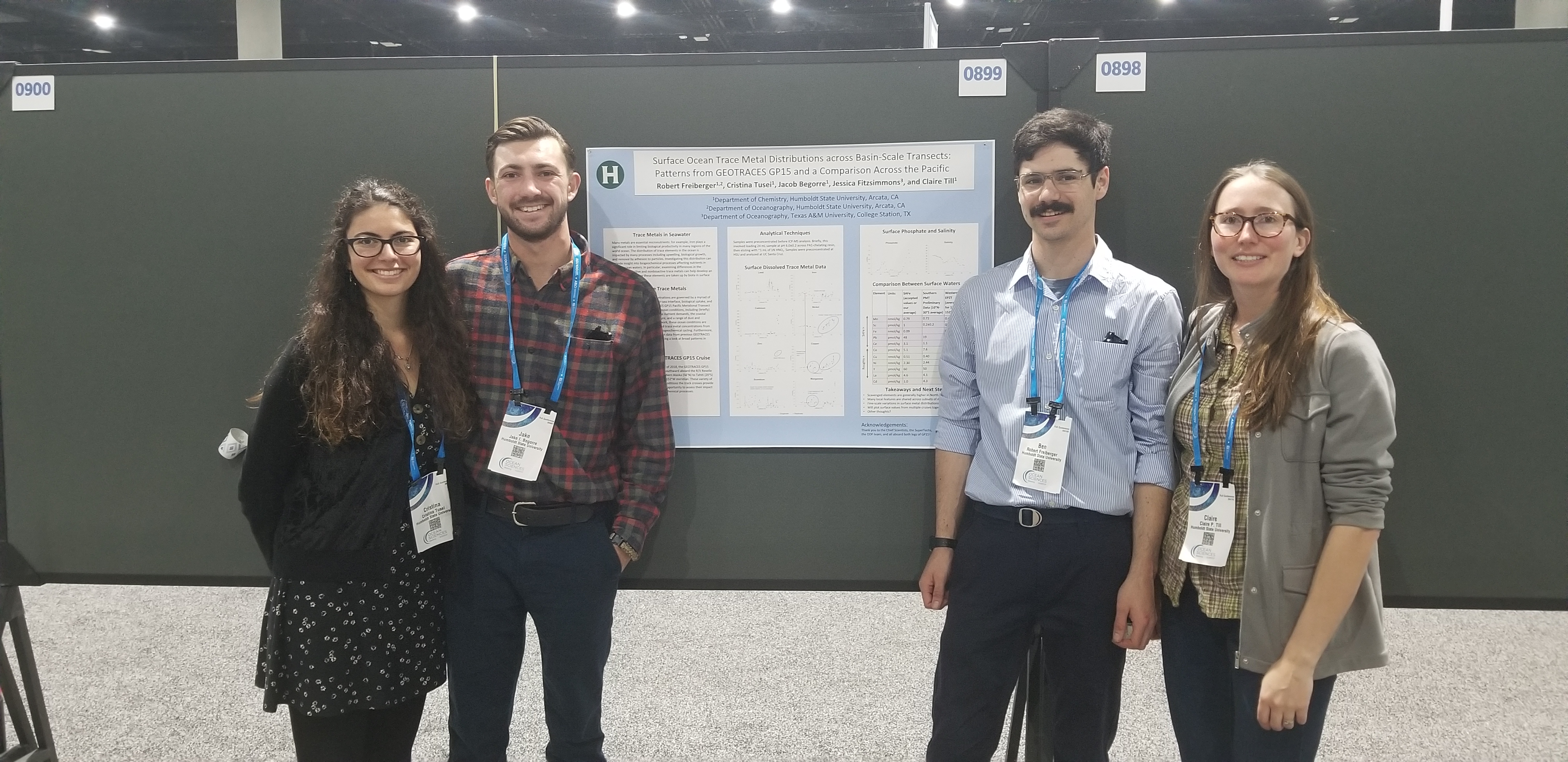
Ben Freiberger, a senior research student for Claire Till, has worked under her for a considerable amount of time.
“The money is now helping us to be able to get more accurate numbers and be able to determine more about scandium.”
Yasmin Zambrano
“We collect seawater samples, pre-concentrate them, and then measure them,” Freiberger said. “We just finished measuring all these samples from a cruise that went from Alaska to Tahiti. I started measuring those samples at the beginning of summer and I’m just getting finished with a couple hundred of those.”
He also went on a cruise last summer and is measuring samples he collected on the trip. His research may benefit from Till’s award.
“It’s good for the research group and it’s great that Claire can get money to keep doing this,” he said.
Yasmin Zambrano, a junior undergraduate research student for Till, was recently hired to work with her on her iron research.
“Right now, we’re just reading a lot of articles and trying to find how the treatments change within the different temperatures to see when it’s the best time to do the experiments and stuff,” Zambrano said.
Zambrano, too, is hopeful for the outlook of the chemistry program with the arrival of the award and subsequent funding.
“The money is now helping us to be able to get more accurate numbers and be able to determine more about scandium,” Zambrano said. “And again it’s going to be for at least three more years, so that’s three more years that she can do stuff, especially during the summer when students want to work in this field —and it looks good.”
Why I don’t think marijuana is everything it’s cracked up to be in baseball
Major League Baseball is an organization that prides itself on having great talent on and off the field. Players are drug-tested fairly regularly and subject to different levels of punishment if caught with opioids or other banned substances. That is all changing with the legalization of marijuana in baseball.
Marijuana graces the covers of magazines and virtually everything in sight in modern culture like a groundbreaking scientific discovery. Seemingly everyone will go to great lengths to defend the devil lettuce’s honor if one attacks it. In general, marijuana is looked at like a god. Sure, people have benefited from it, but its usage has gotten out of control and the relaxed restrictions of marijuana in baseball are just more nails in the coffin.
With the increase in American marijuana users comes the increase of ramifications. While there are many compelling arguments for normalizing marijuana usage, there are also legitimate health concerns around it.
As a matter of fact, marijuana-induced emergency room visits have jumped up, particularly in more left-leaning states.
According to the Colorado Hospital Association, a collection of more than 100 hospitals in the state of Colorado, “the prevalence of hospitalizations for marijuana exposure in patients aged nine years and older doubled after the legalization of medical marijuana,” and “emergency department visits nearly doubled after the legalization of recreational marijuana.”
That is scary stuff. Maybe marijuana can wash away anxiety or depression temporarily, but to risk the added side effects is foolish.
Returning to the realm of Major League Baseball, we find ourselves in the midst of an organization that is trying to appeal to a younger audience by making games more enjoyable and watchable. After all, the kids are the future of the sport.
Yet the idea that loosening the grip on marijuana in baseball will do no harm couldn’t be more wrong. It is common knowledge that youth look up to ballplayers as role models in many different facets.
If marijuana is more debilitating to one’s health than beneficial, we should be making it clear that any, and I mean any, drug or substance will not be tolerated in baseball no matter how harmless it may be marketed as. I certainly wouldn’t want my kids to form the idea that they can get away with smoking weed like it’s no big deal. Marijuana and e-cigarettes are already being passed around like packs of gum in middle and high schools and it’s only getting worse.
“Drugs work very well, at first, for mentally ill people. If you’re anxious, it’ll go away with a couple of hits, a beer. It’s like magic. But then, the tolerance sets in. So, not only do they need to drink more to relieve the anxiety, but every single time they try to stop, the underlying anxiety comes back worse.”
Dr. Alex Stalcup
Beyond setting a bad example for the younger generation, people are using marijuana for non-medical purposes and leaning on it like another shoulder. Especially in Humboldt County, people are socially smoking marijuana and claiming it’s saving their lives.
I recognize there are some individuals who actually need it to function, but nonetheless, it’s spread like a wildfire and now it’s hard to find someone who doesn’t smoke it or consume edibles.
Mental health issues affect the extent to which people get addicted to marijuana or other substances, according to Dr. Alex Stalcup, medical director of the New Leaf Treatment Center in a 2016 interview with Healthline Magazine.
“Drugs work very well, at first, for mentally ill people,” Stalcup said. “If you’re anxious, it’ll go away with a couple of hits, a beer. It’s like magic. But then, the tolerance sets in. So, not only do they need to drink more to relieve the anxiety, but every single time they try to stop, the underlying anxiety comes back worse.”
Stalcup went on:
“Fifty to sixty percent of the people with an addiction to marijuana whom [my] clinic treats have some sort of underlying mental health condition,” he said.
Granted, it is only one clinic, but the point is an overwhelming amount of people across the country who abuse weed are dealing with a mental health crisis of some kind.
I will admit that I am in the same boat with a lot of these folks, but I will never use weed as a solution to my problems. There is an abundance of other remedies and treatments available to cure internal issues.
I can’t control what you do. I can’t control what Major League Baseball does. But I hope that baseball will go back to looking at marijuana as a banned substance that could incur fines and treatment.
Chico State softball lived up to the hype in daytime doubleheader
The Chico State Wildcats got their game going right away in the second inning when, after loading the bases and scoring two runs, third baseman Drew Rodriguez hit a bases-clearing double. The momentum shifted to Chico State in that moment, and they didn’t look back for rest of the day, culminating in back-to-back losses.
Head Coach Shelli Sarchett reflected on her team’s performance.
“Our team is too good to be playing the way we’re playing,” Sarchett said. “We’ve got to figure something out. We’ve got to turn it around right now. We have our moments of brightness, but they’re overshadowed by the moments of darkness.”
Sarchett said their pitching has been struggling and it needs to get better if the team wants to compete.
In the third inning of the first game, Chico pitcher Brooke Larsen clobbered a two-run home run to left field. The Wildcats followed this up with an onslaught of additional offense.
Following five straight runners scoring, Rodriguez hit another bases-clearing double in the fourth inning. This felt like the exclamation mark on the game. The mercy rule came into mind as things were falling apart fast.
Fast forward to the fifth inning Chico had a 17-0 lead. The Jacks didn’t get shut out, though, and managed to squeeze out a run when shortstop Adriana Chavez reached first on an error by Chico shortstop Kristin Worley, and third baseman Izzy Starr scored on an unearned run.
Sophomore shortstop Adriana Chavez makes a play during the Jacks game against Chico State on Feb. 22 at HSU Softball Field | Photo by Thomas Lal
Junior second baseman Danica Grier slides into third during the second game of a double header against Chico State at HSU Softball Field on Feb. 22 in a game where the Jacks stole 5 bases. | Photo by Thomas Lal
Humboldt State outfielder Lauren Lipe runs into to make a catch off of a pop fly during the Jacks game against Chico State on Feb. 22 at HSU Softball Field. | Photo by Thomas Lal
Unfortunately, the Jacks also ran themselves into an out on the very same play as right fielder Mariah Kalamaras was tagged out at third base to end the game.
Jacci Crowe notched the only hit for the Jacks.
The first game was one to forget, but the second game, while also a loss, was more engaging.
Again, Chico scored first. But rather than fall flat, the Jacks managed to tie the game in their half of the first on a RBI bunt single by junior Danica Grier that scored catcher Micaela Harris.
Pitcher Lexee Sheiring was a workhorse in the second game, going almost six innings in relief of starting pitcher Megan Escobar, who got tagged with five earned runs early on.
“I think I just had to take a minute, regroup,” Sheiring said. “Then go out there and really dig through it and be there for my team and show up.”
After trading runs in the following few innings, Chico blew the game wide open in the seventh when shortstop Karter Williams drove in two with a single and right fielder Amanda Metzger brought in Williams on a two run bomb to right.
In their last half of the seventh inning, the Jacks put up a fight when Grier drove in Harris and Starr, and first baseman Anna Brondos followed with an RBI single of their own to bring their team within striking distance. But like the first game, Chico pulled out a victory and swept Saturday’s doubleheader.
MLB rule changes go against what the game is all about
America’s pastime. The phrase has become synonymous all over Major League Baseball. As baseball evolves into new seasons, rules are being implemented in an effort to quicken the game and appeal to a younger audience. Many of the rules aren’t too debilitating to the way the game is played, but several key rule changes will do more harm than good.
There are the more radical, long-term rules like getting rid of the shift or implementing a pitch clock, and then there are the more pressing rules like forcing pitchers to face a minimum of three batters and totally changing up the structure of the postseason.
Three-batter minimum rule:
Baseball is all about strategy. One of these strategies involves using a left-handed reliever to get one or two batters out and then bring in another reliever to close out an inning or game. A new rule, which will go into effect beginning this upcoming season, will make it so all relievers need to face at least three batters before being able to leave the mound.
On its own website, MLB called the rule an effort to reduce the number of pitching changes and cut down the average length of the game.
On the surface, it seems MLB Commissioner Rob Manfred and his entourage are making the game run more smoothly. Digging a little deeper reveals that this is far from the truth.
Again, baseball revolves around strategy. To mess with the strategy of the game is to play with fire—a big, multi-billion dollar fire. As Sports Illustrated put it, “Messing with strategy to attempt to solve a pace of game problem is a wrong-headed approach.”
Take the San Francisco Giants for example. In the 2010s, they would frequently use left-handed relievers like Javier Lopez and Jeremy Affeldt to get critical outs against left-handed batters.
If the three-batter minimum rule was ushered in back then, it would’ve been a different ballgame for all involved. The Giants may not have even won all three of their World Series titles.
Bringing in the new rule would not only be a strategist’s nightmare, but also would fail to accomplish the initial goal to make the game go faster. It’s an odd rule all around, and other stats weren’t taken into account before its inception.
Altered postseason structure:
The details of the new postseason format are very intricate, but to put it in broad terms, the number of teams in both leagues making it to the postseason would increase from five to seven. Opportunities to automatically advance to the next round and manually pick their opponents on a live television show would come to fruition.
No words can describe the sheer ridiculousness of these new postseason rules. It seems as if Rob Manfred has lost his mind.
Baseball is already becoming a money-grab reality TV show. The powers that be don’t need to add insult to injury.
The point of the postseason is only a select few make it in, and an even smaller number move on to higher rounds without weird caveats. Luckily, these new postseason rules are just proposals, as they would destroy baseball from the inside out.
Yet again, baseball has been and should continue to be about enjoying the game for what it is and not trying to throw curveballs into the mix. These rules are ambitious, but aren’t beneficial to anyone except the people at the very top of the totem pole. It’s in the best interest of Rob Manfred and his cohort to leave the game alone and stay faithful to the notion of baseball being America’s Pastime.
You’ve seen it. You’ve heard it. You’ve become annoyed by it. When will it end?
The seismic retrofitting project in the Humboldt State University library is a five-year project of additions and renovations to the library that aims to ensure the safety of the building in the event of a major earthquake. Much of the work of the project is done or is underway.
The completion date of phase three of the project, which includes improvements and expansions to the basement of the library, has been moved to April 14—although there is a chance that it could get moved back again. Much to the dismay of students and faculty, this means jackhammering and drilling will continue throughout the coming weeks. Director of Planning, Design and Construction, Mike Fisher, pointed to a number of factors contributing to the delayed timeline.
“We have to excavate through a number of existing conditions, and through that action, we reveal things we didn’t know about,” Fisher said.
An example Fisher mentioned was the stairs in the library needing to be redone as his workers discovered that the original stairs were poorly designed.
“It’s little instances like that that compound to lead to a time delay,” Fisher said.
Fisher went on to talk about the permitting process.
“During the project, we were moving through permitting and one of the jurisdictions having authority is the Office of the State Fire Marshal,” Fisher said. “Their permitting process took much longer than expected and we had to halt production until we could get that permit secured.”
Fisher also said he and his crew have been working on retrofitting the theatre arts building alongside the library. They considered the theatre arts building to be a higher priority building, as it’s home to regular instruction.
Deema Hindawi, a senior at HSU and a co-coordinator at the Multicultural Center, is one of many directly feeling the effects of the construction. She said it’s hard for her to function in the MCC both as a student and a co-coordinator because she has had meetings interrupted by construction noise.
As a critical race, gender and sexuality studies and criminology double major, she has found it difficult to function because she has been constantly battling jackhammering and drilling.
“It sucks that we don’t really get much of a say in it and it somehow always comes back onto us.”
Maya Habis
Hindawi also noted that there used to be a sign on the side of the MCC that was placed there as part of the retrofitting project without taking into consideration the impact of its words.
“Having people look at that sign is really uncomfortable, especially when you identify as a part of a marginalized community and having to see the sign that constantly is blaring in your face that reads, ‘No trespassing,’” Hindawi said.
Maya Habis, a junior critical race, gender and sexuality studies major and also a co-coordinator at the MCC, echoed much of what Hindawi said.
Habis added their own two cents on being moved around to the bungalows and back.
“It sucks that we don’t really get much of a say in it and it somehow always comes back onto us,” Habis said. “We kind of get put in between these two things—it’s an ultimatum.”
Dean of the University Library, Cyril Oberlander, said he likes to see himself as part of the student body. He has been told and has noticed for himself that students are not enjoying the noise in the library. He wanted to make it clear that he understands the difficulties of the noise. He invited students and faculty to voice their displeasure with him directly along with suggestions for how he and his staff can make being in the library a better experience for all.
This website uses cookies to improve your experience. We'll assume you're ok with this, but you can opt-out if you wish. Cookie settingsACCEPT
Privacy & Cookies Policy
Privacy Overview
This website uses cookies to improve your experience while you navigate through the website. Out of these cookies, the cookies that are categorized as necessary are stored on your browser as they are essential for the working of basic functionalities of the website. We also use third-party cookies that help us analyze and understand how you use this website. These cookies will be stored in your browser only with your consent. You also have the option to opt-out of these cookies. But opting out of some of these cookies may have an effect on your browsing experience.
Necessary cookies are absolutely essential for the website to function properly. This category only includes cookies that ensures basic functionalities and security features of the website. These cookies do not store any personal information.
Any cookies that may not be particularly necessary for the website to function and is used specifically to collect user personal data via analytics, ads, other embedded contents are termed as non-necessary cookies. It is mandatory to procure user consent prior to running these cookies on your website.