The Lumberjack


Students Serving The Cal Poly Humboldt Campus and Community Since 1929

Author: Lora Neshovska

  • A joint opinion: spark it up!

    A joint opinion: spark it up!

    Humboldt County’s reputation around the United States reeks of marijuana.

    As part of the Emerald Triangle, along with the counties Mendocino and Trinity, Humboldt makes most of its green from the seasonal crop.

    Rumor has it that the celebration of April 20 started in Marin County, California, not too far from Humboldt with a group of San Rafael High School students who called themselves The Waldos. These pothead pioneers gathered on campus after school at 4:20 p.m. to spark up and look for a rumored, abandoned pot farm.

    One of the original Waldos said that the term originally meant “Do you have some?” or “Do I look stoned?”

    Eventually, the psychedelic rock band Grateful Dead picked up on the term when they moved blocks away from San Rafael High School and frequently smoked with one of the Waldos’ older brothers.

    Years later, April 20 is a nationwide holiday when stoners smoke copious amounts of weed and spend the day trying not to miss 4:20 p.m.

    Celebrating April 20 in Humboldt County is almost as pointless as the British declaring a national day for beer (which they have, mind you). But the beginning of 2018 marked a monumental time in California history.

    Marijuana advocates have been fighting for legalization of cannabis since the 1960s.

    Finally, on Jan. 1, California Proposition 64 became effective, allowing legal recreational use and taxation of marijuana statewide. Nearly 60 years later, the seed is cultivated into reality.

    Since then, there has been little qualitative information about the impact on Humboldt economy, but tourism and sales tax revenues are likely to increase.

    Now more than ever, April 20 is a holiday to celebrate the progress California has made in decriminalizing the medicinal plant and allowing anyone to enjoy its benefits. For the first time, anyone above the age of 21 can safely spark up a legal, recreational blunt in the comfort of their home.

    If you are partaking in 4/20 this year, please remember that any dank celebration should be in moderation. Spark responsibly.

  • International festival reels universal film into Humboldt

    International festival reels universal film into Humboldt

    Student-run Humboldt International Film Festival hosts film from across the globe for 51 years.

    The longest running film festival entirely managed by students is hosted in the heart of Humboldt every spring.

    Humboldt International Film Fest is open to any film submissions from around the world and combines international film with local film lovers and artists.

    Screenings will begin Wednesday, April 18 and will continue for four days with the Best of the Fest screening on Saturday, April 21. Four final categories include experimental, narrative, documentary and animation.

    A reappearing character in the animation category has been The Bum Collective’s 10-foot, one-eyed, orange monster, Lilly. Lilly Monster was originally drawn up in Calgary, Canada by Xstine Cook’s kids and has developed into a family-run series.

    Cook’s three children, along with her sister’s three daughters, have been making animated shorts since 2010 and have participated in the festival for seven years. The first animated short of the series, Lilly’s Big Day, was drawn and voiced by Cook’s 3-year-old at the time.

    This year, they submitted the film Lilly and the Baby, the most recent adventure of the monster babysitting a human child.

    Cook said she was pleased by the reaction to the previous films by the Humboldt audience.

    “There were all these stoned people and they all got the jokes,” Cook said. “It’s for kids, but they all were laughing.”

    Aside from a class in the film department at Humboldt State, the festival is a campus club that anyone can join and contribute to. Students in the FILM 260 class and club participate in pre-screenings of festival submissions, judge each one and decide on which ones make the final cut.

    Over its 51 years, the Humboldt International Film Festival has moved venues. Held for the first time in 1967 at the Sequoia Theater (currently the John Van Duzer Theatre), the festival has expanded to a yearly, four-day celebration of international film at Minor Theatre.

    Maddy Harvey is a senior film major at HSU. Harvey has been involved in the International Film Fest since 2016 and this year, she is the co-director of entries.

    Harvey says this year, the festival received more than 195 films from 22 countries around the globe.

    “It’s really interesting to see how different countries and cultures express themselves through film, how different stories are told,” Harvey said.

    French exchange student Joanna Cottel is part of the film class at Humboldt State and has loved her experience planning the festival.

    “I have been part of organizing other film festivals in France, so I when I saw this one, I was like, hell yeah!” Cottel said.

    Cottel says as an exchange student, she is proud to be participating in the festival.

    Screenings will be divided into four days based on categories, and will begin at 5 p.m. and again at 7:30 p.m. Tickets are $5 for each day and $10 for the Best of the Fest screening on Saturday, April 21.

    “Even though the festival is international, the heart of it is in the Humboldt community,” Harvey said.

  • As a woman, what are you passionate about?

    As a woman, what are you passionate about?

    “As a woman, what are you passionate about?”

    Name: Kianna Rodriguez
    Age: 22
    Hometown: Temecula, California
    Major: Communication

    “I realized what I want to be doing is working with people. I want to start off working in a social atmosphere. You bring an aspect of your life to people. The way I live my life is by being happy and helping others be happy. I’m always hoping to spread some positivity to others and [communication] really helps you with that. It’s an intersectional way to understand people.”
    Name: Estrella Corza
    Age: 21
    Hometown: Riverside, California
    Major: Economics

    “I’m passionate about people, connections [and] being supportive. That’s why I became an economics major. I feel like if I understand money, I can help people. Money speaks. I want to be able to know what to do with it and give it to the right people.”

    Name: Sarah Rich
    Age: 20
    Hometown: Mountain View, California
    Major: Kinesiology

    “I love moving around. Playing is really important. I would love to help others love moving. I happened to find this wonderful community of hardworking women that are like me and like to hit people, but not in a malicious way, in rugby. At the end of the day, you have to look within yourself and find what you truly enjoy, regardless of any kind of oppressive factors you’ve experienced in your life.”

    Name: Christi Molina
    Age: 21
    Hometown: San Luis Obispo, California
    Major: English

    “I volunteer for a Y.E.S. House program, Step Up and also work with Scholars Without Borders, a safe space program centered around providing for undocumented or DACA students. These have opened a lot of leadership roles for me and helped me get in touch with this activist and resistant side of me. I’m on the teaching pathway. I think there’s a lot of institutional racism in our education system and I want to be in the system to teach kids, specifically girls, how to embrace their culture.”

    Name: Jazmin Sandoval
    Age: 22
    Major: Film
    Hometown: Los Angeles, California

    “As a film major, I like to document a lot of events. I want to incorporate film with my activism. I’m in MEChA and I want to be part of the change they fight for. I also volunteer for the Women’s Resource Center. By being more active, I felt like I have more of a voice. It’s about finding that strength that you can express yourself and be heard, as opposed to keeping quiet and thinking you cannot make a difference.”

    Name: Marleen Woelke
    Age: 18
    Hometown: Hanover, Germany
    Major: Undeclared

    “I once had a very inspiring female doctor, she was very strong and kind. Then, I had another doctor who made me feel so uncomfortable. I want to be there for women, make them feel comfortable to share their story. I want to have my own career, accomplish something for myself, independent of men. I’m in the pre-med club at the university and in the summer, I’m doing an internship in a hospital in Germany.”

    All photos by Lora Neshovska. 


  • Dog Expo has its day

    Dog Expo has its day

    Longtime dog owners in the community showed off their pooches to raise money for spay and neutering funds on March 4 at the Redwood Acres.

    The 31st annual fundraiser was organized by the Humboldt Dog Obedience Group, also known as HumDOG. The local non-profit was founded in 1978 and provides services to “encourage responsible dog ownership.”

    The event presents an opportunity to meet with various dog breeds, share experiences and advice with fellow dog lovers and prospective dog owners.

    Proceeds from the event benefit the Terri Lockett Memorial Spay/Neuter Fund. Lockett started the spay and neuter fund through HumDOG in 1995 and was known as “the spay and neuter queen” to her friends.

    Tricia Morgan of Eureka said Lockett was passionate about the cause and worked to make spaying and neutering available to anyone.

    “If someone didn’t have money, she would pay for it herself,” Morgan said.

    Since Lockett’s death in 2005, Morgan and the HumDOG members have kept her dream alive. The organization hosts fundraisers, such as DogExpo, and receives funding from grants.

    Morgan, who has now taken the title of “spay and neuter princess,” sported a tiara at the event and performed in multiple demonstrations along with her dog Shylo, a Nova Scotia duck tolling retriever.

    Numerous families approached the president of HumDOG, Marilyn Backman, and her two Shetland sheepdogs, Indy and Dunnigan.

    “The training and classes we offer really isn’t for the dogs,” Backman said. “It’s more for the humans.”

    Eureka citizen Sara Borok is a dog trainer and owner of Siberian Huskies Karma and Hildy, who race for the Northern Humboldt Sled Dog Team.

    Karma (left) and her daughter Hildy. Photo by Lora Neshovska.

    “We are an urban mushing team,” Borok said. “We sled even without snow.”

    Dogs train up to months at a time prior to their first race. Karma, who is now 10 years old, led Borok on their first race at only nine months old.

    “This is the first year we are going to have other breeds in the team,”

    Anthony Rojas, a history student at Humboldt State University, is a dog fanatic and volunteers at the Sequoia Humane Society. Rojas, along with the society, took part in the Dog Expo on Sunday.

    “It’s a no-kill shelter and I believe everyone deserves a second chance,” Rojas said. “I volunteer here because it’s important to raise awareness for adoption, spaying and neutering.”

  • A drinking place with a crafting problem

    A drinking place with a crafting problem

    New beer, wine and craft bar Arts and Drafts opens their doors in Old Town Eureka on Feb. 17.

    An improv acoustic guitar solo and noises of lively voices filled the rooms of the E. Janssen Building in Old Town Eureka on Feb. 17.

    The once hardware store became home to Arts and Drafts, a “drinking place with a crafting problem.”

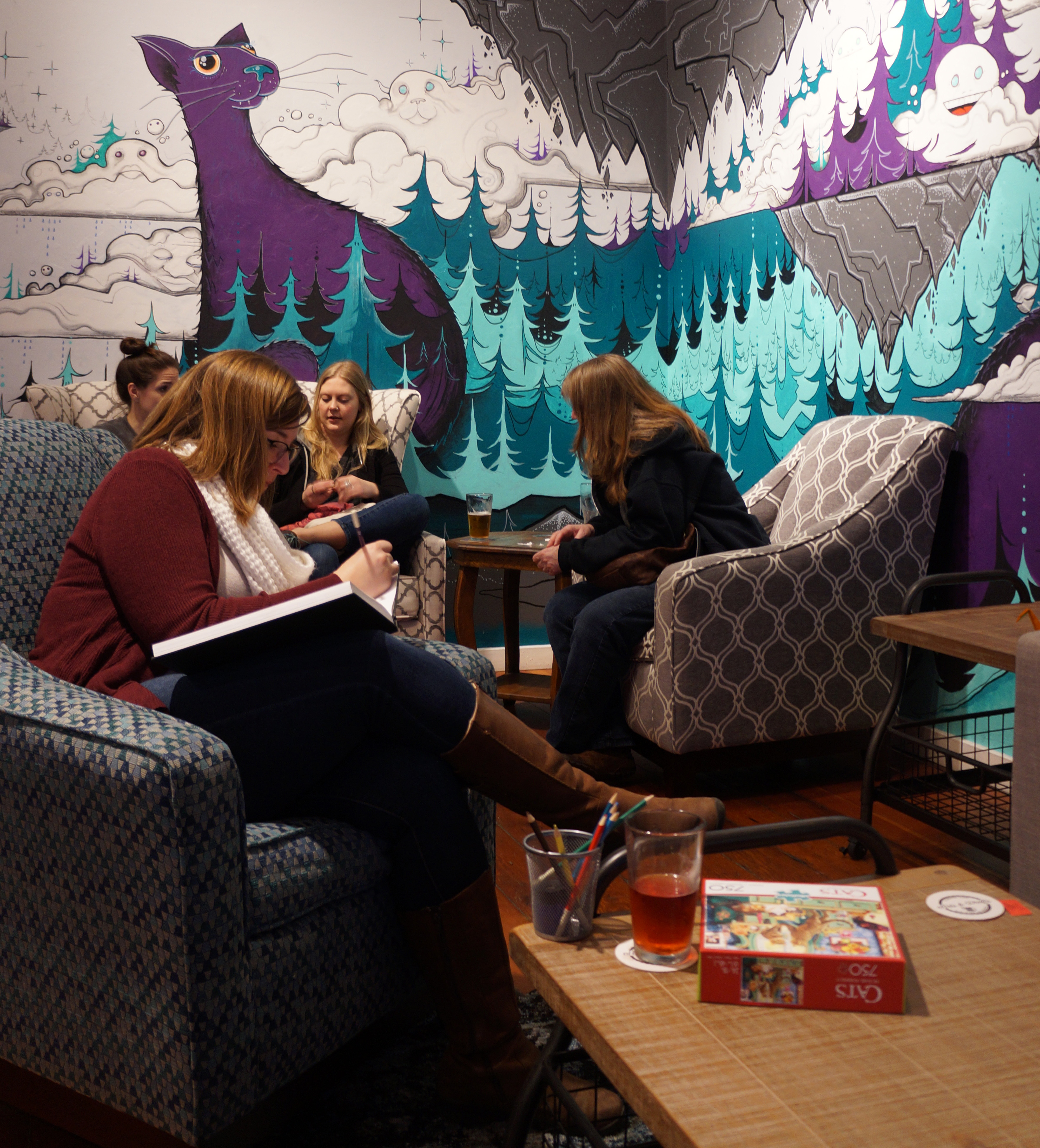
    The venue is divided into two spacious sections. Couches and large wooden tables geared with puzzles, sketchbooks and watercolor pencils surround the bar. Guests are encouraged to leave an art piece in the sketchbook, similar to a visual guest book.

    A bright mural of purple, psychedelic cats and a four-foot wine glass filled with colorful yarn make up the Kitty Corner of the room. The ambiance of the space is relaxed, open and gives the impression of a cozy living room.

    Through the bar, in a separate room, is an art workshop space filled with supplies and art-lined walls. Here, patrons can purchase pre-made DIY art projects, from paintable stone coasters to string art or bring in their own supplies to craft up while hanging out.

    Owner of Arts and Drafts, Tracy Dorgan, said she wanted her dream to come true in Old Town Eureka. After extensive searching for the best possible venue, Dorgan said she fell in love with this one.

    “When I walked into this building,” Dorgan said, “my entire vision changed and expanded.”

    The space is much bigger than her original plan, which ended up doubling Dorgan’s budget.

    The grand opening of the new bar brought a steady flow of people throughout the day.

    Greggory Allbright, Humboldt State University alumnus, high school teacher and artist, says he often enjoys drinking a cold beer while creating.

    “Sitting down and doing art is a lot harder than sitting and drinking,” Allbright said.

    Allbright is setting up for a surrealist art show at the Wine Stop and sketched at Arts and Drafts on the day of the grand opening.

    Brooks Heaslet from Maple Creek, a bartender at Arts and Drafts, said the crowd was a mixture of locals and tourists.

    For Heaslet, the art and beer bar combined two of his passions. Heaslet said he not only works the bar, but also helped build it with his father at Maple Creek Woodworks.

    “Woodwork and beer are definitely my mediums.” Heaslet said.

    The bar offers 12 different taps, including local beers, ciders, kombucha and nitro coffee, as well as an extensive wine list.

    “The only shot glasses we have are the ones you can paint,” Dorgan said.

    The small kitchen offers diverse snacks, such as cheesy jalapeno bread and local vegetarian Sushi Agogo.

    Dorgan said she worked to make the space welcoming to students.

    “You can come hang out, drink a beer and do a mini project for under $10.”

    In the back of the bar, Mark Talbert and wife Laurie of Eureka, sipped ales while weaving a burgundy string through nails in the shape of a wine glass.

    “She convinced me into it!” Talbert said. “I’m generally anti-social, but I feel totally comfortable walking and nailing nails onto a board.”

    Not only are the employees of Arts and Drafts brew buffs, they are craft connoisseurs as well.

    Amanda Anderson painted a wooden wine caddy in a deep, nut brown to demonstrate one of the crafts available for purchase at the venue.

    Anderson, a wildlife conservation major at Humboldt State University, scored a job at Arts and Drafts thanks to her experience with crafting and teaching. As a statistics tutor at HSU, she felt confident in her ability to guide creatively.

    “The goal here is to spread creativity,” Anderson said. “People are going to love this. It’s Arcata, people love their art.”

    Dorgan said that in the future, she plans to extend the working hours and the kitchen, as well as work on an option to divide the space in order to accommodate kids.

    Arts and Drafts is located on 422 1st Street in Old Town Eureka.

  • The fight for David Josiah Lawson’s justice continues

    The fight for David Josiah Lawson’s justice continues

    Community members expressed frustration with the progress of the Lawson case at a community meeting held by Arcata City Council on Oct. 26.

    The second of six planned community sessions was held to provide Lawson case updates and discuss student safety. Humboldt State University students and faculty and Arcata community members filled the D Street Neighborhood Center expecting answers.

    Arcata Police Department Chief, Tom Chapman gave updates on the Lawson murder case. Chief Chapman said APD has recruited Tom Parker, former FBI agent “to objectively review the case…considering the complexities and subtleties.”

    Chapman said forensic evidence testing results have been received, yet APD is “a couple months out from ability to do testing on the last, outstanding piece of evidence.”

    Limited information was provided due to the confidentiality of the case.

    Community members urged for more transparency with the current process of the investigation and activism on behalf of the city.

    Students of HSU voiced concerns of student safety both on campus and in the community.

    Humboldt State University President, Lisa Rossbacher said “we [HSU] are working in conjunction with the city to ensure we have a safer environment for students.”

    “By hearing stories of students feeling threatened… give city insights of how to provide safety for students.” Rossbacher said.

    Chief Chapman urges students to come forward with any safety concerns, as well as suggestions for community involvement.


  • Uncomfortable identities explored

    Uncomfortable identities explored

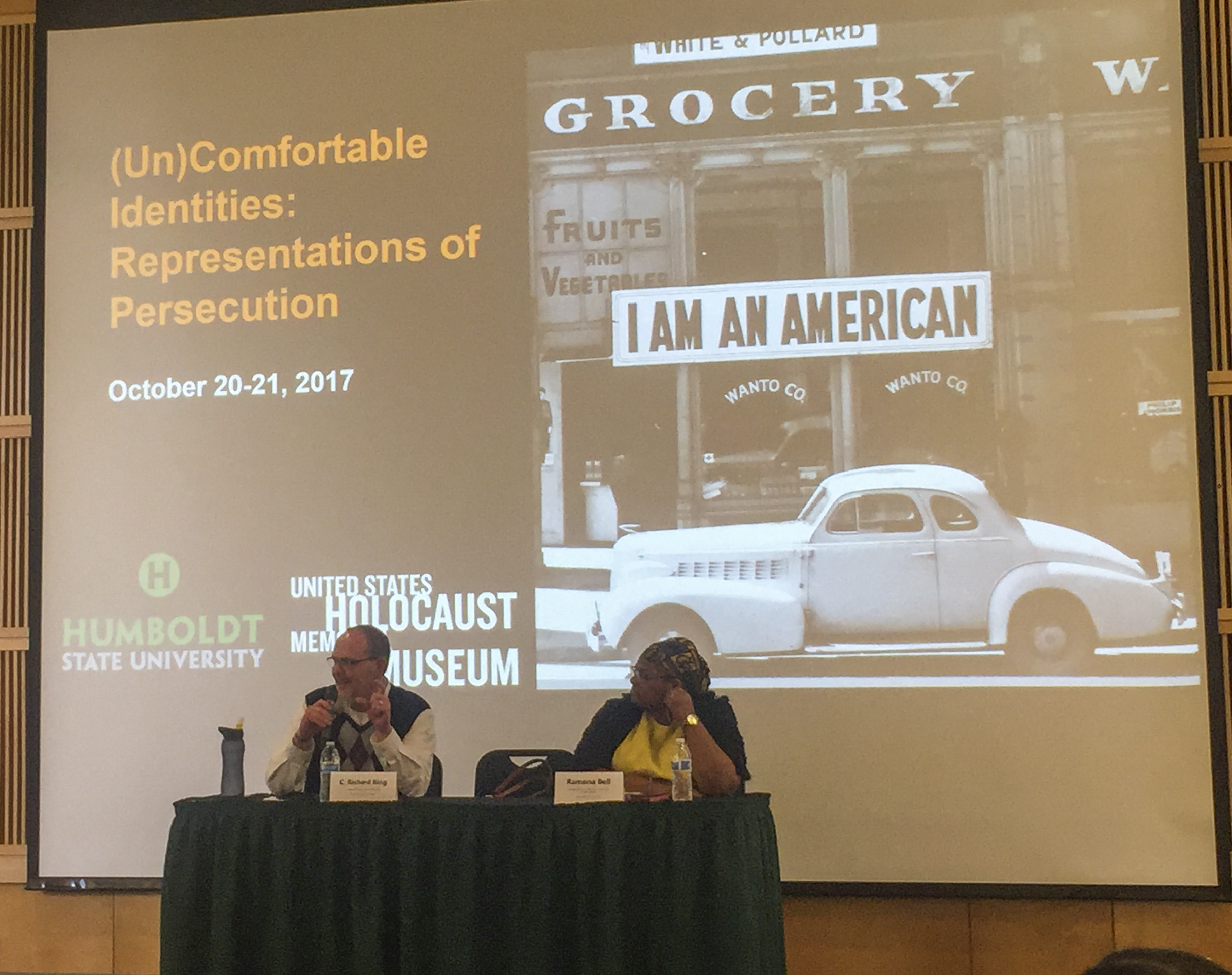
    An event is only defined by its memory or lack thereof. The two-day symposium (Un)Comfortable Identities: Representation of Persecution at Humboldt State University examined the effect of persecution on memory, identity and culture of ethnic groups. The convention held on Oct. 20 and 21 addressed topics of race, sexuality, religion, disability, and gender.

    HSU professors and scholars from across the nation presented research and studies in various disciplines pertaining to displacement, persecution, and memory.

    Organized by United States Holocaust Memorial Museum (USHMM,) the event is part of an ongoing outreach to bring Holocaust studies into North American education via symposia, lectures, and workshops.

    Since attending a faculty program hosted by USHMM, Humboldt State Critical Race and Gender Studies (CRGS) professor Maral Attallah and Native American Studies instructor Kerri J. Malloy have been working to bring this type of event to HSU.

    “We wanted this to be an opportunity to develop relationships for HSU student internships, for research, and for more faculty to participate in these seminars,” Malloy said.

    W. Jake Newsome of the USHMM says this event has been in the works for almost two years. “[Symposiums] are tailored to the local community, so they can be more impactful,” Newsome said. Speakers were selected per panel to complement each other both by USHMM and HSU.

    “We worked closely with [Attallah and Malloy] to bring on leading experts on race, identity, and activism,” Newsome said. “We brought in educators from across the country to talk about some of the challenges, strategies, and rewards of teaching topics students might find problematic.”

    Ramona Bell, CRGS associate professor at HSU spoke on the persecution of black athletes. “I wanted to show today that they are change agents,” Bell said. “They are resilient and not passive.”

    Bell says that getting these topics to be talked about starts with “a realization of your own code of ethics.” Whatever the issue might be, “do you care?” Bell said.

    The event was open to the public and brought together an audience of local community members, students, and faculty. “Even if this is happening at Humboldt, it’s benefiting a much larger audience,” Malloy said.


  • DVAM is now

    DVAM is now

    From O.J. Simpson to Ray Rice, domestic violence in the United States is an issue that has been perpetuated for too long. It is often swept under the rug due to its complexity.

    In honor of recognizing October as Domestic Violence Awareness Month (DVAM), it is worth taking the time to talk about this issue that still requires public awareness, education and involvement.

    Domestic violence is a broad term for a complex issue. The term refers to any form of physical, emotional, psychological, economic or sexual abuse that exists in a household. These include family, non-family and romantic relationships. The underlying issue and its scope expand far beyond the definition of the term.

    It is important to understand that domestic violence is a prevalent issue in many communities. Persons affected by domestic abuse can be of any age, gender, race, sexual orientation or socio-economic status. Forms of domestic violence can differ in individual relationships, but are often conceived as a vicious cycle that is hard to escape.

    Domestic violence victims are often perceived as weak or incapable of leaving the situation, but the solution is almost never easy. As allies, we must recognize the complexity of relationships and show compassion for those affected. Family and romantic relationships are complex on their own, especially when loved ones intentionally disrespect and abuse each other.

    Emotional or financial dependence can trap the victim in a toxic relationship with an even more dangerous outcome. 75 percent of domestic violence murders in the U.S. occur while victims attempt to leave the perpetrator. It is a scary situation, but certainly not hopeless. Support and resources are out there.

    infographic_violence
    Graphic by Lora Neshovska

    The Humboldt Domestic Violence Services is a non-profit organization that provides free and confidential support to victims. Their services include legal, medical and financial support. They also offer referrals to outside services, such as support groups.

    The North Coast Rape Crisis Team is another non-profit organization that offers a variety of education and community-based programs on prevention and self-defense.

    HSU’s Check It is an extension of the North Coast Rape Crisis that provides tailored services to students, staff and faculty on campus. The club holds workshops and events to raise awareness about dating violence and consent culture.

    Many perpetrators were witnesses or victims of domestic violence as children, which illustrates the importance of proper prevention education in both children and adults.

    Community Outreach coordinator at the North Coast Rape Crisis Team, Paula Arrowsmith-Jones, says DVAM serves to “bring [domestic violence] out of the shadows [and] raise awareness so the community can see it happens to everyone.”

    The 31 days of observance focuses on instilling strength and supporting survivors through advocacy. Domestic abuse prevention is a community effort that involves education and support. It also calls for building healthy relationships with our family, friends and peers.

    If you or someone you know needs help, free and confidential support is available to you.

    • 24/7 LOCAL HOTLINE: (707) 445- 2881 – North Coast Crisis Team
    • 24/7 LOCAL HOTLINE: (707) 443-6042 – Humboldt Domestic Violence Services


  • Rising Tides

    Rising Tides

    Transitioning into college as a freshman can be tough, especially if you are new to the surrounding area. Place-based learning communities at Humboldt State University strive to ease this transition by providing social and academic aid for incoming science students.

    A new place-based learning experience is expected to take off in the fall semester of 2018 and will be available to Marine Biology and Oceanography freshmen. The Rising Tides program will be overseen by HSU Botany professor, Frank Shaughnessy.

    Two communities already implemented on campus include Klamath Connection and Stars to Rocks.

    Shaughnessy has been involved with Klamath Connection since its beginning in 2015 and says it served as a model for the following place-based communities on campus.

    With only 14 percent of incoming HSU freshmen being local, many struggle to adapt and settle into the new environment away from home. Shaugnessy says through place-based learning, freshmen build connections before their semester even begins and learn to “survive and adapt.”

    As part of a place-based learning community, students can choose to live with other freshmen in the program who share similar interests as them. Students also collaborate on a year-long linked project.

    Shaughnessy says the main reasons for student success in Klamath Connection and Stars to Rocks has been the social peer support system these programs help set up.

    The new Rising Tides program will focus on exploration of marine life and science in the outer coast Trinidad and compare it to that of the inner coast of Humboldt Bay through field study. The program also includes explorations of Native American life in these areas.

    Currently, the program has close to 20 faculty and staff members on board and is working on developing close working relationships with the Wiyot and Yurok tribes of Humboldt County, as well as the Trinidad Rancheria.

    Approximately 50 students are expected to take part in Rising Tides in the fall of 2018. The program begins with a 5-day summer immersion before the semester and introduces freshmen to fellow students, professors and faculty on campus.

    Despite the programs being science-oriented, they are cross-disciplinary and implemented in students’ classes outside the science field.

    Two more project-based learning communities are planned to roll out within a couple years.


  • Freedom to read

    Freedom to read

    For the fourth consecutive year, the Humboldt Center for Constitutional Rights and the Humboldt University Library came together to celebrate freedom of speech with a read-out of banned books on Oct. 4.

    Community members and Humboldt State University students gathered to read their favorite “dangerous” books.

    From classic literature to children’s books, titles such as “The Grapes of Wrath,” “The Kite Runner” and “Where the Wild Things Are” have been banned or challenged by various schools and public libraries for reasons such as profanity, explicit or sexual content and controversial themes.

    The American Library Association gathers a yearly list of banned books and keeps record of any challenges against the inclusion of books in libraries or school curriculum.

    Senior at HSU, Erika Delos Reyes, 32, says many of these banned books were introduced to readers as children. Delos Reyes, a Communication major, read an excerpt of a favorite book of hers, “Flowers for Algernon” by Daniel Keyes at the read-out.

    HSU alumnus Donald Forrest read part of the 1959 short story “The Time of Her Time” by Norman Mailer. Forrest says at 12 years old, this was the first piece of “dirty” literature he ever found in a banned place – his dad’s sock drawer.

    “It’s an artifact of a time; of defiant misogyny,” Forrest said

    Tommy Woodruff, a 20-year old junior, attended the read-out because he was interested to see the different banned books. Woodruff said it was interesting that so many children’s books have been banned, such as “The Lorax” and “And Tango Makes Three,” a book about a family of two male penguins based on a true story.

    “It’s ridiculous, you can’t hide information from people,” Woodruff said.

    The exhibit on banned books is on display at the HSU library until Monday, Oct. 9.

    *Marcy Burstiner, faculty adviser of The Lumberjack is the Chair of Humboldt Center for Constitutional Rights.

  • Damian Marley

    Damian Marley

    Damian Marley, the youngest of the reggae legend Bob Marley’s children, performed at the Mateel Community Center in Redway, California on Oct. 4. Guest performers were Kingston, Jamaica natives, Kabaka Pyramid.

    Marley and Kabaka Pyramid filled the small, rural venue with sounds of classic reggae, dancehall and reggae fusion.

    In the past, Marley has experimented with various genres of music, such as his album with rapper Nas, “Distant Relatives.” In 2011, Marley was in a supergroup with British soul artists, Joss Stone, rock legend Mick Jagger and Indian composer and producer, A.R. Rahman.

    During the show, Marley performed and talked about songs advocating the medical use of marijuana. In Marley’s native country of Jamaica, marijuana is still illegal and he currently has an ongoing project, #CannabisHeals that features medical cannabis patients and sheds light on their experience with traditional and holistic methods of healing, such as marijuana.

    Damian Marley’s album “Stony Hill” is available in stores and online.

  • Word on the street: Free community college bill

    Word on the street: Free community college bill

    Question: What do you think of Assembly Bill 19? Could it ever be implemented at a four-year university?

    LN_College_TrentDiederich.JPG
    Trent Diederic, a senior majoring in Finance says AB 19 could get more people in college, but they would still struggle financially. Photo credit: Lora Neshovska

    “It could be counterproductive. The people who are already on the fence about college would have to keep paying after that first year. At a four-year university, it would be very expensive. Housing and food would still be difficult to find.” – Trent Diedrich, 22, Finance, Senior

    LN_College_SarahGrover.JPG
    Senior Sarah Grover says it is pointless to make only the first year free. Students would still have expenses in the following years. Photo credit: Lora Neshovska

    “If people can live closer to home and still have that ‘freshman experience,’ it could be good encouragement, but freshmen are the largest group to drop out. It makes no sense for just the first year to be free. After that, you still have to work to survive.” – Sarah Grover, 21, International Studies, Senior

    LN_College_ZacAlfers.JPG
    A Business major, Zac Alfers says community college is definitely the less expensive route, so AB 19 would get more people in school. Photo credit: Lora Neshovska

    “I wish I went to community college, it’s the less expensive route. Money puts people off about college. It would get more people in school. I can’t see it happening at four-year university though, they like their money too much.” – Zac Alfers, 23, Business, Senior

    LN_College_StephanieSouter
    Stephanie Souter, HSU senior says having more education equality would better the country as a whole. Photo credit: Lora Neshovska

    “Even if it was free, there is still a lot of hard work and dedication that goes into school. But then again, if more people were educated, that would bring up our entire country.” – Stephanie Souter, 21, Psychology, Junior

  • Word on the street: Trump’s response to Las Vegas shooting

    Word on the street: Trump’s response to Las Vegas shooting

    Thirty-two floors above the crowd, a shooter opened fire on thousands of people gathered for the Route 91 country festival in Las Vegas, Nevada on Sunday, Oct. 2 Paddock killed approximately 59 people and injured at least 520. Paddock was a Caucasian male and a retired accountant living in Mesquite, Nevada.

    President Donald Trump responded to the casualty on Monday morning. Instead of addressing the reoccurring issue and the nation’s problem with gun laws, Trump said “we are all looking for some light in the darkness. The answers do not come easy.”

    Additionally, Trump has been less than sympathetic towards the United States territory of Puerto Rico, which was severely impacted by Hurricane Maria. Since then, Trump has continuously denied any problems with Puerto Rico relief efforts, as many parts of the island still remain without running water, gasoline or basic necessities. Trump recently visited Puerto Rico on Tuesday.

    In the wake of a crisis, the President’s response is crucial. Whether President Trump responded accordingly is debatable, however. We asked Humboldt State University students what they thought of Trump’s response.

    Question: “What do you think of Trump’s reaction to the Las Vegas shooting on and his plan to visit Las Vegas on Wednesday?”

    “He has left Puerto Rico as they are and put them on the back burner. I don’t think visiting is what he needs to be focusing on, when he has taken as much money from the NRA as he has, that’s where he needs to be looking for a change.” – Macy Suchan, 21, Communication, Senior

    LN_Shooting_MacySuchan.JPG
    Macy Suchan, 23-year-old senior at HSU stands in front of the half-staff flag on Oct.2 2017. Photo credit: Lora Neshovska

    “I don’t like his demagogic use of Twitter instead of another media outlet. The shooter was portrayed as many other white perpetrators in the news, a ‘lone wolf.’” – Quinn Bornemann, 21, English, Senior

    LN_SHooting_Wren_Broekema.jpg
    Wren Broekeama, a 22-year-old graduate student majoring in Academic Research says Trump showed the ability to respond quickly but only in chosen instances. Photo credit: Lora Neshovska

    “This showed his ability to respond with swiftness, he just chooses not to respond to other disasters, which is not presidential at all.” – Wren Broekema, 22, Academic Research, Graduate Student

    “I think he’s so quick to respond because he wants to justify the action, the keep the “American” image. It’s like anyone who isn’t white is bad and whoever is white is justifiable.”- Romero Perez, 20, Environmental Resources Engineering, Sophomore

    “It bothers me that the media is not referring to this white male as a terrorist.” Kammi Loyd, 18, Psychology, Sophomore

    LN_Shooting_FranciscaCrutchfield.JPG
    Education graduate student, Francisca Crutchfield says Trump has lots of financial and corporate power in Las Vegas, a possible reason he was so quick to respond to the Oct. 2 fatality. Photo credit: Lora Neshovska

    “I can assume Trump has a lot of corporate and financial connections and power in Las Vegas. This is a pretty direct issue, unlike the hurricanes that involve a lot of problem-solving so it’s an issue that he can touch on without getting too involved with.” – Francisca Crutchfield, 27, Education, Graduate Student

  • Diversity and inclusion through STEM

    Diversity and inclusion through STEM

    Humboldt State University was one of 24 institutions nationwide to be selected for a $1 million STEM grant by the Howard Hughes Medical Institute.

    The grant is part of HHMI’s program, Inclusive Excellence, which is designed to cultivate inclusion and diversity within the STEM community.

    By funding STEM programs throughout the nation, HHMI Inclusive Excellence strives to enable science education capacity in four-year institutions to provide opportunities for all students to succeed in the field.

    At HSU, this means developing better ways to serve incoming STEM students.

    Matt Johnson, Ph.D. and Wildlife professor said this includes development of student involvement programs, as well as faculty training.

    Johnson, along with Biology professor Amy Sprowles founded an integrative, place-based learning community called “Klamath Connection.” The direct field experience is one of the two current STEM place-based learning communities.

    Through these diverse programs, STEM students are integrated into the field through hands-on learning in the local environment.

    “These feelings help students feel a sense of belonging and community.” Johnson said. “With an approximate 6 percent of HSU students coming from Humboldt County, it is important to introduce incoming students to their new geographical, environmental and cultural environment.”

    Additionally, the grant will allow university faculty to participate in workshops and training opportunities to learn and utilize how to create a culturally inclusive environment.

    David Asai, senior director for science education at HHMI, says it is important to acknowledge that good ideas can originate anywhere. Asai said that often, a person’s success in science been a reflection of where they come from, not where they want to go, causing growing disparities in science education.

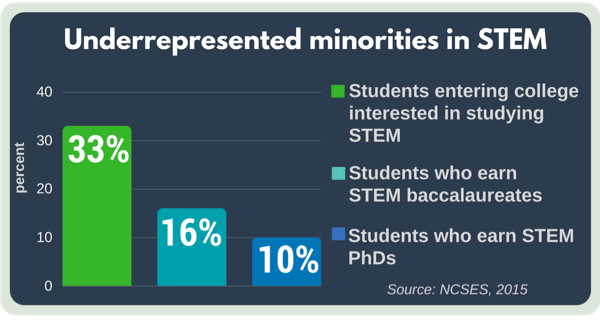
    Underrepresented incoming STEM scholars have significantly lower retention rates than their Caucasian or Asian counterparts.

    According to a 2015 report by the National Center for Science and Engineering Statistics, the percentage of students who receive STEM bachelor’s degrees is nearly half of the students who initially enrolled in science higher education.

    STEMgrantinfo.png


    Laura Carlos, a 22-year-old senior studying Zoology, said she did not feel prepared and included when she first started her science education at HSU. Carlos said that not all students are given the same opportunities in high school, which makes it difficult for students to have the same starting point in college.

    “Without proper resources and tools, underrepresented students can only dream of what it’s actually like to be a STEM student.” Carlos said.

  • Open house with open arms

    Open house with open arms

    On a seemingly quiet Friday afternoon on the Humboldt State University campus, the MultiCultural Center was booming with energy, as international music and the savory smell of lumpia filled the air. Dozens of HSU students gathered in front of the center on Sept. 12 for the MCC open house to represent and celebrate the various cultures our campus consists of.

    LN_OpenHouse(3).JPG
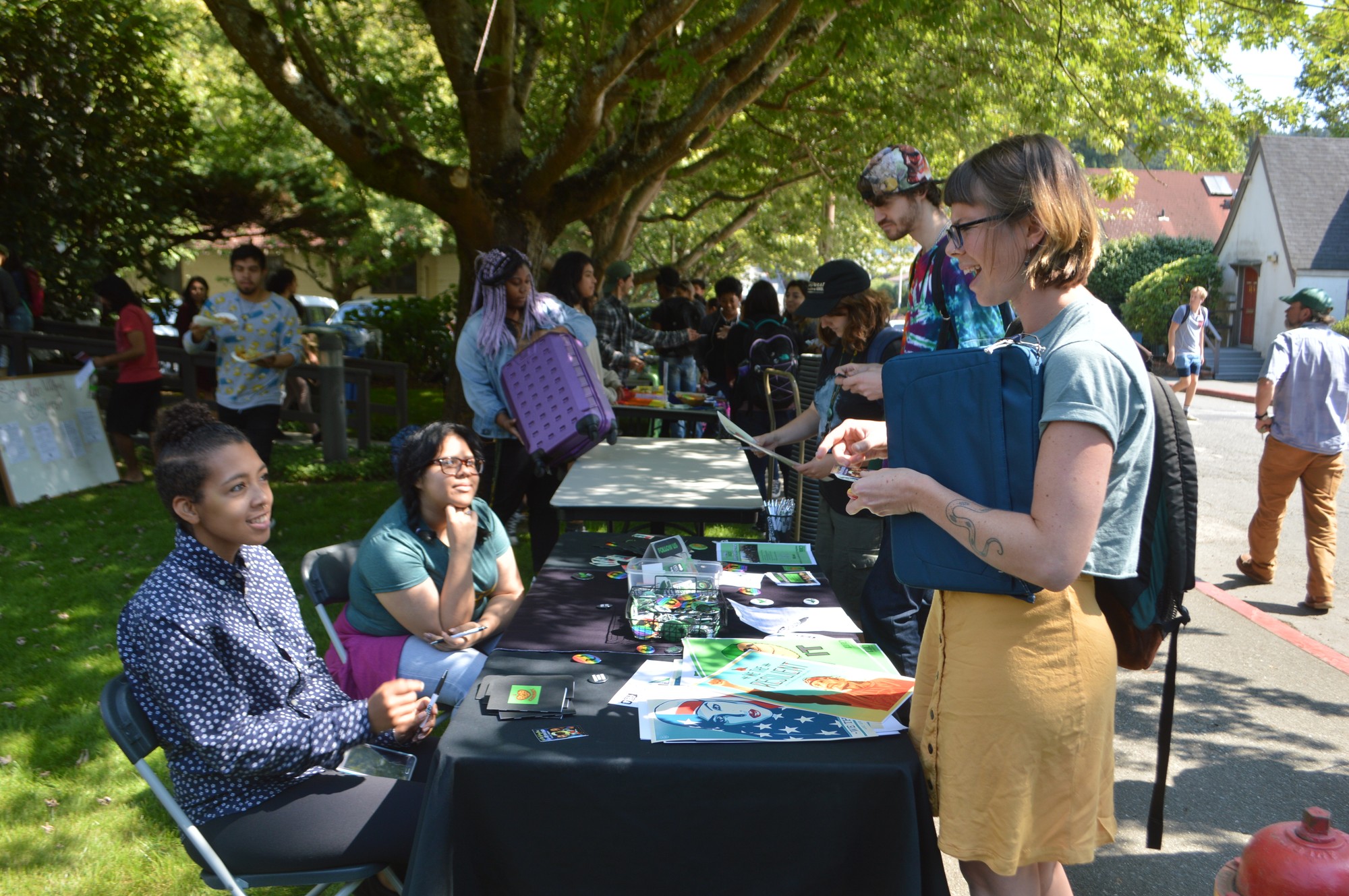
    The MCC featured a cultural exchange through cultural cuisine. Photo credit: Lora Neshovska

    The center open house aimed to familiarize students with the numerous cultural centers available on campus and create a comfortable environment for socializing and learning.

    Among the representatives were Scholars without Borders (SWB), Women’s Resource Center (WRC), the Latinx Center, and the Eric Rofes Multicultural Queer Resource Center (ERC). These centers, as well as much more serve as resources to anyone on campus, especially students who may feel marginalized.

    Although these centers and clubs seem to differ, they all share a passion for solidarity and intersectionality. Jonathon Salinas, 20, is majoring in Spanish and currently working as the event coordinator at ERC. Salinas says instead of viewing activism as separate social movements, it’s important to support each other, heal and move forward together.

    LN_OpenHouse(1).JPG
    Criminology and CRGS student Deema Hindwai (right) converses with EOP staff, Rama Rawal (left). Photo credit: Lora Neshovska

    According to a 2013 Humboldt retention report, an average of 25 percent of the first year, full-time undergraduate students were not retained.

    Cesar Abarca, faculty coordinator of SWB and an assistant professor in the Social Work department said this emphasizes the importance of student support centers, such as the MultiCultural Center and SWB.

    “In a small, rural area,” Abarca said. “It’s really important to make students feel welcome and accepted.”

    Abarca also said there needs to be support and advocacy specifically for underrepresented students

    As of late, SWB has shifted their focus towards assisting undocumented students, specifically with the application process for D.A.C.A. renewal. This includes providing information about the U.S. Immigration and Customs Enforcement (ICE) and basic guidelines and civil rights when dealing with law enforcement.

    Angie Muñoz, current editor of the Cultural Times said the MCC caters to what students need and can benefit from the most. This includes representing student voices and opinions in the Cultural Times, as well as opening up staff meetings to students with suggestions for the center.

    The MultiCultural Center on campus is located in the Balabanis House and is open Monday-Thursday from 10 a.m. to 8 p.m. and Fridays from 10 a.m. to 5 p.m.


  • TRiO Upward Bound program awarded a $1.3 million grant by the U.S. Department of Education

    TRiO Upward Bound program awarded a $1.3 million grant by the U.S. Department of Education

    TRiO is a federally funded outreach and student services program aimed to provide services for students with a disadvantaged background.

    Upward Bound is one of eight national programs within TRiO. The program is designed for first-generation college students who exhibit the potential and interest to strive in college. As members of this program, students benefit from resources such as financial aid assistance and academic counseling.

    Upward Bound has been serving the Humboldt and Trinity school districts since 1965. Within these counties, the program is affiliated with six local high schools: Hoopa Valley, Arcata, South Fork, Southern Trinity, Hayfork, and Trinity.

    Arcata High senior, Tatyanna Keeling said Upward Bound has been particularly helpful with financial aid counseling, as well as deadline reminders and reinforcement.

    This year, Upward Bound received a five-year $1.25 million extension grant. Each five-year renewal, new advancements are developed into the program to ensure quality improvement, as well as operational funding.

    With the funding, Upward Bound began their new summer “Bridge Year” program. This feature strives to provide participating high school seniors with an immersive college experience.

    Upward Bound Director at HSU, Jen Dyke said the summer is the best time to get students committed to following through with their college plans and there is no better way than to allow participants to become “real college students.”

    For the duration of the five-week summer program, students live in the Cypress Residence Hall and get a head start on college courses, all provided by TRiO.

    For the remainder of the school year, students have access to college and career counseling, as well as academic and financial tutoring. The program also organizes and engages students in local social and cultural events, as well as college campus touring.

    Shayna McCullough, a 21-year-old senior majoring in Social Work is an alum from Upward Bound. She said Upward Bound instilled pride in her. As a first-generation student, she has found a lot of emotional support and inspiration in fellow colleagues who also participate in Upward Bound.

    Upward Bound is just one of the three TRiO programs at HSU. Other federal-funded programs, including Talent Search and Student Support Services, which all aim to ease the transition of disadvantaged students from high school to college.

  • Celebrating a multicultural campus

    Celebrating a multicultural campus

    With the official beginning of the new school year, clubs and organizations on campus are off to a strong start, including the African American Center for Academic Excellence, also known as the AACAE.

    The Center hosted their first event of the semester on Sept. 2, 2017, a Welcome Black Reception, to incoming and returning Humboldt State University students. The event brought together students and faculty of all different ages, genders, and races together to kick off the new school year.

    The AACAE is a student support space on the campus of HSU that aims to celebrate our multicultural campus by providing a guiding resource for students who identify as African American, Black or of African descent, as well as the entire university community. The organization was established in 2015 and since then has been continuously contributing to the efforts of making the Humboldt campus more inclusive and safe.

    LNACAAE_Web-1.jpg
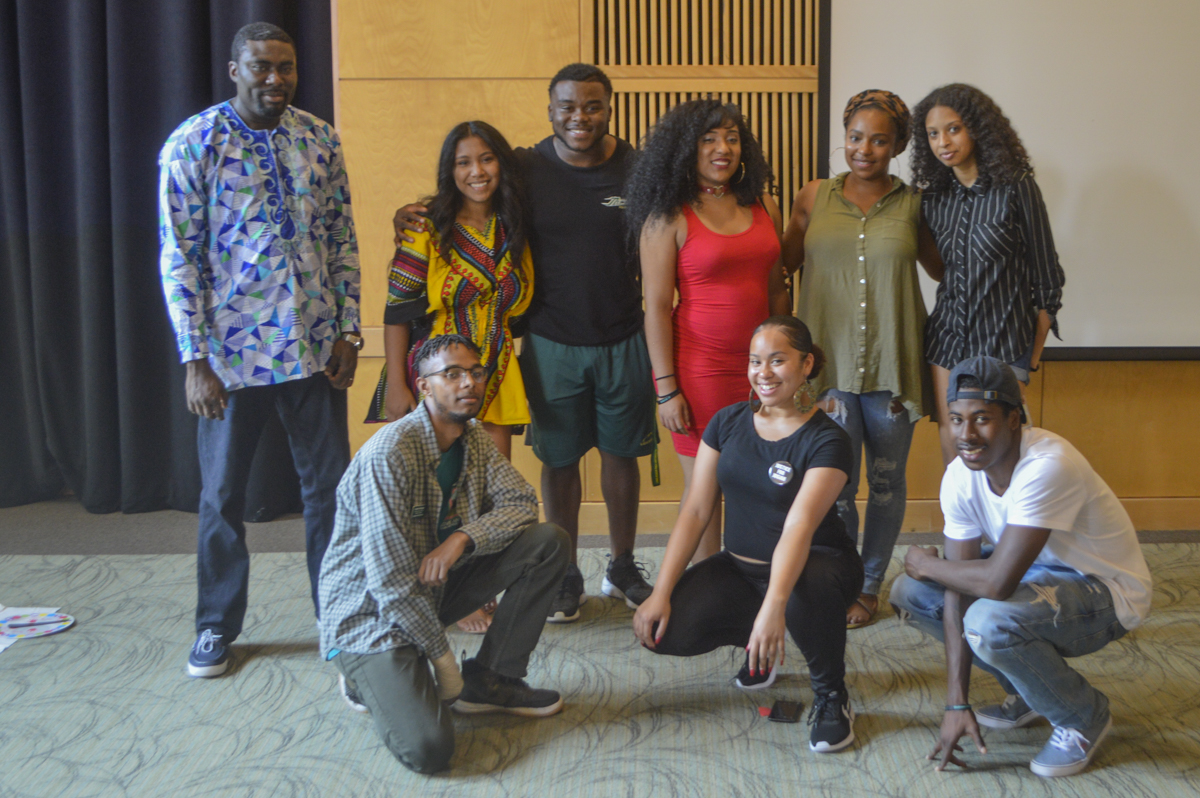
    Games, snacks and music bring together students at “Welcome Black Reception” in the KBR.

    Erin Youngblood-Smith, who is currently pursuing a master’s degree in Social Work and interning at the AACAE says, this semester, the Center’s goals are to continue helping, providing academic support and guidance for the student body of the HSU campus, as well as planning and collaborating with outside services, as well as other campus-based clubs on upcoming events.

    Additionally, the AACAE has a serious agenda this semester, following the murder of David Josiah Lawson in April.

    Jimento Aikhuele, a graduate student majoring in Environmental Engineering and intern at the AACAE said that the event is what brought him into the Center. “I knew the local [population] would be down and they might need support, one way or another.”

    Both Youngblood-Smith and Aikhuele agree there is a gap between the Humboldt University community and the Arcata community that must be bridged.

    “There cannot be a separation between the campus and the local community, there needs to be really structured communication,” Youngblood-Smith said, “stronger ties between the city and the university’ In order for all students to feel safe.”

    Youngblood-Smith advocates education, such as conversations and workshops on safety in communities other than your own.

    “That’s a priority, making sure our students know there are dangers everywhere and you need to be aware of them,” Youngblood-Smith said.

    One student that has benefited from AACAE’s resources and proactivity is 19-year-old senior Psychology major Gabrielle Fox.

    Fox says her transition to HSU would not have been as smooth if it wasn’t for the Center.

    “There are people there who genuinely, truly want to see you succeed, it really makes a difference when you know you have somebody, who has your back and genuinely wants to see you the best that you could be,” Fox said.

    According to Fox, to be willing to open your mind to different experiences and opinion is a significant step to inclusivity on campus and in the community.