The Lumberjack


Students Serving The Cal Poly Humboldt Campus and Community Since 1929

Author: Patrick Maravelias

  • Oh the times, they are a-changin’

    Oh the times, they are a-changin’

    Many a blue moon hath passed since the old days of HSU students coexisting with millionaire weed criminals and attending psychedelic-themed harvest parties in the forest on the full moon.

    The Arcata plaza, once a bustling mecca of culture and community, is now a shadowy remnant of its former self. Whether from COVID-19, cannabis legalization, changing of the tides or a hellish concoction of all three, the Humboldt County community has regressed from happy hippie haven to sullen farm town and in not much more time than it just took me to describe.

    I began attending Humboldt State University in the fall of 2015, about a year before marijuana was legalized for recreational use in California. When I arrived in town for the first time, it filled me with the warmest feeling of togetherness and glee, comparable only to falling head over heels in love.

    My first time attending the Arcata Farmers Market, I witnessed children laughing and playing in the sunshine, street performers and fire spinners entertaining the crowds with a huge smile on their face. There were vagabond travelers smoking six-inch-long joints right in the middle of the square. Live music and block parties could be found in every neighborhood on every weekend. Obama was president. Nobody had a care in the world.

    “If I’m ever describing Arcata I say it’s like a golden vein. A little golden vein of music right in the middle of California,” said Nick Flores in a 2015 interview. At the time, Flores was in a popular local band called the Smooth Weirdos with two HSU students. All three have since left the area.

    Fast-forward 2016 California legalized cannabis for recreational use. About two years later the price of a pound of weed plummeted overnight. Generally speaking, a large portion of Humboldt County’s population had their income cut in half. People got desperate. A lot of people got robbed or killed. That did not just apply to farmers either. Trimmers making $200 per pound one day made $100 per pound the next day, which made several of them hang up their scissors.

    Many trimmers and farm hands were from other countries, colloquially referred to as “trimmigrants,” and were deterred from ever returning once the jobs did not pay as well. Suddenly, there were no more foreigners coming into town on the weekends with five grand in cash in their pocket to blow at the local shops, bars and restaurants.

    All the people holding cardboard signs with crude drawings of scissors on them could no longer be seen lining Highway 299 near Willow Creek. Barkeeps and smoke shop owners could be seen for miles around scratching their heads, wondering when, if ever, their customers would return.

    At that point, it was starting to become pretty clear the economy was struggling. Even with legal marijuana companies popping up, the jobs were not nearly as available and the ones that were usually paid no more than a restaurant job. Processing cannabis is, unfortunately, not difficult enough to justify the exorbitant salaries people were getting during the heyday of cannabis illegality.

    Fast-forward to the onset of the COVID-19 pandemic and now the students were gone too. This is one of the few college towns rural enough that even one semester of remote learning sending students back to their family homes was enough to cause irrevocable damage in a community that is already half-impossible to access, lacking terribly in basic infrastructure and severely inundated with homeless students.

    HSU’s enrollment was in steep decline even before the pandemic, down almost 50% since 2016 according to data recently released by the school. I have to wonder if those numbers will ever reverse even with a polytechnic designation, which the school has predicted will double the student population in seven years. Even if the school’s prediction is correct, there is not enough housing for the students we already have.

    Maybe I was just a bit more of an idealist in 2015. Maybe I’m too old and too grouchy. Maybe Humboldt used to be a mecca for illegal activity and these are all just necessary growing pains on the way to a healthier community. Or maybe the magic is just kind of gone. It seems like people are not quite as happy as they used to be.

    I know COVID-19 made everybody anti-social, but I would challenge everybody to just be a little more kind. Let’s bring back a little bit of that classic, happy-go-lucky hippie vibe that Humboldt was built on. Otherwise, I cannot envision a future that does not end in the locals getting priced out of living here when the area becomes nothing more than a small-town tourist destination filled with vacation homes and cannabis-themed gift shops.
  • Lumberjack sports update

    Lumberjack sports update

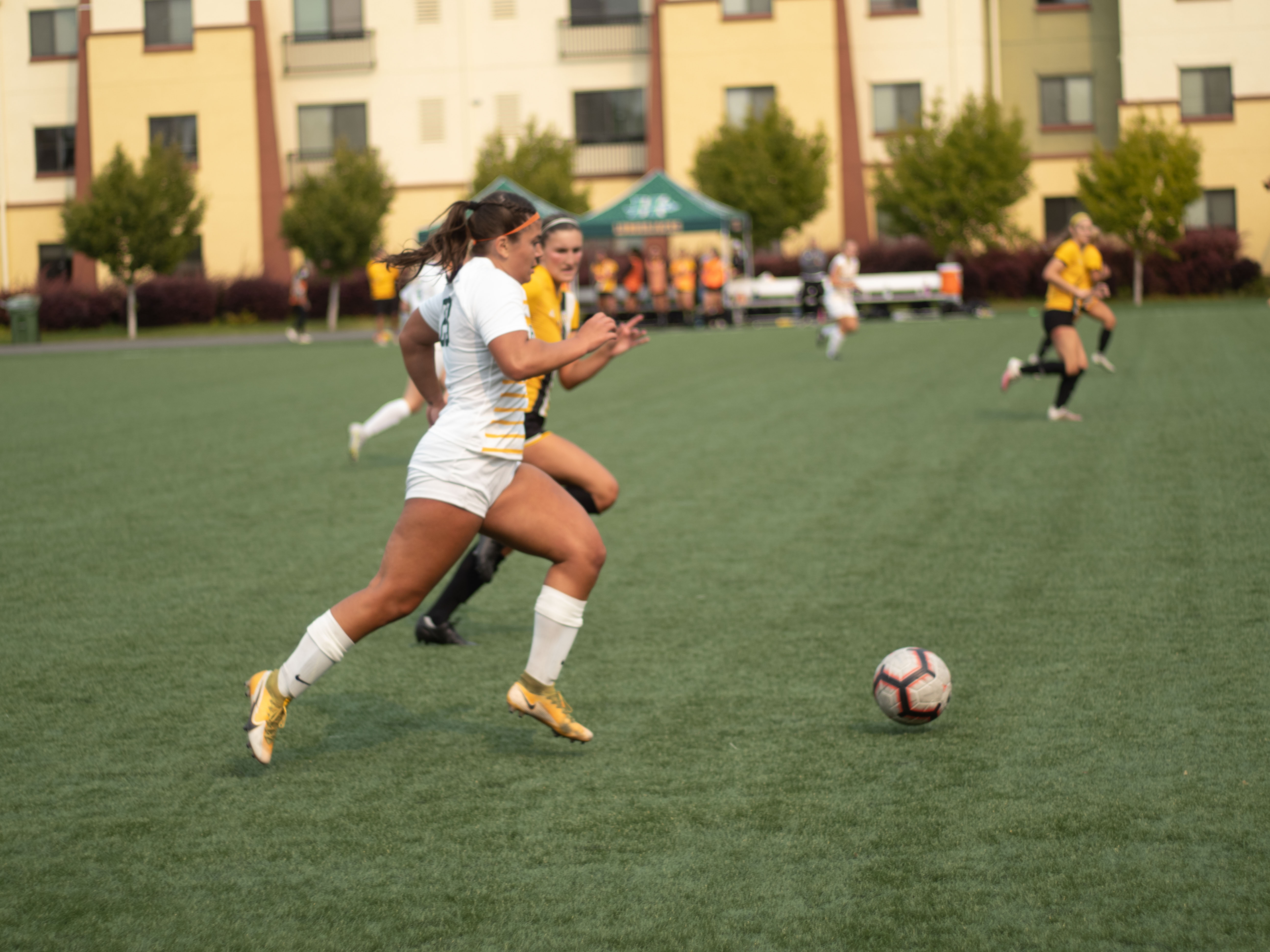
    Men and women’s soccer began their season last week with two home games for the women’s team and two away games for the men’s team.

    The women’s team tied their first match Friday 0-0 against Dominican University. The game went into double overtime but neither team took home a W. Sunday, however, the women’s team won against the University of Hawaii 2-1.

    Senior center back Claire Bareilles believed this weekend’s matches will help the women’s squad going forward.

    “I’m super proud of the performance today,” Bareilles said. “We definitely had a few slow starts in the season with our exhibition games, but we really turned around last game and we carried that momentum through this game.”

    Senior forward Kendall Spencer also said she feels the makeup of this year’s squad prepares them for more success later this season.

    “I feel like we have a really strong team,” Spencer said. “We have a lot of energy. We’re young, which is good, because they [the younger players] bring a lot of energy for us older players. I think it’s just a really good step forward for us.”

    The men’s team played two matches in Salt Lake City, Utah to kick off their season. The men’s team beat Westminster College for their season opener Thursday and took home another victory Friday against Northwest Nazarene University whom they beat 4-0.

    Men’s soccer will play two matches in Hayward, California this coming Friday and Sunday while the women’s team will be traveling to Monmouth, Oregon to play against Central Washington University on Friday and Western Oregon University Sunday.

  • HSU enrollment decline

    HSU enrollment decline

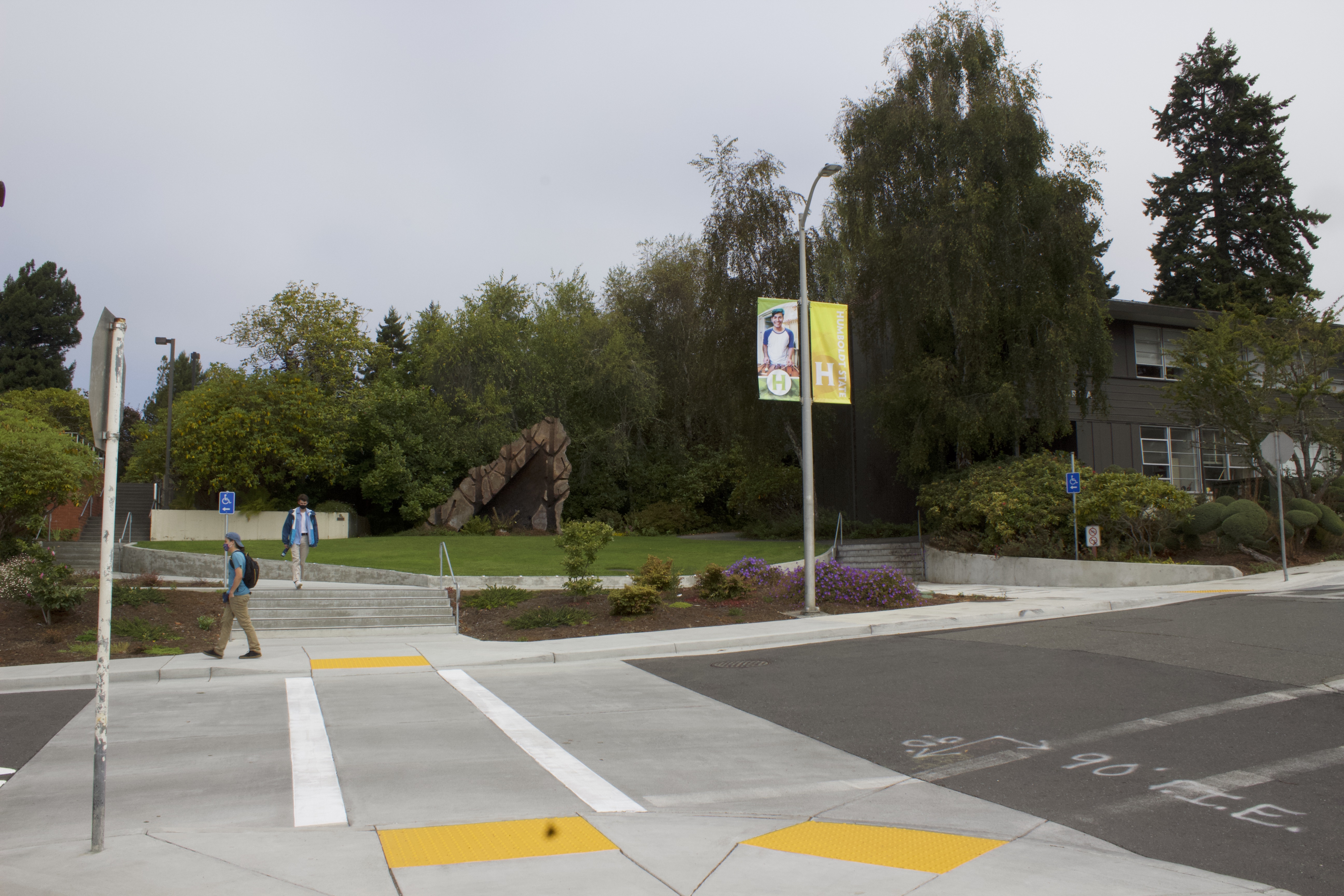
    Humboldt State University has opened its big green doors to the world once more and students are once again flowing through these bright and hallowed halls after an unprecedented hiatus during the onset of COVID-19.

    However, the number of students who ended up attending school has gone down significantly, not only just since COVID-19 hit, but as a general trend over the last five years, according to data released by the HSU Division of Enrollment Management.

    Applications have gone down by 38% since 2016, and more downward trending is predicted due to declining birth rates in California. The data also showed that 10,538 students applied to HSU for the Fall 2021 semester, 1,208 of which ended up registering for classes, compared to 14,226 and 1,642 respectively in Fall 2019.

    On a more positive note, average GPA seemed to go up at the very onset of COVID-19. According to data on the HSU website, the average freshman GPA rose from 2.75 in Fall 2019 to 2.95 in the Fall 2020. Sophomore GPA rose from 2.96 to 3.06, and a similar trend was seen henceforth for all over class levels from the fall 2019 to the fall of 2020, with the exception of the credential program which saw a drop from 3.96 to 3.90.

    These numbers were released just days apart from the submission of HSU’s official application for polytechnic status, which claimed outright that a polytechnic designation would drastically increase enrollment.

    “Humboldt State University would expect to see enrollment increase 50% within three years and 100% within seven years, immediately adding highly educated and trained graduates to the California workforce,” the document said.

    In an interview, representatives from the HSU Admissions team acknowledged the challenges that lay ahead but maintained a vigorous enthusiasm that these goals are more than attainable with some of the changes and improvements they have implemented.

    “We’re building housing that’s going to be connected to academic space and have learning communities and residential Learning and have more connection with advisors and the career center because that’s a key part of seeing students stay. And then the other part is a sense of belonging,” Dr. Meriwether said.

    The plan for polytechnic status includes funding for more student housing as well, an age-old issue for HSU. Dr. Meriwether said the plan would provide housing for roughly 2,200 students both on and off-campus.

    An expanded look at some of the work being done by the Admissions Team to both bring students to HSU and keep them there will be covered in a future issue of the Lumberjack.

  • Wild West in Humboldt County

    Wild West in Humboldt County

    Humboldt County is known worldwide as a safe haven for hippies, liberals and gun-toting conservative cowboys.

    Gun violence is on the rise around the country, especially in regards to mass shootings, as was just seen in Florida. Gun culture is being examined everywhere, questioned in many states and threatened all together.

    “It puts gun owners in a hard position,” Humboldt resident and registered gun owner Liam Doherty said. “We get lumped in with the demonization when we’re trying to be responsible and use these tools for useful purposes.”

    Mass shootings are on the rise, however. There have already been 30 mass shootings in 2018, according to the nonprofit Gun Violence Archive. Protests have erupted all around the United States in attempts to bring about gun law reform to make it harder or even impossible for American citizens to purchase firearms.

    Video by Patrick Maravelias.

    Alexis Pritchard, Humboldt State graduate with a bachelor’s degree in sociology, said if she had the power, she would take everyone’s guns away.

    “I believe that the root of the problem comes with the National Rifle Association and the lobbyists that are paying off these politicians to keep guns like AR-15’s that should only be used in the military,” Pritchard said.

    Arcata in particular has a reputation for being a progressive college town; pro-choice, pro-gun control and proactive in fighting for human rights. Outside of Arcata, however, is a jungle full of conservatives, cannabis and lots of firearms.

    “Arcata’s the only place you don’t see it,” Doherty said. “It’s the only town in Humboldt without guns in it.”

    HSU created a small, safer and more progressive circle than the rest of Humboldt. In addition, Arcata has a reputation for hippies, potheads and other stereotypes. But the truth is the majority of the country is very conservative. Fortuna, Ferndale, Rio Dell and Scotia all have more registered conservative voters than liberals, according to an article by the Times-Standard.

    “Arcata is a bubble, even compared to Mckinleyville,” Pritchard said. “I believe that the gun culture in Humboldt is very diverse in that we have one city specifically that has completely different ideals than the rest of the county as a whole.”

    The recreational cannabis industry is booming in California, and Humboldt is at the center of it. Currently, registered cannabis growers aren’t allowed to own firearms, which has created a mecca for illegal firearm trafficking in Humboldt as well.

    Cannabis is legal to grow and use in California within certain limitations. But on the federal level, cannabis remains illegal, forcing farmers to use cash-only for business transactions, because banks are in control. This has indirectly created a community of farmers who are forced to own unregistered firearms in order to protect their assets.

    The issue of illegal gun trafficking will be discussed further in the video on The Lumberjack website.

  • All journalists go to hell

    All journalists go to hell

    It’s 9 a.m. outside Gist Hall, the mecca for journalism activities at Humboldt State. All the students that typically fill the hallways are still in bed, unable to be bothered until at least 11 a.m.

    Meanwhile, the only ones awake are those who woke up to hit the bong once or twice before they stumble into their sweats and yawn their way to campus somehow.

    Yet, these are the elites. The ones who will go on to be some of the most brilliant voices in news, because, frankly, there are no brilliant voices in news anymore.

    The persona of the tortured artistic type has morphed into a really obnoxious pissing contest not only between news stations, but among individual journalists as well.

    In an era where news outlets and their worker bees are being discredited at every turn, we must face our fears and beat the elephant in the room to death… journalists are all terrible people.

    It takes a certifiably insane human being to want to write news. It’s an impossible job for a level-headed person, and to recommend such a thing to a young and prospering academic is nothing short of treason.

    The late Hunter S. Thompson, well-respected journalist and noted troublemaker, once said, “Sacrificing good men to journalism is like sending William Faulkner to work for Time magazine.”

    Thompson, William Burroughs, Ken Kesey, Tom Wolfe, Tomi Lahren and more are known far and wide for rampant drug use, domestic abuse, drunken and boorish behavior.

    All of these names belong to well-respected and famous journalists, who were all made famous not only by their work, but by the sleaze and trouble that came with it.

    “Journalists have just operated under a veil of superiority, because our role was to call out B.S. and find truth,” said Nick Garcia, Humboldt State graduate with a bachelor’s in journalism. “Now everybody wants to be a personality and has an agenda.”

    A newsroom in full swing is comparable only to the trading floor of the Wall Street Exchange.

    Fingers senselessly tap-dance across the keyboard, beads of sweat trickle off any given forehead, phones buzzing every few seconds. Everybody swears like sailors and the coffee machine heat combines with cigarette stench to create the feeling of a sweat shop in the belly of an antique whaling ship.

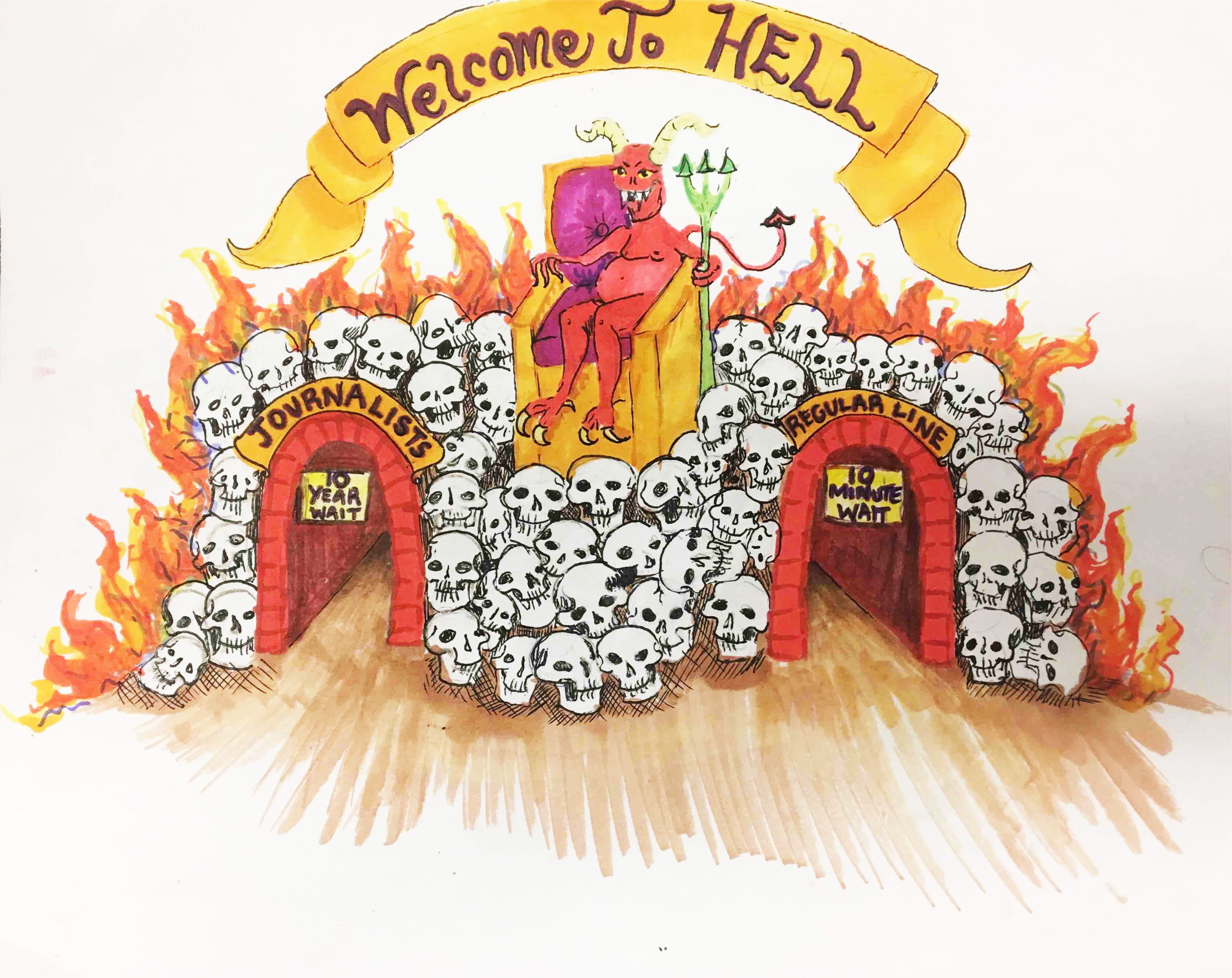
    If there’s a hell, journalists are going to be the first in line. They drink, they smoke, they weasel their way into stories and take photographs without asking.

    Every national tragedy to ever befall this country, journalists earned a salary by showing up to annoy the victims.

    Journalists could have ignored Donald Trump, but they wanted ratings and now there’s a tangerine with a neck running the White House.

    The hell of it all is that the only journalists worth their salt aren’t paid nearly enough to be doing what they do.

    Those who strive for objectivity even in the face of a world where small fish get hooked and transferred to a small pond with toxic runoff to slowly die while the big fish get botox and work for CNN.

    Hats off to those chosen few who toil and sweat for little to no reward.

    To be fair, it’s not like journalists would be good at their jobs if they weren’t capable of getting a little sleazy for the cause. It’s kind of a sleazy job. Writing in general is a bit greasy. It’s an inherently impossible job which might be why so many journalists find themselves at a news agency, addictive tendencies and an ego the size of a house.