The Lumberjack


Students Serving The Cal Poly Humboldt Campus and Community Since 1929

Author: Sophia Escudero

  • Prepare for bears

    Prepare for bears

    by Sophia Escudero

    Nestled in the redwood forest, the Sequoia Park Zoo is a Humboldt County staple. The zoo opened in 1907 and evolved with the times to become one of the smallest Association of Zoos and Aquariums (AZA) accredited zoos in the nation. The zoo’s next exhibit is set to open in November of this year, with the addition of American black bears and coyotes. The bears will be placed in the enclosure first, with coyote cohabitation expected to occur in early 2023 once the bears have gotten settled. 

    Zoo Activities Coordinator Kate Baldwin is excited about the opening, which will be the first major addition to the zoo since the construction of the Redwood Skywalk was completed in 2021. 

    “This is actually going to be a truly state of the art habitat,” Baldwin said. “We increased our footprint by a whole acre to accommodate the Redwood Skywalk and then the addition of bear and coyote, so the Sequoia Park Zoo went from five acres to six.”

    The exhibit will be thematically connected with the nearby river otter exhibit and raptor aviary as a display of local wildlife.

    “It was always the intent to expand our native animals and specifically our native predators,” Baldwin said.

    The exhibit is going to feature two major areas that can be divided or open, night houses for the bears and coyotes, a naturally filtered waterfall feature, and an observation platform around the perimeter. According to Zoo Director Jim Campbell-Spickler, a Humboldt graduate and former university researcher, the exhibit is designed to provide a naturalistic habitat for the animals as well as offering regular enrichment. 

    “I’ve never seen a bear exhibit habitat like this,” Campbell-Spickler said. “This is just one of a kind.”

    Campbell-Spickler, as a wildlife biologist, has done extensive work with animals and plant life in the local area. Despite the common public perception of zoos as 1980s-style barred cages and animals ripped from the wilderness, an AZA-accredited facility such as the Sequoia Park Zoo has much more in common with an animal sanctuary than that outdated image. 

    Photo by Sophia Escudero | Zoo director Jim Campbell-Spickler stands in the future bear and coyote exhibit, showing off the walkway in progress.

    “We don’t go to the wild and just take bears, we adopt bears that need a home, bears that are unreleasable, and we are working with the California Fish and Wildlife [Department],” Campbell-Spickler said.

    The bears and coyotes will be supplied by the state, and will most likely be orphaned animals, animals that have grown too accustomed to humans, or animals with injuries that would impede their ability to survive in the wild. Many other animals at Sequoia Park Zoo, including Winky the spotted owl, Sequoia and Huckleberry the raccoons, and Cheyenne and Juno the bald eagles, are also rescues that could not be safely released. 

    One unique local touch to the exhibit will be due to the zoo’s partnership with the Bear River Band of the Rohnerville Rancheria, a local tribe. The Band has been working closely with the zoo on the project since its inception.

    “It’s been an amazing collaboration. We’re currently working with them to construct a plank house, which is a traditional build for native folks of our area, and they are also the major funder,” Campbell-Spickler said. “It was their money, they have a very close tie to bear and coyote. They’re going to help us interpret that Native American relationship with these two animals that have been very important in their culture and it’s been a great partnership.” 

    Ironically, the plank house will be modified from the traditional design, which served the express purpose of keeping out bears. It will serve as a training and viewing area. 

    “Sequoia Park Zoo is a modern zoo,” Campbell-Spickler said. “We exhibit our animals on a mission of conservation and education. That’s a very important thing for us: an opportunity for us to share these wonderful creatures with the world.”
  • Humboldt’s frogs are thriving

    Humboldt’s frogs are thriving

    by Sophia Escudero

    Humboldt County, with its streams and rivers, undeveloped wild spaces, and above-average amount of rain, is an ideal habitat for amphibians.

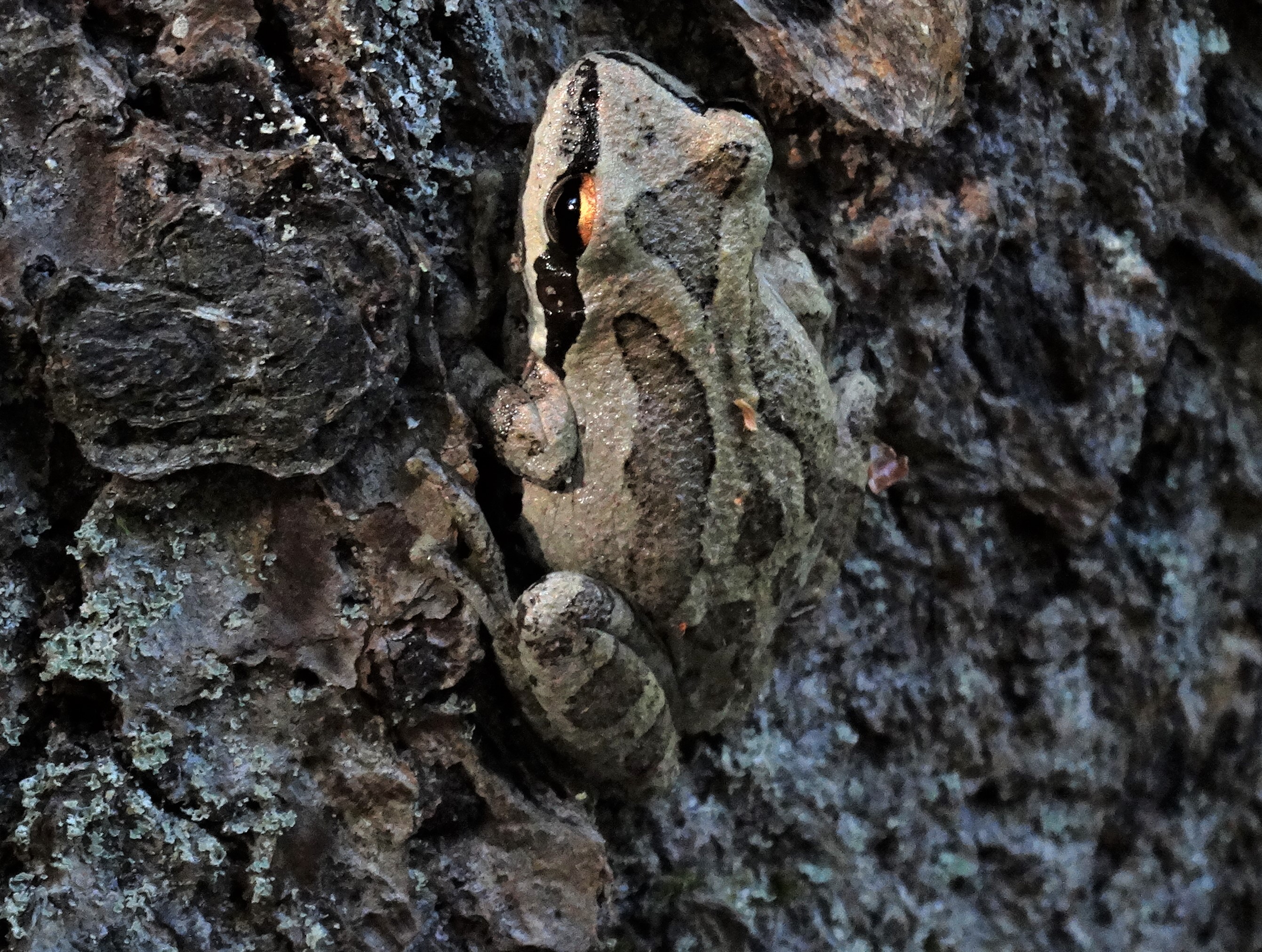
    The Pacific tree frog, also known as the Pacific chorus frog, is the most common local frog. Its habitat spans from Northern California to Alaska, and it makes its home in ponds, rivers, forests, grasslands, and even urban settings. The distinctive “ribbit, ribbit” song of the Pacific tree frog can be heard clearly in spring as the male of the species attempts to attract a mate. However, they can be harder to spot than to hear.

    “They seem to blend with their background,” said adjunct professor Brian Hudgens of the Cal Poly Humboldt wildlife department. “It’s not as fast as a chameleon, but they do. If you put a green one against a brown background for a couple days and then come back, it will turn brown.”

    Less audible is the California red-legged frog, which gives its call underwater and can be found in slow-moving water and ponds. The California red-legged frog has a celebrity history, having been named the California state amphibian and starring in a Mark Twain short story, “The Celebrated Jumping Frog of Calaveras County.” This frog is a threatened species due to habitat loss, despite efforts being made by the state of California and the federal government.

    Photo courtesy of Brian Hudgens. A foothill yellow-legged frog pokes its head out of Honeydew Creek.

    Another protected frog is the foothill yellow-legged frog, which is a species of concern. The yellow-legged frog lives in streams and, although they vary in coloration, can be identified by their rough skin and habit of jumping into moving water. Their historic range extends from Oregon to Baja California.

    “The foothill yellow-legged frogs are breeding now, and you might be able to see egg masses attached to rocks and cobble near the shallow edges of our local rivers,” Hudgens said. “I actually would appreciate hearing if any of your readers see an egg mass and want to pass along the location and any photos.”

    While both the California red-legged frog and the foothill yellow-legged frog are listed as threatened or endangered species in the state of California, the Humboldt populations are thriving.

    “Most of the places where it lives, or where its historic range covers, are the foothills on the edge of the Central Valley,” Hudgens said of the yellow-legged frog. “And those are areas that are under a lot of developmental pressure, a lot of agricultural pressure, and the rivers and streams around here don’t have the same kind of pressure.”

    To help out local frogs, the most important thing you can do is speak out against the development of their natural habitats. Humboldt is a haven for native frog species, and protecting their habitats protects them. When you are in a frog breeding ground, such as a river or pond, it’s important to keep an eye out for eggs and tadpoles underfoot. Washing shoes and swim equipment before and after going to the river can help stop the spread of disease to different populations.

    You can create a habitat for frogs in your own backyard. Providing any size pond or standing water can encourage frogs to lay eggs, especially if you live near an existing frog habitat. Hudgens recommends allowing the pond to dry out fully once a year in order to discourage invasive bullfrogs, which prey on native species and compete with them for resources. Bullfrogs take two years to fully mature, while native frogs reach adulthood in a matter of months.

    “If you’ve got a stream running through your backyard, maintaining a nice cobble area will really help out the yellow-legged frogs,” Hudgens said. “If you’re in an area with bullfrogs, trying to keep them out is probably the biggest thing we can do for all of our amphibians.”

  • COVID-19 cases make a comeback

    by Sophia Escudero and August Linton

    Positive COVID-19 cases are once again on the rise in Humboldt County. According to the Humboldt County Public Health Department, 137 confirmed cases were reported between April 19 and April 26, bringing the total number of confirmed cases in Humboldt County up to 17,311.

    A Humboldt Notification was sent out to the campus community in response.

    “The University encourages the campus community to continue wearing face masks,” the email reads. “We want to remind everyone that N95 masks are recommended and effective for reducing transmission for the wearer.”

    Tina deProspero is one of the COVID-19 testing staff currently working on campus. Despite the inherent risk of exposure that comes with her job, she says that she’s not that worried about being infected. She hasn’t tested positive since she started this job in August 2022

    “I make sure I’m wearing my N95, and if somebody looks like they’re going to sneeze I’ll put my goggles down,” said deProspero.

    According to deProspero, about half of the people come to the testing center are “weekly testers,” those who are mandated by the university to test weekly as a result of their vaccine exemption or other special circumstance. Visiting sports teams make up another large portion of the people they test. DeProspero says that she always sees an uptick in testing after breaks and after weekends.

    While mask restrictions have been lifted for campus, the CDC recommends wearing a mask indoors regardless of vaccination status if you are sick, have been in close contact with someone who is sick, live with someone who is at high risk, or are in a county with a high COVID-19 Community Level. The current level for Humboldt County is low.

    University testing services now require that students and staff being tested have insurance coverage. DeProspero said that in the case that a patient does not have insurance, the testing center gives them a rapid antigen test.

    “That really bugged me though, I was like, we better be able to test everybody,” said deProspero.

    Aside from wearing a mask, hand washing, avoiding crowds and poorly ventilated spaces, and socially distancing are still strongly recommended.In an interview with the Washington Post, National Institute of Allergy and Infectious Diseases Director Dr. Anthony Fauci said that although rates of death and hospitalization have been decreasing, the pandemic is still active.

    “Right now we’re at a low enough level that I believe that we’re transitioning into endemicity. We’re not in the full-blown explosive pandemic phase,” Fauci said. “That does not mean that the pandemic is over. A pandemic means widespread infection throughout the world.… In our country we’re transitioning into more of a controlled endemicity.”

    That outcome is what deProspero is also anticipating.”I’m just hoping that it’ll work its way through,” she said.

    Free N95 and surgical masks can be found at the College Creek Mailroom, the Jolly Giant Commons mailroom, the University Police Department, the Admissions Welcome Center, the Library, and the Gutswurrak Student Activities Center.

  • Cal Poly Humboldt Theatre presents the return of the 24 hour play festival

    by Sophia Escudero

    Putting on a play is traditionally no quick process. It takes months to take a script, design the set, costumes, and lights, cast actors, direct it, and have something polished enough to perform. The 24 hour play festival, however, turns that notion on its head. From 7 p.m. Friday night to the same time Saturday, a group of theater students wrote scripts and presented them as a series of short plays before an audience.

    The event was entirely student run and organized, and was produced by Cal Poly Humboldt students Austin Maisler and David Fisher.

    Maisler served as a producer, director, light designer, and stage manager. He had heard about the 24 hour play festival in his first year at Cal Poly Humboldt, but nothing came of it due to the COVID-19 pandemic. When campus reopened, the idea for the festival returned.

    “Spring came along and our department chair, Dr. Troy [Lescher] brought it up, like, ‘hey, does anybody want to run this?’” Maisler said. “I didn’t want to run it, I wanted to act in it, but nobody came forward so I talked to David. David and I decided to step forward and run this thing.”

    The process of organizing the festival was, by its nature, chaotic. Scripts were written overnight, and given to directors at 7 a.m. the next morning. The actors were cast less than twelve hours before they had to be off-book and ready to present the scene, and rehearsals were intermittently interrupted by costume fittings and discussions of the script. Lighting was finalized shortly before the house opened, and many people found themselves taking on roles that they had not previously had experience in.

    “This is the first show I’ve ever designed lights for,” Maisler said. “I’m actually in the lighting class this semester, so I just stepped forward, like, I kind of know how to do this, so I’ll just do it.”

    The four scenes, each about ten minutes long, took on themes of college-aged ennui, failing romance, finding meaning in absurdity, and impending doom. Of the four playwrights, two also participated as actors, and one as a director.

    Actor and writer Ben Wimer had not been involved in a 24 hour play festival before in either capacity. He found writing for a 24 hour play festival to pose a unique challenge. As the script is to be presented less than a day after its completion, certain factors had to be considered.

    “I wanted to write something that was simple, but had an authenticity to it, and had dialogue that was easy for the actors to memorize⁠— hopefully, it was easy to memorize⁠— but still gave them a lot to play around with,” Wimer said.

    Mollie Donaldson had participated in a previous 24 hour play festival at Cal Poly Humboldt in early 2020 as an actor, a role she repeated two years later. She considers the festival to be intense, but rewarding.

    “It’s definitely stressful,” Donaldson said. “You’re handed a script at 8 a.m. and told at 7 p.m. that you’re supposed to perform it and block it and have everything memorized. It’s a stressful thing, but one of my favorite things is kind of shocking myself with how quickly I can memorize things.”

  • Our Flag Means Death gives the gays everything we wanted

    Our Flag Means Death gives the gays everything we wanted

    by Sophia Escudero

    In episode five of Our Flag Means Death, the two leads share a moment under the moonlight. Stede gently folds a piece of fabric that Ed’s mother had given him and tucks it neatly into a pocket of his waistcoat.

    “You wear fine things well,” he says, tenderly, and Ed looks up at him with nothing short of adoration in his eyes. He leans in, then stops himself, and as the two part ways they look back at each other, both clearly wanting more but unable to bring themselves to voice it.

    That’s pretty gay, I thought to myself, but I didn’t dare hope that this scene was intended as anything beyond bromance.

    I grew up on Tumblr as a queer kid at the height of Superwholock, reblogging edits of Emma and Regina from Once Upon a Time looking longingly at each other and watching conspiracy videos about how, if you really read between the lines, the BBC are totally going to make Johnlock canon in the next season of Sherlock. I believed that the new Star Wars trilogy would give us gay Jedi, and the MCU would give us gay superheroes. Eventually, this hope faded. Each new season of Sherlock was worse, each “first gay Disney character” was less relevant to the plot than the last, and every video I saw from a con featured actors and writers mocking fans in the audience for daring to ask if there would be queer characters.

    I grew to accept that any show that was not explicitly marketed as being about coming out or facing homophobia would ever have a central queer romance. Any scraps I got would be something confirmed on Twitter or by an actor in an AMA and the void would have to be filled by fanfiction.

    When I saw that Taika Waititi was producing a comedy about pirates, I was all in. I was pleasantly surprised when a side character was revealed to be nonbinary and used they/them pronouns. Frankly, my bar for LGBT representation in media is subterranean. If a single character is canonically queer, doesn’t die and is not treated as a joke by the narrative, I will embrace the work wholeheartedly. I don’t ask for much, but I still rarely get more than a “wait and see.”

    Every episode was tailor-made to convince me that this was a love story, but I refused to be tricked so easily. When these characters were found in suggestive scenarios, I accepted it as a joke, and when they shared moments of tenderness and emotional vulnerability, I accepted that they were just really good friends. Even when the cast and crew said, verbatim, “this is a love story,” I was certain they meant it in the nebulous way that a buddy comedy is a love story, and that if I read into it I was a stupid, greedy little homosexual trying to make pop culture gay. Hell, I made it to the ninth episode, where they kiss each other on the lips and make a plan to run away together, still half-convinced that this was some kind of friendship kiss found only in advanced queerbaiting.

    It shouldn’t be shocking to me that queer people exist in television and movies. As a queer person, I should know that we do. Yet, years of media telling me otherwise had convinced me that maybe I was wrong. It has been over a month since the season finale aired, and I haven’t recovered from the sheer impossibility of seeing a romance between two men as central to the plot in a show about something other than queer pain.

    These characters are in love. They kiss, they hold hands, they exist outside of subtext and punchlines. Some jaded part of me thinks that a second season must end in death and suffering, but the inner 14-year-old that was hopeful enough to suffer through four seasons of Sherlock dares to believe that maybe, just maybe, gay people can be happy outside of fanfiction.

  • Local manhunt for homicide suspect ends with arrest

    by Sophia Escudero

    After one week at large, the suspect in a Kneeland homicide was taken into custody on April 10. Austin Michael Medeiros, 27, of Rhode Island, had been the subject of a search involving the Humboldt County Sheriff’s Office, California Highway Patrol, Arcata Police, and University Police following the suspicious death of a Kneeland woman, 28-year-old Emily Rose May Lobba, on April 3. Medeiros was apprehended in Santa Cruz attempting to steal a boat and was transferred to the Santa Cruz Police Department. SCPD officers found a stolen loaded gun and psychedelic mushrooms in Medeiros’ possession during a search.

    Official mugshot of Austin Michael Medeiros take April 10.

    On April 3, a caretaker arrived at Lobba’s residence and was denied entrance by Medeiros, leading to an argument. According to the caretaker, Medeiros and Lobba knew each other and had been spending time together the time prior to the incident. Medeiros assaulted the caretaker and fled the scene in Lobba’s vehicle, and the caretaker found Lobba deceased inside the home and contacted the authorities. A car chase between Medeiros and law enforcement ensued, ultimately resulting in Medeiros fleeing on foot into the Arcata Community Forest.

    Poppy Cartledge, a journalism student, witnessed the chase, driving to a sporting event with her partner when she heard police sirens and pulled over.

    “This van came right at us and swerved into our lane, and at first I thought it was a civilian driving, like, ‘ah, I gotta get out of the way real fast,’ but I realized they weren’t gonna stop, and then they ran the stop sign, and at that point I realized, this was a chase,” Cartledge said. “At that time, I thought it was just something with drugs, but it was crazy to find out it was a murder.”

    This case is particularly close to the campus community after an alert to the student body informing them of a search in the Arcata Community Forest, followed by an update just two hours later saying that the search had ceased. Still, the suspect had not been found.

    According to interim chief of University Police Peter Cress, the Sheriff’s Office had handled the majority of the search.

    “We had one unit on duty that day, one officer, and when the pursuit finished up on Fickle Hill Road and it was reported that the subject had fled into the woods, our officer on duty, Sergeant Carpenter, went up to Redwood Park and asked folks to stay out of the park,” Cress said. “Obviously, if the suspect had run through the park, he would have detained him or gone after him, but he was mostly there just to keep people out of the park at that time.”

    The search was conducted from about 11 a.m. to 3 p.m and involved multiple ground crews, ATVs, and K-9 units. Officials called off the search when the suspect could not be found. According to Sheriff’s Office public information specialist Samantha Karges, it is believed that the suspect had fled the area soon after escaping the chase.

    “It’s my impression that he got out pretty quickly,” Karges said. “A lot of the time people won’t hang around where they escaped. They know it’s a hot area, people are going to be looking for them, and they want to get out of town.”

    It’s believed that Medeiros escaped to Santa Cruz by hitchhiking. No related violent incidents or injuries were reported during Medeiros’ time as a fugitive. Still, Karges urges members of the campus community always to be careful.

    “You could be a victim of a crime at any time,” Karges said. “It’s really important that we are aware of our surroundings, who we’re hanging out with, where we’re going, what we’re doing, those sorts of things. I know in university, we meet a lot of people, we make risky decisions when we’re young, so really think through who you’re getting in a car with, whose house or room you’re going to. Be cautious of new people, and get to know them before you invite them where you live or get into a car with them. Just use an abundance of caution.”

    Medeiros is currently being held in the Santa Cruz County Jail on charges of grand theft, carrying a loaded stolen firearm, and possession of a controlled substance. He ispending extradition to Humboldt County on charges of murder, evading an officer, assault and battery, and possession of a controlled substance. The bail is at $1 million.

  • Cal Poly Humboldt music department performs a once-in-a-decade recital

    Cal Poly Humboldt music department performs a once-in-a-decade recital

    by Sophia Escudero

    One o’clock on a Tuesday afternoon is not the usual time for a music recital. However, this particular performance was more than just a display of student skill. Accreditors from the National Association of Schools of Music were in attendance, after two days on campus visiting classes, listening to students perform, and ensuring the university meets standards for music programs. According to music department chair Cindy Moyer, this process is one that happens only once every ten years.

    “For this particular recital, what they wanted to see was the full spectrum of the program, which is why you can see there were all different music concentrations and students performing,” Moyer said.

    A highlight of the afternoon’s performances was staff accompanist John Chernoff’s rendition of a moody piano piece by composition major Theo Singer. The audience watched in captivated silence as Chernoff played through to the last, lingering note with an intensely focused expression, leaving the music hanging in the air for a moment, before breaking the spell as he turned to the audience with a wide smile and a quick bow, freeing the listeners to rapturous applause. Singer is a senior, but the performers comprised the full range of experience.

    “This was hard because we needed a real breadth of things, we had to find freshmen and sophomores,” Moyer said. “We do an honors recital every year and that’s pretty easy, students audition and the very best play— but that was not the goal here. The goal was not the most advanced, most skilled performers entirely, it was the whole spectrum of performers.”

    Marimba player Makani Bright was singled out by Moyer as a particularly talented senior performer. Bright has been playing for about 12 years, and has an upcoming senior solo recital on April 10. They are a double major in percussion performance and applied mathematics, finding beauty in both.

    “The way that I relate both of my majors in my mind is that I think of them artistically,” Bright said. “I think of mathematics as an art form, it’s perfect and there’s many beautiful things you can do within mathematics. Both of them, to me, are an art.”

    Bright’s piece, “Chain” by composer Kazunori Miyake, was not one they had previously performed before an audience. The instrumental composition had almost narrative elements, combining multiple different feelings and rhythms into a complex and beautiful melody.

    “I feel really good about it,” Bright said. “I feel like I was able to express what I wanted to express and I really enjoyed myself.”

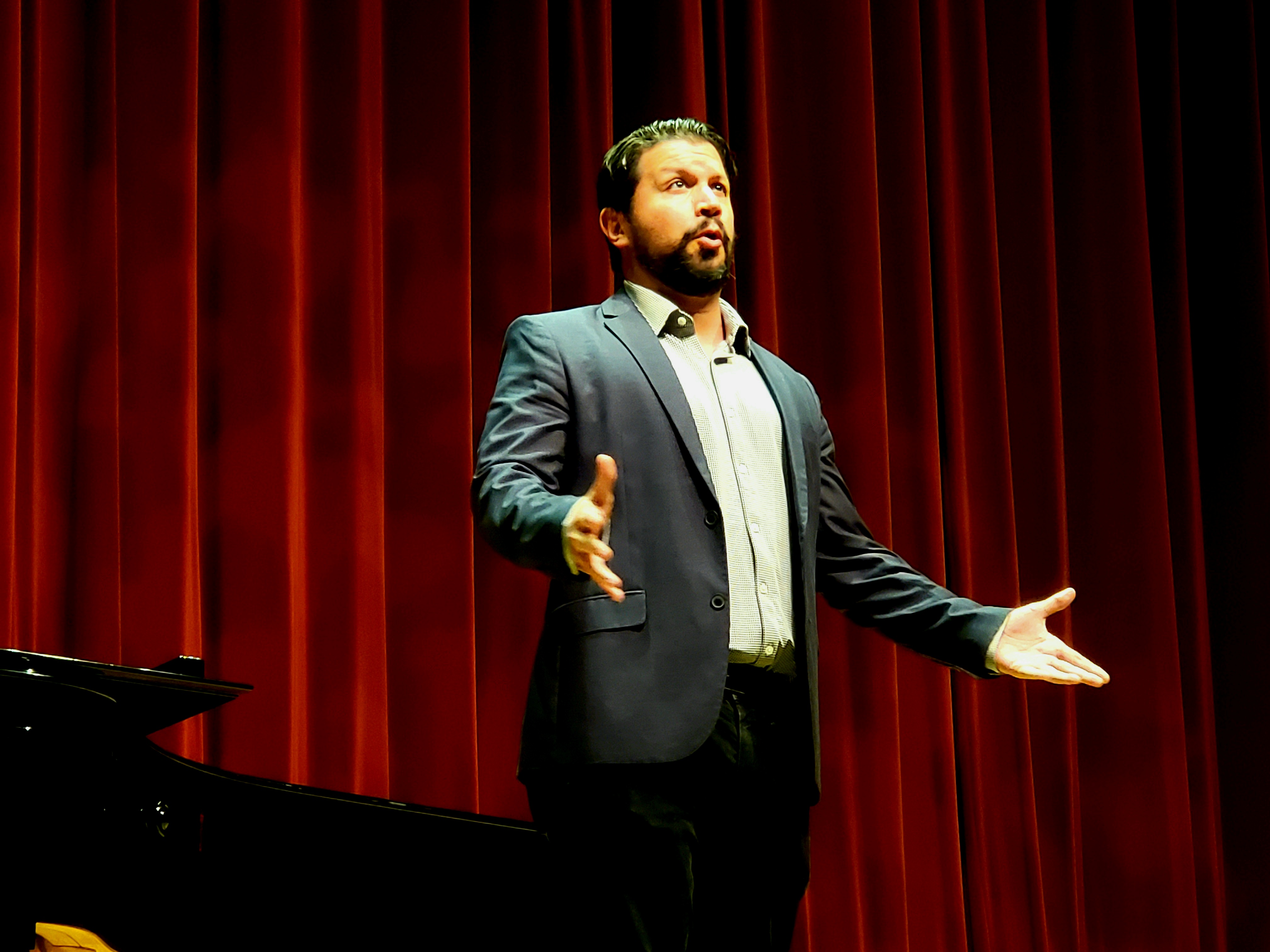
    The majority of the music on display was instrumental, with pianists, percussionists, and a saxophone quartet as standouts, but music education major Pablo Murcia was selected to represent the vocal arts.

    “I’m very honored, honestly,” Murcia said. “I was the only singer chosen, and that’s quite an honor. I’m very flattered, and happy that some people came out to support me. That was nice.”

    Murcia’s piece was an aria from Mozart’s Don Giovanni, “Deh, vieni alla finestra.” He performed in Italian, but his smooth baritone voice, expressive performing style, and connection with the music (which has been part of his repertoire since last semester) carried the story of the song to the audience.

    “Don Giovanni, he’s a Don Juan, he’s a player, and he’s trying to get the attention of a woman at her window,” Murcia said. “The whole piece is just him saying, come to me, come to me, trying different tactics to get her attention, and she just keeps sort of playing coy, and finally, by the end of the piece, she finally gives into his charms.” He laughs. “Quote, unquote charms— he’s kind of a narcissistic jerk, but yeah.”

    Music department ASA Samantha Heppe was excited to be involved in such an important production for the university.

    “I’m just excited for our music students to showcase their talents,” Heppe said. “This recital is in honor of the accreditation team, so this type of recital won’t happen again for another ten years.”

  • Men need to stop talking to me

    Men need to stop talking to me

    by Sophia Escudero

    Today, I was sitting at the bus stop with a significantly more male friend of mine when a man I had never seen before approached us and asked when the next northbound bus was coming. My friend didn’t know, but I pulled up the bus schedule on my phone and informed the stranger that he had another three minutes to wait.

    “Thank you,” the man said with a smile. “You know, I thought you were a huge bitch at first, but you’re actually really nice.”

    I am not a woman, but by accident of my birth, I am often perceived as such. I have experienced the casual misogyny and willingness of strange men to just say things that probably didn’t need to be said since at least the age of ten, when a man first leaned out of a car window and shouted the specifics of what he would like to do to me, and while he’s at it, to the small dog I was walking, in my general direction.

    I speak with experience when I say that men on the street will really say the most bizarre things and go about their day, while the person they shouted at just has to live with the garbage that they spewed without a second thought.

    What really gets me about this man specifically was his sincerity. He truly believed that he was paying me a compliment, and likely went about the rest of his day believing he’d had a pleasant talk at the bus stop.

    It is important to note that I had never seen this man before in my life. What was it that convinced him so thoroughly that I, a stranger at the bus stop minding my own business, was indeed a massive bitch? Was it my short, butchy hairstyle? My Captain Marvel t-shirt? The fact that my friend and I had just been discussing sexism in women’s sports when he got here? If so, why was I the only bitch? Shouldn’t the person agreeing with me be a bitch as well, if that was the case? While I know that when a man is a bitch he is weak and when a woman is a bitch she is a rabid animal, wouldn’t he be a bitch (masculine, derogatory) for cowing to my radical feminist notion that women should not be forced to expose more skin than they are comfortable with, even though he had brought that point up in the first place? Although, the man only told me, not him, that I was really nice and not a huge bitch. Perhaps he meant to suggest through omission that my friend was the huge bitch here?

    I wish I had said, “Oh no, I actually am a massive bitch. You were right the first time.”

    I am a feminist and a lesbian, and if this man’s general vibe was an accurate reflection of who he is, then I imagine both of those words are threats to him. Yet, if I had declared myself a bitch, would he have realized that maybe calling a stranger a bitch for no clear reason is a super weird thing to do? Or would he have laughed at my attempt to assert myself, before going home and complaining online that biologically, women can’t be funny?

    I refer to myself using all kinds of things people have hurled at me —dyke, bitch, man-hater and the like— and have reached the point where I embrace them. I’m a bitchy man-hating dyke on purpose, and I’m proud of it.

    I can certainly reclaim this for myself, but would this man on the street even register that I was subverting the patriarchy by refusing his words their intent? Would he care? Is this even about me?

    Unfortunately, I was too stunned by the fact that a person would just walk up to a stranger, congratulate them on not being as bitchy as anticipated, and think they did something to express all this in the three minutes before his bus got here. I could only say, “…okay?” in a voice I hope adequately expressed how much he was embarrassing himself, and resumed talking with my friend where we had left the conversation.To all the men who are thinking of saying something to a stranger in public, I say only this— don’t. In fact, don’t say anything to anyone, no matter where you are. Just don’t talk. To anyone. Please shut up forever, thank you.

  • New A24 film shows off the beauty of Humboldt County

    New A24 film shows off the beauty of Humboldt County

    by Sophia Escudero

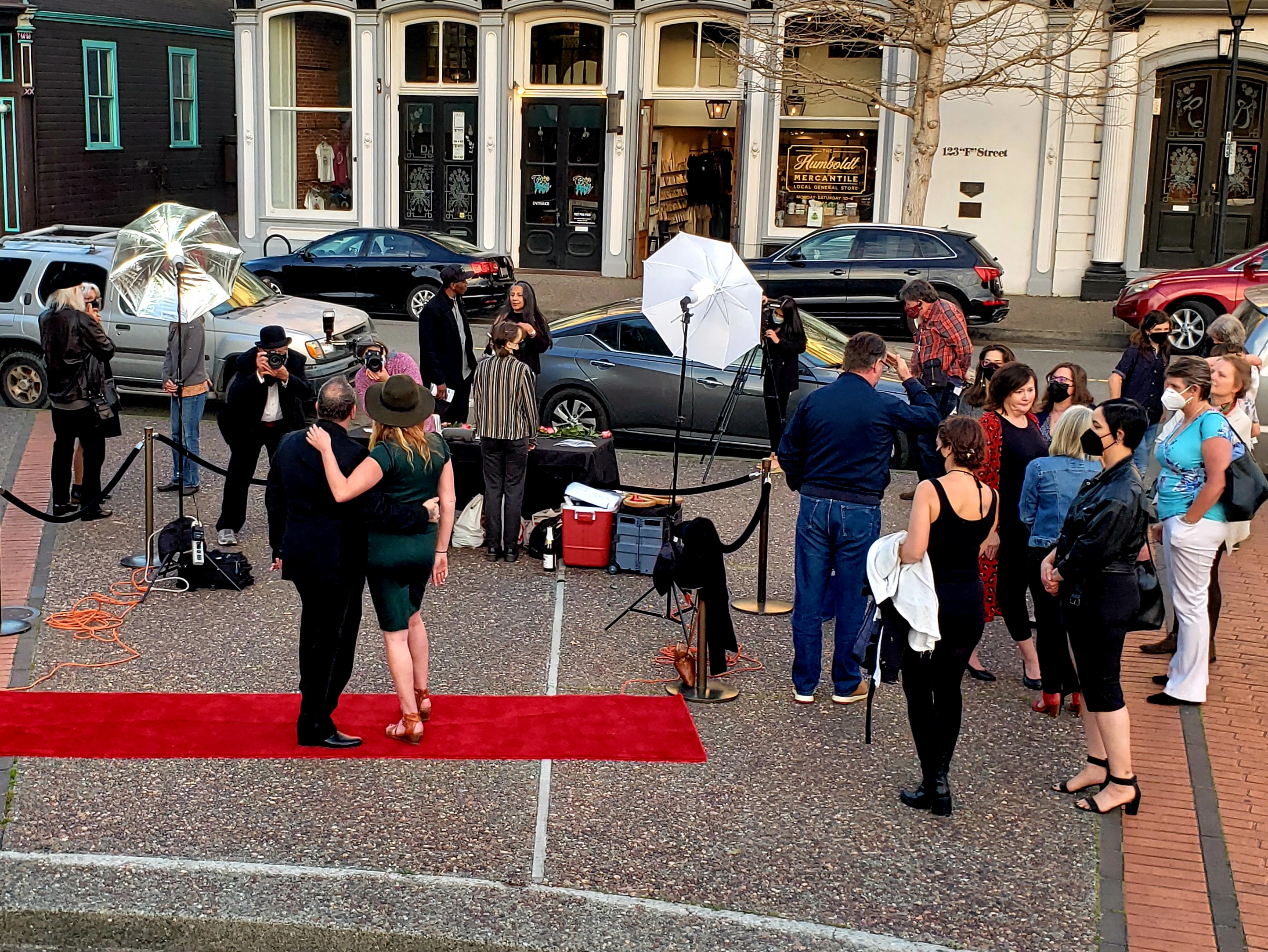
    On Friday, Feb. 11, the A24 movie “The Sky is Everywhere” premiered on Apple TV+, accompanied by a red carpet event in Old Town Eureka. Filming took place locally on such locations as Moonstone Beach, Arcata High School, College of the Redwoods, and Sequoia Park, and over 500 locals were involved in the production, myself included.

    The film itself explores the grief of Lennie Walker, a high school girl grappling with the sudden loss of her idolized older sister. Lennie, portrayed by actress Grace Kaufman, finds herself caught between a grief-forged connection with Toby, her late sister’s boyfriend (Pico Alexander), and Joe, an intriguing new music student fresh from a Parisian conservatory (Jacques Colimon), but more than that, she finds herself torn between mourning and moving on.

    Director Josephine Decker depicts this world through a lens of magical realism. Lennie’s inner turmoil causes a storm around her only she can see, and the act of playing music literally leaves her walking on air. While these slightly surrealist aspects could serve to take one out of a film, here it serves to highlight Lennie’s turbulent emotions and sense of unreality. The visuals help set “The Sky is Everywhere” apart from many other YA dramas, while characterizing it with a certain twee sensibility and aesthetic.

    The film’s minor characters round out the ensemble with heart and soul. Tyler Lofton’s nice guy Marcus, Ji-Young Yoo’s supportive bestie Sarah, and Jason Segal’s stoner uncle Big are all highlights, but Cherry Jones as Lennie’s grandmother Fiona is the standout star of the ensemble. Jones grounds the piece with her kind yet authoritative presence, quietly stealing the show without detracting from her costars. Though the film focuses on Lennie, it, unfortunately, does so at the cost of the people around her. We never get more than one or two shallow notes on many of the people populating this world, despite the actors turning in genuine performances with what they were given.

    Still, nothing is quite like seeing my own hometown (and in one scene about four minutes in, my own face) filmed so beautifully and professionally on the silver screen. Humboldt is on full display here, with every scene reminding the local viewer of a place they know well. A jubilant dance scene appears before the Old Town Gazebo, a heartfelt apology takes place in the streets of Ferndale, and the Arcata Presbyterian Church hosts the funeral that sets so much into motion. The emotion of seeing one’s home in this way was one shared by Deputy Director of the Humboldt Film Commission Nate Adams, who I interviewed at the red carpet.

    Photo by Sophia Escudero | Eureka Mayor Susan Seaman cuts the red ribbon commemorating the Old Town gazebo as a site of filming Feb. 11.

    “It’s overwhelming, trying to focus on the movie and seeing the locations, and the people, and the art, and even my friend’s stickers made it into the movie,” Adams said. “It’s just overwhelming to see so much of Humboldt.”

    Film Commissioner and HSU alum Cassandra Hesseltine teared up as I asked her about her experience helping create this production.

    “I cried at the end of the movie yesterday when I watched it,” Hesseltine said. “Part of why I cried is because I love working in film. I wanted to work in film since I was five. Besides the content of the movie, and it is a beautiful movie, the reason why I cried was just to think about how all this happened in my community, that I helped it happen, and it was really, really special.”

    “The Sky is Everywhere” is available for streaming at Apple TV+.

  • HSU Theatre returns

    After two years of no live performances due to COVID-19, the HSU Theatre Arts Department is returning with the musical comedy Something Rotten!, which opened on Broadway in 2015 with music by Karey and Wayne Kirkpatrick and a book by Karey Kirkpatrick and John O’Farrell. According to an email announcement:

    “Set in 1595, this hilarious show tells the story of Nick and Nigel Bottom, two brothers who are desperate to write a hit play but are stuck in the shadow of that Renaissance rock star known as “The Bard.” When a local soothsayer foretells that the future of theatre involves singing, dancing and acting at the same time, Nick and Nigel set out to write the world’s very first MUSICAL!”

    There are roles available for approximately 20 performers. Aspiring actors do not have to be in the theatre program, but must be at least 18 years old and have proof of vaccination or a negative COVID-19 test.

    “Those auditioning should prepare a monologue (maximum two minutes) and a song excerpt in English (maximum one minute) and come prepared to learn a short dance routine. Bring sheet music for the pianist (or pre-recorded accompaniment and portable speaker, etc.),” the email read.

    Auditions will take place in the Gist Hall Theatre on Sunday, Dec. 5 from 6 to 8pm and on Monday, Dec. 6 from 4 to 7pm. Callbacks will take place at 8pm on Dec. 6. Schedule an audition time by contacting stage manager Ian Aguilera at daa63@humboldt.edu.

  • Savage Henry hosts 10th annual comedy festival

    Savage Henry hosts 10th annual comedy festival

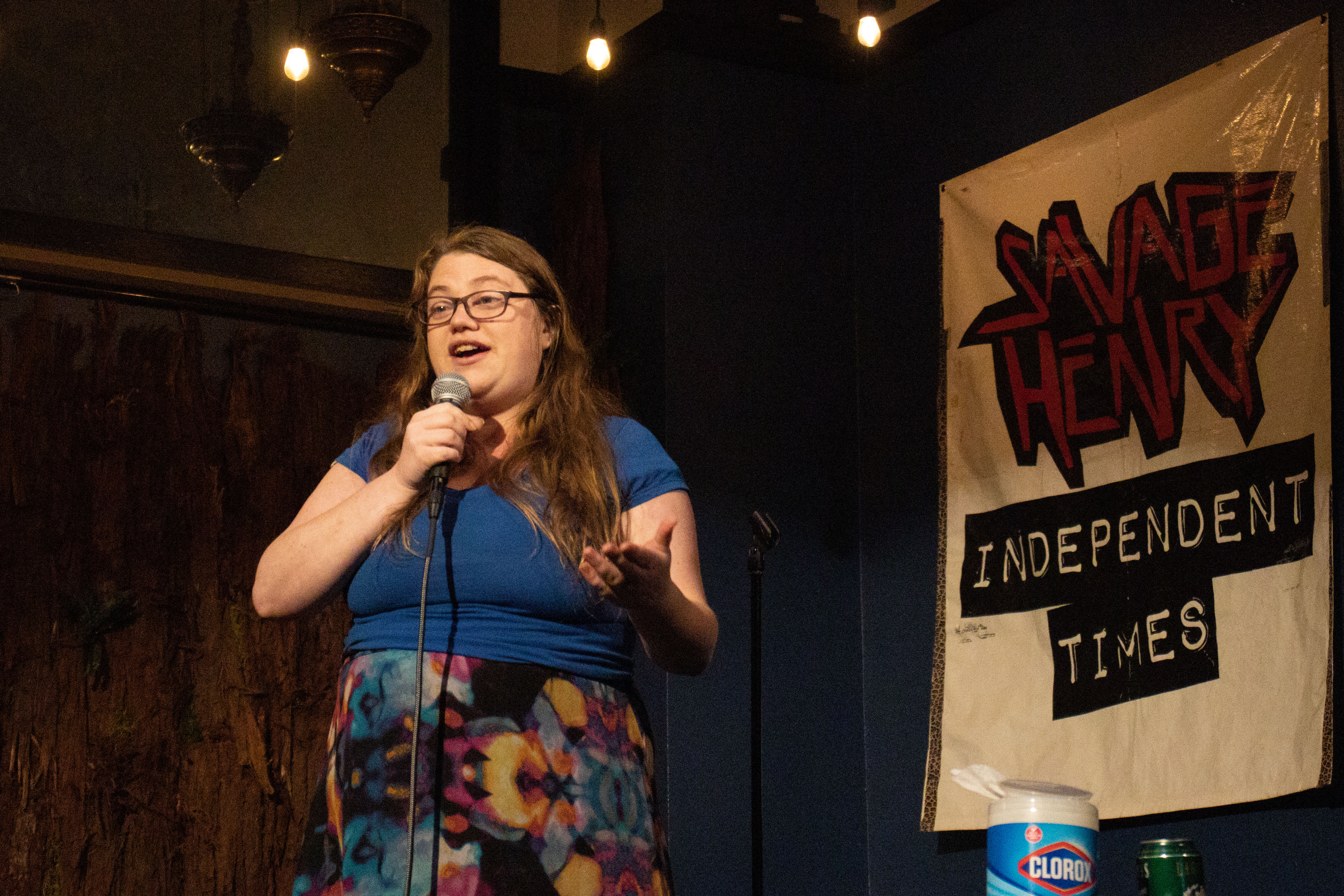
    This past weekend marked the tenth annual Savage Henry Comedy Festival, drawing in over 100 comedians from in and out of the area for a three-day festival with almost 40 shows in ten different venues.

    The Savage Henry comedy club opened its doors for the first show of the festival on Thursday, October 7. The entire venue was filled with a pink spotlight-tinted haze, courtesy of several fog machines provided by the event’s sponsor, Terplandia. The fog itself was infused with Blue Dream terpenes.

    The comedy club was not packed, owing to COVID-19 regulations, but having a physical show at multiple venues was a huge step up from last year, which was held mostly over Zoom. The pandemic definitely took its toll on the comedy scene, but for Chris Durant, owner and founder of the club, the support from the community was indispensable.

    “It really gave us a reason to keep this place open,” Durant said. “Every time we felt like giving up, we’d get some support from the community and be like alright, let’s see what we can do.”

    Unlike many comedy festivals, Savage Henry doesn’t have a submission process, but instead books its talent on an invitation basis.

    “It’s fun, I call it my fantasy football,” Durant said. “These are all friends of mine. I’m meeting some of them for the first time in person, but they’re all friends of mine. Friends of friends of friends kind of thing.”

    The shows themselves were a show of many diverse styles of stand-up, with various comedians taking turns hosting. LA-based comedian and HSU graduate Alec Cole lent his dry, understated style to the second show of the evening, introducing each comedian with a (hopefully) joking list of their crimes against humanity.

    “I know it’s been pretty hard out here, as would be imagined given everything in the past year, but it feels like everyone who’s come out so far is just out for a good time,” Cole said.

    Cole got his start performing comedy locally, and was glad to be back. He had moved to LA to pursue comedy, only to have his plans set back by the global pandemic, a case of COVID-19, and a bout of mercury poisoning.

    “After I had COVID, I tried to take better care of myself so I went pescatarian, but I didn’t do any research, and I just ate too much of the wrong fish,” Cole said. “So yeah, last year was a doozy, but now I’m back out doing stand-up.”

    San Francisco-based comedian Rachel Pinson has been performing comedy for four years, gathering much of her material from her own life.

    “It’s almost like the job of the comedian to take stuff, especially traumatic things or really harsh things, and make them in a way that’s palatable and funny,” Pinson said. “A lot of my comedy is about being a woman and the stuff we face every day, like harassment, and turning around. It’s like growing up and being made fun of, and just being able to make fun of myself before the other people do.”

    Pinson has definitely experienced something of the “boy’s club” mentality in comedy.

    “There’s definitely times when I’ll hear stuff when I get off like, ‘that was a great set, and I’m talking about her jokes, hahaha!’” Pinson said.

    However, she has found that the sexism of the business can be worked to her advantage, being able to be brought on as a “diversity hire.”

    “People are like, ‘we need a female!’ and I’m like ‘you haven’t even seen my set,’” Pinson said.

    HSU graduate and headlining comedian David Eubanks got his start at The Jam in Arcata after seeing an open mic flyer.

    “From the first time I did it, I was just hooked,” Eubanks said.

    Eubanks encouraged any student considering trying stand-up to come to a local open mic night and try something out. The local comedy scene is always looking for more talent, and the festival has been welcoming to newer comics.

    “Humboldt State University, hire me for a private gig,” Eubanks added.

  • Stop speculating on John Mulaney’s personal life

    Comedian John Mulaney has certainly been having a rough year. This past December, he was admitted to rehab after a relapse in alcoholism and cocaine use, and upon his release he announced his separation from his wife of six years, lampshade artist Annamarie Tendler. Within a week of the news going public, rumors began to circulate that Mulaney was already in a relationship with actress Olivia Munn. In his first interview of 2021, Mulaney confirmed on The Late Show with Seth Meyers that he is in a relationship with Munn and that the couple is expecting a child.

    This was definitely surprising information for me to read. I’m a long-time fan of Mulaney, and some of my favorite material were the bits he did about his relationship with his wife. However, the fact remains that I do not know this man. I have never met him, and I likely never will. Although I have watched his comedy specials almost to the point of memorization, John Mulaney is not my friend and never will be. I know nothing about his life and experiences. He may have a confessional, personal style of comedy, but that does not make me anything beyond a stranger, or him anything other than a face on my screen. I only know what he tells an audience.

    Many fans of Mulaney, myself included, were anxiously hanging on for news during his stint in rehab. It’s natural enough to want to know someone is doing okay, but the more personal news coming out about him became, the stranger the fixation got, and the more concerned I was about myself and my own interest. Reading articles speculating on the nature of his relationships honestly began to feel gross, like I was looking at something that I wasn’t supposed to see. The news of Mulaney’s divorce had some on social media going so far as to compare it to the separation of their own parents. When the news came of him dating Munn so soon after the split, people quickly accused him of moving on too fast and her of being a homewrecker. From the way people talked about her, you would think Munn had seduced their actual dad.

    The term “parasocial relationship” is thrown around a lot online and it is largely misunderstood. Essentially, the term refers to a psychological phenomenon where people form imaginary friendships with media personalities. People see a person on television or social media often enough, and come to see them as a friend despite the lack of real connection. Our monkey brains are not evolved to recognize a difference between a Netflix comedian and a fellow hunter-gatherer tribesman. We have to put in mental effort to acknowledge that celebrities are just strangers we know a disproportionate amount of information about.

    Please note that an interest in celebrity gossip or having a favorite celebrity is not inherently bad or parasocial. If you’re a fan of someone, that’s great! There is nothing wrong with enjoying content. Following your favorite singer or actor on social media is completely normal. However, the most important thing to keep in mind is that whatever connection you feel with your icon, this is not mutual.

    Of course he’s going through something. Of course this man is having some sort of rough patch. That much is obvious. The polite thing to do here is to simply stop feeding into the obsession with a random man’s life. You don’t know John Mulaney. His personal life is not your business.

  • The loss of a frog

    The loss of a frog

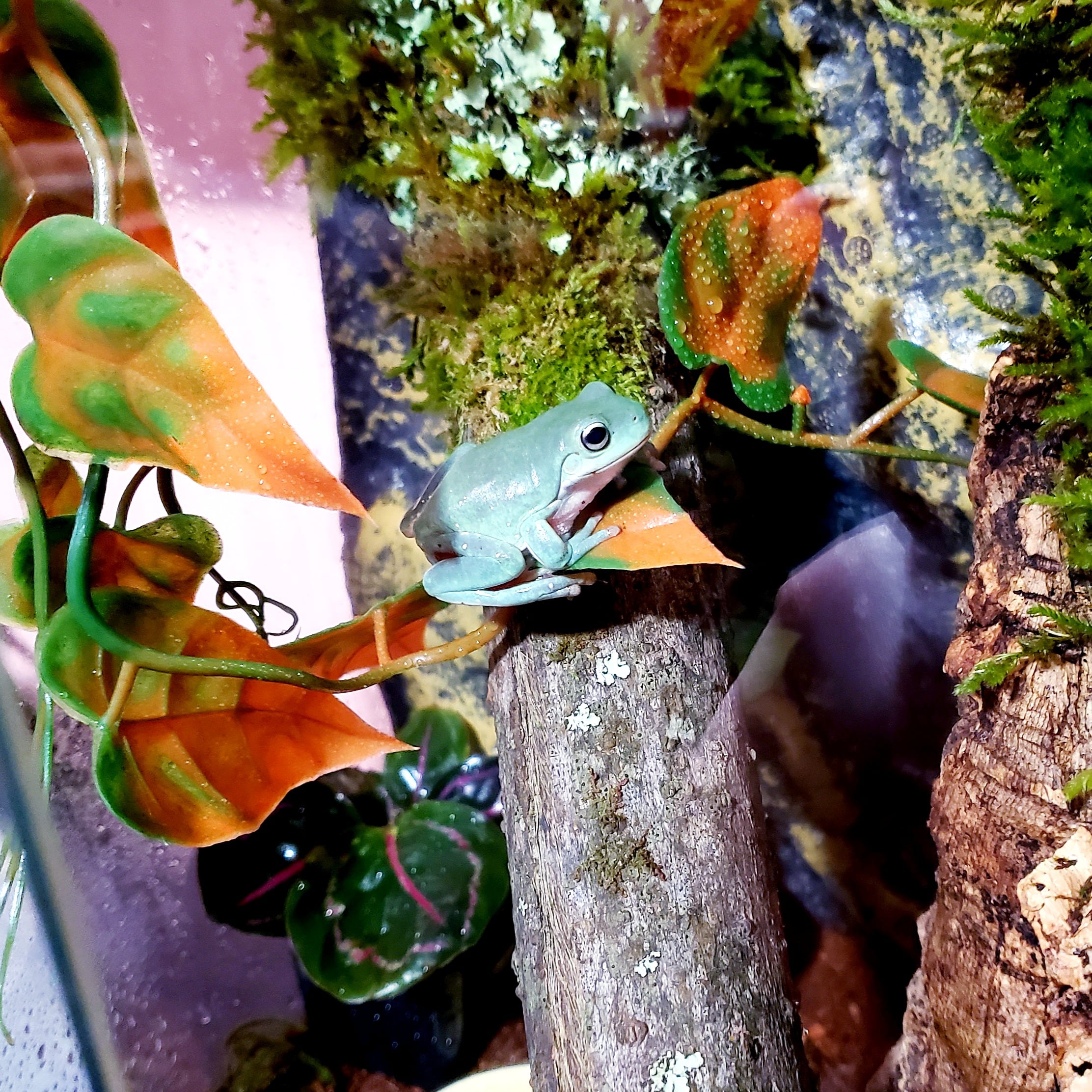
    Everyone may not understand the value of a pet, especially that of animals other than cats and dogs. Creatures such as fish are often treated as a decoration rather than a living being that deserves care and attention. While the average person may not dare to ask for your dog’s collar and bowl within a week of your loss, many would see nothing wrong with requesting a fish tank or terrarium whose occupant is no longer with you. This sort of societal apathy towards the lives of animals is part of what makes the loss of a pet so painful. Not only have you lost something that you loved and that loved you unconditionally, but with so few that understand, your options for support are limited. Even on pet loss forums, discussing the loss of a more unusual animal can and will get you hateful messages about how you should be thankful it wasn’t a dog.

    My pet frog Fitzwilliam passed away recently. He’d become lethargic and started eating less, and before I could bring him in to the only vet in the county that even treated amphibians, he was gone. I spent that day unable to move from my couch, barely able to eat or speak.

    I find it difficult to express my grief in writing. I loved that little guy. He was a baby, my baby, and now he’s gone. Of course I blamed myself. That’s part of the bargaining phase, right? Maybe if I’d been able to act quicker, I could have found him another vet. Maybe if I’d been more meticulous in cleaning his tank, he would never have gotten sick in the first place. Maybe if I had been better, I don’t know how, but if I’d just been better, he would still be here. He was only about six months old, just a baby. He should have had at least a decade ahead of him. Why couldn’t I give him that?

    I had no one to talk to. Less than a day after losing him, people suggested simply getting a new frog as if he was an object to be replaced. For some people, moving on with a new pet might be best, but I couldn’t do it. I broke down in tears just seeing a stuffed frog in a store. I couldn’t handle having something that looked like him, sounded like him, but wasn’t him. It would be unfair to expect another animal to live up to him when the pain is still so fresh.

    The truth is, I have been through a lot this summer, and in his own way, Fitz was there for me through everything. When I was feeling down, he was content to hop onto my hand and sit with me for as long as I needed. When I needed something to do, he had plants to mist and a water dish to refill. When I needed a distraction, he was there, perched on his favorite branch and ready to be admired. Even when I put on sad music, he would croak along to it. His favorite band was The Mountain Goats.

    I am certain that many readers will see this as the ramblings of an overly emotional person with unhealthy attachments. Maybe they’re right, and they can go right back to drafting a letter to the editor about how I don’t understand real pain and other people have things so much worse than I do so I should just shut up. I just want you to know, he mattered to me.

  • Bigfoot is a criminal

    Bigfoot is a criminal

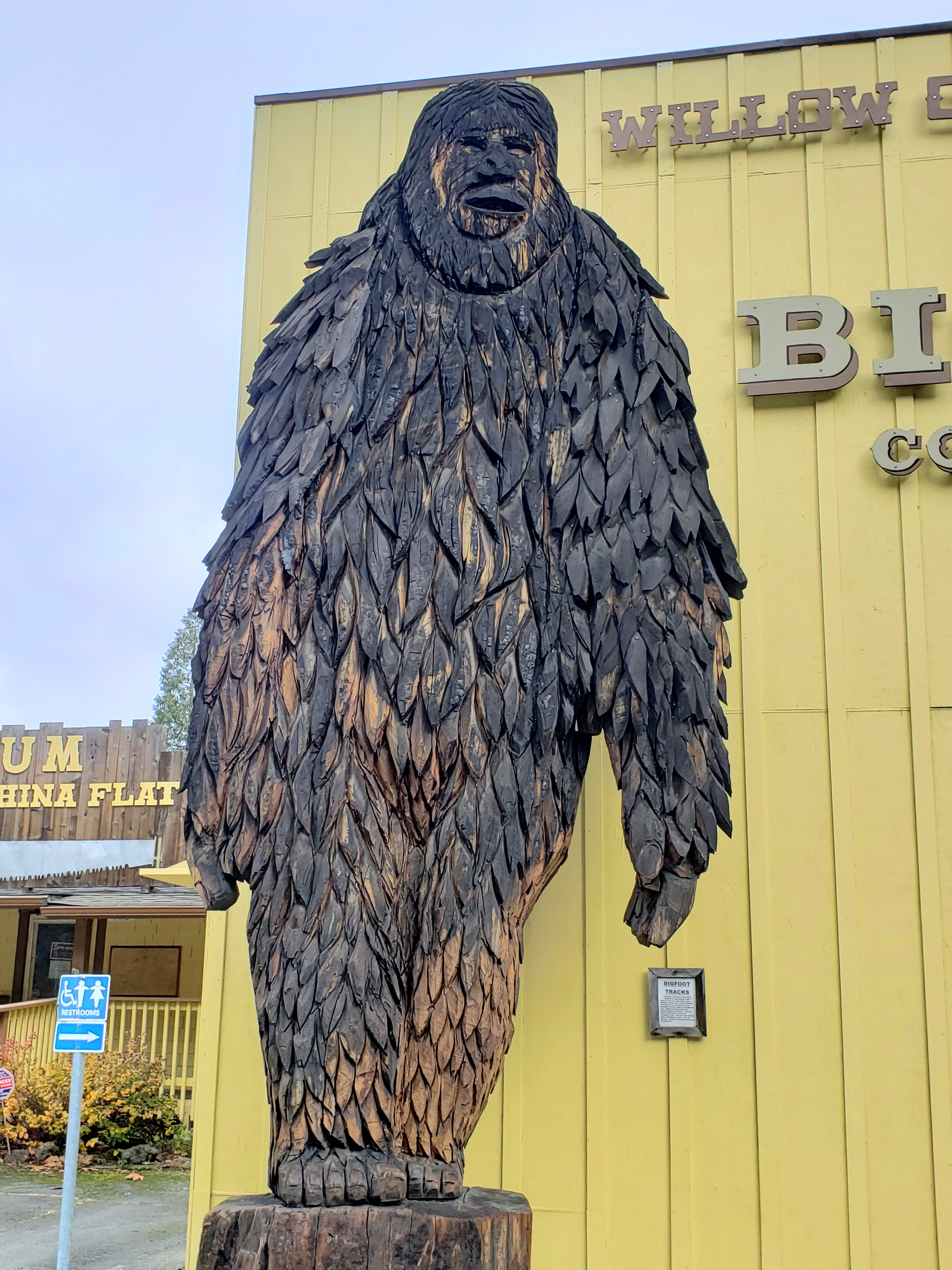
    Hulu’s latest true crime documentary series, Sasquatch, was quite fittingly released April 20. The crime was a triple homicide in mid-1990s Laytonville. The victims? Three employees on a cannabis farm. The lead suspect? Bigfoot.

    The mysterious ape committing a gruesome crime that left three dead is certainly not a claim anyone can ignore. Certainly not investigative journalist and viewpoint of the series David Holthouse, who was working at a Mendocino cannabis farm when a man came in the door in a state of disarray, claiming that “a Bigfoot” had brutally murdered and dismembered three field workers. Any person with an ounce of skepticism would have to look into such a claim, and Holthouse was no exception. Surely the man was lying about what he’d seen, or Sasquatch had been framed in some kind of R-rated Scooby Doo scheme involving Old Man Henderson in a rubber mask. While I won’t spoil the series, the results of the investigation, or even whether or not they find the Bigfoot that did it, it does lead into an interesting line of questioning. How common is sincere belief in folk legend, and what darker sides does such belief have?

    Willow Creek’s own self-proclaimed Bigfoot agnostic, bookstore owner Steven Streufert, is an expert on Bigfoot, as well as the cults of fascination that develop around the creature. Streufert personally takes a more scientific view of cryptozoology than many, one focused on evidence before drawing conclusions.

    “It’s kind of like there’s a competition, on one side, to be the most scientific and rational person you can be, and try and present yourself like you are a scientist,” Streufert said. “And most of them aren’t. Most of them are amateurs like me, I mean, I’m not a scientist. We, those of us in my group, try and conduct what we call citizen science, essentially treating it like studying wildlife in Bluff Creek. We have had trail cameras set up since 2012, recording 24/7 all year round, monitoring for Bigfoot, ostensibly. You know, we don’t get Bigfoot on those cameras. However many years it’s been, nine years this year, we have not gotten a single concrete Bigfoot image.”

    However, not all put proof before belief. True believers take an almost religious fervor to Sasquatch hunting.

    “We’ve got a lot of blurry, weird things that if we were hoaxers or believers in magic we could put forth and say, ‘these are Bigfoot, well that’s a Bigfoot,’ like all you got to do is post the blurry weird ones on Facebook or whatever and suddenly you have a million people telling you you’re great, you’re special,” Streufert said. “And that’s almost more rewarding than the truth. Of course, on the other side of things, some people are just fucked up and crazy to begin with, or they’re drugged on the attention and fame it gets them and they start to believe the weird and magical. If you wrote a book on the weird and magical, it would outsell the book on the critical and rational a thousand to one. People want to believe in monsters and mysteries.”

    Some Bigfoot believers are willing to bend the fabric of reality to accommodate their belief. To them, Bigfoot is not just meat and bone like any animal, but something of a legendary creature akin to a unicorn or dragon, or even an extraterrestrial or divine being. And why shouldn’t a mythical creature have mythical powers?

    Streufert himself has something of a feud going with Bigfoot hunter and true believer Matthew Johnson. Johnson claims to be to Bigfoot what Dr. Jane Goodall is for chimpanzees, and reports numerous Bigfoot encounters around the Pacific Northwest. He and his followers believe that Bigfoot’s species is made up of highly advanced extradimensional beings that create portals to come through to Earth for short visits. Through his purported visits with what he calls “the Forest People,” Johnson has learned that their planet is dying and the Bigfoot spirits need help coming through to our world. Streufert has been a critic of these theories and has received death threats from adherents. He has even had shots fired at his bookstore.

    No connection between the gunfire at Bigfoot Books and the Streufert/Johnson feud has been proven, and no charges have been filed. Still, Streufert does not rule the possibility out.

    People are willing to threaten and perhaps even act based on Bigfoot beliefs. The intra-community drama calls to mind the often violent disagreements between religious sects. Bigfoot belief is much closer to a faith than a genuine science. It is less about what you can prove than what you want to believe.

    Assuming a strictly anthropological perspective, Bigfoot is unlikely to exist. Great apes diverged from monkeys around 30 million years ago, and hominins diverged from the great apes between 5 and 7 million— too late for a hominin or ancestral ape to appear in a Pangaea-era North America. If we imagine Bigfoot as closer to humans than chimpanzees, humanoid cousins such as Neanderthals only migrated as far as Europe and Asia before dying out approximately 40,000 years ago. Humans themselves only reached the Americas about 33,000 years ago. By all accounts, there is no way that another hominid could exist unknown in the Pacific Northwest without having been introduced as an invasive species within the past five centuries.

    Despite knowing this, I do want Bigfoot to be real. Despite knowing logically that there is no way a dinosaur survived to modern times in a Scottish lake or that an enormous moth can predict bridge collapses in West Virginia, there is a part of my brain that wants magic to be real. I want to believe that people come back as ghosts when they die rather than accept that people are gone. I want to believe that disappearances are the result of an alien conspiracy to take us to the stars rather than face the brutal fact that those people are buried in a shallow ditch somewhere. I want to believe that not only is there a wild ape man living in the woods behind my home, but that he is kind, and intelligent, and he would never tear three people limb from limb. The truth is, though I very much wish I did, I don’t believe in magic. There are things we cannot explain, but the truth will never be as fantastic as we hope.

  • Quarantine Quandary

    Quarantine Quandary

    This is no one’s ideal situation. Whether you’re already infected or think you might be, the 14-day quarantine is an anxiety-inducing time. You can take steps to stay safe by following CDC guidelines. Stay away from people, even others living inside your own home. Monitor your own health, making sure to call the hospitals if you have trouble breathing or a fever above 100.4° F. Be sure to get plenty of fluids and rest.

    The most important thing to do in this situation is take care of your health. While avoiding contact and checking for symptoms should be at the top of your to-do list, you have to make sure not to neglect your mental health. Spend time with your friends! There’s plenty of ways to enjoy their company from afar. Texting, calling, Zoom and FaceTime aren’t the only options. Multiplayer video games are always a good choice, as is putting on a video to share on sites such as Watch2gether, Teleparty, or Squad. And of course, there’s always the classic bonding activity of getting on a Discord call and discussing your childhood traumas. Yes, you’re isolated, but you don’t have to be lonely. Your support system is more important now than ever.

    You can also use this time to get started on your list of television shows you meant to get into but didn’t. While all your comfort sitcoms are available on streaming services like Netflix, Disney+, and Hulu, there’s some seriously underrated originals out there if you’re willing to explore. Netflix’s Everything Sucks! is a coming of age dramedy that deserves a place alongside Freaks and Geeks and Firefly in the ranks of great shows gone too soon. HBO Max’s Infinity Train is a surrealist cartoon that feels kind of like going to therapy, assuming your therapist’s building is full of monsters, robots, and talking dogs. Sure, there’s a lot of trash among streaming services, but when there’s a hidden gem it’s worth it.

    I know we’re all sick of that one friend who picked up piano or wrote a novel or something over quarantine, but the truth is it’s a great time to work on your hobby or pick up a new one. Odds are you have at least one thing you meant to learn but didn’t. This is your chance to put all those unused paints or unjuggled juggling pins you have collecting dust to work. The bright side of being alone is that no one can see your failed efforts and embarrassing moments. Whatever mispronunciations you made in your Spanish lessons are between you and the Duolingo owl.

    Total isolation sucks. It’s stressful, it’s understimulating, you’re alone with your own thoughts – yikes. If you need help, don’t be afraid to reach out to a friend or student resources such as CAPS. You may be literally by yourself, but figuratively speaking you aren’t alone.

  • Four years of handling headlines

    Unless you spent the past five years in a coma, blissfully unaware of the world around you, you know the news has been deeply weird and distressing.

    I genuinely believe that the past four years have left a profound impact on my mental health, and that of many people across the nation. I have friends who have stopped reading the news entirely so they can go about their day without feeling hopeless. I’ve read articles about the Biden administration by journalists that seem positively shocked at how boring the policy details are. These past four years have left this country traumatized, a trauma we only now can begin to reckon with.

    I was still in high school when Trump was elected. I vividly recall my blind confidence the weeks before the 2016 election, when my young, dumb, optimistic self bet my best friend ten dollars Trump would never be president. Fast forward to that infamous night. I was crying as I stared at the television screen, watching the electoral votes tick upwards as I envisioned the worst. That night I contemplated walking into traffic to spare myself the agony that awaited a mixed-race queer in the new America.

    Time passed. I handed over the money. I went to the Women’s March. I learned that democracy was a sham. For the next four years, I checked the news, I opened social media, I watched television and every single day it was something new.

    The president said white supremacists were good people. The president threatened nuclear war with North Korea. The president suggested that people inject bleach. It was never enough to simply enforce policy banning transgender people from the military or pulling out of the Paris Agreement. He always had to say things, truly hateful and outrageous things, that became the news because of his position.

    I genuinely feel that some level of emotional abuse occurred. Gaslighting, threats, and wild accusations were common enough, and the hypervigilance that victims of abuse develop was certainly there. I was constantly looking to see what new damage to democracy has happened now.

    Even when it wasn’t exactly bad, it would be strange, and the absence of news and its terrifying unknown would leave me more worried than ever. Bad news was addictive. I had to know what horrible things were happening so I could stay informed, and once I was informed it was my responsibility to stress about them.

    For four years we lived under the constant anxiety that maybe today we would glance at the news and hear martial law declared. Maybe today we’d see World War III. Maybe today we’d lose the Civil Rights Act. It’s only now, when I look up the name of the current president of the United States and don’t see tweets accusing political rivals of treason, I realize that the news cycle wasn’t normal. We aren’t supposed to have panic attacks whenever we glance at NBC. That’s what CNN is for.

    I know bad things happened under the Obama administration. I know bad things continue to happen under the Biden administration. I know it’s an incredibly privileged take to say that if Hillary had been elected, we’d all be at a coronavirus-free brunch reading about how world peace was declared. We will still have climate change, inequality, poverty, unemployment, corruption, and, oh yeah, a GLOBAL PANDEMIC. But the truth is, it isn’t healthy to see a constant stream of bad news all day every day for four years. It’s even less healthy to read the rantings of a man who believes in his word over facts and his ego over human lives. While this section is probably near the back and it’s a bit late to hear it, please put down this paper. Remember that you don’t have to steel yourself like a lab rat for the next shock. What happened here wasn’t okay, and we need to heal.

  • Music is tone-deaf in all senses of the word

    Music is tone-deaf in all senses of the word

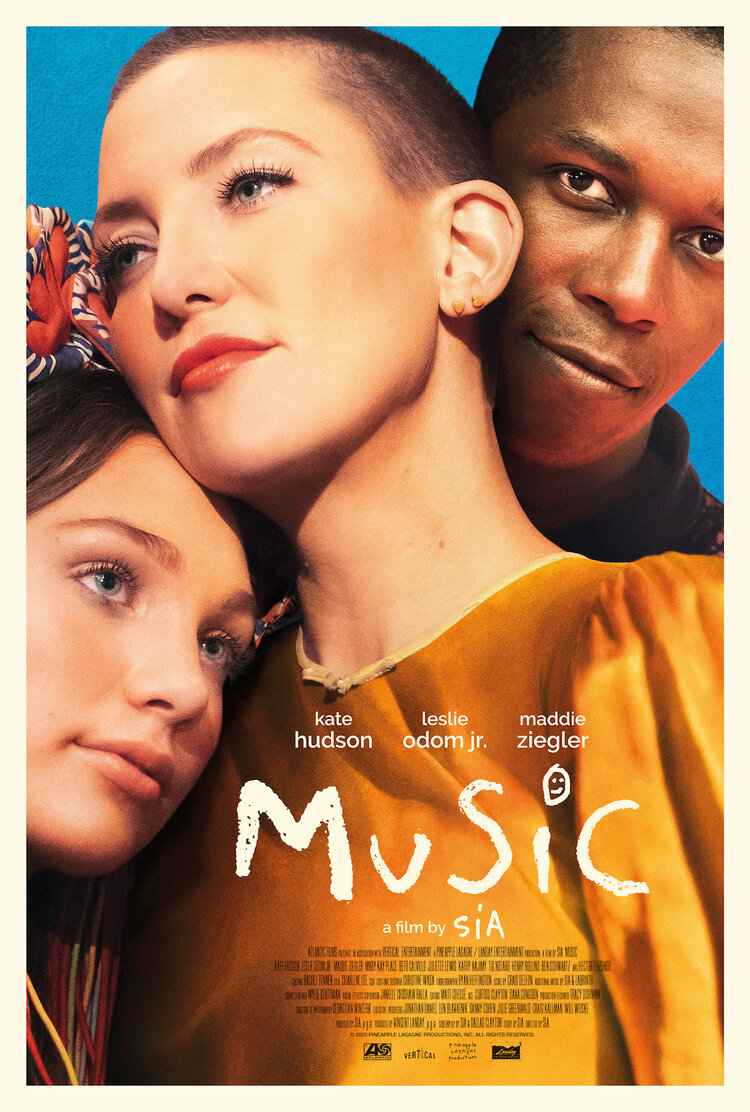
    There are some movies that are so bad they’re good. There are some movies that are so in-your-face offensive it’s funny. Regrettably, Sia’s directorial debut “Music” was neither.

    For those who haven’t been keeping up on the drama relating to this film, Sia became a subject of controversy after she cast a non-autistic actress as an autistic character, worked with known anti-autistic group Autism Speaks, then doubled down on insulting those who suggested she listen to the concerns of actual autistic people. She went so far as to compare autistic people to inanimate objects before telling would-be critics to watch her film before passing judgment. As an autistic critic, I did so, and judge I shall.

    “Music” is ostensibly a film about the titular Music, a nonverbal autistic girl played by the non-autistic Maddie Ziegler in a painful caricature of disability. However, for all the time dedicated to pretentious musical sequences, she could easily be replaced with an animal or an expensive lamp for all the film cares. Music, true to Sia’s belief, is little more than a plot device or piece of set dressing. Instead, “Music” focuses on her older sister, the callously selfish drug dealer Zu (Kate Hudson, inexplicably nominated for a Golden Globe), and her struggles dealing with Music’s needs.

    I cannot stress enough what a disaster this film was from start to finish. “Music” manages to be profoundly insensitive to the point of being nauseating to watch. Music herself is essentially a non-character whose needs and level of ability vary depending on what the film demands. She exists exclusively to inspire neurotypical people with her “inner strength” and act as a conduit for Sia’s self-indulgent and hideously oversaturated song and dance sequences. I shouldn’t have to tell you how disgusting and patronizing this is. Her acting is little more than choreography, her stims and tics set to the beat as she moves in a grotesque pantomime of what I and people like me experience every day. Yet, she seems to live a charmed life, unaffected by grief following the death of her grandmother and offered free fruit and smiles by strangers on the street. Frankly, the most realistic depiction of the autistic experience in this film is Zu’s total disregard for her autistic relative and ignorance of the condition.

    The privilege continues to show in the depiction of Leslie Odom Jr’s Ebo, a black man and magical autism whisperer who evidently lives to serve this white family and dispense down-to-earth wisdom. In a strangely cheerful tone, he explains that his own brother was autistic and died. What was his name? How did he die? It does not matter, as Ebo goes on to directly endorse a dangerous method of physical restraint that has led to the deaths of dozens of autistic people. He’s the most blatant example I’ve seen in years of the Magical Negro, the enlightened yet folksy black man who helps the white hero on their journey while lacking any personhood of his own.

    Even if one can ignore the blatant racism and ableism, “Music” fails to deliver a coherent narrative, developed characters, or even pleasing aesthetics. I found myself checking the time constantly, as this proved to be the longest hour and a half of my life. At one point in the film, a minor character is murdered on screen and it doesn’t affect the plot whatsoever. It’s never mentioned and we never see anyone react. At another point Sia makes a guest appearance as herself. I’ll let you take a wild stab in the dark at how much influence this has on the events of the film. The closest thing to a character arc we see in the entire run time is (spoiler alert if one cares about this paper-thin narrative) Zu changing her mind about giving Music away to a facility that probably is better equipped to care for her than an alcoholic drug dealer.

    Music is bad art marred by bad representation and bad intent behind the scenes. If this review leaves you morbidly curious, all I can tell you is that it’s not even worth a hate watch. Frankly, I’m less offended as an autistic person than I am as a film aficionado. Watching this movie was one of the most draining experiences of my life. Sia’s directorial debut should stay her directorial finale, and I feel worse off for having witnessed it.

  • Is my cat mad at me?

    Cats are weird animals. This is an established fact among anyone who has ever seen one. Fortunately, this behavior does have several explanations! Rest assured, your cat doesn’t hate you for cleaning up after him. He hates you for reasons he refuses to divulge to the press.

    One of the most likely explanations is simple curiosity. Cats are inquisitive creatures, and they may not be sure what you’re doing. The act of burying their waste is an instinctual behavior to hide their scent from predators, and seeing you dig up what they so carefully hid might confuse them. Somewhere in the world, a cat is writing to a cat advice column to ask why his human is carelessly revealing their presence to wolves.

    Cats also like to watch what their humans are doing, and even try to participate. We’ve all been at our computers and had a cat sprawl across the keyboard to see what the hype is about. This behavior is called mirroring. It’s a sign that your cat wants to be included in whatever strange thing you’re doing, and it’s the cat’s way of spending quality time with you. If your cat is sitting by you or even putting a paw in the litter, he’s simply doing his best to help. It’s not his fault he has no thumbs.

    On the other hand, cats are territorial animals. They see your home as their home and everything in it as theirs. The litter box is the only place inside where they can relieve themselves. Seeing you clean it out, the cat wants to supervise you, essentially to ensure you clean it properly and that there will still be a litter box when you’re done. However, territorial behavior can go a bit far. If your cat hisses at you or even attacks you when you clean up after them, this could mean that they feel insecure and unsafe. It’s a good idea to get your cat a second box to use while you clean the first one outside, to give the cat a bit of security that there will always be a usable litter box.

    So long as the cat has an adequately sized box and a sense of consistency, he shouldn’t be angry at you for keeping it tidy. Odds are he appreciates it, as cats like to keep their space clean. Plus, he can only bury his waste so deep and appreciates you hiding his location from large predatory birds. Yes, human. Put the dirty litter in a bag to be taken far from this place. Our enemies shall not find us here.

  • Ask Evergreen’s Valentine’s Gift Guide

    Ask Evergreen’s Valentine’s Gift Guide

    This is a classic predicament. You want to acknowledge the holiday, but you don’t want to come on too strong. For example, ideas of fine jewelry, dinner from a Michelin-star restaurant, or a commissioned Renaissance-style oil painting of the two of you should be thrown right out. Instead, focus on the thought behind your gift. This first Valentine’s Day gives you an excellent opportunity to prove that you’ve been paying attention to their interests.

    The simplest thing to do is to ask yourself, what do they like? Buying a book, game, or album they’ve mentioned having their eye on is an easy way to prove your interest in theirs. You can even start reading/playing/listening along with them to better understand their passion. If your significant other is the more practical type, think about something they’d use, such as a cozy scarf for someone who’s always cold or a cast-iron pan for someone who loves to cook. However, you’ll want to avoid strictly utilitarian presents for Valentine’s Day. While it’s thoughtful to pick up a box of tea that helps with your partner’s stomach aches, you should avoid making that their big gift.

    For those who aren’t sure where to begin, standards like a stuffed animal, flowers, or candy are a good starting place. Instead of a stuffed bear holding a heart-shaped box of chocolates you can grab at CVS, why not pick something more personal? You can pick up a Pokémon plush for the Nintendo fan in your life, or a violet in a cute planter for someone with a green thumb. Even the classic box of chocolates can be upgraded by finding their favorite brand or getting a sampler box of candies from around the world.

    The primary gift-giving tip, of course, is to simply listen to and communicate with the person you’re buying something for. When they tell you what they like, pay attention and store that information away for later. You don’t have to break the bank to find something they’ll love, what matters most is showing your partner that you value what matters to them.

  • How to survive Among Us without being sus

    How to survive Among Us without being sus

    The best game about gaslighting your friends on a spaceship

    Among Us was released by InnerSloth in 2018, but remained in obscurity, averaging only about 30 players at any given time. This all changed in July, when it was picked up and thrust into the spotlight by Twitch streamers such as Sodapoppin.

    Today, Among Us boasts over 100 million downloads and 60 million daily players. Owing to its easy learning curve, low cost and social nature, the game took off. It’s deceptively simple but downright addictive.

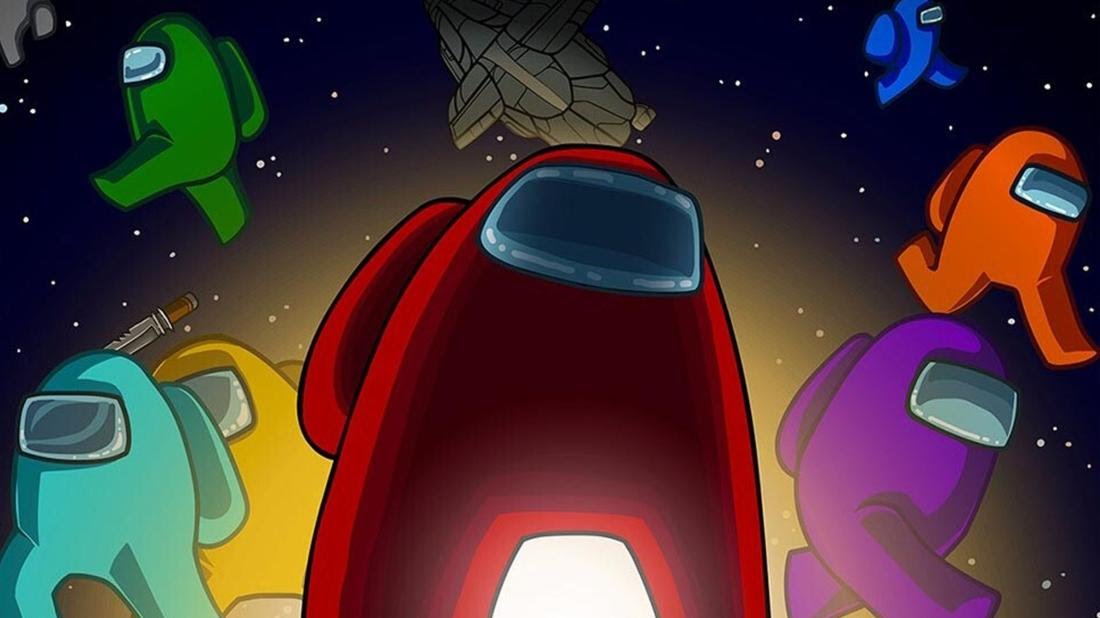
    Among Us is a charmingly animated game with a distinctive visual style. Playing as colorful astronauts, players are divided into two teams: crewmates and imposters.

    Crewmates are charged with completing their tasks and investigating the imposter among them, while imposters must sabotage the ship and murder all of the crewmates before being discovered.

    The real action of the game occurs in the chat feature, where players bring out their best detective work to uncover the liars.

    As one of the 60 million Among Us players, the hype is real. I play as a lime green astronaut who wears a plastic flamingo on their head and it’s as delightful as it sounds. For crewmates and imposters alike, may I present: tips on not getting launched into the void of space.

    1. Always know where you are. Having an alibi is the best way to prove your innocence (or fake it). Be prepared to explain what you were doing and who you might have seen there.

    2. Know how to argue. Whether you’re accusing someone or defending yourself, have evidence. Did a crewmate see you do a visual task? Did you vote out the last imposter? Why were you following Red around the map? You have to be able to find reasons why people are or are not the imposter and persuade people that you know what you’re talking about. Which brings us to tip two and a half: Lying.

    3. Learn to lie convincingly. If you can convince just one or two crewmates that you’re trustworthy, that you couldn’t have been the killer, that you were in medbay the entire time, then you’ve just earned yourself another chance to strike. As in life, lying is a great way to eliminate your enemies with no repercussions.

    4. Find a buddy. If you’re a crewmate, you’ll have a friend who will witness and report your murderer, or simply stand by and protect you while you complete your tasks. If you’re an imposter, you either have an unsuspecting victim or a second imposter to team up with and lend an alibi to.

    5. Don’t be a cheater. If you’ve been murdered, don’t be that guy who calls their buddy and tells them who the imposter was. It’s a jerk move all around and ruins the fun of investigation.

    Good luck everyone, and don’t get murdered!

  • Welcome to the Twilight Zone

    Comparisons between episodes of the classic TV show The Twilight Zone and our own dismal reality

    In what may be the greatest understatement of the century, 2020 has been a rather eventful year. Wildfires, a global pandemic, isolation, protests throughout the world, political turmoil, deaths of public figures – you could write a new version of “We Didn’t Start the Fire” for each month of the year. So, why not look to retro television for comfort? Why not explore a simpler time, when the greatest fears we had were looming nuclear war, human short-sightedness, crippling loneliness and the catastrophic realities of climate change?

    Oh wait.

    1. Nightmare at 20,000 Feet (Season 5, Episode 3)

    A man recovering from a nervous breakdown is the only person on his plane who can see the monster just outside the window. He attempts to warn his fellow passengers, only for people to assume he’s lost his mind. The fear of flying is certainly one many people these days are familiar with, as travel becomes a major factor in the spread of COVID-19. With the US government claiming it’s safe to reopen and many people ignoring mask and distancing guidelines, it can be easy to doubt one’s own concerns. Like the man on the plane, we find ourselves questioning if the invisible force of death is actually there. Are we overreacting, or do we really see an imminent threat?

    2. Where is Everybody? (Season 1, Episode 1)

    A man finds himself alone in an abandoned town, with no memory of who he is or how he got there. He finds himself searching empty streets and abandoned shops for any sign of human life, only to be left alone with just his own thoughts for company. This certainly brings back memories of the beginning of shelter in place, when nothing was open and we all thought it would blow over within a week or two. Remember when it was pessimistic to say we wouldn’t be back to normal until fall? Good times.

    3. It’s a Good Life (Season 3, Episode 8)

    The citizens of a small town are cut off from the world at large and kept at the mercy of a six-year-old boy with reality-warping powers. They live in a state of constant anxiety about what fresh horror awaits while pretending everything is fine to avoid angering someone who doesn’t seem to understand that actions have consequences. What a classic American mood? The townspeople, in their defeated acceptance of the new normal, are certainly relatable to the average person in 2020 watching things fall apart while baking bread, submitting assignments, and occasionally looking at the red sky to say, ‘Sure, this might as well happen. What’s next?’

    4. The Midnight Sun (Season 3, Episode 10)

    Two women are in their apartment building, slowly being consumed by unbearable heat as they await the end of the world. They cope with the loneliness by supporting each other as the world outside erodes. While the twist in this episode is certainly not one of the series’ best, the despair of the two women as the radio presenter snaps on air and paint boils on the canvas feels painfully relevant as wildfire season is upon us. Staying inside and distracting ourselves with hobbies is really all we can do, as we smell the smoke and watch the destruction on the news.

    5. Time Enough at Last (Season 1, Episode 8)

    An absentminded, bookish man is left alone in a ruined city after a bomb destroys everything and everyone he once knew. This episode is one of the classics, and it’s easy to see why. The sense of loneliness permeates the entire episode, even before the bomb drops. Our protagonist can only find solace from his abusive wife and belittling employer in the pages of his books, but once he’s lost the interactions he’d taken for granted he finds himself sinking into depression. Unfortunately, like many of us who’d had grand quarantine plans of learning a language or writing a book have discovered, having all the time in the world doesn’t necessarily mean we can finally indulge in our dreams.

    6. The Monsters Are Due on Maple Street (Season 1, Episode 22)

    A small community is torn apart and devolves into a violent blame-game after the electricity goes out. In a time of abundant anti-Asian hate crimes in response to the “Chinese virus” pandemic, this episode is an excellent example of what not to do. Yes, things are bad – there is no denying that. However, we need to remember that we have to look out for each other. We can’t go around blaming others for everything that’s gone wrong – we have to work with them to solve our problems. Wear a mask. Donate to fire relief funds. Call your representatives. Order takeout from local restaurants. Check in on your friends and family. Do whatever you can to support those around you.

  • Living on Campus during a Pandemic

    Living on Campus during a Pandemic

    Humboldt State University reopens campus and student housing for new incoming students.

    Universities across the nation are experiencing a drop in enrollment this year due to COVID-19 and Humboldt State University is no exception. With around a thousand new students moved into single-occupancy rooms on Aug. 17, HSU remains determined on reopening campus and providing student housing for the fall semester.

    Among those returning is second year HSU student, Bryce Hunt. Hunt lived on campus prior to in-person instruction ending and he knew he would be returning to campus.

    “I had already made my decision internally,” Hunt said. “I knew a majority of my friends were coming back up and I needed to get out of my home and my hometown.”

    For Hunt, the adjustment to life on campus during the pandemic has been fairly easy. While he admits the absence of resources such as in-person advising has been a hindrance, he feels the school is taking strong protective measures.

    “I like that they’re offering free coronavirus testing,” Hunt said. “They’ve been open about the fact that they have had cases.”

    Hunt feels that campus is safe as long as everyone takes proper precautions and follows the advised county health guidelines.

    “Even with everything going on, I want to be here, because I’m happy here.”

    Adrian Black

    “I feel fairly comfortable,” Hunt said. “I know I’m taking the protective measures so I can to be safe. I don’t think it’s bothering me as much as it did after spring break.”

    Adrian Black, a second year student at HSU, is staying off-campus but remaining in Humboldt. Without any in-person classes, Black made their decision partially out of want, and partially out of need.

    “I don’t really have any other place to live,” Black said. “My parents don’t have room for me. Besides, I really like living here. Even with everything going on, I want to be here, because I’m happy here.”

    While they had previously considered not returning to HSU after last semester’s disorganized attempt at online classes, Black decided to give this semester a try. Driven by both a passion for learning and a fundamental hunger for something to do, Black returned. However, they’re disappointed in the lack of resources and social-outlets available to students.

    “A lot of the charm of being a student is being on campus, interacting with students and faculty,” Black said. “I feel like clubs and such are going to be lacking since we can’t do in-person meetings. It limits what types of clubs are allowed and accessible and puts a damper on social lives.”

    With students and faculty better prepared for online classes, new precautions in place and the world adjusting to a new reality, they believe that it can be a good semester.

    “I have high hopes, and I hope that by next year, things will have gotten better,” Black said.

  • Staff Recipe: Oh No, I Bought Too Many Bananas—Banana Bread

    Staff Recipe: Oh No, I Bought Too Many Bananas—Banana Bread

    A recipe for when you have too many bananas and don’t know what to do with them

    I’ve read enough recipe blogs to know you open a recipe with an autobiography.

    It all began when the plague hit. I panicked and bought too many bananas. This was immediately followed by remembering I don’t even like bananas that much. However, I do love bread, and banana bread works best with bananas just on the brink of going bad. Assuming you were able to gather the energy to wear socks in isolation, here’s a recipe that will knock your socks right off.

    With no further ado, here’s the “Oh No, I Bought Too Many Bananas—Banana Bread” recipe (this yields 2 loaves):

    Ingredients:

    4-6 very ripe bananas, mashed
    2 cups sugar
    2 eggs
    1/2 cup vegetable oil
    3 cups flour
    2 tablespoons baking soda
    2 tablespoons salt

    walnuts or chocolate chips, to personal preference (optional)

    Directions:

    1. Preheat the oven to 350 degrees and grease two loaf pans.
    2. In a large bowl, combine bananas, sugar, eggs and oil. It will look lumpy, and that’s OK. There’s bananas in there—there’s only so much you can do.
    3. In a separate bowl, combine flour and baking soda. Fold into the banana mixture and combine until no dry ingredients remain.
    4. Add salt and any additional, optional mix-ins, and combine thoroughly.

    5. Bake for an hour or until a toothpick inserted into the bread comes out mostly clean.

    And you’re done!