The Lumberjack


Students Serving The Cal Poly Humboldt Campus and Community Since 1929

Tag: activism

  • Cal Poly Humboldt faculty criticize administration for policing pro-Palestine protest

    Cal Poly Humboldt faculty criticize administration for policing pro-Palestine protest

    by Alana Hackman

    Cal Poly Humboldt students, faculty, and community members joined a virtual University Senate meeting on Tuesday, April 23. 

    “There is considerable interest in engaging with the open forum today. More than is likely to be possible, given due to time constraints,” meeting leader James Woglom said. “Given that, we’re going to prioritize guests. If you are a senator and we are unable to get to you today, I do apologize.”  

    Woglom then continued to introduce senators present in the meeting that evening, including Provost Jenn Capps and Chief of Staff, Mark Johnson, who would be present on behalf of the university president, Tom Jackson.

    Senator and graduate coordinator of the sociology department Mary Virnoche proposed the upcoming agenda be edited. Virnoche proposed a discussion item to be inserted into the agenda to receive an update on the campus response to the current protestors occupying Siemens Hall. No senate members objected. 

    Woglom began the discussion by citing their own experience observing the protest last night. They mentioned speaking with other individuals earlier in the day to discuss how they can make progress to meet the needs and demands of those occupying Siemens Hall. 

    Woglom then called for any member of the campus faculty or community to share any up-to-date information they may have regarding the current occupation. Each speaker was allocated a three-minute time limit.

    “I had a meeting with [Chrissy Holliday] right before this and it seems the current concern is that there [are] confidential documents in Siemens Hall,” Parker said. “So far, no one has made an attempt to reach those. If that continues, it sounds like they’ll be fairly hands off.”

    The open forum discussing the current state of the Siemen Hall occupation continued with Jamela Hashim, a social work student who was currently joining from a smartphone with other senate meeting attendees, Gabi Kirk of the geology department, and Janet Winston of the English department. All mentioned they were currently outside of Siemens Hall.

    Hashim urged meeting attendees that it was vital to address that internet services have been cut off within Siemens Hall so nobody inside would be able to comment. 

    “That seems like a bias that should be addressed in some way,” Hashim said. 

    Wolgom acknowledged the statement and encouraged protestors inside of the hall should text outside sources information they would like to be relayed during the meeting. 

    The proposed discussion by Virnoche lasted until about 4:12 p.m., until it was cut off to discuss the UPRC budget, CR/NC deadline, and Faculty Awards. 

    As the discussion unfolded many faculty, students, and community members spoke up about supporting the student protestors’ requested demands and urging for a ceasefire. 

    “Here at Cal Poly Humboldt, we pride ourselves on being student-centered and guiding our students’ academic journeys towards careers that will usher in a brighter and more empathetic world grounded in values of justice, diversity, equity, and inclusion,” said Kelly Fortner, Community-based learning faculty. “If we want to hold true to those values, as a university and campus community, we need to meet the demands of our students and make a stand against genocide.” 

    On the frontlines of the sit-in, Kirk and Winston used their three-minute speech slots to read a three-page letter collectively written by faculty deploring the University administration for the use of police force, and standing in solidarity with student protestors. As of now, the letter has 164 signatures from staff, students, and community members. 

    “We call on Cal Poly Humboldt to reflect on the real harm this crackdown on free speech inflicts,” the letter states. “And the message it sends to current and future students, their parents, faculty, and staff, and our communities within and beyond Humboldt”

    Following that, Chief of Staff Mark Johnson made a statement on behalf of the university and President Tom Jackson. Johnson encouraged meeting attendees to share possible ways they can move forward from the current events of possibly 40 to 60 protestors currently occupying Siemen Hall.

    Johnson explained that the students inside Siemens Hall were offered on several occasions to exit the building and protest in the quad or somewhere else suitable for them. He then explains that their denial to do so then equates to trespassing on public property. 

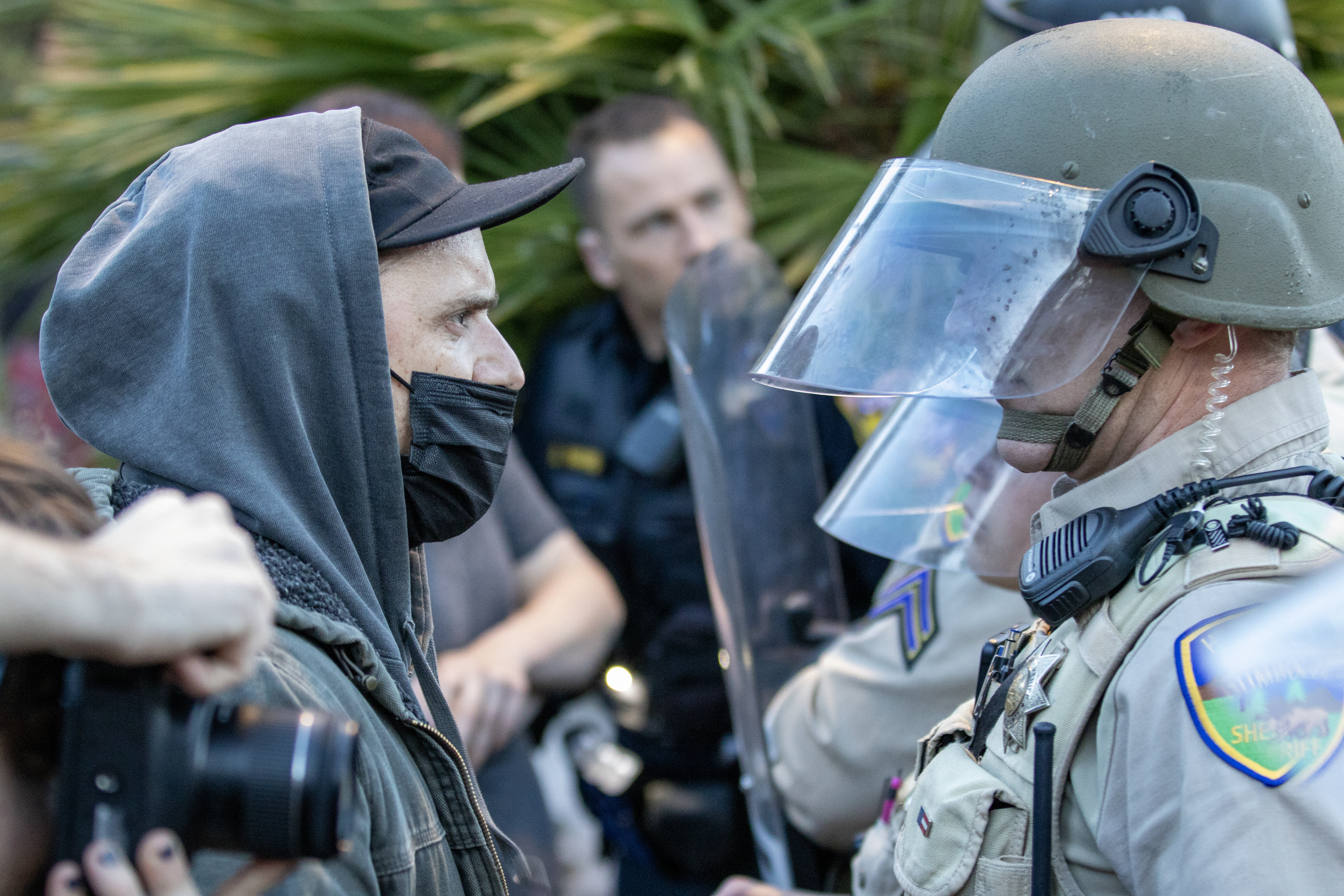
    “They refused that offer and insisted on occupying and effectively shutting down the nerve center of the campus,” Johnson said. “I think all of you understand what happened yesterday as we went through actions to try to remove those protestors who were effectively trespassing in the building.” 

    Johnson also commented that the police force was removed after the realization it was inflaming the situation rather than aiding it. Johnson mentions there are planning efforts moving forward to communicate with the protestors inside the building and provide a more peaceful and secure environment to the other students on campus. Johnson then opened the floor for constructive criticism on how to move forward with current events after reiterating that the police force involved was once again a result of the students refusing to protest in a content-neutral way. 

    “The president’s administrative team and President Jackson are making operational decisions based on real-time information about what is happening around voting and on campus,” Johnson said.

    California Faculty Association (CFA) president Marisol Ruiz laid out recommendations for moving forward on behalf of the CFA. Her requests included not prosecuting anyone involved, showing support for students’ organized efforts for Gaza, and rejecting the use of force and policing. Ruiz also called for a statement from Tom Jackson and Jenn Capps. 

    “The lesson should not be in the sacrifices that have to be made for advocacy but about the possibilities we find there for solutions,” Ruiz said.

    Geology professor Jim Graham followed Ruiz’s statement with a request for possible outside sourcing of an arbitrator to speak to the current protestors. Graham also reflected on the student sit-in in 2015 in regards to Native American Studies professor, Jacquelyn Bowman’s termination. Giving student protestors credit for their organizational abilities and dedication during that event.  

    Another attendee, Katie Koscielak the sustainability analyst at Cal Poly Humboldt then questioned if any of the student protestors’ demands were being met. A list of the demands had been circulating around social media. 

    Woglom spoke before Johnson stating that they are currently working with the students to make their demands more concise. Woglom and Johnson mentioned specifying the investments within the demands of the university can make them more achievable. 

    “The investments at the system level, at the state level, are not under our control in any way shape, or form,” Johnson said. “We do have some investments as part of the endowment and to add to James’ point we are looking into those investments, those portfolios to make certain that we understand what if, if any, percentage of those investments are already in better, broad terms, defense contractors.” 

    Johnson continued to state that President Jackson would not be making any statements in support of or against any political opinions or subjects. 

    “With regard to having a war or causing a ceasefire, causing the United States to divest in broader terms, those are things really outside of the control of anybody here on campus, and therefore are not actionable or realistic for the university to consider as demands to be met,” Johnson said. 

    After Johnson’s final comment, concerned community members shared their thoughts on the University’s handling of the student protestors. Concerns were made surrounding words used to villainize the protestors, hygiene following campus closures, and the overall prioritization of property safety over people. 

    One community member Genevieve Ameduri shared a strong message of disdain of the university’s call for policing the student protestors. Ameduri explained that she and her husband have recently moved to Arcata and adopted three Palestinian children who are hopeful to attend Cal Poly Humboldt in the future. She explains seeing a student hit over the head by police in riot gear in the first fifteen minutes of attending the protest was extremely upsetting and made her question the University’s priorities. 

    “Our children have the decency and the heart to stand up and we put them in violent outcomes, it’s unacceptable,” Ameduri said. “I am ashamed of all of you who have not spoken up and stood with them.” 
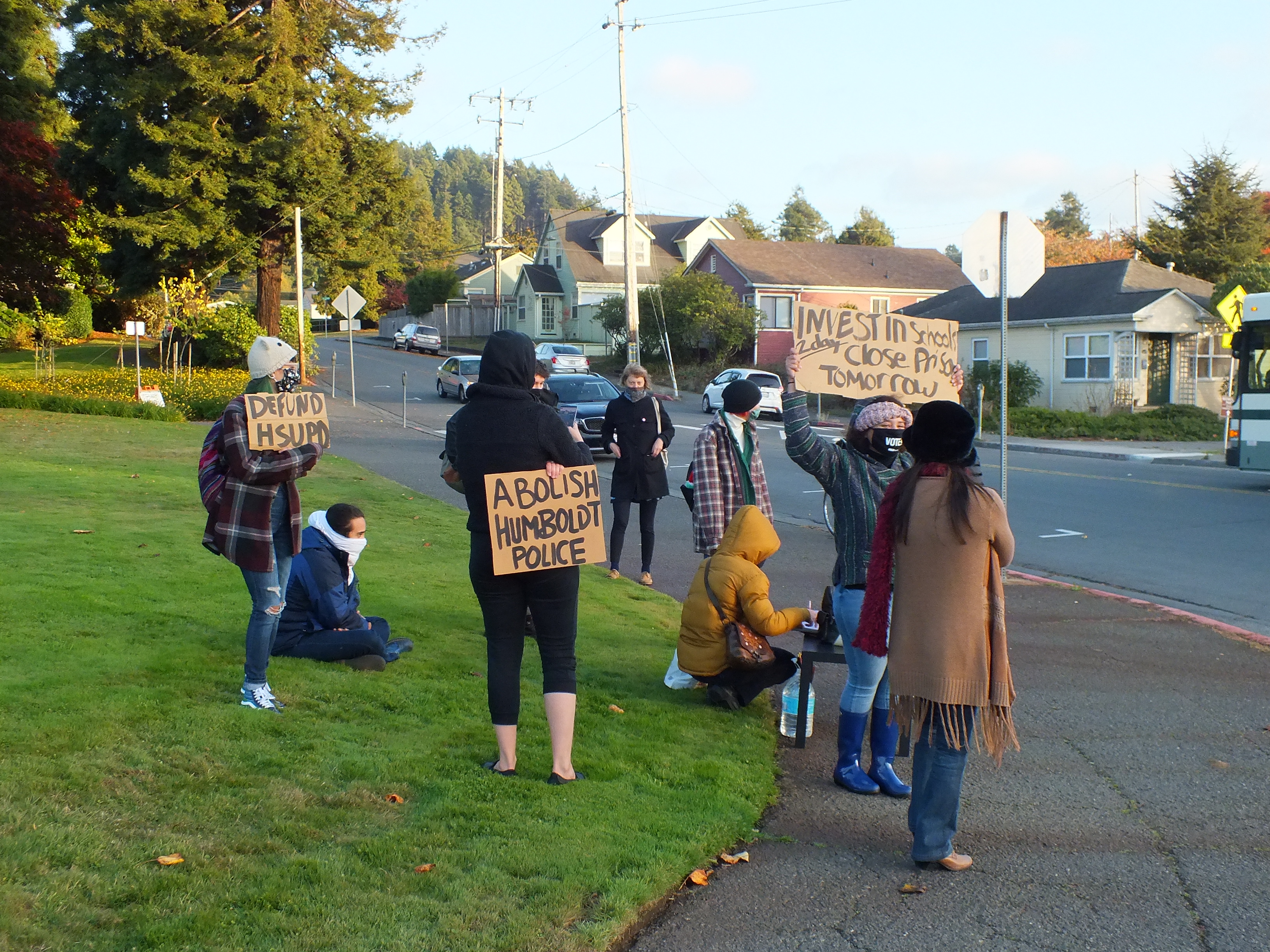
  • Protestors seek to defund HSUPD

    Protestors seek to defund HSUPD

    Two local, activist organizations work together to stage a sit-in against Humboldt State’s police department.

    A small group of concerned students and community members gathered outside Humboldt State University on Nov. 7 to protest the University Police Department.

    The two day protest was organized by Abolish Humboldt Police and Students for Quality Education groups. The two labeled it online as an information sharing session regarding the history of the UPD and Interim Chief of Police Scott VanScoy. VanScoy is the second interim chief that HSU has had this year.

    The UPD Chief position has not been permanently filled since the retirement of former chief Donn Peterson, who retired in May of this year. Peterson faced allegations from his fellow officers of creating a hostile work environment and making racially motivated statements. A independent investigation concluded that there was not enough evidence to either exonerate Peterson or to sustain the complaint.

    Two candidates for the position were recently turned down, with a campus wide email stating that both “…did not demonstrate the leadership needed for our campus.”

    A leader of the Abolish Humboldt Police group, who wish to only identify themselves as an alumni of the school for their safety, said that they seek change in all departments within the county but chose UPD as a jumping off point due to events within the past year.

    “They are adding more psychological load and heaviness to [students] trying to go to class and learn,” the Abolish Humboldt Police organizer said. “That is what the police do in order to keep you from learning, and we do not want that on our campus.”

    Irritation within HSUPD further imploded in the earlier parts of the year when Black Lives Matter protests exposed police brutality specifically targeted on the Black community. Campuses across the nation started questioning the need for campus law enforcement.

    “They have been going on for too long and they have damaged too many people’s lives,” the organizer said. “I didn’t like seeing them as a student here, I don’t like seeing them as an alumni.”

    On the Instagram page for the activist group, the SQE listed the demands they wish to be met if UPD were to be defunded. The demands included the removal of firearms from campus, establishing “a student and faculty run, mutual aid based, program for the emergency/blue lights,” and the creation of a system to address virtual harassment.

    Outside of UPD reform, the group seeks better funding for BIPOC organizations on campus and better protection for LGBTQ+ members of the community.

    Kei Chow was an incoming freshman when they heard about the investigation. Chow was proud to see groups like Abolish Humboldt Police and SQE in the area, sharing the discontent for UPD.

    “I saw their Instagram page when I first came here and I didn’t realize that the school had a defund the police movement,” Chow said. “I think that’s really important, especially since I’ve seen what the campus police spend their time doing.”

    Jasmine Martin, a marine biology major, helped organize the Abolish Humboldt Police event after being directed by other activist organizations in the area.

    “Being white, I have a lot more safety and privilege than a lot of other people do to speak my mind,” Martin said. “I felt it was important to use my privilege to hep the BIPOC members of the group feel safe and encourage other white allies to show up and listen.”

    As cars drove by, some honked their horns in support or gave a thumbs up as the protestors held up signs calling for the abolition or defunding of UPD. At one point a driver expressed their support for the protest by dropping off a carload full of coffee.

    For Chow, the decision to join the Saturday night protest came after witnessing an impactful and resonating event of officers flashing their dominative power.

    “Seeing a group of six squad cars pull up to my residence hall and have a picnic,” Chow said. “They were all in their uniforms and they were in their squad cars. It’s one thing to do it when they’re not on duty and having a lunch, but to do it on campus in their uniform with their cars, I don’t think that is right.”

    While they have plans for future protests on their social media, members of both Abolish Humboldt Police and SQE at the protest said they plan to continue to voice their demands and concerns against HSUPD.

  • Sovereign Bodies Brings Awareness

    Sovereign Bodies Brings Awareness

    Activist creates new database to track violence against Indigenous women

    Accounts of violence and murder toward Indigenous people are lost in history or left unrecorded. This became an even bigger problem for Indigenous women in places occupied by white men, such as mining or gold rush communities.

    The Sovereign Bodies Institute was founded about a year ago by Annita Lucchesi, a Native American and activist. Lucchesi realized the need for a database of violence and murder against Indigenous women after needing one, and it not existing.

    “It really bothered me because at that time in my life, I had just escaped a really abusive relationship that almost killed me,” Lucchesi said. “I also was being trafficked through that relationship, so I had a number of experiences where I almost was one of these missing and murdered Native women, so for me it was really personal and it really bothered me that if that had happened to me there was no guarantee that my story would be used to make sure that doesn’t happen to other women or girls.”

    Four years ago, Lucchesi created her own database for missing and murdered Indigenous women, which eventually became the kickstarter idea for the Sovereign Bodies Institute.

    “Humboldt County is amongst one of the highest counties of missing and murdered Indigenous peoples.”

    Chelsea Miraflor Trillo

    Sovereign Bodies Institute’s website says SBI is a home for generating knowledge of how Indigenous communities are impacted by gender and sexual violence and looking into how they can continue to heal and find freedom from such violence.

    Lucchesi has acquired around 4,000 missing and murdered Indigenous women cases in her database. Lucchesi founded SBI with the help of the Seventh Generation fund, an international organization for Indigenous peoples.

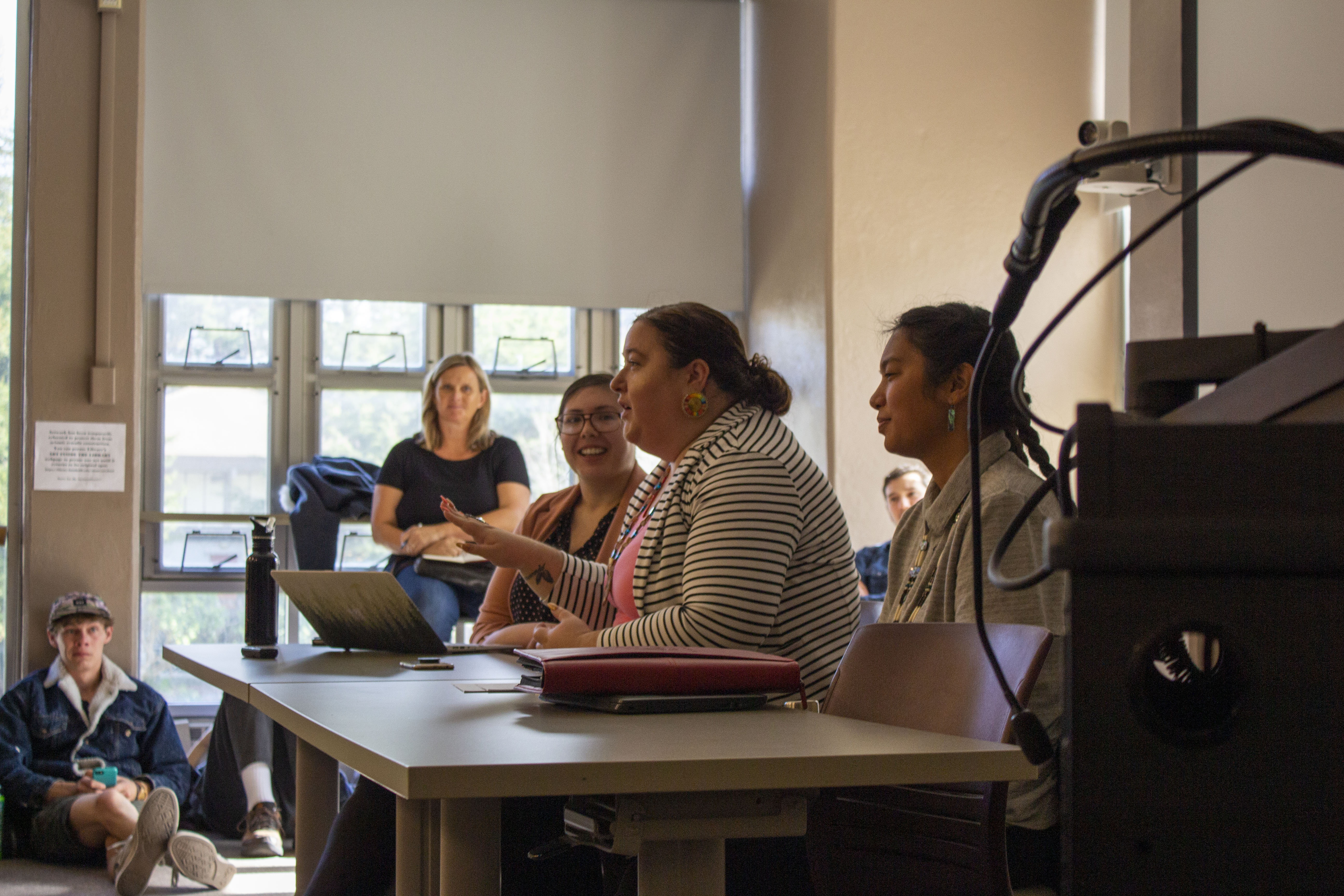
    Chelsea Miraflor Trillo, an Indigenous woman and participant of SBI, received her masters from Humboldt State. Trillo continues to work with SBI and families of missing and murdered Indigenous women to advocate awareness towards these issues.

    “Humboldt County is amongst one of the highest counties of missing and murdered Indigenous peoples,” Trillo said. “Students are usually in the area where community awareness and political action happen.”

    According to Lucchesi, Humboldt and Del Norte County hold a third of missing and murdered Indigenous women in California. Lucchesi said the justice system contributes to missing and murdered Indigenous women and the lack of action taken. Lucchesi said Indigenous women are considered non-human, and the justice system refuses to hold non-Native perpetrators responsible.

    Tammy Carpenter is a member of the SBI organization and an HSU alumna. Carpenter was subjected to the mistreatment of Indigenous people personally.

    “I, myself, am a mother of a victim that was murdered,” Carpenter said. “It’s still unsolved as of today, so I like to support the organization for the awareness for all women. Not just Indigenous women. All women.”

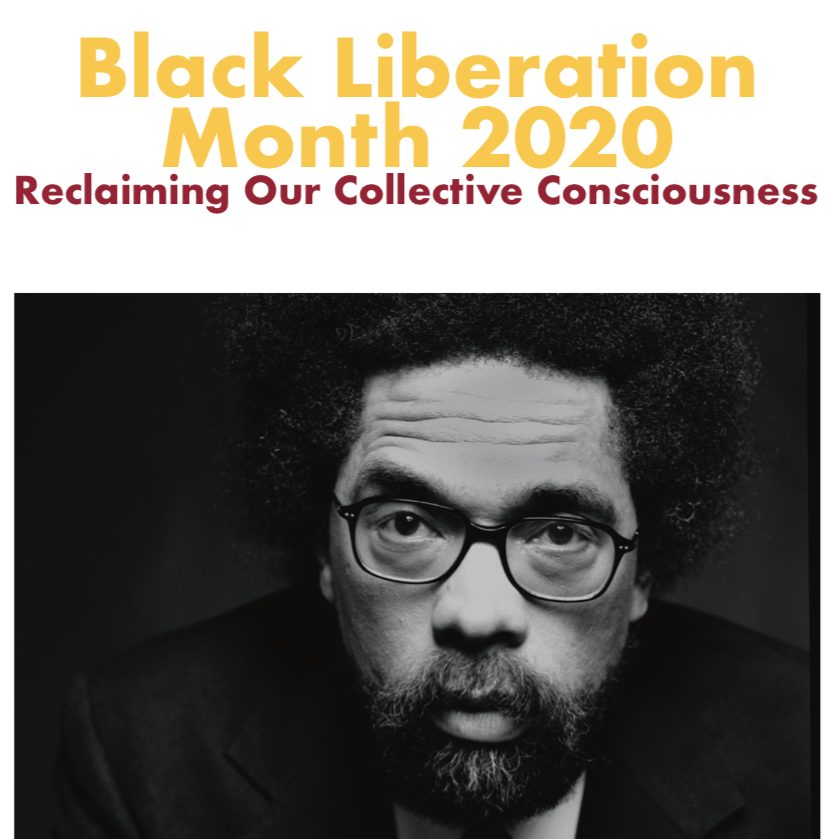
  • Dr. Cornel West Headlines Black Liberation Month at HSU

    Dr. Cornel West Headlines Black Liberation Month at HSU

    Philosopher, activist and intellectual Dr. Cornel West visiting Humboldt State University

    Dr. Cornel West will be at Humboldt State University Friday, Feb. 7 to celebrate Black Liberation Month as the keynote speaker of a series of events.

    West advocates for race, gender and class equality. West’s social and political activism goes back to his days at John F. Kennedy high school where he marched for civil rights and protested against the lack of diversity and black studies classes offered at the school.

    West went on to become class president of his high school before attending both Harvard and Princeton Universities. He is known for infusing the world with academic inference, intelligence and philosophical reflection.

    The event is hosted by HSU’s African American Center for Academic Excellence and HSU Brothers United.

    West’s lecture will focus on topics from his 1993 book, “Race Matters.” Doors open at 6:00 p.m. and the lecture begins at 7:00 p.m. in the Kate Buchanan Room.

    The first 100 students through the door with an ID will receive a free copy of “Race Matters.” Additional copies can be found at Northtown Books at 947 H St. in Arcata.

    Tickets are free and available at the University Center Ticket Office at HSU, which can be reached at (707) 826-3928.

  • Supreme Releases New Collection with Art from HSU Alumnus

    Supreme Releases New Collection with Art from HSU Alumnus

    Martin Wong’s lost art reemerges to bring awareness to a new generation

    Designer street style brand Supreme’s new collection highlights the life and art of Martin Wong.

    Wong, who embodied creativity, empathy and empowerment, lost his battle against an AIDS diagnosis in August of 1999, but his artwork continues to inspire and act as socio-political commentary after his death.

    Wong attended Humboldt State University in 1964, enrolling himself in every available art class before focusing his studies in ceramics. After graduating, Wong left the comfortable walls of university-life to influence the art scene and bring widespread awareness to minority groups often overshadowed by society.

    Wong’s family, friends and supporters partnered together on a collaborative collection with Supreme showcasing Wong’s lost works.

    Anneliis Beadnell, Senior Director and Director of Estates at P.P.O.W Gallery, a contemporary art gallery in New York that represents Wong and his work, explains Wong’s appeal to Supreme.

    “Over a year ago the artist KAWS, who is a good collector and friend of P.P.O.W, approached us to see if the Estate of Martin Wong would be interested in supporting a collaboration between Martin Wong’s work and Supreme,” Beadnell said. “The Estate was supportive, Martin’s circle of friends were encouraging and the collaboration felt right on many levels.”

    The collaboration, as well as the overwhelming support towards the partnership of artist and brand, reinforces the importance of Wong’s legacy, advocacy and support represented through his artwork.

    “Since Martin was interested in cultures that lived on the fringe of society, or outside the realm of the ‘art world,’ we felt that this collaboration would be successful in bringing his imagery into a new demographic.”

    Anneliis Beadnell

    “Through Supreme’s platform, a new generation who may not have had access to the works through visiting galleries or museums, will have a new way to enter into his work,” Beadnell said. “Since Martin was interested in cultures that lived on the fringe of society, or outside the realm of the ‘art world,’ we felt that this collaboration would be successful in bringing his imagery into a new demographic.”

    Like most of Wong’s art, the graphics showcase political and sometimes controversial subjects. Elements of poverty, misfortune and ruin bring attention to the unfair and inhumane treatment of minority groups. Encapsulating inclusion and representation was Wong’s strong suit.

    The ability to take those underrepresented into the spotlight ripples throughout his work. Idolizing the “unprofessional” and disrespected street artists allowed for new perspectives to emerge not only in Wong’s works, but in the art world in general.

    “In his lifetime, Martin gathered one of the largest graffiti collections in the world,” Beadnell said. “Martin turned to his friendship with the graffiti [artists] for collaboration and inspiration in his own works, which often took them as the subjects of various paintings.”

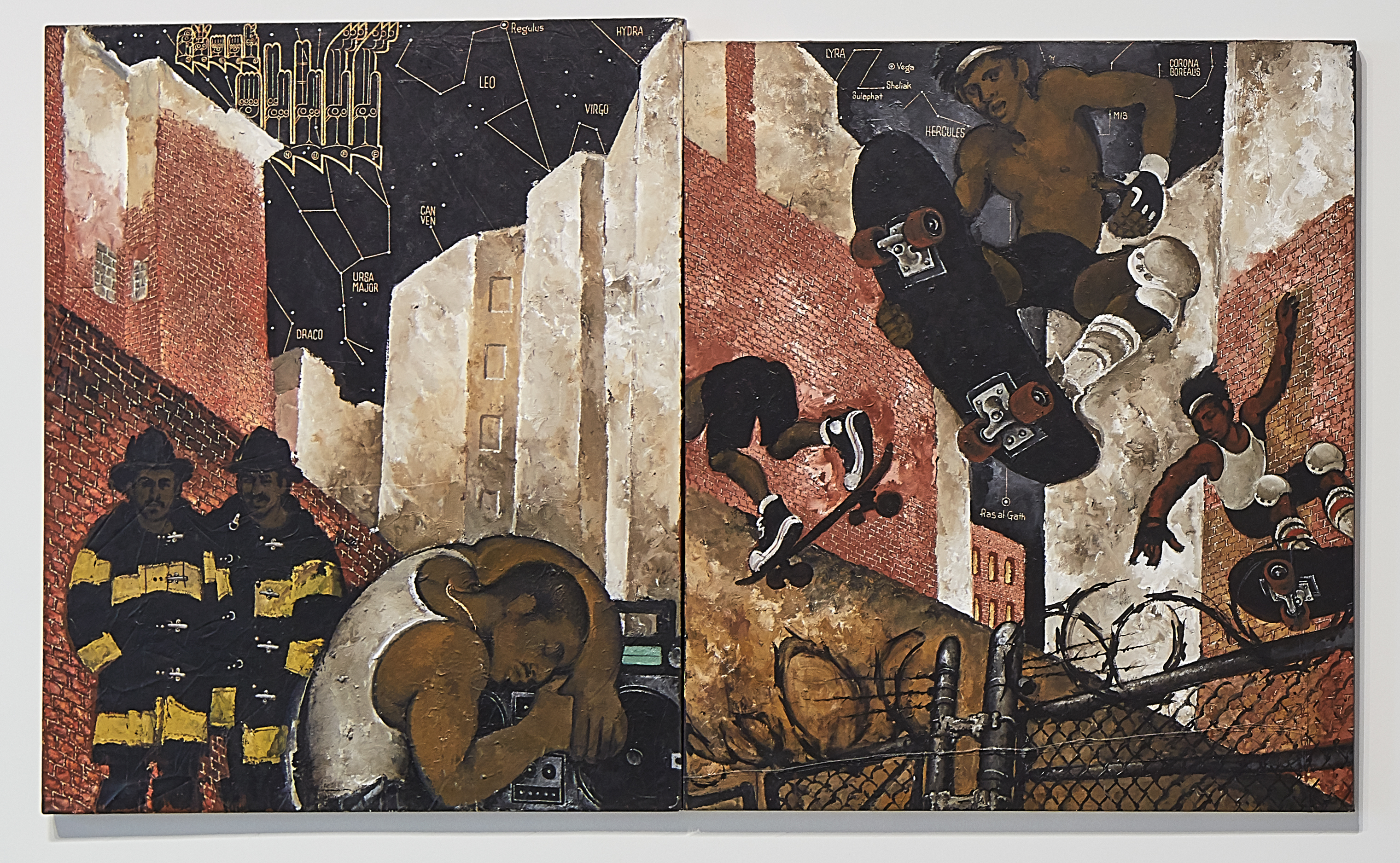
    According to Beadnell, Wong also created several paintings with skateboarders as the primary subjects, like “Sweet ‘Enuff,” a 1987 painting which is in the collection of the de Young Museum in San Francisco.

    Capturing moments ignored by mainstream society gifted Wong the ability to cast a new light on the struggles and discrepancies in subcultures, raising widespread awareness in the art world.

    This type of socio-political activism is still growing today, but there is a need for inclusion of identity and culture regardless of differences. Beadnell emphasized this and said the goal of the collaboration with Supreme was to reinforce those ideals with younger generations.

    “Wanting to extend his demographic outside of the ‘art world’ speaks to wanting to continue his legacy of influence and inspiration as an artist,” Beadnell said. “There is a strong youth culture that follows Supreme and the collaboration with Martin’s work may open a door for those that purchase the items and want to learn about Martin Wong’s contribution to our visual history and culture.”

    Wong’s work revolutionized the stigmas that dismissed groups from society, specifically focusing on the disadvantaged and underrepresented. From sexual orientation and economic standing to uncontrollable impairments, capturing the essence of groups often labeled insignificant or unworthy earned Wong his title of an activist and a visionary.

    “Being that Martin was a gay Asian American, we hope this level of visibility will inspire others, that may have shared histories and identities, to look to Martin as a point of inspiration.”

    Anneliis Beadnell

    “Martin’s paintings connect to the denizens of the Loisaida, the crumbling tenement bricks and urban landscapes, the places where creative subculture thrived and since has been erased by gentrification,” Beadnell said. “The iconography that emerged through Martin’s depiction of the Lower East Side, of closed storefronts, firemen, ASL symbols, constellations and flaming eight balls became graphic points of interest for the line.”

    Although Wong died over 20 years ago. His life and death are ever significant. More than 36 million people are currently suffering from HIV related illnesses.

    The re-emergence of previously destroyed creative outlets allows the newer generation access to the extinguished memories and documentation of the past. The revamped accessibility stems with the hope of generating more activism for the future.

    December 1 is World AIDS Day, recognizing and bringing awareness to the pandemic caused by HIV and mourning those who have died from the disease.

    “Being that Martin was a gay Asian American, we hope this level of visibility will inspire others, that may have shared histories and identities, to look to Martin as a point of inspiration,” Beadnell said.

  • A bus crash survivor’s truth

    A bus crash survivor’s truth

    2014 bus crash survivor now turned activist, Santiago Calderon shares his story

    In 2014, a Spring Preview bus trip filled with many prospective students travling to HSU from southern California was cut short when a Fedex truck collided into it. Five years later, bus crash survivor and activist, Santiago Calderon continues to fight and share his story to save more lives.

    IMG_2145 2.jpg
    Santiago Calderon holds his cat Henny as they swing on his porch swing. | Photo by Dajonea Robinson

    [perfectpullquote align=”right” bordertop=”false” cite=”Santiago Calderon” link=”” color=”” class=”” size=”16″]“I escaped to survive. I was pulled out by God, by some entity and landed head first on my shoulder from the charter bus window.”[/perfectpullquote]

    Calderon went to Oxnard high school located in North Oxnard and graduated in 2014. He is now 22 years young and has a cat named Henny. Calderon played football for 10 years and had plans of continuing his football career in college but, the bus crash changed it all. Calderon said the crash took his life away from him.

    “Football was my life, it was everything,” Calderon said. “I escaped to survive. I was pulled out by God, by some entity and landed head first on my shoulder from the charter bus window.”

    [perfectpullquote align=”left” bordertop=”false” cite=”Santiago Calderon” link=”” color=”” class=”” size=”18″]“I saw death, I saw war, I saw trauma, torment… I saw hell on Earth.”[/perfectpullquote]

    Calderon said he has vivid flashbacks of the collision. He said the visual of the red Fedex truck crossing the median right before impact, is screwed into his brain. Calderon described that day as the worst day of his life.

    “I saw death, I saw war, I saw trauma, torment, I saw hell on Earth,” Calderon said. “That day I accepted death because I didn’t think I was going to make it. I told myself I’m not going to live in fear, to have happy thoughts before I die. I started thinking about my family. The life that I’m losing.”

    Calderon said that during the collision he felt everything, and nothing at once. That he felt numb, completely numb. Calderon said that at some points he was so distraught couldn’t believe it and told himself that he was hallucinating.

    “I remember asking the paramedics ‘Is this real?’and then I began to cry,” Calderon said. “Part of me died on that bus, I don’t know who I am anymore. I don’t know who I was before. I was broken, shattered in pieces and so much more after the crash.”

    IMG_2112.JPG
    Satiago Calderon’s mother, Corinne Pinon looks off into the distance. | Photo by Dajonea Robinson

    Corinne Pinon is Calderon’s mother. She and her family has been Calderon’s backbone since the crash and continues to deal with the after effects that stemmed from the incident. Pinon described Calderon before the accident as a great athlete, a honors student, and a happy carefree kid.

    “The therapist said back then he lost his childhood that day, he was only 17,” Pinon said.

    [perfectpullquote align=”right” bordertop=”false” cite=”Corinne Pinon” link=”” color=”” class=”” size=”17″]“Our family is barely holding on by a string to continue to help him. He is not a happy person. He has survivor’s guilt.”[/perfectpullquote]

    Pinon said that her family is still healing and learning how to cope from the crash. She said that she’s not sure what’s the right or wrong thing is to do but her family keeps on trying.

    “Our family is barely holding on by a string to continue to help him,” Pinon said. “He is not a happy person. He has survivor’s guilt. Like [Calderon] said, it’s easier if he didn’t make because living with this, even for me, his dad and his brother, is pretty unbearable.”

    Pinon said Calderon is definitely a different person than he would have been if the crash didn’t happen.

    Calderon suffers from mental health issues that stemmed from the crash. He was diagnosed with PTSD and bipolar disorder. He has tried therapy but is now trying PTSD groups and other programs.

    Calderon went to HSU for four years and studied psychology to learn how the mind and how people function. Calderon had a psychotic break in May and had to move back home down south from Humboldt County. He described the episode as a very dark moment in his life.

    IMG_2116.JPG

    Calderon said he’s not done recovering. He said the crash lead to PTSD related actions he never thought he’d make. That the crash caused chaos in his head, and the over analyzing of everything.

    “I’ll go into a room and I’ll figure out how to get out alive,” Calderon said. “I’ll do everything I can to stay alive. I feel like everywhere I go I’m going to die. That’s a scary feeling, it’s something I learned to live with. Something that has given me such strength and courage.”

    Calderon said that he’s in a continuous fight. When he’s low he sometimes has suicidal thoughts, and feels that it’d be easier just to stop but that is not what his God wants.

    “I will not be afraid, I have no fear in my heart, I have no fear,” Calderon said. “ I went through hell on earth. I will never stop recovering. How could you be normal after something like that? You can’t. I’ll never be the same person. I lost Santi that day but a new Santi arose a stronger Santi.”

    IMG_2157.JPG
    Angelica Espinoza is a close friend of Santiago Calderon. She is pictured outside of Calderon’s home on a tie swing. | Photo by Dajonea Robinson

    Angelica Espinoza is a close friend of Calderon. They have a relationship that heals each other when they’re both down. Espinoza said that they reunited at a good time because they were both in a dark place struggling with depression.

    “We just talked about healing, we didn’t talk about the crash,” Espinoza said. “It’s really a brotherly/sisterly bond with a lot of caring and deep conversations. We talk a lot of scripture. We’ve been finding answers through scriptures.”

    Calderon received various emails from news agencies after the incident. Calderon said that he came across a message from a man named Harry who is the executive of the Truck Safety Coalition.

    Calderon said that Harry’s message was different. The coalition was fighting against unjust policies that would make roads even more dangerous and, that was something Calderon wanted to be apart of.

    “A truck is like a moving missile on the highway,” Calderon said. “That was a missile, the bus exploded-the charter bus exploded. What if the ruck was 22 feet longer and went 22 feet more into our bus? More people would have died.”

    IMG_2173.JPG
    Corinne Pinon, Santiago Calderon, and Angelica Espinoza sit on Calderon’s family porch. | Photo by Dajonea Robinson

    Every two years the coalition has a conference in Washington D.C. to fight against unjust trucking policies. The coalition educates themselves of the laws and policies that are in the works to better create ideas to stop them.

    [perfectpullquote align=”left” bordertop=”false” cite=”Santiago Calderon” link=”” color=”” class=”” size=”16″]”We have to prepare for war, because we’re fighting for change. We’re fighting for policies that should never happen. We’re fighting for safety procedures that should happen.”[/perfectpullquote]

    Calderon said the coalition plans on fighting a good fight. This year Calderon and his truck coalition members will be in Washington D.C. July 13 through 17 for a week of action.

    “We have to prepare for war, because we’re fighting for change,” Calderon said. “We’re fighting for policies that should never happen. We’re fighting for safety procedures that should happen.”

    Calderon has been apart of the coalition since 2015 and has been striving to save lives ever since.

    “I don’t know where I would be if I didn’t have my truck coalition family behind me,” Calderon said. “They are my family. I would be more lost than I am. The coalition makes me feel like I never went through it. To gain such hope, such courage, we’re like any army fighting against injustices.”

    Calderon does not plan on giving up and succumbing to the obstacles life throws at him. He feels as though he’s doing godly work.

    IMG_2170.JPG
    Santiago Calderon sits on his porch in southern California. | Photo by Dajonea Robinson

    [perfectpullquote align=”right” bordertop=”false” cite=”Santiago Calderon” link=”” color=”” class=”” size=”16″]“If I could, I would die for everyone if that meant for everyone to be good. Saving lives is everything I do.”[/perfectpullquote]

    Calderon wants to be a vessel of God. He wants to let the light shine brighter than it has been before. He feels that he is the light in this world of darkness.

    “If I could, I would die for everyone if that meant for everyone to be good,” Calderon said. “Saving lives is everything I do. I want to hear laughter, I want to see joy and people’s pearly whites. I want the injustices to stop. I want people to hear us and see us. I want truck services to care about truck safety and to actually listen. All we’re trying to do is save lives. That’s all we want.”