The Lumberjack


Students Serving The Cal Poly Humboldt Campus and Community Since 1929

Tag: Animals

  • Think of the critters

    Think of the critters

    by Jake Hyslop

    Ah, the rainy season is upon us. Despite the odd sunny, muggy day that Humboldt likes to shuffle into the fall and winter seasons like a wild card, it is getting cloudier and more drizzly, slowly but surely. 

    I quite like rainy weather, so I couldn’t be happier in that regard. With an umbrella or other rain gear, the inconvenience can be diminished into an enjoyable aesthetic. Sometimes I be out here just raw dogging the downpour with a T-shirt and shorts. Yes, swampy shoes are the worst, but watching where you step is an easy way to avoid that nightmare. 

    Speaking of watching where you step, that brings me to the point of this ramble. I am not the only creature who thrives in the rain (as are many of you, excluding the rainphobic). Allow me to paint a picture for you. 

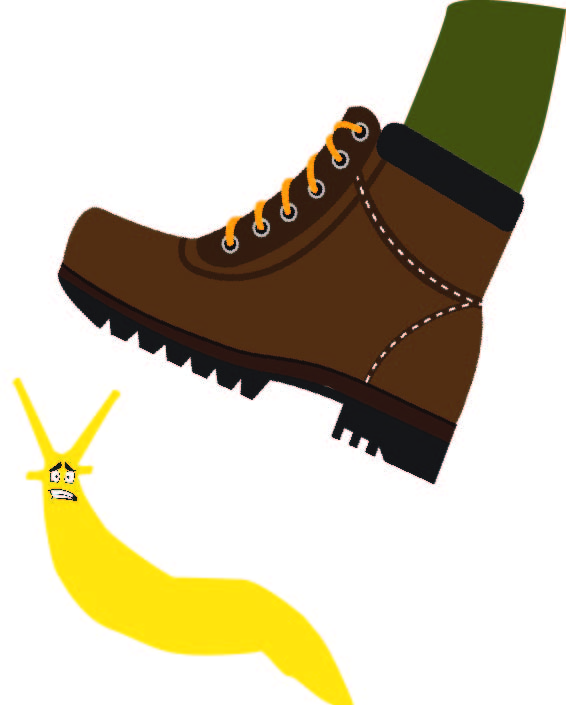
    Thousands of students, staff, and faculty traverse campus on foot to some degree, day-in and day-out. They avoid puddles and stroll along the sidewalk to their class or job. Every once in a while, someone hears a crunch or a pop underfoot, but often it’s so small they think nothing of it. Little do they know, the blatant endangerment they are causing.

    Yes dear reader, from the arboreal salamander to the simple snail, and all the slugs, worms, and more in-between, there is an entire ecosystem of creatures that love the rain more than we do. In fact, rain is an outright necessity for these creatures. 

    Snails and slugs rely on moisture to survive, making them extremely active during the rain. All kinds of worms use rainy days to migrate, as above ground is normally too dry for them. Salamanders and frogs migrate and breed in the rain as well. 

    These creatures have no choice but to sometimes venture onto the cold, wet pavement in order to fulfill their quests. But often, too often, they never make it. 

    That’s right. Martha the earthworm travels the equivalent of many human miles in order to meet her lover, Jim, only for her soul to be snuffed by a single checkerboard Adidas slip-on. 

    The worst thing about these literal crimes against nature, is that they are crimes of negligence. It is incredibly easy to not step on and crush a helpless critter. All it takes is a little look down every few steps.

    Unless you have some sort of neck mobility issue, there is no excuse not to look where you’re stepping and avoid crushing a snail into paste. No, they cannot move to a new shell. That is a myth. Snails ride or die for their shell. 

    We cannot blame the critters for getting in the way. After all, there didn’t used to be concrete on their path. We must be better. Next time you’re out on your travels during a particularly damp day, think of the critters and watch where you step.
  • Beached Whale on Samoa Peninsula

    Beached Whale on Samoa Peninsula

    Despite help from wildlife responders, the whale has died

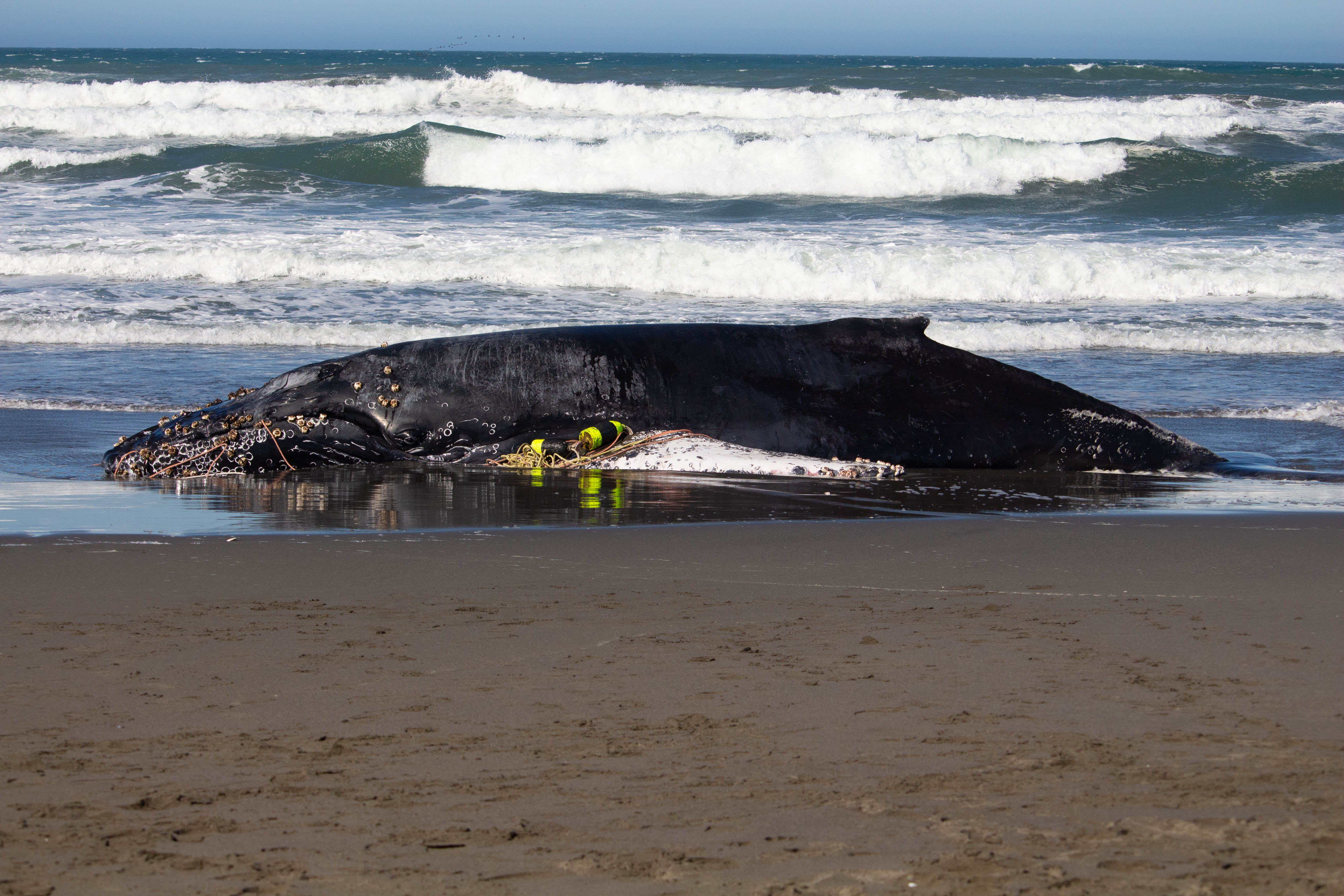
    A humpback whale was found washed ashore on the south end of the Samoa Peninsula early Wednesday morning.

    Eureka resident Berkeley Kijsriopas was on her morning beach walk with her mother and found the whale. It appeared to be wrapped up in a large fish net.

    The pair made a quick call to animal rescuers from HSU’s Marine Wildlife Care Center. Animal rescuers, including HSU’s Dawn Goley, were the first to arrive on the scene, followed by Samoa Peninsula Fire District and the National Oceanic and Aeronautic Administration.

    Humboldt Wildlife Care Center staff rehabilitation Lucinda Adamson was at the scene to help keep people away from the whale as marine biologists worked through an effective plan to cut ties from the whale without harming it.

    Locals gathered with their dogs on leashes and phones in hand as they tried to capture the moment without stressing the whale or the wildlife responders. 

    “Those from NOAA here are working with people from around the country to figure out the best way to help the whale and keep the people safe,” Adamson said. “I’ve just been helping to get gear and people back to keep the whale’s stress down.”

    Earlier today, there seemed to be no serious concerns that the whale may lose its life, but according to Goley and reporting by the Lost Coast Outpost, high tide isn’t until after 8 p.m. tonight and as time passes its chance of survival slims.

    People will continue to work on getting the whale back out to the water as soon as possible, and despite high tide’s timing, there is a chance of the whale floating back out before then.

    “They’ve been cutting some of the lines from him,” Adamson said. “But they’ve been doing a lot of assessments and just trying to get him back out there safely.” 

    Update: The whale has successfully been disentangled, but rescuers are waiting for the tide to rise to ensure he gets back out in the water.

    Update: The whale is still on Samoa beach, but it is alive. Goley remains on the scene, and has been accompanied by sheriff’s deputies and game wardens along with the marine mammal rescuers.

    Update, Thursday 9 p.m.: The whale has died. Goley, along with members of the Northcoast Marine Mammal Center and the NOAA, conducted health assessments, determined the whale wouldn’t make it through yet another night out of the water and decided humane euthanasia was the whale’s best option.

  • My beef with killing the meat industry

    My beef with killing the meat industry

    Eliminating the meat industry would do more harm than good to our planet. The idea that animal agriculture is completely unethical and impractical is false.

    The media does a fine job of antagonizing the meat industry, and we all know about the documentaries that reveal the ugly truth behind factory farming, such as Food, Inc. But have you ever thought about what would happen if we put an end to animal agriculture all together?

    “Agriculture cannot be sustainable without animal agriculture,” said Dr. Frank Mitloehner, Animal Science professor at UC Davis. “That is something I’m sure of.”

    For instance, livestock grazing is used as a tool to stimulate soil production, which in turn removes carbon dioxide from the atmosphere. When herds trample through pastures, they oxygenate soil while pushing down seeds that ultimately promote healthy land restoration. Also, excrement produced along the way fertilizes soil. If managed correctly, livestock distribution can be beneficial to the environment.

    “Soils of the world must be part of any agenda to address climate change, as well as food and water security,” said Dr. Rattan Lal, professor of Soil Science at The Ohio State University.

    Animal parts that are not consumed, such as bones or fat, do not get wasted in the Netherlands. Renewable products from soaps to heart valve replacements are sourced from slaughtered pigs.

    The Dutch eat about a third of the pig “and the rest is exported to all kinds of countries in Europe and the rest of the world,” said Christien Meindertsma, a Dutch artist who is known for using raw materials in her work.

    The truth is that we need to reduce our inherited carbon footprint habits: transportation, dieting and consumerism. The global food production and consumption, namely beef, produce more greenhouse emissions than all of transportation combined. In addition, eating less meat could reduce the risk of heart disease and other health-related issues.

    In extreme cases of either a world full of meat eaters or vegetarians, moderation is the middle ground. Following one extreme over the other will not reduce global warming. We can start by agreeing that livestock is a crucial part of the agricultural system.

  • This week in STEM

    This week in STEM

    By | Bryan Donoghue

    Elon Musk continues to make new announcements on rockets that will help us travel to far away places, but recently he’s getting in touch with his roots. Rather than 12-meter rockets he’s been wanting to go to Mars with, Musk is opting to launch smaller vehicles that are only about nine meters tall. These rockets can travel up to 18,000 miles per hour, making long-distances shorter. Musk said that any two points on Earth would be less than an hour apart. Buying a ticket for a seat will cost the same as full fare economy in an airplane.

    Source: New York Times

    Our species’ origins are close to 200,000 years old according to some investigators. Through a recent study on a boy who lived in South Africa 2,000 years ago, Homo sapiens may have emerged as a genetically distinct species as early as 350,000 years ago. Researchers retrieved a complete version of the ancient boy’s DNA from his skeleton to compare with DNA from modern people and Stone Age species. The boy’s DNA is not affected by the migrations that occurred 2,000 years ago, so evolutionary geneticist Carina Schlebusch of Uppsala University in Sweden finds it to be the best benchmark so far for gauging when Homo sapiens originated in Africa.

    Source: Science News


    Animals travel the world’s oceans on makeshift rafts, whether they’re synthetic or natural. The 2011 Japanese tsunami caused a mega-rafting event and objects from Japan traveled as far as 7,000 km. The tsunami transported hundreds of species to the United States and Canada. Researchers have documented animals on 635 debris objects such as docks and buoys. There were 279 living Japanese invertebrate and fish species, with about 20 species together in each piece of debris. As the world population grows, the amount of waste entering the ocean will rise. Due to this, in the future of our coasts could become a lot less diverse.

    Source: Science Magazine


    Cells can be reprogrammed using mixtures of DNA, RNA and proteins. The most popular method uses viruses as a delivery vehicle—although they can infect unintended cells, provoke immune responses and even turn cells cancerous. Now there’s another process known as tissue nanotransfection, which involves a chip holding an array of tiny channels that apply electric fields to individual cells. This gives the chip the ability to convert or reprogram cells into other types, which has raised hopes for regenerating damaged limbs and organs. Researchers used the chip to restored the legs of injured mice and claim the technique is developed enough to test on people.


    Source: Scientific American

  • Who Knew @ HSU? : The Wildlife Museum

    Who Knew @ HSU? : The Wildlife Museum

    Did you know the wildlife building has over 15,000 animal specimens. In this installment of Who Knew @ HSU? we take a look at the Wildlife Museum which offers a way for students to research animals close up.

    Video by Alex Hasenstab