The Lumberjack


Students Serving The Cal Poly Humboldt Campus and Community Since 1929

Tag: Arcata

  • It’s getting hard to be Jewish on campus

    It’s getting hard to be Jewish on campus

    by Zack Mink

    The biggest challenge with being Jewish on campus at Cal Poly Humboldt used to be the lack of community. There are small groups here and there but nothing that reminds me of home: a more reformed, modern take on Judaism. After the massacre on Oct. 7, 2023, being Jewish on campus has led to issues that I would not have expected from a school or peers that seemed to hold an immense amount of respect for minorities and Indigenous people. I still see these empathetic and humane values in some individuals, but from my experience it has become too easy for people to pick and choose who they respect, value, or who they are open to hearing from. This in turn has led to a new level of blatant antisemitism that I have not experienced before. 

    I want to make it clear that this piece is not about my opinions on the current geopolitical conflict between Israel and Hamas in Gaza, because I couldn’t even begin to take on that responsibility. I’m here simply to share that antisemitism is alive and well at Cal Poly Humboldt, and that finding a middle ground, having empathy and seeking peace is productive rather than dismissing, accusing or blatantly hating someone for sharing their lived experiences.

    Something that I have made clear since Oct. 7 is that I don’t want people to die. I don’t want death, destruction, genocide, ethnic cleansing or anything else that brings harm to Palestinians in Gaza or the civilians in Israel. This may seem basic to just objectively have empathy for human life, yet that is something that I always feel is missing when people send me hateful anti-semitic DMs accusing me of white supremacy, or of being a genocidal colonist. What they don’t see, or perhaps turn a blind eye to, is me consistently looking to educate myself as an American Jew using resources by Jews, Palestinians, Israelis, historical experts and anyone else providing concrete facts (modern or historical), because one perspective isn’t enough.

    Just two days after Oct. 7, anti-semitic messages were written on the sukkah on campus. A sukkah is a traditional Jewish structure used to celebrate the holiday Sukkot. The one thing that was on campus representing Jews (with no connection to the state of Israel) was vandalized. This outward act of anti-semitism was simply the beginning for me. 

    Just days after, a close friend and business mentor of mine who prides themselves on their knowledge of Indigenous history as well as supporting minorities self-determination and equal rights began discussing Jewish history with me. Since I trusted her as someone who is extremely educated on these topics, I wanted to understand her perspective on the current conflict, however different it might be from mine. A conversation I assumed would lead to progress for both of us. After this conversation, I discovered that she had unfollowed me, unshared her location, and essentially cut me out of her life completely. When I asked why, or if she would have another meaningful conversation with me, she said no because of our fundamental disagreements—the fundamental disagreement being that Jews are from the land of modern day Israel. 

    With thousands of years of documentation, it is quite clear and flat out historically accurate that Jewish people come from the Kingdom of Judea (previously colonized by the British, Ottomans, Crusaders, Arabs, Romans, Greeks, etc.) Does this take away from Palestinians’ lived experiences today? Absolutely not. Does it justify the actions of the Israeli government? Absolutely not. Is denying this fact erasing Jewish history and their connection to the land? Absolutely. 

    While I sit here holding empathy for Palestinian civilians in Gaza, acknowledging their pain, struggles and lived experiences, I simultaneously speak about Jewish lived experiences and Jewish history. We can and need to strive for peace, acknowledge and appreciate each other’s connection to the land, value life and not invalidate others to validate ourselves. 

  • Two complaints were the basis for evicting over one dozen homeless Cal Poly Humboldt students

    Two complaints were the basis for evicting over one dozen homeless Cal Poly Humboldt students

    by Jasmin Shirazian

    Alleged complaints regarding unsanitary conditions created by students living in vehicles on campus didn’t exist when university administrators forced students living in their vehicles off-campus in November. 

    Aileen Yoo, Director of News and Information for Cal Poly Humboldt Marketing and Communications, was unable to find any formally filed complaints against alternative living students. 

    “There were no formal complaints filed with the University Police Department but there were informal complaints to UPD, Parking Services, and Facilities Management,” Yoo said in a Jan. 16 email. The italics are hers.

    After informing Yoo of the existing formal complaints and requesting any records of the alleged informal complaints, Lumberjack reporters did not receive a response.

    Cal Poly Humboldt released a campus-wide email stating the enforcement of parking regulations and ultimately the removal of students living within their vehicles on campus on Oct. 25, 2023.

    “There have been an increasing number of RVs and other vehicles parked long-term in University lots across campus,” Cal Poly Humboldt’s email read. “These vehicles are in permit-only parking spots, and have been parked in spaces overnight in violation of University policy that includes a prohibition on overnight camping on campus and overnight parking for anyone not living in University housing.”

    The email contained a statement that these students had received an unspecified amount of complaints regarding their living in on-campus parking.

    “Policy aside, overnight camping in University parking lots creates unsanitary and unsafe conditions for both those encamped and for our campus community at large,” the email read. “The University Police Department and other campus offices have taken calls from concerned members of the campus community expressing fear and frustration about the situation.”

    Only two formally filed complaints were made to UPD by the same people, listed only as RP and Pt, on Oct. 6 and Oct. 7, 2023. The complaints were obtained by The Lumberjack through a public records request 

    “RP owns the property at [redacted] and believes some of our houseless students are people associated with camping in the 14th and Union parking lots are jumping her fence to her unoccupied property at [redacted],” the Oct. 6 report states. “RP sent a photo of the subject who was unrecognizable.”

    The following day, UPD received another complaint from RP. This time, a person identified as Pt is mentioned in the same report, though their relation is unknown. 

    “RP calling back to report RV parked x 2 nights [across] the street from her residence,” the Oct. 7 report states. “Pt states there are ‘several men’ coming and going from the RV. RP is requesting a patrol check of the area. Subject contacted and they advise they will be moving RV.”

    The news of being removed from campus came as a shock to many alternative living students, who had recently formed a club to solidify the bond of their community. Some of these students even recall speaking to parking enforcement and housing administrators about their alternative housing plans prior to moving, to which they received no rejection or denial. 

    Carrie White, a biology major on a pre-medicine track, is one of the students who was pushed off campus by parking enforcement. 

    “Since I was forced to leave campus, I have continued to live in my vehicle, but I am parked in another parking lot,” White said. “I leave before dawn to avoid any potential issues occurring despite having permission to stay where I am. I stay away all day, moving between other street parking, lot parking and the coast line. I return later in the evening.” 

    White was already under tremendous stress when the university notified the students that they had to vacate the parking lots by Nov. 12, 2023, giving them two weeks to find accommodations. 

    “At the time, I had a friend that had just passed away, a sick grandfather, and finals,” White said. “There was a total lack of consideration of my humanity; I might have other things happening in my life besides living in my car, which is hard enough at times. It was a tone-deaf decision on behalf of the university, in my opinion.”

    Journalism major Brad Butterfield, who is also the science editor of The Lumberjack, is an alternative living student who has been living in his van on campus for several semesters. In an email to parking enforcement, Butterfield explained his situation and received a message stating that parking enforcers were aware of students living in their vehicles on campus. In Butterfield’s email, he specifically asked if the school allowed overnight parking if proper permits were displayed.

    “Parking is enforced from 7AM to 10PM, Monday through Friday,” Michaela Old, a parking enforcement employee said. “As long as you have a valid permit you will be able to park – also keep in mind that parking spaces are first come first serve.” 

    Several students said they attempted to acquire documentation of or information about the complaints, but were ultimately left without answers. 

    Recent graduate Maddy Montiel was in their last semester when they were notified of the parking enforcements. Montiel was finally becoming comfortable in their community after nine years in college, four of those spent at Humboldt. 

    “My last semester meant a lot to me,” Montiel said. “I was finally at the finish line, finally letting myself have some fun and deepen friendships. I joined more clubs and went to more events; I let myself enjoy the beautiful environment our school sits in. [I] remembered why I decided to move here and take all the risks I did to be here. I was finally getting what felt like a ‘college experience…  for the first time, I started to feel safe.” 

    This changed when Montiel had to vacate the parking lot in which the community formed. 

    “Having to spend my last couple months of what I thought was a graceful and beautiful end to my college experience, fighting for basic answers and the right to stay on campus until at least the end of the semester, only to have the door shut in my face over and over, was beyond disheartening,” Montiel said. “Since being kicked off campus, I’ve had to live at the community center and on city streets again. Always being on the move gets exhausting.”

    The vacating of students has left many of those affected, such as freshmen MA public sociology student Caleb Chen, feeling disheartened by the university’s decisions. 

    “I feel that this… has highlighted exactly how out of touch the administration and especially the President’s office is from their student body,” Chen said. “When the [administrative] office blatantly ignores the wishes and insights of everybody else, a university is doomed.”

    White shares a similar sentiment. 

    “One of the most hurtful things about that original email from Cal Poly Humboldt was that I realized I was totally disillusioned,” White said. “I chose to invest my time and money in this institution because I believed in its values and inclusivity policy, but upon that email being sent out, I realized that Cal Poly Humboldt is just that: an institution – with dollar signs for eyes.”

    Brad Butterfield is the science editor for the Lumberjack. He had no involvement with the making of this article.

  • Signs of Passage: Nostalgia and New Beginnings

    Signs of Passage: Nostalgia and New Beginnings

    By Christina Mehr

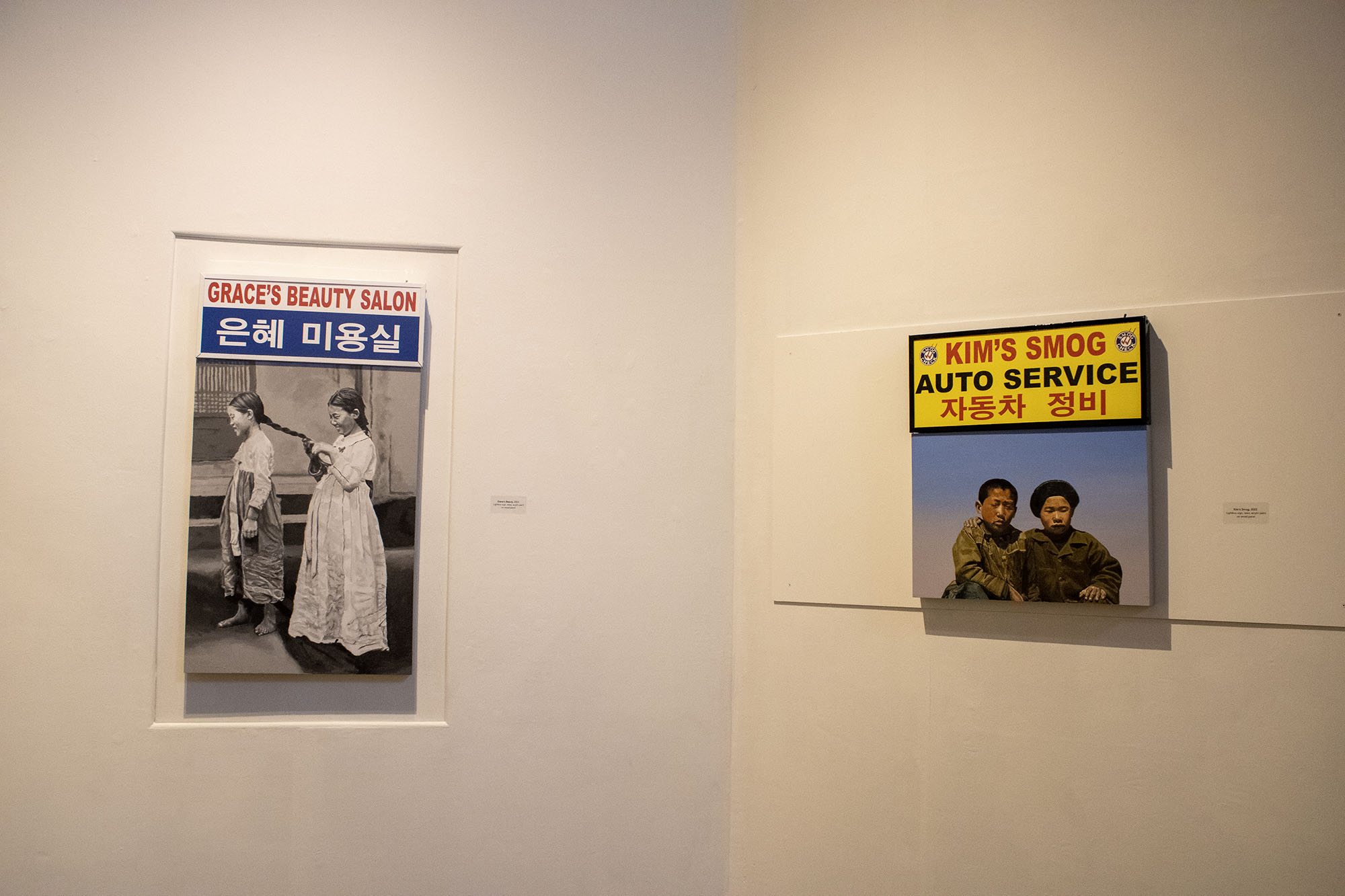
    Signs of Passage: Nostalgia and New Beginnings debuted in the Reese Bullen Gallery at Cal Poly Humboldt on Nov 8. The exhibition runs through Dec. 9 [2023] in the Art Building. 

    The Reese Bullen Gallery is named in honor of a founding professor of the Art Department and has been an addition to Humboldt since 1970. The gallery usually contains the university’s permanent collection of art and sponsors exhibitions of works by professional artists related to many different areas of instruction. The Reese Bullen Gallery also presents an annual exhibition of student art in May, the Graduating Student Exhibition.

    The mission of the Reese Bullen Gallery is to offer free and publicly accessible exhibitions representing artists from all demographics. Extending beyond Humboldt, the Gallery seeks to strengthen partnerships with local communities as well as stimulate support and participation in the arts. 

    This new body of work presented by Dave Young Kim at the Reese Bullen Gallery uses latex paint on wood panels. 

    Dave Young Kim is a Los-Angeles based artist who visited Humboldt County with a newly created body of work for his solo exhibition at the Cal Poly Humboldt Reese Bullen Gallery. Kim is a fine artist, born and raised in Los Angeles. He received his Bachelors of Fine Arts Degree in Studio Art from the University of California, Davis, and a Master of Fine Arts in Studio Art from Mills College. 

    His current display of work engages with the quality of home and explores themes of nostalgia, war, conflict and displacement. Through his work, Kim explores the unifying search for belonging across disparate conditions. In 2020, he co-founded the Korean American Artist Collective (KAAC), which is a group of artists building a community around work rooted in the Korean-American experience. In 2021, he was a selected muralist for the Eureka Street Art Fest and in connection with the Eureka Chinatown Project to paint a mural named Fowl. 

    “My work plays with that idea of manufacturing nostalgia as integrated with my family history, memory, and identity,” Kim said. “My artistic approach is drawn from a sense of loss or longing, looking for a place to belong.”

    His online portfolio can be found at https://www.daveyoungkim.com

    Goudi’ni Native American Arts Gallery displays “Tintah: Amongst The Trails” 

    Robert Benson’s Redwood Sculptures and Watercolor Studies

    By Christina Mehr

    In collaboration with Cal Poly Humboldt, Robert Benson presents his work in “Tintah: Amongst The Trails” at the bottom floor of the Behavioral & Social Sciences Building.

    The art installations of Native art used the mediums of watercolor and wood pieces. Focusing on a new body of work, Tintah, Hupa language for amongst the trails, features newly carved salvaged old-growth redwood sculptures and watercolor studies. Robert Benson, is a leading figure among artists in the NorthWest California art world. He has worked as a teacher for more than 30 years at the College of the Redwoods, as well as being a curator of Native art.

    Tall sculptural wooden carvings adorn the exhibit and viewers must make their way through the art, almost like walking amongst the trails. Redwood slabs carved into beautiful sculptures lined the room. 

    His current paintings and sculptures are filled with imagery of trails, both of the literal kind and suggested. With Benson’s deep connections to the environment and land, those motifs clearly shine throughout his work. 

    “There is the trail into our family hunting camp that I traveled for more than 50 years, there are trails handed down through stories and mythologies, and there are the trails of imagination,” Benson says. “When we consider that at the most basic level, a trail is just something connecting two points, even the ladder and stairway forms that populate my work can be viewed as kinds of trails. To be amongst the trails is to find your rhythm, your place and to discover the interplay between that rhythm and the melody of the universe.” 

    This solo exhibition was installed by the Art + Film Department Museum & Gallery Practices class under the direction of Assistant Professor Berit Potter and Gallery Director Brittany Britton. This exhibition was partially funded by Instructionally Related Activity Fees. 

    Photo courtesy of Goudi’ni Native American Arts Gallery
  • Jasmin Corner; leave your situationship

    Jasmin Corner; leave your situationship

    By Jasmin Shirazian

    Hi Jasmin, 

    Can I be in love with someone I’m not dating? This situationship has got me fucked up.

    How do I answer this without coming off like a complete bitch? Your situationship is not real. That’s not to say your feelings aren’t real, or that the love doesn’t exist – but a situationship is not a real thing. The creation of the label “situationship” has opened the doors for this generation to participate in an unwinnable battle: The IDGAF wars. I like you, so let’s find out which one of us can care the least to keep the other person interested without fully committing? 

    What is a situationship? To me, it’s one person caring more than the other. One person giving more than the other. One person receiving more than the other — you get it. A situationship will never fulfill you in the ways you’re looking for. Rather, this infatuation will leave you feeling more hollow. One person will always have more power than the other. 

    That’s not to say I don’t understand where you’re coming from; you caught feelings for the wrong person. It happens to the best of us. At the core of it, we are all just creatures looking for love, security, comfort, happiness; we want to feel desired and safe. There is no safety in a situationship. In fact, more often than not, they all have a three month shelf life. Seriously, name one situationship where things stayed good after that three month mark — if that existed, it would evolve into a relationship. 

    “We accept the love we think we deserve.”

    Everyone, their mother and their mother’s single best friend knows this phrase. It’s true though! We often don’t love ourselves enough to believe we deserve better, and so we stay in the situation(ships) we know because it’s the space we’ve decided to fill. You deserve to take up space with someone who will appreciate how you light up the room. 

    xoxo, 

    Jasmin

  • I don’t tell people I’m autistic. I’m trying to change that.

    By Griffin Mancuso

    When I was 14 going into my freshman year of high school, my mother enrolled me with a new therapist shortly before school started. My parents were concerned about the transition to high school and wanted me to have a support system. I also went to my hair stylist right before so that I’d look presentable for the first day of school.

    Just after getting my modernized Karen cut trimmed and getting in the car to go to my appointment, my mother turned to me and told me I was diagnosed with autism spectrum disorder (ASD) at four years old. She didn’t want to confuse me when I was younger and didn’t want the therapist to tell me first.

    I was livid, but somehow relieved. I finally had a reason for the continual failure to connect with my peers as a child; I had an answer to the “why?” that had plagued me since I started my education. I had a reason, which meant I had a path forward.

    Besides telling the entire campus I am autistic before even getting into this article, it’s normally something I don’t bring up. I had witnessed how neurodivergent people were treated throughout my childhood, and my greatest fear was being associated with them. I didn’t want to be “special.” I hated being talked down to by adults and peers. I was infantilized and dismissed until I eventually figured out how to pass as neurotypical.

    When I tell people I’m autistic, I’m usually met with surprise. I’m ashamed to say that I feel a bit relieved when I’m told that I don’t seem autistic or that they never would have guessed I was. Internalized ableism is a hell of a beast. I want to embrace my autistic identity, but I also want to blend into neurotypical society. Letting myself unmask means less built-up stress and being able to get things done, but blending in means having friends and job opportunities.

    With the life experience I have now, I have found that there is a lack of education on ASD among the general public and the medical field. I have been assessed for ASD twice because a therapist I had a few years ago didn’t believe I was autistic. Since autism assessments are based on outdated research, I was genuinely afraid that the psychologist doing the test wouldn’t believe me either. I’ve been met with hospital staff declaring me neurotypical after two minutes of knowing me.

    An autism assessment is almost traumatic in and of itself. There is no established test for older children and adults. The current test is made for young children and involves playing with toys and reading picture books. Having to play pretend with Barbies at 17 years old to prove you’re autistic is a little humiliating. I stomached the preschool voice that all adults use with autistic people and whatever juvenile task I was given to prove that my experience was real.

    I don’t want my autism to be defined by suffering and shame. I try to make connections with other neurodivergent people and allow myself to use resources that will help me. Being a part of a community has helped me cope with the stress of blending into neurotypical society. I still put on the mask when I go about my day, but I now have times when I can unwind with people who understand my experience.

    Autism has become much more visible in mainstream media since I was younger. There are autistic social media influencers and shows with autistic characters. While we aren’t quite there yet as a society, I have seen monumental progress in the normalization of autistic people. We now see a wider diversity of experiences and, with new social media platforms, we can see those experiences in everyday life.

    Our society was not made with neurodivergent people in mind. Being neurodivergent can look different for every person, and who are we to decide who gets to have the label and who doesn’t? Neurotypical people haven’t taken me seriously even with a diagnosis. 

    One of the biggest contributors to internalized ableism is worrying about what the majority thinks; worrying that the autistic community won’t be taken seriously because of your individual experience. You don’t have to prove to anyone that you are autistic, nor do you have to tone yourself down to make everyone else comfortable. You are allowed to put a label on your experience so you don’t have to continue asking yourself, “Why?”

  • Students protest at donor event hosted by Cal Poly Humboldt president Tom Jackson

    Students protest at donor event hosted by Cal Poly Humboldt president Tom Jackson

    by Savana Robinson

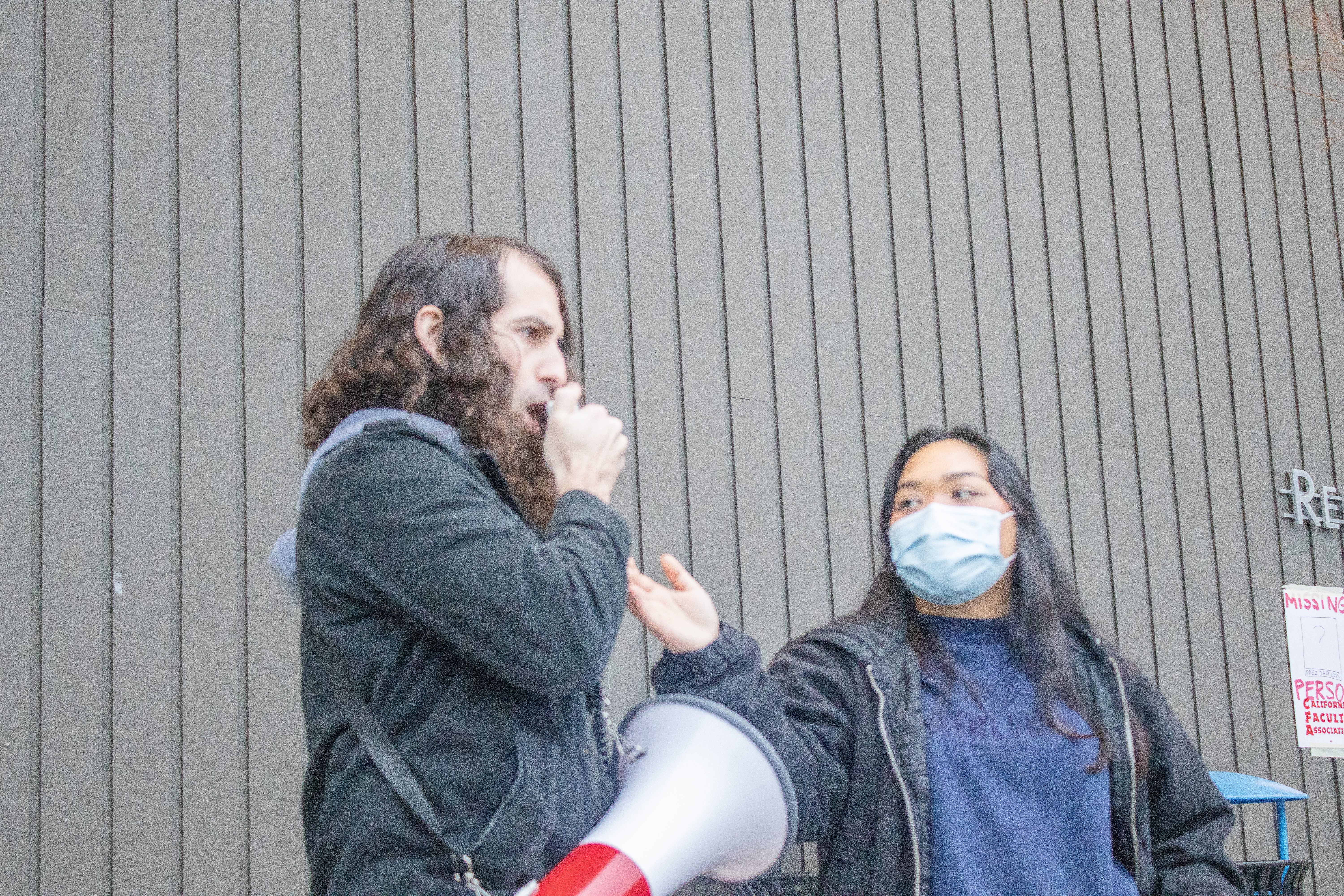
    The doors were locked. The windows were covered up with cardboard. Cal Poly Humboldt President Tom Jackson was set to host a donor event on Jan. 23 at the Reese Bullen Gallery, but a couple dozen protestors gathered outside the gallery to condemn Jackson and his absence from campus, as well as the CSU tuition increase and the addition of the recent housing application fee.

    Rick Toledo, a member of the Students for a Democratic Society, spoke at the rally.

    “The goal was to finally get a hold of Tom Jackson, because he’s never in his office,” Toledo said. “He’s never on campus.”

    One student who preferred to remain unnamed, rather going by Doe, said that they want to bring advocacy to the tuition hike.

    “That is going to hurt students in the coming fall of 2024,” Doe said. “[Jackson] only cares about getting more students and then fucking them over by making us pay more tuition, more in housing.”

  • Eco-Groovy Clearance Outlet opens in Arcata

    Eco-Groovy Clearance Outlet opens in Arcata

    by Zack Mink

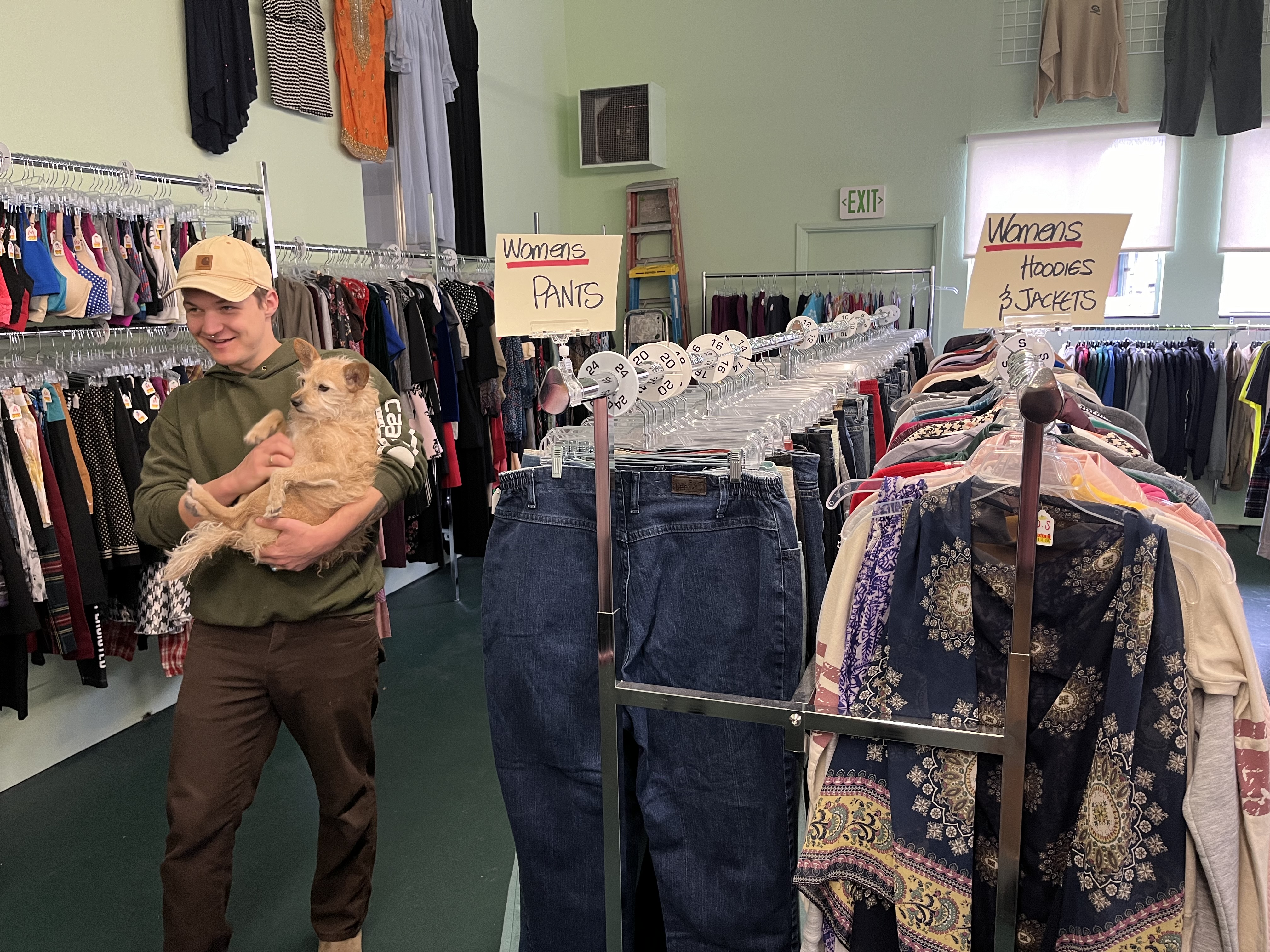
    If you have ever wandered around the Arcata Plaza, you are certainly familiar with Eco-Groovy Deals and their wide range of second hand clothes and home goods. You might have also been someone that would walk out of the store without purchasing anything because you were looking for a wider range of affordable furniture, home utility tools or just sticking to a personal budget. 

    Jayce Walker, owner of Eco-Groovy Deals, has heard your calls and opened the Eco-Groovy Clearance Outlet on 513 K Street just five blocks away from the Arcata Plaza. The store opened on Jan. 10 after months of work and stays open everyday of the week from 10:30 a.m. to 6 p.m. Students can purchase items tax free until the end of this month.

    With this new clearance outlet store, Walker’s goals are to provide the budget furniture, home utility tools and affordable clothing the community has been asking for.

    “People say, ‘what’s your secret to success?’ Listening to what people need and want,” Walker said. “Trying to find that and doing it in a way that is as sustainable as possible.”

    Unlike Eco-Groovy in the plaza which is 75% clothing and 25% refinished furniture and home products, Walker’s goal for the outlet store is to utilize the larger space and have 75% budget furniture, hardware and home goods. 

    “There are items that we were stashing to fix that started to build up. And when people said, ‘don’t they have budget furniture?’ It’s like well, I do have some,” said Walker. “That wasn’t something I could do in the plaza.”

    Other goals for the clearance outlet store are to continue Eco-Groovy’s textile recycling program which lends support to smaller non-profit thrift stores, and do more furniture repairs extending the life of useable items which contributes to their sustainability focus. 

    Walker’s goal for the clearance outlet store is to continue their textile recycling program that supports smaller non-profit thrift stores. This program contributes to their focus in sustainability as they hope to do more furniture repairs. 

    Walker’s set of founding principles are held at both of her stores. 

    1. Reduce local landfill
    2. Create local jobs
    3. And serve the community

    In the future, Walker would like to expand the impact she has in Arcata, both interpersonally and environmentally, by doing more upcycling of clothing, shoe repairs and turning the empty outdoor space into a community garden to host community members.

    “My passion is more about community service than it is about padding my pocket,” Walker said. 

  • Everything comes at a price. My newfound sanity came with an extra 65 pounds.

    Everything comes at a price. My newfound sanity came with an extra 65 pounds.

    by Savana Robinson

    Last year, after a bout of psychosis and mania, I was diagnosed with schizophrenia and bipolar I. I was given a little blue pill called Abilify. Abilify (aripiprazole) is an antipsychotic/mood stabilizer that kept me on my rocker for a few months until my body started changing. I was prescribed Abilify in March 2023 when I weighed about 130 pounds. By May, I was 160. I went to my psychiatrist and he put me on Vraylar (cariprazine) which is a weight-neutral drug, meaning it should have stopped the weight gain. It didn’t. My general mental health was starting to decline, but at least I wasn’t convinced that everyone was out to kill me. I was probably overeating to some extent, but not enough to gain another 30 pounds. Yet around Nov., I hit 195. The drugs had wreaked havoc on my body and I didn’t recognize myself anymore. I had started an antidepressant, Wellbutrin (bupropion) back in the summer and it slowly started to help me accept my body and not mope about it all the time.

    I decided to start Weight Watchers (WW) on Christmas Day. It was the best decision I’ve made in a while. It’s been almost a month and I’ve lost six pounds! I’d been tracking calories for seven months with no results, but doing WW, which factors in grams of fat, protein, carbs and more, I’m taking a more holistic approach to weight loss. It’s also like a game; I get daily and weekly points to spend on food and I have to budget my points like they’re money. I went from constantly planning what I was going to eat to only thinking about it right before eating.

    Even though my body is different than it was before my life-changing diagnosis, I’m still the happy person I was before. I wouldn’t say I’m the same; I’m stronger. I’m more resilient. I am grateful for my body and my opportunity to live this life in this world.

    No matter what you look like, if you’re happy, then you’re perfect. It took me a while to love myself even when I thought I didn’t deserve to. Now, as Billie Eilish said, ‘I’m happier than ever. I’m no longer trying to be someone else.’ I’m just being Savana Motherfucking Robinson.

  • Sipping superb cider at The Local Cider Bar; review

    by Christina Mehr and Andres Felix Romero

    Overall vibes

    The Local Cider Bar is a chill sit-down spot that would be perfect for a mellow first date vibe or an end to a great date. Imagine having a piece of pie and a cider to bond over, or end your night. 

    However, our only drawback is that food does close at 8 p.m. 

    The music was okay, more on the chill indie side.

    They do offer free water which is a bonus. 

    The Cider Bar did have clean selfie-worthy bathrooms.

    The Cider Bar was well-lit and had a relaxing atmosphere with soft indie music playing over the speakers. The environment there felt safe.

    Seating Options and Decor

    The large windows, giving patrons a view of the patio and street, gave the somewhat smaller interior a more spacious atmosphere. If you are someone who loves nautical themes, the big barrels used for seating and tables are a huge plus. The Cider Bar itself has a large wooden bar for patrons to sit alongside a host of tables. The interior design, with its mix of wood and industrial vibe, would allow the Cider Bar to fit into cities like Berkeley.

    The outdoor seating is also a great option for those who want some fresh air, rain or shine. Canopies with space heaters and strung-up light bulbs give your senses a warm and dry feel to the outdoor area of the Cider Bar. However, no smoking is allowed.

    Alcohol

    Flights for $15.

    Swipe right – was sweet and fruity with a hint of cherry .

    Black current – good, but a deeper wine flavor.

    Chile Guava – not spicy enough and a dry cider.

    Dragon Fruit – had a sweet aftertaste, like an adult Capri Sun.

    Blurberry – stronger aftertaste, dark, strong, packaged as wine and wasn’t cidery enough.

    Strawberry – sweet, juicy, good solid cider. Can’t go wrong with strawberries. 

    Mango daydream – not enough flavor, Le Croix lookalike. A hint of piss if you’re into golden showers.

    Gingergrass – very ginger acidic. If you’re a ginger lover then its right up your alley

    Food Review

    Had a wide selection of pies with vegetarian options included. 

    Sweet pies:

    Apple Crumble with Ice Cream – This was my favorite pie. The warm pie with the cold ice cream was an enjoyable temperature contrast.

    Black Bottom Coconut Pie – It was rich and thick, with chocolate mousse and whipped cream.

    Savory pies:

    Veggie Pie – Made my soul feel warmed, which was great considering the cold weather outside.

    Chicken Pot Pie – Crust was flaky, and the pie overall was moist and gooey in a delicious way. There was a very nice hint of sage present with the taste. The pie was warm, homey, yummy and definitely made with love.

    Overall Rating = 4.5/5  STARS

    4.5/5 apple pies.

  • Hitting people ethically; the Cal Poly Humboldt women’s rugby team

    Hitting people ethically; the Cal Poly Humboldt women’s rugby team

    by Savana Robinson

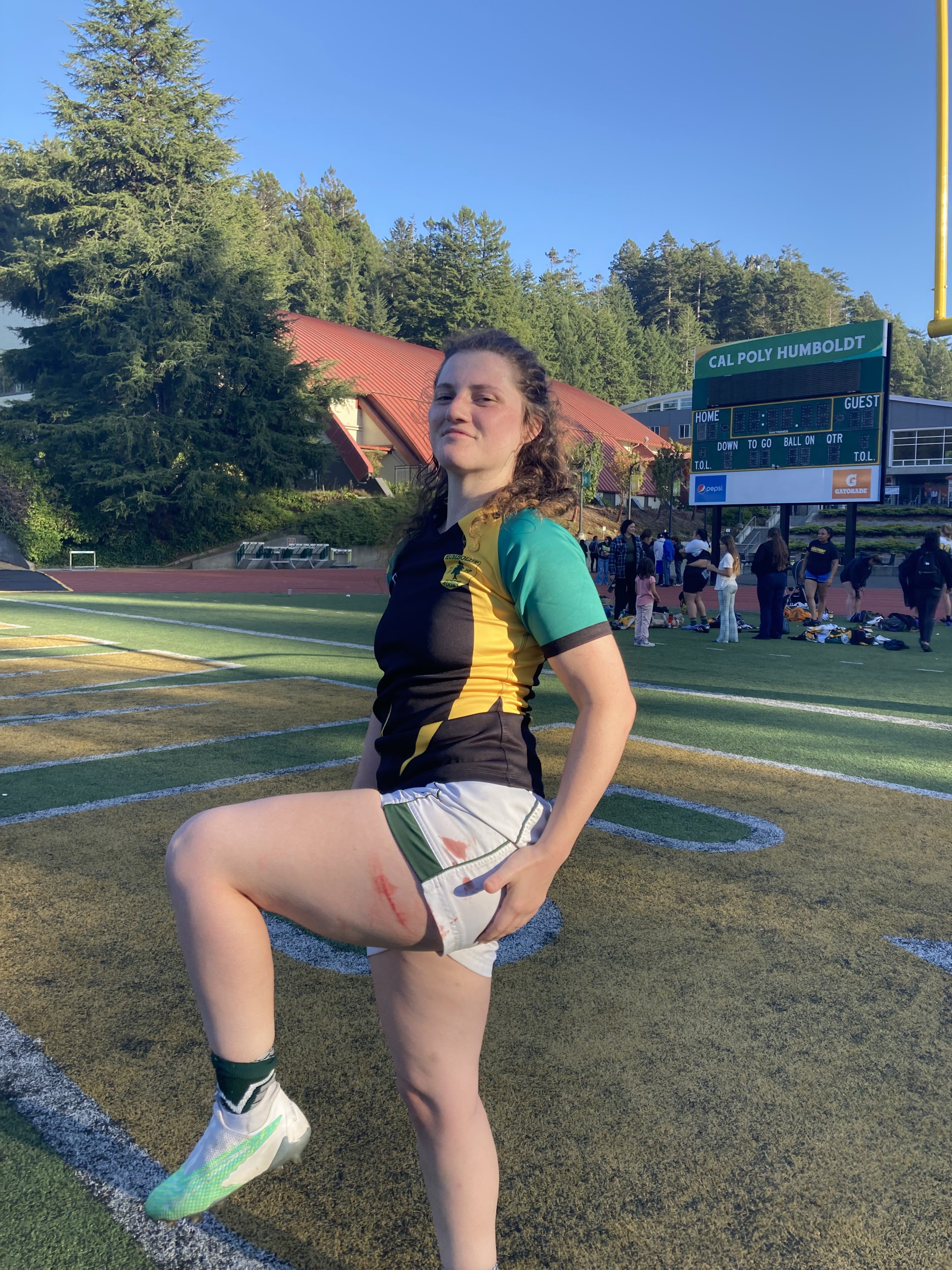
    It was the first minute of the rugby match between Cal Poly Humboldt and University of San Francisco (USF). USF kicked the ball, Humboldt made a play, forwards crashed and Courtney Campuzano got a breakaway. After she broke through the defense, she took off towards the try line. A player pulled her back by her shorts. As she leaned down to touch the ball down to score, another player fully tackled her on the back of her leg. There was a crack, and she tore her ACL. Campuzano made the point, but her season was lost.

    A senior studying social work at Cal Poly Humboldt, Courtney Campuzano is the president and co-captain of HP Rugby.

    Identifying as a lesbian, Campuzano said that rugby is a safe space for queer folks. 

    “I love how many queer people are in the sport,” Campuzano said. “It makes me feel so comfortable and safe.”

    Campuzano said that even though it’s a women’s team, there are non-binary people, too.

    “We’ve had questions about that with the team, naming it women’s rugby and just saying Cal Poly Humboldt Rugby, HP Rugby,” Campuzano said.

    HP Rugby is the club’s moniker, but what HP stands for is a well-kept team secret.

    “I’m not at liberty to say,” Campuzano said. “The teammates know.”

    Campuzano also said that rugby is a size-inclusive sport.

    “Rugby is a sport for everybody,” Campuzano said. “There’s people of all sizes playing. That’s one of my favorite things about it.”

    Her recent knee injury has robbed her of the rest of her season, but she continues to help the team. Campuzano described the moment her ACL tore as feeling like she had just been called into the principal’s office.

    “Your heart drops to your ass,” Campuzano said.

    Before her injury, Campuzano played the position of 10, or fly-half, this season, but said she’s happiest playing center. The fly-half is usually the first player to get the ball from the forwards after the scrum, which is what restarts play. Campuzano has been playing rugby for six years and started on a whim.

    “My roommate’s partner at the time came into the dorm one day and was like, ‘Can you come to practice with me? I don’t want to go by myself,’” Campuzano said. “I loved it.”

    Campuzano said that rugby has taught her how to better deal with issues in her everyday life.

    “[Rugby] taught me to go into things head-on,” Campuzano said. “Even things that aren’t physical.”

    Campuzano said that rugby attracts a certain type of person.

    “People who want to blow off steam and are comfortable hitting people ethically,” Campuzano said.

    There are a plethora of rugby terms, but Campuzano said their favorite is “hooker.” This term is a position where the player tries to hook the ball with their foot during the scrum.

    “People love that on shirts,” Campuzano said. “Like, ‘I can say I’m a hooker and my mom’s proud.’”

  • A goofy night with the Globetrotters; scenes from the game at Cal Poly Humboldt

    A goofy night with the Globetrotters; scenes from the game at Cal Poly Humboldt

    by Carlina Grillo

    Everyone’s seen it: alley-oops, slam-dunks. Nothing but net and jumpshots galore. For the people at the Lumberjack Arena last Wednesday night, basketball was flipped on its head, spun around on a single finger and reimagined by none other than the Harlem Globetrotters. Athletes, theater lovers and comedy fanatics came together as the Globetrotters faced off against their unrelenting rivals, the Washington Generals.

    Before the game, select kids and adults alike got the experience of attempting trickshots in front of hundreds of people. If you weren’t lucky enough to give the warmups with the Globetrotters a go, you might’ve had a run in with their mascot, Globie, who roamed the bleachers & isles getting the crowd hyped for the main act. Between the dances, selfies, community involvement and unironic athleticism, there wasn’t a single person left unimpressed by the Globetrotters performance, although it was more of a party. All this was before the beginning buzzer.

    photo by Alex Anderson

    Elena German, an English education major, had never been to a Globetrotters game. As a surprise Christmas gift, she got tickets to attend the event with her brother Ethan. Despite not being a sports fan and having minimal basketball expertise, there was plenty for her to enjoy.

    “I love a good show, I like to be excited,” German said. “I’m expecting a lot of energy from the crowd. It’s a lot of kids, which is exciting… Definitely the comedy and theatrics aspect of it, that is what was kind of appealing when I looked into it.”

    Unlike typical basketball games, the Globetrotters had their very own MC and DJ. The combination of music, quick commentary, goofy dances and trickshots made for a chaotic night. Audience members, such as Cal Poly Humboldt student Ethan German, couldn’t contain their excitement at the sold out performance.

    photo by Alex Anderson

    “It absolutely exceeded my expectations, wonderful show,” Ethan German said. “The tall player and the short player chasing each other. That was definitely something I did not exactly expect, but it was a great addition.”

    This basketball game was one-of-a-kind in more ways than one. The Globetrotters had the traditional trick shots, like having their back to the hoop and throwing the ball “grandma style,” but they also had a handful of unique yet iconic moments. Originators of the “four point line,” the Harlem Globetrotters took every opportunity to sink four-pointers. If the four pointer missed, there was another player ready to slam dunk a rebound.

    At one point during the game, the MC announced their special rule: game changers. At any point during the game, if the DJ played the special sound, the audience was prompted to shout, “CHANGE! THE! GAME!” In which case the Globetrotters would proceed to do something extremely goofy. The most normal of the game changers included doubling points, resulting in some epic eight pointers, and a dunk contest where the audience voted on the winner.

    More surprising game changers included having kids from the audience shoot free throws, bringing a football onto the court and roleplaying the NFL. After running the ball into the “end-zone,” the audience did the wave and the players did their touchdown dances. Naturally, a referee called a foul and needed to see a replay, so everyone did everything in reverse – including a slow-motion reverse wave across the gym.

    Other oddities included every parent simultaneously holding their baby in the air as the Lion King soundtrack played. One player stole an audience member’s shoe just to give it back Cinderella-style in center court and the same player pulled flags out of the referee’s pocket clown-style.

    Mikey Crispin, a Cal Poly Humboldt graduate and a lifelong Harlem Globetrotters fan, was blown away. After the show, he was one of many jumping out of his seat.

    “When I was a kid, the Globetrotters were all men,” Crispin said. “Now, there’s women in there, and that’s really amazing because they show a lot of girlpower and encouragement. I felt like that was really important… and that’s what we need to see.”

    Chaotic, impressive and goofy are a few words used to describe the night, but none do it justice. Despite the lack of descriptors, everyone can agree it was an unforgettable night at the Lumberjack Arena.

  • Campus Store, Arcata, lost $250,000 in one year

    Campus Store, Arcata, lost $250,000 in one year

    by Brad Butterfield

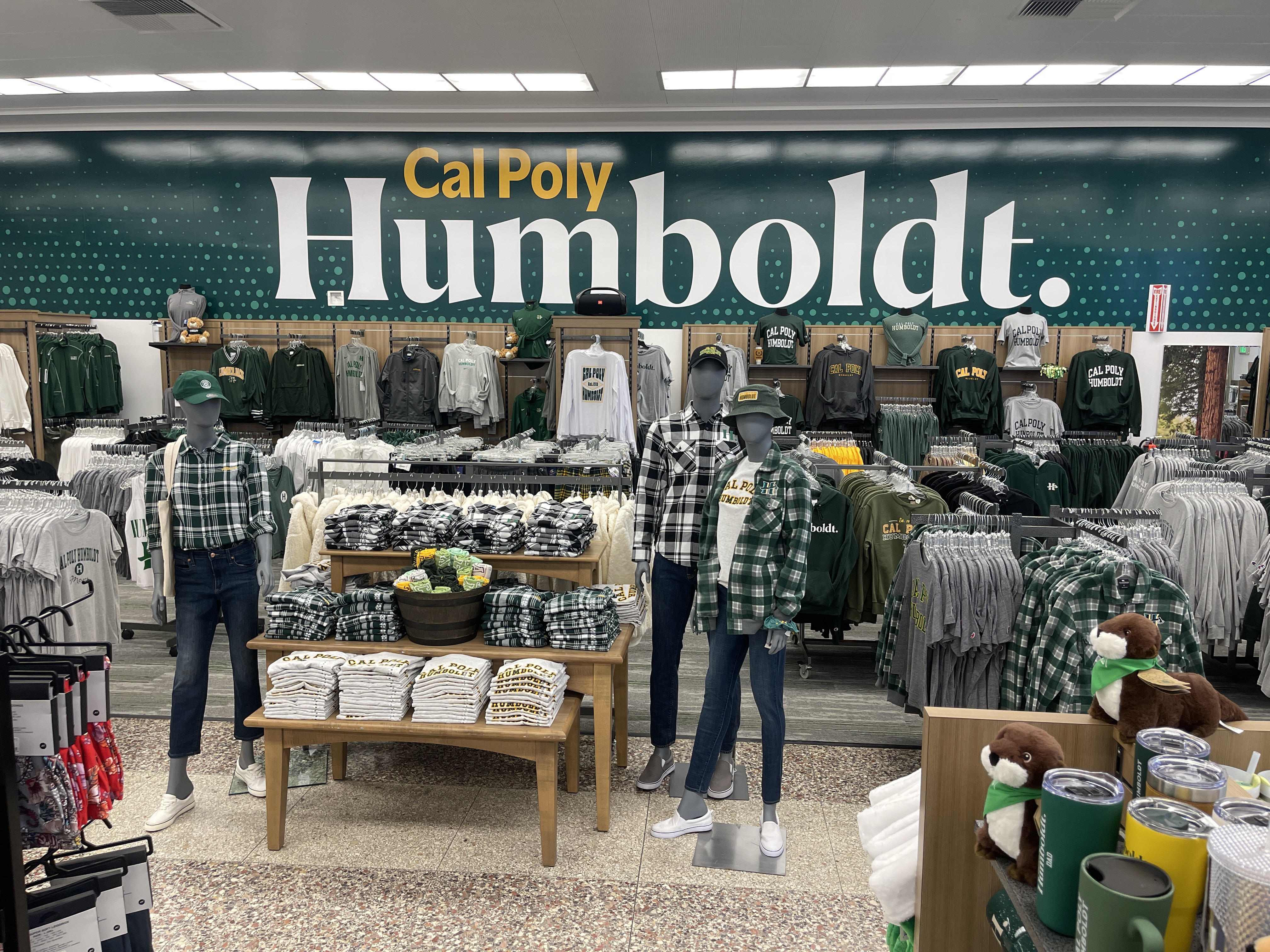
    The Campus Store, Arcata boasts high ceilings, a prime location and 10,200 square feet of usable office and retail space for Cal Poly Humboldt to sell merchandise, build community relations and provide information on California’s new polytechnic. This lot, located at 697 8th St. on the Arcata Plaza, is owned by the Trustees of the California State University and is leased to the Humboldt State University Foundation at $12,240 a month, according to the lease agreement signed June 17, 2021. The expensive investment into the downtown Arcata real estate is both a success and failure, depending on who answers the question.

    Expense reports obtained through public records requests show that from July 2022 – Nov. 2023, the off-campus Campus Store, Arcata had expenses totaling $514,228 with only $258,034 in revenue. The last 15 months of operation have lost Cal Poly Humboldt a whopping $256,194.

    According to Cal Poly Humboldt Communications Specialist Grant Scott-Goforth, the main goals for the Campus Store, Arcata did not include profitability. Instead, according to the university, the new storefront’s main goals are to expand the university’s relationship with the community of Arcata, provide visibility to the community, engage with store guests and provide information about the university, as well as expand Cal Poly Humboldt logo wear offerings.

    “The University sees the stores as successes on those terms,” said Goforth in an email. 

    Karen Diemer, Arcata city manager, highlighted the crucial timing of the store’s opening.

     “It was kind of mid-pandemic and we had been working closely with downtown businesses trying to pivot to outdoor sales areas, outdoor dining, trying to do whatever we could do to assist businesses and keep [us] afloat during COVID,” Diemer said. “I remember just having a really thankful feeling of having the university invest in what would be a retail space right on the plaza as we feared, at the time, that businesses could be closing as a result of the pandemic.”

    It’s important to recognize that prior to the opening of the off-campus Campus Store, Arcata, branded gear, school supplies and books were all sold out of the on-campus Textbook Warehouse (more commonly referred to as the Bookstore), located in the Student Activities Center on the third floor. This on-campus location was difficult for alumni and community members to access, in part, because of Cal Poly Humboldt’s insufficient parking.

    “The campus location was difficult for people to access because of parking and its location on campus,” Goforth said in an email.

    An unnamed, long-term employee of the Campus Store, Arcata detailed how the parking situation at the off-campus Campus Store is not much of an improvement from on-campus parking. They chose to stay under the pseudonym Doe to avoid persecution from their job.

    “Even now, our parking lot still has parking permits [required],” Doe said. “Our whole parking lot; you need a parking permit or like 20 minute parking, so people get really annoyed about that.” 

    The university embarked on a massive undertaking upon buying the building, previously a bank, into a welcoming storefront that both represented Cal Poly Humboldt as well as fitting into the surrounding businesses.

    “The feedback that I received from the community has all been very positive about the bookstore,” Diemer said. “The feedback that I’ve received from retailers about having that kind of a core hub right on the plaza is positive from downtown businesses.”

    The city-center location of the Campus Store, Arcata lends itself to much higher foot traffic. But foot traffic alone does not necessarily translate into improved community outreach nor sales, Doe pointed out.

    “We should be more busy with the whole farmers market going on. Usually we’re not because a lot of people just go there specifically for the farmers market,” said Doe. “They’re not really wanting to shop around the plaza that much and other than that, weekends are pretty slow.”

    The new store’s location off-campus removes it from the epicenter of campus events, like graduation. This means there is an extra step for would-be customers in order to buy their Cal Poly branded gear.

    “We’re getting less foot traffic, from what I’ve been told, than previous graduations and things like that because when you have your main store for apparel and stuff—when parents are coming to buy apparel and things like that—off-campus and you’re holding the graduation on-campus, there’s a disconnect between that,” Justin Plourde said, an environmental science and management major who has worked at both Campus Store, Arcata and the on-campus Bookstore for over two years. “And yes, some people will come to the [off-campus] store specifically to come buy stuff. But before, [during] graduation, people tended to wander in [to the on-campus Bookstore] and buy stuff rather than go out of their way to go to the [off-campus] store.”

    Still, the Plaza location has more consistent foot traffic throughout the year, most notably through the summer months, Plourde said.

    The significant deficit of the off-campus Campus Store, Arcata may be, in part, due to inventory problems, both in price and availability. 

    “Their biggest income is from clothes, which is why they’re so expensive. And they’re all from like, these specific brands like MV, Champion and Nike, stuff like that. Literally, there’s a pair of leggings at our job that is $120. I’m like, no college student is going to pay $120. I would never buy that and I get a 20% discount,” Doe said. 

    The leggings Doe mentioned are not an outlier. A university branded notebook costs $44, a small, stuffed Cal Poly Humboldt branded bear runs $20, women’s shorts go for $78, bras for $78, and a plain white t-shirt with a green ‘H.’ will set customers back $76.

    Plourde explained that shipments coming to the Campus Store, Arcata can take months between the time they are ordered and when they finally hit the shelf. Currently, this has caused a lack of sizing and style options at a crucial time in the Campus Store’s sales year.

    “We usually have big shipments of clothing before graduation and between the new semesters, and we have yet to get anything that I have seen,” Plourde said.

    Plourde added that he has not been in the store this week and a massive shipment may have just come in time for the spring rush. Some inventory currently on-site has evidently sat for some time, as many mugs and cups were caked in a visible layer of dust observed on Jan. 16. 

    With the transfer of apparel and branded trinkets to the Campus Store, Arcata, the Bookstore on-campus has become a shell of its former self.

    “Everyone’s like, ‘what happened, it looks like you guys got cleared out,’ and we’re like… ‘yeah,’” said Doe.

    More concerning from an operational standpoint is the confusion the new store has generated for students buying textbooks. Plourde explained that the Campus Store, Arcata does not make textbook orders nor process returns. They do, however, shuttle books back and forth to the on-campus Bookstore which is responsible for all textbook processing. To confuse matters more, a clerical error in the listed phone numbers for the businesses has led to many customers calling the wrong store.

    “When people look up the on-campus Bookstore number, it gives them our number. So then, whenever I pick up the phone I have to tell the people like, ‘Sorry, I apologize. This isn’t the right store. I can give you the other store’s number.’ I [memorized it] now because of how often it happens,” Plourde said.

    The fact that the off-campus store is named the Campus Store, Arcata has complicated the situation further.

    “The name ‘Campus Store’ is so hard for new people to wrap their heads around because it’s like, oh, the Campus Store is the one on-campus… but it’s not. So, then everyone goes to the wrong store to pick up their package,” Doe said.

    This has led to a frequent shuttling of sold goods to and from the on-campus Bookstore and off-campus Campus Store, Arcata.

    “It’s like so extra and it is so confusing, because then people always think there’s items at one store and then [there aren’t]. It’s ridiculous,” Doe said.

    Plourde detailed the constant state of limbo that the Campus Store, Arcata has been in since its opening.

    “I think the school doesn’t know what they want from us. It sounds like they think they wanted everything off-campus. And then they realized that that probably wasn’t the best move, but they still want everything on-campus because they want to utilize that space,” said Plourde. “It’s very confusing. And like I said, I don’t think the school knows what they want to do.”

    According to Scott-Goforth, speaking on behalf of the University, Cal Poly Humboldt has no plans to close the on-campus Bookstore.

    With so much money poured into the new location, the university is attempting creative (and tasty) ways to attract potential customers to the off-campus Campus Store, Arcata. 

    “I know that we’re also trying to get food trucks and stuff to come by on certain days so that more people would want to come in the parking lot and things like that,” Doe said.

    Doe’s claim was confirmed by a marketing email sent out by the university on Jan. 15 that read, “Pineapple Express Food Truck, Spreading aloha 1 plate lunch at a time! Brought to you by Housing & Res Life. Fridays from 11:30 a.m. to 5:30 p.m. at the Campus Bookstore, Arcata!”

    Interestingly, the university advertised the Campus Store, Arcata as the “Campus Bookstore” in the email.

    With nearly half a billion dollars pumped into California’s newest Cal Poly, it may be true that the university is not concerned with a $256,194 deficit at the Campus Store, Arcata. However, as last semester saw budget cuts to many programs that benefit students, like the swimming pool, students are frustrated with the misallocation of resources.

    “I feel like that money should not be going to a new building. It wouldn’t make much of a difference if I was working on-campus or off-campus. I would appreciate them fixing things like that for the betterment of the students, not really what makes them the most money,” Plourde said before adding, “[There are] many other things that they should be working on, and I don’t see [why] this is something that they should be proud of.”


  • The strike doesn’t dismiss you, I do; why some Cal Poly Humboldt professors didn’t join the strike

    by Eli Farrington

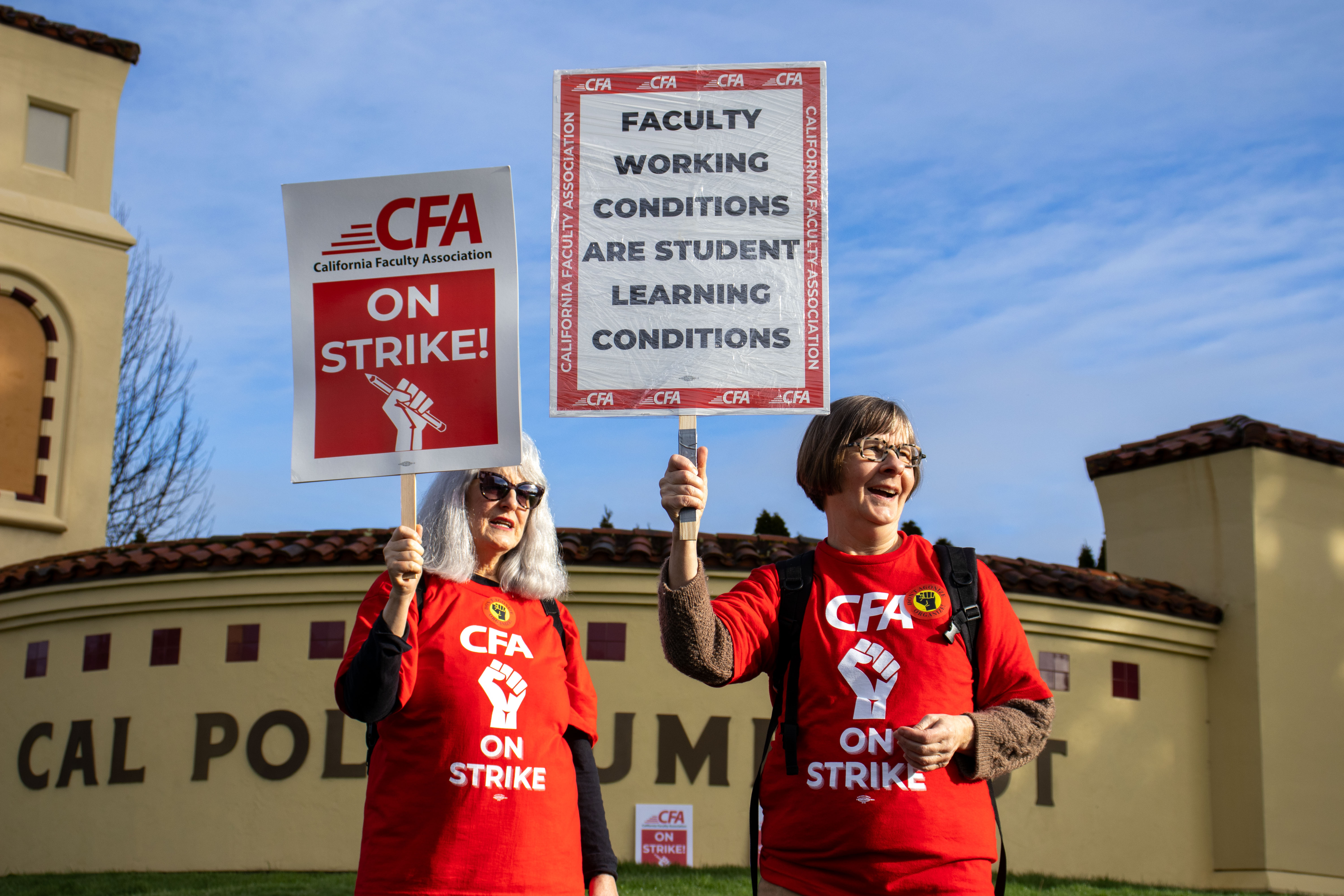
    This Monday marked the beginning of what was projected to be a week-long statewide strike throughout California State University (CSU) campuses, with professors and faculty from every CSU engaging in protest for better pay and working conditions. However, some professors at the Cal Poly Humboldt campus chose to refrain from participating despite a request from the California Faculty Association (CFA) for all faculty members to strike.

    According to the CFA website, the union had a better chance of success if every faculty member in the CSU system participated in a strike. However, any faculty member who chose to participate could not be fired, dismissed or punished in any way by the administration. So, why did some professors choose not to strike?

    Economics professor Beth Wilson is not in the CFA union, having canceled her membership in Dec. 2023 during several strikes across other CSU campuses. 

    “I think that the union is absolutely wrong,” Wilson said. “The university does not have a bunch of extra money; they have already cut several programs, and they’re going to cut more.The Chancellor’s office has come out with a list that is from a data perspective, and it’s the same metric for all CSUs regardless of size. We’re a smaller campus, so we have more programs [in danger of being cut] on this list.” 

    According to Wilson, the Chancellor’s office has used this list for program elimination, and worries that Cal Poly Humboldt would look very different in the future if the union priced themselves out of the market by demanding a 12% raise rather than accepting the CSU’s original offer of 5%. She is wary about the impact this could have on her department and her students in the coming years, and wants to prioritize their education over her own financial gain. 

    “A 12% increase is ridiculous,” Wilson said. “It is way too high. A 5% increase is reasonable, and it is not a pay cut. We have not had annual inflation of 5% and we’ve had prices that have come back down again, so the idea that we need 12% to keep pace with inflation is factually incorrect.”

    Many professors and faculty viewed the CSU’s 5% offer as offensively inadequate considering the $12 billion dollars that the chancellor and management have been stockpiling as reserves, according to the CFA’s strike FAQ page.

    Despite Wilson’s insistence that a 12% increase was an unreasonably large demand for the union to make, an independent report on CSU finance titled, “Financial Analysis of the California State University System,” by Howard Bunsis, Professor of Accounting at Eastern Michigan University, found that the CFA’s request could be fulfilled using existing annual surpluses without dipping into the CSU system’s reserve funds. It also explains how a 12% raise was an acceptable amount given current and predicted California inflation rates, as well as statewide raises in tuition and cost of living.

    According to the CFA, CSU management recently voted in favor of a 34% tuition increase over the course of the next five years and imposed a $2 monthly parking fee increase on faculty. All the while Cal Poly Humboldt created a $100 on-campus housing application fee for new students. Coincidentally, campus presidents saw an increase in pay of up to 29%. According to the CalMatters website, CSU Chancellor Mildred Garcia herself received a 27% pay increase July of 2023, upped to a $795,000 base salary, along with monthly allowances for automobiles and housing. 

    A professor, who chose to go by John Doe, for personal safety reasons stated that they were in favor of the strike and the CFA’s demands, but chose not to participate because of the timing and impact on student success. 

    “My reason for not striking is, that with the classes I have, it’s too much of an impact on the students,” Doe said. “The timing is very poor for the scheduling that I have for my classes, and so it’s not fair to the students to force everyone to stop for a week and then play catch-up all the way through to the final.”

    This professor made the decision to continue teaching despite supporting the strike, but they still had many problems with the way the campus is managed. 

    “I believe the workloads are excessive relative to other universities that I’ve taught at,” Doe said. “There’s a lot of chaos and instability that’s introduced when you have a system where a lot of non-full time instructors are brought on to fill in holes in the schedule. It creates chaos for the departments and the individuals, so I’m fully in support of additional wages and an increase to a living wage.”

    Many professors without a PhD and a full-time contract are struggling to afford the cost of living and make ends meet. With salary adjustments that don’t match the current inflation rates, they worry about their ability to afford adequate healthcare and save for retirement. 

    Another faculty member who refrained from striking was Dr. Cynthia M. Le Doux-Bloom, a Cal Poly Humboldt Fisheries Biology & Oceanography lecturer. She is not currently a CFA member, but she strongly supported all of her union member colleagues in their right to strike and believes that CSU instructors, librarians, coaches and other faculty are truly underpaid. She felt conflicted on whether or not she should join the strike, but ultimately chose against it and backed up her decision with two main reasons in an email. 

    “First of all, I am not a CFA union member, nor have I ever been during my five years here at CPH [Cal Poly Humboldt] because, until very recently, I was not teaching every semester; hence, joining a union that I may or may not be a member of every 15 weeks seemed highly unusual,” Le Doux-Bloom said. “I was a member of the California Association of Professional Scientists (CAPS) union for over two decades. I support unions and may join CFA now that I seem to be teaching year-round. Secondly, our students (or their parents or someone else) are paying [around] $15,000/semester to attend CPH [Cal Poly Humboldt]. Semesters include 15 weeks of instruction, which equates to paying $1,000/week or $250/day.” 

    Le Doux-Bloom hoped that her colleagues could appreciate and respect her path even if they disagreed with it. She loves being an instructor and truly wants what’s best for her students. 

    “I cannot stomach penalizing my students’ learning (which they prepaid prior to knowing about the strike) to increase my income,” Le Doux-Bloom said. “Each of our students paid $1,000 this week to support the strike, but were given no choice about their loss of instructional time. This is on top of the ongoing tuition increases, larger classes, reduced services, dilapidated facilities and antiquated equipment. My beef is not with my students, it’s with CSU’s top-heavy administration and administrator salaries.”

  • Students should support the CFA strike

    by Alexandra Berrocal

    First, they came for our housing.

    Then, they came for our alternative housing students.

    Now, they are coming for our professors.

    When is this going to end?

    At this time, it is easier than ever to develop an ‘us versus them’ mentality. However, we need to remember that students and professors are all in this together. When we stood up for the right to basic housing last year, professors stood with us. When students living in their vehicles were, for heaven’s sake, cruelly kicked out of the school parking lots, professors stood with us. Professors have always been our allies in a world that seems to be squeezing us tighter and tighter. 

    Let’s make this clear: the world is becoming a harsher and harsher place to live, and universities, unfortunately, are not exempt from this. Students can still struggle throughout their college experience for all kinds of reasons. Despite the university attempting to make it easy for students to access mental health resources and disability accommodations, accessing those services can still be hard for people. We need them now more than ever.

    I personally cannot justify the university only giving staff a month of parental leave. How can anyone justify leaving a new baby without their parent at daycare after only a month? Professors should have a semester of parental leave, at least. That should just be common sense, and I don’t understand how that isn’t the law of the land. I also cannot believe that some of the lecturers who are so willing to share their expertise with the students are not making liveable wages. This is unconscionable. I believe that college professors and lecturers deserve the greatest respect because they pass down important knowledge and educate the new generation. This respect should extend to transgender and non-binary staff. It is basic common sense that there should be access to gender-neutral bathrooms for faculty. Students these days claim to care about trans rights, yet fail to advocate for their leadership’s rights to these same facilities. Universities claim to be bastions of progressive ideals yet they pay lip service to trans students, while simultaneously neglecting their own faculty. Speaking of faculty, my former faculty advisor was swamped with work that was completely unrelated to teaching last semester and I know that he is not alone. My advisor has had to do more administrative work lately with less time to focus on her passion for teaching. From my point of view, that’s pretty crazy – and not in a good way.

    When we protested, our teachers stood with us. It’s time for us to stand with them.

  • The best discounts for Cal Poly Humboldt students in Arcata

    The best discounts for Cal Poly Humboldt students in Arcata

    by Zack Mink and Jasmin Shirazian

    Student ID required at all locations.

    Food:

    Wildberries: 10% off every Saturday

    Romans Kitchen: 15% off everyday

    Cafe Brio: 10% off everyday

    The Couxp: $1.50 off of your order

    Blondies: 10% off everyday 

    Gyro Shop: 15% off everyday

    Fiesta Grill Cantina and El Chipotle: 10% off everyday

    Coffee and tea: 

    Northtown Coffee: 10% off everyday

    Coffee break: $5 bagel and 12oz coffee everyday 

    Moonrise Herbs: 5% off bulk herbs and teas

    Home:

    Ace Hardware: 10% off your purchase (ranges per item)

    Bubbles: 25% off any personal clean bottle refill

    Fun:

    Pacific Paradise: 10% off every Sunday

    Heart of Humboldt: 10% off every Sunday

    The Fireplace: 10% every Saturday 

    Heart of the Emerald: 10% off everyday

    Livity: 10% off everyday 

    Herb & Market: 10% of every Sunday

    Humboldt Premium: 10% off everyday

    Body High Pole: 15% off any class with code CALPOLY

    Adventures Edge: 10% off everyday 

    Hatchet House: $3 off everyday

    Thrift: 

    The Hospice Shop: 10% off every Saturday

    Youth Ability: 15% off every weekday (Monday-Friday)

    Eco-groovy Deals Clearance Outlet: no tax on purchases for the rest of January

  • CFA settles and calls off strike after one day, Teamsters settle over weekend

    CFA settles and calls off strike after one day, Teamsters settle over weekend

    by Andres Felix Romero

    Across the California State University system, thousands of students expected a pause in classes, thousands of faculty expected to trade in their pens and markers for picket signs and thousands of skilled laborers were prepared to drop their tools for the week of Jan. 22-26 to strike.

    However, the Teamsters 2010 announced Friday, Jan. 19 they reached an agreement with the Chancellor’s Office. After one day of a weeklong planned strike, it was announced by the California Faculty Association (CFA) the night of Jan. 22 that they and the Chancellor’s office had settled with a tentative agreement as well. Campus operations are set to return to full swing by the end of this week. 

    Teamster’s Agreement Highlights

    The Teamsters were able to secure an immediate 5% pay increase, with back pay retroactive to July 1, 2023. They were also able to establish a step-pay system, meaning that skilled laborers within the CSU system will have a pay increase each year. Teamsters were also able to maintain their pension, medical benefits, and their emergency pay.

    With the Teamsters able to get back to work and have an agreement for a solid contract in order with better pay, skilled laborers on the Humboldt Campus such as locksmith Phillip Bradley felt a sense of relief. 

    “Obviously [having an agreement in place] just takes a lot of stress off,” Bradley said. “Uncertainty creates a lot of anxiety.”

    Librarian Carly Marino drums while crossing 14th St. | Photo by Griffin Mancuso

    CFA Agreements Highlights

    The CFA also secured a 5% increase in pay retroactive to July 1, 2023. There is planned to be another 5% increase on July 1, 2024, effectively giving faculty a roughly 10% increase in pay. However, the 2024 increase is contingent on the state not cutting CSU funding. There will also be more protections in place for faculty dealing with police, and improved access to gender-inclusive restrooms and lactation spaces. Also for faculty that are new parents, paid parental leave has increased from six to 10 weeks.

    Faculty, such as English professor Sarah Ben-Zvi, had to find ways to balance parenthood with work. Despite the support of her department to make her maternity leave as smooth as possible, she still felt some struggle. She felt that the increase in time for maternity leave was appreciated, but it may not be enough. 

    “It’s definitely a step in the right direction, but I still don’t think it’s enough time,” Ben-Zvi said. “I feel like it was not until maybe three months after my kid was born, that I started to feel almost human again… and able to give my students what they deserve, which is a great teacher who is on her game.”

    Another mother and professor with a newborn is English professor Tessa Head, who was on the picket line with her 14-month-old child. Head feels that a paid semester of parental leave would be beneficial for not just parents but the students as well. 

    “[A semester of parental leave] would give you time to bond with your babies and take care of them, to form that secure attachment,” Head said. “And for students, I think it would provide better learning conditions because they would have a faculty member who is present for the whole semester.”

    CFA faculty rights chair Loren Cannon was present on the picket line striking his drum and leading strikers. He shared his thoughts on the outcome of the tentative agreement.

    “We really did make some gains,” Cannon said. “I guess [the Chancellor’s Office] didn’t expect us to actually pull off a strike or something, because we only struck for one day [then came to a tentative agreement with the Chancellor’s Office].”

    Richard Toledo leads faculty and students across 14th St. holding signs on the picket line. | Photo by Griffin Mancuso

    Student Reactions

    With notice being given by faculty not to expect classes this week, some students made plans for work or travel. Students like Criminology and Social Justice Major Jocelyn Douglas faced some struggles when they scheduled extra shifts at work this week, only to be told that class would be back in session. The short notice has left students such as Douglas feeling disorganized.

    “I took this opportunity of thinking that I had a week off of school to work 60 hours with both jobs that I work at, to be able to catch up on bills,” Douglas said. “Being a full-time student and working full-time, sometimes conflicts with each other. And with less than a 24-hour notice that we do have to attend school, and with my classes being mandatory for attendance, I’m kind of conflicted about [choosing] between work and school. Thank God the teachers are being pretty lenient so far.”

    Scene of Strike

    As for the strike itself, dozens of faculty and their supporters were on the picket line. They danced with their signs to the passing cars that honked their support, all the while they moved to energizing music blaring over speakers. Some signs read, “5% don’t pay the rent,” “California Strike University” and “You can’t put students first if you put faculty last.”

    Students were present on the line to support their faculty. Students such as accounting major Lealu Freedom felt an obligation to support their professors due to the past support they have given to her. 

    “[If faculty have better conditions they] can devote more time to their students, and create a more enjoyable experience versus focusing so much on trying to get their needs met,” Freedom said. “It’s kind of like a student. You know, if the student’s struggling with housing, they’re not gonna be able to learn. Same thing with a teacher, if they’re struggling with basic needs, they are not gonna be able to teach.”

    What’s Next

    Language for the contracts will be rewritten based on the tentative agreement, and the CFA is expected to vote on whether or not to officially ratify the contract within the coming weeks to months.

    Although the CFA and Teamsters unions made gains in this situation, CFA President Marisol Ruiz acknowledges that there is still work to be done.

    “When we are striking, we’re striking for better working conditions for all,” Ruiz said. “For all the faculty and the students, we should all be supportive and in unison working together to fight. There’s still a 6% increase of tuition hikes, and that’s a fight that needs to continue to happen.”

  • Self-diagnosed autism is a trend

    by Kae Dennert

    I would like to preface this with the words: I AM NOT TALKING ABOUT PEOPLE WITH DIAGNOSES; I believe autism is incredibly real, and a struggle a lot of people deal with, but I also believe that with the internet these days, it has become trendy to have the newest popular mental illness. 

    I have been diagnosed with many things in the past few years, so I am aware how tricky getting a diagnosis is, so I’m not going to shut down self diagnosis as a whole, as it isn’t that black and white. Walking down memory lane, back in 2016 it was incredibly “quirky” to post about how depressed you are, and it became something where everyone tried to outstage each other, which also brought along people who felt they felt similarly to the creators posting about it, which led to people self-diagnosing. 

    This again happened in 2019-2020, where it suddenly became a trend to have anxiety, and that was once again followed in 2021 where it was a trend to have ADHD. Now where am I headed with this? Earlier this year there was an uptick in trending conversations on what symptoms could mean you are possibly secretly autistic. This led to many “oh my god maybe I’m autistic I keep seeing these videos” comments. 

    Now, there are certainly people who saw these videos, felt like they saw themselves, and decided to take steps to use tools to help them, or help them get diagnosed, and I think that it’s amazing that awareness online can help people, but I also think it has become hard to decipher who is pretending for attention, and who actually needs the help. It has been trendy to make videos about what symptoms are “autistic” (which also overlap heavily with other disorders, like ADHD, anxiety, depression, OCD, etc.) with no further context of what could be going on besides autism.

    These narrowings into one answer don’t take into account each person’s individuality and their struggles and what that can mean for them. Because diagnoses overlap, the trending diagnosis is the one that is going to stick. This can shut people down and discourage them from finding more answers that could have helped them more in the long run.

    It locks people in a corner, and they can believe there is no other option for them besides aligning with that determination. Because of this many people don’t search for answers that could lead them to help, because other illnesses become stigmatized while being “neurotypical” gets you scrutinized for not understanding the viewpoint of neurodivergence. I think that everyone should be able to be themselves without having to shape themselves into different people for others, but doesn’t everyone want that? 

    At the end of the day, a new trend will inevitably pop up, and people will swear up and down in their life that they “never had autism” and instead have the new hip trending illness.

  • This week in Lumberjack athletics

    This week in Lumberjack athletics

    by Vanessa Saltos

    MEN’S BASKETBALL

    Over Thanksgiving break, men’s basketball competed at home in Lumberjack Arena. On Saturday, Nov. 18, the ‘Jacks faced Cal Maritime. They were down in the first half with a score of 37 – 40. Humboldt took the game in the second half after a hard fought battle, the final score being 80 – 70. The following week, they competed against Northwest Indian College on Tuesday, Nov. 21. This was a high scoring game for the ‘Jacks. Rob Diaz III recorded 21 points and four steals, four other Lumberjacks also posted double digits. The final score was 104 – 71. Thursday, Nov. 30, they will be back in Lumberjack Arena playing against Cal Poly Pomona. Tip off is set for 7:30 p.m. Then, on Saturday, Dec. 2, Cal State San Bernardino will be traveling to Arcata for a game time of 7:30 p.m. 

    WOMEN’S BASKETBALL

    On Saturday, Nov. 18, women’s basketball had their home opening game against Concordia University Irvine. The ‘Jacks competed hard and took the game with a score of 72 – 63. Some standouts were Sara Ahmadpour leading the team with a career high of 21 points and nine rebounds, Emilia Long followed suit recording 20 points. In the fourth quarter alone the ‘Jacks recorded 30 points. After their home opener, Humboldt traveled to the Azusa Pacific Thanksgiving Classic. Friday, Nov. 24, they played Azusa Pacific. Despite coming off of a victory, the ‘Jacks fell with a final score of 64 – 87. Saturday, Nov. 25, they faced off with Biola, and their hunger to win showed by taking the game into overtime. The final score was 63 – 53. The ‘Jacks are back at home this week. Thursday, Nov. 30, they are opening CCAA play with Cal Poly Pomona, tip off is set for 5:30 p.m. Humboldt will also be playing at home Saturday, Dec. 2 against Cal State San Bernardino at 5:30 p.m. 

  • The Aquatic Center’s $412,000 facelift

    by Brad Butterfield

    To date, $412,000 has been spent on renovations at Humboldt Bay Aquatic Center (HBAC) to allow for half of the University Advancement Division to move their operations into the Eureka waterfront building. According to Marketing and Communications for the university,  this transition, which began in the Fall of 2020, led to a change in management of the building from the non-profit ‘University Center’ to Cal Poly Humboldt. 

    Marketing and Communication states that the relocation of the Advancement Division to HBAC has provided an easier landing pad for donors and Alumni to interact and opened up space on campus for the Associated Students to utilize. In effect, this move has forced many of the previous operations at HBAC to alter and many to exist as shells of their former selves. Additionally, the Advancement Division’s move to HBAC forced Center Activities employees out of their offices and workspaces without giving them a say in the matter. 

    The money spent:

    While Marketing and Communications Director, Aileen Yoo and Communications Specialist, Grant Scott Go-forth stated in separate emails that renovations and upgrades to the HBAC total $412,000 to date, public records requests submitted under the Freedom of Information Act, led to the release of only three construction contracts totalling $22,700, leaving $389,300 unaccounted for. 

    In an effort to establish a complete framework of work done at HBAC, a second public records request was submitted on Nov. 16, asking for all publicly disclosable records related to renovations/construction carried out at the Humboldt Bay Aquatic Center from 1/1/2019 – 11/16/2023. This second request was denied by Records Access Officer, Michelle Williams citing, “Balancing Test. Records where the public interest against disclosure outweighs the public interest in disclosure. Cal. Govt. Code §7922.000.” 

    The Advancement Division moves into the HBAC:

    Yoo wrote, on behalf of Marketing and Communications that, “The location improved accessibility for donors and alumni to interact with Alumni Relations, the Cal Poly Humboldt Foundation, and other areas of the Division. Having a more prominent presence in Eureka has helped improve community outreach.”

     There are now 16 University advancement employees working in the HBAC’s new cubicle spaces and pre-existing offices.

    Under its previous management, the HBAC was focused on aquatic equipment rentals, scenic tours, OLLI classes, education on local wildlife and Humboldt Bay and, critically, water safety. The moving in of the Advancement Division led to some of the HBAC’s equipment being stored off-site and a diminished ability for the Aquatic Center to continue its services to students and community as a waterfront property.

    Renovation’s cause chaos: 

    An employee with direct knowledge of the reworking of HBAC spoke under the condition of anonymity fearing repercussions for speaking out. They will be referred to as J. Doe in this article. When word came that Center Activities was expected to vacate the HBAC offices, there was confusion as to where that left them to operate from. After initially vacating their offices, Sherie Gordon, Vice President for Administration and Finance, paid a visit to the building to assess the situation.

    “Sherie Gordon came around to look at the situation on the waterfront. It was agreed that there is no reason why Alumni [Relations] would need a waterfront office when Center Activities was responsible for monitoring waterfront safety,” Doe said.

    After Gordon’s visit Center Activities was allowed to maintain use of the office for a couple of months before being kicked out again.

    Under HBAC’s new management, a creative solution was found for the employees who’d unwillingly forfeited their workspaces. 

    “They took what used to be a maintenance closet, and they turned it into an office. So, Center Activities doesn’t have a front door office anymore where people can come up to a counter and ask questions. They have this tiny, hidden little space that used to be a closet that is now an office without access to any of the other rooms or lobby. So they can’t do community services, program coordination or classes in other rooms unless it is reserved out in advance,” Doe said.

    According to Doe, Stephanie Lane, Executive Director of Alumni Relations, has the final approval on all reservation requests submitted for the building through 25Live.

    Yoo, on behalf of Marketing and Communications wrote through email that in addition to adding cubicle spaces for Alumni Relations, they would also be occupying two offices that didn’t require any updates. According to Doe, one office went to Lane who was adamant about getting it.

    “That’s one thing that never changed. She was gonna get that waterfront office.” Doe said.

    The second office went to one of the Advancement Departments VP’s. 

    Stephanie Lane declined to be interviewed for this article, deferring to statements from Marketing and Communications.

    HBAC’s waterfront safety obligations:

    Regardless of who occupies which office or what departments operate out of the HBAC, there are a few operational guidelines that HBAC must adhere to. These guidelines stem largely from who owns the land, who paid for the HBAC to be built, and who owns the building itself.

    According to Scott-Goforth, the building is on land that is leased long-term from the City of Eureka, the HBAC was built with a grant from CA Boating and Waterways and it is currently fully owned and operated by Cal Poly Humboldt. 

    Pat Hyland, who has been a member of the women’s rowing team coaching staff for 30 years as well as lecturer in Kinesiology, provided valuable context that the HBAC was originally one of three CA Boating and Waterways safety facilities. With that, came an obligation to provide waterway safety.
    “[The university] may have been a little light on that,” Hyland said.

    From the perspective of the city of Eureka, Miles Slattery, City Manager, points out that operations at HBAC have been ever-evolving and have always included ancillary conferences and classes unrelated to water safety.

    “Our whole thing was the original permit for that [HBAC] needed to make sure that they did maintain a certain aspect of the boating safety requirements,” Slattery said. “From what I can tell on the outside – I’m not working there anything – the operations don’t seem to have drastically changed,” Slattery said.

    Center Activities struggles to continue operations:

    From the outside, HBAC sure does look peachy with her extensive (and currently unsafe for use) balconies and expansive windows which reflect the bay’s glistening, choppy waters. However, the situation within the building is much more complicated. Doe said the University Center’s space is down to about an eighth of the building, and approval is required before using any other part of the HBAC.

    “Our whole department was kind of being gunned for, and we felt very threatened. So, you know, we had to focus a lot on explaining to the university over and over again, through all of the different administration changes that we’ve had, there’s a valid reason for us to be a part of this campus community,” Doe said. “A lot of time was spent just justifying what we do and how we do it and why it’s important.”

    This constant fight to validate their right to exist took away from their ability to teach waterway safety and keep eyes on the dangerous waters of Humboldt Bay.

    Though the transition has been painful for some, there are some important silver linings. Most notably, Men’s Rowing has now joined Women’s rowing at HBAC. Hyland said that with the available space at HBAC, a good job has been done to optimize it.

    “Both rowing teams use it early and late. They don’t use it in the middle of the day. Then the center of the day is primetime and advancement uses it the whole time then.”

    Additionally, from the University’s standpoint, taking over management of the building has been a major victory.

    “HBAC is available at no cost for ad hoc meetings and events put on by campus and community groups,” Yoo wrote in an email.

     Previously, under the management of the University Center, the university would be charged a nominal fee to host events in the building in order to support the work that the non-profit was doing. Naturally, losing that income and the management of the building has been a huge blow to Center Activities.

    “When the Center Activities department would ask questions regarding funding to replace lost income, they received mixed messages and unclear guidance on what they should expect from the Athletics Department, which Center Activities is now managed by,” said Doe.

    With renovations yet to be completed at HBAC, Scott-Goforth provided a look into the usage of the building thus.

    “There have typically been two or more events occurring each week in the space. Examples include: multi-day placement orientation activity by the Social Work program; program meetings by the California Center for Rural Policy; one-day retreat for areas including Intercollegiate Athletics, Enrollment Management, University Advancement, Advising Center, and Financial Aid Office; Nursing alumni gathering; CSU,” Scott-Goforth wrote in an email on behalf of Marketing and Communications.

    Apparently the upper echelon of Cal Poly Humboldt wasted no time in using the waterfront property for one-day retreats.

    Who drove for this change?

    With budget cuts widespread at Cal Poly Humboldt, it seemed an unorthodox initiative, to Doe, to spend nearly half a million dollars to renovate the HBAC for the benefit of Alumni, Donors, and the University Advancement Division.

    “We were told that the changes at HBAC were happening due to initiatives set forth by President Jackson using presidential funds,” Doe said.

    Jackson’s involvement was corroborated by Hyland, answering who he thought drove for the changes at the HBAC.

    “That was all President Jackson.”

    Further, Marketing and Communications provided extra context for HBAC’s expensive facelift.

     In answering the question of which administrators had driven for the renovations at HBAC, Goforth wrote through email, “Frank Whitlatch, VP for University Advancement, in close consultation with colleagues and with President Jackson.”

    The winners and losers:

    The renovations at HBAC benefitted many people and departments, while hurting many others. It is, of course, a very nuanced topic. What can’t be overlooked is the effect this had on those involved. Of which, feelings are mixed.

    For Slattery and the city of Eureka, all developments that increase Cal Poly Humboldt’s presence in Eureka are beneficial.

    “The presence of the university here in the city of Eureka is extremely important,” Slattery said. “I think that having that influx of not only just people in general, but the diversity of that is something that Eureka would benefit from extremely and I think that Cal Poly would benefit from it as well.”

    Hyland said that practices for Women’s Rowing have not been interrupted because of the renovations and explained that the space is being divided as best as possible.

    “The men’s team would love to have more space, just as Center Activities would. I’d love to have more space and I’m sure that Advancement would love to have more space, but we’ve got a finite thing and I think we’re playing nice as far as sharing goes,” Hyland said.

    Unfortunately, for students and faculty who grew and learned through the courses and services provided by HBAC under its previous management, the renovations and addition of the Advancement department has been quite negative. 

    “This has seriously impacted students’ abilities to learn and have viable professional careers before leaving school. They used to hire a lot of students who would come down to work at the Aquatic Center, get professional experience and do internships down there,” said Doe. “They still try to have internships but they are not the same, people aren’t getting the same out of it. They’ve kind of pulled back on doing student based programming at the same level we used to because we just can’t function with less space, less ability to manage a building. There’s less for them to do honestly.”

  • Veterans find healing through the arts

    Veterans find healing through the arts

    by Andrés Felix Romero

    On a gloomy Thursday afternoon, a Gulf War Marine Corps Veteran brought a warm energy to the ceramics studio, nicknamed, “The Laundry.” The veteran, Ehren Tool, is the senior laboratory technician for the ceramics studio at UC Berkeley, and has created and given away over 26,000 ceramic cups. Tool’s art documents the pains that military veterans struggle with after their service. Tool smiled behind his bushy beard and told stories about his healing journey, from his time as a Marine to his time as an artist. Tool expressed how his ceramic cups convey aspects of military culture that are difficult to openly discuss.

    “The cups are an opportunity to talk about unspeakable things,” Tool said. “War is murder, and military sexual trauma is rape, that happens in the civilian world too. Where can you talk about that? Where in polite society do we talk about these things that happen with too many people and the effects they have on their lives?”

    Ceramic students in attendance to Tool’s demonstration, such as Jack McCann, were inspired by how veterans have found ways to express the grief they feel. 

    “I really felt like in the art there’s a lot of pain, every piece is almost like mourning,” McCann said. “It’s helpful to see people grow even after experiencing something like war.”

    The class that Tool was a guest instructor for was part of a weekend-long veteran’s day celebration, organized by Humboldt College Corps, Cal Poly Humboldt’s College of Arts, Humanities and Social Sciences and College of the Redwoods. The events aimed to focus on how veterans can heal from their traumas in the military. Part of the weekend events was a dinner and panel by veterans at the Arcata Veterans Hall on Nov. 9. Tool was part of the panel alongside Air Force veteran Mark Walker. Walker is the East Bay Deputy Director for the veteran’s support non-profit, Swords to Plowshares. Walker and his wife Lynn were in attendance at Tool’s demonstration in The Laundry. Lynn Walker hopes that the arts can help veterans similar to how ceramics have helped Tool. 

    “For me, [art] allows you to open up [feelings] that are suppressing you, to things that you don’t want to say,” Lynn Walker said. “[Art] opens up your being to where there’s a healing process as you identify [your emotions] through art.” 

    Alongside Tool and Walker for the Nov. 9 panel were Air Force Veteran Joe Fox, Marine Corps Veteran Ryan Jensen, Veterans Affairs Health Nurse Ella Price, and U.S. Army veteran and Dean of Arts, Humanities, and Social Sciences Jeff Crane. Crane shared his experiences on how education in his college has supported veterans.

    “I’ve thought about this in my own work,” Crane said. “Arts and Humanities have a critical role to play in veteran’s transition, in supporting veterans, and in educating people about the role of the military in American life and in the world.”

    Panelist Joe Fox is an interdisciplinary studies major at Cal Poly Humboldt and also facilitates a veteran’s ceramics class at College of the Redwoods

    “I found healing in significant ways through playing with clay,” Fox said. “My only plan in all of this [art] is that somehow I’ll be able to connect some resources in our community, and there will be space for other people to find [healing].”

    The main event was the 3rd annual Veteran’s Day at McKay Community Forest in Eureka, CA on Nov. 11. There was a five and ten kilometer walk/run, as well as free barbeque, music, and painting. There was an opportunity for attendees to decorate their own ceramic mugs to be completed later. On Nov. 13 and 14, there was another ceramic demonstration at College of the Redwoods by Jessica Putnam-Phillps.

    No matter how veterans try to overcome their traumas and suffering, Mark Walker holds onto hope that his fellow vets will find whatever sustainable means available to find their healing, art or otherwise.

    “Different veterans find different things of purpose, inspiration, and therapy,” Walker said. “Whether it’s formal or informal therapy. It’s just about what veterans find to be healthy, get healthy, and stay healthy.”

  • Teamsters union strikes against unfair labor practices and bad faith bargaining

    Teamsters union strikes against unfair labor practices and bad faith bargaining

    by Andrés Felix Romero

    Beginning at 5:30 a.m. in the cold rain on Nov. 14, members of Teamsters 2010 began their one day strike picketing outside of the College Creek Marketplace, the Library Circle and the parking lot of the J. It was the first official strike by any California State University union for the first time in 28 years, and the one day demonstration was performed by the other Teamster 2010 chapters across all 23 CSU campuses. The union members adapted to the weather by bundling up, sporting Teamster 2010 rain ponchos and covering their picket signs with plastic coverings. 

    The union’s picket line had two main goals. One, to establish that the unions are ready and willing to strike. Locksmith for Housing and Teamster member, Phil Bradley, said that the Teamsters are ready for more strikes.

    “The one day strike today is to show the CSU we are serious about this, and to come to the table and bargain with us,” Bradley said. “It’s to show that we have the resolve to do this if that’s what it comes down to. If they don’t show up and start working with us, we’re gonna have to do a longer strike.” 

    Teamsters 2010 represent skilled trade laborers across the CSU system such as plumbers, painters, mechanics and electricians. Campus painter Jeff Robinson shared his thoughts on how campus will be impacted if the Teamsters decide to strike for a longer period of time in the future.

    “Say you have a rainy day,” Robinson said. “You have old buildings on campus, so you’re getting leaky calls that aren’t getting attended to. [You’ll get] clogged toilets, lights that are out, or the heat’s not working.”

    The second goal is for the Teamsters to draw attention to unfair labor practices.

    “[We want] to bring awareness that the CSU has been conducting unfair labor practices,” Bradley said. “There’s rules on what the [CSU] can and can’t do such as, retaliation, delaying, and bargaining in bad faith.”

    Maintenance lead Daniel Bouchard crosses the street in the rain in front of the Jolly Giant Commons parking lot. Photo by Griffin Mancuso.

    The Teamsters have expressed frustration at what they feel are continued practices of bad-faith bargaining by the CSU Chancellor’s office.

    “[The bargaining team for the Chancellor’s office] show up to meetings completely unprepared, and they keep canceling negotiating sessions,” Bradley said. “They’re basically just doing whatever they can to delay and obstruct.”

    Although the primary focus of the strike wasn’t financial, some on the picket line highlighted their grievances with a lack of an adequate wage-increase structure. Campus Building Service Engineer Steve Brands felt lucky that he was able to receive some increase in wages during his time employed with the CSU, but he feels frustrated that his colleagues haven’t had the same opportunity.

    “We used to have a very defined step-structure,” Brands said. “As long as you were getting good evaluations and things were going well, you got the raises until you moved to the top of the range. And now, nobody really moves through the range.”

    Teamsters such as campus automotive mechanic Ryan Moore explained how they have struggled with a lack of increase in wages, especially as inflation continues to rise

    “I live out towards Willow Creek and I have kids to commute to school and sports,” Moore said. “Fuel and [groceries] goes through the roof just trying to raise a family. I never thought I’d actually be out on the picket line here at the college.”

    On Nov. 9, Cal Poly Humboldt released a statement addressing the Nov. 14 strike. The message clarified to the campus community that the Humboldt and other CSU campuses have contingencies in case of an event such as a strike. As promised in the email, the Humboldt campus remained open and operational on the day of the strike. The email also promised to not pay any of the employees who participate in the strike. The email also asks the campus community to remain patient as the Chancellor’s office continues the bargaining process with the Teamsters 2010 and the other CSU unions.

    The Teamsters weren’t the only union on the picket line that day. Members of California State University Employees Union (CSUEU) were there with picket signs and chanting alongside the Teamsters. The California Faculty Association (CFA) also showed solidarity that day. Some members joined the picket line and some faculty even refused to host class. CFA Faculty Rights Chair and philosophy lecturer Loren Cannon is excited to work alongside other lecturers.

    “CFA is fully in solidarity with the teamsters right now, and with our other sister unions,” Cannon said. “We’re all in this together. Without the teamsters doing their work, without teachers doing their work, without staff doing their work, this place can’t run. And so we are together, supporting each other’s rights to a fair contract to make sure that we don’t have unfair labor practices.”

  • The campus parking patrol sucks

    by Brad Butterfield

    I have this old 1978 Mercedes 300d named Cocoa. I spent somewhere around 100 hours over summer repairing her rust-holes and fixing a plethora of engine issues. Cocoa runs pretty well now, and most of the holes are patched – most, but not all. As a result, I’ve been covering her during Humboldt County’s rainy days. Throughout summer and the fall semester, Cocoa has been parked on campus, covered, without issue. She is properly permitted to park on campus.

    Then, on Monday, Nov. 13, along with two parking citations on my RV, Cocoa had a nasty $40 citation taped to her cover. The RV parking tickets list “no use of vehicle for living/overnight” and “beyond designated lines,” as reasons for citation. The comment section of the $53 “overnight” violation reads, “windows covered,” as proof I was occupying the RV overnight. My RV, Tibby, was parked within the designated lines, as shown by the Parking Patrol’s own photos. 

    That’s $173 in parking fines for properly parked and permitted vehicles in two days.

    Monday marked the first morning of the university’s sudden enforcement of the regulation against overnight sleeping in vehicles on campus. Three weeks of meetings with administrators on this issue resulted in more confusion than clarity. I had been told by Lt. Peter Cress of university police that multiple days of probable cause and/or reasonable suspicion proving one’s vehicle was being used for sleeping would have to be established before citation or other disciplinary actions like academic probation, suspension or arrest could be considered. Cress was either misguided, misinformed or purposefully misleading, as nearly every van, bus and RV was cited on the morning of Nov. 13. Even van-dwelling students who had accepted the university’s offer for temporary dorm housing received parking citations. Most of us vehicle dwellers, aware of the university’s attempt to evict us, were not in our vehicles when given citations. We stayed at friends’ houses, on gym floors and in dorms. No attempts were made to discern if the vehicles were actually occupied. The university went ahead with a blanket citation for all potential vehicle dwellers citing ‘windows covered’ as reason for the expensive citations.

    In black sharpie on an old pizza box, I wrote my permit number and placed it on Cocoa’s (covered) windshield so as to avoid further citation on the 14th. Despite this I, again, awoke to a $40 citation on Cocoa taped next to my blatant pizza-box-sign showcasing my permit number. 

    Whether or not I have been targeted for my weeks of advocacy for Cal Poly Humboldt’s homeless students is difficult to prove –  especially with an administration that governs like a closed-off dictatorship. Particularly suspicious are the citations on Cocoa, which had been parked and covered, in the G11 lot adjacent to the Parking Patrol kiosk during most of the fall semester without issue. Regardless, four parking tickets totalling $173 for properly parked and permitted vehicles is ludicrous. 

    After Cocoa’s second citation, I asked Krista Paddock (Transportation & Parking Services) questions to clarify the reasoning behind the citation. Paddock was immediately hostile, wholly unhelpful and displayed a total lack of professionalism and respect.

    I attempted to set up a meeting with Cris Koczera, Director of Risk Management & Safety Services, and Mark Johnson, Chief of Staff, mediated by university Ombuds, Suzanne Pasztor, to discuss parking enforcement and the creation of a safe parking program on campus. Kozcera agreed to the meeting, but Johnson did not.

    “I heard back from Mark Johnson this afternoon.  He is stating that neither he nor Chris Koczera will be meeting with you. He is indicating that the university’s policy on this, and its stance on the options presented is clear. For this reason, he thinks that no constructive discussion is to be had,” Pasztor sent in an email on Monday evening.

    Johnson introduced himself to The Lumberjack team as the “relationship builder,” and said he would commit to being available during a presentation on Sep. 28. So far, every meeting I have attempted to schedule with the grand relationship builder has been ignored, canceled or cut short. 

    Every conversation with parking patrol officers regarding these unjust citations has resulted in them repeating, “You’re welcome to contest the citation online.” Well, that’s not good enough for me. I’ve been wrongly cited four times in two days. I’ve paid to park on campus and should not be cited without just cause.

    Hey Parking Patrol, leave me alone – please!

    Your Friend,

    Brad Butterfield

  • Triathlon ends season in Arizona

    by Vanessa Saltos

    Swimming, cycling, running; all great sports on their own, but some people tackle all three at once. For Cal Poly Humboldt, seven triathletes took on this challenge. On Saturday, Nov. 11, the Lumberjacks traveled to Tempe, Arizona for the NCAA National Championship. 

    After their last race on Oct. 1, they had about four weeks to prepare to finish out their fall season. Head Coach Kinsey Laine wanted to ensure she was getting the best out of her athletes for this last stretch of the season. What Laine wanted to focus on in practice was speed and maintaining health. 

    “The deeper you get into the season, the greater the chances are for injury and illness. After regionals, I did have them take a week where it was easier,” Laine said. “They had an extra day off, just because I wanted to make sure they were healthy and not go right back into challenging training, and maybe compromise their immune system or put them at a higher risk for injury.”  

    This is the second season Cal Poly Humboldt has had a triathlon team. The growth from the players and the team is evident. Last season, they finished 12th out of 12 teams. Going into this race, they have earned the 7th spot out of 13 teams. Laine attributes this growth to the culture shift she has seen within the team. She notices her athletes wanting to not only get the best out of themselves, but out of each other in a positive way. 

    “It’s been phenomenal. It’s been such a joy to watch this team grow and improve,
    Laine said. “I think probably the biggest difference is that the new athletes that are here this year came in knowing part of the reason they came to Humboldt was to do triathlon.”

    One of the new athletes this year is Sierra Erlandson, a freshman majoring in environmental resource engineering. Erlandson had no experience with collegiate triathlon, and didn’t know what to expect when joining the team. She was pleasantly surprised to be a part of what she now calls family. Erlandson understands that the deeper you get into the season the more mental strength it takes. 

    “Right now, we’re just supporting each other, and we’re just so proud of how far we’ve come so far as it is, that we’re not looking for some miraculous outcome from nationals,” Elandson said. “We’re looking for strong finishes and smiling faces”. 

    Six out of the seven Lumberjack athletes crossed the finish line in Tempe, Arizona this weekend. Leading the way was freshman Eve Wendley placing #137 out of 208 athletes. Racers were either from division I, II or III programs. As a team, Cal Poly Humboldt placed 10th out of the 12 division II teams in attendance.