The Lumberjack


Students Serving The Cal Poly Humboldt Campus and Community Since 1929

Tag: Arcata

  • Dozens of protestors decide to stay on Cal Poly Humboldt campus, occupation continues

    Dozens of protestors decide to stay on Cal Poly Humboldt campus, occupation continues

    by Dezmond Remington

    Resolute hope mixed with a tinge of fear and anxiety have been the dominant emotions today on Humboldt’s campus after officials sent an email saying protestors participating in the ongoing Siemens Hall occupation should leave before 5 p.m. to avoid being arrested. 

    Though only a few people have been arrested, many more than that have received interim suspensions today. 

    Administration set up a “check out” booth next to the library circle, where activists who got a suspension could make a case that they didn’t deserve one and attempt to get it wiped. 

    According to Dean of Students Mitch Mitchell, the decision was made by an emergency operation committee with over 30 people on the board. They thought it was the best way for students to vacate without being physically harmed. Mitchell believed it was highly likely that many people would take the opportunity to leave. 

    “This is not a person’s normal dwelling,” Mitchell said. “Students walk out, same way they walked in.”

    Most of the activists are staying, and won’t leave until the university meets their demands.  Many of them say it’s worth getting arrested.

    “A lot of us have known that the university has problems caring about students,” one protestor who asked to remain anonymous said. “This just confirmed what I suspected.”

    Another protestor, who gave the pseudonym “Rosie”, thought the check out booth and insinuation that everyone else who didn’t use it could be arrested was an unnecessary scare tactic. To leave, Rosie said the CSU would have to commit to a system-wide divestment policy to stop investing in Israeli interests, a statement a lot of protestors echoed. 

    “If we stay here long enough, we can get the CSU to divest,” said one speaker in the UC quad with a megaphone. “We can be a thorn in the side of Genocide Joe [Biden] as long as it takes.”

    Although the vast majority of protestors have decided to stay, at least one who asked to go by “Tord” left because of the threat of violence. Tord had been staying on campus since Monday, and could not condone the possibility of physical harm coming from either law enforcement or protestors. 

    “I’m leaving for my own safety,” Tord said. “I want to be 100% peaceful and I won’t associate with violence. I just wanted community.”

    Humboldt County Sheriff William Honsal showed up to campus at around 4 p.m. to try and work with activists to devise a plan to get everyone to leave campus. He also said the sheriff’s office had no plans to breach the barricades and enter the occupied portion of campus, but only if the police and protestors could come to some agreements.

    “The last thing we want is violence,” Honsal said. “If we continue down this road, that [could] happen.”

    The occupation continues to disrupt campus life as in-person classes have been shut down for the rest of the semester. Many of the activists have little sympathy for students who are mad at the developments. One alumni said the protests are “land-based learning.”

    “If our demands are not met and if all we’ve done is show hope, I am happy,” one speaker said. “To those who have said this was a waste of time, or unproductive, or just a lot of needless destruction of property, I say we inspired hope.”

    Dean Mitchell doesn’t agree.

    “I think there’s been a lot of light shed on the situation [the war in Palestine],” Mitchell said. “My focus is the student body. What about the other students? There is no access to the cultural centers or study halls. How are we showing support for all of our campus? How do we restore our campus? I believe in disruption, not destruction. Don’t take it [destruction] home.”

    Protesters have been moved to Nelson Hall while university officials currently survey the damage in Siemens Hall.

  • President Tom Jackson should resign, say Cal Poly faculty and CFA

    President Tom Jackson should resign, say Cal Poly faculty and CFA

    by Dezmond Remington

    University president Tom Jackson and his Chief of Staff Mark Johnson aren’t fit to lead Humboldt, according to both the Humboldt CFA and 174 Humboldt faculty.

    The executive board of the Humboldt chapter of the California Faculty Association passed a vote of no confidence today in Jackson’s leadership. The vote comes after Jackson’s handling of the student pro-Palestine protests this week.

    According to the faculty resolution, Jackson and Johnson were responsible for calling the police to campus, a move which led to police hitting several students with batons and three people being arrested. 

    In addition to the CFA’s vote, a university faculty meeting held on Zoom today also ended with a resolution calling for Jackson and Johnson’s resignations. Although the vote isn’t completely verified due to uncertainty about proxy votes, it was 174-10. 

    The resolution does not force them to resign.

    “[Tom Jackson and Mark Johnson], through their unfamiliarity with the Cal Poly student body, mishandled the protest by calling those law enforcement agencies to attempt to extract protestors from Siemens Hall, which led to the injury of students and faculty of Cal Poly Humboldt,” the resolution reads. 

    Faculty were divided on whether to include University Provost Jen Capps. Professor Nicola Walters thought she should be included, but the resolution went unamended so it could be passed as quickly as possible. 

    “[We’re doing this] so we can tell our students we’re doing something to protect their safety,” said James Woglom, who lead the meeting. “I will pass whatever resolution you want, as long as we get those kids out of there safely.” 

    Many of the faculty believe Jackson is doing a bad job leading the university through this moment, if he’s leading them at all.

    “We’re rudderless,” sociology professor Josh Meisel said. “There’s a complete lack of leadership.”

    Read the faculty resolution below.

  • Student protestors barricade themselves inside Siemens Hall, demand end to war in Gaza

    Student protestors barricade themselves inside Siemens Hall, demand end to war in Gaza

    by Dezmond Remington

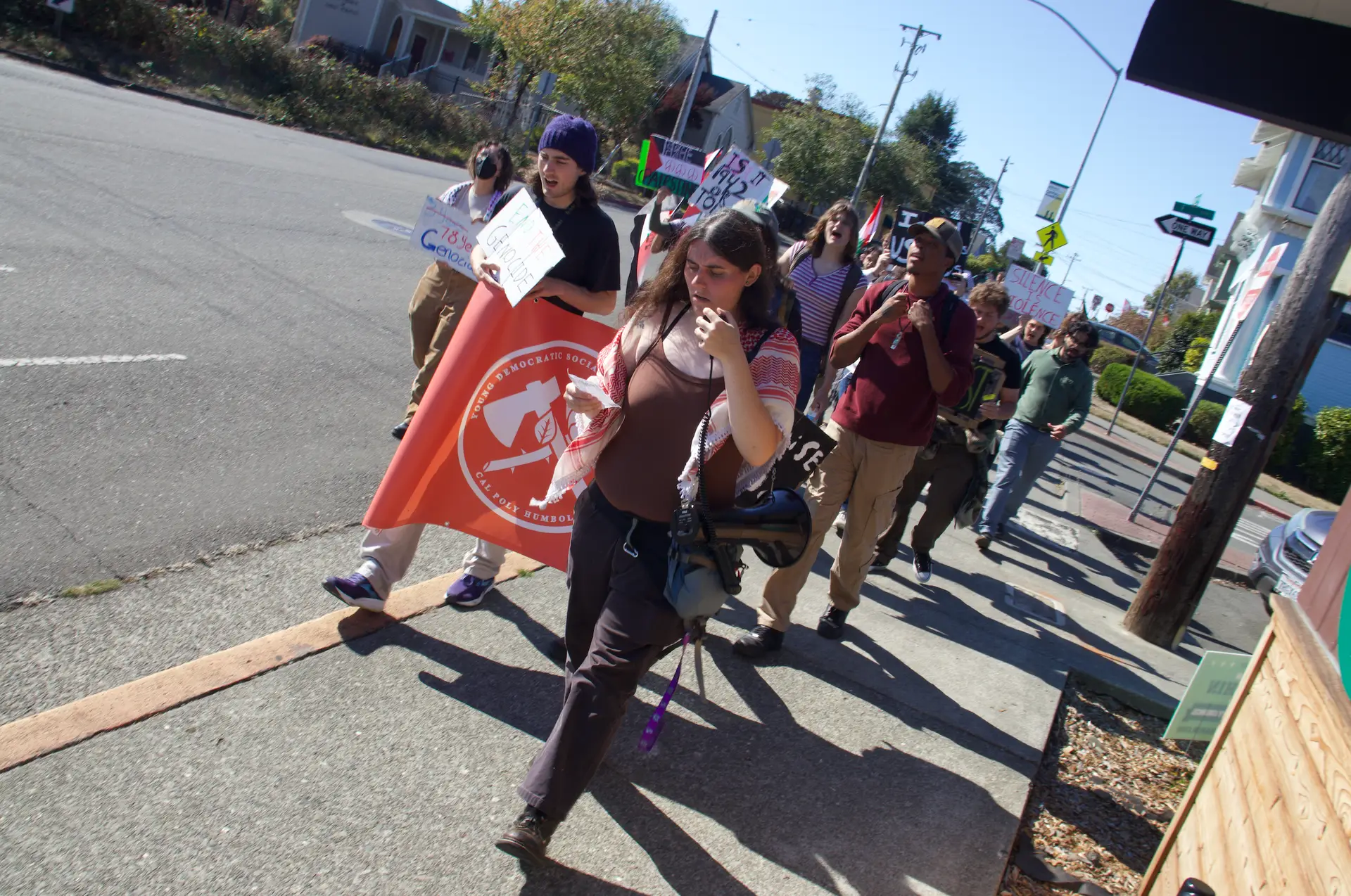
    Dozens of students barricaded themselves in Siemens Hall and hundreds more swarmed the UC quad to protest the war in Gaza and to demand Humboldt stop associating with Israeli organizations.

    At least one person, local teacher Alice Rose Finen, was arrested by the University Police Department. She was released on Monday night. 

    The protest started at around 5 p.m. on April 22, when a few protestors showed up to Siemens Hall. They piled chairs and tables up in front of entrances. The five classes being taught in Siemens were evacuated. Police arrived soon after, as did a California Highway Patrol helicopter.

    As of publication, the protest is still ongoing. Dozens of students occupy Siemens, and doors have mounds of office furniture blocking them. Though there’s no consensus, they plan on staying until their demands are met or they are forcibly removed. Several occupiers broke into university president Tom Jackson’s office by shattering the window on the door. Siemens Hall is covered in graffiti, as is the outside of the Van Duzer theatre. The American and Californian flags were taken off of the flagpole in front of the library by a man with climbing gear. 

    For hours, student activists inside Siemens Hall were only a few feet away from the police on the other side of the main entrance on the second floor. Cops showed up from all over Humboldt, including the California Highway Patrol, Humboldt County Sheriff’s Office, and even some officers from as far away as Rio Dell. At one point, police scanner traffic indicated riot control police from Redding were coming to campus, but they never showed up.

    Police left at 11 p.m. on April 22, and those inside tore the barricades down. Over 100 students entered the top floor, walked to the end of the hallway, turned around, and left. After that, the protest dwindled to less than 100 people, most of them outside. People played music and barbecued. 

    The occupation had been generally peaceful, but violence broke out at around 7 p.m. when police tore down the barricade and entered Siemens Hall. A line of law enforcement with riot shields and a crowd of activists crushed together, and a protester inside hit an officer with an empty water jug. At least one officer retaliated by bludgeoning a protester with a baton. Other reports of students being batoned are circulating, but unconfirmed. 

    The main demands of the protestors are: to end the war in Palestine, for the university to disclose any dealings with Israeli companies or the Israeli government (and end those relationships if they exist), cut all ties with Israeli universities, and for the university to end prosecution of student activists. Many of the same demands student activists all over the nation are demanding at universities such as Columbia and UC Berkeley.

    “We’re doing this out of principle and righteous rage for our comrades,” said Casey, one of the protestors who was inside the building before the police left. “We want to make this happen at other universities across the nation.”

    Another one of the protestors, who asked to be identified as “Bum,” was one of the first to blockade inside the hall. They decided they would join their friends the day before the protest was planned. 

    “When the homies started talking, I was like, ‘Yeah, dog,’” Bum said. “It’s time to fight genocide in general. It’s time to stand up with our Indigenous homies. [We’re occupying the building because] trying to dialogue with the oppressors doesn’t work well.”

    Cal Poly Humboldt has not responded to a request for comment on its ties to Israeli institutions.

    Some of the people at the protest weren’t there to demonstrate. Students thronged the balconies of the Student Activities Center and crowded around the main cluster of activists in front of Siemens Hall to watch the action, many of them on their way home from class. The helicopter hovering overhead attracted many sightseers.

    “Nothing ever happens in Arcata,” said Shawn Rogan, a curious student. “It’s novel for a small campus, and [the war in Gaza] is a cause worth protesting.”

    One of the biggest concerns the protestors had was the heavy police presence. Before they left, those barricaded inside the building said they would negotiate once the police were gone. One protester blockaded inside who asked that he only be identified as “Joe” said he would stay there until he was fought off by law enforcement.

    “I’m going to resist,” Joe said. “If they beat me, they beat me.”

    Protestors chanted anti-police slogans at law enforcement to try to get them to leave, and many of them tried to talk some officers into leaving. Communications professor Aaron Donaldson argued with Rio Dell’s Chief of Police Greg Allen and two other officers outside of Siemens Hall for over half an hour. Donaldson attempted to make the case that they could decide to leave. Allen disagreed. 

    Cal Poly Humboldt has made it clear they want protestors to leave Siemens Hall and to return home. As of April 23, graduation is still planned to happen on May 11.

    “The University supports free speech through open dialogue that is respectful and constructive, but will not tolerate endangering people, destroying property, and disrupting campus,” read an alert published on April 23. “As a community, we are committed to keeping our students, staff, and faculty safe and fostering a learning and working environment where the campus community can feel safe, included, and respected.” 

  • Cal Poly Humboldt faculty criticize administration for policing pro-Palestine protest

    Cal Poly Humboldt faculty criticize administration for policing pro-Palestine protest

    by Alana Hackman

    Cal Poly Humboldt students, faculty, and community members joined a virtual University Senate meeting on Tuesday, April 23. 

    “There is considerable interest in engaging with the open forum today. More than is likely to be possible, given due to time constraints,” meeting leader James Woglom said. “Given that, we’re going to prioritize guests. If you are a senator and we are unable to get to you today, I do apologize.”  

    Woglom then continued to introduce senators present in the meeting that evening, including Provost Jenn Capps and Chief of Staff, Mark Johnson, who would be present on behalf of the university president, Tom Jackson.

    Senator and graduate coordinator of the sociology department Mary Virnoche proposed the upcoming agenda be edited. Virnoche proposed a discussion item to be inserted into the agenda to receive an update on the campus response to the current protestors occupying Siemens Hall. No senate members objected. 

    Woglom began the discussion by citing their own experience observing the protest last night. They mentioned speaking with other individuals earlier in the day to discuss how they can make progress to meet the needs and demands of those occupying Siemens Hall. 

    Woglom then called for any member of the campus faculty or community to share any up-to-date information they may have regarding the current occupation. Each speaker was allocated a three-minute time limit.

    “I had a meeting with [Chrissy Holliday] right before this and it seems the current concern is that there [are] confidential documents in Siemens Hall,” Parker said. “So far, no one has made an attempt to reach those. If that continues, it sounds like they’ll be fairly hands off.”

    The open forum discussing the current state of the Siemen Hall occupation continued with Jamela Hashim, a social work student who was currently joining from a smartphone with other senate meeting attendees, Gabi Kirk of the geology department, and Janet Winston of the English department. All mentioned they were currently outside of Siemens Hall.

    Hashim urged meeting attendees that it was vital to address that internet services have been cut off within Siemens Hall so nobody inside would be able to comment. 

    “That seems like a bias that should be addressed in some way,” Hashim said. 

    Wolgom acknowledged the statement and encouraged protestors inside of the hall should text outside sources information they would like to be relayed during the meeting. 

    The proposed discussion by Virnoche lasted until about 4:12 p.m., until it was cut off to discuss the UPRC budget, CR/NC deadline, and Faculty Awards. 

    As the discussion unfolded many faculty, students, and community members spoke up about supporting the student protestors’ requested demands and urging for a ceasefire. 

    “Here at Cal Poly Humboldt, we pride ourselves on being student-centered and guiding our students’ academic journeys towards careers that will usher in a brighter and more empathetic world grounded in values of justice, diversity, equity, and inclusion,” said Kelly Fortner, Community-based learning faculty. “If we want to hold true to those values, as a university and campus community, we need to meet the demands of our students and make a stand against genocide.” 

    On the frontlines of the sit-in, Kirk and Winston used their three-minute speech slots to read a three-page letter collectively written by faculty deploring the University administration for the use of police force, and standing in solidarity with student protestors. As of now, the letter has 164 signatures from staff, students, and community members. 

    “We call on Cal Poly Humboldt to reflect on the real harm this crackdown on free speech inflicts,” the letter states. “And the message it sends to current and future students, their parents, faculty, and staff, and our communities within and beyond Humboldt”

    Following that, Chief of Staff Mark Johnson made a statement on behalf of the university and President Tom Jackson. Johnson encouraged meeting attendees to share possible ways they can move forward from the current events of possibly 40 to 60 protestors currently occupying Siemen Hall.

    Johnson explained that the students inside Siemens Hall were offered on several occasions to exit the building and protest in the quad or somewhere else suitable for them. He then explains that their denial to do so then equates to trespassing on public property. 

    “They refused that offer and insisted on occupying and effectively shutting down the nerve center of the campus,” Johnson said. “I think all of you understand what happened yesterday as we went through actions to try to remove those protestors who were effectively trespassing in the building.” 

    Johnson also commented that the police force was removed after the realization it was inflaming the situation rather than aiding it. Johnson mentions there are planning efforts moving forward to communicate with the protestors inside the building and provide a more peaceful and secure environment to the other students on campus. Johnson then opened the floor for constructive criticism on how to move forward with current events after reiterating that the police force involved was once again a result of the students refusing to protest in a content-neutral way. 

    “The president’s administrative team and President Jackson are making operational decisions based on real-time information about what is happening around voting and on campus,” Johnson said.

    California Faculty Association (CFA) president Marisol Ruiz laid out recommendations for moving forward on behalf of the CFA. Her requests included not prosecuting anyone involved, showing support for students’ organized efforts for Gaza, and rejecting the use of force and policing. Ruiz also called for a statement from Tom Jackson and Jenn Capps. 

    “The lesson should not be in the sacrifices that have to be made for advocacy but about the possibilities we find there for solutions,” Ruiz said.

    Geology professor Jim Graham followed Ruiz’s statement with a request for possible outside sourcing of an arbitrator to speak to the current protestors. Graham also reflected on the student sit-in in 2015 in regards to Native American Studies professor, Jacquelyn Bowman’s termination. Giving student protestors credit for their organizational abilities and dedication during that event.  

    Another attendee, Katie Koscielak the sustainability analyst at Cal Poly Humboldt then questioned if any of the student protestors’ demands were being met. A list of the demands had been circulating around social media. 

    Woglom spoke before Johnson stating that they are currently working with the students to make their demands more concise. Woglom and Johnson mentioned specifying the investments within the demands of the university can make them more achievable. 

    “The investments at the system level, at the state level, are not under our control in any way shape, or form,” Johnson said. “We do have some investments as part of the endowment and to add to James’ point we are looking into those investments, those portfolios to make certain that we understand what if, if any, percentage of those investments are already in better, broad terms, defense contractors.” 

    Johnson continued to state that President Jackson would not be making any statements in support of or against any political opinions or subjects. 

    “With regard to having a war or causing a ceasefire, causing the United States to divest in broader terms, those are things really outside of the control of anybody here on campus, and therefore are not actionable or realistic for the university to consider as demands to be met,” Johnson said. 

    After Johnson’s final comment, concerned community members shared their thoughts on the University’s handling of the student protestors. Concerns were made surrounding words used to villainize the protestors, hygiene following campus closures, and the overall prioritization of property safety over people. 

    One community member Genevieve Ameduri shared a strong message of disdain of the university’s call for policing the student protestors. Ameduri explained that she and her husband have recently moved to Arcata and adopted three Palestinian children who are hopeful to attend Cal Poly Humboldt in the future. She explains seeing a student hit over the head by police in riot gear in the first fifteen minutes of attending the protest was extremely upsetting and made her question the University’s priorities. 

    “Our children have the decency and the heart to stand up and we put them in violent outcomes, it’s unacceptable,” Ameduri said. “I am ashamed of all of you who have not spoken up and stood with them.” 

  • Seven years after the killing of Josiah Lawson, Arcata still mourns his loss

    Seven years after the killing of Josiah Lawson, Arcata still mourns his loss

    By Eli Farrington

    On April 15, 2017, David Josiah Lawson, an HSU sophomore, community leader, and member of the Black community, was killed at a house party in Arcata. He was sprayed with bear mace and then fatally stabbed six times after he was falsely accused of stealing someone’s cell phone. 

    On the seventh anniversary of Josiah’s passing, members of the Arcata community gathered in the square to honor his time on earth with a candlelight vigil and call for justice to be served. 

    Sarai Bordeaux, community member and former Humboldt State University student, spoke about the lack of justice surrounding Josiah’s case. She was heartbroken to hear that nothing was being done to bring Josiah’s attacker to justice. 

    “The fact that people knew who did it, knew who was involved, and very much could have done something, but didn’t, has stuck with me throughout my entire context in moving back to Humboldt,” Bordeaux said. “I’m a substitute teacher, and I work in the community, and to hear that there’s an event to celebrate Josiah’s life in the midst of a space that has done nothing to get justice for him just made me really want to come out.”

    For Bordeaux, the vigil served as a firm reminder that the Arcata community hasn’t forgotten about what happened to Josiah, and that the strength, persistence, and power of the community as a whole has the power to make positive change and make Arcata a safer place for people of color. As much as she loves the tight-knit community of Arcata, Bordeaux knows that it can be a bit intimidating and unwelcoming to marginalized communities coming here for the first time, especially when it comes to getting housing, jobs, and meeting locals. 

    “As much as I love coming out here, and as much as I need to come out here and see the community and know that we’re all still grieving, as much as I want space to be held for us, I am tired of holding it in trauma. the vigils that we hold are a visible display of our trauma,” Bordeaux said. “[The vigils] are important because people need to know that this is what we’re still dealing with here. We have to keep holding vigils because our folks keep getting murdered. We have to keep coming out to honor the lives of those that we have lost.” 

    Marlon Jones II, a community leader, activist, and organizer of the vigil, shared Bordeaux’s desires to create a safer and more accessible Arcata for people of color. He acknowledged the hard work and dedication of places like El Centro and the Umoja Center, but he expressed the fact that many black and brown students still feel unsafe outside of these environments. 

    “Through the vigils, I’ve met so many amazing people who all have this common goal of just making this place safer for Black and brown people, and providing these spaces where we can just exist,” Jones said. “Places where we can be ourselves and not feel threatened by this white supremacist, patriarchal society that tells us that we have to conform to certain spaces, or that we don’t belong in them at all.”

    Jones believes that Josiah’s vigil will continue to impact the community and motivate people to take action and seek justice, even when it may not be easy. 

    “It’s important to remember how to remain hopeful in a place that surrounds you with hopelessness,” Jones said. “It’s important to be the answer to the question … to understand that we the people, as a community, are the solution to this. We have to understand how powerful we are.”

    A major source of hope for the Justice for Josiah Committee and all of its supporters is Charmaine Lawson, Josiah’s mother. After Josiah’s passing, Jones was introduced to Charmaine. She immediately took him under her wing and showed him unconditional love and support. While she wasn’t able to attend the vigil this year, she has attended every year in the past, and even often comes on a regular basis, making the long trip up to Humboldt from Southern California to honor her son’s life and continue to spread love in Arcata. 

    “[Charmaine] does so many things for the Arcata community, despite the lack of justice,” Jones said. “She does so many things out of love and gratitude because that’s just who she is. That’s who her son is, even though he’s no longer with us physically. This young man was on the path to changing the world positively, and he was taken from us, through that avenue. There’s been so much love and support behind getting that justice, behind putting those minute steps into action, going to the courthouses, calling the [District Attorneys], and making sure that they know that this is important. Not just to Arcata, but to California, and to anybody that has had to deal with a missing or murdered person.”

    Charmaine Lawson’s goal since her son’s passing has been to continue to uplift the Cal Poly Humboldt and Arcata community. Her passion and positivity inspired countless others to follow in her footsteps, including Romi Hitchcock Tinseth, a community leader and organizer of the vigil. When Tinseth heard about Josiah’s murder, she immediately knew that she had a responsibility as a mother to take action and help the cause in any way that she could. 

    “It’s no wonder that DJ [David Josiah] was a spectacular human being, because his mother is a spectacular human being,” Tinseth said. “She has devoted her energy to carrying on the love that DJ gave, that is a product of her love. So she comes here, she does good in this community, she does the work that DJ would be doing, and she has come often every single month on the 15th, for years now. And it has been seven years. This is the first anniversary of DJ’s death that she was not here, because she chose to surround herself with her family in Southern California and celebrate DJ’s life that way.”

    Seven years after his passing, Josiah’s positive impact on the community is still being felt in many different ways, giving Tinseth and many others an outlet for creating a better Arcata and a better world. 

    “[He was] an incredible student at Humboldt State University, a leader, a person who was dedicated to changing people’s lives for the better, and fighting for justice in the world,” Tinseth said. “In fact, he was a criminology and justice studies major. He was President of Brothers United at Humboldt State, and just an amazing, good human being.”

    Michihiro Sugata, Cal Poly Humboldt Criminology & Justice Studies Program Coordinator, Associate Professor of Sociology, and former teacher of Josiah’s, spoke about who Josiah was as a student and a man. According to him, Josiah had a contagious smile that brought people in and kept them engaged. Josiah brought so much light and energy to his class, and his positivity was infectious. He loved to learn new things and take on new challenges, and he wasn’t afraid to discuss difficult topics. 

    “Losing Josiah was like watching hope die,” Sugata said. “I’ve never articulated it this way before, but Josiah was the type of student that [educators] put our hope in. He was the type of student that makes you believe that the challenges of this world can be met and overcome — he instilled hope in all of us and to lose that was just devastating. But I know he wasn’t the only one, and to see young people showing up to the vigil, to see young people painting murals and writing poetry about Josiah, that brings back the hope.”

    The vigil was ultimately a celebration of Josiah Lawson’s life, a life that was taken far too soon. But it was also a sobering reminder that justice has still not been served. 

    “These vigils remain important for many reasons,” Sugata said. “They keep us connected to one another, and keep us connected to the broader fight for injustices in our community and beyond. Just as important, the vigil serves as a symbol for the continued struggle for racial justice within this community and this country. For those of us who knew Josiah, gathering in community and fighting for just causes isn’t just an act of remembrance. It’s a way to honor the man he was and the life he lived. These are the things he embodied.”

  • Student dancers bring art to life in the Van Duzer

    By Dezmond Remington

    Dance Visions can’t be summed up in a few simple opening sentences. 

    The concert can’t be judged as a whole because of the six students and three faculty that choreographed 10 different dances, all performed by dancers from Humboldt’s dance department. Each dance had its own different look. There were fairy tales, night clubs, and cabaret halls all on stage, as well as a few more archetypal modern dance pieces. 

    It was a celebration of aesthetics. Though none of the costumes or lighting was overly elaborate, it was all rich. No dance was boring to watch. All of the dances were a thrill to watch as performers contorted and flipped, swayed and leaped. Broken Boundaries, a dance choreographed by professor Linda Maxwell and performed by just three dancers, looked like a moving painting. 

    Though the pieces by the professors were perfectly, reasonably interesting, the most entertaining and daring performances came courtesy of the student choreographers. Alli Bush’s 8te was a neo-burlesque extravaganza. Miriam Allen’s Evocative Pigment juxtaposed three different colors in a dazzling display of light and motion that was wholly captivating.

    The one criticism that could be thrown at Dance Visions is that art usually has some kind of meaning, a meaning that many of the dances seemed to lack. What significance or idea they expressed wasn’t easy to pick up on, though I’m no professional art critic.

    But how much does that even matter? Dance Visions was a beautiful spectacle, a fun look into the minds of Cal Poly Humboldt’s dance auteurs and performers. Meanings or messages can be overrated when it comes to critiquing art, especially at a college level when people are just learning how to express themselves. It was joyous, a delight to the senses. That in itself is a meaning. 

  • Jasmin’s corner; what-ifs

    Jasmin’s corner; what-ifs

    Hello Jasmin, 

    I have this special person with whom I had a long standing relationship with. Going to college sort of brought an end to things and we came to a mutual understanding, so the breakup wasn’t bad at all and we’re still friends. It’s been 3 long hard lame ass years and she still pollutes my mind – it’s ridiculous. I can say I’m over the emotional heartbreak, but I still think I’m hung up on the idea that something might come of the future when I’m making big money and able to support that type of relationship. I saw them recently after a year or two of not talking and they seemed interested, though maybe I’m delusional. What’re your thoughts on revisiting relationships and do you think it’d be a good idea to try and pick up the pieces, or should I continue on as is? 

    Friend, you’re not over the emotional heartbreak or the girl. Leaving for any reason besides losing feelings or realizing your partner was actually a bum the whole time is always going to leave you with unresolved feelings and daydream-ey what-ifs. 

    If you think she’s interested, I don’t see why you wouldn’t at least try – especially if you’re not long distance. If you are, consider where you might both be in the future before you get too excited. No one should have to suffer through a long distance rekindle with an ex. You very obviously are holding out for this girl, so I definitely recommend not seeking anyone else romantically until you figure out your feelings and what to do with them. We don’t want anyone else getting their feelings hurt. 

    I don’t know the reasons behind your breakup, but I do insist that you reflect on the bad parts of your relationship and not only the warm, fuzzy memories. I will never tell you not to follow your heart – I actually encourage it. If you don’t think the timing is right, you’re right – it never is. We’re given the cards we’re dealt and have to figure out how to play them accordingly. You can show your love without having a big money job. The future isn’t promised and we have to act while the people we love are still around us. Just try to not be too aggressive or forthcoming with it.

    All in all, the only person that can tell you what to do is you. Would you rather suffer through the what-ifs or just find out for yourself? Is finding out for yourself worth the potential let-down of a second breakup? You tell me. 

    xoxo,

  • An excerpt from Sanctuary

    An excerpt from Sanctuary

    Sanctuary: A book of essays on faith (with some romantic poetry mixed in) 

    By Alexandra Berrocal

    I

    Dream of

    Red hair and

    Soft green eyes. 

    The eyes of my mother.

    I have dreamed of her for

    Decades upon decades and

    Centuries upon centuries.  I paint

    Her because she is clear when all fades.

    The one thing I reliably recall.

    She walks into the front door of my space

    I feel like she has entered myself

    And with every painting she sees

    She gazes into my soul.

    A soul that’s filled with her.

    For time after time

    I look at her

    And feel I

    Collapse 

    In.

    Graphic by Griffin Mancuso
  • To fuck or not to fuck… your co-workers

    To fuck or not to fuck… your co-workers

    By Christina Mehr and Andres Felix Romero

    To fuck:

    Do you like making money? Do you like making love? Well, why not combine the two?

    I believe in messing around with the people you work with. The dating pool in Humboldt is already limited, so you have to take them where you can get them. If you’re already spread so thin between classes, homework, and work, why not get spread by someone you are literally getting paid to see? It’s the best of both worlds. 

    There’s plenty of benefits to being in cahoots with your coworkers, like getting to flirt with them in passing, sharing rides to work if you share the same schedule, or sneaking away together on breaks. On the plus side, if your work is getting overwhelming, you can turn that into sexual frustration towards that coworker. It creates some fun and exciting drama in an otherwise boring workplace. Having a work crush is amusing and gives you some more motivation to actually want to go to work. 

    However, I understand the opposing side of, ‘what if we break up or get in trouble?’ or whatever, but honestly if you’re at a minimum-wage college job, just go ahead and do it for the plot. 

    To not fuck:

    Workplace romance – it’s fun and exciting, but also a potential threat to you and your emotional wellbeing. I’m not disagreeing that a romance in the workplace isn’t a bit of a thrill, but from another perspective, you might be walking into a game where everybody can lose. 

    Obviously, things can get awkward if the passion fizzles out. Breakups hurt and can be as devastating as losing a loved one. Sometimes, breakups can be amicable. However, how many of you have had those relationships (or situationships) end with your gut feeling like it’s been poisoned? The lovely person who once made you smile suddenly turns into a bitter and painful relationship? 

    Want to know the cherry on top of the heartbreak cake? Imagine losing someone you care deeply about, then seeing them when you walk into the place that pays your bills, and seeing customers flirt with your former beloved. Jealousy is a poison, and it’ll infest your workplace and create tensions and conditions that are toxic and unbearable.

    Now, flirting in itself is a whole other beast of ethics, however the general rule is to back the hell off when someone isn’t showing interest or signs that they’re uncomfortable. At a bar or party, it’s easier for someone who isn’t interested to get some distance from your flirting skills. At a workplace, your crush is probably stuck with you. Do you really want to risk making your crush uncomfortable? Do you really want to make it awkward when y’all work together? Do you really want to go to human resources (HR)?

    If you have a little crush, it’s not the end of the world. A lesson I’ve learned is that it can be harder to control our feelings, but we are in control of our actions. I agree that the rush can be fun, but all highs have to come down when we come back to reality. It’s like a bong rip just before a morning class. It sounds great, and for a while, you feel like you’re walking on the clouds doing something you really shouldn’t be doing.

  • From the psych ward to the newsroom

    From the psych ward to the newsroom

    By Savana Robinson

    March 8, 2023, I was released from a psychiatric facility with two diagnoses: schizophrenia and bipolar I. A year later, I’m doing better than ever. I’ve got a nice job as a multimedia journalist, I’m close to graduating, and I have a great group of people who care about me. Getting here wasn’t easy – I had to reconstruct myself as a person. It took a lot of support, therapy, and medication, but I did it.

    I went back to the fundamentals of me. I left Humboldt and moved back into my childhood bedroom in Redwood Valley. The pink walls with pastel butterflies and flowers, my rock collection, and my numerous stuffed animals helped gently bring me back to where I needed to be.

    The first few weeks of being back in the world were scary. I wasn’t in psychosis anymore, but the paranoia and hallucinations of onset schizophrenia were still present. I had been started on medication for it a few days before I was released, but it still took some time and help to be manageable. I’ve been in therapy since the day I got out of the facility, which has helped tremendously. Of course, I chopped off my hair. Some people believe that hair holds on to memories, so I got a bob. I loved it for a while, but I eventually mourned my long hair. 

    Per my routine-abiding father’s suggestions, I started by waking up early, making my bed, walking the dogs, and making breakfast. I took it one day at a time and eventually, I was thriving. I had to drop advanced photojournalism, and I couldn’t use the school’s camera anymore, but I love taking photos, so I bought my own. 

    Photography is another form of therapy for me. It’s relaxing and lets me express my creativity. I got a job doing photography and blog writing at a mini golf course in Ukiah. I continued with a few of my classes from home, doing online work when I wasn’t taking pictures. I finished out the semester and by the summer, I felt that my medications had leveled out enough to feel “normal.” I didn’t feel like I was moving through jello anymore.

    Halfway through the summer, I decided that I wanted to go back to Humboldt, despite my parents’ protest. I found out my friend had a vacant room, so I moved back to Arcata and went back to school in person. I was a bit nervous, but I was confident that I would be fine. I worked on The Lumberjack and continued to take photos. I started doing sports photography and made some money doing it. I even did my first wedding photography gig. In January, I got my job at Redwood News. I’m just getting started in my career, but I’m optimistic for the future.

    After being released from the psychiatric facility, I had no idea where I’d be in a year. I was hopeful that I’d be somewhat successful, but I didn’t expect to be working as a professional journalist. If I had to do my year of healing all over again, I’d do it the same, because I’m very happy with how I turned out.

  • Mar’s Gaming Garage: HI-FI Rush

    Mar’s Gaming Garage: HI-FI Rush

    By Mario Orozco

    Every good game has music. Usually a game’s music plays in the background and has no actual effect on the gameplay. This week’s game uses music differently, it’s not just in the background of your gameplay, but part of the mechanics of the game itself. Justin Crittenden, a software engineering major, recommended “HI-FI Rush” to me, a rhythm-based action game released in 2023. Before I played this game, I was under the false impression that it would be like other rhythm games, but “HI-FI Rush” isn’t like anything I have experienced before. 

    This game has a really simple story, but it was well executed and had my complete attention throughout the playthrough. It did a fantastic job taking a simple plot and making it feel entertaining and fresh. One aspect of the game that I enjoyed was the art style. The characters are cel-shaded, giving the game a comic book like appearance and the main bosses of the game each had beautifully detailed freeze frames that contributed to this design. Another aspect I enjoyed were the characters; each character had clear motives and reasoning behind their actions which is extremely important. The characters were also very entertaining, the main cast had fantastic chemistry with each other and it was fun to see them interact and grow together. 

    The main aspect of the game that makes it memorable is the gameplay – the combat is amazing. There is a constant beat playing throughout the game and combos performed exactly on this beat increase the effectiveness of your attacks, which is also used to parry enemy attacks. The beat is useful in ways outside of combat too. It is used to move faster and assists in traversing through the levels. The style of gameplay temporarily switches a few times in specific portions, it even becomes like “Guitar Hero” in a few battles with buttons needing to be pressed exactly on time to the song playing in the background.

    Like always, there are a couple negatives that I would like to address. The first is the design of the levels. Most of them have a similar feel, following the same general outline. This is okay though, the main focus is the combat, which is fun enough for the repetitive nature to not really matter. The other issue is how difficult the timing can be. In the later stages of the game, there are just way too many enemies attacking you all at once to be able to focus on hitting your opponents with rhythm. Instead, it turned into me just dashing around chaotically, randomly swinging at everything close to me. If this is a problem, you can just turn the difficulty down and it’ll make staying on rhythm more manageable.

    “HI-FI Rush” took me a grand total of nine hours and one minute to complete. It is evident through playing the game that the developers had a blast making it, and it feels like a passion project. I rate this game a 4 out of 5, and if you like fast paced, hack-and-slash gameplay, then I strongly recommend this game to you. “HI-FI Rush” is definitely worth the purchase. 

    If you have any games you would like me to review you can email marsgaminggarage@gmail.com.

  • New shark discovery offers glimpse into a lost world

    New shark discovery offers glimpse into a lost world

    By Brad Butterfield

    326 million years ago, Arkansas was underwater and teeming with an unusual, gill-covered shark, a shark that is now called Cosmoselachus mehlingi after a years-long project led by Dr. Allison Bronson, a Cal Poly Humboldt professor. The unique conditions in the Fayetteville Shale preserved the precious cartilage that was critical in digitally reconstructing an accurate image of the ancient shark, which was named to honor Carl Mehling, a senior museum specialist for the American Museum of Natural History (AMNH). The shark’s ancient origins and recent identification have been made possible by CT scans, digital reconstruction, and years of careful work carried out by Bronson alongside Alan Pradel, John Denton, and John Maisey. The findings were recently published by the journal Geodiversitas.

    Cosmoselachus mehlingi is distinctly important, according to Bronson, due to the fact that its ancestors survived a catastrophic mass extinction that killed 95% of the fish population in the Devonian period.

    “In the wake of these extinctions, we often have what we call an adaptive radiation where the groups that make it through can then diversify into all these niches that were left open,” Bronson said.

    The acidic and anoxic environment of Arkansas’ Fayetteville Shale preserved the shark’s delicate cartilage for millions of years until the 1970’s, when Royal and Gene Mapes, the husband and wife duo, discovered the fossil. The Mapes would eventually donate the specimen to the AMNH. 

    “Cartilage is really rare in the fossil record, because it’s soft and squishy, and usually microbes break it down before it can fossilize,” Bronson said.

    The rare preservation of the shark’s cartilage allowed Bronson and her collaborators to use CT scanning to digitally reconstruct the ancient shark’s biological structure and identify one of its most unique attributes, gill covers.

    “It’s made of little rays of cartilage that grow off of its gill arches,” Bronson said. “In our shark, unlike anything that’s been described in any cartilaginous fish, they’re all fused together.” 

    The gill covers may have functioned to help close the gill openings, according to Bronson. Though gill covers are found today in ratfish, Bronson and her colleagues’ statistical testing showed that it is unlikely that ratfish are descendents of the group of fishes that includes Cosmoselachus mehlingi. Additionally, the digital reconstruction revealed that the ancient shark had widely spaced teeth with tooth-like scales in between.

      Bronson and her colleagues’ work to identify Cosmoselachus mehlingi gives scientists a valuable glimpse into our ancient world and another datapoint that aids in our understanding of evolution over time.

    “Once you have an understanding of the long branching pattern of evolution, you can reconstruct the way that traits evolved over time with a group like cartilaginous fishes that’s been successful for more than 400 million years, and made it through multiple mass extinction events to now be the dominant predators of the ocean,” Bronson said. “A lot of evolution is just like, if it ain’t broke, don’t fix it.”

  • Smelting in the water

    Smelting in the water

    Cal Poly Humboldt fisheries professor is working with local tribes to create better fishing stewardship practices.

    By Gabriel Zucker

    Jose Marin Jarrin is a new assistant professor in the department of fisheries biology at Cal Poly Humboldt. He is leading a new form of fishery science in Northern California, using empathy and understanding when talking with impoverished communities. He is originally from South America and he never forgets where he came from. 

    “Being Latinx, I’m also from a historically excluded community,” Marin Jarrin said. “So I saw a lot of similarities.”

    Marin Jarrin was recently awarded a little over $1.1 million from the California Climate Action Seed Grant to research climate change resilience by looking at tribal fishery practices. His goal is to reinvigorate Northern California fishery research, while also building a center that will last for years. 

    He is working with the California Department of Fish and Wildlife and multiple local tribes, such as The Blue Lake Rancheria, Resighini Rancheria, Tolowa Dee-Ni’ Nation, and other smaller indigenous communities. Each native group was able to pick a fish that has historical and cultural value to their tribe. The fish that are being mainly researched are green sturgeon and smelt. Five grad students are working with Marin Jarrin, acting as liaisons for the different Rancherias. On top of doing research all over Northern California, the tribes and researchers have a monthly meeting where they go over the progress and find where they can improve.

    Creating a trusting relationship with the Indigenous communities is important. To solidify this relationship, Marin Jarrin signed a data sharing agreement with all of the tribes, giving them final say on what information is published. Historically this has not been the case, and some even admitted they had never been asked to do this before.

    “The researchers would go in, ask the tribes to participate, and then the tribes don’t get a say on how the data is used,” Marin Jarrin said. “And so, one of the things we wanted to ensure is that the tribes had complete ownership of that data. For the most part, they’re not too concerned about fishery species, they’re more interested in preserving their cultural data and history. What they don’t want is for people to just take information from them and disseminate in ways that are sometimes not correct or hurtful to the tribe.”

    Laurie Richmond is an environmental science and management professor at Cal Poly Humboldt. She has worked with the tribes for years, working a quarter time for California Sea Grant as an extension specialist. Where she connects local communities with coastal science knowledge. Her role for the study is in a partner advisory role, where she offers advice and direction when grad students need a new perspective. She has been working with Marin Jarrin since the beginning of the grant and is elated at the way he is going about his research.

    “I think it’s a really new way to be a scientist that I think [Marin Jarrin] is pursuing,” Richmond said. “It’s really exciting and it requires a lot of skills that scientists don’t always have, like building partnerships and facilitating and thinking about ethics. He’s done a great job of trying to learn those things, and he has some of those because of his unique background that he brings as a scientist.”

    To record the biodiversity of the fish in different areas, grad students are using environmental DNA metabarcoding techniques, giving them data about all of the animals that have come into that area.

    “If a fish swims by, it’ll leave its DNA in the water column,” Marin Jarrin said. “If you were to collect a sample and filter out the DNA from that, you can identify what species of fish was there. The idea is that if you then go around taking samples throughout the whole coast, you can identify all the fish – actually, not just fish. From bacteria all the way to mammals.”

    Before conducting this research, they had to work with the California Fish and Wildlife department. The advisor on the grant is Kenneth Oda, a former Humboldt State University student, who is with the Marine Region and works on the State Managed Finfish Research and Management Project. Oda gives advice and helps review the proposals before they are submitted. 

    “I was just asked to be an advisor… we approve protocols, if they’re gonna be taking fish, we need to have that spelled out, and the methodologies as well,” Oda said. “We review their permit application and then approve it. I also help them with protocols regarding surf perch and red tail.”

    Olivia Boeberitz, one of the graduate students on the team, just moved to Humboldt. She chose Humboldt partly because of this research project, and the opportunity to work closely with Indigenous tribes. She has been studying fisheries since 2020, focusing on fish that inhabit both freshwater and green water. This made the transition from inland to coastal easier. 

    “I’m working specifically with Blue Lake Rancheria on green sturgeon… I’m designing a project to get some baseline information on how green sturgeon are using Humboldt Bay,” she said. “There hasn’t been much of any research, at all, of green sturgeons in this area.”

    Boeberitz is in the methods phase of her research project. She is running through a couple ideas for data collection. She wants to use acoustic receivers, alerting if any previously tagged fish are using these areas. She is also planning to use satellite tags  on fish off the coast. None of the actual research will be conducted until the summer.

    Right now, she is most excited about working and meeting with the tribes. She has worked with tribes before, but never one on one.

    “I see and talk to them very frequently,” Boeberitz said. “As soon as I produce any drafts for my proposal, as soon as I come up with a schedule, they’re going to be incorporated every step of the way. Their feedback is both incredible and extremely valuable. I’m working on this project for them, they’re the center of this project. They’re guiding me – giving the guidance they need to start putting together what our goals are.”

    Marin Jarrin is changing how people view the scientific process. He is finding paths of communication that are not usually seen in western science. He is not just doing research, he is creating positive social change.

    “I want to help communities that have been historically excluded, to be better – better informed and the different techniques and methods they could be using to manage their fisheries,” Marin Jarrin said. “We want to empower people right. Our community to tribal communities, but to the community at large in the far north of California, so that they feel they are more capable of being stewards of their resources. But also, the students that we bring, we want to prepare the best students we can because they can go out… and bring this idea of diversity, equity, and inclusion to the next job that they take.”

  • Khalil Ferguson speaks on the obstacles to equity and a fair cannabis market

    By Georgina Munoz-Villanueva

    The Cannabis Studies Program at Cal Poly Humboldt hosted a discussion on achieving social equity in California with United Core Alliance’s President and CEO Khalil Ferguson on March 22. 

    Ferguson is a social equity advocate, author, a business law and marijuana law student at Pacific’s School of Law, owner of a cannabis dispensary and the face of the United Core Alliance, a non-profit organization founded by social equity advocates, that works with communities affected by the war on drugs. 

    Ferguson spoke about the role of the legislative and constitutional limits, including California’s Proposition 209, in hindering equity efforts. The measure eliminated affirmative action programs in public employment, education and contracting and made it illegal for the government to show preferential treatment based on race, sex, color, ethnicity, or national origin.

    “The civil rights movement was asking to ban discrimination based on that,” Ferguson said. “I don’t think that’s a drawback, but it poses a hindrance when it relates to wanting to solve issues such as how to get more women involved in the market.” 

    In the cannabis industry, affirmative action will sometimes look like state-wide licensing systems with a quota that would grant a certain percentage of licenses to racial minorities, allowing them access to capital and social mobility. Nationally, according to the Diversity, Equity and Inclusion in the Cannabis Industry special report, racial minorities account for less than 16% of cannabis business ownership, while also accounting for more than 40% of the total U.S. population. In places like Illinois, Black and Hispanic cannabis majority owners comprise only 1% of the industry. 

    “The issue of this decade is how to include diversity, equity and inclusion in programs, jobs, houses, services, etc.,” Ferguson said. “It’s kind of frustrating […] to talk about racial justice because we all want racial justice, […] but how can you be passionate about it without knowing what your constraints are?” 

    Following the legalization of marijuana in California, AB-1793 was passed into law, which automatically dismissed or reduced all marijuana convictions that disproportionately targeted Black and Brown communities during the war on drugs. Equity programs were created to address these impacted communities, but created more problems. 

    “[Equity] has been over-inclusive,” Ferguson said. “There are folks in North Hollywood who haven’t been impacted by the war on drugs who qualify for social equity benefits.”

    Ferguson talked about equity programs across California, and acknowledges that while Sacramento’s Resolution 2018-0323 has its pitfalls, he still uses it as a reference when compared to other equity programs. He believes Los Angeles’ cannabis equity program, for example, is one of the worst equity programs, as it requires applicants to have a commercial lease in the city before applying for a cannabis business license. The average office lease in Los Angeles costs around $45-$55 per square foot. 

    Humboldt County’s equity program, Project Trellis, has come under fire for similar issues as many cannabis farmers, some of which faced decade-long sentences in the 90’s for growing marijuana, find themselves unable to qualify for the program. 

    “That’s inequitable in itself,” Ferguson said. 

    Social equity advocates are now trying to argue for a more narrow definition of what equity would entail. 

    “I have to say that social equity is not a monolith,” Ferguson said. “Social equity is also easily challengeable because of the restraints that are erected by Prop 209. So, as an advocate, our job and your job is to be very innovative with how we can get around that.” 

    More information on Khalil’s work can be found at United Core Alliance and Khalil Ferguson’s website. 

    https://khaliljferguson.com/

  • Having a doggone good time at the Dog Expo

    Having a doggone good time at the Dog Expo

    By Griffin Mancuso

    Last Sunday, in the middle of a warehouse bustling with families and dog lovers alike, I stepped into the compact demo area, waving nervously to the packed bleachers on either side. The president of Humboldt Disc Dogs introduced me and my dog-child athlete, Oscar Meyer, as newer members of the club with a lot of promise.

    While Oscar leaped into the air trying to grab the frisbee from my hands, I lead him to the center of the demo area and gave a thumbs up to the president. The familiar start cue before every disc dog game echoed through the warehouse.

    “Ready, set, go!”

    I had the honor of participating and volunteering at the annual Dog Expo hosted by the Humboldt Dog Obedience Group. After a grueling five-hour set up the day before, I was ready for Oscar to show his skills – and to buy dog supplies that I didn’t need. 

    Even though the expo was hosted in one building this year, it was still packed with visitors. Thirty dog breeds were present for visitors to meet and learn about, ranging from the Golden Retriever to the Lancashire Heeler. There were also demos for dog sports like disc sports, rally, carting, and agility.

    Only a few Humboldt Disc Dogs members were interested in participating in the demo, and I wasn’t surprised. We normally have our games on an expansive, lush green field in Fortuna, and we were now having to show off our sport in a 30-foot long rectangle with rubber mats for traction. I was determined to make it work.

    I thankfully had the foresight to practice on set-up day and realized that my plastic discs would either a) hit a spectator, or b) go skidding out of the demo area and Oscar would follow suit.

    Equipped with a new rubber disc that would not injure anyone or send Oscar flying over the fence, I demonstrated the games 4-Way Play and Throw n’ Go along with a few other teams. As Humboldt Disc Dogs is a newer club, I felt its reputation weighing on my shoulders. I felt obligated to prove that my dog had the skill and focus to catch frisbees while surrounded by cheering spectators and barking dogs.

    Brimming with energy, Oscar caught the first frisbee throw with ease, drawing cheers from the crowd. I yelled, “Good boy, Oscar!” as he ran back to me, frisbee in mouth. Before I could tell him to drop the frisbee, he started to violently spin and thrash it around. He had too many ants in his pants. The more I chased after him, the faster he spun away from me. Once I grabbed the frisbee, we engaged in a brief game of tug-of-war as the audience roared with laughter. 

    Besides the spinning shenanigans, Oscar did fantastically and I did not hit anyone. I left the demo area with a relieved smile and gave Oscar lots of love and treats for a job well done. After the fact, the president told me Oscar was a crowd favorite.

    I spent the rest of the conference sprinting around trying to recruit booths for the upcoming All Breeds Show in July and observing the demos. Keeping myself busy helped me resist the urge to spend hundreds of dollars on dog-themed hoodies, leather collars, leashes, homemade dog treats, dog art, ceramic dog bowls, and wooden dog coasters.

    As someone who is just starting out in dog sports, I was glad to have the opportunity to see demonstrations of the sports I haven’t tried yet, especially agility. I have been told by several members of the dog sport community that agility is a rich man’s sport. Coming in at a whopping $22 per entry and hundreds of dollars for classes, it would not be an ideal sport for a college student. However, watching a poodle go flying over hurdles and diving through weave poles is really convincing. I might have to consider it despite the state of my checking account.

    One of my favorite parts of the expo was getting to meet dog breeds I otherwise wouldn’t see out and about in Humboldt. I got to meet a lovely 8-year old Drentsche Patrijshond named Mr. Tickles. The more I pet him, the more he drooled, and he’d paw at my hand if I dared to stop. The Irish Wolfhound, whose back reached just below my chest, stared at me blankly while I ran my fingers through his wiry coat. Vinnie the Lagotto Romagnolo’s entire body wiggled with excitement before I even approached him. One of the Greyhounds, Maxwell, wanted nothing to do with me and refused to sit still for a photo. Maxwell was my favorite.

    While I enjoyed the expo as a dog nerd, this event is especially important to the casual dog-lovers and families visiting. The Dog Expo exists to educate the public on responsible pet ownership, how to take care of different dog breeds, and all the amazing skills dogs are capable of. Maybe next year I’ll suggest a rescue dog booth for Oscar and I.

  • Who are the faces behind the picket lines?

    Who are the faces behind the picket lines?

    By Dezmond Remington

    The sun is setting and people are hollering. 

    There’s a group of about 20 students parked outside of the Reese Bullen Gallery screaming their best chants at the university administrators and jet-setting donors who are supposedly inside. None of the protestors have seen them in the hours they’ve been there, and the windows are covered in cardboard anyway. 

    At the top of 12 stone stairs facing the buildings opposite stand a few people with a megaphone speaking to those down below — and across the quad, and across the street, too. Their megaphone is crackly, but effective. 

    “All he cares about is getting more students and then fucking them over by making us pay more tuition and more in housing!” Mary Mangubat said, clad in a blue surgical mask and an undone black zip-up hoodie. The protestors nod, as does student Richard Toledo, who is holding the megaphone for her. 

    Mangubat and Toledo are constant presences at protests in and around campus. They’ve supported everything from Palestinians in Gaza to professors striking this semester. Mangubat even got a protest in her honor when the megaphone usage and other violations of the university’s Time, Place, and Manner restrictions on free speech at the Reese Bullen Gallery on Jan. 23 got her and Toledo yanked into a meeting with Dean of Students Mitch Mitchell and handed a “deferred probation”— in other words, a slap on the wrist. The next time one of them breaks the rules, they may face measures such as expulsion. As it was, they had to write a reflection essay on how to be a better organizer. 

    Signs from the student protest on Feb 8 prompted by Toledo and Mangubat’s deffered probation following a violation of the university’s Time, Place, and Manner restrictions. Photo by Griffin Mancuso.

    Though many of the things people see Mangubat and Toledo do are similar, such as leading protests and showing up to meetings, how they approach those actions contrast heavily. 

    Mangubat, 20, started protesting when she was attending high school in San Francisco’s SoMa district, where she said there were issues with things like outdoors accessibility. Mangubat, a Filipina, said she had an early awareness of concepts like intersectionality when she noticed the other students working to raise awareness of those issues were richer and went to private schools. 

    She occupies many roles on campus. She’s the environmental educator at the Women’s Resource Center. She interns for the Student for Quality Education chapter at Cal Poly Humboldt. She works for the Environmental Science and Management department on their Justice Equity Diversity Inclusion committee. All of these titles add up, but at the end of it, Mangubat sees herself as a coordinator, setting people up with resources they need. 

    Toledo, 32, defines his role on campus similarly. However, the route he took to get to Humboldt was vastly different than Mangubat’s.

    He developed an early sense of the unfairness in the world after watching his mom struggle to afford to house them while he was growing up. When Toledo was 18, he tore his ACL skateboarding a few days after his insurance provider dropped him and got thousands of dollars worth of debt when he couldn’t afford to pay it all. He hopes others can avoid that fate.

    “I find purpose in anything that I can tell is making a difference of some kind,” Toledo said. “That’s why I want to work in restoration science as well. I think that being on the ground and watching those seeds literally grow – not even just metaphorically, but watching the seeds that I’ve planted grow, the things that I’ve done, develop. That makes me happy. Seeing an actual difference from my actions is something I really enjoy.”

    Now in his third semester at Humboldt, Toledo is in his second go-round through a university. He got a multimedia production degree from CSU Northridge in 2020, but after a few years of working as a web developer, he decided to quit and get a degree in environmental studies. 

    “It turned out that I was pretty good at coding and there was a lot of money in it,” Toledo said. “So, I just kind of fell into it, and I ended up despising it. Something about just how tedious the work was, and seeing the news everyday, and watching what was happening outside of my bubble at work, and wanting to do something about it as well and not just be sitting behind the computer. After a certain point, you see enough climate headlines that the pay doesn’t really matter anymore, and you just want to do something good.”

    Toledo, a self-described “de-colonial Marxist,” is deeply into studying leftist theory, and idolizes people such as Marxist revolutionary Thomas Sankara and Black Panther Fred Hampton. He’s currently working on organizing a chapter of the Students for a Democratic Society. His earliest memory at a protest was during the Occupy protests back in 2012, when he was 20 years old. Toledo met everyone from garden-variety Democratic Socialists, to anarchists, to socialists to full-blooded commies. The experience left a large impact on him. Now, he has too many books to store them all on the dorm bookshelves and leaves them in piles on his floor. 

    Mangubat’s style tends to be more accessible, not founded on turgid leftist musings or obscure revolutionaries. Though these self-appointed guardians of campus operate on distinct levels, what does make them come to the forefront of every anti-something shindig on campus is a love of disruption. 

    It’s what Toledo and Mangubat use to explain college students protesting events happening both half the globe away and close to home. Student activists get a lot of flak from the general student body because of the perceived irrelevance and disconnect from Arcata to places like Gaza or Washington D.C. They argue that that’s part of the point. 

    “The only avenue that people have is disruption,” Toledo said. “And if you disrupt as many things as possible, even if they may not be wholly related, it’s going to cause more problems for the people at the top. They’re going to take notice of that. If you have whole businesses shut down, if you have schools that are shut down on certain days, if you have more and more people that are sympathetic to the cause and getting out there in the streets, making noise and demanding things on the local level, that reaches up to the top. They realize that and they start to change their narrative, and they might even start to change things.”

    Both Mangubat and Toledo feel the Time, Place, and Manner (TPM) restrictions they violated are excessive and defeat the point of protesting and organizing. One of the TPM restrictions requires organizers to make it clear to administration when and where they plan to protest, a rule Mangubat hates. 

    “The rule of protesting is that you’re disrupting systems,” Mangubat said. “You’re disrupting the place and the people who are oppressing you, so it’s not productive or efficient to just be like ‘Hey, here’s everything I’m doing,’ and then, admin will be like, ‘OK, now we know what they’re saying…’ They have every step to prepare to cover their own asses if they had to.”

    Both Toledo and Mangubat do not have mixed feelings when it comes to Cal Poly Humboldt’s administration, which they characterize as aloof from campus and not held accountable often enough for things like last semester’s eviction of the van lifers.  At the Jan. 23 protest, Dean of Students Mitch Mitchell called the university police department on them — something campus employees are supposed to do when there’s a protest on campus. It wasn’t a move that went over well with the students that were there, especially after he talked to some of the protestors there in a way many of them thought was overly confrontational. Mitchell left when protestors booed him and chanted the word “Shame” at him over and over again. Mangubat feels that outburst was reasonable because of his position as an administrator. 

    “From my perspective, I think it’s justified because every step that they had taken since my disciplinary notice to the students trying to put on this protest, they had been escalating everything …” Mangubat said. “So, I think in some way, it was needed for admin to see what students are capable of doing. Not in a harmful way, but in a human way, like a human response type of way … it’s a complicated situation because, you know, at the end of the day, people are human, they have feelings, but your hierarchy stands out so much more. And you’re acting in that position.”

    “I’m proud of what we set out to try to do to try to get the attention of Tom Jackson,” Toledo said. “I’m not proud of exactly how it turned out.”

  • UPD Bytes

    UPD Bytes

    Sunday March 17, 2024

    7:24 a.m. – Welfare Check – student’s phone is pinging to the area of the D street neighborhood center and parent says he should be in his dorm. Didn’t answer the door but his vehicle was on campus. 

    1:23 p.m. – Medical Aid – Alcohol related – Willow Residence Hall on Granite Ave.

    Subject laying on ground with scratches on him in front of building.

    Monday March 18, 2024

    1:12 p.m. – Citizen Assist – Library 

    Subject reported unattended E-bike charging with keys still inside of it. Subject states bikes are not supposed to be in the library. Unable to locate owner. 

    Tuesday March 19, 2024

    4:09 p.m. – Suspicious Circumstances – Nelson Hall West

    Subject states there is a suitcase outside near a green electrical box.

    6:05 p.m. – Grand Theft – Campus Apartments

    Anonymous report of an E-bike that was stolen between March 18 and 19.

    8:08 p.m – 911 Abandoned call – Shasta Resident Hall

    8:16 p.m. – 911 Abandoned call – Humboldt Ave.

    9:30 p.m. – 911 Abandoned call – Lot FS-6 on Plaza Ave

    Laughing heard in the background.

    Wednesday March 20, 2024

    8:49 a.m. – Emergency Elevator Button – Behavioral and Social Sciences

    1:53 p.m. – Vehicle Booted – Lot Library South on Laurel Dr.

    Vehicle booted for unpaid parking citations.

    5:13 p.m. – Vehicle Boot Removal – Lot Library South on Laurel Dr.

    Fines paid, boot removed.

    Thursday March 21, 2024

    2:34 p.m. – Suspicious Person 

    Subject and her friend were walking through the community forest when a male approached them and made a concerning statement regarding doing harm. Unknown if he is associated with campus. 

    4:20 p.m. – 911 Hang up/ No Response

    Two 911 hang ups from two different 911 only phones.

    6:17 p.m. – Drug Activity

    Subject enroute to address a possible marijuana related incident. Residents are refusing to open the door for the RAs. Negative contraband, handled by housing. 

    11:35 p.m. – Patrol Check – Creekside Lounge 

    Subject calling to report hearing a female scream in unknown area of creekside 

    Friday March 22, 2024

    3:36 p.m. – Disturbance – Library

    Female in the first floor women’s restroom heard yelling and cussing. She was escorted out of the building and going to take the bus home.

    Saturday March 23, 2024

    3:16 p.m. – Suspicious Person – Craftsman Mall on St. Louis rd. 

    Subject wearing a raincoat walking through the property.

    Sunday March 24, 2024

    2:31 p.m. – Suspicious Person – Craftsman Mall on St. Louis rd. 

    Report of person walking through property. Only described as wearing a yellow rain jacket.

    Monday March 25, 2024

    2:46 p.m. – Disturbance – Library 

    Subject in the lobby filming another member. He is currently sitting at the cafe wearing an orange jacket. Subject contacted and decided to leave the premise for the day.

    2:58 p.m. – Public Intoxication – Kinesiology & Athletics on Gymnasium Ln. 

    Intoxicated subject falling down the stairs. Arrested.

  • Femme Fronted: local bands to check out

    Femme Fronted: local bands to check out

    By Mia Costales

    Picture this: you’re mindlessly scrolling through your Instagram feed when you stumble across a repost of a hand-drawn show poster and the words, “DM for address.” After a quick pep-talk to the reflection in your mirror, you muster up the courage to DM the account and get the address for quite possibly the greatest night of your short 16-year-old life. As you walk up to the door you are instantly hit with the smell of American Spirits, PBR and a gaggle of grown men who are way too old to be hanging out with teenagers. 

    The music is great and you’re right—this is probably the best night of your life. But you can’t help but feel a little out of place in the sea of mustached, rolled beanie, American traditional tattooed guys that will inevitably ask you if you’ve ever listened to Sonic Youth. The unfortunate truth is that this may sound all too familiar to femmes. Luckily, Arcata has a small but mighty music scene. While there is always room for improvement, there are a handful of queer and femme musicians that are putting in the work to make the scene safer and more inclusive for everyone. Here are two Arcata bands who are diversifying the scene and putting on damn good shows while they do it. 

    Porcelain Dog

    Porcelain Dog is the indie three-piece composed of guitarist Jack Hallinan, drummer Jude Daughdrill, and bassist and singer Vivian Spear. The self-proclaimed loser-rock band has made strides in the Arcata music scene, playing house shows, local venues, and even playing a live set on Cal Poly Humboldt’s very own student-ran radio station, KRFH. Spear has been open about her queer identity and has actively encouraged other queer femmes to join the scene on platforms such as Instagram and KRFH.

    “I think Arcata is probably better than most places,” Spear said. “It’s such a small scene. I feel like we all look out for and support each other. I just wish there were more queer girl bands here. I know there’s a lot of creative queer femmes here, I think we’re just more inclined to feel self-conscious about putting ourselves out there.”

    Spear attributed iconic femme musicians such as Kathleen Hannah of Bikini Kill and Le Tigre, and Kim Deal of Pixies and The Breeders to inspiring her openness to vulnerability in her songwriting. 

    “I held myself back for so long because I felt not good enough,” Spear said. “Now that I’ve been in this band for six plus months, I know that I’ve been ready for a while. If you feel you have something to say or just want to play then go for it—you’ll pick it up along the way.”

    Heart Eyes

    Heart Eyes, the feminist queercore punk trio, is bringing back the gritty enthusiasm of 90s riot grrrl, but with a modern twist on the genre. Members Kianna Znika, Lexi Takaki, and Milo Lorence-Ganong aim to make music with punk and emo influences that portray an authentic depiction of the highs and lows of the queer experience. Local scenes can be a breeding ground for casual misogyny and bigotry. However, Heart Eyes have used these experiences as inspiration for their songwriting and hope to expand Arcata’s scene to be as inclusive as possible. 

    “It’s been hard to overcome being labeled as a ‘girl band,’” Takaki said. “We are a punk band regardless of our gender and identities. We want to be seen as musicians in the local scene, not a token band because of our perceived gender.”

    The band also encourages fellow queer and femme musicians to reach out to them and get involved in the local scene by making connections with like-minded people. 

    “Go to open mic nights and local shows, talk to musicians you like and make connections,” Lorence-Ganong said. “Your unique perspective as a femme or queer person will be appreciated, don’t feel the pressure to cater your artistic message to a wider audience. Maybe most importantly, just do it! Even if you are new to music, even if everyone else in the room knows more than you, even if you can’t afford nice equipment, don’t be intimidated. Your creative spirit is valuable, and don’t let anyone have you believe otherwise.”

  • It’s a small world, after all

    It’s a small world, after all

    By Carlina Grillo

    ‌These days, there are multiple forms of sightseeing. There’s the typical guided tours, pub hopping, gift shops, and getting lost. Then, there’s Tinder.

    ‌Using Tinder abroad took sightseeing to a whole new perspective—that perspective being from the depths of the dating pool.

    I am writing to you from across the pond, all the way from Ireland, where I am currently sitting on a bus on my way to Cork.

    ‌Besides writing for The Lumberjack and watching raindrops roll down the bus windows, there are limited activities for these long travel days.

    ‌Social media is pretty boring when most of my mutuals are still sleeping. The seven hour time difference means when I’m sipping on my morning cappuccino, or on my mid-day bus ride, the only people up are the night owls and insomniacs.

    ‌That’s when I switched to Tinder, social media for the single and bored. I’ve noticed two things about Irish Tinder: half of the men are named Seán (or some other variation of Shawn) and 99% of Tinder cover photos are group photos. When you figure out who in the group the profile belongs to, it’s never the one you had hoped for. It’s especially difficult when the European men are friends with people who look exactly like them. I can go through an entire profile never knowing who’s who.

    ‌So, here I am, scrolling on Tinder as I’m leaving Galway, and I see another familiar face. This person however didn’t have a group photo, didn’t have a stereotypical European profile and what caught my attention the most was a photo from the Monterey Bay Aquarium. This man is either a tourist in Galway or has been a tourist around my stomping grounds. Either way, there’s some commonality.

    ‌I swiped right and it was a match. Immediately, I asked if he was from Ireland.

    “Yes! I lived in America for a good while… didn’t we go to school together?” He asked.

    ‌Then it all clicked. His face was familiar because we attended the same small town high school in the Santa Cruz mountains. Turns out, he moved from Ireland to California, and then back to Galway. What are the odds?

    ‌And maybe this coincidence wouldn’t have blown my mind so much if it was my first encounter within this teeny tiny world.

    ‌What I failed to mention was my plane ride to Ireland from SFO. I sat in the terminal with my friend waiting to board our Aer Lingus direct flight to Dublin. From the corner of my eye, I see another familiar face. Sure enough, I wasn’t the only Cal Poly Humboldt student who had traveled from Arcata to SF to Dublin for Spring break.

    I felt a sense of déjà vu as a classmate from my women’s studies lecture sat right down the row, just like we had done in the classroom 48 hours prior. I wasn’t completely sure it was them until 11 hours later when we caught the same bus into town. It was clear we caught each other by surprise, experiencing our first moments in Ireland together. Again, what are the odds?

    ‌Needless to say, my first time abroad, from one rainy city to another, I’ve been feeling right at home and  as the Irish say, céad míle fáilte – or one hundred thousand welcomes.

  • Mar’s Gaming Garage : The Legend of Zelda: Tears of the Kingdom

    Mar’s Gaming Garage : The Legend of Zelda: Tears of the Kingdom

    By Mario Orozco

    Welcome back to Mar’s Gaming Garage. This week’s game is “The Legend of Zelda: Tears of the Kingdom,” and was requested by a rangeland resource science major. “Tears of the Kingdom” (TOTK) is the newest entry in a long line of Zelda games and picks up sometime after the events of “The Legend of Zelda: Breath of the Wild.” 

    Going into the game, my expectations were through the roof. Its predecessor was awarded game of the year in 2017, so I expected TOTK to live up to this legacy. Thankfully for me and my wallet, this game exceeded my high expectations.

    TOTK’s story is amazing, from the main quests to the side quests. The game does a great job expanding on the stories of previous characters and creating compelling stories for the new faces. The game stands out as a sequel when compared to others because of the brand new mechanics. Most sequels I have played take similar gameplay and insert them into a new world. TOTK does the opposite, taking a different style of gameplay and putting it into an expanded version of the “Breath of the Wild” world. These mechanics assist in making the game feel completely different than the original, despite sharing many similarities. The expansion to the world is massive; it allows for players to enter the depths of the original map and go underground in what is essentially a second full world. The sequel also introduced islands in the sky that can be explored. 

    While “Tears of the Kingdom” improves on the overall gameplay and provides more for the player to do, there are a couple things that fall short when compared to the precursor. The first of these shortcomings is the storytelling. While I enjoyed the story of TOTK more than “Breath of the Wild,” it was told in such strange ways at times. Multiple different questlines can be completed out of order, which can cause a lot of confusion. For instance, if you find the Master Sword before completing its dedicated questline, it completely ruins what I believe to be the most impactful cutscene in the entire franchise by showing it with none of the required buildup. The other issue is the graphics. The quality is a slight downgrade from “Breath of the Wild” despite being released six years later. This isn’t really a problem for me, as the reasons for the downgrade are the expanded world combined with the limits of the Nintendo Switch. While slightly disappointing, graphics were sacrificed for extra content and extra content is never a bad thing.

    “The Legend of Zelda: Tears of the Kingdom” took a total of 63 hours and 42 minutes to complete and is arguably just as good as, if not better than, “Breath of the Wild.” I rate this game a 4.8/5. If you can afford to invest a considerable amount of time into a game, then I wholeheartedly recommend this one to you. “The Legend of Zelda: Tears of the Kingdom” is worth the purchase.

    If you have any games you would like me to review, you can email marsgaminggarage@gmail.com.

  • Being a part of the fourth estate: The Lumberjack attends the ACP conference in La Jolla

    Being a part of the fourth estate: The Lumberjack attends the ACP conference in La Jolla

    By Griffin Mancuso

    One of the distinctive qualities of a journalist is that they never truly stop working. They may finish working on a story or taking photos, but they are always thinking of their next story, their next assignment, their next grand idea to pitch to their editor. A great journalist can make a story out of almost anything.

    One of my greatest qualities (and downfalls) is my ability to turn what was supposed to be my vacation into another article.

    Every March, just before spring break, a handful of journalism students at Cal Poly Humboldt get the chance to attend the Associated Collegiate Press Conference (ACP), where we get to attend panels on journalistic practices, connect with companies and other students, and submit our work for the chance to win awards. It takes place in a different city in California every year, which gives us the opportunity to travel to new places and see all the local sights.

    This year, the ACP conference was held in La Jolla, a sunny beachside town populated by rich people and entitled seagulls. Journalists travel from all over the country to attend this conference and, hopefully, win some awards for their student media. Apparently, this year had the most attending journalism students out of any ACP conference, according to a fellow journalist who interviewed me for an article. Even with the large number of attendees, there was an unspoken sense of comradery and understanding among us, even if we had never met each other.

    One of the appeals of the conference, besides the opportunity to network and learn new skills at the dozens of panels, is getting to explore the city as a group. I didn’t have the opportunity to stick around and enjoy the city at last year’s conference, so I’m happy I had the chance to spend time with the rest of the Lumberjack team. We had a group breakfast of homemade eggs and potatoes made by our editors. We visited the Birch Aquarium where I stared at the leopard shark tank for a good ten minutes. We browsed downtown La Jolla and I made everyone visit my mother’s yoga teacher’s deli shop. I got to swim at the beach for the first time since high school.

    I make an effort to attend panels with differing topics to broaden my knowledge and gain an appreciation for the other jobs in the newsroom. I learned about the particular but important art of typography, I got a refresher on inclusive design for newspapers and websites, I learned about covering LGBTQ+ communities in San Diego County, and I attended the panel on satire news hosted by our amazing adviser and one of our editors-in-chief. Everyone was laughing for a good half of the presentation, so I consider that a success. I smiled as journalists from other schools ecstatically told me how they planned to pitch a satire issue to their publications. Holding figures of authority accountable is much more fun when you get to be funny about it.

    The biggest part of the conference for our newspaper is the awards. The ACP hosts its own award show, and a separate group called the California College Media Association (CCMA) has its own awards on the last night of the conference. ACP is a national organization, and out of all the schools with less than 15,000 students, we still won 5th place in Best in Show for one of our papers. Not too shabby for a staff of less than 30.

    The CCMAs focuses more on awards for individual journalists and is where we get most of our recognition. We all watch with anticipation as the announcer reads off each category, waiting for our school’s name to appear on the projector.

    Being unable to take a break ever, I took it upon myself to film all of our announced awards for social media. As the announcer read off the top three winners for Best Headline Portfolio, I narrowed my eyes as three familiar headlines rolled across the screen. I soon realized they were my headlines and I had won second place out of all California schools with under 15,000 students. I can now proudly put on my resume that I have the second best headlines in the state, and I have the piece of paper to prove it.

    We embraced one another and cheered as we collected a total of 14 awards for the Lumberjack. We placed in categories like Best Social Justice Coverage, Best Feature Photo, Best Arts and Entertainment Story, and Best in Show. We were struggling to get a photo with all of our awards together on the table, even when I stood on a chair and raised my camera in the air. Our advisor soon approached each of us to get a snippet of our reactions for social media. At the time, I was so overwhelmed with excitement and pride in my team that I couldn’t give the groundbreaking, heartfelt speech I wanted. I can at least give that speech in writing.

    I didn’t originally come to Cal Poly Humboldt as a journalist. I was an English major and I wanted to write novels. I joined the student magazine, Osprey, during my first semester and fell in love with it. I loved learning from people and giving that knowledge to the public. I knew I wanted to write. When I took the Lumberjack workshop, I didn’t expect to be writing for an award-winning paper. I’m grateful to be a part of the process and I am honored that our hard work gets to be recognized on a state and national level. The pressure of working on The Lumberjack is intense, but you take on that pressure as a team. No matter what else is going on in our lives, we get together every Tuesday, hunker down in the newsroom, and make a newspaper for our campus.

  • Proposed state assembly bill gives van lifers hope

    Proposed state assembly bill gives van lifers hope

    By Eli Farrington

    On Oct. 25, 2023, Cal Poly Humboldt sent out an email to the entire student body detailing a list of new parking regulations that were going to be enforced effective immediately. However, none of the new regulations actually pertained to the majority of the on-campus community, but rather to a much smaller and more vulnerable one: the van lifers. 

    Jan. 11, 2024, Assembly member Corey Jackson introduced bill AB 1818 into the state legislature. If passed, all California State Universities and California Community Colleges would be required, and all UC campuses requested, to allow students that live in their vehicles to park on campus overnight as long as they possess a valid parking pass issued from their institution. 

    A humble community of vehicle-dwelling college students, the van lifers lived comfortably and peacefully in the parking lots of Cal Poly Humboldt for many years before the university finally decided to crack down on them. After the university claimed that their presence in the parking lots created ‘unsafe and unsanitary conditions,’ the van lifers were forced to leave the campus and look for overnight parking elsewhere. 

    Caleb Chen, a first-year Cal Poly Humboldt masters student in the public sociology program, was one of the students who were forced to leave. At the time, he was living in his vehicle, and the uncertainty of not knowing where he was going to sleep that night took its toll on him. 

    “In November, when we all had to move, it scattered us all to different places, and some of us ended up at the Arcata Community Center,” Chen said. “It definitely felt less safe there. It caused a lot of [stress] at the end of the semester that got in the way of schoolwork and the research assistantship that I’d come to this school for. Cops locking the gate to the community center at night meant if I needed to drive off all of a sudden in the middle of the night due to a break-in attempt, I’d be stuck in that parking lot. That wasn’t ever a concern at the school parking lot.” 

    At the beginning of 2024, Chen’s vehicle broke down. He couldn’t afford to fix it, so he ditched the van life and moved into an apartment with his significant other. Regardless of his new living situation, Chen was still impressed with the opportune timing of AB 1818’s proposal. 

    “It’s very timely, and whoever introduced it must have had their finger to the pulse, because this isn’t only happening at Cal Poly Humboldt,” Chen said. “It just speaks to the widespreadness of this and the fact that students at Humboldt are really just a drop in the pond, so to speak, of people that are affected by this situation.”

    In contrast to Chen, junior Hannah Barrett and sophomore Joshua Tarman left their overpriced one bedroom apartment at the beginning of the new year and moved into a camper together for a more favorable living situation. Barrett is a psychology major, while Tarman attends College of the Redwoods with a focus on early childhood education. 

    The couple originally planned to park their camper on Cal Poly Humboldt’s campus overnight, but when the Oct. 25 email was sent out they were forced to make other arrangements, including parking in areas of Samoa and Manila Dunes. 

    “I think that secure parking is something that should be a given for students,” Tarman said. “[Students are] paying to be in an environment where they’re supposed to learn, and so if a school wants to be able to provide all the facets for students to learn, they should definitely have a priority over their safety and their emotions. Students can’t learn when they’re just figuring out how to live in the first place.”

    While Barrett and Tarman are doing well enough with their vehicle parked off campus, they would definitely prefer the safety and security of an on-campus parking spot if AB 1818 were to pass. 

    “I just think that if you’re able to park here overnight with a parking pass, it is a little silly that you just can’t physically be inside your vehicle,” Barrett said. “It’s like at that point, [the university] is just trying to make it more difficult for people, because there’s [nobody] – at least I didn’t see – being unsanitary or dumping anything.” 

    The unsafe and unsanitary accusations have rubbed many of the van lifers the wrong way, including junior and mechanical engineering major, Derek Beatty. 

    “That was a smear campaign,” said Beatty. “It was, I guess, the only way that they could find to try to make other students feel like, ‘Oh I guess that’s why they’re getting kicked out.’ It was like they needed to give some reason so that there wasn’t as much outrage, but obviously, I don’t think many people believed those claims, and I think that even made people a little more upset on our behalf. But yeah… it’s kinda bullshit that they said that and then didn’t have any evidence to back it up other than a picture of a rainwater collection bucket.”

    The Lumberjacks request for complaints against van life students resulted in a total of two back-to-back complaints made by two anonymous people. Otherwise, no complaints were found. 

    Beatty is hopeful that AB 1818 will pass soon, so that he and others can park on campus again. He misses the safety net and the sense of community that on-campus parking provided for the van lifers, and having to park off-campus every night has taken that away. 

    One of the primary benefits of on-campus overnight parking is consistency. Having a dependable place to call home, even if it’s just a place to park a van or camper, can make all the difference in the world to the van lifers, one of Cal Poly Humboldt’s most at-risk communities. 

    “I spend all my time in this same parking spot,” Beatty said. “It’s just now for some reason I have to not be here from 10:00 p.m. to 7:00 a.m., when I could just stay parked here, not have to move all the time, and just have a consistent spot.”

    Carrie White, a Cal Poly Humboldt senior and biology major, lived on campus in her camper starting in 2021, but it recently broke down and has been stuck at a mechanic shop for several weeks. Since then, White’s living situation has been volatile, sleeping sometimes with friends, and at other times on the floor at one of her places of work. She hopes that AB 1818 will pass, to give low-income, displaced, immigrant students like herself a safe and secure location for alternative living. 

    “I think that passing the California Assembly Bill AB 1818 is the bare minimum a multi-million dollar institution affiliated with the CSU organization owes to its students,” White said. “In general, folks living in their vehicles are amongst the most vulnerable students. We know from thousands of studies that homelessness is a risk factor for mental and physical health pathologies, increased loneliness and isolation, decreased academic performance, decreased quality of life, and suicide. Passing a bill allowing homeless students to stay on-campus, in their vehicles, with a valid permit shouldn’t be a discussion – it should be a glaringly obvious choice. This is a social crisis, a public health crisis, a humanitarian crisis – and it is here, on our campus.”

    Student homelessness is a problem that plagues practically every college campus in California, and Cal Poly Humboldt is no exception. Cal Poly Humboldt students are still prohibited from sleeping in their vehicles on campus, but if AB 1818 passes, they can come back and the van life community can rebuild in a safe environment. 

    “I felt safer staying on-campus up until I was forced to leave,” White said. “In the act that I believe was an attempt to shame homeless students off campus – cue gross Cal Poly Humboldt email accusing homeless students of being ‘unsafe and unsanitary’ – the trust I have in this institution is null and void. Having said this, I would absolutely move back to campus if Bill AB 1818 passed; proud, in a state of activism, and don’t worry – safe and most definitely sanitary.”

  • Cal Poly Humboldt allegedly breaches contract with the state of California

    Cal Poly Humboldt allegedly breaches contract with the state of California

    by Brad Butterfield

    California’s Division of Boating and Waterways (DBW) alleges that Cal Poly Humboldt has been misusing the Humboldt Bay Aquatic Center (HBAC) for its scenic views and now swanky administrative office space – thanks to a recent $412,000 renovation. The university is not, the breach of contract notice charges, fulfilling its commitment to boating instruction and safety training.

    “[Cal Poly Humboldt] is not using the [HBAC] for the purposes for which the building was funded, or for which the property was leased from the city and approved by the state lands commission,” stated a notice of breach of contract notice sent to Cal Poly Humboldt President Tom Jackson Jr. in Dec. 2023. The notice outlined the key problem – that without notice nor written approval, which is required by the operating agreement, Cal Poly Humboldt transformed boater-funded classrooms, offices and storage spaces into alumni fundraising offices, private club rowing, storage of private club vessels and support for private university fundraising activities.

    In understanding the breach of contract, it is helpful to recognize the complex web of involvement at the HBAC between the city of Eureka, the state of California and Cal Poly Humboldt. In summary, the Department of Boating and Waterways put forth $4.067 million to fund the construction of the facility, as well as $702,000 since 2003 to offset the costs of the university’s ongoing boating instruction and safety training. Cal Poly Humboldt leases the land the facility sits upon from the city of Eureka. Though the HBAC is fully owned and operated by the university, an operating agreement between the DBW and the university, as well as a lease agreement between Eureka and the university, outline specific guidelines for the expected uses of the facility, many of which have not been fulfilled by the university, according to DBW.

    This room, formerly storage space, is one of the rooms that have been converted and expanded to create office space for Center Activities.

    The operating agreement was signed in 2003 and it expires in 2028. While uses of the HBAC have consistently evolved, the university’s costly renovation to create office space for top administrators conflicts with the contracted uses of the HBAC, according to the breach of contract notice. Section 5 of the operating agreement states that the university shall operate the HBAC as a boating instruction and safety center, providing two key functions: (1) boating and water safety instruction for the general public as well as university students, faculty and staff and (2) recreational services, provided that it does not interfere with the boating and waterway safety instruction courses.

    Furthermore, the operating agreement states that any material alterations or improvements to the Humboldt Bay Aquatic Center must have the prior written approval from DBW. The university did not obtain written approval for changes made at the HBAC, however the university did mention the Advancement Division’s move to the Eureka waterfront property on at least two occasions, according to DBW. First, in March 2022, the university told DBW that university fundraising teams had temporarily moved into the HBAC conference rooms, due to the pandemic. In September 2022, the university informed DBW that cubicles had been moved into the second floor classrooms of the HBAC for the Alumni Relations department, while the extended education program, OLLI, had been moved to campus. The DBW alleges that Cal Poly Humboldt has denied their recent request to inspect the building. DBW’s last inspection of the HBAC occurred on Aug. 15, 2018.

     Additionally, the breach of contract notice highlighted the university’s failure to share copies of financial records showing investments and modifications to the HBAC. These records were requested on Sept. 20, 2022 during a conference call with Frank Whitlatch, Cooper Jones, and Tim Downs, according to the DBW. The records had still not been shared with DBW at the time of mailing the breach of contract notice on Dec. 19, 2023. Frank Whitlatch, vice president & executive director of the University Foundation, did not respond to an interview request. 

    Cal Poly Humboldt’s Response

    On Feb. 8, Cal Poly Humboldt sent the requested financial records as well as a letter written by Nick Pettit, executive director of athletics and campus recreation, which directly responded to many of the issues raised by the DBW.

    “While DBW claims that the University provides ‘negligible [HBAC]-offered public access and boating services,’ the numbers and the facts show otherwise,” Pettit said in his response.

    Cal Poly Humboldt shared multiple Aquatic Center Grants Annual Report’s showing the tally of individuals who had enrolled in HBAC provided boating safety courses: 2020 (124 individuals), 2021 (70 individuals), 2022 (800 individuals), and 2023 (465 individuals). 

    In contrast, DBW’s investigation displayed a lack of courses available to the general public. 

    “As of Dec. 2023, the Department of Boating and Waterways’ internet searches did not reveal that courses were, or had been, available to the general public,” Adeline Yee, information officer for California State Parks, said. “Aquatic Center annual reports informed DBW that some private groups, school groups, and non-profit groups used the docks and outdoor areas of the HBAC for boating classes during that time frame.”

    During DBW’s Feb. 1 search for current courses offered to students and the general public, they found that the five sailing courses are currently being offered by the HBAC, with a max capacity of 26 students between the five courses.

    For context, DBW highlighted that a similar DBW investment, Sacramento State University’s Aquatic Center at Lake Natoma, teaches approximately 6,600 students annually.

    In response, the university noted the higher enrollment at Sacramento State as well as the larger population of Sacramento County.

    Aileen Yoo, Director of News and Information for Cal Poly Humboldt, confirmed that boating and outdoor programs have seen a slight decrease in participation in the 2023-24 academic year. 

    Pettit noted that the university has spent over $44,000 on student staffing since July 2021 for equipment rentals, while only bringing in $20,801 in revenue. More broadly, the university disagreed with DBW’s interpretation of the operating guidelines. 

    “To the extent DBW asserts that the agreement requires that the University exclusively use the HBAC for those activities, the agreement has no such language. While it provides that the ‘University shall operate the PROJECT as a Boating Instruction and Safety Center,’ this does not mean that the University cannot utilize portions of the HBAC for other University purposes,” Pettit said in his response. 

    If anything can be agreed upon in the chaos, it is that the university has indeed used the HBAC for a plethora of uses over the last two decades. Eureka City Manager Miles Slattery said that the HBAC had previously taught classes in everything from home economics to cooking when the non-profit University Center managed the facility (currently, the HBAC is managed by Cal Poly Humboldt).

      “[When] the University Center ran it, I would venture to say that there was an equal amount of non-complying uses, if not more,” Slattery said. “I think that somebody could have previously made the same accusations.”

    Acknowledging that the catalyst for the breach of contract notice appeared to be the university Advancement Division’s move to the HBAC, Pettit emphasized that this move had not negatively affected boating and waterway safety instruction. 

    Advancement Division moves into the HBAC

    The Advancement Division now uses 1,906 square feet of cubicle space, two waterfront offices and a renovated 606 square foot first-floor lobby in the HBAC, according to construction documents obtained through public record requests. The university spent $80,849 on furniture and supplies for the new office spaces created for the Advancement Division, including $11,076 on new chairs. The first-floor, waterfront office previously used by Center Activities is now occupied by Stephanie Lane, executive director of Alumni Relations. Lane did not respond to an interview request. An existing storage room on the first floor was modified and expanded to create a new office for Center Activities.

    On five separate visits to the HBAC by a Lumberjack reporter, access was never given to the modifications made to the second floor to accommodate the university Advancement Division. More importantly, no representatives from Center Activities were present during any of these five visits to the HBAC. To schedule a viewing of the new office spaces on the second floor, Lane advised contacting Travis Flemming, director of Facilities Management. Neither Flemming nor Building & Program Coordinator Danielle Muniz responded to a request for an interview. Likewise, none of the 20 Advancement Division employees contacted for an interview granted one. 

    Pettit’s response to DBW concluded by stating that the university is open to an inspection of the HBAC, but emphasized that advanced notice and the presence of representatives from both parties was crucial. Pettit was contacted for an interview, but deferred to the university News and Information department for answers.

    The breach of contract notice gives the university 90 days, until March 29, to remedy the noted breaches.

    “The DBW looks forward to the HBAC being restored to a public access resource and the purposes for which it was constructed and the revitalization of a vibrant publicly accessible boating education program that stimulates boating recreation and safety in the north coast region,” Yee said in an email.

    Read Brad Butterfield’s first article about the Humboldt Bay Aquatic Center here. https://thelumberjack.org/2023/11/29/the-aquatic-centers-412000-facelift/

    View Cal Poly Humboldt’s response to the breach of contract notice here: https://drive.google.com/file/d/1Gffpqn8160L7i9_FRS-zsRTn9tm_KiOh/view?usp=sharing

    The breach of contract notice sent to Cal Poly Humboldt:

    https://drive.google.com/file/d/12WhySGie9_-oeLVoN69WkTXbnrVznpA_/view?usp=drive_link

    The operating agreement between Cal Poly Humboldt and DBW:

    https://drive.google.com/file/d/1zLN2rxxpcYT3t1MWZAZ2GQDFTnGUjOm7/view?usp=drive_link