Dance Visions can’t be summed up in a few simple opening sentences.
The concert can’t be judged as a whole because of the six students and three faculty that choreographed 10 different dances, all performed by dancers from Humboldt’s dance department. Each dance had its own different look. There were fairy tales, night clubs, and cabaret halls all on stage, as well as a few more archetypal modern dance pieces.
It was a celebration of aesthetics. Though none of the costumes or lighting was overly elaborate, it was all rich. No dance was boring to watch. All of the dances were a thrill to watch as performers contorted and flipped, swayed and leaped. Broken Boundaries, a dance choreographed by professor Linda Maxwell and performed by just three dancers, looked like a moving painting.
Though the pieces by the professors were perfectly, reasonably interesting, the most entertaining and daring performances came courtesy of the student choreographers. Alli Bush’s 8te was a neo-burlesque extravaganza. Miriam Allen’s Evocative Pigment juxtaposed three different colors in a dazzling display of light and motion that was wholly captivating.
The one criticism that could be thrown at Dance Visions is that art usually has some kind of meaning, a meaning that many of the dances seemed to lack. What significance or idea they expressed wasn’t easy to pick up on, though I’m no professional art critic.
But how much does that even matter? Dance Visions was a beautiful spectacle, a fun look into the minds of Cal Poly Humboldt’s dance auteurs and performers. Meanings or messages can be overrated when it comes to critiquing art, especially at a college level when people are just learning how to express themselves. It was joyous, a delight to the senses. That in itself is a meaning.
Shannon Rhodes already had a passion for fashion and makeup before delving into Humboldt’s drag scene. After attending several drag shows dressed to impress, Rhodes ran into drag artists Val de Flores and Sharon Taterz who offered them the opportunity to start booking their own performances. In May of 2023, Rhodes debuted as Killpop at the Septentrio Winery.
“I kind of blackout when I’m performing, because it’s very short,” Rhodes said. “It’s just like, three to four minutes. The energy—it’s addicting. The crowds are amazing. It’s awesome getting to perform in front of a fully queer space, where everybody’s there just to see you and support you and be positive. All the other girls, they’re super fun to hang out with.”
Killpop’s friend Seraphim Nagel joins their performance at the Septentrio Winery. Photo courtesy of Makayla Kuhnke.
Despite being a small county, Humboldt has a thriving drag community. Every member’s introduction to drag and their personal relationship to the art form is unique. Additionally, every drag artist’s reason for performing is different and reflective of their life experiences.
Paul Michael Leonardo Atienza, an assistant professor of Critical Race and Gender Studies at Cal Poly Humboldt, has been doing drag performances for 20 years. They began to explore their gender expression after attending an LGBT campus retreat during their senior year at UC Riverside.
“We were processing trauma in our lives, and what came out for me was how I was shamed as a child of my gender expression, and particularly feminine gender expression,” Atienza said. “Many of us were figuring out, ‘Well, how do we work to strengthen and remove less of the stigma that we learn?’”
Atienza took on the identity of Maria Arte Susya Purisima Tolentino during their drag performances. Ma Arte drifts between being an extension of Atienza and a separate persona, but Atienza considers her to be a creative collaborator. Together, Atienza and Ma Arte have collaborated with drag artists and members of the queer community across the world.
Lawrence Fobes King, a queer middle schooler from Ventura, California, was murdered in 2008 by a classmate. This tragedy moved Atienza to use drag as a form of protest by bringing awareness of injustices against the queer community.
“At that time, [drag] was still quite small, but people were really into watching drag, and a lot of the drag at that time also was lip synching to popular music,” Atienza said. “And I was like, ‘Well, if you have this audience, what can you do to also add more social issues to it?’ And with the murder of Larry King, I tried to pair a song and created a performance in honor of his struggle and his memory.”
Drag also offers a secure support system to queer people and an opportunity to share queer joy. Joel Costello, who performs as Feral Fawcett, found his inspiration in popular drag queens like Trixie Mattell and Bob the Drag Queen. Performing since March of 2023, Costello found that Feral Fawcett had a positive impact on a wide range of community members.
“This mom asked if she could take a picture of us because her daughter was in grade school and was getting bullied for being gay,” Costello said. “There was a lot of drama against drag queens happening at the time, so that felt really good… it reminds me that there’s more to it than just being silly and collecting the bills.”
Feral Fawcett also provided Costello a space to explore feminine gender expression.
“I feel like she is a representation over the feminine side of myself, which is something that before I used to try to squash down,” Costello said. “I came from a hometown that was not very pro-LGBT, so I always tried to be like the manly gay guy. It was nice to have a release… I like blending my masculine and feminine side into one thing.”
Through drag, Rhodes has been able to gain confidence in their artistic skills and their body.
Thrash and Recycling (left), Gliterous Cliterous (middle), and Killpop (right) pose together at the Septentrio Winery. Photo courtesy of Makayla Kuhnke.
“I feel like my confidence was taking a hit for a while – you know, my body was changing,” Rhodes said. “That also means my favorite clothes that I like to wear don’t fit, I got to figure out new styles, new clothes. Having people just be like, ‘Damn, bro,’ and seeing photos of myself looking good performing in the body that I have is just like, ‘Alright, I guess your ass is kind of fat.’ The crowd really just shows you like, ‘I am cool. I’m doing this because I got so many awesome qualities to me.’”
Drag expects a lot out of its performers, both mentally and physically.
“What people don’t realize — until they maybe watch [RuPaul’s] Drag Race or something — drag queens have to be a comedian, a dancer, a seamstress, a hairdresser, a makeup artist, like your own manager,” Rhodes said. “You do everything for that performance. Even some are singers. You have to be so many things as a drag queen, and I think it’s a really pure form of art because you’re doing it all.”
Drag artists have a lot to carry on their shoulders, including the stigma and lack of education around drag.
In 2023, Tennessee legislators passed the Adult Entertainment Act, meant to prohibit adult cabaret entertainment on public property, including, “male or female impersonators.” The act’s broad language allowed law enforcement to potentially prosecute drag artists and trans people. After Tennessee, anti-drag bills have been introduced in at least 14 other states. Many conservative legislators have used concern for the safety of minors to pass anti-drag laws and censor openly queer expressions.
“A lot of people think it’s a super sexual thing and that it’s like a fetish,” Costillo said. “Most drag performers I know have a very distinct separation between the two.”
People of many different gender identities do drag, but their gender identities are separate from their identity when in drag.
“In general, people conflate gender expression, gender performance, [and] gender identity with sexual orientation, sexual behavior and practice. And all of those are separate,” Atienza said. “People who are drag performers are of all gender expressions and sexual orientations. I think that’s one thing that we need to challenge not just in drag, but in understanding gendered and sexual lives. We’re bodies that have different ways of feeling [and] expressing themselves and society has put us in specific boxes.”
Despite the adversities the drag community faces in the U.S. and the rest of the world, drag artists have been thriving in Humboldt County. The definition of drag is constantly changing and growing. Members of Humboldt’s queer community from all backgrounds have been able to find a safe haven in drag, allowing them to heal from trauma and play with gender performance.
“I do believe RuPaul in saying that we’re born naked, and the rest is drag, right?” Atienza said. “Drag is really a way to demonstrate the constructiveness of gender and how there’s so many possibilities out there. Drag to me is not just on stage, with queens and kings and in-betweens. Drag is every day.”
Signs of Passage: Nostalgia and New Beginnings debuted in the Reese Bullen Gallery at Cal Poly Humboldt on Nov 8. The exhibition runs through Dec. 9 [2023] in the Art Building.
The Reese Bullen Gallery is named in honor of a founding professor of the Art Department and has been an addition to Humboldt since 1970. The gallery usually contains the university’s permanent collection of art and sponsors exhibitions of works by professional artists related to many different areas of instruction. The Reese Bullen Gallery also presents an annual exhibition of student art in May, the Graduating Student Exhibition.
The mission of the Reese Bullen Gallery is to offer free and publicly accessible exhibitions representing artists from all demographics. Extending beyond Humboldt, the Gallery seeks to strengthen partnerships with local communities as well as stimulate support and participation in the arts.
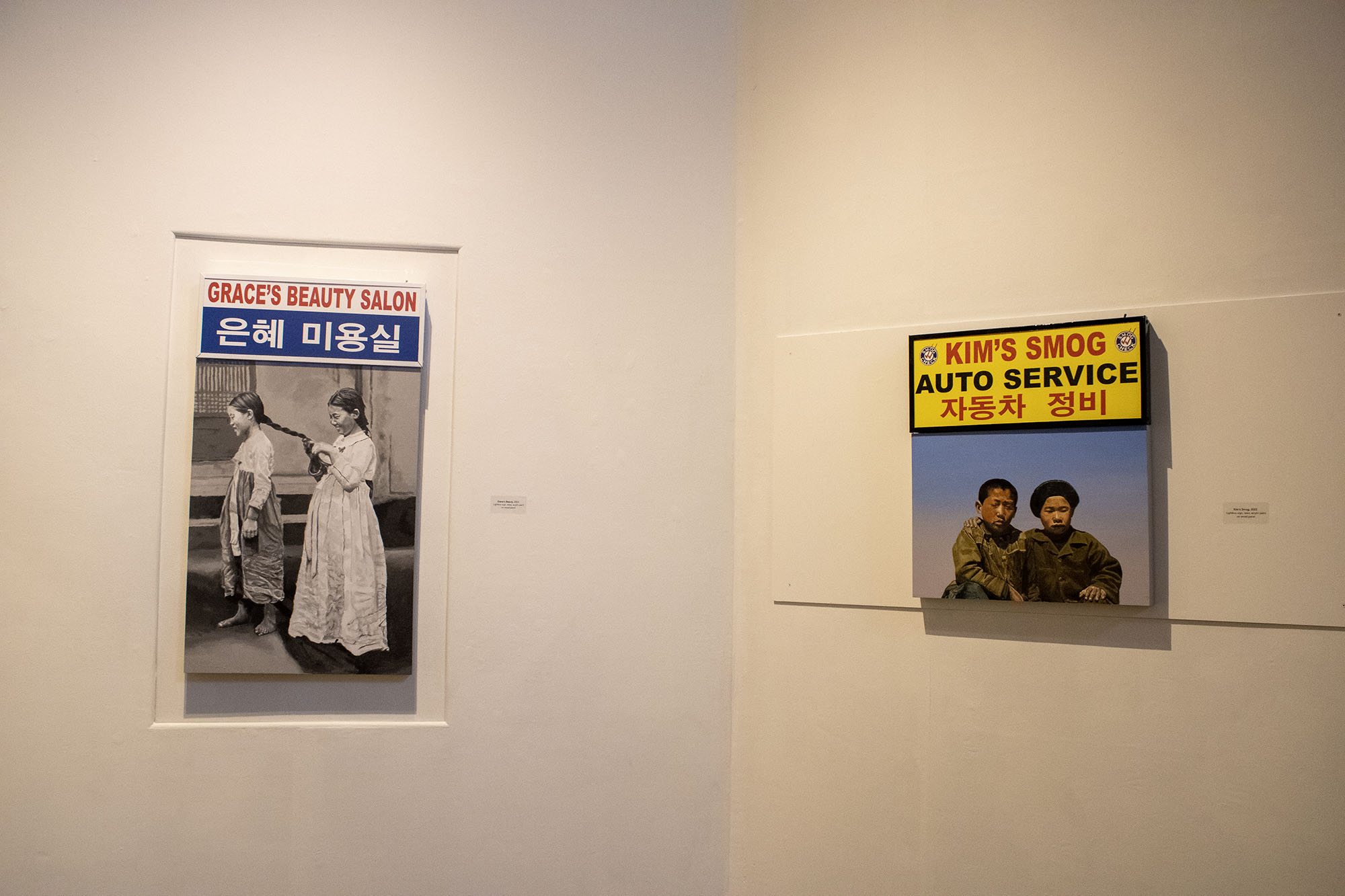
This new body of work presented by Dave Young Kim at the Reese Bullen Gallery uses latex paint on wood panels.
Dave Young Kim is a Los-Angeles based artist who visited Humboldt County with a newly created body of work for his solo exhibition at the Cal Poly Humboldt Reese Bullen Gallery. Kim is a fine artist, born and raised in Los Angeles. He received his Bachelors of Fine Arts Degree in Studio Art from the University of California, Davis, and a Master of Fine Arts in Studio Art from Mills College.
His current display of work engages with the quality of home and explores themes of nostalgia, war, conflict and displacement. Through his work, Kim explores the unifying search for belonging across disparate conditions. In 2020, he co-founded the Korean American Artist Collective (KAAC), which is a group of artists building a community around work rooted in the Korean-American experience. In 2021, he was a selected muralist for the Eureka Street Art Fest and in connection with the Eureka Chinatown Project to paint a mural named Fowl.
“My work plays with that idea of manufacturing nostalgia as integrated with my family history, memory, and identity,” Kim said. “My artistic approach is drawn from a sense of loss or longing, looking for a place to belong.”
Goudi’ni Native American Arts Gallery displays “Tintah: Amongst The Trails”
Robert Benson’s Redwood Sculptures and Watercolor Studies
By Christina Mehr
In collaboration with Cal Poly Humboldt, Robert Benson presents his work in “Tintah: Amongst The Trails” at the bottom floor of the Behavioral & Social Sciences Building.
The art installations of Native art used the mediums of watercolor and wood pieces. Focusing on a new body of work, Tintah, Hupa language for amongst the trails, features newly carved salvaged old-growth redwood sculptures and watercolor studies. Robert Benson, is a leading figure among artists in the NorthWest California art world. He has worked as a teacher for more than 30 years at the College of the Redwoods, as well as being a curator of Native art.
Tall sculptural wooden carvings adorn the exhibit and viewers must make their way through the art, almost like walking amongst the trails. Redwood slabs carved into beautiful sculptures lined the room.
His current paintings and sculptures are filled with imagery of trails, both of the literal kind and suggested. With Benson’s deep connections to the environment and land, those motifs clearly shine throughout his work.
“There is the trail into our family hunting camp that I traveled for more than 50 years, there are trails handed down through stories and mythologies, and there are the trails of imagination,” Benson says. “When we consider that at the most basic level, a trail is just something connecting two points, even the ladder and stairway forms that populate my work can be viewed as kinds of trails. To be amongst the trails is to find your rhythm, your place and to discover the interplay between that rhythm and the melody of the universe.”
This solo exhibition was installed by the Art + Film Department Museum & Gallery Practices class under the direction of Assistant Professor Berit Potter and Gallery Director Brittany Britton. This exhibition was partially funded by Instructionally Related Activity Fees.
Photo courtesy of Goudi’ni Native American Arts Gallery
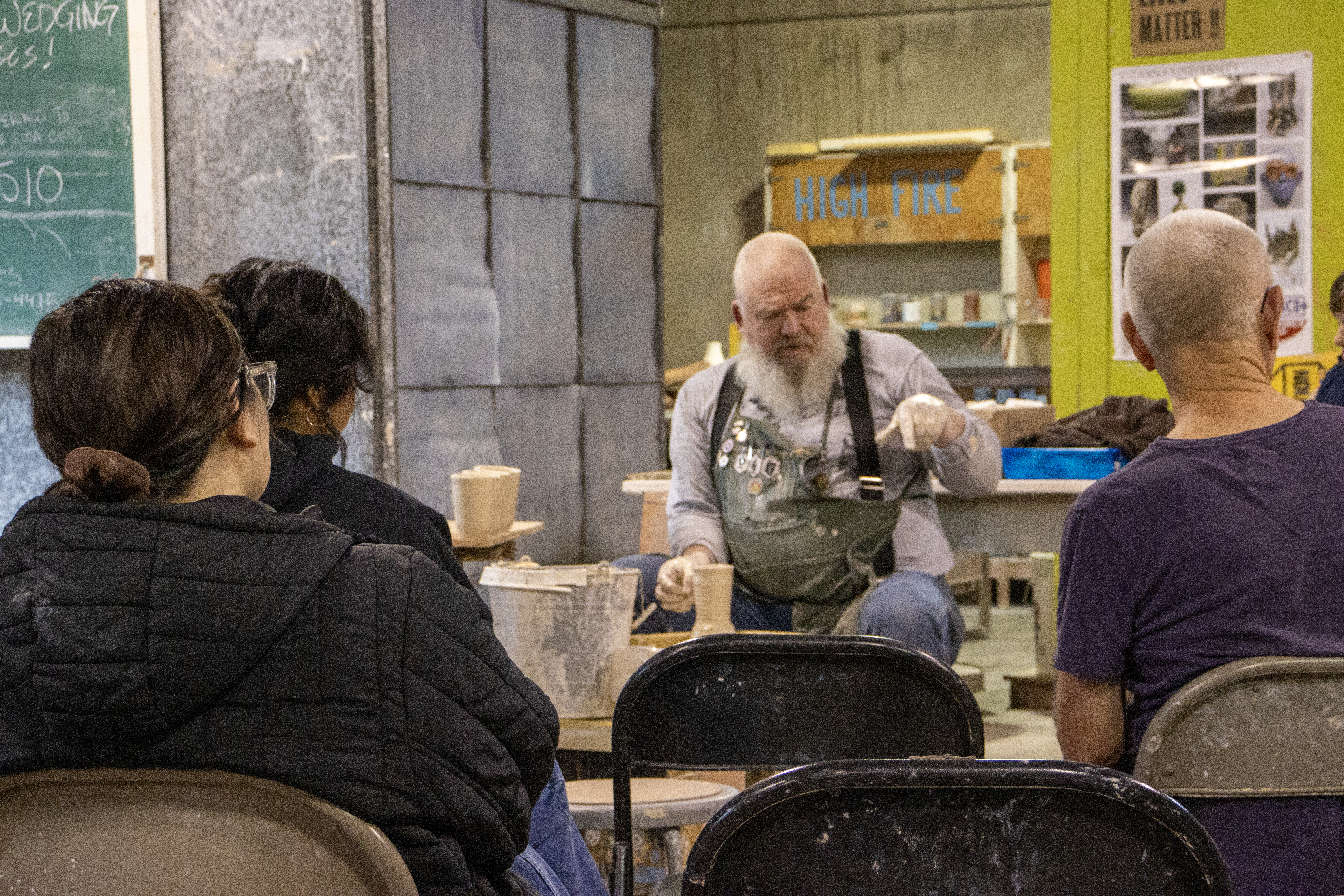
On a gloomy Thursday afternoon, a Gulf War Marine Corps Veteran brought a warm energy to the ceramics studio, nicknamed, “The Laundry.” The veteran, Ehren Tool, is the senior laboratory technician for the ceramics studio at UC Berkeley, and has created and given away over 26,000 ceramic cups. Tool’s art documents the pains that military veterans struggle with after their service. Tool smiled behind his bushy beard and told stories about his healing journey, from his time as a Marine to his time as an artist. Tool expressed how his ceramic cups convey aspects of military culture that are difficult to openly discuss.
“The cups are an opportunity to talk about unspeakable things,” Tool said. “War is murder, and military sexual trauma is rape, that happens in the civilian world too. Where can you talk about that? Where in polite society do we talk about these things that happen with too many people and the effects they have on their lives?”
Ceramic students in attendance to Tool’s demonstration, such as Jack McCann, were inspired by how veterans have found ways to express the grief they feel.
“I really felt like in the art there’s a lot of pain, every piece is almost like mourning,” McCann said. “It’s helpful to see people grow even after experiencing something like war.”
The class that Tool was a guest instructor for was part of a weekend-long veteran’s day celebration, organized by Humboldt College Corps, Cal Poly Humboldt’s College of Arts, Humanities and Social Sciences and College of the Redwoods. The events aimed to focus on how veterans can heal from their traumas in the military. Part of the weekend events was a dinner and panel by veterans at the Arcata Veterans Hall on Nov. 9. Tool was part of the panel alongside Air Force veteran Mark Walker. Walker is the East Bay Deputy Director for the veteran’s support non-profit, Swords to Plowshares. Walker and his wife Lynn were in attendance at Tool’s demonstration in The Laundry. Lynn Walker hopes that the arts can help veterans similar to how ceramics have helped Tool.
“For me, [art] allows you to open up [feelings] that are suppressing you, to things that you don’t want to say,” Lynn Walker said. “[Art] opens up your being to where there’s a healing process as you identify [your emotions] through art.”
Alongside Tool and Walker for the Nov. 9 panel were Air Force Veteran Joe Fox, Marine Corps Veteran Ryan Jensen, Veterans Affairs Health Nurse Ella Price, and U.S. Army veteran and Dean of Arts, Humanities, and Social Sciences Jeff Crane. Crane shared his experiences on how education in his college has supported veterans.
“I’ve thought about this in my own work,” Crane said. “Arts and Humanities have a critical role to play in veteran’s transition, in supporting veterans, and in educating people about the role of the military in American life and in the world.”
Panelist Joe Fox is an interdisciplinary studies major at Cal Poly Humboldt and also facilitates a veteran’s ceramics class at College of the Redwoods
“I found healing in significant ways through playing with clay,” Fox said. “My only plan in all of this [art] is that somehow I’ll be able to connect some resources in our community, and there will be space for other people to find [healing].”
The main event was the 3rd annual Veteran’s Day at McKay Community Forest in Eureka, CA on Nov. 11. There was a five and ten kilometer walk/run, as well as free barbeque, music, and painting. There was an opportunity for attendees to decorate their own ceramic mugs to be completed later. On Nov. 13 and 14, there was another ceramic demonstration at College of the Redwoods by Jessica Putnam-Phillps.
No matter how veterans try to overcome their traumas and suffering, Mark Walker holds onto hope that his fellow vets will find whatever sustainable means available to find their healing, art or otherwise.
“Different veterans find different things of purpose, inspiration, and therapy,” Walker said. “Whether it’s formal or informal therapy. It’s just about what veterans find to be healthy, get healthy, and stay healthy.”
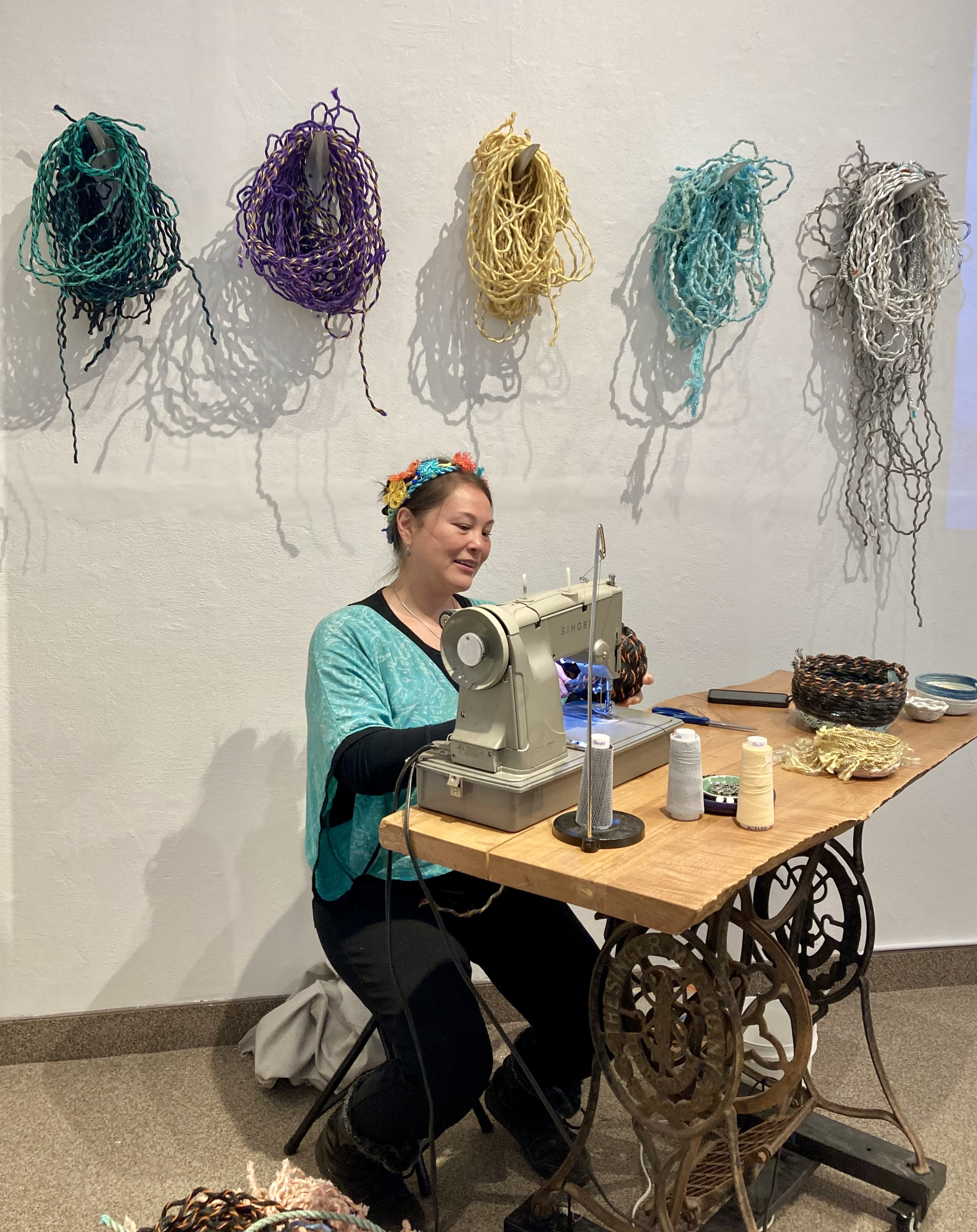
Until Oct. 14, walking into the Reese Bullen Gallery is to walk into an aquatic dreamscape. Artist Emily Jung Miller utilizes discarded fishing nets, also called “ghost nets,” to craft baskets, coral sculptures and build immersive installations that inspire meditations on waste and reusability.
In 2015, Miller had been learning how to stitch coil baskets with cotton cords when she came across some ghost net washed up on the shores of Maine where her grandparents lived. She was inspired by the material and its connection to place, and began stitching her baskets with ghost net.
Ghost Net Landscape is much more than a showcasing of Miller’s talent. It is a collaboration, inviting the public to create their own art with the giant mass of materials collected and cleaned by Miller. Her installation is a form of environmental activism that takes out the doom and gloom of climate collapse, opening up a space for play and collaboration.
“We are aware that there is a big problem, and the part where we figure out how we deal with climate anxiety and what our position is in making a change hasn’t been discussed so much,” said Miller. “…I think this work is not about the problem. And it’s also not exactly about a solution. It’s about being in a state of mind where I feel like I’m open to creative transformation, and feeling like I’m in a place with myself where I can feel good about making a difference, and I’m not doing it in reaction to a terrible thing that has happened or my need to fix it right away”.
Every Ghost Net installation starts unfinished, evolving based on the space and the community who’s making it in this show. Miller’s installation creates ripples in every community that she shows in, often using local material and focusing on regional issues. For the remainder of her show in Reese Bullen, the public will be creating a watershed map from Humboldt Bay all the way up to the Klamath River on the Oregon border using debris found in these areas.
Miller provides a heap of ghost net for the public to decorate the gallery wit.Reliquaries For Your Journey, 2021 Barnacles, 2020 by Emily Jung Miller
“So, I was here for the first week of the show to sort of lay the foundation for that and kickstart people, and basically tell them it’s okay to take ownership of the process,” said Miller. “Because I feel like people need to be told a couple of times that this is your space. This is your thing… and then that piece is going to live somewhere else on campus after.”
There is something special about Miller’s installation and it is the level in which she connects with whatever community she shows in, often gifting her baskets and planting seeds for collaborative projects. As an artist-in-residence, she treats the gallery like a living room, inviting participants to feel at home in their creative potential and add to the community gallery.
“Seeing what other people make with [ghost net] is super inspiring, because everything in the community gallery was made by other people and I didn’t have any of those visions to make those things,” said Miller. “It’s so delightful.”
Into The Deep, a student film-makers showcase, was put on by the Cal Poly Humboldt Art + Film department on Sept. 15 at the John Van Duzer theater. The showcase included a diverse collection of 19 creative short films.
Since the fall of 2022, film students have been preparing to make the dive head-first ‘Into The Deep’ with their films for this showcase. Each student film-maker took an exclusive journey of self-discovery to create these one of a kind films, and that was made apparent by the depth in each and every film.
“‘Into the Deep’ is more than just a theme,” read the program handed out at the showcase. “It’s a guiding principle. It encourages us to venture beyond the surface and embrace the uncharted territories of storytelling,”
With a total screen time of around 80 minutes, viewers were taken on a voyage down a deep, and at times dark, college-core rabbit hole. Bouncing between experimental films like ‘Momento Mori,” directed by Wren Kosinski, narratives like “Shrimp Film,” directed by Solomon Winter, and documentaries like “Camino,” directed by Nat Cruz, each piece was completely different from the one before.
Film production professors Dr. Michelle Cartier and Dave Jannetta attended the event and expressed the joy they felt during the showcase.
“This was the most solid showcase I’ve seen in a minute,” Cartier said.
He recalled how big the event used to be pre-pandemic, and how good it felt to see a room full of people celebrating student film-makers.
“We’re incredibly proud of the work they’re doing as artists,” Jannetta said. “I want students to make work they’re proud of.”
Whether viewers were giggling at Humboldt public bathroom reviews, learning about fisheries and sustainable fishing practices, deep in thought from spoken word and interpretive movement, or questioning their sanity as the films became increasingly unhinged, this showcase proved that Cal Poly Humboldt students are filled to the brim with imagination and creativity.
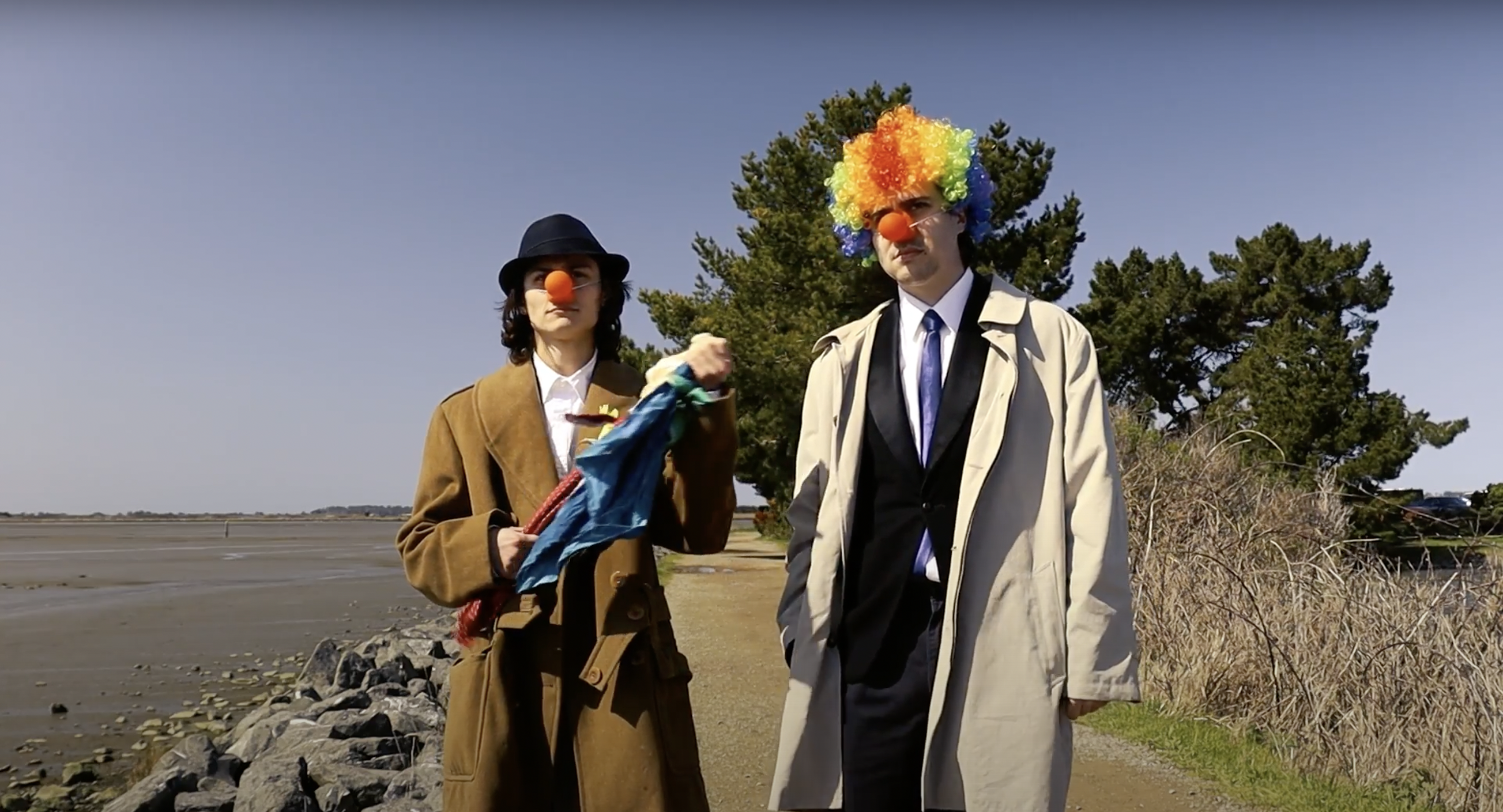
John Farley, a film major in his fourth year, directed the three and a half minute film “Circus Peanuts.”This was a memorable satire mafia film that played at the beginning of the show. The film involved local mobster clowns pushing circus peanuts, and a mafia boss dealing with a snitch in their peanut ring.
“It was quite a rush to see something I worked on displayed on the big screen,” Farley said. “Sitting next to my crew who helped with the making of this, we were probably laughing the hardest.”
Farley ran into a bit of trouble behind the scenes. After a whole day of filming, the original footage for the film was deleted. What viewers saw at the showcase, was actually the second attempt.
“I felt so defeated, but luckily we were able to rally the troops to get another crack at it,” Farley said. “We got together the following week and shot the entire film in one day. It was fast paced, but an absolute blast getting what we needed to get between scenes and locations. When the actors can’t keep a straight face during a scene and end up breaking character, it is a reassuring feeling that what I’m making will turn out funny.”
At one point in the latter half of the night, it seemed like films began bleeding into one another and causing a sense of chaos that made viewers question their sense of time. This chaos was apparent as viewers would begin to give an applause just to realize the film wasn’t over.
Eventually, realization struck the audience that these pieces were all a part of the larger puzzle: “Teen High School Movie: The Show: The Broadcast,” directed by Mara Lifquist. This film could be described as “Black Mirror” esque, and that is a compliment not to take lightly. This narrative film was around 14 minutes and contained satire commercials, frequent call backs and impressive horror effects. Between laughter and fear was a dissociation from reality that prompted a yearning to watch the film again.
At the end of the night, viewers left the John Van Duzer theater feeling inspired, touched and possibly disoriented.
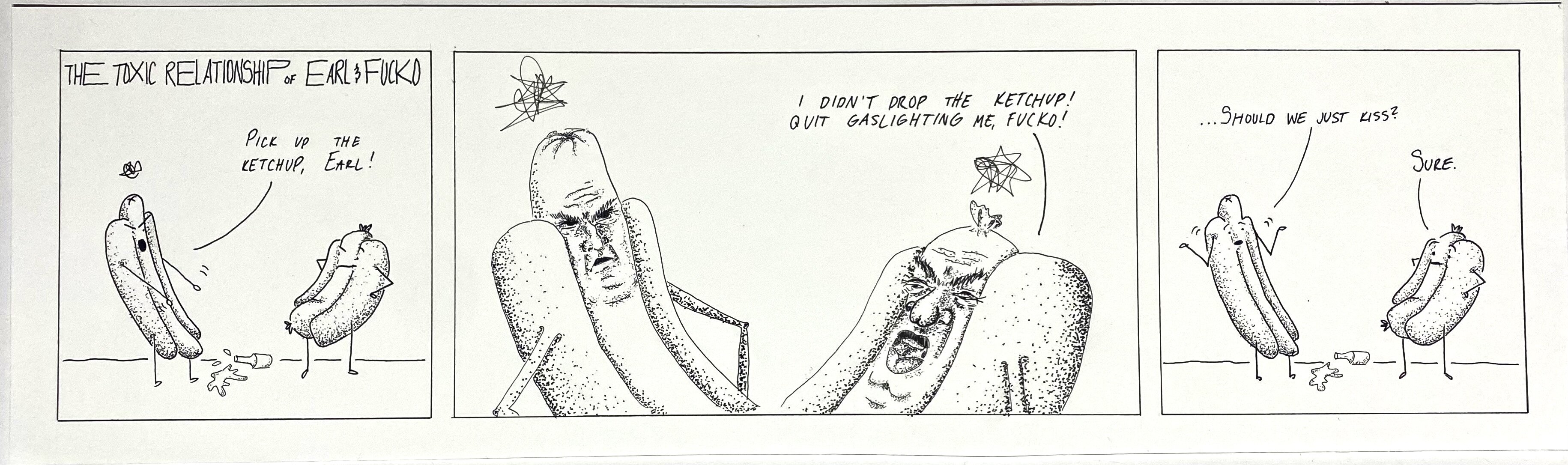
The Staff and Faculty Exhibition is now open at the Cal Poly Humboldt Reese Bullen Gallery, featuring artwork created by members of the art department.
The exhibition will run until Oct. 15. It features a variety of mediums from all of the divisions of the art and film departments. Isabela Acosta, a gallery attendant and art history major, was excited about the variety of work presented.
“It’s literally every faculty member from every art sector, and they’re presenting their work here which is super cool,” Acosta said. “You have jewelry, ceramics, sculptures, paintings, some videos, there’s some digital art that’s really cool. It’s just like a whole nebula of stuff.”
Photo by Angel Barker | Sarah Whorf’s “Palm to Pine”, 2005 at the Reese Bullen Gallery on Friday. The piece is a photo screen print construction.
Students were excited to see their teachers’ work in a gallery setting. Jack Miklik, an English major, talked about the importance of featuring faculty work.
“They’re practicing artists and teachers,” Miklik said. “It’s good to like, look and see if you enjoy the work that your instructor is making. I think it’s like one of the more important shows as students for us to see in the art department.”
Many of the artists featured in the exhibition were heavily impacted by COVID-19. Their works feature themes of isolation and a desire for connectedness.
“A lot of this work I think was done during like COVID so when you read their little manuscripts they just talk about like what they were doing during COVID and what came out of it,” Acosta said.
Dave Woody, a photography and film lecturer, has two pieces in the gallery. “Gabe” and “Madeline” are both silver gelatin prints created in 2022. In the card next to his work, Woody discusses how the pandemic has impacted his art.
Photo by Angel Barker | Sarah Whorf’s “Palm to Pine”, 2005 at the Reese Bullen Gallery on Friday. The piece is a photo screen print construction.
“The lessons learned during that period of isolation really helped me to value the time that I do have with friends and strangers,” Woody wrote. “These photographs included in this show feel reflective of my current state of thinking about images of people- a desire to connect and to embrace the beauty and mystery of life.”
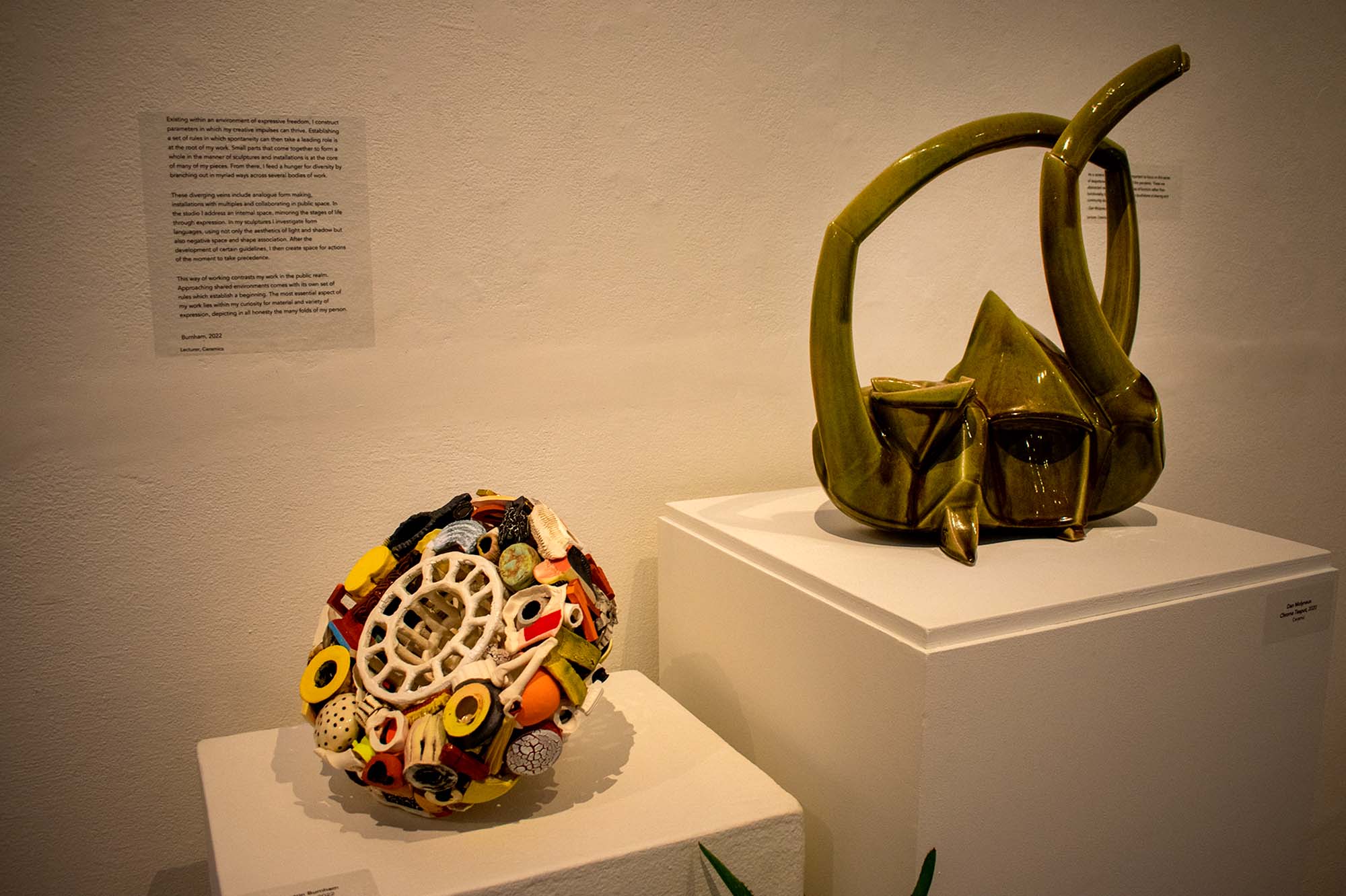
Dan Molyneux, a lecturer specializing in ceramics, also wrote about his experience of the pandemic. His featured work “Chroma Teapot” is part of a series of ceramic teapots that were created during the pandemic.
“As a ceramic sculptor, it became important to focus on this series of teapots/ewers over the course of the pandemic,” Molyneux wrote. “These are abstract vessels that project an idea of function rather than functionality itself but served me as a touchstone of sharing and community during a very isolated time.”
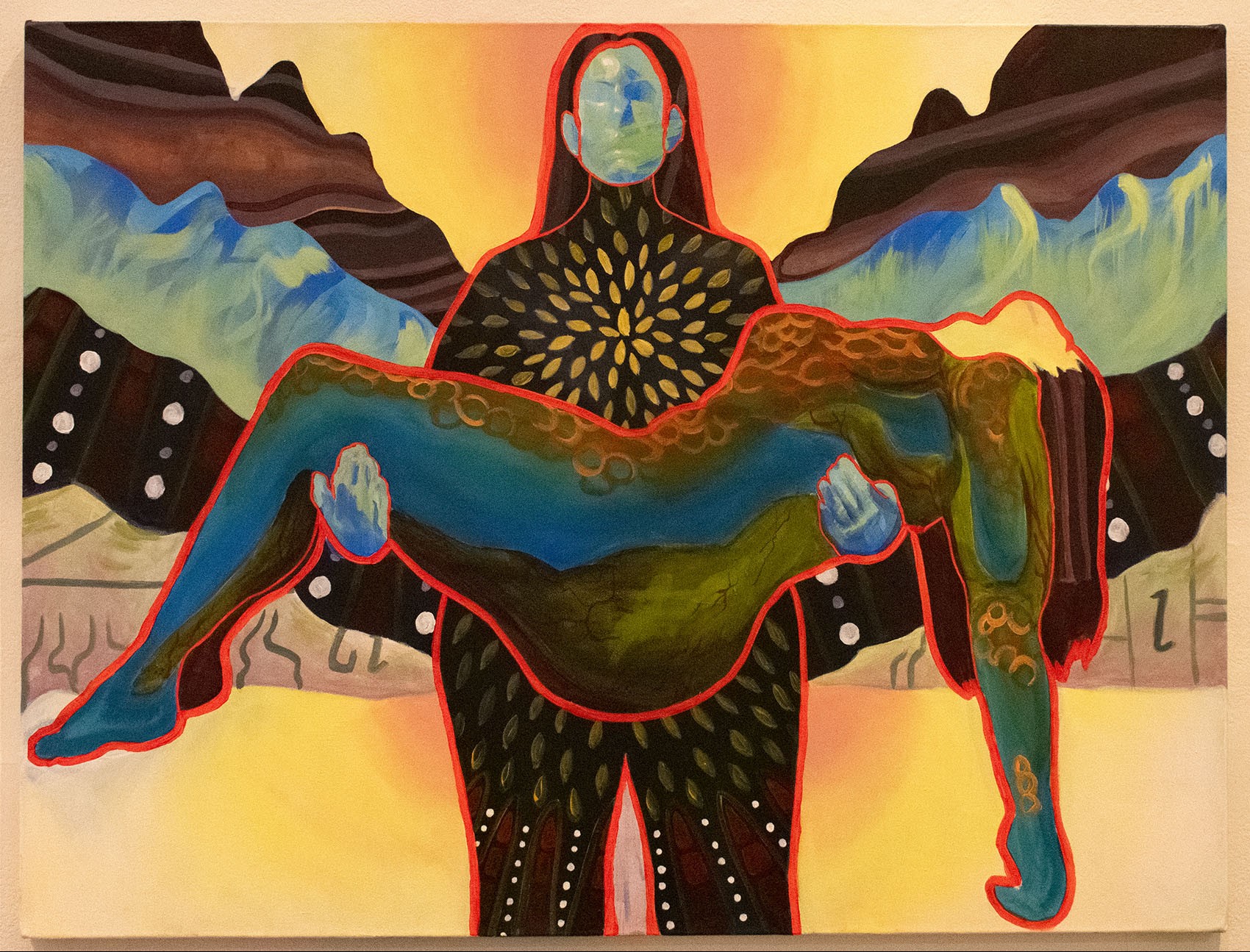
COVID-19 was not the only subject of the faculty artworks. Sondra Schwetman, an associate professor who specializes in sculpture. Her piece “Witness” was created in 2019 from fabric, pigment, and steel. In her description of the piece, Schwetman writes about how her work embodies the themes of the female experience.
“My current body of work addresses the ambiguous space between reality and fiction where the female form and therefore females often dwell,” Schwetman wrote. “The works in this series concentrate on psychological, religious, cultural, and social issues that impact women everyday such as: reproduction and reproductive rights, illness and COVID-19, class systems, colonization, compliance, silence, and war.”
Marilyn Koch, a visiting faculty member who specializes in jewelry and small metals, discussed the concept of “self” in her two featured works, “We are a colony,” and “Year 30: Age Badges.” The pieces utilize unique mediums like hair and synthetic teeth.
Photo by Angel Barker | Sarah Whorf’s “Palm to Pine”, 2005 at the Reese Bullen Gallery on Friday. The piece is a photo screen print construction.
“It is egocentric in nature and at first glance, coyly uses replicas of the human body to simultaneously repel and entice us,” Koch wrote. “Beyond the skin, teeth, or hair, are themes of ephemeral youth, community, social norms, and a prominent objective: A desperate attempt to define the Self.”
A wide variety of mediums and subject matter means that there is something that everyone can connect with.
“My favorite piece is this painting over here and it’s called ‘From palms to pines.’ It’s just about moving from SoCal to up here,” Acosta said. “There’s like the map of Los Angeles and Orange County that goes into the map of Humboldt County.”“Gina [Tuzzi]’s paintings are really nice,” said Martin Lopez, an economics and studio art major. “And the cars, the ceramic cars, are pretty sweet. Yeah, that shit’s tight.”
The Arts Graduate Exhibition for the class of 2022 is now open at the Reese Bullen Art Gallery at Cal Poly Humboldt.
Kylie Maxfield, a senior whose work is featured in the exhibit says that having one’s work in a gallery is an integral part of being an artist.
“Being a student artist myself, I think it’s really important to be able to showcase my work,” Maxfield said. “To feel validated for what I’ve been working on. It inspires me to continue my education in art.”
Photo by Angel Barker | Reflective Perspective, made of bronze and glass by Lisa Heikka Huber
The exhibition showcases the work of graduating students in the Art Department. It features work from a variety of mediums including painting, sculpture, illustration, drawing, printmaking, photography, ceramics, and jewelry.
“There’s a lot more diversity than I would expect,” said student Duncan McDougall.
Another student, Justin Henderson, also appreciated how diverse the selection of art is within the gallery.
“Each one is pretty unique,” Henderson said. “I like that there’s a lot of creativity going on.”
McDougall and Henderson were excited to be able to attend an exhibition of their peers’ art. Student exhibitions allow for their work to be seen by those outside the art department.
“Otherwise, I wouldn’t see any of their art,” said Henderson. “I don’t have any art classes, so I’m never over here.”
“There’s a lot of student creativity,” McDougall said. “You don’t really see a lot of these student galleries.”
Displaying their work also gives student artists new opportunities.
Photo by Angel Barker | “Present” by Kaitlyn Ladines. This paining invites students to be apart of the exhibit by sitting in the chair. This piece won 2nd place for the Glenn Berry Painting Award.
“Having this graduate exhibition also gives students the chance to be awarded for what they’ve been working on,” Maxfield said. “I think that if students didn’t have the opportunity to do something like this that feels real, then they probably wouldn’t make as much or be inspired to.”
One of the opportunities that Cal Poly Humboldt art students have is the opportunity to win the Permanent Collection Purchase Prize award. The honor is given to one student from each graduating class. The work is then added to Cal Poly Humboldt’s permanent collection of student artwork.
Maxfield says that selecting the correct piece for an exhibition is a challenging task.
“I think critiques really narrow down, like what are people interested in and what is catching people’s attention,” Maxfield said. “Getting a lot of opinions on what strikes people as an interesting photograph.”
Maxfield also discussed challenges with her chosen medium, photography.
“I think that sometimes it’s hard to get through with people,” Maxfield said. “Like a lot of people kind of think ‘oh, well they just press a button.’ With paintings or drawings it’s a lot more evident the amount of work that goes into it, but with photography, not as much.”
Photo by Angel Barker | “Human Flower” by Emily Newark. Made from low-fire white clay. This ceramic sculpture won the Phoenix Ceramic Award.
There were many interesting pieces featured in the gallery. One sculpture entitled The Human Flower was the topic of discussion among students.
“I think The Human Flower rules,” McDougall said. “If I had a million dollars, I’d buy it right now.”
Another opinion on the piece was offered.
“I appreciate that a lot of work went into that, but it just freaks me out,” Henderson said.
The exhibition will run through Saturday, May 14 with a reception to follow the College of Arts Humanities & Social Sciences commencement ceremony.
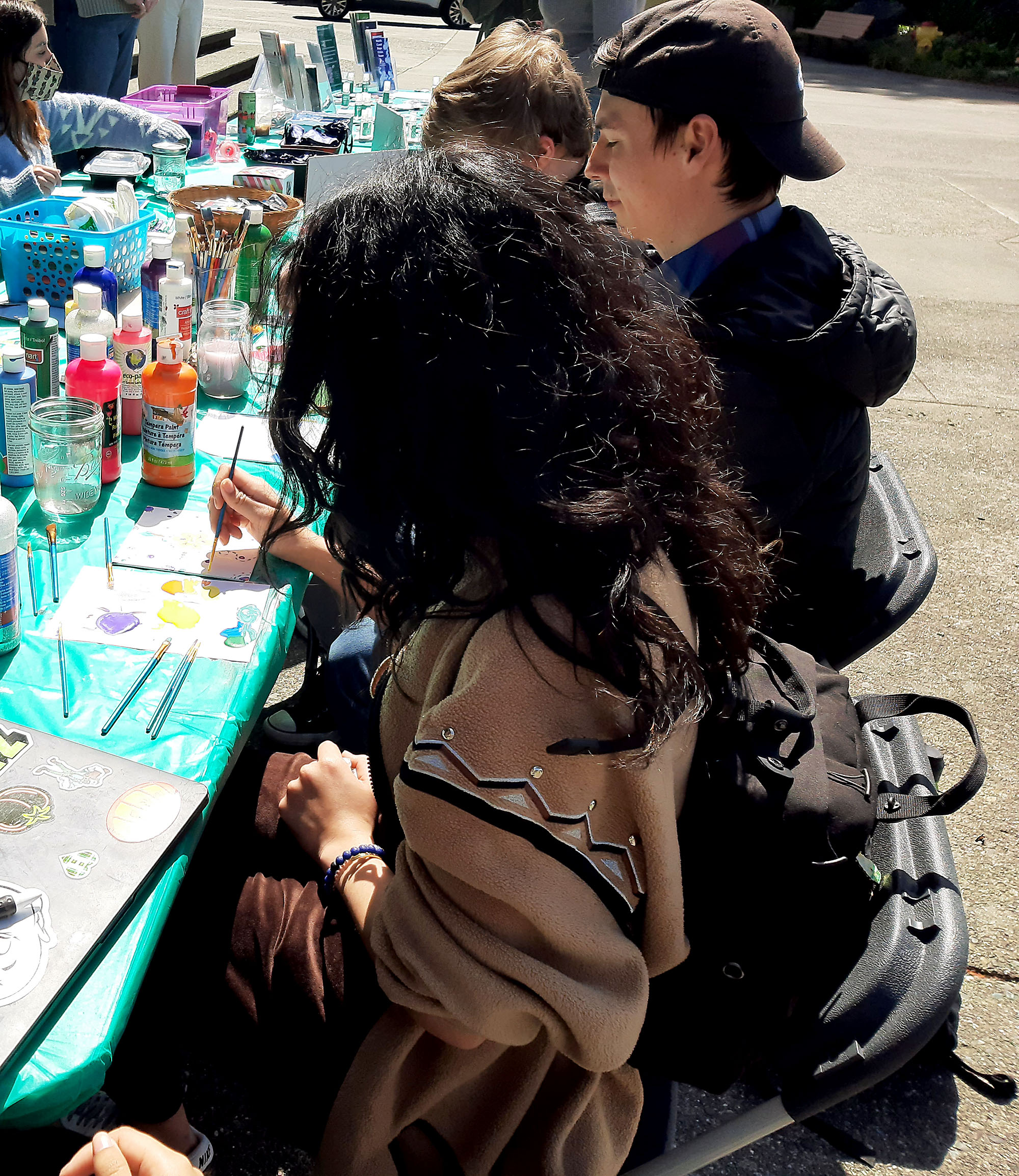
Pamphlets and papers flew around the UC Quad. Three teal blue tables stood to the right of The Depot entrance, pushed up close to the SAC’s concrete stairs. Dozens of paint bottles cluttered the leftmost table while various pins cluttered the right. April is international recognized as Sexual Assault Awareness month and The North Coast Rape Crisis Team alongside its on campus program Campus Advocate Team (CAT) have worked together to host its annual Take Back the Night week. The week-long event lasts from April 4 to April 7 and includes activities such as Denim Day, Clothesline Project Workshop, and Take Back the Night.
Photo by Matthew Taylor | Liliana Cortez (center) speaking with students on the UC Quad about Teal Day on April 4.
Tuesday marked Teal Day, a day dedicated to the awareness of sexual assault survivors and their stories. Students at the tabling event were encouraged to paint their expressions of positive growth and healing. By the end, all the small canvases would be placed together to form a larger mural. Liliana Cortez, the Violence Prevention Advocate at the Women’s Resource Center, expressed that the mural was an optional part of the activity.
“It’s up to them,” Cortez said. “If they want to create their piece and keep it, or if they want to go ahead and give it to us so we can make it part of [the mural].”
Together with Cortez, CAT Education Coordinator Kira Morse was also present at the table.
“We provide services here on campus for survivors of sexual assault,” Morse said. “We have counseling, we have an office here, and we also respond out if there’s any incidents or things like that and help with [things] like Title IX and accommodations.”
Rachel Mack, a Rangeland Resource Management major, was one of the handful of students painting at the table.
Photo by Matthew Taylor | Painting by Rachel Mack created during the Teal Day event at the UC Quad on April 5.
“It’s nice to have something positive as well as it being important for what it stands for,” Mack said, whilst painting her sunflower piece. “I think [it’s] really important for survivors to be able to have control over their own situation.”
Alexa Farias, a Critical Race, Gender & Sexuality Studies major, expressed this event is very important to her work and role within Students for Violence Prevention.
“We actually want to be part of the whole Speak Out, because it’s a really good way to show people what it feels like to really look through the situations,” Farias said.
Speak Out is one of the many sub-events planned within Friday’s Take Back the Night program. This event will provide a safe space with counselors on hand for survivors to ‘speak out’ about their experiences and tell their stories.
“The main movement and push with Take Back the Night is that people can feel safe here on campus and have their voices heard,” Morse said. “I feel a lot of times that survivors feel like they’re hush hushed. There’s not that open space where people can name their experiences. Take Back the Night, there is a lot of this amazing support where people feel comfortable.”
Friday’s event will begin with a speech by Dr. Rachel King that will culminate into a rally and the aforementioned Speak Out event. Lasting between 6 to 10 pm, the event will end in a vigil dedicated to the victims of sexual violence.
“I feel like [this] is really good,” said psychology major John Clark. “If this could happen at most events, then people would start to see that this is a [common] thing that we should talk about.”
Like the blossoms of our early spring, genuine and vulnerable artistic collaboration is blooming at Cal Poly Humboldt.
The Toyon Multilingual Literary Magazine’s ‘SANA, SANA: Hope and Healing for Latinx Communities in Times of Precarity’ was a contest that asked for submissions of poetry, with the intention of having the winning entries set to music.
The poem selected to be interpreted into a choral work by the award-winning composer Carlos Cordero was Alannah Guevara’s ‘Fresh Fruit.’ It is a deeply affecting rumination on vulnerability and intergenerational trauma, filled with haunting and tender images of bruised fruit and parental care.
Guevara says that she wrote the poem thinking of her father, who passed over ten years ago. She’s a native of California’s Central Valley, where many Latinx people have settled and work on the area’s vast orchards. Guevara is half Mexican; she sees in her family and in her community an unwillingness to discuss the painful past, and an unending hope for the future.
“I have really vivid memories of going to an orchard in the town I grew up in… It all melded together, these words that I had and these memories,” said Guevara. “Here in Southern California, who’s working in those orchards is Latinx people, Mexican people. And it got me thinking about my familial trauma, my generational trauma, the things that my dad left me to deal with.”
Graphic by August Linton
Guevara is about to become a parent herself. In ‘Fresh Fruit,’ she feels the protection and hope that her parents struggled to give her, and also the intense desire to protect and uplift her own child.
The final choral piece is deeply beautiful, modern, and connected to the emotional core of Guevara’s poem. Cordero was a fantastic composer for the ‘SANA SANA’ project, both as a stunningly talented musician and also as a member of the Latinx community.
Cordero’s Friday talk, hosted by CPH’s El Centro Académico Cultural, focused heavily on his personal struggle towards vulnerability, and how that has affected his compositions and musical career.
Cordero’s writing process is a very visual one, although his medium is entirely auditory. He works with charts of inter-connected words and line graphs of emotional intensity to visualize his compositions in a more visceral way.
“[Vulnerability] isn’t always going to come back to you immediately, but it’s coming to build or to open that door for people who want to connect with you,” Cordero said. “I’ve learned in art that I open up the door, I don’t make you come in. All I can do is present myself.”
He recounted a story of opening up about his family’s experience of losing his younger sister to members of a choir he was working with. They came to him with stories of their miscarriages, of their losses, and that allowed the whole group to access an emotional connection that was not visible before.
Cordero is originally from Maracaibo, Venezuela, and now lives in Austin, Texas. He says he, like Guevara, has struggled with an unwillingness to have hard conversations with his family about the traumas they’ve experienced.
His piece ‘¡Ayúdame!’ was written as a “Venezuelan plea for life.” Members of the choir cry out “ayúdame, escúchame” (help me, listen to me) in Cordero’s attempt to communicate the suffering and disillusionment of the Venezuelan people.
However, ‘¡Ayúdame!’ also represents the importance of being vulnerable, both by asking for help and by letting other people support you.
Cordero spoke about the expectation within Latinx families and communities that people be strong, that they don’t show their struggles. As he struggled with the trauma of being Venezuelan in the midst of an ongoing humanitarian crisis, Cordero realized that he sorely needed help, that people need to ask for help.
“[In ‘Fresh Fruit,’] Alannah showed me that the struggle is OK. It says to our kids, to our generation, to our families: we want to show that everything is ok but we can also share in their struggles,” said Cordero.
The Cal Poly Humboldt University singers will perform ‘Fresh Fruit’ on Sunday, April 24th, alongside other musicians performing other works from the ‘SANA SANA’ project.
“Photography as Material,” a photography exhibit featuring the work of Julia Bradshaw, is now open at Cal Poly Humboldt’s Reese Bullen Gallery. The exhibit will be featured in the gallery until March 26. Gallery hours are on Tuesday and Wednesday from 11 a.m. to 5 p.m. and Thursday and Friday from 1 to 6 p.m.
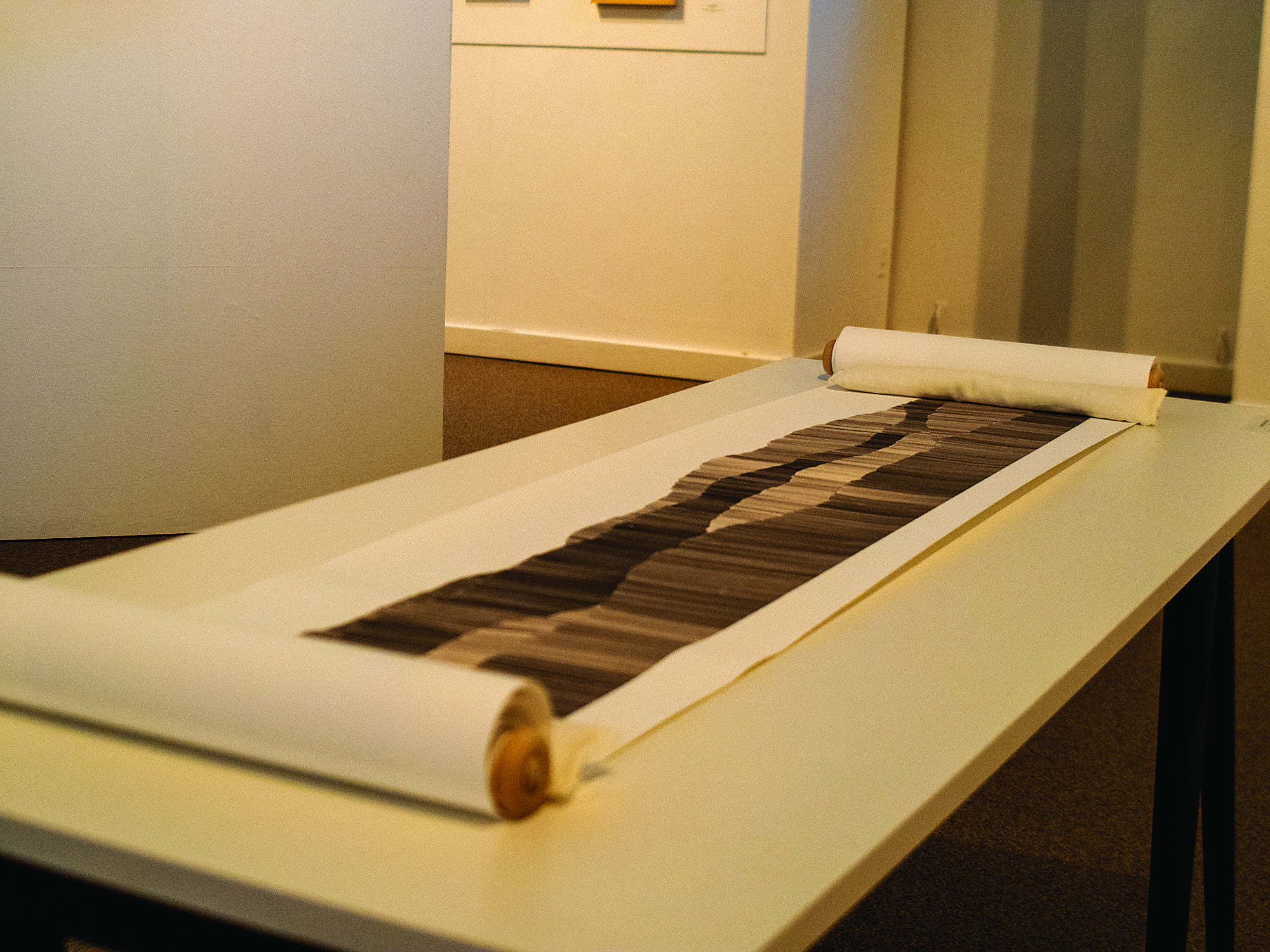
Bradshaw’s work involves taking high resolution photos and then processing them through traditional darkroom and editing techniques as well as computer photo editing.
“I’ve never seen anything high resolution like that, it’s almost an illusion,” said Isabela Acosta, a Cal Poly Humboldt art history major. “I want to touch it because it looks like it’s coming at you.”
The exhibition features two of Bradshaw’s bodies of work, “Stacks and Shapes” and “Survey.” “Stacks and Shapes” features manipulated images of paperback books. Photographs of books are arranged to create geometrical forms, some of which resemble landscapes. “Survey” includes images of concrete that resemble scientific photographs of the moon.
Photo by Morgan Hancock | Julia Bradshaw’s “Survey” project inspired by early astrological photography.
“All of those are concrete, that’s just concrete, but she’s making it look like images of the moon,” Acosta said. “She does that through different processes of developing films and taking things at a certain angle.”
On her page on the Cal Poly Humboldt Department of Art website, Bradshaw says that the pieces included in “Survey” were inspired by scientific diagrams and notes. The photos were taken using a cardboard box and were edited using knives, inks, dyes, and other techniques.
“The simplicity of the materials is a subtle poke at the vast gap between investment in science and investment in art,” Bradshaw wrote. “By pointing my camera at the most abundant of materials, I aim to empower imagination in conjunction with science.”
Former Cal Poly Humboldt student and current faculty member at the Cultural Resources Facility in the anthropology department, Zedekiah Minkin, was impressed by Bradshaw’s moon-esque photos.
“Compared to the real scientific images, it looks like it could be straight out of NASA,” Minkin said.
Religious studies and art history major Cass Jensen also commented on the realism depicted in the photos. They also think that, by comparing concrete and the moon, Bradshaw is commenting on recurring patterns and themes throughout the universe.
“I really like the collage work because it does look exactly like some sort of scientific model that you would see come from NASA,” Jensen said. “It helps elaborate how certain things can be very similar but very different all at the same time. It’s like how a lot of things that may look really far away and intangible are just, like, everywhere.”
Jensen is a collage artist as well. They are inspired by how concisely Bradshaw is able to convey her message through her artwork.
“I like the simplicity of it, it still makes a point without being too much,” Jensen said. “It’s not as complicated and overwhelming as sometimes my pieces come out to be.”
Overall, the most striking quality of Bradshaw’s work is the illusion that she creates. The images are created to allow the viewer to see beyond just the materials used in each piece. The pieces do not necessarily resemble the materials that they are made of.
“I get a raw sense,” Acosta said. “She’s just doing things from a different perspective.”
Student-made poster boards detailing the lives and legacies of Black artists and activists filled the Gold and Green Room in Founders Hall during the Black History Month Art Exhibit hosted by the Umoja Center on Feb. 17.
The exhibit was an opportunity for Cal Poly Humboldt’s Black students to express themselves and celebrate their African heritage, much as their forebears did before them in a self-determined push to resist the injustices of slavery, segregation and ongoing oppression.
“It is a creative way to show our unity and stand for everyone who identifies as Black,” said Demi Ogunwo, a Masters student at Cal Poly Humboldt and Charter President of the National Society of Black Engineers. “It’s a lot of activists, a lot of people who broke out of the norm of oppression to make a name for themselves.”
Photo by Abraham Navarro | Asia Anderson, a Cal Poly Humboldt chemistry senior stands next to a photo of her great aunt Marion Anderson.
Biochemistry senior Asia Anderson comes from a line of radical Black women who defied the norm during their lifetimes. She made a poster board about her late great aunt Marian Anderson, a renowned Black opera singer. It was a popular exhibit among the attending students.
“I don’t sing worth beans, but I do chemistry,” Anderson said. “I still think about her strength and not letting a ‘no’ close doors. That was passed down through the line of women in my family.”
Jovie Garcia-Diaz, a senior majoring in Environmental Engineering, was a student attendee at the exhibit. Her favorite poster board detailed the appropriation of Black culture in popular social media culture.
“That’s something that I see a lot on social media that stands out to me,” Garcia-Diaz said. “People who aren’t Black get praised and get popular for [appropriated elements from Black culture.]”
Cal Poly Humboldt students and faculty alike visited the exhibit as the evening went on. Frank Herrera happens to be both. He is a student pursuing a Masters degree in Business Administration and the Coordinator of the Social Justice, Equity, and Inclusion Center on campus.
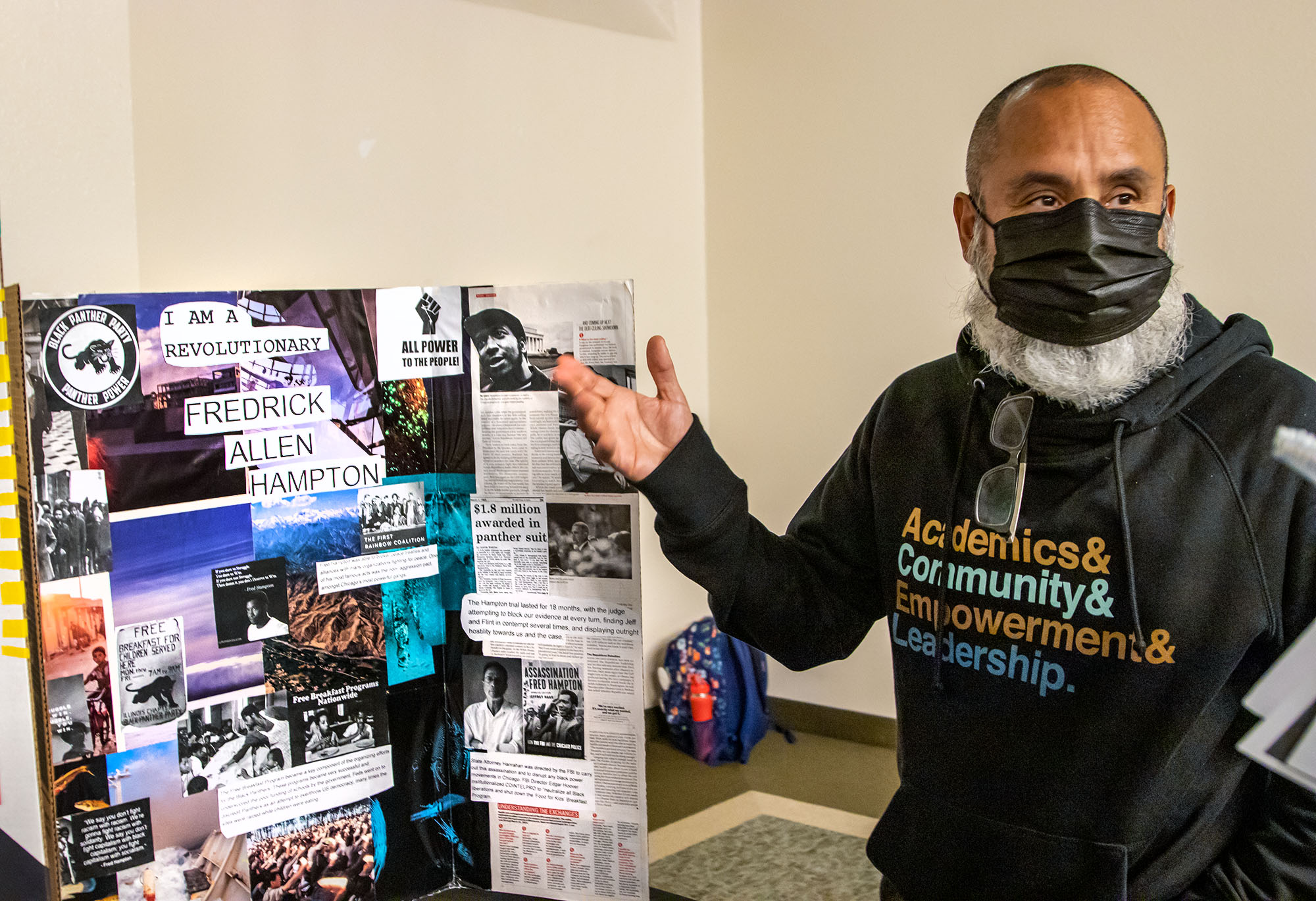
A collage poster board about the life of Fredrick Allen Hampton, former Chairman of the Black Panthers, stood out to Herrera. Herrera was alive in the final years of the Black Panthers’ existence before it dissolved.
“I had met folks who were involved, I just remember the guys in leather jackets and the energy,” Herrera said. ”It’s amazing what they were doing, the bravery and courage they had during the time.”
Photo by Abraham Navarro | Students look at posters of black leaders and events in history during the Black History Expo in the Green and Gold room in Founder’s Hall on Feb. 17.
According to Ogunwo, the art exhibit in general characterized three of the seven guiding principles of the Nguzu Saba, or African heritage, that the Umoja Center stands They are Kuumba (creativity), Umoja (unity) and Kujichagulia (self-determination).
“The pillars reinforce what we stand for and how we want people to see us,” Ogunwo said.
Anderson feels a deep connection to her great aunt and to her heritage that empowers her. To her, the exhibit was a chance for Black students to see themselves in the trailblazers before them.
“They weren’t the first,” Anderson said. “You’re not going to be the last. It feels good because one day, those boards are going to be about you.”
Tucked away in a small alley behind Six Rivers Solar on Broadway in Eureka is John Gibbons Glass. At his glass art workshop, Gibbons can be found coaxing hot molten glass into stunning art pieces or after melting down raw glass in his homemade furnace.
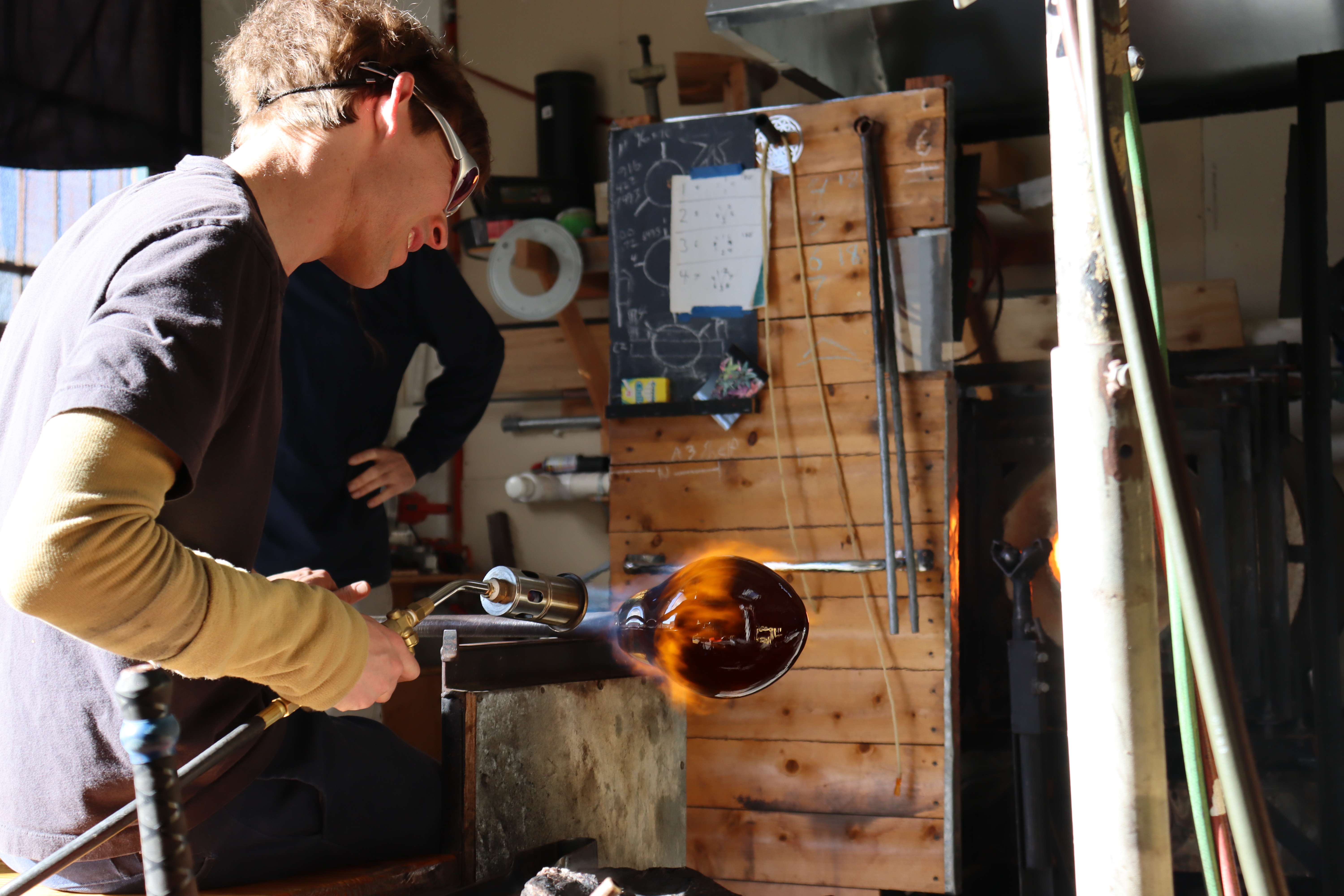
Photo by Lex Valtenbergs | John Gibbons (left) and Matthew Gagliardi (right) shaping a glass sphere at Gibbons’ glass art shop in Eureka on Feb. 1
Gibbons was first introduced to glass art by his father at antique glass shows when he was five or six years old. He’s been hooked ever since. While studying glass art at college, he dreamed of it when he slept.
“All I could think about was blowing glass,” Gibbons said. “I dreamed about it every night for a year.”
The glass artist community in Humboldt County is small but tight-knit. Matthew Gagliardi, a glassblower with three decades of experience under his belt, has worked with Gibbons for the last five years. Gibbons and Gagliardi both use soft glass, a fluid type of glass that is ideal for sculpting.
“We all kind of work with each other,” Gagliardi said. “There’s only so much of us in the county that work with soft glass.”
Photo by Lex Valtenbergs | Michelle Coelho diverts heat from John Gibbons’ face with wooden heat shields while Gibbons shapes a glass sphere in his shop in Eureka on Feb. 1
Michelle Coelho is another one of the few Humboldt-based glass artists who works with soft glass. She has been doing it for 20 years, about as long as Gibbons has. Gibbons, Gagliardi and Coelho all specialize in Venetian glassblowing, a technique that dates back to the 8th century AD. The type of tools that they use goes back to the 14th century AD.
The trio worked in synchronized harmony on the morning of Feb. 1 to transform a glob of raw glass into a beautiful pendant light, a lime green sphere with a hypnotic spiral pattern rolled into the glass on a steel table – a marver – and inlaid with a mold.
“It’s like a well-orchestrated dance,” Coelho said. “John’s body language tells us what to do next. It’s not so much verbal, it’s visual.”
They were constantly in motion to prevent the glass from losing its temperature and shattering or drooping down towards the floor like viscous honey falling off a honeycomb, as Coelho put it. They have to be on sharp alert at all times. Not only is the glass is heated up to over 2,000 degrees Fahrenheit, the operating costs involved are expensive as well.
“There’s a lot of trust, and also money,” Gibbons said. “You gotta trust them not to break your investment because there’s a lot of money that goes into it.”
Photo by Lex Valtenbergs | A close-up shot of a hypnotic pendant light made by John Gibbons, Matthew Gagliardi and Michelle Coehlo at Gibbons’ glass art shop in Eureka on Feb. 1
Gibbons hired a media assistant in April 2021 to vamp up his online presence. Makayla Sandifer worked in information technology before she found a niche in media production and picked up the job at Gibbons’ shop.
As a Black woman in a white and male-dominated field, Sandifer enjoys the opportunity to work in such a dynamic space that fosters her creativity.
“It’s honestly awesome,” Sandifer said. “It allows me to bring diversity to spaces that didn’t have it previously and to reflect that in my work. It’s super gratifying.”
The product photos that Sandifer takes for Gibbons’ Etsy profile do justice to his vibrant glass art pieces. Whimsical starfish vases, turtles with bubbles of glass trapped inside their shells, and light fixtures adorned with alluring spiral patterns boggle the mind with their complexity, vibrant colors, and otherworldly beauty.
Martin Wong’s lost art reemerges to bring awareness to a new generation
Designer street style brand Supreme’s new collection highlights the life and art of Martin Wong.
Wong, who embodied creativity, empathy and empowerment, lost his battle against an AIDS diagnosis in August of 1999, but his artwork continues to inspire and act as socio-political commentary after his death.
Wong attended Humboldt State University in 1964, enrolling himself in every available art class before focusing his studies in ceramics. After graduating, Wong left the comfortable walls of university-life to influence the art scene and bring widespread awareness to minority groups often overshadowed by society.
Wong’s family, friends and supporters partnered together on a collaborative collection with Supreme showcasing Wong’s lost works.
“Tell My Troubles to the Eight Ball (Eureka)” 1978-81 | Courtesy of the Estate of Martin Wong and P·P·O·W, New York
Example from the Fall/Winter 2019 Supreme clothing line featuring Martin Wong’s work.
Example of the Fall/Winter 2019 Supreme clothing line featuring Martin Wong’s work.
Example of the Fall/Winter 2019 Supreme clothing line featuring Martin Wong’s work.
Anneliis Beadnell, Senior Director and Director of Estates at P.P.O.W Gallery, a contemporary art gallery in New York that represents Wong and his work, explains Wong’s appeal to Supreme.
“Over a year ago the artistKAWS, who is a good collector and friend of P.P.O.W, approached us to see if the Estate of Martin Wong would be interested in supporting a collaboration between Martin Wong’s work and Supreme,” Beadnell said. “The Estate was supportive, Martin’s circle of friends were encouraging and the collaboration felt right on many levels.”
The collaboration, as well as the overwhelming support towards the partnership of artist and brand, reinforces the importance of Wong’s legacy, advocacy and support represented through his artwork.
“Since Martin was interested in cultures that lived on the fringe of society, or outside the realm of the ‘art world,’ we felt that this collaboration would be successful in bringing his imagery into a new demographic.”
Anneliis Beadnell
“Through Supreme’s platform, a new generation who may not have had access to the works through visiting galleries or museums, will have a new way to enter into his work,” Beadnell said. “Since Martin was interested in cultures that lived on the fringe of society, or outside the realm of the ‘art world,’ we felt that this collaboration would be successful in bringing his imagery into a new demographic.”
Like most of Wong’s art, the graphics showcase political and sometimes controversial subjects. Elements of poverty, misfortune and ruin bring attention to the unfair and inhumane treatment of minority groups. Encapsulating inclusion and representation was Wong’s strong suit.
The ability to take those underrepresented into the spotlight ripples throughout his work. Idolizing the “unprofessional” and disrespected street artists allowed for new perspectives to emerge not only in Wong’s works, but in the art world in general.
“In his lifetime, Martin gathered one of the largest graffiti collections in the world,” Beadnell said. “Martin turned to his friendship with the graffiti [artists] for collaboration and inspiration in his own works, which often took them as the subjects of various paintings.”
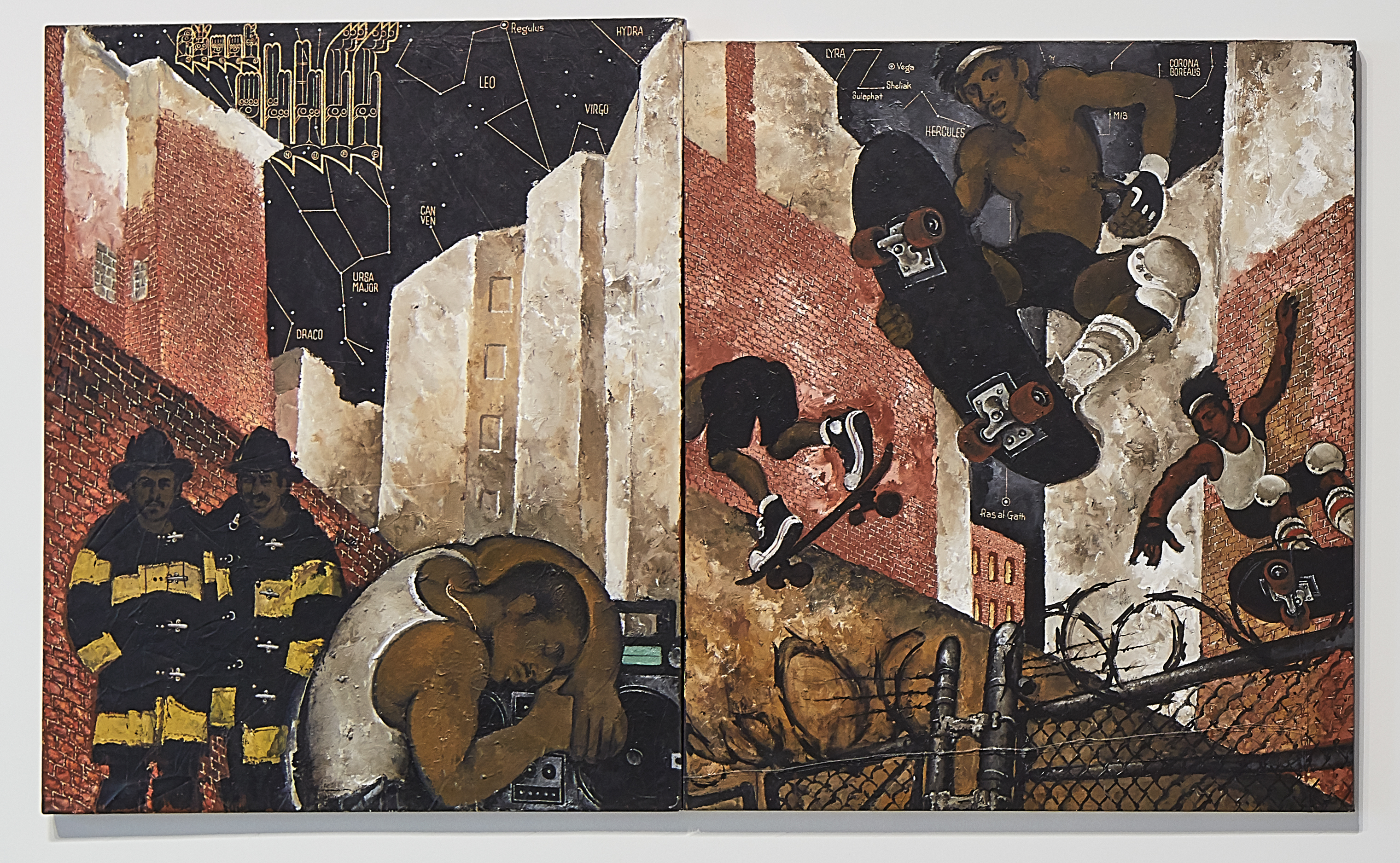
According to Beadnell, Wong also created several paintings with skateboarders as the primary subjects, like “Sweet ‘Enuff,” a 1987 painting which is in the collection of the de Young Museum in San Francisco.
Capturing moments ignored by mainstream society gifted Wong the ability to cast a new light on the struggles and discrepancies in subcultures, raising widespread awareness in the art world.
“Big Heat” 1988. | Courtesy of the Estate of Martin Wong and P·P·O·W, New York
“Sharp Paints A Picture” 1997-98. | Courtesy of the Estate of Martin Wong and P·P·O·W, New York
Iglesia Pentacostal 1986. | Courtesy of the Estate of Martin Wong and P·P·O·W, New York
Amigos 19xx. | Courtesy of the Estate of Martin Wong and P·P·O·W, New York
“Malicious Mischief” 1997-98. | Courtesy of the Estate of Martin Wong and P·P·O·W, New York
This type of socio-political activism is still growing today, but there is a need for inclusion of identity and culture regardless of differences. Beadnell emphasized this and said the goal of the collaboration with Supreme was to reinforce those ideals with younger generations.
“Wanting to extend his demographic outside of the ‘art world’ speaks to wanting to continue his legacy of influence and inspiration as an artist,” Beadnell said. “There is a strong youth culture that follows Supreme and the collaboration with Martin’s work may open a door for those that purchase the items and want to learn about Martin Wong’s contribution to our visual history and culture.”
Wong’s work revolutionized the stigmas that dismissed groups from society, specifically focusing on the disadvantaged and underrepresented. From sexual orientation and economic standing to uncontrollable impairments, capturing the essence of groups often labeled insignificant or unworthy earned Wong his title of an activist and a visionary.
“Being that Martin was a gay Asian American, we hope this level of visibility will inspire others, that may have shared histories and identities, to look to Martin as a point of inspiration.”
Anneliis Beadnell
“Martin’s paintings connect to the denizens of the Loisaida, the crumbling tenement bricks and urban landscapes, the places where creative subculture thrived and since has been erased by gentrification,” Beadnell said. “The iconography that emerged through Martin’s depiction of the Lower East Side, of closed storefronts, firemen, ASL symbols, constellations and flaming eight balls became graphic points of interest for the line.”
The re-emergence of previously destroyed creative outlets allows the newer generation access to the extinguished memories and documentation of the past. The revamped accessibility stems with the hope of generating more activism for the future.
December 1 is World AIDS Day, recognizing and bringing awareness to the pandemic caused by HIV and mourning those who have died from the disease.
“Being that Martin was a gay Asian American, we hope this level of visibility will inspire others, that may have shared histories and identities, to look to Martin as a point of inspiration,” Beadnell said.
Art is more than just another form of expression, it’s a lifeline
Taylor Bruzza is a studio art major at Humboldt State University whose love for creating art can be traced back to when she was first able to hold a pencil. Bruzza enjoys painting, making jewelry and drawing. She uses a wide range of mediums including ink, watercolors and colored pencils, but she predominately dabbles with acrylic paints. She takes inspiration from nature as she often creates art pieces involving biological and hyper-realistic forms.
An early reflection of the second annual Eureka Street Art Festival
Artists from around the world swarmed Eureka with colorful supplies on hand ready to paint vibrant and diverse murals.
The Second Annual Eureka Street Art Festival kicked off July 27 and ended August 3. Artists were sponsored by local businesses and the Headwaters Reserve Fund. Last year, organizers brought several artists to paint murals on many of Eureka’s downtown buildings with the intent to beautify the area.
Eureka local and artist Lucas Thornton specs out his mural on the side of the Redwood Art Association Gallery. | Photo by Deija Zavala
Shipping container design by Bay Area artist Benjamin Goulart (the Mural-Man) across from Humboldt Bay Fire in Eureka. | Photo by Deija Zavala
Sponsored by the Eureka Chamber of Commerce, Miami-based artist Eric Karbeling’s mural sits in the parking lot on the corner of 6th and G in Eureka. | Photo by Deija Zavala
Mural sponsored by the Local Cider Bar on the Picky Picky Picky Store 6th Street wall. | Photo by Deija Zavala
Mural by Seattle-based artist Genevieve St. Charles-Monet (@goldsuit) at 6th and E Neighborhood Eatery. | Photo by Deija Zavala
Southern California artists Dave Van Patten and James Carey collaborated on this piece at 6th and F Streets in Eureka. | Photo by Deija Zavala
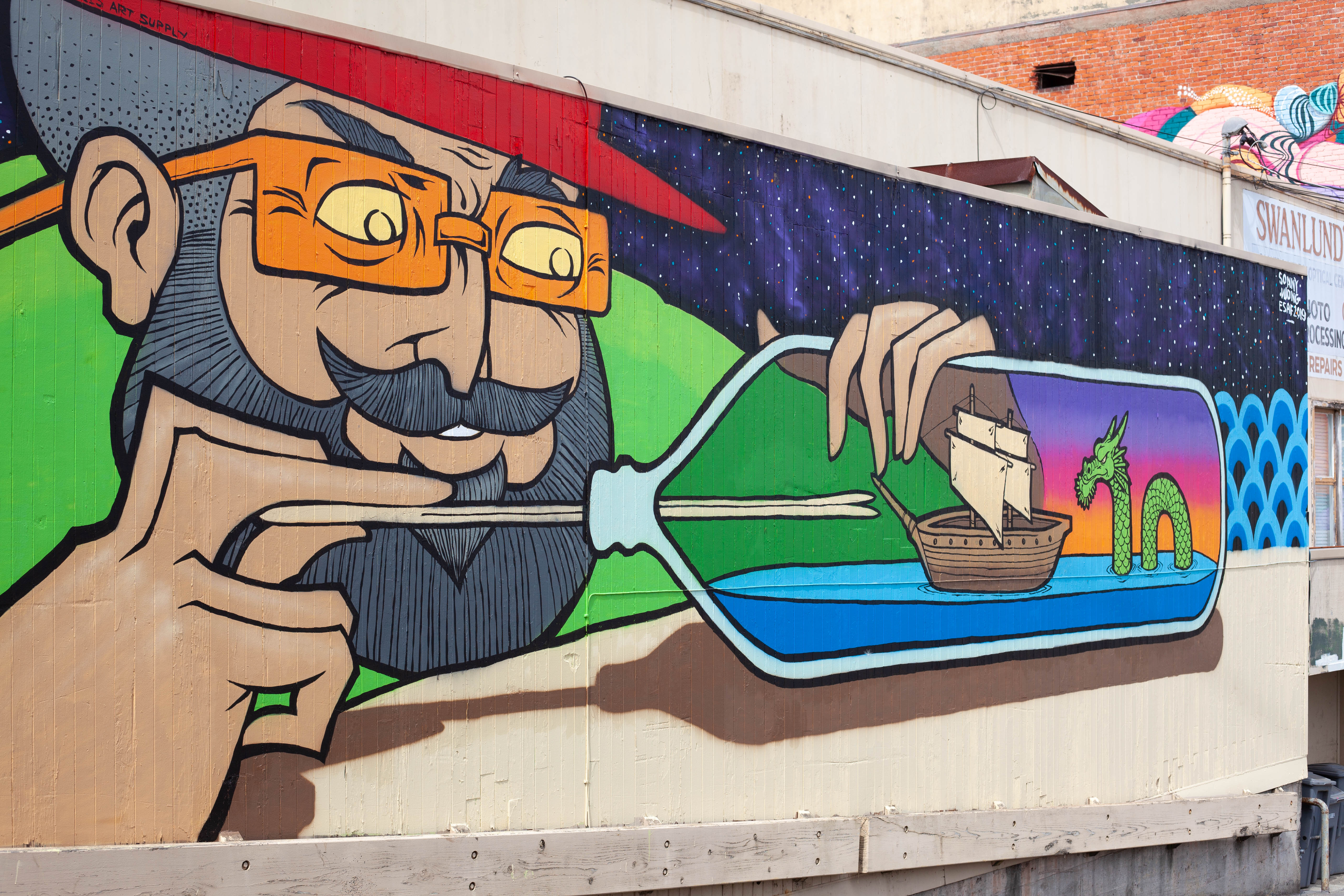
Humboldt resident Sonny Wong’s mural sits on the corner of 6th and G Streets in Eureka. | Photo by Deija Zavala
Mural for Humboldt Bay Fire by Miami-based artist Eric Karbeling. | Photo by Deija Zavala
Argentinian artist Mabel Vicentef’s mural in the parking lot of Picky Picky Picky Store. The mural was originally planned for the second-level 6th Street wall of the Eureka Theatre. | Photo by Deija Zavala
The murals painted were put up to benefit the community. It’s been less than a month since the street festival and the official unveiling of these pieces, but an early reflection was in order to highlight the impact of the pieces.
“I think it’s great and it’s not costing the taxpayers anything,” said Margaret Gibson, a Eureka local when asked about her thoughts on the benefit of having these murals.
Nathan Mathers, who has resided in different parts of Humboldt County for the last 20 years, wishes that the funds that pay the artists for these projects would be used in helping other parts of the community.
“There’s no reason these businesses can’t donate to help the homeless or fix the roads instead of paying people to paint the buildings,” Mathers said.
While the majority of the projects have focused on areas closer to Eureka Old Town, Humboldt natives like Jessica Warren hopes that in years to come they’ll see murals throughout the entirety of Eureka.
“Why stop at Old Town? If we want these murals to benefit the community they need to be seen everywhere,” Warren said.
Another local by the name of Sheri Jacobs said that she believes these murals will have several positive effects on the community.
“Some people might drive through Eureka and think it’s rundown, but how can they say that with all these vibrant murals hanging around,” Jacobs said. “It might make people want to stop and do their business here but if not, at least we all have something pretty to look at.”
April Abbot’s art pops into life with bold colors and intricate colors
April Abbott fills the details on a new painting in the Art B building. | Photo by Freddy Brewster
Sunlight casts through the windows of the Art B building, drawing long shadows across a color filled canvas. Stroke by stroke, April Abbott fills the void, paying close attention to detail and color choice.
“The striking and graphicness of a pattern and mixing it in with something that is more organic is something that strikes me as interesting,” Abbott said. “I like mixing things that don’t seem like they should work.”
Abbott, a junior, is an art education major at Humboldt State, who is also minoring in English. Born in southern California, her family moved to Humboldt when she was nine. Art has played a big role in her life since she was a child.
“I’ve been using watercolors and acrylics since I was a little girl,” Abbott said. “My grandma taught me how to do it when I was four or five.”
Abbott’s preferred medium are oil paints, after shifting from digital art a few years ago. Her first piece of art that she is proud of is a digital piece where she took photos, found a pattern within them and layered them on top of each other. But it is oil painting where she said she found herself. Her influences come from the beauty in the simplicity. Everyday things such as shapes and unique colors play a role in her art, as well as what she sees on Instagram. A connecting theme across most of her pieces are patterns and bright colors.
“There is something obnoxiously pretty about [bright colors] and I dig it,” Abbott said.
One of Abbott’s pieces is currently on display in the Art B building on the first floor. Hanging in the hallway is a painting of a woman with green and yellow pixelated hair. Pop culture and collage influences jump out right away with the visual aesthetics of flowers that follow.
“I was definitely playing off of that 50s-pop culture-y thing,” Abbott said.
Untitled Piece painted by April Abbott. Photo courtesy of April Abbott
The piece is untitled, like most of her work. If there is any sort of art Abbott tries to avoid, it is realism. She said that she doesn’t dislike it, but whenever she tries to paint it she turns it into something abstract. Teresa Stanley, one of Abbott’s professors, described her work as “strange and dream-like” and bordering on surrealism.
“She loves juxtaposing flat patterns against things that are more rendered, creating unexpected effects,” Stanley said. “She paints her flawless patterns in oil which is extremely difficult to do.”
Abbott’s studies here at HSU have also brought her under the guidance of Dr. Jim Woglom. Woglom received a Ph. D in art education from the University of Georgia in 2014 and is currently an Assistant Professor.
“April is an incredible student and positive,” Woglom said. “She’s committed to bringing art to other students.”
Woglom said that the work Abbott does in his class focuses on producing public art and developing future lesson plans. Some of the public art they have made in his class has gone towards fundraising for English language classes for adults in the greater community. Abbott’s positivity and kindness has also extended to her classmates. Amanda Feathers is a senior also majoring in Art Education. Abbott and Feathers met at the beginning of the semester, when Feathers first moved to Humboldt from Chico.
“April is the most welcoming and warm person I’ve ever met,” Feathers said. “She is really sweet and caring.”
Feathers said that Abbott’s art is intricate and “some of the most painstakingly detailed” she has seen. Amethyst Shelton is also a friend of Abbott’s; having met her when they attended high school at Arcata High.
“April is one of the most driven people I know,” Shelton said. “She’s a sweetheart to almost everyone and has a lot of patience.”
That patience shows in Abbott’s art. The patterns that transpire across her work are visually pleasing and impressive; allowing the eyes to find a sequence and resting point from the bright colors.
“I just do what I think looks good and it usually ends up working out,” Abbott said.
Once she acquires a wider collection of pieces she plans to showcase them. But for now, she is focused on her studies. Abbott said she wants to continue a career in art, bringing it to the public at large.
“I want to show that there is a lot of importance in [art],” Abbott said. “And that even though there are people who aren’t ‘artistic,’ they can still find an appreciation for it.”
Alumnus Stephen Hillenburg makes permanent mark at HSU before passing
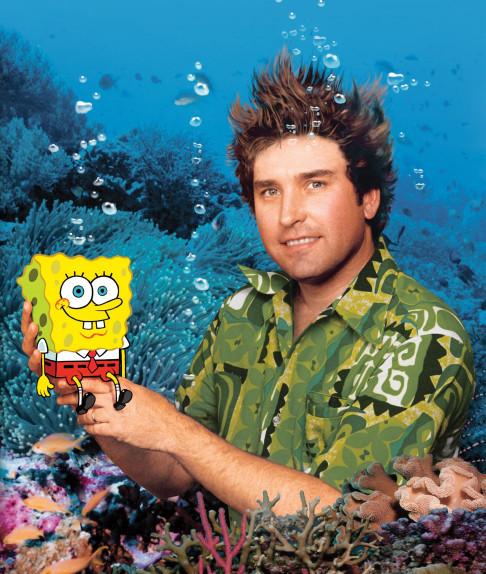
Stephen Hillenburg, Humboldt State alum and creator of Nickelodeon cartoon “SpongeBob SquarePants,” has passed away.
Nickelodeon confirmed the news in a Tweet on Tuesday.
“We are sad to share the news of the passing of Stephen Hillenburg, the creator of SpongeBob SquarePants,” the network wrote. “Today, we are observing a moment of silence to honor his life and work.”
The 57-year-old Hillenburg revealed March of last year to Variety Magazine that he had been diagnosed with Lou Gehrig’s Disease, or ALS.
Hillenburg and his wife Karen gifted $135,000 to HSU back in Sept. to grant awards for students doing research with faculty in the marine sciences. The couple used the money to create the Stephen Hillenburg Marine Science Research Award Endowment fund.
According to an HSU press release, Stephen Hillenburg furthered both his knowledge of marine biology and his talent as an artist while he attended HSU. The creation of SpongeBob SquarePants was a natural merging of Hillenburg’s passion for art and the ocean.
The animated series first aired on Nickelodeon in 1999 and features a square yellow sponge named SpongeBob SquarePants. He lives in a pineapple under the sea with his pet snail, Gary, in the city of Bikini Bottom on the floor of the Pacific Ocean.
SpongeBob SquarePants has won both U.S. and British Emmy Awards and has been translated in more than 60 languages, including Urdu, Azerbaijani and Maori.
Hillenburg is survived by his wife of 20 years Karen Hillenburg, son Clay, mother Nancy Hillenburg and brother Brian Kelly Hillenburg.
Independent labeled alternative rock bands from Spain usually do not garner the attention in the U.S that say a band from California or New York tend to. Even the explanation of the band strikes as a hipster retweet but Vetusta Morla is nothing but an exception to this rule.
Vetusta Morla has been nominated for three Latin Grammy awards this year for their recent album entitled “Mismo Sitio, Distinto Lugar.” These nominations include Mejor Album de Música Alternativa (best alternative music album), Mejor Canción Alternativa – ‘Consejo de Sabios’ (best alternative song) and Mejor Diseño de Empaque (best packaging design or best album cover art).
Álvaro B. Baglietto has been the longtime bassist for Vetusta Morla and has seen both the highs and lows of working on an independent label.
“We have always done what we want to do,” Baglietto said. “And we have never had to really have pressure put on us by some record [executive].”
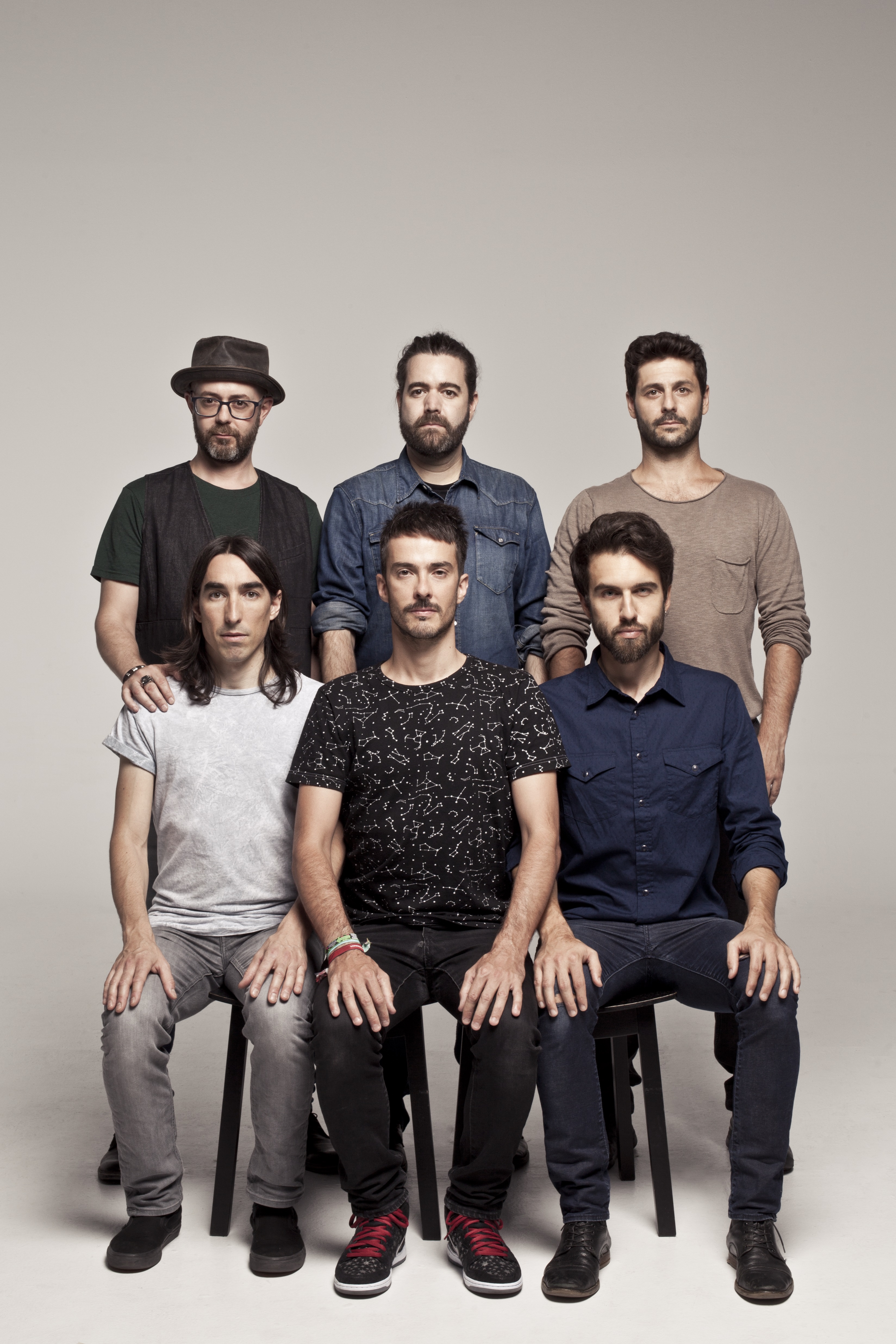
Baglietto and his bandmates, guitarist Juan Pedro “Pucho” Martin, drummer David Garcia, percussionist Jorge Gonzalez, guitarist Guillermo Galvan and keyboardist Juan Manuel Latorre have known each other since they were young. They grew up in the Tres Cantos neighborhood of Madrid, Spain, and formed the band in 1998.
“We love Madrid; it’s our city, it’s our base,” Baglietto said. “And hey, maybe will move to Miami, who knows, but we love Madrid, we love the way of life here.”
Baglietto and his bandmates said music is sacred, and since their creation, Vetusta Morla has been adamant about being independent from any record labels, media companies and celebrity management. Although this has made them into one of the most famous and acclaimed independent artists in Spain, Baglietto and the band don’t really think about themselves in the spotlight.
“We don’t think about those things that much, we don’t even really talk about it,” Baglietto said. “In the beginning, we just wanted to do music in a honest way and the best that we could.”
Vetusta Morla’s musical genre is generalized as alternative rock but Baglietto said that the likes and interest of the band and himself vary greatly.
“The music that I listen to changes all the time,” Baglietto said. “I used to love rock, reggae, jazz, blues.”
Baglietto says that the evolution of his musical tastes have led him to genres that he has never really listened to before and artists he never previously would have known.
“Nowadays, I am listening to a lot of rap or hip-hop and it didn’t happen before,” Baglietto said. “I like Kendrick Lamar and Eminem.”
With 20 plus years of experience under their belt, the band had a lot of time to work on different projects and album concepts. This includes everything from writing and producing the music for a video game entitled “The Rivers of Alice” all the way to writing and producing an album for an AIDs awareness program.
“For me music is like poetry with a soundtrack and it’s so important,” Baglietto said. “We have to make people think and make people feel and not say something that others have said before.”
Student shredders take first flight at Jam’s Pint Night
Icarus & Suns, a three piece band featuring Miles Oliart on drums, Nick Redfern on bass and Rahkiv “Rah” Lewis on guitar, played their first show at the Jam in Arcata last night.
“We’re progressing and going somewhere now,” Oliart said. “I’m super stoked about the situation.”
The group takes influence from a number of genres; citing musicians like Jaco Pastorius, Jimi Hendrix and Django Reinhardt as some of their favorite artists.
“I honestly get my rhythm from Gabriela Quintero,” Lewis said. “She came to campus this semester, but I missed it and was bummed!”
The Jam has been holding shows in Arcata for more than 30 years, claiming that the Foo Fighters played their first show at the bar on Feb. 23, 1995.
The Foo Fighters actually played their first show days before on Feb. 19, 1995 in Seattle, Washington, but you can see how the legend would help shape the Jam’s persona for eager young musicians like Icarus & Suns.
Rahkiv Lewis and Miles Oliart, of Icarus & Suns, rock The Jam’s stage during their last Thursday Pint Night show at The Jam in Arcata on Oct. 11. | Photo by Sean Bendon
Icarus & Suns has only been practicing for a month or so, but the trio already seems to have found their rhythm, playing nearly 40 minutes of downtempo Latin-influenced songs to a packed house on Thursday night.
“We have three hours [of songs] or something ridiculous like that,” Redfern said.
Although the band was limited to a 30 minute set, it didn’t take long for the crowd to get in groove with them.
“Cheap beer, cheap pizza, and free tunes,” said crowd member Connor West. “People are out here having a good time.”
The name for Icarus & Suns comes from the myth of Icarus and Daedalus attempting to escape Minos maze in Greece with wings made of wax and feathers. Icarus gets carried away with his ability to fly and goes too close to the sun, melting away his wings and sending him to his death below.
“I wanted to remind myself not to fly too close to the sun,” Redfern said. “Hopefully we don’t melt away.”
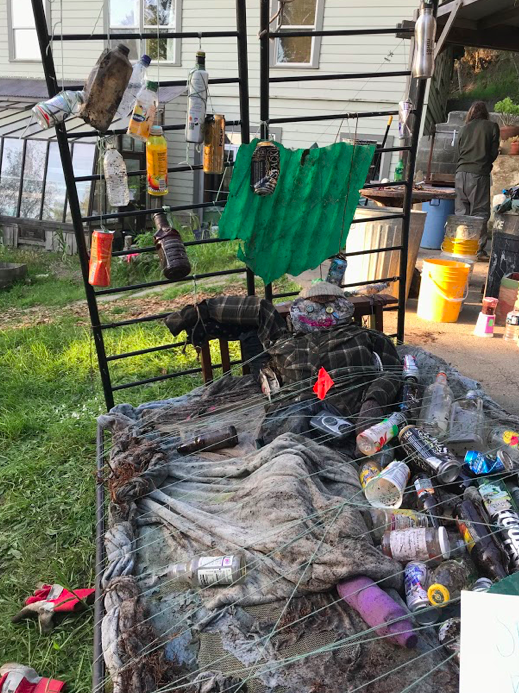
Hands gripped ankles, one leg pointed for balance, creating a human bridge. An arm reaches out over a river in the community forest to grab a long forgotten sour cream container. It would have never decomposed, so instead, it was upcycled into art. A collaborative art installation to visualize human influence on our natural world, showing what we leave behind and what will stay behind. The tagline: “you made your bed, now sleep in it.”
Jonelle Alvarez, a Humboldt State student majoring in environmental science and management, helped collect the trash and turn it into a sleeping student. She was inspired to be participating in the transition from trash to art.
“There was a lot more trash than I imagined and it would’ve stayed out there forever,” Alvarez said. “We had to get really creative with it. Prove we have no limits.”
This past Sunday, a group of students from Earth Guardians suited up in their rain gear and headed to the forest, armed with empty sandbags to fill up with trash. It was the first of many community forest clean up days hosted by the club.
Earth Guardians is a global movement founded and sustained by young people to spread resiliency through direct action activism. They are demanding greener policy from governments and leaders around the world, co-creating our future by empowering youth leaders. They are currently suing the federal government for endangering our generation through excessive fossil fuel consumption.
Earth Guardians picking up trash in the community forest. Photo by Madeline Bauman.
The Humboldt State Earth Guardians chapter meets every Monday in the CCAT house at 5 p.m., fostering an all-inclusive, accessible space for local activists to turn their ideas into reality.
Simone McGowan, an environmental studies student who brought Earth Guardians to Humboldt, struggled to find an accessible outlet for her activism, a space for people to feel good about themselves and what they’re doing.
“We’re uniting a large group of activists for political and social action on the macro and micro scale,” McGowan said. “Activism should be accessible and everyone should be included in the conversation.”
Earth Guardians promotes activism for anyone trying to catalyze change. They are bridging the disconnect between social and environmental justice, starting an open dialogue where all voices can be heard.
Jacob Gellatly, an environmental resource engineering major, believes Earth Guardians’ inclusive, collaborative activism is the answer to the social and environmental problems that plague our planet.
“Don’t focus on what can’t be done,” Gellatly said. “Instead, figure out what we can do together to make it happen.”
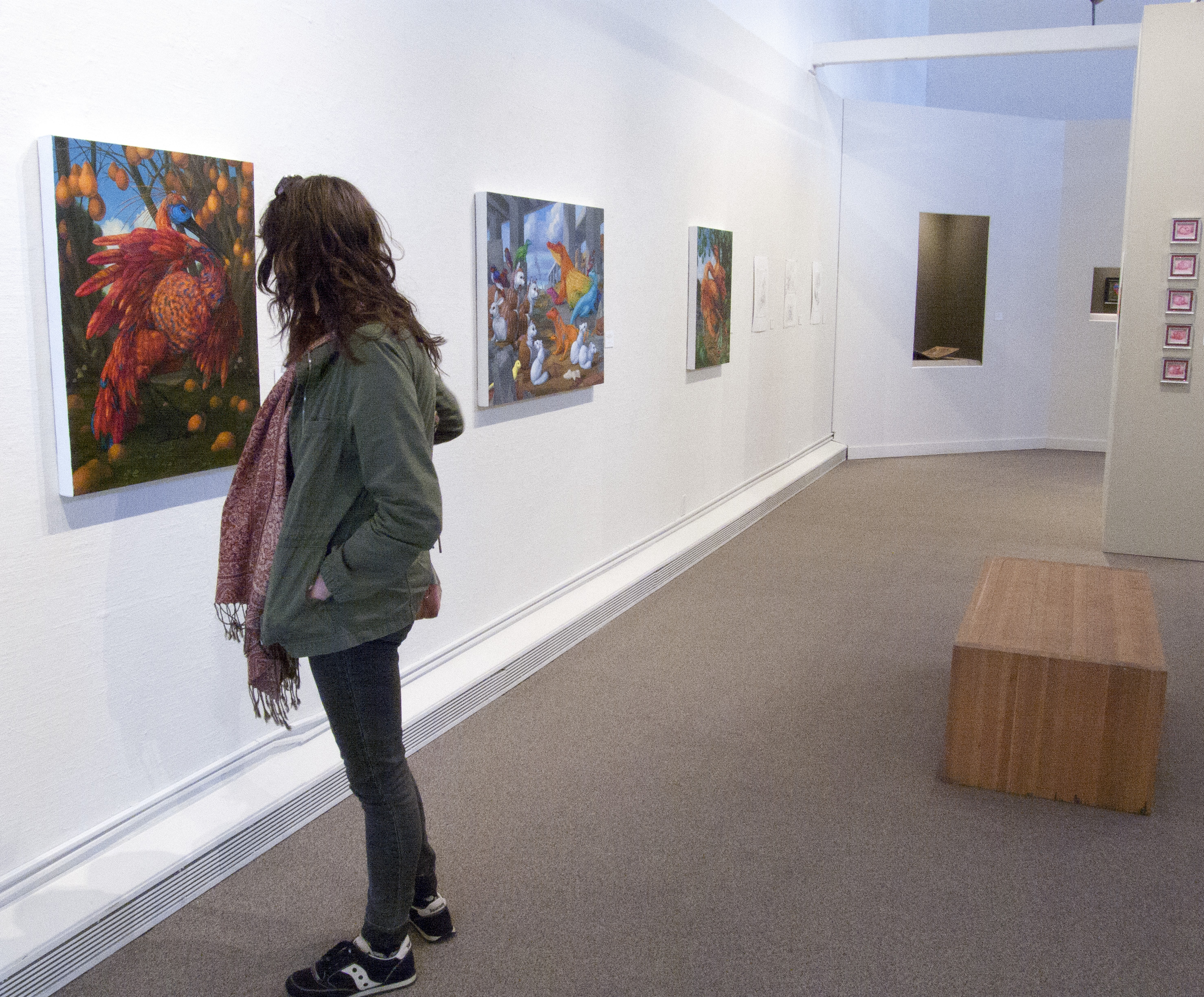
Humboldt State hosts the artworks of Illinois-based professor and artist Laurie Hogin. Dozens of her paintings are displayed in the art department’s Reese Bullen Gallery, most of which highlight Hogin’s signature neon colors depicting chaotic scenes that involve brightly plumed birds, psychedelic bunnies and hyper-saturated flowers and fruit.
Most of the paintings are oil on canvas, but some are sketches from Hogin’s personal notebooks and watercolors on paper.
Hogin says her works primarily consist of “allegorical paintings of mutant plants and animals in languishing, overgrown settings or posed as though for classical still life or portraiture.”
Hogin’s paintings are fascinating, evoking memories of Henri Rousseau – leafy greenery and subjects nearly phosphorescent in color and brightness.
HSU sophomore Kelsey Briscoe, 20, agrees.
“These paintings are super interesting,” Briscoe said in front of Hogin’s painting “Sugar Trilogy I: Tricks,” which depicts a rather murderous blood-soaked bunny seated in front of an Easter candy. “This is definitely some commentary on capitalism and that sort of ‘Hallmark-holiday-card’ consumerism.”
HSU junior Logan Clark stopped by to check out the exhibit on a whim and was pleasantly surprised by the display.
Looking at “Echo Turnpike,” a painting that depicts several formidable tangerine crocodiles in front of the wreckage of a turnpike, “All the subjects of her paintings tend to be bright, while the background is monochromatic or even dull,” Clark said. “She seems to really focus on one main thing.”
Visitors also have the opportunity to utilize skills demonstrated to them through HSU’s art department. Patricia Ely, a 19-year-old sophomore at HSU visited the gallery during her 20th century art class.
“It’s crazy being in here and seeing actual parallels in this artwork and what I’m currently learning about,” Ely said. “I feel like this is all really familiar to me.”
The exhibition to Hogin’s works is located at the Reese Bullen Gallery (Art B, room 101) until March 31.
This website uses cookies to improve your experience. We'll assume you're ok with this, but you can opt-out if you wish. Cookie settingsACCEPT
Privacy & Cookies Policy
Privacy Overview
This website uses cookies to improve your experience while you navigate through the website. Out of these cookies, the cookies that are categorized as necessary are stored on your browser as they are essential for the working of basic functionalities of the website. We also use third-party cookies that help us analyze and understand how you use this website. These cookies will be stored in your browser only with your consent. You also have the option to opt-out of these cookies. But opting out of some of these cookies may have an effect on your browsing experience.
Necessary cookies are absolutely essential for the website to function properly. This category only includes cookies that ensures basic functionalities and security features of the website. These cookies do not store any personal information.
Any cookies that may not be particularly necessary for the website to function and is used specifically to collect user personal data via analytics, ads, other embedded contents are termed as non-necessary cookies. It is mandatory to procure user consent prior to running these cookies on your website.