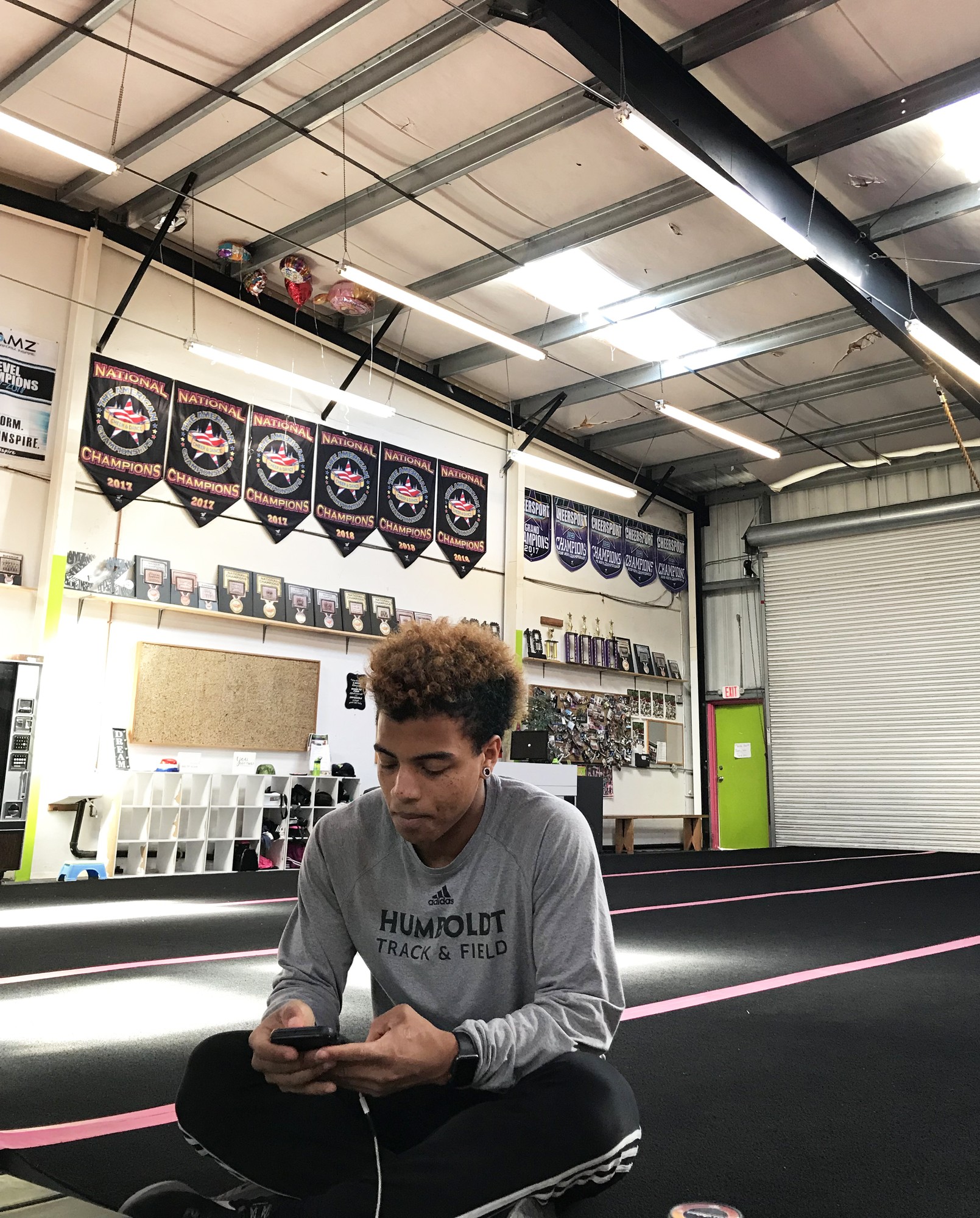
Growing up as a Black person who attended a predominately white school in his hometown of Palmdale, California, Doug Smith learned early on how to code-switch, or alter his behavior to fit white societal norms. Still, his peers expected him to act a certain way because he was Black.
“People had perceptions of what it was like to be Black; they have their own ideas,” Smith said. “I remember one time a new Eminem song had come out and some white dudes in my P.E. class knew the lyrics and I didn’t know the lyrics, and they’re like, ‘Oh, so we’re Blacker than you are.’”
Smith’s formative lived experiences with code-switching and microaggressions – subtle statements or actions that are discriminatory against members of marginalized groups – made him very cognizant of other peoples’ perceptions of him early on.
“That was really my first understanding of code-switching,” Smith said. “I would totally present differently because I was really conscious of how people were perceiving me.”
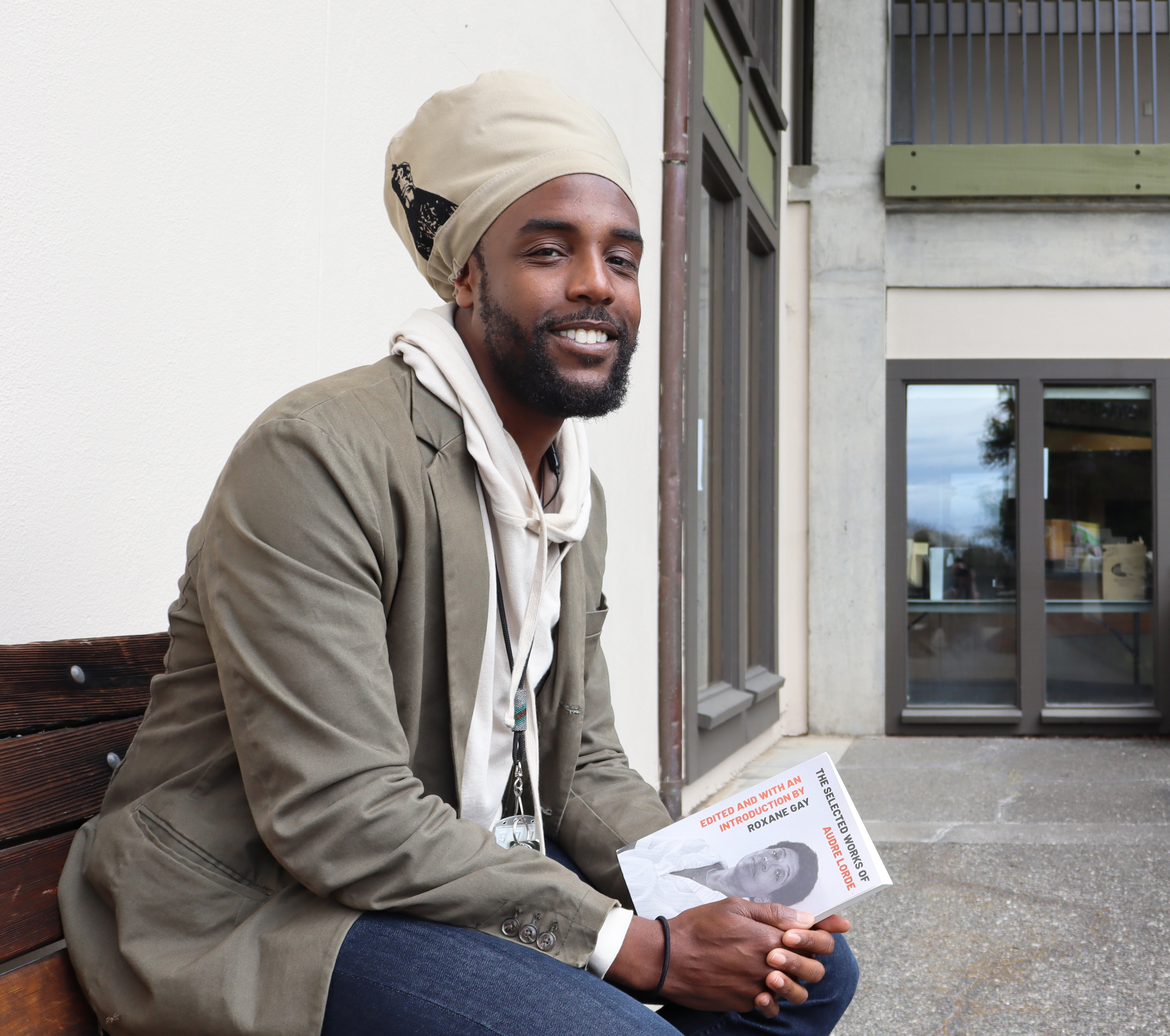
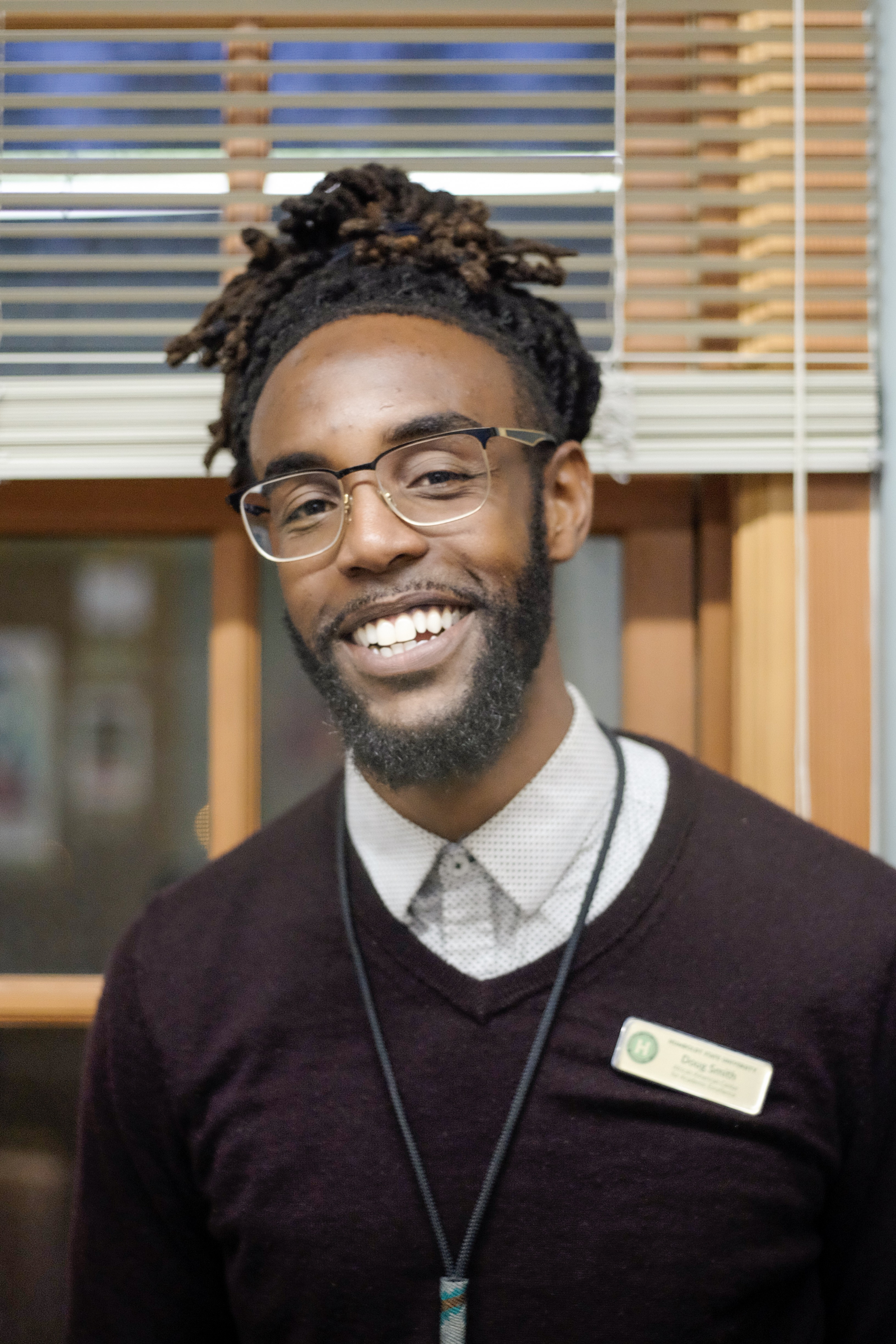
As a Cal Poly Humboldt international studies alumnus, staff member and graduate student majoring in English, Smith has been involved in the campus community since 2013. Today, he is the coordinator at the Umoja Center for Pan African Student Excellence at Cal Poly Humboldt, a position that he has held since July 2019.
“It’s such a rare opportunity for Blackness to be centered,” Smith said. “So I really want Black students to be able to make it theirs.”
Smith’s vision for the Umoja Center going forward is to foster Black student development, including but not limited to publishing their writing, and foster Black liberation by curating spaces that are made for and by Black people. Amplifying Black voices that often get silenced or ignored is key.
“[I’m] always visible because I’m a Black person, because you stand out,” Smith said. “But then at the same time, I think that oftentimes my voice isn’t always audible or isn’t always heard.”
Although the Umoja Center is first and foremost a space for Black students, faculty and staff, it’s open to everyone on campus.
“I think it’s so cool that we have an educational, Black-centric space [at] a university that really has an opportunity to educate our campus and local community,” Smith said.
To learn more, visit the Umoja Center in Room 206 at Nelson Hall East, follow @umojahumboldt on Instagram, or go to umoja.humboldt.edu. To get involved, attend an event listed on the website or volunteer with the Umoja Center on Fridays from 11 p.m. to 3 p.m. at Bayside Park Farm on Old Arcata Road.
Students lined the Redwood Bowl Plaza for food, music, games and a performance on Feb. 24 for the Black Out Basketball pre-game rally. Organized by the Umoja Center for Pan African Student Excellence, it was a celebration of Cal Poly Humboldt’s Black faculty and staff.
Photo by Angel Barker | From left: students Demi Ogunwo, Joy Mehn, Douglas Smith, and Gloria Thompson at the Black Out Rally on Feb. 24 that took place at the Redwood Bowl Plaza.
The celebration was not just for the faculty and staff, but for the black student community. Douglas Smith, coordinator of the Umoja Center and masters student in English, was a critical part in making the event successful.
“It means a chance to have community,” Smith said. “A chance for Cal Poly Humboldt to support our Black student community like we would in society.”
The Umoja Center’s mission is to support the pan-African student community. Lots of students were in attendance for the pre-game tailgate, to support and celebrate community and the campus.
“I came out to support the game and the celebration that’s going on right now,” said Joy Mehn, a political science major.
The center is very important to Mehn.
“To me the center means family,” Mehn said. “So many good friends are in the Umoja Center. It is a place to just relax and come together.”
Gloria Thompson, a child development major, was attending the rally to celebrate Black excellence. Thompson found her people at the Umoja Center.
“I was a student at home dealing with a toxic family,” Thompson said. “I found my community and family there [the center].”
Photo by Angel Barker | Drummer Bongo Sidibe and dancer Joti Singh perform at Blackout Rally on Feb 24.
The rally featured Southern food and a drum and dance performance by the Duniya Dance and Drum Company. The San Francisco-based company was formed in 2007 to create dance and music.
Before the men’s basketball game, a video was played in honor of Black History Month and featured student athletes and what the month means to them and who they look up to.
All throughout the men’s game, free t-shirts were given to every person featuring the hashtag #LoveIsTheNewBlack and Black Out Game 2022. During half time of the men’s game, many of Cal Poly Humboldt’s Black faculty and staff were honored with flowers and a gift bag. The drummers from Duniya Dance and Drum Company were also in attendance and helped hype up the crowd with their music.
Thursday Feb. 24 was just one of the days to celebrate the Black community on the Cal Poly Humboldt campus.
“It is to celebrate school spirit, hang out and enjoy each other,” Smith said. “To enjoy good food and Black culture.”
Photo by Angel Barker | Dancers for Duniya Dance and Drum Company at the Redwood Bowl Plaza on Feb. 24Bongo Sidibe, artistic director for Duniya Dance and Drum Company, plays drum in performance at the Redwood Bowl Plaza on Feb. 24 for Blackout Tailgate
Claps and cheers echoed through Founders Hall 118 during the Umoja Center’s Black Excellence in STEM event, probably far more than had graced the room in quite a while. Many HSU community members filled out the seats, just as their enthusiasm and passion filled the room.
Dr. Kim White, Cal Poly Humboldt professor of chemistry, hosted the event at the request of Umoja Center for Pan African Academic Excellence.
After an indigenous land acknowledgement, she began by paying homage to several Black scientists under whom she studied. One of these was Dr. Loyd Noel Ferguson, the first Black person to earn a PhD in chemistry from UC Berkeley.
“He was the original backyard chemist, he synthesized moth repellent and stain removers in his backyard in Oakland when he was growing up,” White said. “He also used his academic talent not only to propel his own career but also to create opportunities for others.”
She also spoke fondly about Dr. Phillip Crews, a UC Santa Cruz professor of chemistry known for his involvement in diversity programs.
“Phil instilled in me a strong desire to use my privilege for the benefit of others… seeing him use his strengths to lift up others was pretty fundamental in the trajectory of my career,” White said.
Dr. Chris Harmon, another member of Cal Poly Humboldt’s chemistry department, spoke next. He spoke on the importance of acknowledging and celebrating the growing diversity within science.
“It matters where you come from, it matters what language you grew up speaking, and absolutely the color of your skin matters, Harmon said. “When I got into chemistry, one of the things that I loved was all of these rich, beautiful colors that you would see in the lab… if we celebrate the colors of the chemicals why can’t we celebrate the colors of the chemists?”
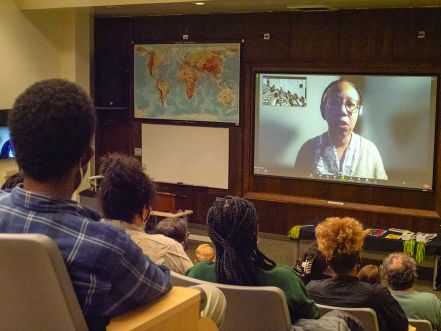
Photo by Morgan Hancock | Dr. Kensha Clark speaks to students of her work in chemistry via Zoom at Founders Hall on Feb 11
Harmon introduced Dr. Kensha Clark, a highly celebrated and accomplished Black chemist currently teaching at the University of Memphis.
After brief technical problems, she appeared on the projector screen, Zooming in to the event.
Clark discussed her work, both as a private sector chemist with Chevron and as an academic. Her current fields of interest include molecular electronics, solar energy conversion, and small molecule activation, among others.
In her lab, she makes sure that students of all backgrounds feel welcome.
“I think [our diversity] makes our science all the better,” Clark said.
When she was a student, however, Clark felt that her interest in science was quashed. She described only being encouraged to become a writer or an artist, all the while never wavering from her passion for science.
Even though strong familial support allowed her to achieve her dream, Clark is still faced with a shocking lack of diversity in her field.
“By default, you are the representative of your people,” Clark said. “It makes it exciting when one sees up-and-coming scientists of color.”
Photo by Morgan Hancock | Asia Anderson explains her research into membrane protein isolation on Feb 11.
Cal Poly Humboldt student Asia Anderson took the stage after Clark, to a joyous round of applause from the audience. A transfer student from College of the Redwoods, Anderson is obviously beloved to the campus community.
She spoke about the community and support that she has found while studying chemistry at Cal Poly Humboldt, and how her mother’s going back to school to study English inspired her.
“I feel like every step of the way I’ve had this ushering of peers around me… I will also be the first person in my family to graduate from college,” Anderson said.
Anderson’s research during her undergraduate degree at Cal Poly Humboldt has been in the targeted extraction of membrane proteins. She said that the proteins’ sensitivity to light means that further study could illuminate ways to use these proteins for targeted medication delivery.
After graduation, Anderson will study to receive a graduate degree at UC Santa Cruz.
The Umoja center hosted this event in collaboration with NSBE, the National Society of Black Engineers. Demi Ogunwo is a masters student in Cal Poly Humboldt’s Energy Technology and Policy Program, and spoke at the event as the president of the school’s NSBE chapter.
“NSBE offers a platform for students to network and get mentored by … Black professionals,” Ogunwo said. “It’s not for engineers alone, it’s for all STEM students.”
NSBE is a community focused on supporting Black scientists, whether academically or professionally. They will be hosting a social hangout for students potentially interested in joining this Friday Feb. 18, from 1 pm to 3 pm in the University Upper Quad.
Bridging the cultural gap between the campus and community
Douglas Smith drove up to Humboldt State for the first time in 2013 as a transfer student with big eyes for a small school.
Smith was seeking same the small school feeling that he got while attending College of the Canyons, away from his home in Los Angeles. At first, Smith experienced anxiety about being one the few people of color in Arcata, but he found a way to adapt and thrive in time.
Today, he’s the director for the African American Center for Academic Excellence, and is four months into his new role. Smith holds his own college experiences as reference when approaching the job.
“My big benefit to coming to Humboldt State was that I had these opportunities for cultural exchange with different kinds of people,” Smith said.
Smith believes the center should be a place that highlights the black experience and culture, a space where students and community can freely speak and learn. Smith hopes the center will strengthen the campus community and bridge the gap between the campus and locals.
Smith emphasized intercultural exchange as an important part of learning. One way the center achieves this is through Talking Drum, a safe space that gives students the agency to converse over the issues that matter to them.
HSU sophomore Brooklyn Reed is the new facilitator for Talking Drum. She met Smith tabling in the quad and offered some of her ideas on how the center’s discussions could be run.
“I talked to him about how to facilitate it, about what I wanted it to look like, how I wanted to build community,” Reed said. “He was just very, super supportive. Just yes, like, ‘let’s do this!’”
Reed wants to run the discussions the way she learned back home in Los Angeles. She also wants the chief of police to attend some meetings so that the center can hold the police accountable if they disagree with their conduct.
Smith’s approach to working with Reed speaks to how he wants to take a step back when it comes to campus dialogue. For his first couple of months, Smith said he spent the majority of his time listening to student feedback.
“I’m trying to come in with this idea of like, ‘Okay, I have some ideas for things,’” Smith said. “But I really want to learn and listen to what students’ needs are, and identify those needs before I go in and start making decisions here and there.”
In Talking Drum, students have a safe space that gives them the agency to converse over the issues that matter to them. | Photo by Michael Weber
This approach allows the Dean of Students Office to be informed by what the center is doing, versus managing from the top down. Letting students take control of the dialogue means that they will be directly influencing the Dean of Students.
“I have been wanting every [discussion] to be student-led, student-driven, and have that peer to peer connection,” Smith said.
Smith promotes the free exchange of ideas because he believes dialogue and cultural exchange is important to becoming part of the community.
One of Smith’s most profound influences on the way he approaches intercultural exchange occurred in his senior semester spent abroad in Santiago, Chile. When he landed, Smith recognized the feeling of being alone and started to familiarize himself with the local area.
“My experience in Humboldt County and at HSU as the ‘other,’ and learning how to move from a perpetual state of survival mindset to adapting and thriving prepared me in so many ways for my time abroad,” Smith said.
Smith’s directive for the center is a culmination of his experiences learning about other people.
“Having that cultural exchange and different kinds of people allowed me to have more diverse viewpoints,” Smith said. “I’m an extrovert. Inside, I might feel anxiety about me, but I’ve always kind of pushed myself to engage with people.”
2014 bus crash survivor now turned activist, Santiago Calderon shares his story
In 2014, a Spring Preview bus trip filled with many prospective students travling to HSU from southern California was cut short when a Fedex truck collided into it. Five years later, bus crash survivor and activist, Santiago Calderon continues to fight and share his story to save more lives.
Santiago Calderon holds his cat Henny as they swing on his porch swing. | Photo by Dajonea Robinson
[perfectpullquote align=”right” bordertop=”false” cite=”Santiago Calderon” link=”” color=”” class=”” size=”16″]“I escaped to survive. I was pulled out by God, by some entity and landed head first on my shoulder from the charter bus window.”[/perfectpullquote]
Calderon went to Oxnard high school located in North Oxnard and graduated in 2014. He is now 22 years young and has a cat named Henny. Calderon played football for 10 years and had plans of continuing his football career in college but, the bus crash changed it all. Calderon said the crash took his life away from him.
“Football was my life, it was everything,” Calderon said. “I escaped to survive. I was pulled out by God, by some entity and landed head first on my shoulder from the charter bus window.”
[perfectpullquote align=”left” bordertop=”false” cite=”Santiago Calderon” link=”” color=”” class=”” size=”18″]“I saw death, I saw war, I saw trauma, torment… I saw hell on Earth.”[/perfectpullquote]
Calderon said he has vivid flashbacks of the collision. He said the visual of the red Fedex truck crossing the median right before impact, is screwed into his brain. Calderon described that day as the worst day of his life.
“I saw death, I saw war, I saw trauma, torment, I saw hell on Earth,” Calderon said. “That day I accepted death because I didn’t think I was going to make it. I told myself I’m not going to live in fear, to have happy thoughts before I die. I started thinking about my family. The life that I’m losing.”
Calderon said that during the collision he felt everything, and nothing at once. That he felt numb, completely numb. Calderon said that at some points he was so distraught couldn’t believe it and told himself that he was hallucinating.
“I remember asking the paramedics ‘Is this real?’and then I began to cry,” Calderon said. “Part of me died on that bus, I don’t know who I am anymore. I don’t know who I was before. I was broken, shattered in pieces and so much more after the crash.”
Satiago Calderon’s mother, Corinne Pinon looks off into the distance. | Photo by Dajonea Robinson
Corinne Pinon is Calderon’s mother. She and her family has been Calderon’s backbone since the crash and continues to deal with the after effects that stemmed from the incident. Pinon described Calderon before the accident as a great athlete, a honors student, and a happy carefree kid.
“The therapist said back then he lost his childhood that day, he was only 17,” Pinon said.
[perfectpullquote align=”right” bordertop=”false” cite=”Corinne Pinon” link=”” color=”” class=”” size=”17″]“Our family is barely holding on by a string to continue to help him. He is not a happy person. He has survivor’s guilt.”[/perfectpullquote]
Pinon said that her family is still healing and learning how to cope from the crash. She said that she’s not sure what’s the right or wrong thing is to do but her family keeps on trying.
“Our family is barely holding on by a string to continue to help him,” Pinon said. “He is not a happy person. He has survivor’s guilt. Like [Calderon] said, it’s easier if he didn’t make because living with this, even for me, his dad and his brother, is pretty unbearable.”
Pinon said Calderon is definitely a different person than he would have been if the crash didn’t happen.
Calderon suffers from mental health issues that stemmed from the crash. He was diagnosed with PTSD and bipolar disorder. He has tried therapy but is now trying PTSD groups and other programs.
Calderon went to HSU for four years and studied psychology to learn how the mind and how people function. Calderon had a psychotic break in May and had to move back home down south from Humboldt County. He described the episode as a very dark moment in his life.
Calderon said he’s not done recovering. He said the crash lead to PTSD related actions he never thought he’d make. That the crash caused chaos in his head, and the over analyzing of everything.
“I’ll go into a room and I’ll figure out how to get out alive,” Calderon said. “I’ll do everything I can to stay alive. I feel like everywhere I go I’m going to die. That’s a scary feeling, it’s something I learned to live with. Something that has given me such strength and courage.”
Calderon said that he’s in a continuous fight. When he’s low he sometimes has suicidal thoughts, and feels that it’d be easier just to stop but that is not what his God wants.
“I will not be afraid, I have no fear in my heart, I have no fear,” Calderon said. “ I went through hell on earth. I will never stop recovering. How could you be normal after something like that? You can’t. I’ll never be the same person. I lost Santi that day but a new Santi arose a stronger Santi.”
Angelica Espinoza is a close friend of Santiago Calderon. She is pictured outside of Calderon’s home on a tie swing. | Photo by Dajonea Robinson
Angelica Espinoza is a close friend of Calderon. They have a relationship that heals each other when they’re both down. Espinoza said that they reunited at a good time because they were both in a dark place struggling with depression.
“We just talked about healing, we didn’t talk about the crash,” Espinoza said. “It’s really a brotherly/sisterly bond with a lot of caring and deep conversations. We talk a lot of scripture. We’ve been finding answers through scriptures.”
Calderon received various emails from news agencies after the incident. Calderon said that he came across a message from a man named Harry who is the executive of the Truck Safety Coalition.
Calderon said that Harry’s message was different. The coalition was fighting against unjust policies that would make roads even more dangerous and, that was something Calderon wanted to be apart of.
“A truck is like a moving missile on the highway,” Calderon said. “That was a missile, the bus exploded-the charter bus exploded. What if the ruck was 22 feet longer and went 22 feet more into our bus? More people would have died.”
Corinne Pinon, Santiago Calderon, and Angelica Espinoza sit on Calderon’s family porch. | Photo by Dajonea Robinson
Every two years the coalition has a conference in Washington D.C. to fight against unjust trucking policies. The coalition educates themselves of the laws and policies that are in the works to better create ideas to stop them.
[perfectpullquote align=”left” bordertop=”false” cite=”Santiago Calderon” link=”” color=”” class=”” size=”16″]”We have to prepare for war, because we’re fighting for change. We’re fighting for policies that should never happen. We’re fighting for safety procedures that should happen.”[/perfectpullquote]
Calderon said the coalition plans on fighting a good fight. This year Calderon and his truck coalition members will be in Washington D.C. July 13 through 17 for a week of action.
“We have to prepare for war, because we’re fighting for change,” Calderon said. “We’re fighting for policies that should never happen. We’re fighting for safety procedures that should happen.”
Calderon has been apart of the coalition since 2015 and has been striving to save lives ever since.
“I don’t know where I would be if I didn’t have my truck coalition family behind me,” Calderon said. “They are my family. I would be more lost than I am. The coalition makes me feel like I never went through it. To gain such hope, such courage, we’re like any army fighting against injustices.”
Calderon does not plan on giving up and succumbing to the obstacles life throws at him. He feels as though he’s doing godly work.
Santiago Calderon sits on his porch in southern California. | Photo by Dajonea Robinson
[perfectpullquote align=”right” bordertop=”false” cite=”Santiago Calderon” link=”” color=”” class=”” size=”16″]“If I could, I would die for everyone if that meant for everyone to be good. Saving lives is everything I do.”[/perfectpullquote]
Calderon wants to be a vessel of God. He wants to let the light shine brighter than it has been before. He feels that he is the light in this world of darkness.
“If I could, I would die for everyone if that meant for everyone to be good,” Calderon said. “Saving lives is everything I do. I want to hear laughter, I want to see joy and people’s pearly whites. I want the injustices to stop. I want people to hear us and see us. I want truck services to care about truck safety and to actually listen. All we’re trying to do is save lives. That’s all we want.”
Don’t let Jussie Smollet’s actions ruin what Black History Month can accomplish
Jussie Smollett is an American actor on the popular tv show “Empire” who staged a racially and homophobic attack on himself to boost his career. Smollett alleged attack has mountains of evidence that it was staged.
The case has left Smollett’s fans and colleagues stunned. This scandal comes out on the tail end of Black History Month, which hurts more. We should not leave Black History Month on a bad note, so we want to highlight some black individuals who left their mark in history.
Claudette Colvin was a teen in 1955 living in Montgomery, Alabama as an African American. While inside a bus, she refused to move from her seat for a white passenger, saying that it was a violation of her constitutional rights. She was arrested for the action and labeled a troublemaker by her community, leading her to drop out of school. Despite Colvin’s actions preceding Rosa Parks by nine months, little is known about what she did. She went on to be part of one of the four plaintiffs in Browder v. Gayle, where Montgomery’s segregation laws were found to be unconstitutional.
Henrietta Lacks was an African American woman who passed away due to cervical cancer. Her cells were collected, and in a rare case they doubled every 24 hours. The aptly named HeLa cells are now used to study the effects of radiation and poisons without using human subjects, and were used for the development of the polio virus. Although there is controversy in the use of the HeLa cells, as Lacks’ family never received any recognition or compensation for the discovery. Despite this, the HeLa cells were pivotal in their medical uses.
Bessie Coleman was the first African American woman to stage a public flight in America. Coleman lived in Atlanta, Texas in 1892 until moving to Chicago at age 23. She wanted to explore aviation, but due to being black and a woman she faced racial and gender discrimination. Despite challenges, she broke through those barriers and received her pilot’s license after moving to France. She had a dream of starting an African American flight school in the US, but tragically died during an aerial flight rehearsal at the age of 34. Coleman was a pioneer for other African Americans who aspired to become a pilot, and was inducted in the National Aviation Hall of Fame in 2006.
The Harlem Hellfighters were the 369th Infantry Regiment and mainly consisted of African Americans. The Harlem Hellfighters fought in the trenches of Germany during World War I for six months, the longest any American infantry regiment fought during World War I. Two of their bravest soldiers were privates Henry Johnson and Needham Roberts, who fought off 24 German soldiers killing four during a surprise attack. Both Johnson and Roberts were awarded the French Croix de Guerre and were the first Americans ever to receive the award. This is one of many awards that the Harlem Hellfighters received.
We wanted to move away from the negativity that came from this year’s Black History Month. Instead we want to highlight these African American individuals that had a pivotal role in shaping history and inspiring others.
Beersheba Kirksey shares how her lifelong dream is becoming a reality
Ever since high school, biochemistry graduate Beersheba Kirksey has had a knack for the sciences. With multiple obstacles, and an outstanding sense of determination and hard work Kirksey is now on her way to pharmacy school after graduating from HSU this year. As a woman of color she hopes to go against the odds and follow her dreams by staying true to herself.
Kirksey chose to follow the pharmaceutical route when she was picking up her older sister’s medication. As she bought the medication she noticed a young black female technician at the pharmacy. This was a bit unusual for Kirksey. She had never seen a woman of color working at a pharmacy, especially a black woman.
“She was really pretty and young, she had a white coat,” Kirksey said. “And I was like, ‘How did you get this job?’ It was different. I’ve never seen any women of color work in the pharmacy before.”
Kirksey decided to approach the pharmacist to ask her how she got her job, and how she herself could get in the same position. The young pharmacist gave Kirksey helpful advice on how to plan out her future. However, Kirksey was warned about the hard work and challenges that would soon face her.
“She was like, ‘Well when you go to school you want to major in either biology or chemistry and it’s going to be hard. It’s going to be a lot of work, once you do that you apply to pharmacy school, get experience you know the whole shabang,’” Kirksey said.
[perfectpullquote align=”right” bordertop=”false” cite=”Beersheba Kirksey” link=”” color=”” class=”” size=”19″]”[The] biology department is a little more diverse but chemistry… It’s not diverse.”[/perfectpullquote]
Kirksey has been determined to achieve her goal since 2010, after receiving her acceptance to HSU. She majored in chemistry with a focus in biochemistry during her freshman year.
“It’s been a long, hard, tough journey,” Kirksey said.
Although she was gaining experience with her job and labs, Kirksey noticed the lack of diversity in the chemistry department and all around Humboldt county.
“It was a culture shock,” Kirksey said. “Not having anybody to reach out to, it just really felt like you’re out of place, like you don’t belong. Especially in the chemistry department, it’s really not diverse. Biology department is a little more diverse but chemistry, it’s not diverse.”
Kirksey is used to the SoCal environment. Moving to Humboldt was a drastic change, and she knew that the process was not going to be easy. Against all odds Kirksey managed to stay strong and continued to be true to herself. She found support in herself, and Kirksey said that it benefited her in becoming stronger.
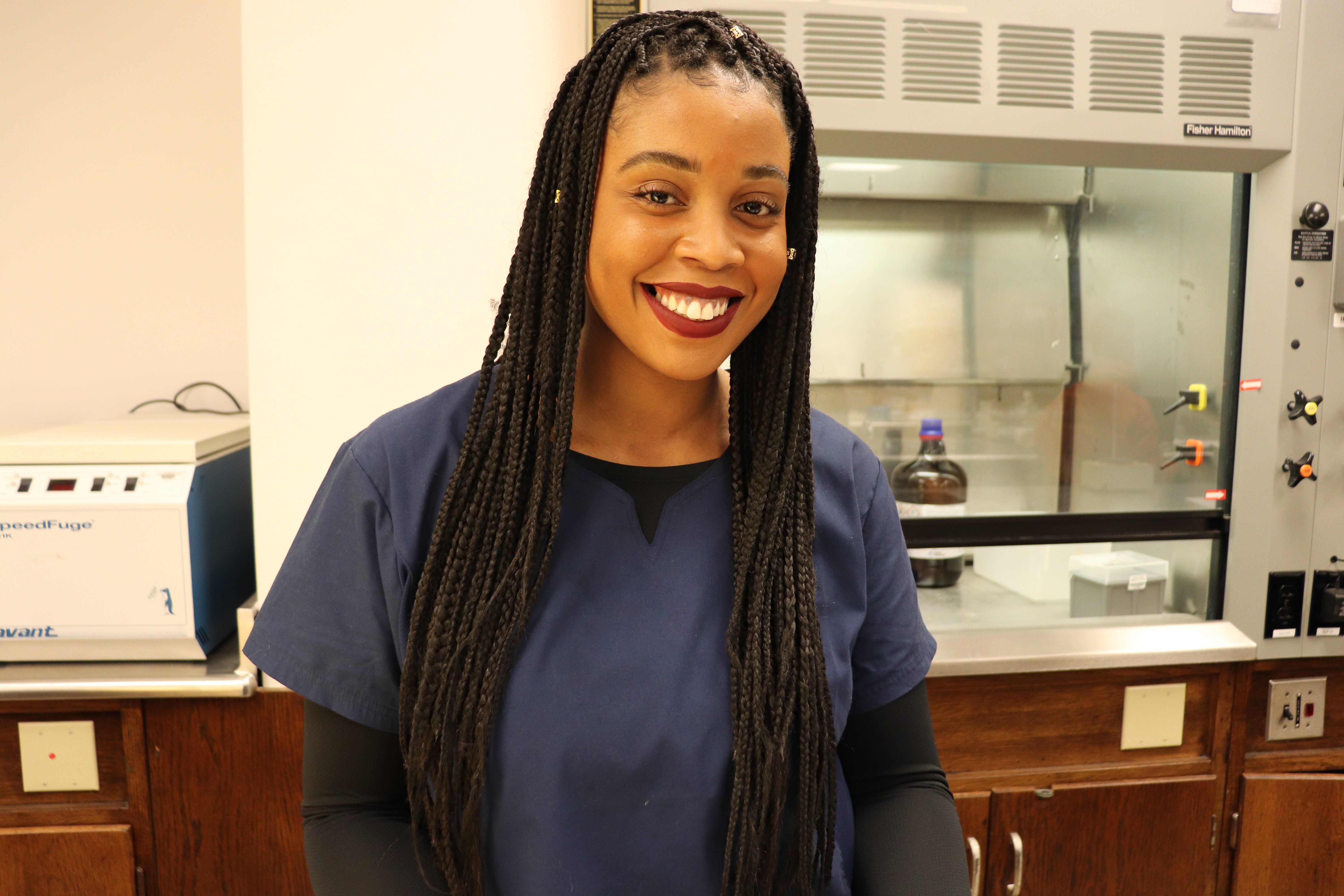
Kirksey glowing outside in the sun. Feb. 21. | Photo by Skylar Gaven
“I’m from SoCal. Just because I’m in the sciences, I still like to dress, I still like do the things that I grew up on,” Kirksey said. “I like to wear lipsticks, change my hair and things like that. It sucks sometimes because it makes you stand out and it brings pressure but at the same time that’s me, if I were to go to school in SoCal it wouldn’t be a problem so why should I change up here?”
Even though the department is not as diverse as one would hope, HSU still provided Kirksey with a variety of hands-on experience in the labs on campus.
“One thing that I do appreciate about Humboldt is that it’s a lot of hands on experience that you don’t find on a lot of campuses especially CSUs,” Kirksey said. “We did a lot of hands on things in the lab that I feel really strengthened me. The amount of work and that we do in the labs really prepares, so I give them that.”
Kimberly White, a biochemistry professor who has been teaching for two years at HSU, has witnessed Kirksey’s strong determination to succeed. Because biochemistry is not the easiest subject for most, White takes into consideration that students have different education methods and tries to incorporate different delivery methods. She does this through detailed lectures that are easy to follow and fun extra credit projects that are the students favorite.
Beersheba Kirksey prepares to dilute a 50x solution TAE buffer to a 1x solution for an electrophoresis agarose gel. | Photo by Dajonea Robinson
White said the Kirksey’s extra credit assignment was “mind blowing”. Kirksey went to White’s office hours more than any student of hers, she had “meticulous” notes and she was prepared for every lab.
White said that Kirksey’s motivation and attitude were always something that stood out and despite all the many things that were going on in Kirksey’s life she was always cheerful and ready to learn. White wrote Kirksey a letter of recommendation because she believes she can accomplish her goal.
“She is ready to go, I know that she is,” White said. “Not everybody has had an equal amount of opportunities, she has worked hard. Her success makes it that more sweet.”
Kirksey has already gotten her degree in biochemistry and is now working on the requirements needed for pharmacy school. She has applied to multiple schools and is looking forward for what the future has in store.
“I’m looking at Washington, Oregon State, and Midwestern in Arizona. I also had in interest in Roseman (University of Health Sciences) and I also applied to Howard, so we’ll see,” Kirksey said.
As she continues with her path into pharmacy school, Kirksey is working to use alternative medicines to give to others.
“I really see a problem when it comes to the pharmaceutical business in general,” Kirksey said. “I think it’s ridiculous. I feel like there are alternative ways to heal and treat people, not just based on harsh chemicals.”
Beersheba Kirksey dilutes a 50x solution TAE buffer to a 1x solution for an electrophoresis agarose gel. | Photo by Dajonea Robinson
Kirksey has many plans set up for herself. Her ultimate goal is to provide healthy, natural-based medicines that can help benefit a person’s health, instead of giving them a prescription that will make them worse.
“My ultimate goal is to become a pharmacist, get into business, learn everything there is about the body and how it reacts to medication,” Kirksey said. “I eventually want to open my own pharmacy and practice alternative medicine, just to give patients that option to lean off of strong chemicals.”
Kirksey has an amazing outlook on life and is a hard worker determined to pursue her goals. She now has to wait for an acceptance letter which is sure to be soon. Until then she will walk the HSU campus with radiant confidence and strength that she has built for herself for so long. She believes that every student of color should embrace themselves and not let anything get in the way of following their dreams.
“I stay true to myself and that’s my advice to anyone here of color, whatever major you’re in just stay true to yourself,” Kirksey said.”Don’t feel like you have to change or dumb down who you are, your culture, or where you’re from.”
Accomplished track star, Romel Robinson, is a triple-threat
As a starting sprinter for HSU’s track team, and recipient to over a hundred awarded medals, Romel Robinson, is familiar with identifying himself as a runner. However, beyond the many medals, is a self-taught gymnast and break-dancer.
“I taught myself [to tumble] in middle school,” Robinson said. “My friend knew how to back flip and tried to teach me, we were just messing around.”
Finding a new interest in the gymnastics world, Robinson continued to teach himself new tumbling tricks.
“My favorite is a double back flip,” Robinson said. “It’s a work in progress, I don’t have the right equipment to perform it without hurting myself.”
The right side of the Dream Athletics gym is painted with bright, neon colors and lines of championship banners. Feb. 18. | Photo by Grace Caswell
Robinson is extremely careful when practicing tumbling, as he’s already out for the season with two pulled hamstrings.
“It’s a lot of strain, very similar to running,” Robinson said. “You tumble until your body can’t, which is about an hour, to an hour and a half in. After that, you’re sloppy and too weak.”
While finding a commonality between the physical excursions of tumbling and track, Robinson views the two sports very differently.
“Tumbling is just for fun,” Robinson said. “I got pushed into track, it’s more competitive, and I take it seriously. It’s a lifestyle.”
Fellow teammate, roommate, and competitor, Stefan John, supports Robinson both on and off the track.
“We’re straight up family, we gel,” John said. “We have a lot in common, and run the same events. He wants my stride and I want his quickness! We’re great friends and competitors.”
Stefan John, HSU track athlete poses in the library post interview. Feb. 19. | Photo by Grace Caswell
With athletic support, Robinson pursues an environmental engineering major as a first generation college student. Idolizing his first engineering professor, Sintana Vergara, Robinson refers to her as his “Humboldt Mom”.
“She’s always been there to help,” Robinson said. “She helped me through starvation freshman year, buying me groceries. She’s constantly encouraging me in and out of the classroom.”
Sintana Vergara shares a very similar attitude toward Robinson. Vergara said that Robinson was the first student she met at HSU.
“It was a very friendly start,” Vergara said. “I remember he casually mentioned eating one meal a day, it broke my heart, I wanted to advocate for him. It was crazy and exceptionally frustrating. He’s such an amazing athlete and student, full of potential.”
Robinson pursues a masters and doctorate degree, with a goal of becoming the first doctor in his family. Vergara fully supports and believes in Robinson’s dream.
[perfectpullquote align=”left” bordertop=”false” cite=”Romel Robinson” link=”” color=”” class=”” size=”17″]“I grew up in a difficult area. I remember we didn’t always have food and my mom was working multiple jobs. She’s my biggest inspiration and is totally killing it now…”[/perfectpullquote]
“There’s no doubt he can do it,” Vergara said. “Everyone struggles regardless, no matter who you are. It’s a tough major, but, he will be successful.”
Focused on following a strict plan for the next ten years of his life, Robinson has an interesting goal for his more distant future.
“After getting my masters and doctorate degree, I want to change my name,” Robinson said. “Romel Fresh Robinson, so when I’m a professor, I can be called Dr. Fresh or Professor Fresh.”
Coming from the tough area of Visalia, California Robinson emphasizes opportunity and dedication.
“I grew up in a difficult area,” Robinson said. “I remember we didn’t always have food and my mom was working multiple jobs. She’s my biggest inspiration and is totally killing it now, doing accounting at a firm.”
Watching a powerful and successful transition in his family, encourages Robinson to achieve and accomplish more.
“My mom taught me everything I know,” Robison said. “She helps me with whatever I need, even if she doesn’t know how, she’s my favorite.”
With serious goals and aspirations for the future, track becomes nearly invisible on the long list of objectives. However, it gave Robinson an opportunity in the first place, and will remain his life indefinitely.
“I like running, it’s something I will always do, until I die!” Robinson said. “I mean, it got me here.”
This website uses cookies to improve your experience. We'll assume you're ok with this, but you can opt-out if you wish. Cookie settingsACCEPT
Privacy & Cookies Policy
Privacy Overview
This website uses cookies to improve your experience while you navigate through the website. Out of these cookies, the cookies that are categorized as necessary are stored on your browser as they are essential for the working of basic functionalities of the website. We also use third-party cookies that help us analyze and understand how you use this website. These cookies will be stored in your browser only with your consent. You also have the option to opt-out of these cookies. But opting out of some of these cookies may have an effect on your browsing experience.
Necessary cookies are absolutely essential for the website to function properly. This category only includes cookies that ensures basic functionalities and security features of the website. These cookies do not store any personal information.
Any cookies that may not be particularly necessary for the website to function and is used specifically to collect user personal data via analytics, ads, other embedded contents are termed as non-necessary cookies. It is mandatory to procure user consent prior to running these cookies on your website.