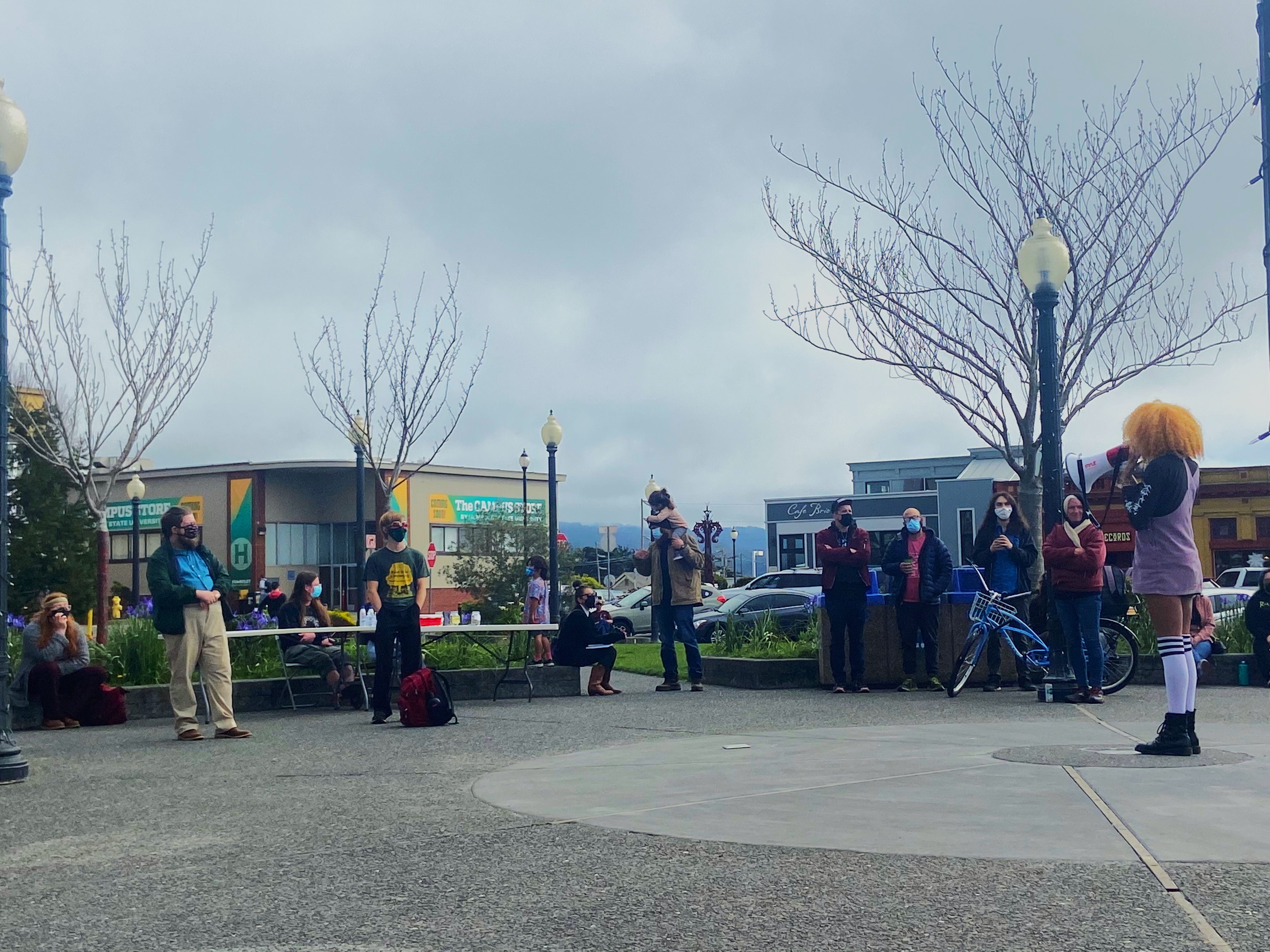
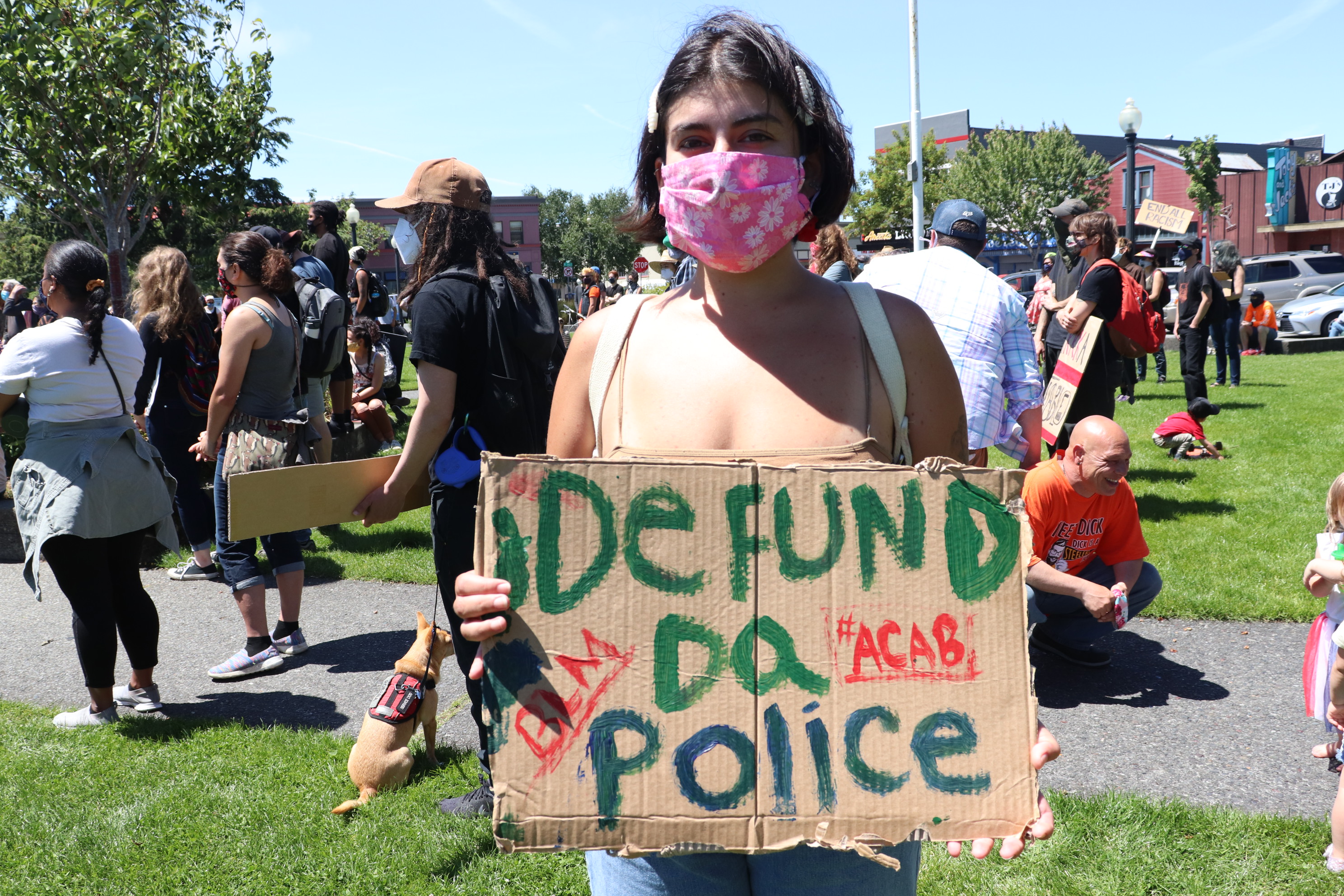
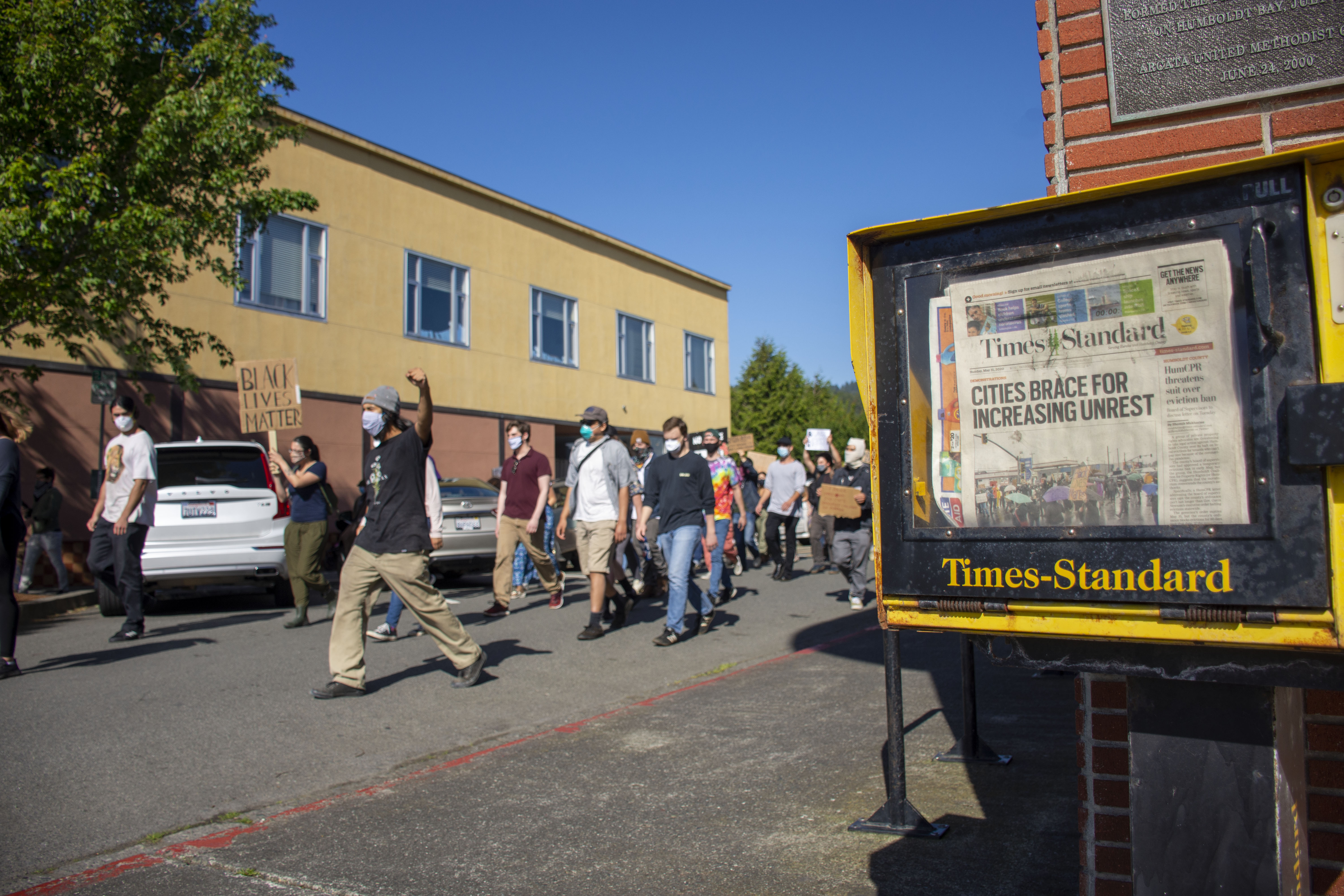
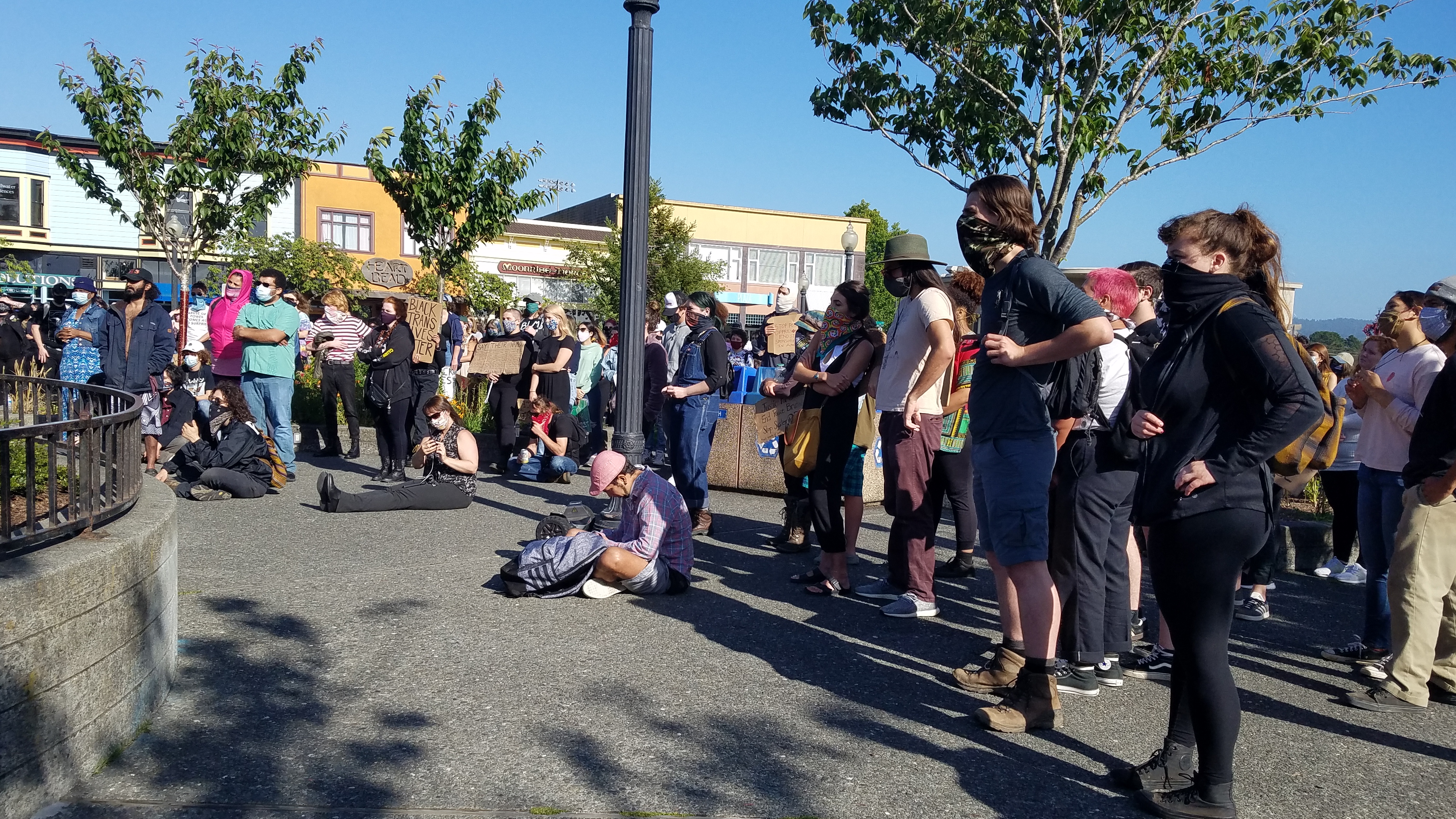
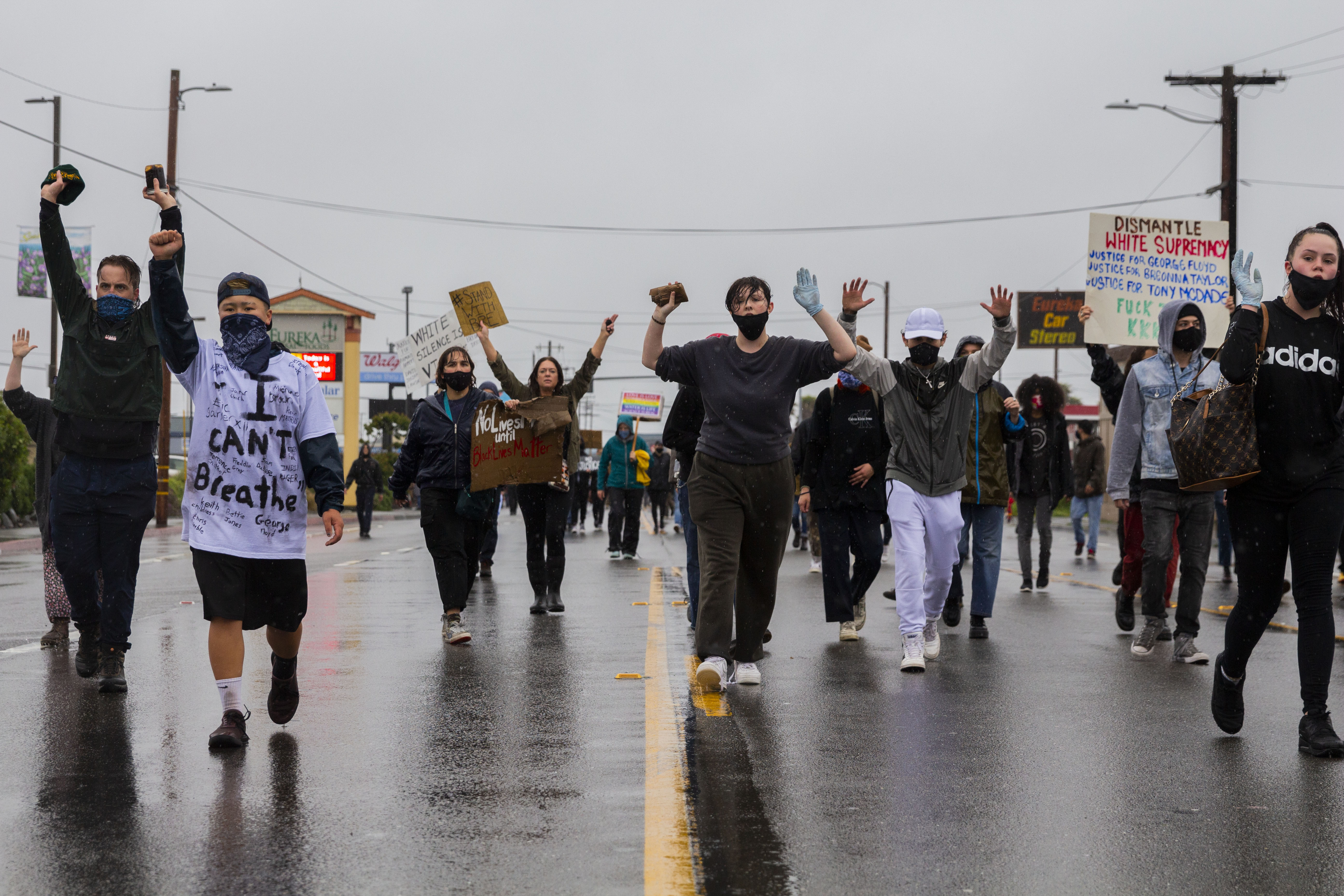
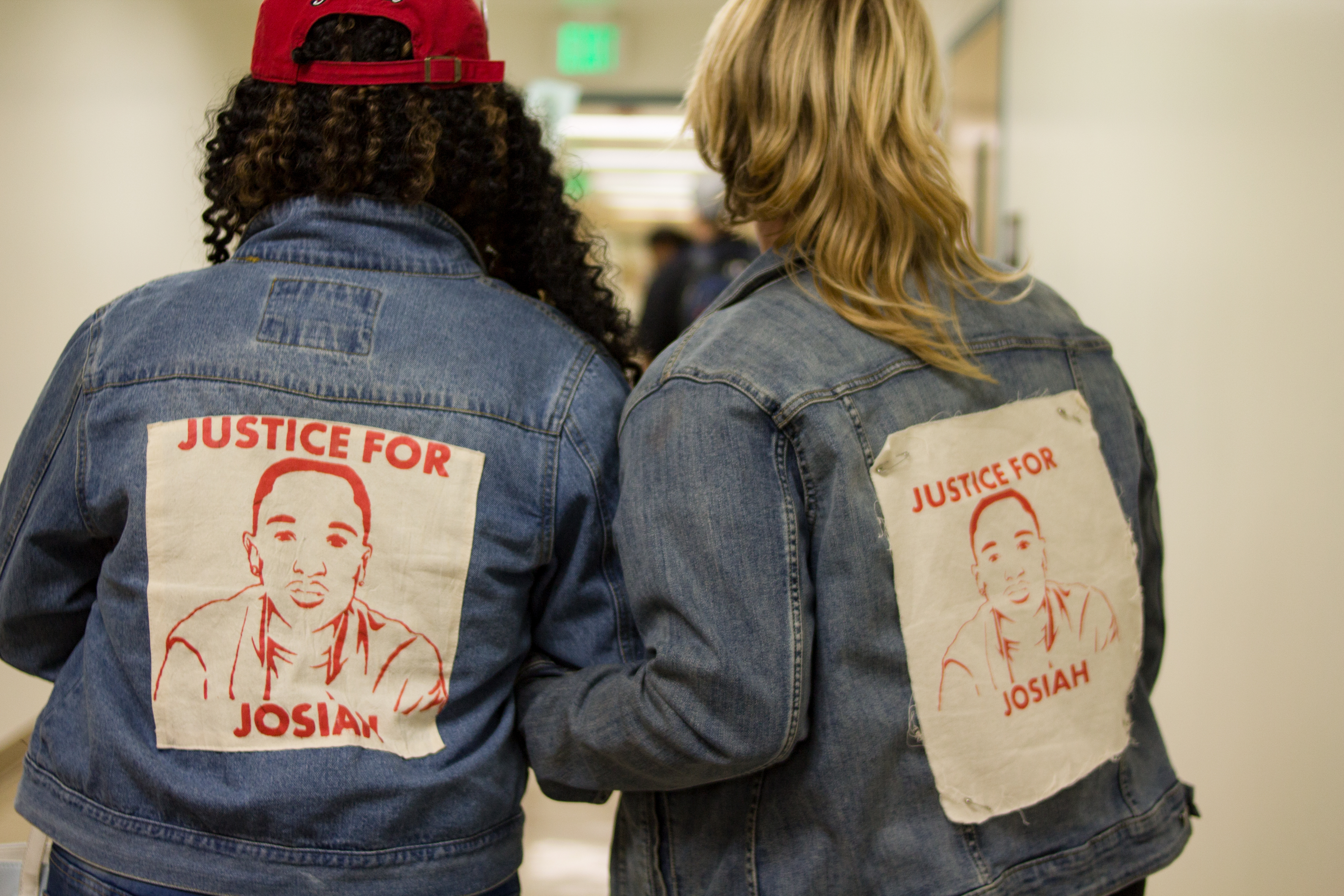
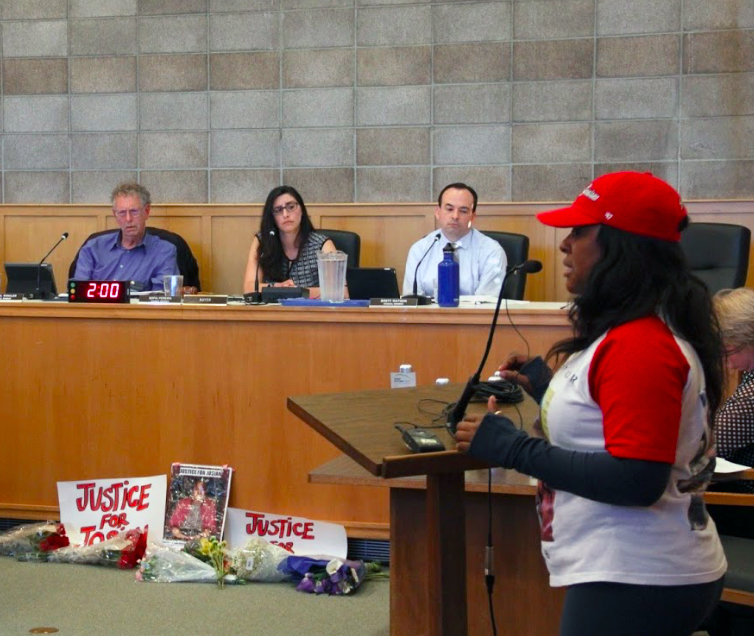
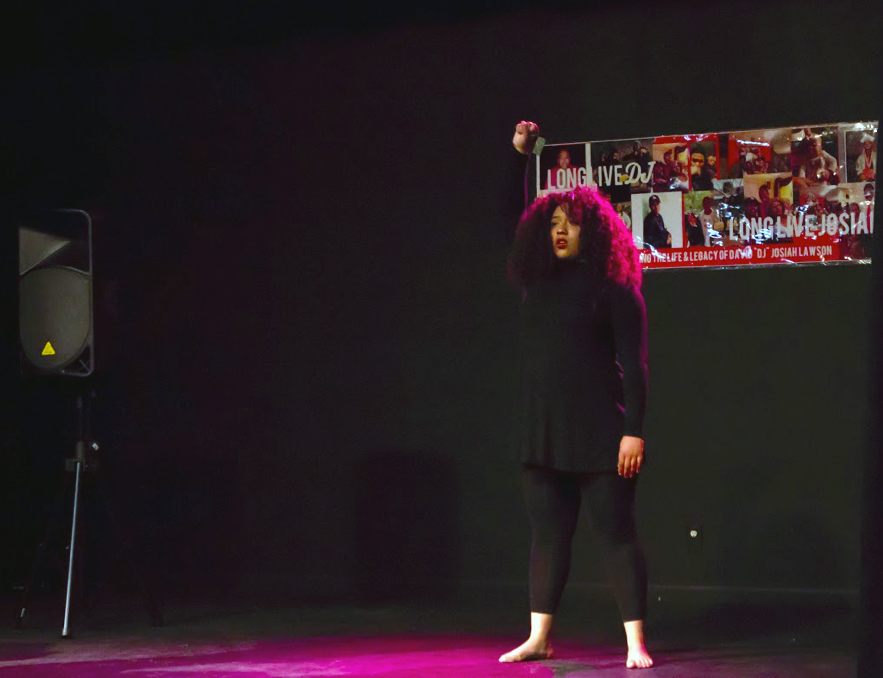
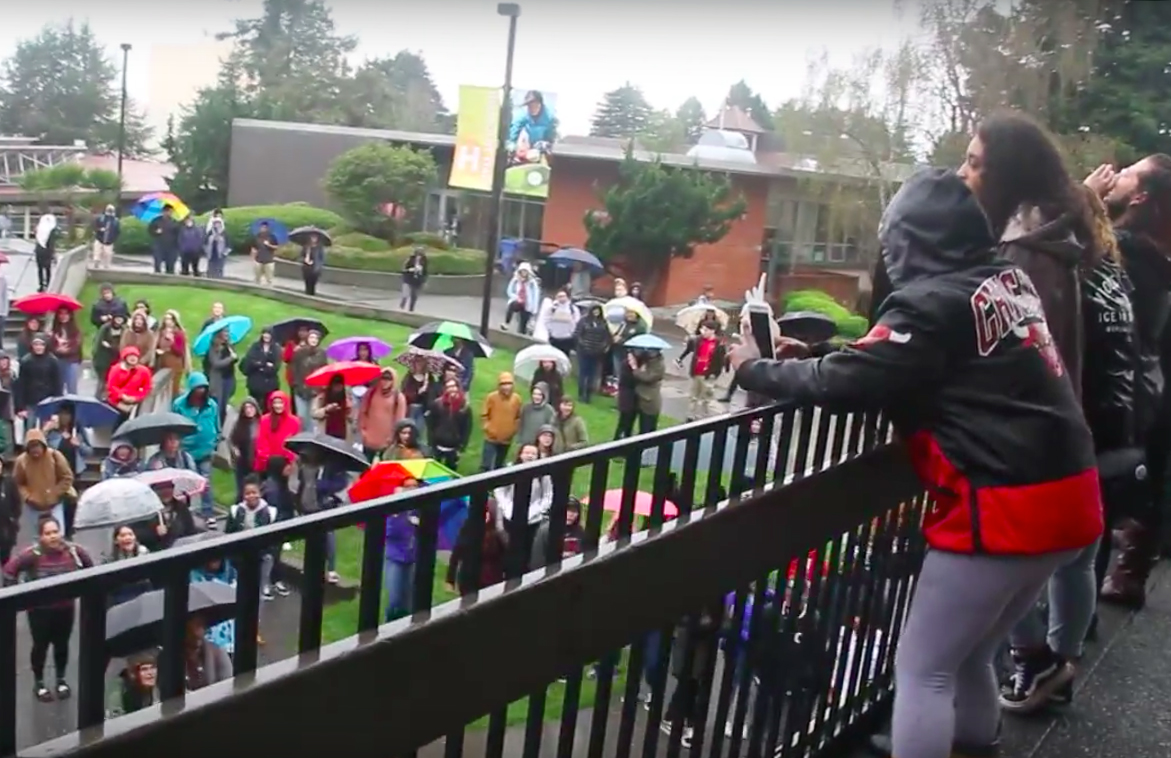
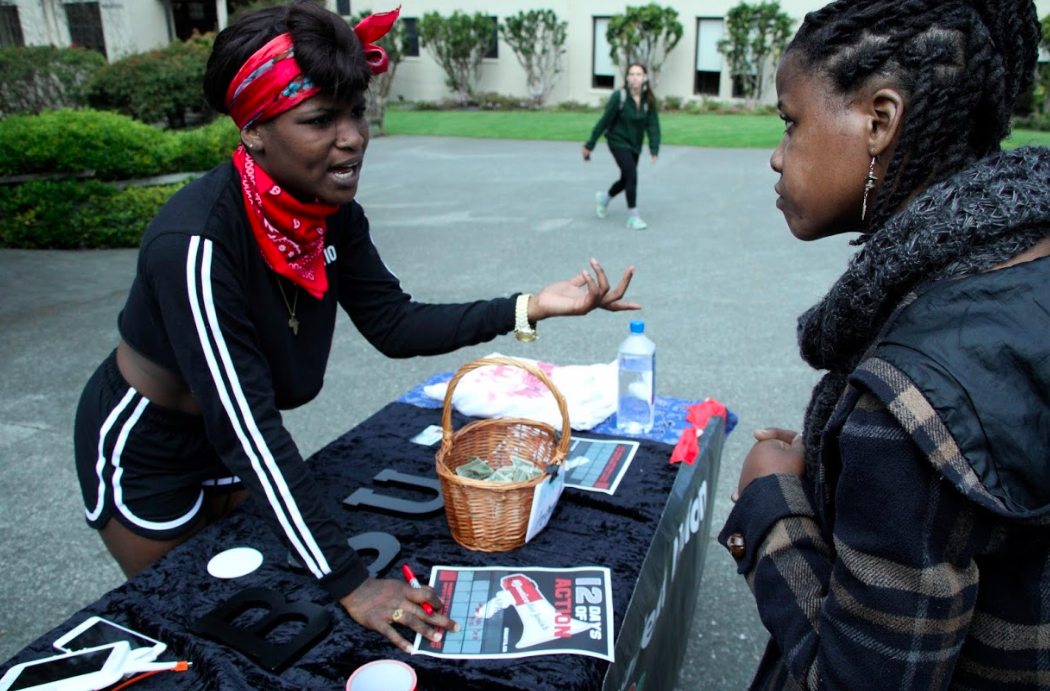
Nikki Valencia hosts a protest in the Arcata Plaza with a group of supporters on the last Thursday of every month. These protests are meant to raise awareness for the problems facing the BIPOC and LGBTQ communities and March’s protest had an emphasis on Women’s History Month. Despite Valencia’s poster gaining traction ahead of time online, only a handful of people showed up for the actual protest.
The first hour of the protest consisted mostly of a few people meandering around the plaza while Valencia and her group of supporters sat at booths handing out flyers and selling art created by Valencia. After a few more people arrived, Valencia took out her megaphone and gave an impassioned speech to the twenty or so people who had gathered.
The protests around these issues weren’t always so small in Humboldt County. In previous protests, during the peak of the Black Lives Matter movement, the community rallied and supported the causes in a far more substantial way.
Valencia is a Cal Poly Humboldt student and she organized her first protest in McKinlyeville in 2020 and over three hundred people showed up.
“A lot of supposed allies fell off,” Valencia said. “When I had my protest in 2020, you know, I had three hundred people, all these people cared and it was easy to care because black death you know, it doesn’t take much for that.”
The problem activists are facing now is getting people to still care and be active when there isn’t a sensational story playing through social media constantly.
“What I learned from a lot of people is a lot of that (community support) was outrage and outrage runs out fast and then you see who’s really there,” said Valencia.
Valencia thinks a lot of these problems stem from students lacking intersectionality in their social circles. They said that people will post infographics on their Instagram stories but that doesn’t actually mean they’re attending protests or even connecting with people outside of their race and social circle.
“People can hide behind their infographics and say that they’re progressive by like sharing something and they don’t have to really read it, apply it or really like care about that,” said Valencia, continuing. “It takes no energy to do that and a lot of people can barely do that.”
The best way that Valencia thinks allies can show their support for these issues is by diversifying their social circle and embracing intersectionality, educating themselves on topics so others don’t have to do it for them, and finally showing up for events and protests that support BIPOC and LGBTQ communities.
For more information regarding future protests, follow Nikki Valencia on Instagram @soulbunni. The protests are held in the Arcata Plaza the last Thursday of every month from 3-5 pm.
Anyone with information regarding the David Josiah Lawson case is encouraged to call the APD’s 24-hour confidential tip-line at (707) 825-2590 or the APD Dispatch Center at (707) 822-2424
On April 15, 2017, Humboldt student David Josiah Lawson was fatally stabbed at an Arcata house party around 3 am. McKinleyville resident Kyle Zoellner, 23, was taken into custody relating to the incident. After five days of the preliminary hearing, the judge ruled that there was not sufficient evidence to hold Zoellner and the suspect was released despite witness testimonies.
Since this day, David Josiah Lawson’s mother, Charmaine Lawson, has fought endlessly to bring justice to her son. There have still been no arrests made and Charmaine Lawson pleads for those in the community who know something about what happened to come forward.
Over the past four years, approaching five, there has been a documentary made about the injustice of David Josiah Lawson and the case has attracted the attention of a number of murder mystery channels.
Danielle Hallan is a true crime YouTuber who investigates unresolved cases through news outlets, speculations of investigators, journalists and family members. Charmaine Lawson encouraged the video that was made by Hallan about the Lawson case to be shared to the Humboldt community to keep the case alive with hope that justice will be served.
The 5th grade students of Fuente Nueva lead the one mile march for Peace & Justice in Arcata on Friday, Jan 14th. Photo by Morgan Hancock.
“So often MLK is portrayed in a very white-washed and sanitized way. I think he was portrayed in a very true way here today.” said Marche Hines, a mother of two children who currently attend Fuente Nueva Charter School.
On Friday, January 14th, three days prior to the upcoming national holiday of revered civil rights leader Dr. Martin Luther King Jr, bilingual charter school Fuente Neuva hosted an event entitled “Dreams Coming Alive” in his honor. Students, parents, and community members alike were invited to come and participate and to hear the voices and words of many important black community members and organizations from around the county.
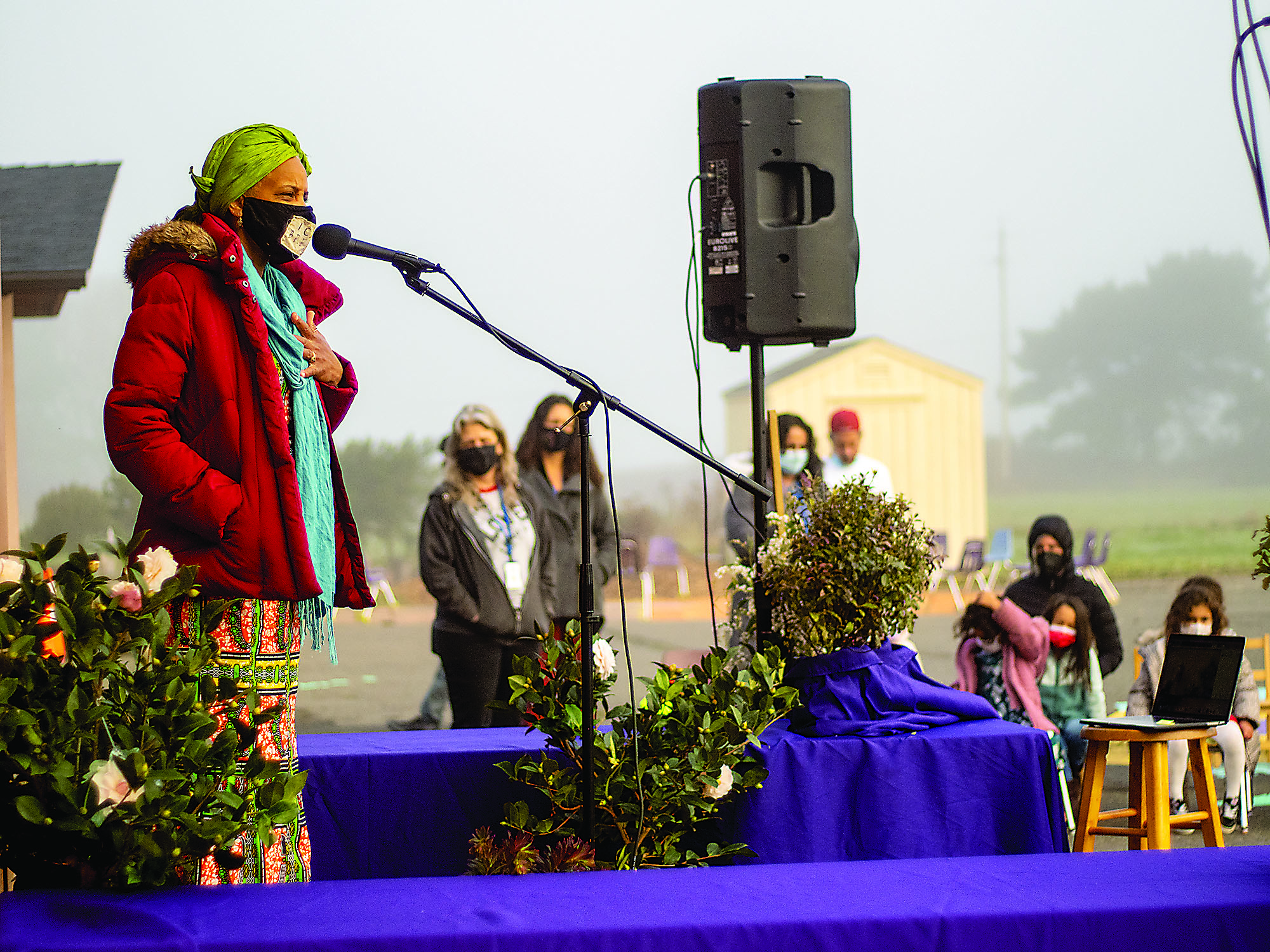
One such speaker was James Braggs, an active member of Black Male Empowerment Network (B.MEN) and Black Humboldt, who opened the outdoor event at 8:30 am with a short land acknowledgement and prayer. Braggs expressed in both portions of his speech the importance of remembering history and learning from it. Reflecting on where we have grown, and being grateful, and reflecting on where we can improve, and changing it.
“Remembrance is critical,” Braggs said later that day during a personal one-on-one interview with the Lumberjack. “It’s important to acknowledge the history.”
“King existed due to the work of thousands of ordinary people,” Braggs said as well, explaining how we often fail to see the bigger picture behind MLK’s events and actions. “[It] wasn’t just super smart politicians and leaders. It was mothers, fathers, brothers and sisters.”
After Braggs opening prayer, president of the Humboldt county’s NAACP, Sharrone Blanck, stepped up to the stage, greeted by the children in the front and adults in the back. Blanck’s speech revolved around the ideas such as the importance of diversity in groups and the freedom for everyone to live life as their full selves.
“We exist here as individuals and we have the privilege to be a part of groups,” Blanck’s said. “Who we are connects us to other people. I’m a black woman, I’m a Jewish woman, I’m a mom and a wife, I’m a friend, and all those parts of me I bring wherever I go.”
April Koepke, attendee and parent of two students, noted this particular speech as being her favorite.
“[It’s] important for young people to know the values of working together and the equality of all.” she said, hoping that this speech will become an inspiration to her own children over the years.
Students, staff, and community members participant in a short yoga session before the start of the march. Photo by Morgan Hancock.
Other important speakers included Dr. Kintay Johnson, current director of CR’s Multicultural Center, Lorenza Simmons, youth coordinator at HC Black Music & Arts, and Mo Desir, co-founder of Black Humboldt. Each telling their own unique story of how they empowered themselves and the people around them in Humboldt county in the struggle to have their voices as black people be heard. Never being afraid to point out the changes that still need to be made and the injustice still faced by their community everyday, in a way that not only adults could understand but the children as well.
“[The event] let students of color know [that] they’re heard,” Hines said
Cybele Porpee, another attendee and mother of a student, found the event inspiring.
“It helped me review my own goals, hopes for the future, and engagement towards the community,” Porpoise said.
“Diversity, multiculturalism, acceptance, everything he taught is important,” she added.
The event hit its peak at 10:30, when students, staff, parents, and attendees alike were asked to participate in a mile march around the school, a moment to show students MLK’s often used tactic of righteous civil disobedience in practice and for both young and old alike to walk in the footsteps of not only him but of his many fellow protestors too.
Fifth graders led the march through the school’s neighborhood. Each carefully held the main banner heralding the beginning of the protest. Towards the caboose of the group were the younger first grade students, carrying their own posters with messages for peace and equality. Each student along with their parents, staff, and attendees stepped in sync crying out for the peace and equality of all, and the respect, dignity, and right to life of every black and brown person locally and nationally.
February 4 marked the first of five events meant to celebrate Black History Month. Due to Covid-19 restrictions, the speakers cannot be on campus but each Zoom meeting is open for registration. Coordinator Douglas Smith and the students at the African American Center for Academic Excellence (AACAE) have brought together the speakers this Black History Month with the theme of different methods of liberation.
“The theme is mapping routes of liberation with the idea that there are different routes for us individually or as a community,” Smith said.
The AACAE, in conjunction with Center Arts, puts together their monthly speakers each year largely through the efforts of members of their student staff, like Imari Washington.
“When we initially chose our guest speakers, we tried to choose individuals who we thought Black/African American students would benefit most from,” Washington said. “We are very big on supporting our students in personal development, mental well-being, and academic success at the center.”
The first of the month’s speakers was Dr. Safiya Noble, Associate professor at UCLA and author of the book “Algorithms of Oppression: How Search Engines Reinforce Racism.” Information technologies open worlds of information to people that may otherwise be out of reach, but as Noble states, these technologies do not develop in a vacuum, they contain the same biases as the people who created them. While they seem impartial and mathematical and separate from the personal bias of individual people, technology is still designed by people who themselves may have racist bias, or in the cases of algorithms like Google will begin to take on the racial bias that exists in society and in doing so reinforce it. As this technology has advanced, it has created new avenues for discrimination rather than providing liberation.
“We have more data and technology than ever,” Noble said. “And with it more social, political, and economic inequality and injustice to go with it.”
Along with containing all of their own biases, Noble says the over-focus on technology creates a situation where what would otherwise be public goods like libraries, open meeting places, or other public institutions are replaced by technology-based solutions, which are privately controlled by a single company and so are subject to any kind of change they see fit without any real avenue for public complaint other than speaking out against the service itself.
Noble says this tech can’t really fix social inequality on its own it’s just a tool, but they occupy so much of our world that they seem to leave no room for other avenues for finding solutions to social problems. Worse, they force people to work within their confines and therefore limit what people can actually do and instead funnel people into the profit-driven patterns of the medium itself.
“Social inequality will not be solved by an app,” Noble said. “What we see are these technologies displacing our ability to adjudicate our lives without them.”
Other speakers for the month include; Director of Campus Life at GVSU Dr. Kyle Boone presenting “The Grey Area: Creating a Space for the Engagement of Black Students”, Farm Manager at Soul Fire Farm and food sovereignty activist Leah Pennimen with “Liberation on the Land” about Black land reclamation, Author and CEO Ja’Net Adams with “Going Deeper than Google: How the History of Black Wealth Can Help Close the Racial Wealth Gap of Today” and Psychology Professor and mental health expert Dr. Nina Ellis Hervey. The events will be going on until February 27, and are available for registration on the Virtual Quad or on the AACAE web page.
Kris Nagel captures chaotic social demonstrations with photojournalist and professor Mark Mckenna
During speeches given at the Multnomah County Courthouse on the night of July 29, demonstrators carried signs signifying their investment. Pictured here, an unnamed protester carries a sign saying, “Black lives matter.” | Photo by Kris Nagel
On the north side of the Hatfield Federal Courthouse on the night of July 28, an unnamed protestor broke from the crowd to sit in front of a line of police, sitting cross-legged behind a sign. | Photo by Kris Nagel
During speeches given at the Multnomah County Courthouse on the night of July 29, demonstrators carried signs signifying their investment. Pictured here, two unnamed demonstrators in scrubs carrying signs saying, “No justice; no peace; no racist police; gestapo GTFO,” (left) and “I uphold my oath to first do no harm, what of you oath to serve and protect?” (right.) | Photo by Kris Nagel
Law enforcement began using crowd-control agents early in the night of July 29. They fired canisters of tear gas, shot pepper balls, and threw flash bangs. Many demonstrators attempted to clear the area of tear gas by throwing the canisters back. | Photo by Kris Nagel
A line of law enforcement officers forms near the Mark O. Hatfield US Courthouse on the night of July 29 in Portland, Oregon. Plumes of tear gas linger in the air from canisters fired into crowds shortly before this image was taken. | Photo by Kris Nagel
Each night in Portland, speakers address the crowd from the steps of the Multnomah County Courthouse. Pictured here is a protestor telling the crowd about law enforcement firing crowd control agents at the protesters and how several weeks prior he had be struck in the head, hospitalizing him. He carries with him a gas mask in a green bag to use when law enforcement begins crowd-dispersement measures. | Photo by Kris Nagel
As the police began firing teargas into crowds of protesters on July 28 in Portland, Oregon part of the “Wall of Moms” were caught in a thick cloud of gas. Only using common painter’s respirators for protection against the irritant, the moms soon broke up and fled away from the gas. | Photo by Kris Nagel
The hip-hop community rallies behind the Black Lives Matter Movement
When footage of an unarmed black man named George Floyd being murdered by police officer Derek Chauvin was uploaded to the internet on May 25, Black Lives Matter protests began erupting across the country and throughout the world. Given the role hip-hop plays in the black community, it’s natural that protesters adopt anthems from the genre to fuel their cause.
In the weeks following Floyd’s death, several members of the hip-hop community took their frustrations to the studio and created new anthems to further fuel the protests, notably including FTP by YG, Other Side of America by Meek Mill and The Bigger Picture by Lil Baby, all of which are raw reflections of the artists’ real experiences as black men living in America.
An unlikely protest anthem came from the late Pop Smoke, who was gunned down in his Los Angeles residence earlier this year. Thousands of New Yorkers took to the streets of Manhattan during the initial protests, chanting the words to the former rapper’s hit song “Dior.”
To celebrate Juneteenth, the holiday commemorating the abolition of slavery in the United States, Beyoncé released her own Black Lives Matter anthem, “Black Parade.” On July 31, she delivered an entire visual album titled “Black is King” celebrating the African race throughout history.
When the protests were at their height, another song from Beyoncé’s 2016 album “Lemonade” titled “Freedom,” featuring Kendrick Lamar, was also being played across the country. Along with Lamar’s own song, “Alright.” Another artist with a critically acclaimed album celebrating Black excellence in “To Pimp A Butterfly,” Lamar has remained suspiciously silent since the protests broke out, beside participating in the Compton Peace Walk.
Regarded alongside Lamar as one of the best and most progressive rap artists of the era, J.Cole chose a different path that landed both him and Lamar on the list of Twitter cancellation campaigns.
Afterwards, Cole admitted in a tweet, “[he hasn’t] done a lot of reading and [doesn’t] feel well equipped as a leader in these times.” Cole released a song on June 16 titled “Snow On Tha Bluff,” addressing both his own ignorance of the plight of his people, and the criticisms of an unnamed Black woman, quickly discovered to be Chicago rapper, Noname. On the track, Cole compels Noname to preach her knowledge rather than shame those unwilling to speak up and to share it with audiences outside of those that already have access. Cole’s “queen-tone” lyric, however, muddied the message with accusations of policing a Black woman’s tone and inspired a response track from Noname with “Song 33,” in which she questions how he could write about her in a time of such international tragedy.
As the Black Lives Matter movement carries into the fall, hip-hop continues to celebrate its roots, most recently with the release of the first official, full-length Nas album in over eight years, “King’s Disease,” preceded a week by his own Black Lives Matter anthem, lead single “Ultra Black.”
Actions are being taken to bring about change in a country dominated by racism and police brutality
Fueled by the Josiah Lawson case and the George Floyd murder, Humboldt State University students are taking to the internet and the streets in protest of systemic racism. Students and community members alike are actively displaying their pent-up anger and fear surrounding being marginalized.
Kiara Mixon, a fourth-year psychology student, has been trying to educate herself and those around her about what’s going on. Namely, she has been sharing different resources with people who are unaware of the Black Lives Matter movement and watching documentaries about racism to get a deeper insight into it.
While she hasn’t really been going out in the streets and protesting, she has still seen both sides of the movement.
“I see people who are of color protesting and, truthfully, it means a lot that those people are standing up when it’s an issue for them as well,” Mixon said. “But I’ve also had people who aren’t really speaking up or haven’t said anything or don’t really have a personal opinion on the matter and that makes me a little bit uncomfortable because you never know where they’re standing.”
Senior psychology major Edwin Rosales has become more outspoken and animated in the wake of the revamped BLM movement. He lives with his mother’s side of the family and has gone back and forth with them about everything going on.
“After talking with them, it’s kind of difficult to talk to them about it because they’re very, you know, still in the olden ways and are very ignorant about it,” Rosales said. “So, I’ve had to be outspoken about it and be like ‘You know what? You’re not understanding the cause’ or having to explain to them what it is.”
Rosales has carried his new-found, forthright persona around racism into the land of social media as well.
“I never really posted about that stuff,” Rosales said. “I’m not helping if I don’t say anything, and so if I am posting about something, maybe someone will read it and maybe someone will help in some way.”
Julianne Blandford is a senior majoring in child development. She is feeling a lot of mixed emotions in the midst of the string of racist events that have occurred from the George Floyd murder to the leaked video of three HSU students making racist taunts toward Black people. She is attending protests and doing everything she can to move the conversation about racism along.
“It is my time to sit down and listen and also stand up for those who can’t speak,” Blandford said.
Blandford recognizes her own status but also wants to work with those who are being suppressed.
“I’m seeing it as an opportunity to continue to create change, create a more peaceful place to live, create new systems that aren’t founded upon racism, and a world where no-one has to live in fear,” Blandford said.
“We need to redistribute resources and really build communities.”
Dr. Ramona J.J. Bell
Dr. Ramona J.J. Bell, a critical race and gender studies professor, believes that there are a number of factors to look at that are feeding into a racist America.
“We’re a country where we put so much money into our military, but there’s people without health care, so we concentrate on, you know, defending the country,” Bell said. “But we have to reconfigure and reimagine what that really means to defend the country, to defend America.”
Bell emphasized the importance of unifying communities in a country where the opposite is happening at the hands of the police.
“We need to redistribute resources and really build communities,” Bell said. “When you are killing black folks in communities and the police are killing us, that’s not building our community — that’s killing our community. So we have to look at ways in which we can build America because our country was built off the backs of Black people, particularly during the Holocaust of enslavement.”
Bell recognized a need for change in America when it comes to race and embraced the protests that have spawned from it.
“We have to revisit America’s notion of belonging and we have to revisit race in America,” Bell said. “There’s never been a real conversation about race and racism in America. And I think the protests going on all over the country, all over the world are telling us something’s wrong and it needs to be fixed.”
More than anything, Bell emphasized that we are all in this fight together, no matter the color of your skin.
“That’s part of the fight. That’s part of the struggle to get people to understand that Black lives matter,” Bell said. “It’s about letting us be free to live lives like America has promised.”
A photo essay of the Arcata protests: fists high and voices raised
An activist addresses the crowd at the Arcata Plaza during a Black Lives Matter demonstration on Monday, June 1. The demonstration is one of hundreds to occur nationwide after the killing of African American man George Floyd by a white police officer on May 25. | Photo by Elliott Portillo
A protester holds up a sign that states “Black Lives Matter” during a demonstration held at the Arcata Plaza on June 1. The demonstration is one of thousands held to protest the killing of African American man George Floyd by a white police officer in Minneapolis on May 25. | Photo by Elliott Portillo
An activist addresses the crowd at the Arcata Plaza during a Black Lives Matter demonstration on Monday, June 1. The demonstration is one of hundreds to occur nationwide after the killing of African American man George Floyd by a white police officer on May 25. | Photo by Elliott Portillo
A protester looks on during a Black Lives Matter demonstration held at the Arcata Plaza on June 1. The demonstration is one of thousands held nationwide to protest the killing of African American man George Floyd by a white police officer in Minneapolis on May 25. | Photo by Elliott Portillo
An activist addresses the crowd at the Arcata Plaza during a Black Lives Matter demonstration on Monday, June 1. The demonstration is one of hundreds to occur nationwide after the killing of African American man George Floyd by a white police officer on May 25. | Photo by Elliott Portillo
Protesters gather and raise their fists in solidarity in the Arcata Plaza during a Black Lives Matter demonstration on Monday, June 1 in Arcata CA. Nationwide protests have occurred since the killing of African American man George Floyd by a white police officer in Minneapolis on May 25. | Photo by Elliott Portillo
Demonstrators stand and sit outside of Arcata City Hall in protest of police brutality and racism on June 1 following the death of George Floyd while in custody of Minneapolis police. | Photo by Thomas Lal
Demonstrators listen to community members speak at the Arcata Plaza while protesting against police brutality and racism on June 1 following the death of George Floyd in Minneapolis police custody. | Photo by Thomas Lal
A demonstrator takes a moment to reflect while listening to speakers from the community at the Arcata Plaza protesting against police brutality and racism on June 1 following the death of George Floyd in Minneapolis police custody. | Photo by Thomas Lal
Demonstrators listen to community members speak at the Arcata Plaza while protesting against police brutality and racism on June 1 following the death of George Floyd in Minneapolis police custody. | Photo by Thomas Lal
Demonstrators sit and stand in front of Arcata City Hall while protesting against police brutality and racism on June 1 following the death of George Floyd in Minneapolis police custody. | Photo by Thomas Lal
Signs calling for an end to police brutality and racism sit are carried by demonstrators outside of Arcata City Hall on June 1 following the death of George Floyd in Minneapolis police custody. | Photo by Thomas Lal
Protesters gathered at Arcata City Hall and the plaza to speak out against police brutality and racism
Peaceful protesters gathered in Arcata on June 1 to continue their demonstrations against police brutality and racism across the nation. People gathered around Arcata City Hall, bringing signs and wearing facemasks while listening to members of the community speak.
Demonstrators spilled off of the lawn and into the streets, taking a moment of silence in remembrance of George Floyd and Black lives that have been unfairly and unjustly taken in police custody.
A moment of silence for George Floyd outside Arcata City Hall on June 1 | Video by Thomas Lal
As demonstrators marched toward the plaza, they chanted in unison, “no justice, no peace,” which quickly became a rallying cry across the country.
Protesters marching to the Plaza, chanting “No Justice. No Peace” on June 1 | Video by Thomas Lal
There was no police present at the gathering which encouraged community members to stand up and share their stories in the center of the plaza where the President McKinley statue used to be. Community members rallied together and demanded for better education on racial issues and systemic injustices. Allies were called upon to do more than simply showing up to rallies and to exercise their rights to reinforce just advocacy.
Eureka protesters gathered in front of the Humboldt County Courthouse
Hundreds of community members gathered in the rain outside of the Humboldt County Courthouse, Sat. May 30, to protest the death of George Floyd who was murdered while in police custody in Minneapolis, MN. From 3 to 10:30 p.m. demonstrators marched through Eureka up to the Slough Bridge, back through town and then down Broadway. Law enforcement was largely cooperative with demonstrators, blocking intersections as people made their way through traffic. Chants could be heard the entire way even as groups split up and went to various parts of the city.
Demonstrators walkin front of the Humboldt County Courthouse to protest police brutality and racism in Eureka, CA on May 30 following the death of George Floyd in police custody in Minneapolis.
A demonstrator walks thorugh the street to protest police brutality and racism in Eureka, CA on May, 30 following the death of George Floyd in police custody in Minneapolis.
Demonstrators walk past the post office though the street to protest police brutality and racism in Eureka, CA on May 30 following the death of George Floyd in police custody in Minneapolis.
A demonstrator holds up a rose above the crowd as they confornt Eureka Police Department officers in front of the Humboldt County Courthouse to protest police brutality and racism in Eureka, CA on May 30 following the death of George Floyd in police custody in Minneapolis.
Demonstrators walk down Broadway to protest police brutality and racism in Eureka, CA on May 30 following the death of George Floyd in police custody in Minneapolis.
As the group returned to the courthouse tensions flared at the sight of several police vehicles, which were soon removed from the scene. Eureka Police Chief Steve Watson was present at the protest and spoke with demonstrators as the crowd dispersed and headed away from the courthouse. These demonstrations in Humboldt are some of countless that have sprung up across the nation following Floyd’s murder.
Demonstrators stop a police vehicle at an intersection as they make their way thorugh Eureka down to Boroadway to protest police brutality and racism in Eureka, CA on May 30 following the death of George Floyd in police custody in Minneapolis. The vehicle attempted to make it’s way slowly though the gathered people and left with a broken back window.
Demonstrators confront Eureka Police Department officers in front of the Humboldt County Courthouse to protest police brutality and racism in Eureka, CA on May 30 following the death of George Floyd in police custody in Minneapolis.
Demonstrators push back against a police vehicle as it attempts to move past the gathered crowd as they protest police brutality and racism in Eureka, CA on May 30 following the death of George Floyd in police custody in Minneapolis.
Demonstrators walk thorugh the street through the rain to protest police brutality and racism in Eureka, CA on May 30 following the death of George Floyd in police custody in Minneapolis.
Demonstrators confront Eureka Police Department officers in front of the Humboldt County Courthouse to protest police brutality and racism in Eureka, CA on May 30 following the death of George Floyd in police custody in Minneapolis.
Charmaine Lawson travels to CSU campuses with SQE and CFA
It has been 18 months since the death of Humboldt State University student David Josiah Lawson. His murderer still walks free and case remains open.
Charmaine Lawson, Josiah Lawson’s mother, spoke at Sacramento State on Oct. 15 on a panel with Justice for Josiah committee member Jill Larrabee, and Courtney Wagner, the director and editor of “Unsolved Hate,” a documentary of Josiah Lawson’s murder.
Sacramento State was one of many campus stops for Charmaine Lawson during “Week of Action,” an event put together by Students for Quality Education to remember Josiah and discuss safety and the CSU’s accountability of Josiah Lawson’s murder.
Twenty-one of the 23 California State University campuses participated in “Week of Action.” Lawson was invited to CSU San Francisco, Sacramento, Pomona and Fullerton.
“I never thought I’d be sitting here right now,” Charmaine Lawson said, “We have gotten so much attention because of students.”
Charmaine Lawson has also gained support of the California Faculty Administration. Charmaine Lawson said CFA has been amazing in the effort to hold the CSU accountable for Josiah Lawson’s murder and to better protect students.
Charmaine Lawson (center) said she has been greatly supported by students and CFA in trying to hold CSU accountable for the murder of her son, David Josiah Lawson, who was a HSU student. Charmaine was in Sacramento on Oct. 18, 2018 and has travelled to four other campuses during Weeek of Action. | Photo by Tony Wallin
Charmaine Lawson said that the CFA is helping by making postcards for people to sign, asking Humboldt County DA Maggie Fleming to excuse herself from the case.
“CFA has been instrumental in their action plan and their resources,” Charmaine Lawson said.
Charmaine Lawson told the crowd of CSU faculty, students and parents that she has had resistance from city officials, law enforcement and HSU administration since the beginning of the case.
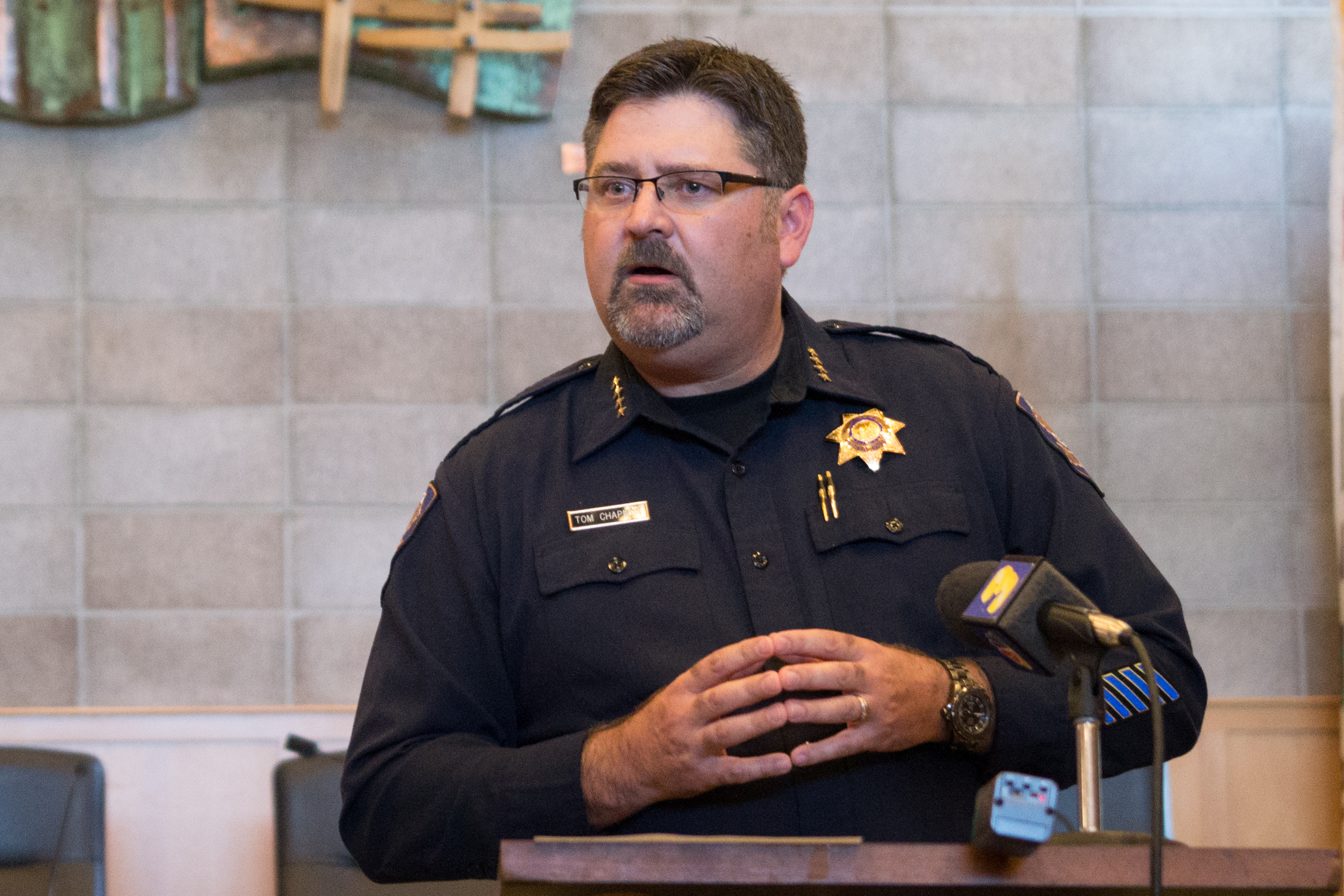
For months, when the case was being first investigated, Charmaine Lawson said Lt. Todd Dokweiler told her she could only speak with police chief Tom Chapman. Charmaine Lawson said that Chapman was telling her false information and has since resigned from the police force.
“Chapman lied by saying San Jose and Eureka were helping with the case, but none of that was true,” Charmaine Lawson said.
Charmaine Lawson said Arcata City Manager Karen Diemer, defended Chapman when she confronted her about Chapman’s lies.
“She defended the presence of the city instead of exposing the city for what it really stands for,” Charmaine Lawson said. She said Diemer needs to go next.
When she tried to contact HSU President Lisa Rossbacher about her son’s murder, Charmaine Lawson said she never got a response. She said she called her twice and has yet to get a call back. Rossbacher’s resignation as HSU’s president is effective June 30, 2019.
“Lisa Rossbacher hasn’t even called me to offer her condolences,” Charmaine Lawson said.
Jill Larrabee, Justice for Josiah committee member, Margarita Berta-Avila, CFA president at Sac State, Charmaine Lawson, mother of Josiah Lawson, and Raul Tadle, faculty at Sacramento State University on Oct. 18. | Photo by Tony Wallin
Sacramento State CFA president Margarita Berta-Avila said one of the problems with the CSU system is recruiting potential students of color without informing them all the details of their possible future environment. The details that aren’t shared include the amount of students of color admitted and how isolated the area may be. Berta-Avila said there should be institutional policy guaranteeing new students will graduate and be safe.
“It shouldn’t be when someone is killed that change occurs,” Berta-Avila said.
Berta-Avila said the CFA got involved when Charmaine Lawson met with CSU Chancellor Timothy White. Berta-Avila said that when Charmaine Lawson stood in front of CSU administration to speak of her son’s murder, a police officer walked behind her and put his hand on his gun. Berta-Avila said that was the moment when CFA had to pursue action.
“The violation doesn’t stop — it continues off campus,” Berta-Avila said.
Jorge Quintana, a leader of Students for Quality Education at Sacramento State, said there is a difference between recruiting and having available space. Quintana said CSUs don’t hold safe spaces for students of color. Quintana said moving forward means addressing the shortcomings of the university regarding safety and to make sure protocol is followed.
“It is CSU’s responsibility to keep us safe,” Quintana said.
Quintana said if the HSU president didn’t call Lawson and CSU hasn’t done anything to help, then this is clearly an issue for students of color. Quintana said CSU hands are tied now that a student has died. Quintana said this is when educating students is needed.
“Whats most important is to remember Josiah,” Quintana said.
Quintana said CSU only cares when students are only doing good, but once they’re off campus or even struggling they stop caring. He said they have a choice on who gets admitted and who stays, but don’t have a choice of being students of color.
“Systemic racism and micro aggressions are happening all over CSU campuses,” Quintana said, “There are more police officers than counselors.”
Angry mothers, students and community members all marched in solidarity with Charmaine Lawson from Humboldt State’s Library Circle to Arcata City Hall demanding Justice for Josiah on April 18.
Just a few days after the one-year anniversary of the death of HSU student David Josiah Lawson, who was fatally stabbed at an off-campus party on April 15, 2017, people are impatient for answers.
“We demand justice for Josiah and we want Tom Parker back,” Charmaine Lawson said.
Tom Parker is a retired FBI agent who was brought up to privately inspect the case for the last eight months. He resigned last week.
The march made its way from HSU to City Hall through F Street. The city council was meeting that day and the shock could be seen on their faces when up to 100 people marched into the hall chanting, “Justice for Josiah!”
The mayor of Arcata, Sofia Perreira, was in attendance, as well as city council members Brett Watson, Paul Pitino and Michael Winkler.
The forum opened up for members of the public to address the board and a line started to form.
“There is a killer on the loose and if I feel unsafe as an old white lady, how are these students of color supposed to feel safe?” Arcata resident Denny Dorsett said.
As many other people came up to speak their minds, the energy in the room began to grow more charged.
“I grew up in this place and I don’t feel safe anymore. Why are you not trying to protect me?” Faith Shaineider, an Arcata High School student who came to show her support said.
Shaineder’s mother, Zera Starchild, was also in attendance and had some heavy words to deliver.
“This town has already changed because of this,” Starchild said. “Arcata will never be the same again.”
While many brought up concern for their own safety, others brought up different reasons justice needs to be served.
Leslie Rodelander is a grant analyst at the Sponsored Programs Foundation at HSU.
“If compassion doesn’t move you, hopefully economics will,” Rodelander said. “I see the sheets, and the number of students coming to HSU is dropping and will continue to drop if this does not get fixed.”
After every other person spoke their mind, it was Charmaine Lawson’s turn. Mayor Perreira did not impose a time restriction on Charmaine Lawson as she had on everybody else, so she was able to deliver a powerful message.
“I demand Tom Parker back. Call him in the morning Sofia,” Charmaine Lawson said. “If the roles were reversed, I know my son would be sentenced already. I need to know what happened to my son!”
Cheers and applause could be heard around as people shared their support.
After hearing from everybody who wanted to speak, Mayor Perreira motioned for a 10-minute recess, during which she approached certain members of the audience. In a strange turn of events, Perreira returned from the recess and adjourned the meeting. People tried to figure out why, but were given no answers.
It has been over a year since Charmaine Lawson lost her son and the case is still wide open.
Demands for justice for David Josiah Lawson increase as the anniversary of his death arrives and his life is celebrated with family, friends and community members.
Charmaine Lawson gave everything she had to make sure that her son David Josiah Lawson was safe, secure and educated for 19 years. Within a matter of minutes, at a house party in Arcata, one individual decided to take all of that away by plunging a 10-inch kitchen knife into the abdomen of her child. It was around 3 a.m. on April 15, 2017, when David “D.J.” Lawson was murdered over the loss of a cell phone.
“I sacrificed so much to make sure my children were safe,” Charmaine Lawson said. “There’s absolutely nothing I wouldn’t do for my children.”
It has been a year and there is no one in custody for the murder. Tension on campus and in the community for justice to be served has been building since the event. Kyle Zoellner, a McKinleyville local, was originally arrested at the scene and later released by Humboldt County Superior Court Judge Dale Reinholtsen for insufficient evidence.
Protest from the Lawson family, Justice for Josiah Committee, community members and students began following the release, and efforts have been increasing as the one-year mark of the incident was arriving.
Barbara Singleton speaks at the Justice for Josiah rally in the UC Quad on April 12. Photo by Nick Kemper.
The Justice for Josiah Committee began 12 days of action leading up to the anniversary ending with a Celebration of Life for Lawson on April 15. As the week continued, pop-up events occurred after developments in the criminal case.
From August of last year until April 9, retired FBI and licensed private investigator Tom Parker had been assisting the Arcata Police Department in the Lawson investigation. Parker had joined the case after receiving a call from a friend telling him the details. Parker specializes in expert witness work on police practices, mostly for wrongful convictions.
Parker came up from Santa Barbara and met with the police department. He said he would see the case, but only if they would allow him to review all of the police files.
“I could see a lot of problems with the way the police had handled the case,” Parker said.
Parker agreed to take the case pro bono if the city would pay his expenses, and began working toward solving this case. He provided suggestions for improvements on protocol. He said he was met by resistance and obfuscation from the Arcata Police Department.
“I had been telling chief Chapman and detective Wiler that they were not moving the case the way they needed to,” Parker said.
He said his recommendation to Karen Diemer, the city manager, was to get a new police chief and that a lack of leadership was impacting the entire department. Parker threatened to quit, but Diemer asked him to wait. On April 9, after hearing nothing from Diemer, Parker resigned from his position.
He said though his official position is terminated, his involvement with the case is not over. Parker will continue to make the trip from Santa Barbara regularly until justice for Josiah is served.
From left to right: attorney Shelley Mack, former FBI agent Tom Parker, Charmaine Lawson and a man comforting her at the D St. Community Center during the Justice for Josiah celebration on April 15. Photo by Nick Kemper.
Less than 24 hours after Parker resigned, Arcata chief of police Tom Chapman resigned from his position after 24 years with the department.
In Chapman’s statement to coworkers in an email, he said this decision was driven by what is best for himself and his family, as well as the department.
There has been no confirmation on whether his decision to resign was related to Parker in any way.
On April 12 at noon, the Justice for Josiah committee held a rally in light of the new developments within the APD and the Lawson case. Daniel Segura, 23, a critical race, gender and sexuality major, was leading the rally.
“I have a lot of information on the case of Josiah Lawson,” Segura said.
Segura began informing the crowd about the resignation of Parker and Chapman, saying that himself and other individuals went to City Hall to ask Diemer how these resignations would impact the Lawson case. Segura said they were met with resistance and gaslighting, continually being placated. He claimed the cases were undeniably related.
“I remember [Diemer] laughed at one of our questions,” Segura said.
At the rally, quotes from Parker were provided and read, and Segura read a personal letter he had written to Humboldt State President Lisa Rossbacher, challenging her involvement in this case.
“She needs to stop this silence,” Segura said. “When you silence, you silence with the voice of the oppressor.”
Students were allowed the opportunity to share testimonies of their experiences dealing with racism in Humboldt. Student Rahkiv Lewis, 23, said he has been here for five years now, and as much as he loves this community, he can’t deny that people of color are targeted. He challenged students to step up and make a change now to improve the situation for further generations.
“Once we leave, people will forget. That’s how history happens,” Lewis said.
The protest ended with more information being provided to students, including the plan for Josiah Lawson’s vigil to be held on April 15, one year after his death.
In the early afternoon of April 15, friends, family and community members began filling the D Street Neighborhood Center as the rain continued to fall outside. The protest had been moved from the Arcata Plaza due to the torrential downpour. As people arrived, the Marching Lumberjacks were performing outside and a large grill barbecuing meat was set up under a pop-up tent.
A man grilling chicken outside of the D St. Community Center during the Justice for Josiah celebration on April 15. Photo by Nick Kemper.
Inside, there were tables for guests, as well as a bouncy castle for kids. In one corner, a long table is covered with plastic baggies filled with toiletries and snacks.
Christina Accomando, HSU professor and member of the local NAACP, said it was Charmaine Lawson’s idea to package toiletries for students of donated supplies, which they called “starving student care packages.”
The celebration of life began with Charmaine getting onto the stage and giving a powerful speech. She described for the crowd her experience, beginning at 3:37 a.m. on April 15. She describes being asleep on the couch when she received a call from Josiah’s phone. Surprisingly, it was not her child on the other end of the line, but rather one of his friends.
Charmaine hears from the girl, “He’s here at the Mad River Hospital and they’re not telling us anything.”
The hospital told Charmaine Lawson her child was in surgery, but refused to give any information to Josiah’s girlfriend, regardless of Charmaine encouraging them to do so. She said the person on the phone told her there was over 100 students present at the hospital.
Within a matter of hours, she would get the call that her child was dead.
The emotional weight in the room is tangible as Charmaine Lawson is unable to keep her composure for another moment. She gathers herself as family members rush to comfort her, and continues telling how Josiah valued education, for not only himself, but for both of his younger siblings. She said he wanted them to know how important getting an education was.
“I was so proud of my son,” Charmaine Lawson said. “We are still proud. We are still proud of D.J.,”
She then took the time to thank Humboldt County, HSU and College of the Redwoods students, as well as a number of individuals from her family and friends. Charmaine Lawson thanked Diemer as a mother, saying exuberantly, “Thank you. Thank you. Thank you.”
Charmaine Lawson also took time to talk about the recent tragedy that impacted HSU. On April 13, two HSU students were killed in a car crash on the southbound 101 freeway, south of Myers Flat.
KHSU office manager Lorna Bryant (left) and Charmaine Lawson. Photo by Nick Kemper.
The driver of the car was Emely Selina Carreno-Arenas, 20, and the passenger of the vehicle was Michelle Segundo, 19. Charmaine Lawson told the crowd the two girls were friends of her son that would have attended the vigil, had it not been too difficult for them to bear.
“We are going to celebrate Emely, Michelle and David Josiah Lawson,” she said.
Pastor Roger Williams and Lorna Bryant, community liaison and officer manager at KHSU spoke, and the celebration began. Food was served to the crowd. Charmaine Lawson helped the kitchen staff to cook up a celebrated meal of chicken, macaroni and cheese, collard greens, as well as vegan options, pink lemonade and baked goods at the end.
Students were entered into raffles for care packages, and donated supplies from community members, including a skateboard, which one of Josiah’s fraternity brothers from Brothers United received.
Randi Darnelle Burke, HSU dean of students, was the next guest to speak. He was announcing the university’s decision to designate a memorial grove on campus to honor and celebrate and a memorial will be held there in Josiah’s memory.
Individuals took the stage and told stories about Lawson’s life. Angel Sylva and dancer Ayanna Wilson came up stage and performed a powerful poem written by Sylva and an interpretive dance by Wilson.
“No matter what, we are going to thrive. No matter what, we are going to survive,” Sylva said.
Charmaine returned to the stage and began discussing the criminal aspect of her son’s case, saying she was pleased with former chief Chapman’s resignation. She also passionately thanked her lawyer and Tom Parker, who both made statements to the crowd.
Parker addressed his resignation and reassured that though he had officially resigned, he would still be present in attaining justice for Josiah.
“It should have been solved 30-45 days after this tragic incident happened,” Parker said.
Lorna Bryant returned to the stage and gave Charmaine Lawson praise in her efforts, and told her she was tied with her own mother as the best she had met.
Charmaine Lawson continues to drive every month from Southern California to Humboldt County seeking justice for her son’s unsolved murder.
Bryant announces a podcast, which will be going live the following day, April 16, on KHSU and can be streamed and shared anytime at KHSU.org.
Within a matter of hours of the release of the KHSU podcast with Tom Parker, the City of Arcata sent out a press release, also available on KHSU.
In a quote from the press release, the city stated, “The events of the last week have not deterred the investigative team from their ultimate purpose, which is to deliver a prosecutable case on behalf of David Josiah Lawson.”
As students, we have reasonable expectations of safety so we can focus on academic success without fear. This is not the reality for Humboldt State University students of color, both on campus and in the community. Both the Arcata Police Department and HSU have a long way to go to gain the trust of students of color.
The recent resignation of APD police chief Tom Chapman only worsens public confidence in local law enforcement.
A good deal of community members, including HSU students, are aware that 19-year-old HSU student David Josiah Lawson was murdered at an off-campus party in Arcata on April 15, 2017.
McKinleyville resident Kyle Zoellner was arrested at the scene of the crime, but released on May 5, 2017, due to lack of evidence connecting him to the murder.
There is a clear and serious disconnect within our community regarding racial diversity. Because Lawson is black and Zoellner is white, racial tensions tightened in the community. And as one group tries to engage with the community about race and public safety, others view such meetings as a way to promote white guilt.
To this day, no one is in custody of Lawson’s open homicide case.
Former FBI agent Tom Parker, who offered his investigative services on the Lawson case for free, resigned on April 9. According to the North Coast Journal, Parker said a lack of trust and cooperation by the APD led to his decision to resign.
“It was clear they were holding back things and not telling me the truth,” Parker said. “They had things going on and they wouldn’t tell me what they were.”
Chapman announced his resignation the following day without reason.
Following a press release by the City of Arcata announcing Chapman’s resignation, Arcata City manager Karen Diemer followed up with local media concerning both departures.
“[Chapman’s] decision does not stem from any one single thing,” Diemer said. “It is a combination of personal reasons and professional judgement on what he believes is best for the department and himself.”
In regards to the Lawson case, Diemer said the APD continues the investigation without Chapman.
“The investigative team for the David Josiah Lawson case is solidified with members of both the Arcata Police Department and District Attorney Investigators office,” Diemer said. “This team will stay in place and focused on the case through its completion.”
Parker’s claim that the APD withheld information raises major concerns. While it’s reasonable to conceal information from the public during an open investigation, why wasn’t the APD willing to cooperate with Parker?
Also suspicious is the timing of Chapman’s resignation. Why did Chapman resign the day after Parker terminated his contract with the APD and just five days before the one-year mark of Lawson’s death? Coincidence would be an unbelievable excuse.
While there’s only so much we can do in a case like this, we can demand more from from our law enforcement and other officials. Check with the City of Arcata, the Arcata Police Department and the Division of Student Affairs at HSU about the investigation. Don’t just do it once, but follow up as well.
We must stand in solidarity of not just the Lawson case, but for students of color. By remaining quiet, local law enforcement will prioritize less pressing issues and no progress will be made. We need to stand up for ourselves because the ones who should protect and serve us are stepping down.
On April 5 at 1:30 p.m., students at Humboldt State left class to attend a rally on the UC quad in remembrance of David Josiah Lawson, a student who was stabbed to death at a party in Arcata almost a year ago.
“It’s been a year, and that is fucking ridiculous,” Barbara Singleton, president of the Black Student Union at HSU said.
Singleton stands on the second floor of The Depot, surrounded by a crowd of students who all left class as a part of the student-led walkout for safety in honor of David Josiah Lawson. The rain pounds down relentlessly, seemingly undetturent to all in attendance. The walkout is a part of 12 days of events being hosted in honor of the anniversary of Lawson’s unsolved murder.
Video by Surya Gopalan.
A year ago at a party in Arcata, Lawson, a black HSU student, was stabbed to death. There are currently no persons in custody. Students walked out of class at 1:30 p.m. on April 5 to be present at the 2 p.m. rally to bring justice to Josiah and demonstrate for student safety.
Kalyn Garcia, 18, social work major, left class to be present at the rally.
“I think that it is way bigger than Josiah,” Garcia said. “Any black, Mexican or children of color should not be concerned to leave their house.”
As the rally began, two students, Singleton, as well as Daniel Segura, 23, a critical race, gender and sexuality studies major, began leading the rally. They began by explaining there have been rumors about the Justice for Josiah movement being involved in illegal or destructive activities, and that they do not condone any violence or illegal actions.
Angel Sylva then performed a poem she wrote for Lawson, which will be performed again on the vigil held for Lawson on April 15.
“If it happened to one of us, it can happen again,” Sylva said.
With no sound equipment available to students after 1:00 p.m., due to campus policy, Sylva projects her voice as her only tool to spread her message to students.
Students then began calling out the members of administration in the crowd. Alex Enyedi, the provost of HSU, as well as Wayne Brunfield, the interim vice president of Student Affairs, were two of the members of administration in attendance.
“They have been silent this whole 12 months,” Singleton said.
Singleton directly addressed HSU administration, the Arcata city council and the police department.
“They have blood on their hands,” Singleton said.
The crowd screamed for administration to speak, one individual saying, “It’s fucked up for you to be here and not say anything.”
Eventually, Enyedi took the stage after much student call-out. He thanked the crowd for the opportunity to speak, then began.
“Students are told you need to be patient, but I get it. How long should you be patient for?” Enyedi said. “I share your frustration, I share your impatience. It shouldn’t take this long.”
Enyedi is not the one the students want to hear from. The question on everybody’s mind is where is Lisa Rossbacher, president of HSU? Students call out to Enyedi, demanding answers.
“I’ll tell her you’re unhappy she isn’t here,” Enyedi said.
A voice from the crowd screams, “We aren’t unhappy, we’re angry!”
President Rossbacher never showed up.
Brumfield was not getting away with silence either. Singleton and Segura called from the stage, “Wayne, where are you?”
Brumfield did go up to the stage and approved students to use a megaphone, but never addressed the crowd. Many continued asking why he did not speak.
When asked, Brumfield spoke of a racial equity plan he says he is currently working closely with students on. He said students deserve a voice in how equity and inclusion are happening in the community.
“We’re working with the two chiefs of police, students and community members to look at policies of police reacting to students, both on and off campus,” Brumfield said. “I think we are moving in the right direction.”
As the rally continued, a song written about Josiah was performed and then different chants were yelled throughout the crowd.
The event coordinators then relayed the message of future events and concluded the event, inviting students to continue their activism and presence in the coming weeks.
“The Justice for Josiah movement is very peaceful,” Singleton said.
At one point in the rally, a group of people visiting for spring preview walked past the UC quad.
“Anything they tell you will not justify his murder,” Segura said to the passersby.
Segura, being in his 10th semester at HSU, he says he has seen how the administration deceives students. He said HSU goes down south and recruits students of color without disclosing the violence toward people of color that has happened in the area.
“How are we supposed to welcome students of color when they trick you?” Segura asked.
This article has been updated from its original version on Monday, April 9 at 5:58 p.m.
With the song, “JUSTICE FOR JOSIAH (RIP)” by Oboy Flocka playing in the background, sophomore criminology student Barbara Singleton stood near the front of Siemens Hall with pamphlets, spreading awareness on the events planned for the following 12 Days of Action.
“The university needs to commemorate the death of Josiah so we can get a mural or a plaque with his face,” Singleton said. “We’re asking the university to put up a legal fund to help out his mom.”
Humboldt State University students are organizing a 12-day plan of action to gain national attention and investigative help to assist the process of bringing justice for the murder of 19-year-old, David Josiah Lawson.
As the one-year anniversary of Lawson’s death approaches, students, family and friends continue to grieve over the lack of acknowledgment and support from surrounding members of the community, and most importantly the university.
Humboldt State students stand together to bring awareness to the case of David Josiah Lawson on April 4, 2018.
Video by Garrett Goodnight.
Do not confuse the university’s scripted statements with signs of actual progress.
The lack of support and desirability to create change within the university’s setting reflects the mere comfort within the administration and presidential office. The lack of motivation to bring awareness to Lawson’s case demonstrates that the university may not actually support the students’ movement at all.
Current race relations surrounding our campus environment is met with “optional” racial awareness training for students.
By making this type of training optional, the campus is refusing to take responsibility for the perpetuation of racist behavior, and by refusing to mandate this training in every department.
The ability to brush over racial tensions on and around our campus, staging it as an optional training, makes it easy for the university to trap new students of color in its institution, making them believe that our campus is a perfect, safe-haven for incoming freshmen and transfer students.
Even though the campus may claim that the university is inclusive, they do not inform students about the murder of Lawson before recruiting them here.
Freshman student, Marianna Baines, was frustrated with the university. She was not informed about the murder of Lawson before she transferred to HSU.
“I wasn’t told the truth,” Baines said. “If I knew about this, it would have given me more clarity.”
When it comes to voicing their opinions, students do not shy away from expressing their true feelings about the institution and what it is lacking.
Student organizer, Vanessa Cota explained that protests are extremely powerful in the sense that they are inspirational movements.
“It matters that people get their voice out there,” Cota said. “Protests can mobilize people, that’s where the power of protest is!”
This website uses cookies to improve your experience. We'll assume you're ok with this, but you can opt-out if you wish. Cookie settingsACCEPT
Privacy & Cookies Policy
Privacy Overview
This website uses cookies to improve your experience while you navigate through the website. Out of these cookies, the cookies that are categorized as necessary are stored on your browser as they are essential for the working of basic functionalities of the website. We also use third-party cookies that help us analyze and understand how you use this website. These cookies will be stored in your browser only with your consent. You also have the option to opt-out of these cookies. But opting out of some of these cookies may have an effect on your browsing experience.
Necessary cookies are absolutely essential for the website to function properly. This category only includes cookies that ensures basic functionalities and security features of the website. These cookies do not store any personal information.
Any cookies that may not be particularly necessary for the website to function and is used specifically to collect user personal data via analytics, ads, other embedded contents are termed as non-necessary cookies. It is mandatory to procure user consent prior to running these cookies on your website.