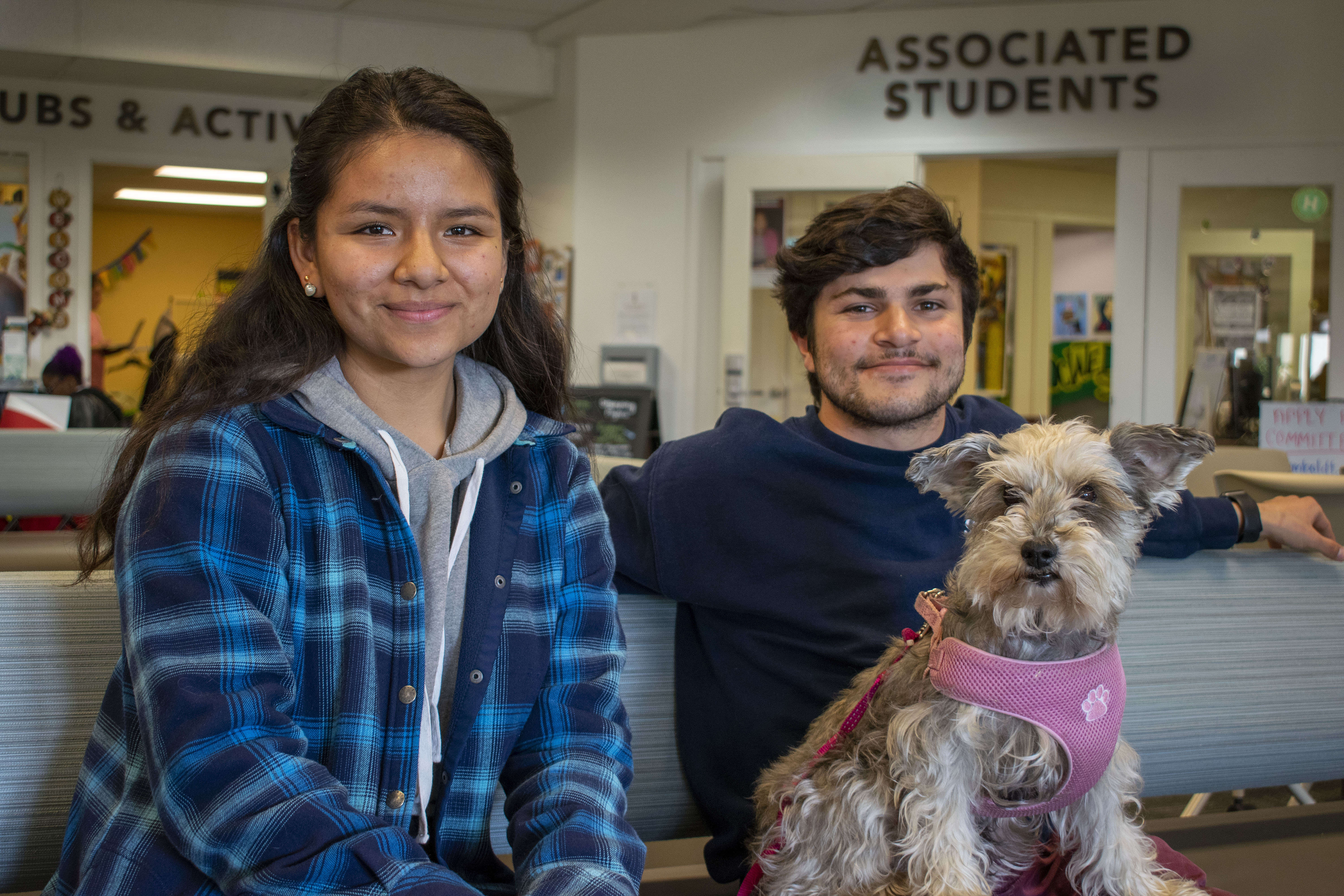
Faced with a deficit of more than $500,000, the Associated Students (A.S.) met Friday to make huge cuts to student programs. The Womxn’s Resource Center saw a large cut of $25,850, Diverse Male Scholar Initiative was reduced by $29,340 and Recreational Sports Clubs were cut by 50%, now left with $15,000. Those were three of the over 20 funded program cuts that were approved.
It was a misty Friday morning in Arcata, specifically in Gist Hall room 218, where fewer than 20 people met in person to discuss the budget reform for funded student groups on campus. The meeting was called to session at 10:03am. Tensions were high and budget cuts were higher.
A $500,000 deficit heightened the tensions between A.S. and core funded student groups on campus. With thousands lower in enrollment numbers than originally projected by the university, it has left a sour taste in the mouths of everyone whose budget was about to be cut by thousands of dollars.
Associated Students Administrative Vice President (AVP) Andres Olmos facilitated the discussion for the necessary cuts of the budget. He stated that because of lack of funds, they are essentially starting from the ground up with the bare minimum of only wages for student workers, which would still leave them over budget. The revenue is much less than predicted in the spring due to the high enrollment projections made by the university.
Olmos acknowledged that it was important to A.S. that student workers were able to keep their jobs, and that the main priority was keeping each budget at least at their current wages only so students could continue to survive.
The approved 2023-2024 funded student programs budget sat at $1,278,717, and because of the lack of funding they needed to get to $750,000. Over 20 student groups like cultural centers, service organizations, and more, saw cuts that ranged anywhere from $2,500 to $186,498. Some individual budgets were getting cut entirely because they have trust funds that they can survive on for the year; others were biting their nails to try and get more than just enough to pay student workers.
The original revenue number was $786,000. Using A.S. reserve funds the number would have been $865,000. The financial office told A.S. to get to $750,000, meaning the total number of funds cut were $528,717.
The Eric Rofes Queer Multicultural Resource Center (ERC) approved budget for the 2023-2024 school year was $42,500 and was reduced today to $30,000 after exchanges between Ascher Marks, the fiscal director for the ERC and AVP Olmos.
“We still need to work over the winter and spring break,” Marks said over Zoom.
“Like I have stated to other organizations,” Olmos said, “you guys might have to reconsider working through winter break and summer break, so I apologize for that.”
“We cannot really consider that because our bills don’t stop during winter and summer break,” Marks responded. “We need to be working over the breaks because this is our job and how we make money.” In the end, the ERC’s budget was reduced by $12,500.
Some organizations still have enough to sustain for the year, like the Waste Reduction Resource Awareness Program (WRAPP). The Program was cut by $9,200 leaving them below the A.S. recommendation of only wages, yet they remain optimistic.
“We are so excited to have $44,000,” Ella Moore, Rose Co-Director said. “It means we are going to be able to pay our employees and [have] a little wiggle room for basic operations.”
A more in depth story will be printed this week on Wednesday, October 4.
With Humboldt State University anticipating lower enrollment for the upcoming academic year, the athletics department has been preparing to make budget adjustments in alignment with the rest of the university. While the department is still waiting on official numbers from the administration to what the budget will look like next semester, Athletics Director Jane Teixeira has been actively working towards making changes with athletics.
“We are going to start going through program by program, looking at ways that we can reduce costs or maximize our benefits and resources,” Teixeira said. “We look at everything from corporate partnerships and how we can maximize those, to donations, to can we live without a second pair of tennis shoes if that’s something we were buying.”
Student enrollment is directly linked to the budget through the Instructionally Related Activities fee that every student pays each semester. The fee currently costs students $337 and covers coach salaries as well as operational expenses for athletics. The funds generated by the IRA fee are also split among the IRA Committee Fund, Jack Pass Fund and Humboldt Energy Independence. A large majority of the money goes to athletics. However, with the department receiving $3.3 million for the 2019-2020 academic year. There is no talk at this time of the fee being raised even if enrollment drops in the future.
The IRA Fee may not be changing, but faculty salary which applies to coaches and is determined with unions and includes automatic increases is at risk. Associated Students Executive Director Jenessa Lund points out that at a certain stage this model will simply stop working as salaries fall out of balance with the fee.
“Salary increases for positions paid by the state are included in the state allocation, as the state builds in a cost of living increase when funding for CSU’s,” Lund said. “When salaries are paid by a flat fee, eventually the salary increases will exceed the amount of fees.”
Newly elected Associated Students President Jeremiah Finley believes that students should not be having to pay for athletics faculty and instead should be paid with state-side funds.
“Ultimately I believe that the wages should be off the back of students. So I’ll advocate that it moves back to state-side.”
Jeremiah Finley
Moving faculty wages back to state-side funding is something the budget office has been looking into since Spring 2018 according to Lund. If this move is made then the money allocated by the CSU system would take rising salaries into consideration. While the current flat fee does not.
Athletics will certainly take a financial hit if enrollment drops as the university predicts. Teixeira was adamant that even though the department has been asked to make changes, the existing programs will not be going anywhere.
“There’s no talk of contracting on our sports,” Teixeira said. “I know there has been some thought from some individuals that were nervous about that because you’re starting to see that happen across the country.”
With enrollment down significantly in the Fall semester, athletics will be leaning more heavily on other sources of revenue; state-side, private donations and corporate sponsorships. Teixeira was unable to provide exact numbers on how much money comes from these sources, but did say that support from the community is especially important for athletics. However with the long term effects following COVID-19, donors contributions will potentially be affected.
“I appreciate the individuals who have given to us and hope we can continue to gather their support for that,” Teixeira said. “We’re going to need it as we move forward in this budgetary time. But we also are aware that this pandemic has affected people. It’s affected our neighbors and we have to be really smart about that.”
“Rec sports is a huge part of what HSU does for students. So it’s not just an athletic issue, this is a student issue.”
Athletics Director Jane Teixeira
If student enrollment takes the anticipated dip for the 2020-2021 school year, recreational sports would see a dip in funding, since they’re part of the athletics department. Teixeira said that recreational sports had already taken a reduction and needs support since it applies to so many students.
“Rec sports is a huge part of what HSU does for students,” Teixeira said. “So it’s not just an athletic issue, this is a student issue.”
The potential to use unspent money from this semester to bolster athletics is being explored as an option. While the final numbers haven’t been released, track and field, softball and rowing all had their seasons cancelled before completion. Meaning funds that are normally spent on travel and lodging are still available. This money could be used for other operations in the future.
Finley thinks that any athletic money not spent due to COVID-19 should be dispersed back into the program.
“Ultimately if that money is allocated, which it currently is, for our student athletes,” Finley said. “Then our student athletes should still benefit from that. I don’t know what that looks like, but that’s why we have different bodies in different pockets of excellence around campus to get that input.”
Without certainty from HSU’s administration, the athletic department continues to create scenarios for possible budget outcomes they will face going into the 2020-21 school year.
Only four students attended the first University Resources and Planning Committee’s public budget forum, according to Associated Students President Yadira Cruz.
Around 50 faculty, staff and community members were in attendance as well, according to Art Education Assistant Professor and URPC Co-Chair James Woglom.
Woglom said the URPC’s presentation, which can be found online at budget.humboldt.edu, focused on the URPC’s work toward creating a scalable budget model, or a budget that can be altered periodically to represent changing values.
“It ends up bringing more people into the process of decision-making, and thus hopefully reflecting more people’s feeling of what we want this organism to do,” Woglom said of the URPC’s new model.
James Woglom, art education assistant professor and University Resources and Planning Committee co-chair, checking his laptop in the Humboldt State Univeristy library on Nov. 14. Woglom said the URPC has created a new scalable budget model that allows for more flexibilty and input from the HSU community. | Photo by James Wilde
URPC has been meeting over the course of the semester to form a three-year budget for Humboldt State. Woglom said the first step for deciding where to allocate funds is to clarify which values HSU should prioritize.
Besides the forum, the URPC is taking feedback online through an online submission form, a Google survey designed to scale which campus values are most important and a pie chart budget simulator that allows proposals of how HSU should divide funds. Woglom said he’d also be happy to take suggestions through direct emails.
While Cruz said she appreciated the existence of the online feedback forms, she said they can be obscure due to budgetary jargon.
“Although it’s available, it might not be accessible in that way,” Cruz said.
The Google survey, which is not yet released, lists a series of California State University values and asks the respondent to rate how much they agree with each one.
“It’s not saying that we want to devalue any of them, but it’s trying to get a quantitative sense of where the University’s priorities are in terms of allocation of resources based across a series of ideas,” Woglom said. “And then hopefully with that quantification we can make decisions based on where we can make things happen.”
The URPC’s current projections show a $5.4 million budget gap by the 2021-2022 school year, which reflects the impact of reduced tuition due to declining enrollment. According to the presentation, every 100 students generate about $560,000 in tuition.
The University Resources and Planning Committee pointed to declining tuition numbers as the cause of HSU’s current projected $5.4 million budget gap.
Joseph Reed, a political science and economics double major and a student representative on the URPC, said the key challenge has been ramping down the budget with the declining student body.
“It’s kind of been hard to keep this budget for about 8,000 students when we don’t have 8,000 students anymore,” Reed said.
Cruz said the budget should focus on the students HSU has now, and not the students it had in the past.
“Being in that cutting mindset is potentially jarring for morale. I mean, you’re coming from a space where you’re like, ‘Alright, what do we have to not do this year?’”
James Woglom
“I think every campus goes through these sorts of financial challenges, but I think how we move forward is centering students,” Cruz said.
Reed said the URPC has no plans to cut whole departments. Instead, Reed said cuts are more likely to be smaller and broader across the board.
“Every department is being affected, but each one has its own budget, so each one has its own certain amount that it’s being reduced by,” Reed said.
Over the past three years, URPC reduced the budget by $11.5 million. However, Woglom emphasized a difference between past and future cuts due to the new scalable budget model.
“[In the past] we’ve cut what we’ve determined to be at the fringe of the project of the University—so maybe not in direct agreement with the strategic plan of the University or the general values of the University,” Woglom said. “Being in that cutting mindset is potentially jarring for morale. I mean, you’re coming from a space where you’re like, ‘Alright, what do we have to not do this year?’”
The University Resources and Planning Committee showed three possible enrollment and budget scenarios in its Nov. 7 public forum presentation.
With the new model, Woglom said HSU can start with a specific budget number and then distribute it to the things HSU values most. Woglom said the budget can be continually changed, which allows HSU to scale back up or down if monetary realities change.
“We don’t want to make hurried and necessary decisions every year,” Woglom said.
The URPC uses Financial Information Reporting Management System codes, which are used in higher education to categorize expenses by their function, to compare HSU’s spending to other CSUs.
FIRMS codes break down HSU’s spending into five categories: instruction ($56.6 million in the current budget), institutional support ($21.6 million), operations and maintenance of plant ($16.3 million), academic support ($15.6 million) and student services ($12 million). Each of these categories represent a FIRMS program, and the budget determines what percent of the total amount of funding goes to each category.
Using these categories, the URPC also compares HSU’s spending to other CSUs. According to the presentation, spending at HSU in comparison to similar-sized campuses for the 2017-2018 school year was 17% higher at HSU for instruction, 24% higher for academic support, 3% higher for student services, 10% higher for institutional support and 1% higher for operations and maintenance of plant.
The presentation also showed three possible scenarios for the future of enrollment and its effects on the budget. The best case scenario, called the growth scenario, shows a leveling off of the enrollment decline and a budget gap in the $4 million range by the 2021-2022 school year.
The current scenario, upon which URPC’s projections are based, shows a continued decline that leads to the budget gap of $5.4 million. The worst-case scenario shows further decline and a budget gap of up to $7 million by the 2021-2022 school year.
The URPC’s current budget plans are based on the middle scenario of a $5.4 million gap.
Woglom said the URPC still has to figure out how to allocate its funding to keep current programs intact.
Budget projections from the University Resources and Planning Committee’s Nov. 7 public forum presentation show a $5.4 million budget gap by the 2021-2022 school year.
“It raises interesting questions about where you can move within that,” Woglom said.
Just one day after the URPC’s public forum, HSU released a campus announcement detailing the process for filling staff vacancies during the current enrollment decline and budget deficit. The announcement said that while current staff positions will not be eliminated, positions deemed “non-critical” by the vice president of the relevant division won’t be backfilled when a person leaves that position.
Woglom confirmed that announcement.
“The intention of the University at this point is to work to determine where attrition will happen and backfill positions in that manner,” Woglom said.
This backfiring process does not apply to faculty, according to the announcement.
The URPC’s next and final public forum is scheduled for Dec. 3 at 11:30 a.m. in the Goodwin Forum, during which the public can review the URPC’s draft plan before it is sent to the University president for review. Woglom urges everyone to give their input.
“Any ideas that people have that they’d like to share with us, the better our decision-making process can be,” Woglom said.
“I think [student input is] a challenge in itself,” Cruz said. “But I think that just because it’s challenging doesn’t mean it shouldn’t be pursued.”
Yadira Cruz
Reed and Cruz said they don’t think two public forums are enough to gather sufficient student input.
“I think overall we should be making a stronger effort to connect with students and get their overall opinions,” Reed said.
Reed suggested that the URPC should seek to get input not just from some students, but from the majority of students. Cruz agreed.
“I think that’s a challenge in itself,” Cruz said. “But I think that just because it’s challenging doesn’t mean it shouldn’t be pursued.”
Humboldt State’s current budget crisis has been on everyone’s mind since the gravity of our school’s financial situation was brought to light. Besides the obvious, inevitable budget cuts and downsizing, our budget crisis has and will affect much more than our education.
Humboldt State’s own Office of Diversity, Equity & Inclusion, or ODEI, was supposed to host a collaborative community roundtable in the Jolly Giant Common’s recreation room on March 21.
This meeting was meant to prompt discussions among students as well as the local community regarding possible strategies to make our community safer and more welcoming for students of color.
However, the event didn’t take place and hasn’t in some time.
HSU sophomore Davina Hernandez, 20, attempted to attend the latest meeting. The previous two meetings have been canceled or poorly attended, forcing it to be rescheduled.
“I went on a whim, but I was kind of disappointed when I showed up and literally only one other person was there,” Hernandez said. “It was literally just me, one other person and the person who was supposed to talk to us. I ended up leaving early.”
The event Equity Arcata is listed on HSU’s event page every week. It’s supposed to be a conglomerate of local business and community members uniting with the student body and faculty. They discuss ways to ensure that the area surrounding the school, as well as the campus itself, become more inclusive and safe for our large population of students of color.
HSU hired a new executive director of ODEI, Dr. Cheryl Johnson, to oversee the branch and coordinate for Title IX. This was the sole change to the department made by the school administration.
ODEI was created in order to ensure that every marginalized student is represented and advocated for on campus.
In lieu of our current political and societal climate, it seems that our school should prioritize the safety and well-being of our students of color by allocating more funds to ODEI. This is especially true following the death of HSU student David Josiah Lawson last April.
Our school’s administration disproportionately benefits from the presence of students of color on campus. However, they are not prepared to support them, especially in such a rural and isolated area.
ODEI student representative and HSU senior Elijah Chandler said it is clear that, while the passion and motivation to meet with students and advocate for our rights is there, the group lacks the funding and resources needed to meet the demands of our student body.
“We’ve had three successful meetings with over 50 people showing up,” Chandler said. “As of right now, we only have a few people really working through the school, and our schedules don’t always work out.”
Chandler has worked with ODEI since last October. He remarked on the importance of grassroots organizations such as ODEI.
“There’s currently a tier or hierarchy for our collective right now” Chandler said. “With admin[s] being our organizational guides [and] student leaders getting the word out, we have been talking to other community leaders as well, like former senators, the mayor of Arcata and members of the local NAACP chapter.”
It’s clear that, while our school may be in a dire financial crisis, our student body seems determined to not allow this situation to jeopardize their resources.
Humboldt State students from College of Natural Resources and Sciences, or CNRS, gathered for a talk on Thursday, March 8 to address the CNRS budget crisis. The talk was facilitated by Stephany Salgado, a biology major. Both the interim dean, Steve Smith, and associate dean of CNRS, Rick Zechman, attended the talk.
“I want to make sure CNRS is getting the students involved,” Salgado said.
The CNRS is facing $2 million in budget cuts and students are concerned their fall 2018 semester classes will be cut.
Smith is filling the position that Richard Boone held until March 5. Smith was the dean of CNRS between 2010-2016. Being back from retirement for only two days prior to this talk, Smith revealed some ideas of possible solutions to the CNRS budget deficit. Smith mentioned possible changes, but would not go into any specific details.
Smith explained how the department spending works and, how in the past, the reserve would take care of expenditures exceeding the budget. There is currently little reserve funds and the CNRS department spending is required to stay within the budget.
“For a long time, the university has been deficit spending and we have to turn that around,” Smith said.
Smith expressed the most important factor of all is to meet the students’ academic unit demand.
“We are going to meet the academic demand for student courses. What might change is who is teaching the course,” Smith said.
Smith did not go into details about allocating teaching modes.
Smith assured the students the same courses will be available this fall, but he doesn’t know when or if he can solve all of the budget deficit problems.
“This is the short version of a very complicated problem,” Smith said.
A student asked Smith if professors could teach more and spend less time on research. Smith responded that it would be up to the tenure-line faculty.
Smith also reminded students that professors belong to a labor union that directs their hours, and that tenure-line faculty are expected to do research.
A student asked if graduate student programs will be adversely affected.
“Graduate funding will increase, if anything,” Smith said.
Another student asked about a fall class that is listed as unavailable. Smith assured the student that will change before registration. He also assured that all classes will appear on the schedule for registration.
One student asked about reductions in programs. Smith didn’t think there would be reductions.
“I don’t see anything along the lines of downsizing, probably elimination,” Smith said. “I don’t see that in the cards. Please don’t rush out and say we are going to cut programs.”
Zechman pressed on the importance of having students’ degree audit reports, or DARS, planned out for three semesters ahead of time.
“It is critically important to have your DARS planned out for three semesters ahead so CNRS knows how many seats it needs to offer for that class,” Zechman said.
President Lisa Rossbacher reassures students the administration is working to guarantee them the classes they need to graduate.
“We are doing everything possible to make sure students get the classes they need to make progress towards graduation and graduating on time,” Rossbacher said. “We still have one of the best science departments in the country with our natural resources and outdoor labs.”
“I couldn’t compromise the values of CNRS and my own.”
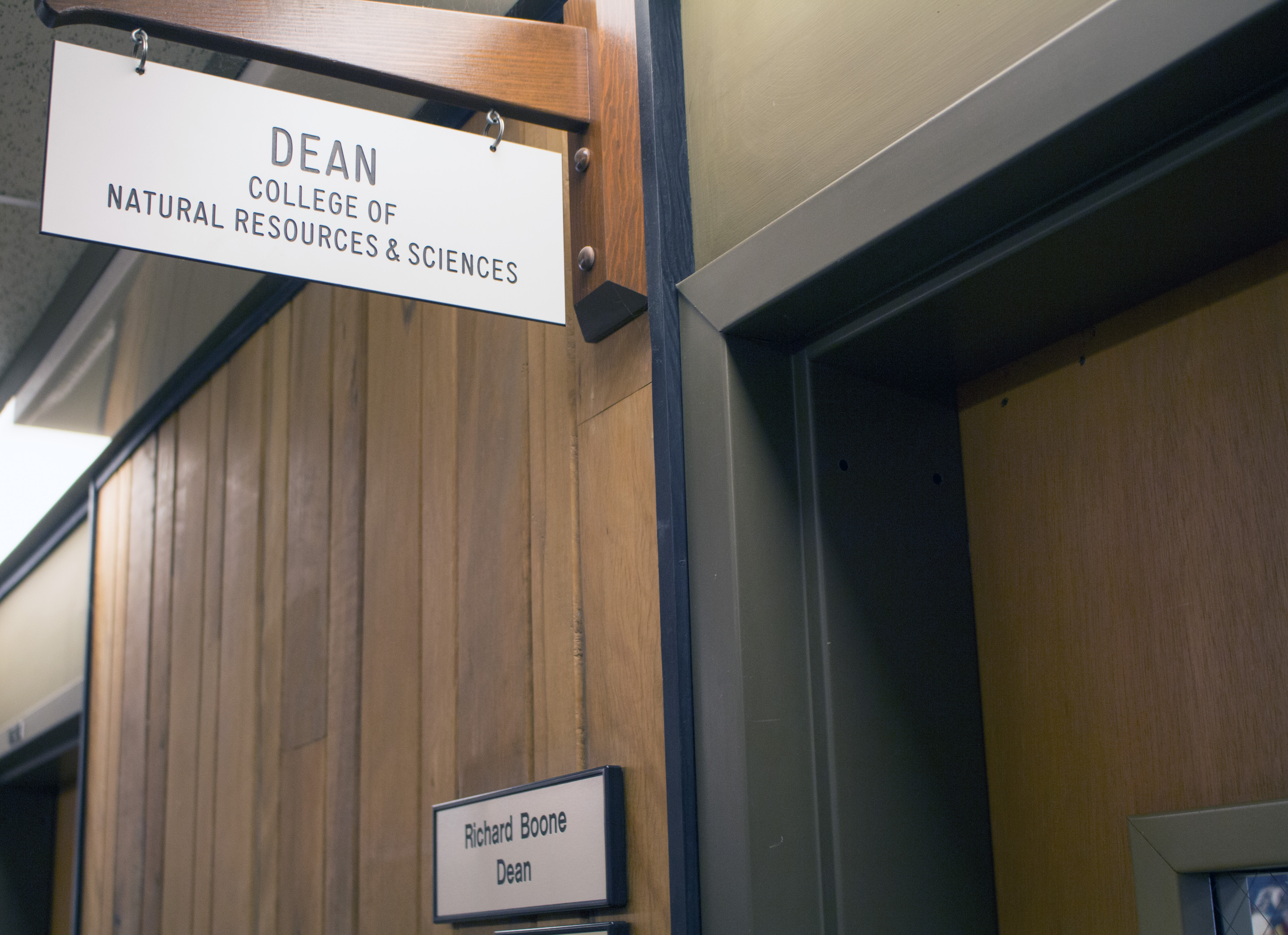
Richard Boone, the former dean of College of Natural Resources and Sciences at Humboldt State, was let go before his resignation came into effect. Earlier this month, Boone formerly announced his resignation, effective June 30. But Alexander Enyedi, provost and vice president for Academic Affairs, informed him in a meeting on March 9 that his resignation was accepted and effective immediately. Steve Smith took office as the new interim dean for CNRS, replacing Boone.
Boone planned to remain dean of CNRS until June 30, as he said to the provost when he resigned. He was surprised during the meeting that he didn’t have the time to continue working on the things he planned out.
It was important for Boone to carry out his plans leading up to the initial June 30 resignation. He and his staff were in the process of finalizing the steps to reduce the budget for next year.
“Having the remaining time was important for me, personally and professionally,” Boone said. “Also for the college and my role in the college, I was looking forward to working in Humboldt until the end of June.”
Boone said he doesn’t know why he was asked to leave office four months before his initial resignation date.
“I had conveyed to [the provost] my resignation was effective June 30 and he had not rejected the date when I met with him,” Boone said.
The Lumberjack reached out to the provost to comment on Boone’s resignation, but was directed to HSU’s public relations team. Humboldt State communications specialist, Grant Scott-Goforth, responded about why the provost adjusted his resignation date.
“Unfortunately, because it’s a personnel issue, the school can’t release anymore details about the resignation,” Scott-Goforth said. “We have a duty to protect individual privacy in these kinds of matters. I’m sorry I can’t help more.”
Boone left the area and is now in the process of relocating to Fairbanks, Alaska.
“I’m leaving Humboldt with a great deal of sadness,” Boone said. “I loved Humboldt and I really loved Arcata. This is a part of me and it will always be a part of me.”
Reflecting on his time at HSU, Boone said he really enjoyed his time working as dean.
“It was an honor to serve as the dean,” Boone said. “It was really a joy to work for the CNRS faculty, staff and students.”
According to Rick Zechman, associate dean of CNRS, Boone was respected across HSU and concerned about CNRS.
“He was very concerned about the health and vitality of the college, its students, faculty and staff,” Zechman said.
Why did Boone resign?
Boone and HSU provost Enyedi had conflicting views regarding the depth of the cuts to the CNRS budget.
“I decided to resign, because it became clear the provost and I had irreconcilable differences over the depth of budget cuts and priorities for CNRS,” Boone said. “I couldn’t compromise the values of CNRS and my own.”
Boone said his strength is in building new programs, developing interdisciplinary teams, integrating research in teaching and graduate education. With the current budget crisis HSU is facing, there’s going to be some downsizing. In such an environment, Boone thinks he can’t put his skills to practice.
“I felt that I couldn’t utilize that experience and skill set sufficiently to make me satisfied and to help the college as much as I wanted to,” Boone said.
Boone said he is proud of the work he has done as the dean of CNRS.
“I think I did good work in my time there and would have continued doing good work through June,” Boone said.
Though Boone is proud of his work as dean, he said he could’ve done better if not for the current budget cuts.
When he joined HSU on July 25, 2016, Boone was aware of CNRS budget deficit, but not the university deficit.
The cause of CNRS deficit wasn’t clear to Boone at first. Last year, he spent time understanding the budget for CNRS and the university.
“It wasn’t clear to me initially why there was a mismatch between the budget and the expenditures in the college,” Boone said. “I learned the mismatch is primarily due to the under-budgeting of lectures in college.”
Boone started the CNRS strategic planning committee. One of the goals of this committee is to find ways to achieve a balanced budget.
“I took my responsibilities seriously to eliminate the deficit,” Boone said. “I believe that the strategic planning process we started this year would’ve led to recommendations for a balanced budget.”
According to Zechman, the strategic planning committee is one of Boone’s major initiative during his short time as dean for CNRS. This initiative will guide the college for coming years.
“[Boone] has a collaborative leadership style that was reflected in one of his major initiative during his brief time as dean of CNRS, a strategic planning effort involving faculty, staff and students that will guide the college over the next several years,” Zechman said.
Over the last eight years, the college grew in terms of majors and number of full-time students. To accommodate the growth, the college hired around 57 lecturers. Costs for most of those lecturers were not added to the college budget.
“Last year, if the money for the lecturers that we employed was in the budget, there would not have been a deficit,” Boone said.
Lecturers and students are potentially affected by budget deficit.
Richard Boone is the dean of the College of Natural Resources and Sciences. Boone attended the open budget forum on March 1 to share valuable information to students, staff and faculty about the financial situation of the CNRS.
“We’ve been in deficit mode for the last five years so it’s in the academic year of 2012-2013,” Boone said.
Boone wanted those who attended the forum to know there are many reasons as to why there is a deficit within the CNRS.
“I wanted them to understand more information about the status of the college’s financial condition and why it is that we have a deficit, who has been influenced by changes in the number of students in the college [and] changes in the number of instructors in the college,” Boone said. “I felt that they should be as informed as possible to help them better understand our situation in the college and also university wide.”
As the dean of the CNRS, Boone said it is his responsibility to bring the deficit spending down and that he and his team are taking actions to move in that direction.
“Reduction of weighted teaching units, offering a class every other year instead of every year, every other semester instead of every semester or combining sections in some cases or reducing the required class for a major,” Boone said. “There are some trade-offs here that are difficult trade-offs.”
At this point, it is unclear what the final decisions will be about the reductions.
“We take our job very seriously, and we value students highly. It’s our mission here,” Boone said. “The values of the faculty here and the administrators of the college are as strong as ever and we’re dedicated as ever to students’ education and their success at Humboldt State.”
Anthony Julien is a zoology major at HSU and is part of the CNRS.
“I greatly appreciate the professors who have a little more stability in their job for speaking up and saying the things ever single person in there wanted to ask,” Julien said. “One professor informed us that because of budget cuts, there will be 700 less seats available in the biology department, the department with the greatest volume of new and current students. Now there will be less courses available and I am worried if I’ll be able to get into my courses and graduate.”
Anthony Baker is the budget analyst for the CNRS. Baker came to the forum to support the dean with the budget presentation.
“It’s a pretty complex problem, as the dean had mentioned, because of the deficit that’s associated with the lecturer budget,” Baker said. “It’s easy to point to that and say this is where the deficit came from. It’s a complex college, but that’s the primary place where we can see the greatest amount of money spent where we didnt have money to spend.”
Baker said there’s a variety of different ways the deficit can be resolved.
“One way to approach that is to reduce the total number of seats that a lecturer may be teaching. This is one of many different ways we can do this. It’s really depending on how we want to approach it,” Baker said.
Melanie Michalak is part of the strategic planning committee for the CNRS. Michalak’s role in the committee was to look at bottleneck courses, which are courses that have low success rates. In those classes, students either get the letter grade of an F, D or WU.
“If we’re able to eliminate or lower [the] success rate we can potentially have more seats for students,” Michalak said. “We’re really trying to identify those courses and work with instructors to provide more opportunities for students to pass the classes. That speeds up their time for graduation and it decreases our cost for tuition, we can offer slightly less seats and everyone can graduate. That’s what everyone on the committee talks about. That’s our goal the future.”
This website uses cookies to improve your experience. We'll assume you're ok with this, but you can opt-out if you wish. Cookie settingsACCEPT
Privacy & Cookies Policy
Privacy Overview
This website uses cookies to improve your experience while you navigate through the website. Out of these cookies, the cookies that are categorized as necessary are stored on your browser as they are essential for the working of basic functionalities of the website. We also use third-party cookies that help us analyze and understand how you use this website. These cookies will be stored in your browser only with your consent. You also have the option to opt-out of these cookies. But opting out of some of these cookies may have an effect on your browsing experience.
Necessary cookies are absolutely essential for the website to function properly. This category only includes cookies that ensures basic functionalities and security features of the website. These cookies do not store any personal information.
Any cookies that may not be particularly necessary for the website to function and is used specifically to collect user personal data via analytics, ads, other embedded contents are termed as non-necessary cookies. It is mandatory to procure user consent prior to running these cookies on your website.