The Lumberjack


Students Serving The Cal Poly Humboldt Campus and Community Since 1929

Tag: budget cuts

  • Pool budget drained by Associated Students

    Pool budget drained by Associated Students

    by Valen Lambert

    Since the Associated Students cut nearly $500,000 from student programs in September because of the administration’s faulty admission estimate, students and faculty are enduring the collateral damage. The cut of the campus pool’s budget from $25,000 to $7,500 means a big shift for its 15 employees and the hundreds of students and faculty that recreate in it, and pool staff claim that the AS correspondence has been less than professional.

    The budget cut isn’t anything new to the pool’s programs, which are a part of the School of Applied Health. Lawre Maple, who has been the pool’s program director for nine years, notes that the pool hasn’t had full budgeting since COVID. Every year the program struggles to stay open, and every year staff have to fight to get the funding they need.

    “We’re only open right now because the [Dean of Professional Studies] came in and found us some funding and gave us $10,000,” said Maple. 

    This year, however, according to Maple and student lifeguards, A.S. confused the pool program with an entirely different department. Initially, A.S. reached out to the pool program that sent over the necessary paperwork about what the budget will be used for. When A.S. came back to clarify the budget, they reached out to Paul Wells, who is the Recreational Sports Coordinator and totally unaffiliated with the pool programs that got their budget reduced. 

    “A.S. had accidentally included drop-in pool hours with the same funding as drop-in sports when we first applied for funding,” said Wells. “I believe the similar naming convention caused the confusion when I first applied for funding earlier this year, during the spring semester.”

    “To verify the information or to gain more information about the pool, we were not told that they reached out to a faculty member [Paul Wells] in [Rec Sports],” said student lifeguard Kaden Tobin. “A.S. claimed they were a part of our staff, but they are not and in no way connected to the staff that works at the pool. A.S. claimed at the board meeting on Oct. 13 to have contacted the pool staff directly, but only through email. Only one member [Andres Olmos] of the A.S. board ever came to the pool in person to talk, which was on Oct. 12. All it takes is a simple search on Google or the school website to figure out who to talk to.”

    This miscommunication resulted in Maple not hearing about the budget cut until Oct. 4, five days after they passed the cut. At an A.S. meeting on Oct. 13, The Marching Lumberjacks also claimed A.S. failed to notify them of the Sep. 20 budget meeting where they would have had an opportunity to fight for their funding. Student lifeguard Sam McLane attended the Oct. 13 meeting where he asked the A.S. board if they even knew where the pool was.

    “I asked the Board of Associated Students ‘How many of you know where the pool is?’” said McLane. “I think two out of nine of them knew.”

    “There were some mistakes made,” said A.S. President Samuel Parker. “We had to make the budget in such a short time frame. We could have done better. We went with the allocation that the previous board had suggested.”  

    Interim executive director of AS Kendra Higgins commented on the budget discrepancy.

    “Last year, the Board of Directors collected budget applications for A.S. funding for the 23-24 school year,” said Higgins. The application had incorrect contact information for the swim program that had been copied from previous years,” Higgins said in an email statement. “Upon realizing this discrepancy, our Administrative Vice President, Andres Olmos, personally visited the pool for further clarification, apologized for any confusion, and invited representatives from the pool to participate in our board of directors meetings and the finance sub-committee, where the recommended budget for the next year is discussed.” 

    The budget cuts are not affecting the classes that take place in the pool, but the hours of its open lap time are affected. Decreasing from 25 hours to about 12 hours of open lap swim each week means that its 15 employed lifeguards have significantly reduced hours. Grace Kasberger, a student lifeguard, is seeing her hours diminish from around 15 hours a week to just four, and is scrambling to make up for the loss.

    “This is one of my only jobs, and the only job that can work because I’m also a student athlete,” said Kasberger. “Most other places on campus aren’t very lenient with an athletic schedule as well as my school schedule. This all happened in the middle of the semester. I had the security and now I don’t, and so it’s kind of a little bit of a panic.” 

    Student staff aren’t the only ones affected by the significant cut. Students of the nationally acclaimed scientific diving minor rely on the open hours of the pool to practice their diving in a safe space instead of in Humboldt’s dangerous and unpredictable ocean. Student athletes utilize the pool for cross training or training with their PT’s if they have an injury. According to Tobin, they’ve already had at least 950 people recreate during lap time in the first eight weeks, when usually they’ll get that many in a whole semester, and the amount of faculty passes sold this semester is already above average. All of these people will be affected by the diminishing open hours.

    “You have people that swim for wellbeing, mental and physical,” said Maple. “People that can’t do traditional workouts. They have different needs. They have different bodies. Swimming is one of the only sports that everybody can do.”

  • Associated Students cuts $500,000 out of student programs

    Associated Students cuts $500,000 out of student programs

    by Angel Barker

    Faced with a deficit of more than $500,000, the Associated Students (A.S.) met Friday to make huge cuts to student programs. The Womxn’s Resource Center saw a large cut of $25,850, Diverse Male Scholar Initiative was reduced by $29,340 and Recreational Sports Clubs were cut by 50%, now left with $15,000. Those were three of the over 20 funded program cuts that were approved.

    It was a misty Friday morning in Arcata, specifically in Gist Hall room 218, where fewer than 20 people met in person to discuss the budget reform for funded student groups on campus. The meeting was called to session at 10:03am. Tensions were high and budget cuts were higher.

    A $500,000 deficit heightened the tensions between A.S. and core funded student groups on campus. With thousands lower in enrollment numbers than originally projected by the university, it has left a sour taste in the mouths of everyone whose budget was about to be cut by thousands of dollars.

    Associated Students Administrative Vice President (AVP) Andres Olmos facilitated the discussion for the necessary cuts of the budget. He stated that because of lack of funds, they are essentially starting from the ground up with the bare minimum of only wages for student workers, which would still leave them over budget. The revenue is much less than predicted in the spring due to the high enrollment projections made by the university.

    Olmos acknowledged that it was important to A.S. that student workers were able to keep their jobs, and that the main priority was keeping each budget at least at their current wages only so students could continue to survive.

    The approved 2023-2024 funded student programs budget sat at $1,278,717, and because of the lack of funding they needed to get to $750,000. Over 20 student groups like cultural centers, service organizations, and more, saw cuts that ranged anywhere from $2,500 to $186,498. Some individual budgets were getting cut entirely because they have trust funds that they can survive on for the year; others were biting their nails to try and get more than just enough to pay student workers.

    The original revenue number was $786,000. Using A.S. reserve funds the number would have been $865,000. The financial office told A.S. to get to $750,000, meaning the total number of funds cut were $528,717.

    The Eric Rofes Queer Multicultural Resource Center (ERC) approved budget for the 2023-2024 school year was $42,500 and was reduced today to $30,000 after exchanges between Ascher Marks, the fiscal director for the ERC and AVP Olmos.

    “We still need to work over the winter and spring break,” Marks said over Zoom.

    “Like I have stated to other organizations,” Olmos said, “you guys might have to reconsider working through winter break and summer break, so I apologize for that.” 

    “We cannot really consider that because our bills don’t stop during winter and summer break,” Marks responded. “We need to be working over the breaks because this is our job and how we make money.” In the end, the ERC’s budget was reduced by $12,500.

    Some organizations still have enough to sustain for the year, like the Waste Reduction Resource Awareness Program (WRAPP). The Program was cut by $9,200 leaving them below the A.S. recommendation of only wages, yet they remain optimistic.

    “We are so excited to have $44,000,” Ella Moore, Rose Co-Director said. “It means we are going to be able to pay our employees and [have] a little wiggle room for basic operations.”

    A more in depth story will be printed this week on Wednesday, October 4.

  • Drastic declines in the 2020-21 budget update

    Drastic declines in the 2020-21 budget update

    A quick and easy breakdown of how the university was impacted by budget cuts.

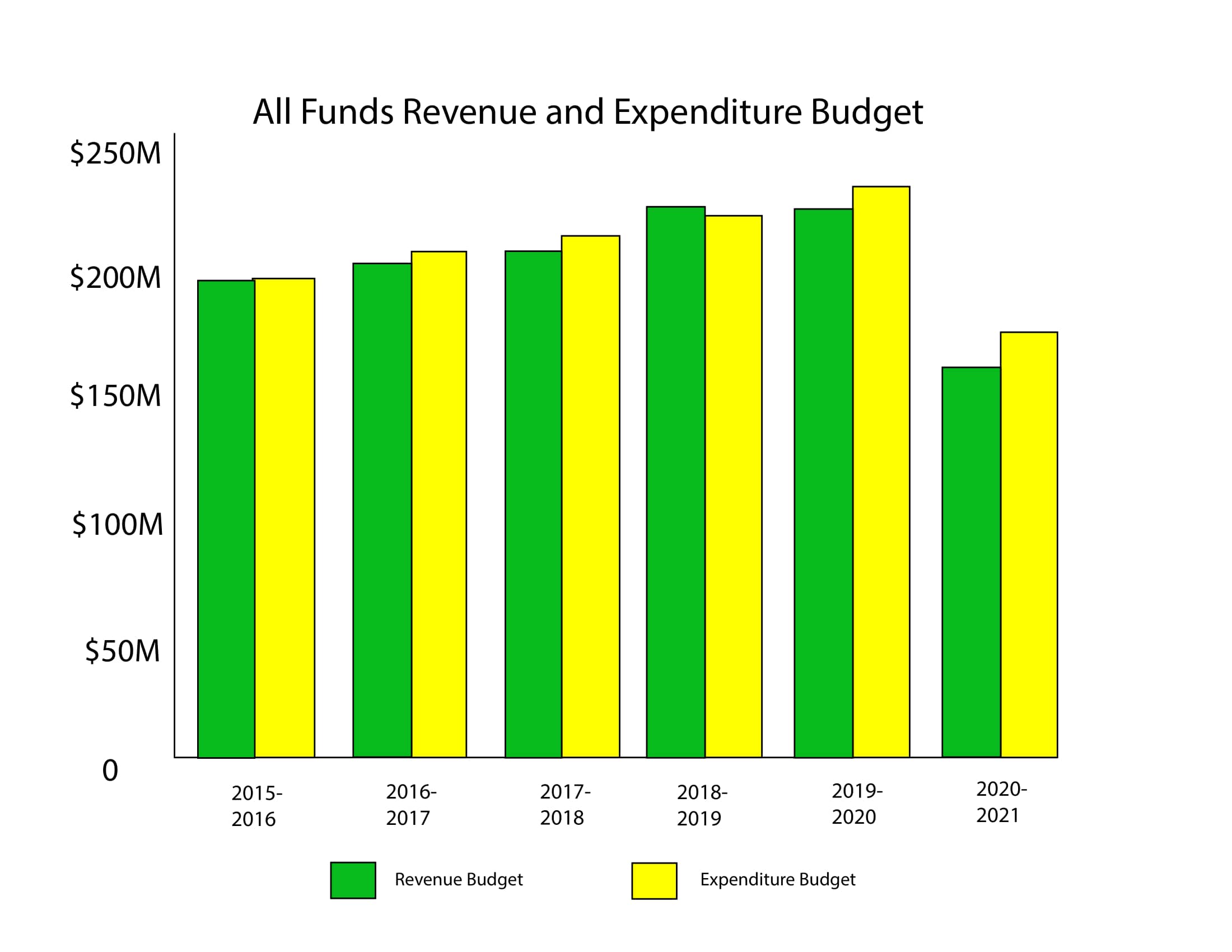
    The budget for this academic year was released on Sept 15. There are two sets of budgets laid out, the University Operating Fund and the All Funds Budget. Each budget provides the expenditure and revenue breakdown.

    The All Funds budgets dates back to the 2015-16 academic year to display all changes that the budget had gone through throughout the last five years.

    Both the Expenditure and Revenue All Funds budgets have significantly decreased in various ways.

    The budget released this past week does not reflect any Center Activities, Center Arts or HSU dining services funds.

    The revenue budget, is based on how Humboldt state University receives its money, is $164.6 million. According to the 2020-21 All Funds Revenue budget, this was decreased by $58.2 million. This is the first major decrease since 2015 and the lowest the budget has ever been since the last recorded academic year, 2015-16.

    Educational Appropriations, which is just another way of saying state and local funding, make up over 50 percent of HSU’s revenue. The amount of appropriations received for the 2020-21 academic year is $85.6 million, resulting from a $5.1 million decline. This is the first reduction recorded since the 2015-16 academic year.

    A quarter of the revenue comes from higher education fees, which includes tuition, student health, AS fees, graduation fee, etc. This portion stands at $42.2 million which is an $8.2 million decrease from last year. This could be the result of COVID-19 causing drops in enrollment.

    The expenditure budget, which is the budget based on what the university will spend their money on, is $180.5 million. According to the All Funds Expenditure budget, this was decreased by $43.8 million. This is the first reduction in the budget since 2015 and the lowest the budget has been since the last recorded academic year, 2015-16.

    The salaries and wages of HSU employees reflects 44.5 percent of the budget. These include not just tenured professors and lecturers but also department chair members, assistants, teaching associates, support staff and the university president.

    The Regular salaries and Wages budget did have an overall decrease of $8.9 million. With the budget dropping across the board, the president managed to increase his salary by $10,000.

    This is also the first time the revenue budget was significantly smaller than the expenditure budget since 2015. The usual trend is having the numbers very close in amount with a maximum $5 million gap. This year’s budget has a $15.9 million gap.

  • HSU Cultural Center Budget Slashed

    HSU Cultural Center Budget Slashed

    Associated Students leaves student body devastated after significant reductions in cultural center’s budget.

    Two months ago, Associated Students released its proposed budget for the 2020-21 school year at Humboldt State University. Included in this budget were major budget cuts to on-campus cultural centers such as the Multicultural Center and the Eric Rofes Multicultural Queer Center.

    For the budgeting process to begin, A.S. applications are submitted by various campus-based clubs to the A.S. Finance Committee, previously known as the Board of Finance. From there, the committee reviews all the incoming applications and after holding public appeals, creates a Recommended Budget that is sent over the A.S. Board of Directors, a mix of A.S. elected representatives and faculty advisers. The Board of Directors then holds another round of public appeals, drafts a revised Recommended Budget and sends it over the A.S. president, who promptly turns it over to the campus president for official approval.

    David Lopez, the Associative Vice President of A.S. and a sophomore at HSU, emphasized that he still greatly values the cultural centers but they will be funded differently.

    “We really appreciate them for the work they do,” Lopez said. “So to make sure that they continue to do that work still because we’re not funding them, we’re doing it through the clubs grant, and we’re forming this grant process to be as neutral as possible with funding student organization needs.”

    Lopez is personally leading the charge for these new clubs grants, which aim to support student organizations like the Asian Desi Pacific Islander Collective and the Women’s Resource Center in a reduced capacity.

    One thing that factored into the decision by Associated Students to sever the cultural centers’ funding was the Apodaca v. White lawsuit that took place between a pro-life student organization at CSU San Marcos and CSU San Marcos’s Associated Students. The pro-life student organization claimed that it was being discriminated against by CSU San Marcos because requested funding for a pro-life speaker was denied while other groups were recieiving the same funding. The final ruling by a federal court was in favor of the student organization, arguing that the funds that come from student fees need to be allocated in the most viewpoint neutral way possible. The CSU Chancellor’s office has yet to clarify what this means.

    For Lopez, this new funding procedure is radical but also necessary given the circumstances.

    “We’re supporting the greatest amount of viewpoints and opinions possible,” Lopez said. “The plan for this club grant is to further diversify the opinions on campus per Apodaca v White and to err on the side of caution while awaiting the Chancellor’s interpretation of Apodaca v White.”

    Lopez recognized that he and his staff are working with a limited financial capacity and therefore need to distribute funding in a way that will keep clubs satisfied and avoid a lawsuit of their own.

    “What’s happening is we’re being faced with the choice of either becoming a club or becoming absorbed into an administrative or academic department.”

    Amanda Huebner

    “Our total budget is less than eight hundred thousand dollars,” Lopez said. “Meaning that by not funding in a viewpoint neutral manner, we are potentially risking over a fourth of our budget, a fourth of student fees that could go to things like our Club Grants Committee or that could go to other campus resources if we were to risk not funding in a most neutral way possible.”

    Celene Gonzalez is an HSU grad student in the psychology program and an El Centro employee. She has worked closely with the cultural centers and has seen their collective downfall over the years.

    “What gives me hope in what I had seen in that time is that students were getting really connected with each other,” Gonzalez said. “They were finding their communities. It is not shocking to me that the school felt the need to kind of push that down a little bit.”

    Gonzalez is disheartened by the disconnect that has been formed between her and these students through said budget cuts.

    “I feel like our work gave us a way to connect with one another and I feel like our activism gave us a way to connect with one another,” Gonzalez said. “That it’s going to be hard to maintain and it’s going to be hard to ask of them when I know that they aren’t being compensated for that work.”

    The Eric Rofes Multicultural Queer Resource Center is getting hit hard by the extreme budget cuts. Concerned about the future of her cultural center, Amanda Huebner, a rangeland and social sciences senior and an employee at the ERC, wants to see it remain in the state that it’s in already.

    “What’s happening is we’re being faced with the choice of either becoming a club or becoming absorbed into an administrative or academic department,” Huebner said. “So I think there has been dialogue by students in the past that this would be a bad move being absorbed by a department or by an administrative department because it would make the group not be as student-run.”

    In other words, the absorption of the ERC into another department would be ill-advised because there would be more faculty interference in how it would be managed, and that wouldn’t align with the goal of this cultural center of being a student-led one.

    Student leaders like Katherine Nguyen who work in the cultural centers are frustrated with the fallout from all of this. Nguyen doesn’t feel like the administration cares about its marginalized students.

    “Are you going to be supporting your cultural centers, are you going to be supporting your students?” Nguyen said. “I’m not confident about that and I’m tired of just being told by admin, like: ‘Oh, you got it wrong, like we actually care about you. We’re going to figure out a way,’ but it’s like if you did, why didn’t you make a plan? Show that you’re invested in students.”

    When it comes to the shrinking budgets for the various cultural centers, neither the students nor the administration can be totally satisfied. After the Fall 2020 census, the A.S. cumulative budget will be reevaluated.

  • Associated Students Lose Core Programs and Student Wages

    Associated Students Lose Core Programs and Student Wages

    Based on projected enrollment, the Associated Students budget is expected to decrease 20% each year, for the next five years

    The Associated Students Board finalized their proposed budget for the upcoming academic year, during the April 24 board meeting. The budget includes cutting the entire budgets of the Asian, Desi, Pacific Islander Center, the Eric Rofes Multicultural Queer Resource Center or ERC and the Women’s Resource Center, among other programs.

    Jeremiah Finley was elected the incoming AS President for the 2020-21 academic year. He wants to assure students they won’t be losing their programs.

    “The reality is that we want to support y’all so bad,” Finley said. “That we’re willing to go into our reserves almost $100,000 to be able to still support in some type of way.”

    Budget Administrator of the Campus Center for Appropriate Technology Justin Hawkins was baffled by the budget decisions and spoke out during the meeting.

    “How does the budget increase $14,000 and it’s going directly to the AS government in-between these recommended budgets, and yet, all of us are getting cut.”

    Justin Hawkins

    “It’s just tragic, honestly, to see these massive cuts to the ERC and the Women’s Resource Center,” Hawkins said. “I’m a male body person, I identify that way, but that doesn’t mean that I don’t empathize and really appreciate the services that are provided.”

    Hawkins questioned the justification for the AS budget increase after having several thousand dollars of his own program cut.

    “It’s really troubling what I see going on,” Hawkins said. “How does the budget increase $14,000 and it’s going directly to the AS government in-between these recommended budgets, and yet, all of us are getting cut.”

    Despite losing one of their three staff positions, the AS general operations budget has increased over $15,000 for the upcoming academic-year. This comes as a result of general operations losing miscellaneous revenue, largely made up of compensation for the oversight of Instructionally Related Activities. Without the $35,000 miscellaneous revenue provided for the 2019-20 year, the general operations budget requires additional funds to function.

    As a result of budget reductions, AS was forced to down-size their office administrator position. This sharp deadline made it impossible for AS to administer payroll for the upcoming year and as a result student-wages have been removed from AS and most of its funded-programs. Executive Director of AS, Jenessa Lund, said the current system isn’t working.

    “Even with three employees,” Lund said. “When we have eight programs spread across campus, the oversight is impossible. It’s a huge liability!”

    In order to compensate students for their time, AS has come up with several loopholes to get around the extra paperwork that comes with administering official wages. These include paid-internships and stipends for students, both of which have been allocated specific funds in the final budget.

    These allocations include a $15,000 committee compensation package that increased the AS government budget. The package is specifically set aside for non-AS board members that are involved in AS committees.

    “The optics on the final number of $111,000 looks bad,” Lund said. “But if you really look at what’s inside of it, it’s support to the students.”

    The finalized proposal includes a significant increase to the clubs’ budget, with money that can be used for student-stipends and internships. Programs that didn’t receive any funding from AS have the option to transition their organization into a club and can apply for funding through AS and the clubs’ office. Programs that weren’t given a budget for the upcoming year have also been allocated specific funds.

    “I don’t think that all of the clubs should have an equal opportunity for that funding.”

    Alexia Siebuhr

    Queer Coordinator for the MultiCultural Center, Alexia Siebuhr voiced her concerns about access to AS grants distributed through clubs, at a board meeting on May 8. Siebuhr pointed out a white supremacist club on campus, who promotes hateful behavior towards groups denied an AS budget, is competition for club funding.

    “I don’t think that all of the clubs should have an equal opportunity for that funding,” Siebuhr said. “They have the equal opportunity to apply for those grants. That just rubs me a little bit the wrong way.”

    President-Elect Finley addressed Siebuhr’s concerns, explaining the reasoning behind the allocation.

    “Every fee-paying student has to be able to have access to these funds,” Finley said. “If we do not allow them to have access to these funds, then we are doing a dis-service to our students.”

    Programs with a department and a state employee overseeing paperwork are the only ones able to maintain regular wages because their payroll doesn’t go through AS. For programs that didn’t receive a budget from AS, finding a department to adopt them and re-applying for funding is currently their only option.

    AS is already in discussion with the Student Access Gallery, the Waste-Reduction and Resource Awareness Program, the Campus Center for Appropriate Technology and several departments about the possibility of adoption. Executive Director Lund believes this will be the most beneficial direction for the programs, moving into next year.

    “We didn’t have enough time to do that for every program,” Lund said. “That would’ve been ideal.”

    AS is prepared for the possibility of refunding fee-paying students for potentially cancelled events and other unspent student-fee funds. Ultimately, if they aren’t providing the services outlined by student-fees, they shouldn’t be charging them.

  • Athletics Deals with a Budget Curveball

    Athletics Deals with a Budget Curveball

    With Humboldt State University anticipating lower enrollment for the upcoming academic year, the athletics department has been preparing to make budget adjustments in alignment with the rest of the university. While the department is still waiting on official numbers from the administration to what the budget will look like next semester, Athletics Director Jane Teixeira has been actively working towards making changes with athletics.

    “We are going to start going through program by program, looking at ways that we can reduce costs or maximize our benefits and resources,” Teixeira said. “We look at everything from corporate partnerships and how we can maximize those, to donations, to can we live without a second pair of tennis shoes if that’s something we were buying.”

    Student enrollment is directly linked to the budget through the Instructionally Related Activities fee that every student pays each semester. The fee currently costs students $337 and covers coach salaries as well as operational expenses for athletics. The funds generated by the IRA fee are also split among the IRA Committee Fund, Jack Pass Fund and Humboldt Energy Independence. A large majority of the money goes to athletics. However, with the department receiving $3.3 million for the 2019-2020 academic year. There is no talk at this time of the fee being raised even if enrollment drops in the future.

    The IRA Fee may not be changing, but faculty salary which applies to coaches and is determined with unions and includes automatic increases is at risk. Associated Students Executive Director Jenessa Lund points out that at a certain stage this model will simply stop working as salaries fall out of balance with the fee.

    “Salary increases for positions paid by the state are included in the state allocation, as the state builds in a cost of living increase when funding for CSU’s,” Lund said. “When salaries are paid by a flat fee, eventually the salary increases will exceed the amount of fees.”

    Newly elected Associated Students President Jeremiah Finley believes that students should not be having to pay for athletics faculty and instead should be paid with state-side funds.

    “Ultimately I believe that the wages should be off the back of students. So I’ll advocate that it moves back to state-side.”

    Jeremiah Finley

    Moving faculty wages back to state-side funding is something the budget office has been looking into since Spring 2018 according to Lund. If this move is made then the money allocated by the CSU system would take rising salaries into consideration. While the current flat fee does not.

    Athletics will certainly take a financial hit if enrollment drops as the university predicts. Teixeira was adamant that even though the department has been asked to make changes, the existing programs will not be going anywhere.

    “There’s no talk of contracting on our sports,” Teixeira said. “I know there has been some thought from some individuals that were nervous about that because you’re starting to see that happen across the country.”

    With enrollment down significantly in the Fall semester, athletics will be leaning more heavily on other sources of revenue; state-side, private donations and corporate sponsorships. Teixeira was unable to provide exact numbers on how much money comes from these sources, but did say that support from the community is especially important for athletics. However with the long term effects following COVID-19, donors contributions will potentially be affected.

    “I appreciate the individuals who have given to us and hope we can continue to gather their support for that,” Teixeira said. “We’re going to need it as we move forward in this budgetary time. But we also are aware that this pandemic has affected people. It’s affected our neighbors and we have to be really smart about that.”

    “Rec sports is a huge part of what HSU does for students. So it’s not just an athletic issue, this is a student issue.”

    Athletics Director Jane Teixeira

    If student enrollment takes the anticipated dip for the 2020-2021 school year, recreational sports would see a dip in funding, since they’re part of the athletics department. Teixeira said that recreational sports had already taken a reduction and needs support since it applies to so many students.

    “Rec sports is a huge part of what HSU does for students,” Teixeira said. “So it’s not just an athletic issue, this is a student issue.”

    The potential to use unspent money from this semester to bolster athletics is being explored as an option. While the final numbers haven’t been released, track and field, softball and rowing all had their seasons cancelled before completion. Meaning funds that are normally spent on travel and lodging are still available. This money could be used for other operations in the future.

    Finley thinks that any athletic money not spent due to COVID-19 should be dispersed back into the program.

    “Ultimately if that money is allocated, which it currently is, for our student athletes,” Finley said. “Then our student athletes should still benefit from that. I don’t know what that looks like, but that’s why we have different bodies in different pockets of excellence around campus to get that input.”

    Without certainty from HSU’s administration, the athletic department continues to create scenarios for possible budget outcomes they will face going into the 2020-21 school year.

  • Letter to the Editor: Reflections on 30 Years at HSU

    Letter to the Editor: Reflections on 30 Years at HSU

    Where we were, what went wrong & how we build a brighter future

    This is a letter to the editor from Humboldt State University Education Department Chair Eric Van Duzer, Ph.D. It has been edited only for minor punctuation and grammar style preferences.

    As I reflect back on nearly 30 years at Humboldt State University, first as a student and then for the past 20 years as a faculty member, I wanted to share some of the thoughts that I have about HSU’s current situation and where the campus might go from here.  

    As a student I experienced a remarkable education where faculty were fully invested in my intellectual and personal development. There were so many opportunities to explore areas of interest and develop new ones. I have spent many hours trying to encapsulate the nature of the schooling I experienced in a way that would really represent the experience. 

    The best analogy I have been able to come up with was that HSU offered a graduate education to undergraduates. The small classes typical of graduate school encouraged faculty to fully invest in their student’s growth. The university, set so far from the oversight of CSU headquarters in Long Beach, offered a great deal of flexibility to shape our experiences. 

    This would be impossible today. In those days HSU had the third smallest class sizes in the 23 campuses of CSU. But more than that, it had a unique faculty ethos that reflected nearly 100 years as a student-focused institution that exalted excellence in teaching above all else.  

    I was the first student CEO of the Institute of Industrial Technology, a self-supporting club that allowed us to use the skills and knowledge we were developing to grow in business acumen, engage in manufacturing and light construction on campus as well as conduct experiments for local agencies. In its second year, Bill Wilkinson used the institute to earn enough profit making desks for campus offices that it paid for several pieces of expensive equipment for the department.

    This would be impossible today. In those days HSU had the third smallest class sizes in the 23 campuses of CSU. But more than that, it had a unique faculty ethos that reflected nearly 100 years as a student-focused institution that exalted excellence in teaching above all else.  

    Faculty came to campus because this is where they wanted to spend their career. Unlike most universities where faculty play academic hopscotch building their resume through research reputations and earning ever-higher salaries as they bounce from college to college, HSU faculty built their reputations on teaching.  These were inherently local reputations, not very valuable if one wanted to move on, but rather a reflection of the values and attitudes associated with a culture of excellence in the service of students’ intellectual growth.

    As anyone who has worked with university budgets will tell you, graduate education is expensive.  That is why through the first 100 years, the administration and other services were done on a shoestring. It was common for a variety of upper administrative positions to be filled by faculty who served temporarily. Staff was thin and overworked and processes were slow and inconsistent. 

    What happened? In the early 2000s the CSU was facing the onslaught of a Generation X student bulge. Chancellor Charles Reed decided the best strategy to deal with this situation was to homogenize campuses so that if a student could not get into Sacramento State because it was impacted, they could simply go to another campus and get a similar experience. 

    Yet, the campus, with significant leadership from the faculty, focused its significant resources on classroom instruction, and through that dedication, produced exceptional graduates who were deeply committed to HSU when they graduated. 

    I remember an administrator in the early years telling me that he had been in a restaurant on the East Coast and overheard a group of students talking at a nearby table. He was so impressed with their sophistication and the values they held he found out where they came from and immediately applied for a job at HSU. 

    He was the first person hired under then-president Rollin Richmond to manage our enrollments in the early 2000s. The diversity on our campus is a credit to him and Richmond, who reached out across the state to bring in students from urban areas. Sadly he became disillusioned and left. So did most of the faculty leaders. 

    What happened? In the early 2000s the CSU was facing the onslaught of a Generation X student bulge. Chancellor Charles Reed decided the best strategy to deal with this situation was to homogenize campuses so that if a student could not get into Sacramento State because it was impacted, they could simply go to another campus and get a similar experience. 

    Shortly thereafter the upper administration received inflated titles and significant raises in an apparent effort to reduce resistance. Then the attack on the faculty began.

    Naturally, faculty on campuses such as HSU who were proud of their traditions and niche identities resisted. Fiercely. At one point, three campus presidents, including Rollin Richmond, suffered through votes of no confidence by their faculty as they implemented this strategy. 

    To achieve the required changes in the face of faculty resistance, campuses, including Humboldt, began shifting to a corporate structure of top down management. Faculty who had held a privileged position in campus life were systematically reduced to workers with only a symbolic voice in campus decisions. The administration turned its focus inward towards improving the functioning of the bureaucracy. They eliminated administrators such as Rick Vrem, an ethical provost, who refused to implement changes that hurt the traditional focus on instruction.  

    Vrem was replaced with a provost who had no such compunction. Shortly thereafter the upper administration received inflated titles and significant raises in an apparent effort to reduce resistance. Then the attack on the faculty began. Nearly 80 faculty positions were eliminated over several years and during the same time period, a similar number of new staff positions were created and filled to support administrative functions. 

    Over the majority of the intervening 15 years, budget reductions for academic programs have been the norm: reductions in staff, program availability and courses. This year it was a 6% cut, last year another and many like it before. The funds have been shifted to an ever-expanding variety of administrative initiatives. 

    Now we sound more like a parks and recreation office than a university. Come for the redwoods, the beaches, the bike riding—that is wonderful and I love it, but it is not why people pick a university.  

    We spend nearly 68% of our budget on administration and campus facilities. Despite the results of a study commissioned by Rollin Richmond’s administration that showed the two most important factors that cause a student to come to HSU are quality of education and availability of the program they are interested in, both have been repeatedly attacked, sliced and diminished.

    It is surprising that no one seems to notice that every time we cut academic programs, fewer students want to come here. And when fewer students come here, the budget suffers and HSU responds by cutting academic programs even more severely—a cycle the faculty in 2004 described as a “death spiral.” 

    As we address our current crisis and try to figure out what we need to become in order to grow back to a sustainable enrollment, we might want to engage in some soulful reflection. What would cause a 20-year-old to come to a place five hours from major centers of civilization and spend four years with us? What do we have to offer them that is so valuable, so different from what they can get at any of the other CSU campuses which are closer, cheaper and offer a great deal more college life in the community? 

    We stopped selling the small classes and close academic relationships with faculty when the hypocrisy became too much to bear as campus priorities shifted. Now we sound more like a parks and recreation office than a university. Come for the redwoods, the beaches, the bike riding—that is wonderful and I love it, but it is not why people pick a university.  

    When I arrived here as a faculty member in 2000 we had one staff member, John Filce, doing institutional research. He was wonderful and badly overworked. I am sure he still is. Now we have nine staff members listed in the directory in the Office of Institutional Effectiveness, including a vice president. I am sure their work is valuable, but to pay for it we had to cut 64 class sections. 

    Today, we are an organization of inflexible rules and their keepers.

    We have proliferated the bureaucracy, which is unfortunately necessary to achieve top-down control of a professional organization. Had our leadership studied industrial technology with me, they would know what companies in the 1970s learned: that this form of management is ineffective and inefficient in a professional organization. 

    To achieve control requires monitoring, which in turn requires more staff. For a top-down organization, where the vast majority of employees serve at the will of their manager, fear prevents innovation and compliance is key. Before the shift to this model, administrators were problem solvers. In fact, the standing joke in those days was that everything was an exception. Faculty, staff and administrators had the flexibility to serve the needs of students even when it required bending the rules. 

    Today, we are an organization of inflexible rules and their keepers. It has greatly diminished the effectiveness of the organization and its ability to make decisions that best serve our students. The resulting bureaucratic culture has seen a proliferation of forms, rule books and rigid adherence to often dysfunctional orders.

    This is no way to run a university. Perhaps a grocery store, but not an organization of 500 highly educated experts with thousands of years of collective experience. Top-down decision-making, particularly when the president and upper administrators are drawn from institutions that do not share the culture and values of the campus, is inherently poor compared to what would be possible if faculty once again had a meaningful voice in campus affairs.  

    No student has ever come to HSU because we have a wonderful registrar’s office or because the president’s office is fully staffed.  These only matter when they impact the quality of the education a student receives. 

    The proof of this is apparent everywhere at HSU. When Rollin Richmond came, he had no interest in what made HSU special. Like a white suburban principal coming to a school in Watts, he thought he knew what needed to be done to remake the university into his vision of a modern institution. That ignorance has cost us immeasurably. Today we face the consequences. The failure to fundamentally change direction of subsequent presidents has simply deepened the mess. We now have a new president, perhaps we can find a new vision. 

    In my view there are two key concerns that need to be addressed from a rational and values-driven perspective. First, an effective budget model that allows funding to follow enrollment is essential to support growing programs while shifting resources to where they will best serve student needs and interests. This can refocus the campus on providing the service/product students come here for—classroom instruction—and it is essential.  

    There are so many amazing faculty and academic staff here. They are people with a heart for their students, struggling in a system that constrains and conflicts with their efforts. Let their voices guide the future and we may yet have one worth celebrating.

    No student has ever come to HSU because we have a wonderful registrar’s office or because the president’s office is fully staffed.  These only matter when they impact the quality of the education a student receives. 

    Second, we have to decide how we are going to rebuild the excellence we once were known for in our student’s academic programs.  The day Rollin Richmond refused to give the Outstanding Faculty Award to a physics professor (selected by the faculty based on his ability to delight and inspire students) because that professor had not published, is the day we snuffed out the soul of the old HSU campus. 

    Now we need to find out what animates us in ways that provide an experience worth the isolation, cost and struggles required to live in this remote community. Redwoods are not enough; we need a reinvestment in education. 

    I am retiring from HSU at the end of this May. I am sad to see what has happened to my university. There are so many amazing faculty and academic staff here. They are people with a heart for their students, struggling in a system that constrains and conflicts with their efforts. Let their voices guide the future and we may yet have one worth celebrating.

  • HSU Sails into Uncharted Waters

    HSU Sails into Uncharted Waters

    Humboldt State faces enrollment drop, budget cuts and academic department reorganizations

    If Humboldt State University was a ship, it would be sailing straight into uncharted seas, thick with fog.

    Atop the tallest mast, HSU administrators spy an enrollment drop of around 20% for the fall semester, mainly due to COVID-19. Administrators project a resulting budget cut of around $7.4 million for the next school year and $20 million in the next two years, according to HSU’s most recent enrollment report and webinars held April 13 and 15.

    Faculty and staff are scrambling across the deck to reorganize HSU’s academic departments.

    Vice President of Academic Affairs and Interim Provost Lisa Bond-Maupin said HSU’s colleges are looking at combining department staff and faculty and adjusting fall course schedules for a smaller student population.

    “Those are the strategies we’re looking at—combining staffing where it makes sense and combining chair leadership where it makes sense,” Bond-Maupin said via Zoom interview. “We’re not doing away with academic programs.”

    A proposed plan emailed to department chairs of the College of the Arts, Humanities and Social Sciences divided CAHSS departments into four schools, each of which would have one chair. The presumed thinking behind the plan would be to eliminate the need for each department to have its own chair and free up chairs to teach more courses—reducing the number of other needed faculty.

    Bond-Maupin did assure that HSU has no plan to cut any academic departments—but semester course offerings will depend on what students need.

    Bond-Maupin said that exact proposal probably would not move forward. Bond-Maupin said she and the deans of the HSU colleges are still figuring out what they will do.

    With department reorganizations and course offerings expected to be adjusted for the fall, lecturers will likely end up with fewer courses to teach. Bond-Maupin said schedules for a reduced number of students inevitably affect the availability of work. In other words, if all of a lecturer’s courses are pushed off the fall schedule, they would be thrown overboard too.

    Bond-Maupin did assure that HSU has no plan to cut any academic departments—but semester course offerings will depend on what students need.

    “As enrollment changes, we need to sort of follow the needs of the students,” Bond-Maupin said.

    Over 2,000 individuals signed a change.org petition asking for HSU tuition to be reduced for the spring. Bond-Maupin said a change in tuition would come from the California State University Chancellor’s Office, not HSU.

    Tuition reduction or not, HSU faces serious challenges. In an April 13 webinar HSU held on the enrollment decline and budget cuts, Vice President of Enrollment Management Jason Meriwether delivered dire news on enrollment.

    “If the CSU is in a recession for enrollment, Humboldt State needs to worry about being in a depression for enrollment,” Meriwether said. “I hate to use those terms, but it just forecasts the impact HSU could face in the terms of COVID-19.”

    HSU has refunded nearly $2.5 million to students for housing, parking and dining and projects to lose around $7 million by the end of June.

    “We are hearing from the governor that there may be some return to being together but with some new social distancing parameters—so that’s possible.”

    Lisa Bond-Maupin

    Vice President of Administration and Finance Douglas Dawes emphasized the importance of the campus understanding the need to make quick budget cuts. Dawes said HSU is looking into a mix of measures, including hiring chills, spending freezes and retirement incentives.

    These hits to the hull come despite progress HSU made before it entered the murky waters of the pandemic—208 local students accepted the Humboldt First scholarship, up from 32 local students per year for the last three years.

    Both Meriwether and Bond-Maupin said details of the fall semester remain uncertain and hinge on public health recommendations. Bond-Maupin said HSU is preparing for a variety of potential scenarios, from remaining online to opening partially.

    “We are hearing from the governor that there may be some return to being together but with some new social distancing parameters—so that’s possible,” Bond-Maupin said. “We might work with spacing. We also may look at timing. One scenario I can think of is that we are delayed in going back fully to face-to-face, so we begin online. I think we just have to plan for all those scenarios.”

    The Lumberjack requested an interview with HSU President Tom Jackson multiple times for this story, but he could not be reached. HSU Communications Specialist Grant Scott-Goforth cited an “incredibly busy time.”

  • IRA Budget Expected to Take Substantial Hit

    IRA Budget Expected to Take Substantial Hit

    Associated Students prepare for massive budget cuts

    Associated Students is anticipating a nearly 20% cut to the Instructionally Related Activities Committee budget.

    As of April 7, the IRA Committee budget for the 2020-2021 academic year is predicted to be about $375,000, compared with around $520,000 approved for the 2019-2020 budget. This accounts for an anticipated loss of around $27,000 due to COVID-19.

    As a condition of enrollment at Humboldt State University, each full-time student pays about $3,900 in student fees, around $2,900 of which is tuition. The remaining amount of about $1,000 is split between six student fees, including a $337 contribution the IRA.

    From that $337 paid by each student, the IRA budget is divided into about $260 for athletics, $8 for the Humboldt Energy Independence Fund, about $17 for the Jack Pass and about $19 for the IRA Committee. Made up entirely of Associated Students board members, the IRA Committee votes on the allocation of their budget among instructionally related activities.

    Executive Director of AS Jenessa Lund is heavily involved in the committee.

    “It’s interesting that there is not a lot of money compared to the big budget, but what I’ve realized over the past couple of years is because they are so visible, people react to them very strongly,” Lund said. “IRA is less than $500,000, and compared to the campus budget that’s just drops in the bucket. But because it means whether or not a group of students can go compete, or do something, they feel it directly.”

    “We had conflicting pieces of arguments that said, ‘You do this, but you don’t do that in these cases,’ which makes it very hard to evaluate who’s gonna be in and who’s gonna be out.”

    Sandy Wieckowski

    IRAs are limited to those that are disciplined, department-based and sponsored, and are integral to formal instructional offerings. They are intensive, structured activities that reflect active rather than passive student involvement. They are considered essential to the quality of an educational program and an important instructional experience, and they demonstrate skills derived from intensive coursework. They include everything from The Lumberjack newspaper to club sports, and almost everything in between.

    Made up of majority student voters, the IRA Committee has been meeting to re-evaluate their funding guidelines, based on the Education Code, their current IRA funding guidelines and memos between the AS president and HSU president from the 2019-2020 academic year that outline the direction they were headed. Sandy Wieckowski is currently the longest-acting board member.

    “This is the same thing we hit last year,” Wieckowski said. “We had conflicting pieces of arguments that said, ‘You do this, but you don’t do that in these cases,’ which makes it very hard to evaluate who’s gonna be in and who’s gonna be out.”

    Lund blamed the rotating chairs for inconsistent goals.

    “This current model has annual turnover,” Lund said. “It’s new faculty on this committee every year, and it’s often new student leaders every year.”

    On top of HSU having new administration for the past three years, AS has had four presidents in three years. With administrations in a constant state of change, it’s much more difficult to accomplish progress.

    “I’ve been on the committee four years and we’ve done it different every year,” Wieckowski said.

    Board members were assigned budget applications from IRA groups to review in advance of their April 7 meeting. During the meeting, the board looked at each application and adjusted the proposed budgets where they saw fit. As Lund scrolled down the list of submissions, board members weighed in with their recommendations.

    One significant impact looks to be the denial of a budget for the campus sexual assault prevention program, CHECK IT, as the “swag” the budget was requested to pay for wasn’t considered a priority.

    Other impacts include The Lumberjack newspaper, which faces over $8,000 in cuts from a budget of around $28,000. Osprey magazine faces about $4,000 in cuts from a $10,000 budget, and the KRFH student radio station also faces a $5,000 cut from their budget of $10,000. AS Public Relations Officer Cassaundra Caudillo suggested the cuts.

    “All of the publications on campus tend to over-print,” said Caudillo. “I think all of the publications could probably take a little bit of a cut because of that.”

    Despite the budget crunch, the IRA committee managed to make room for programs that did not receive IRA funding in the 2019-2020 academic year, including $2,500 for the Youth Educational Services program, $5,000 for reserve library textbooks and $3,000 for the Society of American Foresters Quiz Bowl. The IRA budget recommendations have been finalized, but they currently have an open appeals period before the budget will be sent to HSU President Tom Jackson by April 30.

    A potentially significant factor in next year’s budget is possible carry-over from money that didn’t get spent in the 2019-2020 academic year. That amount, for now, is yet to be known. However, the IRA Committee felt comfortable over-allocating about $25,000 they expect to gain in roll-over.

    “We have all these potential expenses out there that we need to get covered and tidy up before we try and allocate that money to next year,” Lund said.

    In the past, AS has put in place a contingency plan to allocate money based on a projected headcount in case there is money left over from the previous school year’s budget.

    “If money were to roll forward and be available in addition to what we’re looking at today, then they gave three priorities, and that was already voted,” Lund said. “So, it made it a pretty clean process for us if there was funding there.”

  • With Future Unknown Amid Pandemic, HSU Plans for Enrollment Drops and Budget Cuts

    With Future Unknown Amid Pandemic, HSU Plans for Enrollment Drops and Budget Cuts

    HSU, like all colleges, prepares for tough times and serious measures

    Humboldt State University is preparing for an enrollment drop of around 20% for the fall and a budget cut of around $20 million by the 2022 fiscal year, according to a joint press release from HSU and College of the Redwoods.

    Before the COVID-19 pandemic, HSU projected an enrollment drop for total students of around 14% for the fall and had proposed a budget cut of around $5.4 million by the 2022 fiscal year. 

    Given the uncertainty of the next year, HSU is planning for an even larger enrollment decline and budget cut. HSU currently projects new student enrollment to drop by 30%. The specifics of what the budget cuts will mean are still being worked out.

    “Many options are being looked at, including combinations of a hiring chill, spending freeze, operational changes, incentives for retirements, travel reductions, and more,” the press release said.

    In a Zoom interview, HSU Vice President of Enrollment Management Jason Meriwether said a worst case scenario projection might be only 500 new students and 500 transfer students admitted to HSU in the fall. 

    These numbers, to be clear, are projections. No one knows exactly how the next year will play out. Meriwether hoped HSU could keep enrollment and retention as high as possible.

    “The sad part is, I don’t know,” Meriwether said. “There’s no benchmark. There’s nothing to project against. We could be doing all this and, you know, 1400 students show up—which would be wonderful.”

    HSU is not alone. As noted in Meriwether’s Tuesday enrollment management report to the HSU Senate, colleges everywhere are facing enrollment drops amid the pandemic. The report cited articles from Forbes and the Associated Press along with some early data suggesting one out of every six college-bound students won’t attend college in the fall.

    With education expected to shift to a more local focus, Meriwether pointed out that HSU already shifted to local recruitment in the last year with measures like the Humboldt First Scholarship.

    Compared to an average of about 32 local students attending HSU per year in the last three years, HSU currently has 208 local students confirmed to attend HSU in the fall with the Humboldt First Scholarship. 

    “The good news is we’re not starting local recruitment today because there’s a problem,” Meriwether said. “That’s the best part of all this—is that we already have a really solid foundation that we built in the community over the last eight or nine months.” 

    The enrollment management report includes a graph of enrollment scenarios, with red lines for lower enrollment scenarios and a blue line for a growth scenario. Meriwether hoped for HSU to remain close to the blue line.

    “Essentially, pray we get as close to the blue line as possible,” he said. 

    Meriwether pointed out that, since COVID-19 has hit everywhere, current students might not have much reason to transfer. If classes are still online in the fall at HSU, they will presumably be online everywhere. 

    “Let’s say a student says, ‘OK, well, you know, I want to transfer because I didn’t want this experience,’” he said. “OK. Well, the question will be, ‘What school are you going to transfer to?’ Because every school is stuck in this scenario right now.”

    Nevertheless, the pandemic will likely temporarily derail HSU’s efforts to improve enrollment. 

    “Long term, you know, prior to COVID-19, prior to this hit, we had a plan of getting to an FTE of 7600 students [full-time students] in about four years,” he said. “So now, what if the COVID-19 environment says, well, gosh, it can make us take eight years to get there.”

    Meriwether was optimistic that eventually, HSU would get through this.

    “I believe that we will bounce back, and I believe we will bounce back strong if the hit is really bad,” he said. “This is a marathon. Enrollment is a marathon.”

  • HSU Projecting Grave Hit to Enrollment for Fall Semester

    HSU Projecting Grave Hit to Enrollment for Fall Semester

    Freshman class projected to shrink, number of academic departments to be reduced

    For the latest information, see our story here.

    Update 11:10 a.m.: a second email sent yesterday from College of Natural Resources Dean Dale Oliver and obtained by The Lumberjack makes similar points but does not give a specific number to the expected enrollment drop for fall beyond noting that a 15-20% drop was expected prior to the COVID-19 outbreak. We will update this story when we have confirmed the numbers below. The second email is pasted below.

    Humboldt State University has issued a budget directive to take immediate action to prepare for the fall semester, including the freezing of open staff positions and the reduction of the number of academic departments, according to an email sent to faculty and staff of the College of Arts, Humanities and Social Sciences Tuesday morning.

    The email, sent by Interim Dean of CAHSS Rosamel Benavides-Garb, projected a freshmen class for fall 2020 of around 500 students, down from around 1,400 students five years ago and down from around 1,000 students for fall 2019.

    “The scale and impact of our current predicament is grave and as a result our budgetary practice has to be reconsidered and reformulated based on the simple equation of demand and resources,” the email said. “We have become, de facto, a much smaller institution, which compels us to undertake a comprehensive reset at HSU.”

    The email listed six directives, including requests to freeze all vacant staff positions, reduce the number of academic departments and develop online programs for current and transfer students to complete their degrees.

    The email promised to make the process consultative and sustainable.

    “We remain committed to “the student first” approach,” the email said, “and are extremely aware of the critical importance, now more than ever, of issues of social justice, equity, and inclusion in all we do.”


    The full email is copied below:

    Dear CAHSS Colleagues,

    On April 2, the deans of all three academic colleges received new administrative directives from Interim Provost Lisa Bond-Maupin regarding the coming academic year. The directives are a call to action, issued in response to the budget and recruitment/retention reality at HSU. The Interim Provost reiterated these directives yesterday, Monday, April 6 in her Provost/VPAA Report to the senate.

    As we all know, our student enrollment has been declining for several years and the institutional budget has been negatively impacted. The administration’s efforts to address the problem must now be reframed in light of new and profound challenges the current COVID-19 pandemic poses for HSU, and the CSU system in general.

    We are projecting a freshmen class of 500~ students across all three colleges. Five years ago, the freshmen class numbered 1,400+ students. The scale and impact of our current predicament is grave and as a result our budgetary practice has to be reconsidered and reformulated based on the simple equation of demand and resources. We have become, de facto, a much smaller institution, which compels us to undertake a comprehensive reset at HSU.

    The Interim Provost has directed the three academic deans to reduce spending and grow retention/recruitment. Her directives require our college to implement the following action areas immediately:

    1. Freeze all vacant staff positions: This is indefinite or until each college develops a plan to organize staff support within colleges and across colleges.

    2. Reduce the number of academic administrative units (departments): This needs to be planned immediately and be in place for this next fiscal year so we are reorganized starting fall 2020.

    3. Develop online degree completion opportunities for certain existing majors in the last two semesters of their programs.

    4. Develop two-year degree online completion opportunities for transfer students of certain majors beginning fall 2020.

    5. Develop a partnership with CEEGE related to workforce development, responding particularly to a post COVID-19 context.

    6. Integrate the Center for Teaching and Learning (CTL) in the development and implementation of new teaching capacity.The Interim Provost has also indicated that she expects this process to be:

    The Interim Provost has also indicated that she expects this process to be:

    · Consultative with unit leadership.

    · Consultative and collaborative across colleges.

    · Sustainable by creating new retention and recruitment opportunities.

    The deans of the three colleges have already begun discussing the directives. I have also initiated planning within CAHSS, in collaboration with the three associate dean fellows, and will continue to discuss budget with the chairs. We will move forward together, exploring multiple budget management opportunities to make our colleges strong and resilient in the face of present and future challenges. We can also regard these adjustments as unique opportunities to explore new and exciting programs to attract and serve our ever-diverse student population in a shifting and challenging workforce environment. We remain committed to “the student first” approach and are extremely aware of the critical importance, now more than ever, of issues of social justice, equity, and inclusion in all we do.

    Sincerely and in solidarity,

    Rosamel


    Email from CNRS Dean Dale Oliver:

    April 6, 2020

    CNRS Faculty and Staff

    Dear Colleagues,

    Earlier today Interim Provost Lisa Bond-Maupin sent out her report to the HSU University Senate in preparation for Tuesday’s meeting.  Included in her report was a call for collective action to prepare for fewer students and fewer resources in the next academic year.  I’ve pasted the relevant section of the Provost’s report below my signature.

    Current estimates indicate we could have 20% fewer students in Fall 2020 that we had in Fall 2019.  This reduction is significant, and we must plan over the next weeks and months so that those students who start or continue with us in the fall experience high quality, engaged learning that will prepare them well for STEM professions and advanced study.

    Three items from the Provost’s report that I want to highlight are personnel, administrative re-structuring, and online education.

    Personnel: Although we will be finishing out the two faculty searches currently underway, and ensuring we have sufficient temporary faculty to deliver our curriculum, all other hiring is frozen for the moment, including those which are currently vacant and those which will soon be vacant due to expected retirements. Through improving business processes, realigning and reorganizing staff positions, and targeting professional development we will find a way to support our educational enterprise without hiring additional personnel.  This work will be both necessary and challenging, and require collaboration with relevant unions and careful consideration of multiple factors.

    Administrative restructuring: At the Dean’s level we were already planning a partial re-assignment for Associate Dean Rick Zechman to manage the marine lab while marine lab director Brian Tissot transitions from full-time director to FERP faculty.  We are also being asked to reduce the number of administrative units in the college, meaning that some departments will be merged or reformed.  This work will be done in close collaboration with the CNRS Council of Chairs and the other two academic deans.

    Online Education: There are some programs in CNRS for which one of the following scenarios might make sense:  provide an online degree-completion option for a group of students who have a year or less left to complete their degree; provide a degree-starter program for a group of first year (or transfer) students to get started with HSU from home during the fall 2020 semester, and then begin on campus in Spring 2021; provide more online sections of general education courses for undeclared students or majors from outside CNRS.  For the moment, I recommend that faculty discuss within their departments whether one or more of these scenarios might be appropriate for their program.

    For this week I am collaborating with the Provost’s office, with the other academic deans, and with a working group of CNRS Chairs to create possible models for administrative restructuring that can then be discussed among all of the CNRS chairs the following week.  Relatively soon I will also set up a mechanism by which input can be given from across the college.

    We face a significant challenge as a college and university over the next few months and years, but I am confident that we will find solutions that serve our students and the citizens of California well.  My confidence rests solidly on the incredible talent, dedication, and creativity of our faculty and staff, whom I am proud to serve.

    Best wishes, safety, and health to you and your families,

    Dale R. Oliver, Dean

    College of Natural Resources and Sciences

    From Interim Provost Lisa Bond-Maupin’s report to HSU’s University Senate, April 6, 2020

    Realignment of Spending with Reduced Revenue

    In addition to supporting instructional continuity and Academic Master Planning, our division leadership is turning our attention to budget planning for next fiscal year and beyond. Prior to COVID-19, our enrollment picture for next academic year was apparently trending toward a 15-20% fall-to-fall (one year) student headcount decline. We were likely headed toward a reduction to the HSU budget for next fiscal year that was double that anticipated when the URPC created its annual budget recommendations to President Jackson.  While the college-going enrollment impact of the pandemic is unknown for all in higher education across the nation, it is clear that the CSU and HSU will experience further decline in student enrollment. Given the enrollment challenges felt across the state, it is likely that impaction at our southern campuses will be lifted. It is highly likely that more students will choose for financial and other reasons, in the shorter term at least, to remain at home or closer to home to study. 

    While we await the release of up-to-date enrollment projections and budget information, Academic Affairs is implementing a few immediate strategies toward student retention and recruitment on the heels of the pandemic and toward further reducing our spending. As we do so, we are guided by the URPC principles and our own commitments to meeting the instructional needs of our students and protecting employment. In addition to continuing to adjust our academic offerings for Fall, immediate strategies also include: 

    • Working with each dean and director to reduce budget allocations for FY 21 

    • Freezing hiring in all open staff positions for now and planning to absorb staff attrition

    • Working collaboratively with staff within and across colleges and budget units in Academic Affairs to reimagine and reorganize our staff support 

    • Working collaboratively with department chairs and faculty to condense the number of separate academic administrative units in the colleges 

    • Working within the Office of the Provost to realign and reorganize staffing

    • Identifying academic programs ready to continue to offer upper division major courses online into next year and beyond to: a) help students in their final semesters to study from home and complete their degrees, and b) offer new transfer students an opportunity to complete their degrees online 

    • Identifying a COVID-era retention specialist in Academic Affairs who will support the continued offering of all existing retention efforts in a virtual format and will work in collaboration with ODEI to implement inclusive retention practices at a distance. 

    Each one of us will be implicated in and needed for this work. It is tough and unavoidable at this time. Each one of us has a very important role to play, now, more than ever in maintaining close connections with our students, helping them to problem-solve their educational needs and connect to resources and to stay connected to HSU. We need our students. And I think we are finding in their response to our transformed instruction – they need us. This powerful connection will ultimately move HSU through and beyond this tough moment in our collective history to the future we envision. Thank you.


  • News Recap: HSU Budget

    News Recap: HSU Budget

    The Humboldt State University budget proposal is under overview from President Jackson

    What?

    The University Resources Planning Committee of Humboldt State University submitted its budget proposal to HSU President Tom Jackson on Dec. 23, 2019. The URPC spent last semester meeting each week to form a new budget to address a projected $5.4 million budget deficit for the next three fiscal years.

    The proposal includes $2,500,000 of cuts from instruction, $720,000 of cuts from academic support, $420,000 from student services, $1,070,000 from institutional support and $690,000 from operations and maintenance of plant.

    The total cuts amount to 4.4% of the total budget. The cuts would equal 4.4% of the instruction, academic support and operations and maintenance of plant budgets, 3.5% of the student services budget and 4.9% of the institutional support budget. The proposal must be approved by Jackson to come into effect.

    When?

    The URPC discussed the proposal in the University Senate Jan. 28, and will discuss it again Feb. 11., according to URPC Co-Chair James Woglom.

    Why?

    The budget deficit stems from HSU’s enrollment decline. Less tuition makes for a smaller budget. When Woglom spoke with The Lumberjack previously, he noted that the URPC has designed a scalable budget model, or a budget that allows HSU to be more flexible with its money as the University’s priorities change. Despite the cuts, Woglom assured The Lumberjack that the URPC was seeking to limit any negative impacts on students’ education. Thus far, HSU has publicly announced plans to phase out employees only through attrition, or not rehiring select employees, rather than outright cutting positions.

    See more of the HSU Budget here.

  • URPC Builds Budget, Seeks Student Feedback

    URPC Builds Budget, Seeks Student Feedback

    Only four students attended the first University Resources and Planning Committee’s public budget forum, according to Associated Students President Yadira Cruz.

    Around 50 faculty, staff and community members were in attendance as well, according to Art Education Assistant Professor and URPC Co-Chair James Woglom.

    Woglom said the URPC’s presentation, which can be found online at budget.humboldt.edu, focused on the URPC’s work toward creating a scalable budget model, or a budget that can be altered periodically to represent changing values.

    “It ends up bringing more people into the process of decision-making, and thus hopefully reflecting more people’s feeling of what we want this organism to do,” Woglom said of the URPC’s new model.

    James Woglom, art education assistant professor and University Resources and Planning Committee co-chair, checking his laptop in the Humboldt State Univeristy library on Nov. 14. Woglom said the URPC has created a new scalable budget model that allows for more flexibilty and input from the HSU community. | Photo by James Wilde

    URPC has been meeting over the course of the semester to form a three-year budget for Humboldt State. Woglom said the first step for deciding where to allocate funds is to clarify which values HSU should prioritize.

    Besides the forum, the URPC is taking feedback online through an online submission form, a Google survey designed to scale which campus values are most important and a pie chart budget simulator that allows proposals of how HSU should divide funds. Woglom said he’d also be happy to take suggestions through direct emails.

    While Cruz said she appreciated the existence of the online feedback forms, she said they can be obscure due to budgetary jargon.

    “Although it’s available, it might not be accessible in that way,” Cruz said.

    The Google survey, which is not yet released, lists a series of California State University values and asks the respondent to rate how much they agree with each one.

    “It’s not saying that we want to devalue any of them, but it’s trying to get a quantitative sense of where the University’s priorities are in terms of allocation of resources based across a series of ideas,” Woglom said. “And then hopefully with that quantification we can make decisions based on where we can make things happen.”

    The URPC’s current projections show a $5.4 million budget gap by the 2021-2022 school year, which reflects the impact of reduced tuition due to declining enrollment. According to the presentation, every 100 students generate about $560,000 in tuition.

    The University Resources and Planning Committee pointed to declining tuition numbers as the cause of HSU’s current projected $5.4 million budget gap.

    Joseph Reed, a political science and economics double major and a student representative on the URPC, said the key challenge has been ramping down the budget with the declining student body.

    “It’s kind of been hard to keep this budget for about 8,000 students when we don’t have 8,000 students anymore,” Reed said.

    Cruz said the budget should focus on the students HSU has now, and not the students it had in the past.

    “Being in that cutting mindset is potentially jarring for morale. I mean, you’re coming from a space where you’re like, ‘Alright, what do we have to not do this year?’”

    James Woglom

    “I think every campus goes through these sorts of financial challenges, but I think how we move forward is centering students,” Cruz said.

    Reed said the URPC has no plans to cut whole departments. Instead, Reed said cuts are more likely to be smaller and broader across the board.

    “Every department is being affected, but each one has its own budget, so each one has its own certain amount that it’s being reduced by,” Reed said.

    Over the past three years, URPC reduced the budget by $11.5 million. However, Woglom emphasized a difference between past and future cuts due to the new scalable budget model.

    “[In the past] we’ve cut what we’ve determined to be at the fringe of the project of the University—so maybe not in direct agreement with the strategic plan of the University or the general values of the University,” Woglom said. “Being in that cutting mindset is potentially jarring for morale. I mean, you’re coming from a space where you’re like, ‘Alright, what do we have to not do this year?’”

    The University Resources and Planning Committee showed three possible enrollment and budget scenarios in its Nov. 7 public forum presentation.

    With the new model, Woglom said HSU can start with a specific budget number and then distribute it to the things HSU values most. Woglom said the budget can be continually changed, which allows HSU to scale back up or down if monetary realities change.

    “We don’t want to make hurried and necessary decisions every year,” Woglom said.

    The URPC uses Financial Information Reporting Management System codes, which are used in higher education to categorize expenses by their function, to compare HSU’s spending to other CSUs.

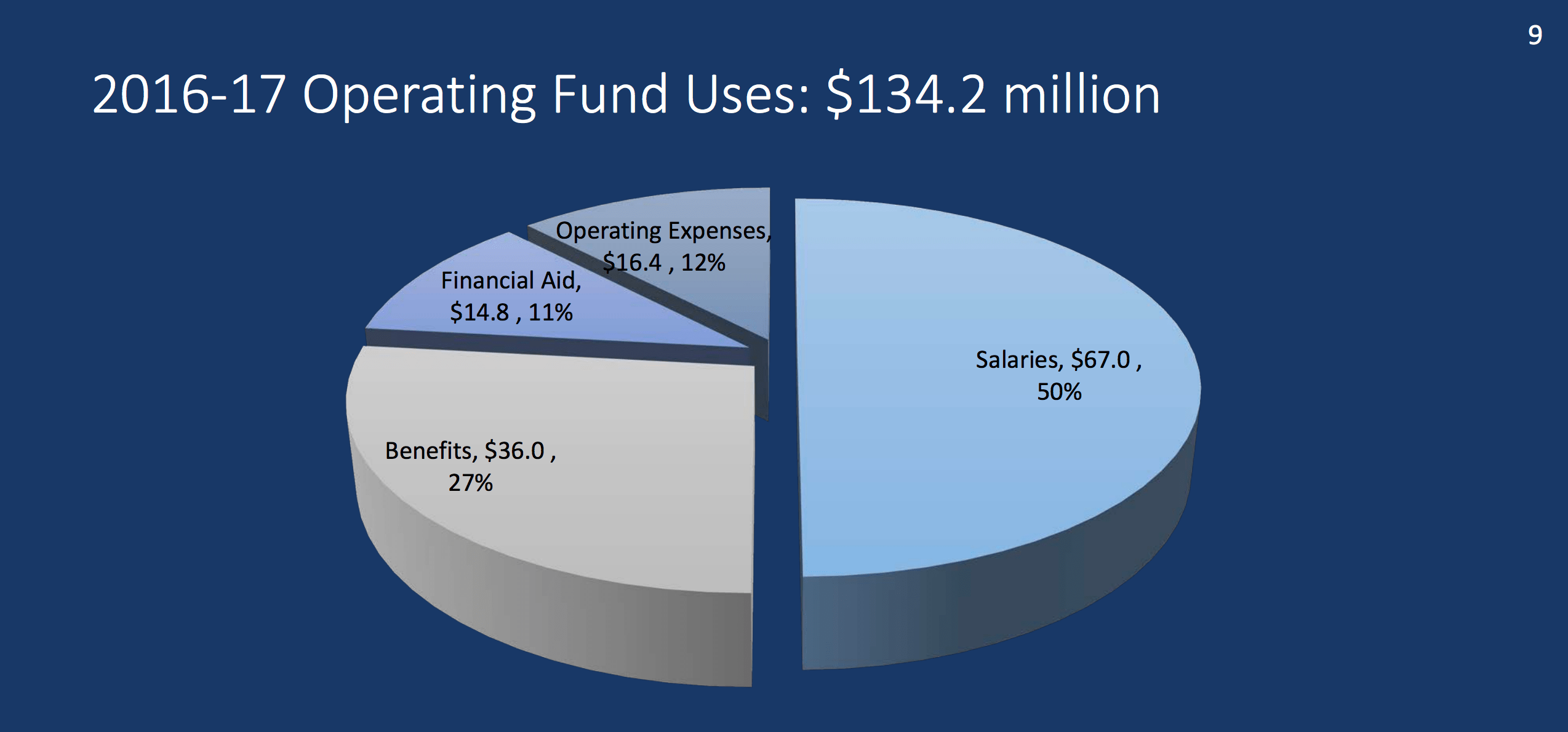
    FIRMS codes break down HSU’s spending into five categories: instruction ($56.6 million in the current budget), institutional support ($21.6 million), operations and maintenance of plant ($16.3 million), academic support ($15.6 million) and student services ($12 million). Each of these categories represent a FIRMS program, and the budget determines what percent of the total amount of funding goes to each category.

    Using these categories, the URPC also compares HSU’s spending to other CSUs. According to the presentation, spending at HSU in comparison to similar-sized campuses for the 2017-2018 school year was 17% higher at HSU for instruction, 24% higher for academic support, 3% higher for student services, 10% higher for institutional support and 1% higher for operations and maintenance of plant.

    The presentation also showed three possible scenarios for the future of enrollment and its effects on the budget. The best case scenario, called the growth scenario, shows a leveling off of the enrollment decline and a budget gap in the $4 million range by the 2021-2022 school year.

    The current scenario, upon which URPC’s projections are based, shows a continued decline that leads to the budget gap of $5.4 million. The worst-case scenario shows further decline and a budget gap of up to $7 million by the 2021-2022 school year.

    The URPC’s current budget plans are based on the middle scenario of a $5.4 million gap.

    Woglom said the URPC still has to figure out how to allocate its funding to keep current programs intact.

    Budget projections from the University Resources and Planning Committee’s Nov. 7 public forum presentation show a $5.4 million budget gap by the 2021-2022 school year.

    “It raises interesting questions about where you can move within that,” Woglom said.

    Just one day after the URPC’s public forum, HSU released a campus announcement detailing the process for filling staff vacancies during the current enrollment decline and budget deficit. The announcement said that while current staff positions will not be eliminated, positions deemed “non-critical” by the vice president of the relevant division won’t be backfilled when a person leaves that position.

    Woglom confirmed that announcement.

    “The intention of the University at this point is to work to determine where attrition will happen and backfill positions in that manner,” Woglom said.

    This backfiring process does not apply to faculty, according to the announcement.

    The URPC’s next and final public forum is scheduled for Dec. 3 at 11:30 a.m. in the Goodwin Forum, during which the public can review the URPC’s draft plan before it is sent to the University president for review. Woglom urges everyone to give their input.

    “Any ideas that people have that they’d like to share with us, the better our decision-making process can be,” Woglom said.

    “I think [student input is] a challenge in itself,” Cruz said. “But I think that just because it’s challenging doesn’t mean it shouldn’t be pursued.”

    Yadira Cruz

    Reed and Cruz said they don’t think two public forums are enough to gather sufficient student input.

    “I think overall we should be making a stronger effort to connect with students and get their overall opinions,” Reed said.

    Reed suggested that the URPC should seek to get input not just from some students, but from the majority of students. Cruz agreed.

    “I think that’s a challenge in itself,” Cruz said. “But I think that just because it’s challenging doesn’t mean it shouldn’t be pursued.”

  • HSU’s Budgetary Future

    HSU’s Budgetary Future

    Humboldt State’s Budget Committee seeks best path forward

    Humboldt State University’s University Resources and Planning Committee met on Sept. 12 to begin planning a three-year university budget.

    Art Education Assistant Professor and Co-Chair of URPC James Woglom said URPC hopes for a budget that will allow HSU to be its best.

    “My hope is to have the best university we can be in the context of what we have,” Woglom said. “I think that is the hope of everybody involved.”

    URPC exists as part of the University Senate, with 14 members, including administration, faculty and students.

    URPC released an update on Sept. 16 in which it estimated a $5.4 million budget gap by the fiscal year of 2021 to 2022.

    HSU Budget Director Amber Blakeslee said HSU has already made over $10 million of budget reductions in the last few years. The $5.4 million projected gap comes from the continuing decline in student enrollment.

    Assistant Professor of Art Education and Co-Chair of the University Resources and Planning Committee James Woglom in the HSU library on Sept. 20. Woglom emphasized the need for imaginative thinking to create the best budget possible for HSU. | Photo by James Wilde

    “If there are less students on campus there’s less tuition coming in the door,” Blakeslee said. “So it’s not that all-of-the-sudden we’re spending more. It’s that there’s less revenue coming in to support the spending that we have.”

    HSU’s enrollment dropped from 7,774 to 6,763 students this year. Projections expect enrollment to continue to drop. HSU has yet to update its website, which still lists 7,774 students enrolled and advertises having over 8,000 students.

    HSU issued a press release on Tuesday, Sept. 24 detailing new efforts to increase enrollment, including a focus on local recruitment, improving student analytics and decreasing costs. 

    However, Blakeslee said that HSU’s plans to recover enrollment numbers will take time. Until then, the budget gap must be reconciled.

    Blakeslee hoped the budget cuts won’t have an impact on students, but Blakeslee acknowledged that any cuts will be difficult.

    “There’s not a single thing we do on this campus that doesn’t have strong, passionate people behind it,” Blakeslee said. “If you’re talking about cutting things, you’re talking about the difference between multiple good things.”

    “If there are less students on campus there’s less tuition coming in the door. So it’s not that all-of-the-sudden we’re spending more. It’s that there’s less revenue coming in to support the spending that we have.”

    Amber Blakeslee

    At this early stage, neither Blakeslee nor Woglom could rule out any specific cuts.

    “We do need to have everything on the table in terms of our discussion so that we can make the best decision,” Woglom said.

    Woglom emphasized multiple times that URPC will have to use its imagination to maintain HSU’s educational mission while cutting back financially.

    “We do need to be creative within the context of the resources that we do have,” Woglom said. “If a course is not offered, how do we make sure that the curricular needs of the students is met with what we do have?”

    Blakeslee said that while HSU is currently reducing expenditures, it is still trying to improve the student experience.

    “There is simultaneous new investment happening, so it’s not like we’re just in a reduction mindset purely” Blakeslee said.

    URPC expects to complete a plan by Dec. 6. Before then, both Blakeslee and Woglom emphasized the importance of seeking input from the HSU community.

    “As much stakeholder input as we can get, the better our decisions are going to be, and the more interpersonally-invested we’re going to be,” Woglom said.

    Blakeslee and Woglom said URPC will be holding public forums to discuss the budget, but no dates have been set.

    Once URPC finalizes its plan in December, the plan will go to University President Tom Jackson, Jr., who will have the final say over the plan.


    This article was updated Sept. 26 to include information from Humboldt State’s press release on the topic.

  • CNRS students want answers

    CNRS students want answers

    Humboldt State students from College of Natural Resources and Sciences, or CNRS, gathered for a talk on Thursday, March 8 to address the CNRS budget crisis. The talk was facilitated by Stephany Salgado, a biology major. Both the interim dean, Steve Smith, and associate dean of CNRS, Rick Zechman, attended the talk.

    “I want to make sure CNRS is getting the students involved,” Salgado said.

    The CNRS is facing $2 million in budget cuts and students are concerned their fall 2018 semester classes will be cut.

    Smith is filling the position that Richard Boone held until March 5. Smith was the dean of CNRS between 2010-2016. Being back from retirement for only two days prior to this talk, Smith revealed some ideas of possible solutions to the CNRS budget deficit. Smith mentioned possible changes, but would not go into any specific details.

    Smith explained how the department spending works and, how in the past, the reserve would take care of expenditures exceeding the budget. There is currently little reserve funds and the CNRS department spending is required to stay within the budget.

    “For a long time, the university has been deficit spending and we have to turn that around,” Smith said.

    Smith expressed the most important factor of all is to meet the students’ academic unit demand.

    “We are going to meet the academic demand for student courses. What might change is who is teaching the course,” Smith said.

    Smith did not go into details about allocating teaching modes.

    Smith assured the students the same courses will be available this fall, but he doesn’t know when or if he can solve all of the budget deficit problems.

    “This is the short version of a very complicated problem,” Smith said.

    A student asked Smith if professors could teach more and spend less time on research. Smith responded that it would be up to the tenure-line faculty.

    Smith also reminded students that professors belong to a labor union that directs their hours, and that tenure-line faculty are expected to do research.

    A student asked if graduate student programs will be adversely affected.

    “Graduate funding will increase, if anything,” Smith said.

    Another student asked about a fall class that is listed as unavailable. Smith assured the student that will change before registration. He also assured that all classes will appear on the schedule for registration.

    One student asked about reductions in programs. Smith didn’t think there would be reductions.

    “I don’t see anything along the lines of downsizing, probably elimination,” Smith said. “I don’t see that in the cards. Please don’t rush out and say we are going to cut programs.”

    Zechman pressed on the importance of having students’ degree audit reports, or DARS, planned out for three semesters ahead of time.

    “It is critically important to have your DARS planned out for three semesters ahead so CNRS knows how many seats it needs to offer for that class,” Zechman said.

    President Lisa Rossbacher reassures students the administration is working to guarantee them the classes they need to graduate.

    “We are doing everything possible to make sure students get the classes they need to make progress towards graduation and graduating on time,” Rossbacher said. “We still have one of the best science departments in the country with our natural resources and outdoor labs.”

  • Students v. admins: frustrated conversations at the budget cuts walkout

    Students v. admins: frustrated conversations at the budget cuts walkout

    “Students’ rights! Students’ rights!”

    “Where the fuck is Lisa? Where the fuck is Lisa?”

    “Cut her pay! Cut her pay!”

    Video by Bailey Tennery.

    HSU students could be heard storming through Siemens Hall yesterday, demanding the school’s administration to face students’ anger surrounding the budget crisis.

    Trevor McDowell, a wildlife major at HSU, was among the crowd of student protestors.

    “We are marching to find President Rossbacher, wherever she is meeting with WASC,” McDowell said.

    WASC, or the Western Association of Schools and Colleges, is a reviewing body that determines whether a school is capable of preparing students for the next steps in their careers.

    Dr. W. Wayne Brumfield, interim vice president of student affairs, explains the significance of a WASC approved institution.

    “WASC accreditation happens all across the country, and is important to a student’s degree. Having the accreditation is a sign of a healthy institution with good academics,” Brumfield said.

    Interim VP of Student Affairs Dr. W. Wayne Brumfield listens to student demands in Siemens Hall on March 21. Photo by Philip Santos.

    David Alvarez, a student protestor, wanted Brumfield to know that HSU is not healthy.

    “Why is there a lottery to live on campus? That’s not healthy,” Alvarez said. “I am scared to be homeless. We are not healthy.”

    The students’ protest, led by Moxie Alvarnaz, started in the UC Quad.

    “How do you feel about the budget cut? The administration just got another raise,” Alvarnaz said.

    A collective “boo” swept through the crowd.

    Dr. Alexander Enyedi, HSU’s provost and an administrator, was in attendance at the protest.

    “I think we should keep the focus on the budget structure,” Enyedi said. “A deficit is different from a budget cut. The colleges’ budgets are mostly untouched, but we are asking them to not spend more than what they are given.”

    Enyedi was certain that using the school’s degree auditing system, or DARS, to gather an idea of what classes students need will ensure that students have the right classes to graduate on time, in spite of the deficit reduction effort.

    Tents in the UC Quad at Humboldt State during the student-organized event to protest budget cuts on March 21. The walkout was organized by Students Coalition for Organized and Direct Action. Photo by Matthew Hable.

    As students marched into Siemens Hall from the UC Quad to find President Lisa Rossbacher, they confronted Enyedi in front of his office. William Cooke, a student protestor, disagreed with Enyedi on the class offering strategy.

    “If you think that we should be prepared for the rest of our lives, then why offer only the classes we need?” Cooke said. “I pay so much money for my education. Why can’t I take the classes that I want to take and experience college fully?”

    Footage by Garrett Goodnight. Edited by Bailey Tennery.

    David Alvarez, an undeclared major, expressed concerns for students’ ability to explore different majors.

    “I am undeclared. What if I want to become a biology major? Are you going to cut biochemistry [and] botany classes?” Alvarez said.

    Kelsey Meusburger, another student protestor, explained what students are seeking from administrators.

    “We are asking for an income cap to make HSU a more equitable place,” Meusburger said. “Is that something you’d be open to?”

    “Always, always,” Enyedi said.

    Ben Gorham and other HSU students ensure they are heard while WASC reviewers meet in Siemens Hall 222 on March 21. Photo by Philip Santos.

    Brianna Allen, who was missing a capstone class to be at the protest, expressed frustrations with the responses Enyedi has given to students’ questions.

    “I need to see you take action,” Allen said. “I need to know if you will advocate for us, on the board of admin, to take budget cuts through your money.”

    “I will advocate for you,” Enyedi said. “I will discuss with the cabinet about the ideas that are being put through.”

    Dixie Blumenshine, a biology major, brought up the recent firing of CNRS’s dean, Dr. Richard Boone.

    “Why did Rich Boone leave early? His resignation isn’t effective until June,” Blumenshine said.

    “He wasn’t interested in doing his job anymore,” Enyedi said. “If he was committed, he wouldn’t resign.”

    Kylie Brown, a general biology freshman student, was watching the protest from the UC Quad.

    “I am here today because I heard that some classes, which I’m hoping to take, will be cut,” Brown said. “I hope to become an endangered species biologist. If the [budget deficit] cuts botany classes at HSU, I will not be prepared for my career. This makes me angry. I haven’t been able to experience all the classes I want to take, and they’re already taking it away.”

    Lizzie Phillips (left), one of the members of Students Coalition for Organized and Direct Action who participated in the HSU walkout on March 21, stands in front of a makeshift mural where students air our their grievances on the budget cuts at Humboldt State. Photo by Matthew Hable.

    Hana Watanabe and Kotaro Kawakubo, international students, were present at the protest in the UC Quad.

    “We heard about this protest through our professor, who told us to come see the cultural differences,” Watanabe said.

    “We’re also here because we’re worried about the office of international programs,” Kawakubo said. “Our boss has already been fired. We don’t want the office to close. Losing this program would be like losing a home for us.”

    Students are encouraged to attend the Associated Students budget forum on Monday, March 26th, from 5-6:30 pm in the KBR for further questions.

    See what the HSU budget looks like at URPC.

    Information on HSU’s WASC accreditation can be found here.

  • Housing and international program directors lose jobs

    Housing and international program directors lose jobs

    The reality of Humboldt State budget cuts sets in as three departments recently lost employees. The positions of Associate Director of Housing Facilities, Steve McKenzie, Director of Center for International Programs, Ge-Yao Liu, and Associate Vice President for College of Extended Education & Global Engagement, Alex Hwu, were brought to an end.

    When contacted to speak on this matter, Liu did not wish to make a comment on his dismissal or the budget reductions.

    “All I want to say is to wish the university the best, and I am grateful for the opportunity to serve as the director of International Programs for a bit over one year,” Liu said.

    All other employees contacted at the International Center did not respond or did not wish to comment.

    Since the open budget forum held on Feb. 2, it hasn’t been a mystery to HSU students and faculty that the school is facing a major budget crisis. In the summary of the University Cabinet outline of Budget Reduction Decisions, an immediate plan is to “Reduce five administrator positions and eight vacant staff positions.”

    In a message sent to HSU students on Feb. 26, President Lisa Rossbacher wrote that HSU must reduce its budget spending by $9 million over the next two years.

    “I am writing today to reassure you that our very highest priority remains your educational experience,” Rossbacher wrote. “Even as we make reductions, we are protecting the core offerings of classes and support to help you progress toward completing your degree. Our budget decisions will lead to a ‘Students First’ budget, which I will share with the campus community by March 29.”

    It is not yet clear what the “Students First” budget will look like, but some students are worried about the way the budget cuts will affect them.

    “I came in from a break and people kept saying, ‘We’re gonna lose our jobs,” student assistant in Housing and Residence Life, Zach Pole, said.

    Though Pole says he is still in denial, he believes students losing their jobs is a possibility and thinks this will affect the department negatively.

    “The student assistants kind of do all the really basic, remedial and trivial stuff,” Pole said. “Without us, they’re gonna have to do this themselves when there’s more important things going on.”

    Pole said in a Housing and Residence Life meeting last week that Housing and Facilities Management are merging, and that McKenzie’s position was eliminated.

    Director of Housing and Residence Life, Stephen St. Onge, did not have time to give an interview, but wrote an email responding to student concerns.

    “We have not cut any student assistant positions for budget cuts,” St. Onge. “In fact, we added resident advisor positions last year to best support the building of community on campus.”

    This story has been changed from its original version on March 12 at 11:09 a.m.

  • Universities should model accountability

    Universities should model accountability

    The sudden retirement of HSU Athletics Director Daniel Collen raises unanswered questions of accountability. How did administrative oversight fail to anticipate and mitigate Athletics’ budget crisis threatening the football program? Did Mr. Collen’s political campaign and election to the Northern Humboldt School District Board interfere with directing the athletics department? Did Mr. Collen hold appropriate academic credentials for a top university post? (Does his replacement?).

    Did Collen negotiate a secret settlement to immediately retire after facing lawsuits alleging misappropriation of donations for his fishing trips to Ketchikan, Alaska with two other HSU executives; or, the lawsuit by long-term HSU athletics employee Dan Pambianco alleging he was demoted for exposing Collen’s extravagant university-funded travel; or, Collen’s termination of 25-year track coach Dave Wells resulting in a $250,000 settlement?

    Apparently, no reforms were enacted since the infamous $15 million fraud committed by HSU executive John Sterns in 2001, and the secret settlement from the class-action lawsuit filed by Education Department professors. Following these scandals, former HSU President Alistair McCrone negotiated a retirement settlement by accepting a temporary “consultant” position at his full president’s salary. Sterns’ immediate supervisor, Vice President Don Christensen, became a university administrator in Oregon. (CSU auditors concluded that HSU’s fearful workplace enabled Stern’s financial fraud and embezzlement to continue for 3 years!).

    Humboldt County has extraordinary recreational resources: rivers, forests, shoreline, parks, trails, lagoons, harbor and wetlands, yet, McCrone and former HSU president Rollin Richmond authorized hundreds of millions of dollars over 2 decades on new and remodeled facilities for recreation, leisure, entertainment and sports, requiring more staff, faculty, management and maintenance while simultaneously cutting academics. Expanded leisure activities attracted wealthier students despite high participation fees… until a declining economy persuaded families to rediscover the value of academics closer to home, leaving HSU today with fewer students and a fully funded “resort.”

    Divesting in HSU academics produced overcrowded classrooms; elimination of numerous courses and entire degrees in nursing, industrial technology and German language; early retirement of the most experienced professors; the highest athletics fees in the CSU system; and three decades of relentless tuition increases culminating in debilitating debt for graduates. HSU’s high-security “campus resort” with pretentious locked-gate housing, rock climbing walls and library lattes are the LAST things needed by hundreds of homeless students (and thousands more working-class) who rely on administrative leadership to focus on relevant academic resources required to succeed.

    The public deserved to hear responses to unasked questions of accountability from Collen, Richmond, McCrone, Christensen and many others.

    Prioritizing accessible academics over a class-centered resort is essential in preparing graduates for the looming realities of environmental, economic and social crises from climate change and perpetual wars for foreign oil, minerals and oppressed labor. Achieving carbon reduction and full employment from a green, U.S.-made economy would require prerequisites in urban planning and social, political, economic and environmental activism tailored to every degree. These include prerequisites in citizenship, labor history, contract law, diplomacy and negotiation that are fundamental in developing confidence and assertiveness within student’s chosen career; in demanding accountability at work, school, community and personal relationships, or in signing countless contracts for housing, employment, transportation, credit cards and healthcare.

    Accountability at HSU requires transparency. For example, administrator’s academic credentials, compensation and pensions are not being reported. In fact, HSU cancelled publication of its annual directory listing everyone working on campus and their titles. Incompetence, nepotism, favoritism, fraud and corruption, like mycelium, thrive in darkness and costs millions!

    The Bay Area firm Strategic Edge Consulting, hired by HSU last year, noted communication problems between former HSU Athletics director Collen and other departments raising broader questions about campus leadership and professionalism. Few ironies are more astonishing than a public university led by administrators lacking advanced degrees in public administration or communication who are charged with promoting and governing “academic excellence” for teachers and students. A credible vision for academic excellence could come from administrators recruited from hundreds of adults graduating with honors on U.C. campuses each year with advanced degrees in public administration, public finance and human resources; individuals more capable in avoiding budget chaos and recurring failures to integrate due-process employment rights into personnel practices. Until then, HSU’s lack of vision and its history of unaccountable multi-million dollar scandals, lawsuits and secret settlements will continue.

    Without basic skills, experiences, and responsibility in demanding accountability where we live, work and learn, every community’s local government, university and media will continue to cooperate, legitimize and empower this nation’s fascist drift that Donald Trump’s reelection and “Alt-Right” policies rely on.


    Sincerely,

    George Clark

    HSU Liberal Arts graduate 1982,

    (My debt-free education met the requirement for an “accessible public education” guaranteed under the U.S. Education Act of 1965).

    HSU Center Accounting Technician 1979-1989


  • One dollar forward two dollars back

    One dollar forward two dollars back

    By | Curran C. Daly

    Humboldt State has spent more money that it has made in each of the last seven years. This tradition of deficit spending has led to the implementation of a three-step process to address the deficit and reinvest in the university.

    The university is currently in the early stages of planning Phase Two of the budget re-organization. Where Phase One looked to make changes that could be implemented quickly, Phase Two is tasked with making more systemic changes. A January letter from President Rossbacher’s cabinet to the University Resource and Planning Committee outlined the different aspects of the budget reduction plan.

    “To start, we are focused on Phases One and Two to reduce the University’s expenditures by 5 percent to address the deficit,” said the letter. “If any funds remain, begin strategic reinvestment.”

    Instead of making horizontal cuts, in which every department gets cut 4-5 percent, the Provost’s office is looking at making vertical cuts in which some departments take larger cuts than others. How large a cut a department will be asked to make depends on potential cuts identified within departmental budgets.

    Screen Shot 2017-10-24 at 3.29.19 PM

    “We are looking at a 5 percent efficiency,” said Provost Alexander Enyedi. “But we told the colleges to look at 2 percent.”

    The effort to balance Humboldt’s budget is not as simple as increasing enrollment. Even when Humboldt’s enrollment reached its peak in the 2015-2016 academic year, the school still overspent its revenue by $700,000. Humboldt State currently spends more money per full-time equivalent students than any other similarly sized campus in the California State University system. What reached $15,810 per student in the financial year of 2015-2016 is expected to reach $17,904 for the 2017-2018 financial year. This has created an expected deficit of $1,600,000 for the 2017-2018 Academic year.

    Phase Two is now tasked with getting Humboldt State’s budget to a point where the revenue exceeds the expenditures for the first time in nearly a decade. Still early in the planning stages, Dean for the College of Professional Studies Manohar Singh is still not able to say exactly what cuts to expect.

    “We have not identified any specific things because we are right in the beginning of that process,” said Singh. “We are looking at photocopying for example, we are looking at how many papers we print, we are looking at how many telephone lines are in the college, so maybe there are some sources of savings there.”

    Screen Shot 2017-10-24 at 3.23.36 PM

    The largest component of Humboldt State’s expenditures is spent on salaries and wages. What comes out to $67,000,000 takes up 50 percent of Humboldt’s expenditures for the 2017-2018 year. Salaries and wages take up a large part of the budget. There is a possibility that cuts could impact faculty positions.

    “We are also very conscientiously looking at every individual as a human being, so it’s not like we are going to go out and say ‘alright one, two, three, four are out,’” said Singh. “It is going to be a very, very sincere, conscientious effort to respect everybody.”

    One way the school is currently saving money is the elimination of vacant positions. This has lead to the elimination of the position of Dean of Research and has cut down on the number of available custodial positions on campus.

    The university is focused on making budget changes that will lead to a more efficient budget that does not negatively affect student experiences on campus.

    “What we want to do, is we don’t want to impact students,” said Provost Enyedi.