
The Lumberjack


Students Serving The Cal Poly Humboldt Campus and Community Since 1929

Tag: budget deficit

  • URPC Builds Budget, Seeks Student Feedback

    URPC Builds Budget, Seeks Student Feedback

    Only four students attended the first University Resources and Planning Committee’s public budget forum, according to Associated Students President Yadira Cruz.

    Around 50 faculty, staff and community members were in attendance as well, according to Art Education Assistant Professor and URPC Co-Chair James Woglom.

    Woglom said the URPC’s presentation, which can be found online at budget.humboldt.edu, focused on the URPC’s work toward creating a scalable budget model, or a budget that can be altered periodically to represent changing values.

    “It ends up bringing more people into the process of decision-making, and thus hopefully reflecting more people’s feeling of what we want this organism to do,” Woglom said of the URPC’s new model.

    James Woglom, art education assistant professor and University Resources and Planning Committee co-chair, checking his laptop in the Humboldt State Univeristy library on Nov. 14. Woglom said the URPC has created a new scalable budget model that allows for more flexibilty and input from the HSU community. | Photo by James Wilde

    URPC has been meeting over the course of the semester to form a three-year budget for Humboldt State. Woglom said the first step for deciding where to allocate funds is to clarify which values HSU should prioritize.

    Besides the forum, the URPC is taking feedback online through an online submission form, a Google survey designed to scale which campus values are most important and a pie chart budget simulator that allows proposals of how HSU should divide funds. Woglom said he’d also be happy to take suggestions through direct emails.

    While Cruz said she appreciated the existence of the online feedback forms, she said they can be obscure due to budgetary jargon.

    “Although it’s available, it might not be accessible in that way,” Cruz said.

    The Google survey, which is not yet released, lists a series of California State University values and asks the respondent to rate how much they agree with each one.

    “It’s not saying that we want to devalue any of them, but it’s trying to get a quantitative sense of where the University’s priorities are in terms of allocation of resources based across a series of ideas,” Woglom said. “And then hopefully with that quantification we can make decisions based on where we can make things happen.”

    The URPC’s current projections show a $5.4 million budget gap by the 2021-2022 school year, which reflects the impact of reduced tuition due to declining enrollment. According to the presentation, every 100 students generate about $560,000 in tuition.

    The University Resources and Planning Committee pointed to declining tuition numbers as the cause of HSU’s current projected $5.4 million budget gap.

    Joseph Reed, a political science and economics double major and a student representative on the URPC, said the key challenge has been ramping down the budget with the declining student body.

    “It’s kind of been hard to keep this budget for about 8,000 students when we don’t have 8,000 students anymore,” Reed said.

    Cruz said the budget should focus on the students HSU has now, and not the students it had in the past.

    “Being in that cutting mindset is potentially jarring for morale. I mean, you’re coming from a space where you’re like, ‘Alright, what do we have to not do this year?’”

    James Woglom

    “I think every campus goes through these sorts of financial challenges, but I think how we move forward is centering students,” Cruz said.

    Reed said the URPC has no plans to cut whole departments. Instead, Reed said cuts are more likely to be smaller and broader across the board.

    “Every department is being affected, but each one has its own budget, so each one has its own certain amount that it’s being reduced by,” Reed said.

    Over the past three years, URPC reduced the budget by $11.5 million. However, Woglom emphasized a difference between past and future cuts due to the new scalable budget model.

    “[In the past] we’ve cut what we’ve determined to be at the fringe of the project of the University—so maybe not in direct agreement with the strategic plan of the University or the general values of the University,” Woglom said. “Being in that cutting mindset is potentially jarring for morale. I mean, you’re coming from a space where you’re like, ‘Alright, what do we have to not do this year?’”

    The University Resources and Planning Committee showed three possible enrollment and budget scenarios in its Nov. 7 public forum presentation.

    With the new model, Woglom said HSU can start with a specific budget number and then distribute it to the things HSU values most. Woglom said the budget can be continually changed, which allows HSU to scale back up or down if monetary realities change.

    “We don’t want to make hurried and necessary decisions every year,” Woglom said.

    The URPC uses Financial Information Reporting Management System codes, which are used in higher education to categorize expenses by their function, to compare HSU’s spending to other CSUs.

    FIRMS codes break down HSU’s spending into five categories: instruction ($56.6 million in the current budget), institutional support ($21.6 million), operations and maintenance of plant ($16.3 million), academic support ($15.6 million) and student services ($12 million). Each of these categories represent a FIRMS program, and the budget determines what percent of the total amount of funding goes to each category.

    Using these categories, the URPC also compares HSU’s spending to other CSUs. According to the presentation, spending at HSU in comparison to similar-sized campuses for the 2017-2018 school year was 17% higher at HSU for instruction, 24% higher for academic support, 3% higher for student services, 10% higher for institutional support and 1% higher for operations and maintenance of plant.

    The presentation also showed three possible scenarios for the future of enrollment and its effects on the budget. The best case scenario, called the growth scenario, shows a leveling off of the enrollment decline and a budget gap in the $4 million range by the 2021-2022 school year.

    The current scenario, upon which URPC’s projections are based, shows a continued decline that leads to the budget gap of $5.4 million. The worst-case scenario shows further decline and a budget gap of up to $7 million by the 2021-2022 school year.

    The URPC’s current budget plans are based on the middle scenario of a $5.4 million gap.

    Woglom said the URPC still has to figure out how to allocate its funding to keep current programs intact.

    Budget projections from the University Resources and Planning Committee’s Nov. 7 public forum presentation show a $5.4 million budget gap by the 2021-2022 school year.

    “It raises interesting questions about where you can move within that,” Woglom said.

    Just one day after the URPC’s public forum, HSU released a campus announcement detailing the process for filling staff vacancies during the current enrollment decline and budget deficit. The announcement said that while current staff positions will not be eliminated, positions deemed “non-critical” by the vice president of the relevant division won’t be backfilled when a person leaves that position.

    Woglom confirmed that announcement.

    “The intention of the University at this point is to work to determine where attrition will happen and backfill positions in that manner,” Woglom said.

    This backfiring process does not apply to faculty, according to the announcement.

    The URPC’s next and final public forum is scheduled for Dec. 3 at 11:30 a.m. in the Goodwin Forum, during which the public can review the URPC’s draft plan before it is sent to the University president for review. Woglom urges everyone to give their input.

    “Any ideas that people have that they’d like to share with us, the better our decision-making process can be,” Woglom said.

    “I think [student input is] a challenge in itself,” Cruz said. “But I think that just because it’s challenging doesn’t mean it shouldn’t be pursued.”
    Yadira Cruz

    Reed and Cruz said they don’t think two public forums are enough to gather sufficient student input.

    “I think overall we should be making a stronger effort to connect with students and get their overall opinions,” Reed said.

    Reed suggested that the URPC should seek to get input not just from some students, but from the majority of students. Cruz agreed.

    “I think that’s a challenge in itself,” Cruz said. “But I think that just because it’s challenging doesn’t mean it shouldn’t be pursued.”

  • Provost speeds up dean’s resignation

    Provost speeds up dean’s resignation

    “I couldn’t compromise the values of CNRS and my own.”

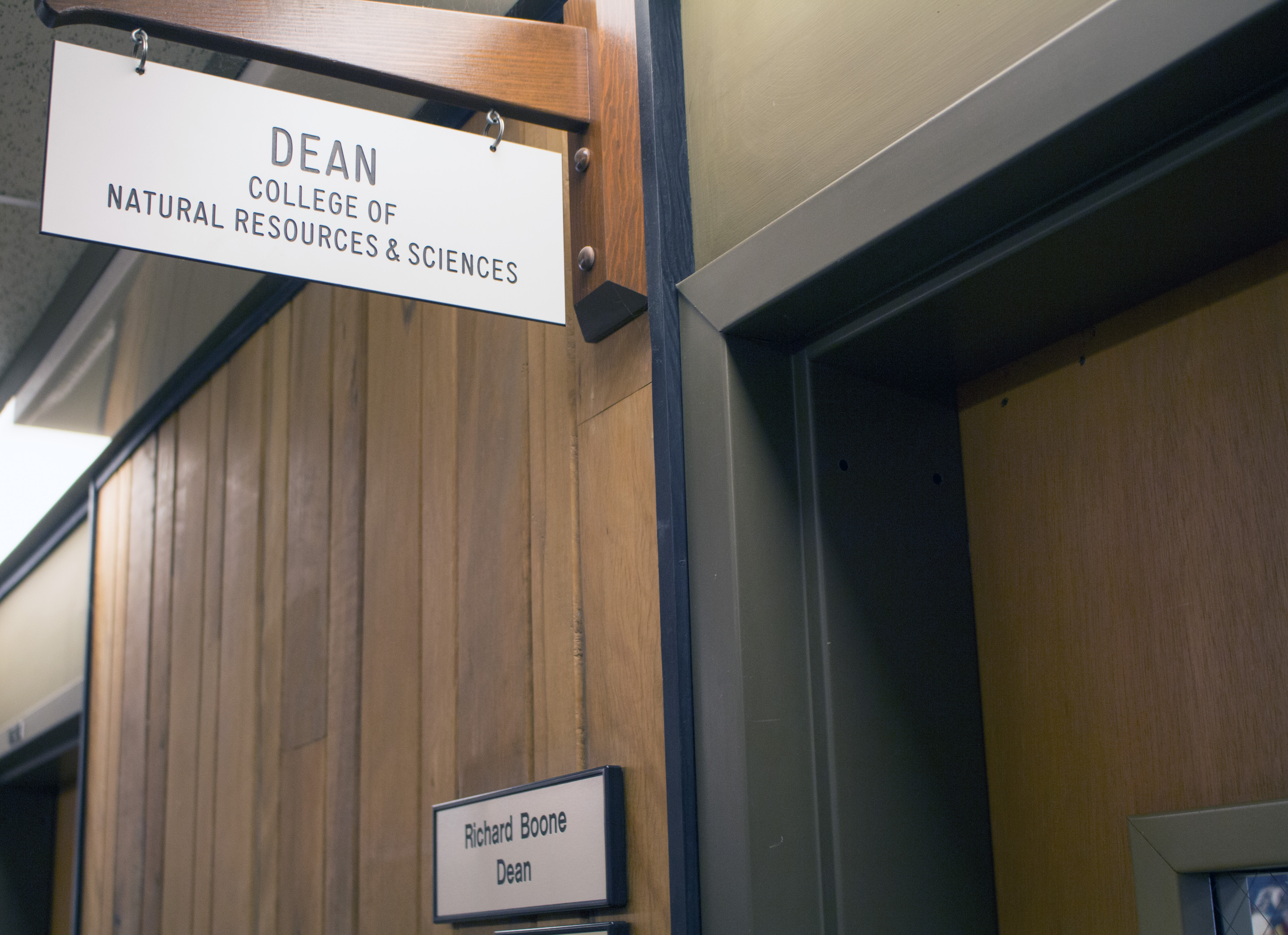
    Richard Boone, the former dean of College of Natural Resources and Sciences at Humboldt State, was let go before his resignation came into effect. Earlier this month, Boone formerly announced his resignation, effective June 30. But Alexander Enyedi, provost and vice president for Academic Affairs, informed him in a meeting on March 9 that his resignation was accepted and effective immediately. Steve Smith took office as the new interim dean for CNRS, replacing Boone.

    Boone planned to remain dean of CNRS until June 30, as he said to the provost when he resigned. He was surprised during the meeting that he didn’t have the time to continue working on the things he planned out.

    It was important for Boone to carry out his plans leading up to the initial June 30 resignation. He and his staff were in the process of finalizing the steps to reduce the budget for next year.

    “Having the remaining time was important for me, personally and professionally,” Boone said. “Also for the college and my role in the college, I was looking forward to working in Humboldt until the end of June.”

    Boone said he doesn’t know why he was asked to leave office four months before his initial resignation date.

    “I had conveyed to [the provost] my resignation was effective June 30 and he had not rejected the date when I met with him,” Boone said.

    The Lumberjack reached out to the provost to comment on Boone’s resignation, but was directed to HSU’s public relations team. Humboldt State communications specialist, Grant Scott-Goforth, responded about why the provost adjusted his resignation date.

    “Unfortunately, because it’s a personnel issue, the school can’t release anymore details about the resignation,” Scott-Goforth said. “We have a duty to protect individual privacy in these kinds of matters. I’m sorry I can’t help more.”

    Boone left the area and is now in the process of relocating to Fairbanks, Alaska.

    “I’m leaving Humboldt with a great deal of sadness,” Boone said. “I loved Humboldt and I really loved Arcata. This is a part of me and it will always be a part of me.”

    Reflecting on his time at HSU, Boone said he really enjoyed his time working as dean.

    “It was an honor to serve as the dean,” Boone said. “It was really a joy to work for the CNRS faculty, staff and students.”

    According to Rick Zechman, associate dean of CNRS, Boone was respected across HSU and concerned about CNRS.

    “He was very concerned about the health and vitality of the college, its students, faculty and staff,” Zechman said.

    Why did Boone resign?

    Boone and HSU provost Enyedi had conflicting views regarding the depth of the cuts to the CNRS budget.

    “I decided to resign, because it became clear the provost and I had irreconcilable differences over the depth of budget cuts and priorities for CNRS,” Boone said. “I couldn’t compromise the values of CNRS and my own.”

    Boone said his strength is in building new programs, developing interdisciplinary teams, integrating research in teaching and graduate education. With the current budget crisis HSU is facing, there’s going to be some downsizing. In such an environment, Boone thinks he can’t put his skills to practice.

    “I felt that I couldn’t utilize that experience and skill set sufficiently to make me satisfied and to help the college as much as I wanted to,” Boone said.

    Boone said he is proud of the work he has done as the dean of CNRS.

    “I think I did good work in my time there and would have continued doing good work through June,” Boone said.

    Though Boone is proud of his work as dean, he said he could’ve done better if not for the current budget cuts.

    When he joined HSU on July 25, 2016, Boone was aware of CNRS budget deficit, but not the university deficit.

    The cause of CNRS deficit wasn’t clear to Boone at first. Last year, he spent time understanding the budget for CNRS and the university.

    “It wasn’t clear to me initially why there was a mismatch between the budget and the expenditures in the college,” Boone said. “I learned the mismatch is primarily due to the under-budgeting of lectures in college.”

    Boone started the CNRS strategic planning committee. One of the goals of this committee is to find ways to achieve a balanced budget.

    “I took my responsibilities seriously to eliminate the deficit,” Boone said. “I believe that the strategic planning process we started this year would’ve led to recommendations for a balanced budget.”

    According to Zechman, the strategic planning committee is one of Boone’s major initiative during his short time as dean for CNRS. This initiative will guide the college for coming years.

    “[Boone] has a collaborative leadership style that was reflected in one of his major initiative during his brief time as dean of CNRS, a strategic planning effort involving faculty, staff and students that will guide the college over the next several years,” Zechman said.

    Over the last eight years, the college grew in terms of majors and number of full-time students. To accommodate the growth, the college hired around 57 lecturers. Costs for most of those lecturers were not added to the college budget.

    “Last year, if the money for the lecturers that we employed was in the budget, there would not have been a deficit,” Boone said.


  • Humboldt State University budget crisis

    Humboldt State University budget crisis

    Humboldt State University held an open budget forum on Feb. 2 to discuss the threatening budget situation that could put the university in a potential crisis.

    Shortly after the forum, HSU President Lisa Rossbacher sent a message to the campus community:

    “In short, HSU’s budget situation has worsened over the course of this year due primarily to ongoing deficit spending in some areas, unfunded increases in salary and benefits, a continued decline in enrollment and projections based on the recent state budget for 2018-19 proposed by the governor,” Rossbacher said.

    Rossbacher wanted students, faculty and staff to take away a few things from the budget forum.

    First, a sense of the position that we’re in and the history of how we got here. Rossbacher wanted to make clear that it’s not anyone’s fault. This crisis has been ongoing from decisions made 10 to 30 years ago.

    “I want people to understand the situation that we’re in, the importance of working as a community to address it and solve the problems now,” Rossbacher said. “All of us that were involved in the discussions and planning are acutely aware of the impact the decisions will have on people… employees, potentially on students.”

    “We’re trying to do this with care and compassion,” Rossbacher said.

    Beth Eschenbach is the chair of environmental resources and engineering. She doesn’t quite know how the budget cuts will affect her.

    “I think everybody is afraid of saying what they’re really going to do,” Eschenbach said. “What I fear, they keep telling the academic side to save money, but the only way to save money is to teach fewer classes.”

    Zack Pitnick, environmental studies major, is a senior at HSU. He was one of the three students that showed up to the budget forum.

    Pitnick decided to come to the forum after hearing about it from his environmental studies professor. Pitnick wanted more of a student input in the discussion.

    “There needs to be a lot more transparency and [student] involvement,” Pitnick said. “I think there still does need to be cuts to higher up faculty salary. If they are so focused on this budget deficit, that should be the first thing to start instead of the very last resort.”

    Alex Enyedi, provost and vice president for Academic Affairs for Humboldt State, described the financial crisis in a nutshell.

    “It’s a simple overspending of the budget, and the next steps are to identify and trim back where spending is too much,” Enyedi said. “For example, we’ve got certain areas where we’re deficit spending, so we need to stop the deficit spending and that will help us with our budget.”

    Enyedi went on to say the problem is solvable, but it’s going to take combined efforts to solve.

    “It’s not the students’ problem,” Enyedi said. “It’s the administration, the staff and faculty’s responsibility to figure this out and we’re on it. This is a high priority, [and] we don’t have sufficient reserved dollars to be able to keep on covering the deficit spending.”