
The Lumberjack


Students Serving The Cal Poly Humboldt Campus and Community Since 1929

Tag: budgetary impact

  • HSU Projecting Grave Hit to Enrollment for Fall Semester

    HSU Projecting Grave Hit to Enrollment for Fall Semester

    Freshman class projected to shrink, number of academic departments to be reduced

    For the latest information, see our story here.

    Update 11:10 a.m.: a second email sent yesterday from College of Natural Resources Dean Dale Oliver and obtained by The Lumberjack makes similar points but does not give a specific number to the expected enrollment drop for fall beyond noting that a 15-20% drop was expected prior to the COVID-19 outbreak. We will update this story when we have confirmed the numbers below. The second email is pasted below.

    Humboldt State University has issued a budget directive to take immediate action to prepare for the fall semester, including the freezing of open staff positions and the reduction of the number of academic departments, according to an email sent to faculty and staff of the College of Arts, Humanities and Social Sciences Tuesday morning.

    The email, sent by Interim Dean of CAHSS Rosamel Benavides-Garb, projected a freshmen class for fall 2020 of around 500 students, down from around 1,400 students five years ago and down from around 1,000 students for fall 2019.

    “The scale and impact of our current predicament is grave and as a result our budgetary practice has to be reconsidered and reformulated based on the simple equation of demand and resources,” the email said. “We have become, de facto, a much smaller institution, which compels us to undertake a comprehensive reset at HSU.”

    The email listed six directives, including requests to freeze all vacant staff positions, reduce the number of academic departments and develop online programs for current and transfer students to complete their degrees.

    The email promised to make the process consultative and sustainable.

    “We remain committed to “the student first” approach,” the email said, “and are extremely aware of the critical importance, now more than ever, of issues of social justice, equity, and inclusion in all we do.”


    The full email is copied below:

    Dear CAHSS Colleagues,

    On April 2, the deans of all three academic colleges received new administrative directives from Interim Provost Lisa Bond-Maupin regarding the coming academic year. The directives are a call to action, issued in response to the budget and recruitment/retention reality at HSU. The Interim Provost reiterated these directives yesterday, Monday, April 6 in her Provost/VPAA Report to the senate.

    As we all know, our student enrollment has been declining for several years and the institutional budget has been negatively impacted. The administration’s efforts to address the problem must now be reframed in light of new and profound challenges the current COVID-19 pandemic poses for HSU, and the CSU system in general.

    We are projecting a freshmen class of 500~ students across all three colleges. Five years ago, the freshmen class numbered 1,400+ students. The scale and impact of our current predicament is grave and as a result our budgetary practice has to be reconsidered and reformulated based on the simple equation of demand and resources. We have become, de facto, a much smaller institution, which compels us to undertake a comprehensive reset at HSU.

    The Interim Provost has directed the three academic deans to reduce spending and grow retention/recruitment. Her directives require our college to implement the following action areas immediately:

    1. Freeze all vacant staff positions: This is indefinite or until each college develops a plan to organize staff support within colleges and across colleges.

    2. Reduce the number of academic administrative units (departments): This needs to be planned immediately and be in place for this next fiscal year so we are reorganized starting fall 2020.

    3. Develop online degree completion opportunities for certain existing majors in the last two semesters of their programs.

    4. Develop two-year degree online completion opportunities for transfer students of certain majors beginning fall 2020.

    5. Develop a partnership with CEEGE related to workforce development, responding particularly to a post COVID-19 context.

    6. Integrate the Center for Teaching and Learning (CTL) in the development and implementation of new teaching capacity.The Interim Provost has also indicated that she expects this process to be:

    The Interim Provost has also indicated that she expects this process to be:

    · Consultative with unit leadership.

    · Consultative and collaborative across colleges.

    · Sustainable by creating new retention and recruitment opportunities.

    The deans of the three colleges have already begun discussing the directives. I have also initiated planning within CAHSS, in collaboration with the three associate dean fellows, and will continue to discuss budget with the chairs. We will move forward together, exploring multiple budget management opportunities to make our colleges strong and resilient in the face of present and future challenges. We can also regard these adjustments as unique opportunities to explore new and exciting programs to attract and serve our ever-diverse student population in a shifting and challenging workforce environment. We remain committed to “the student first” approach and are extremely aware of the critical importance, now more than ever, of issues of social justice, equity, and inclusion in all we do.

    Sincerely and in solidarity,

    Rosamel


    Email from CNRS Dean Dale Oliver:

    April 6, 2020

    CNRS Faculty and Staff

    Dear Colleagues,

    Earlier today Interim Provost Lisa Bond-Maupin sent out her report to the HSU University Senate in preparation for Tuesday’s meeting.  Included in her report was a call for collective action to prepare for fewer students and fewer resources in the next academic year.  I’ve pasted the relevant section of the Provost’s report below my signature.

    Current estimates indicate we could have 20% fewer students in Fall 2020 that we had in Fall 2019.  This reduction is significant, and we must plan over the next weeks and months so that those students who start or continue with us in the fall experience high quality, engaged learning that will prepare them well for STEM professions and advanced study.

    Three items from the Provost’s report that I want to highlight are personnel, administrative re-structuring, and online education.

    Personnel: Although we will be finishing out the two faculty searches currently underway, and ensuring we have sufficient temporary faculty to deliver our curriculum, all other hiring is frozen for the moment, including those which are currently vacant and those which will soon be vacant due to expected retirements. Through improving business processes, realigning and reorganizing staff positions, and targeting professional development we will find a way to support our educational enterprise without hiring additional personnel.  This work will be both necessary and challenging, and require collaboration with relevant unions and careful consideration of multiple factors.

    Administrative restructuring: At the Dean’s level we were already planning a partial re-assignment for Associate Dean Rick Zechman to manage the marine lab while marine lab director Brian Tissot transitions from full-time director to FERP faculty.  We are also being asked to reduce the number of administrative units in the college, meaning that some departments will be merged or reformed.  This work will be done in close collaboration with the CNRS Council of Chairs and the other two academic deans.

    Online Education: There are some programs in CNRS for which one of the following scenarios might make sense:  provide an online degree-completion option for a group of students who have a year or less left to complete their degree; provide a degree-starter program for a group of first year (or transfer) students to get started with HSU from home during the fall 2020 semester, and then begin on campus in Spring 2021; provide more online sections of general education courses for undeclared students or majors from outside CNRS.  For the moment, I recommend that faculty discuss within their departments whether one or more of these scenarios might be appropriate for their program.

    For this week I am collaborating with the Provost’s office, with the other academic deans, and with a working group of CNRS Chairs to create possible models for administrative restructuring that can then be discussed among all of the CNRS chairs the following week.  Relatively soon I will also set up a mechanism by which input can be given from across the college.

    We face a significant challenge as a college and university over the next few months and years, but I am confident that we will find solutions that serve our students and the citizens of California well.  My confidence rests solidly on the incredible talent, dedication, and creativity of our faculty and staff, whom I am proud to serve.

    Best wishes, safety, and health to you and your families,

    Dale R. Oliver, Dean

    College of Natural Resources and Sciences

    From Interim Provost Lisa Bond-Maupin’s report to HSU’s University Senate, April 6, 2020

    Realignment of Spending with Reduced Revenue

    In addition to supporting instructional continuity and Academic Master Planning, our division leadership is turning our attention to budget planning for next fiscal year and beyond. Prior to COVID-19, our enrollment picture for next academic year was apparently trending toward a 15-20% fall-to-fall (one year) student headcount decline. We were likely headed toward a reduction to the HSU budget for next fiscal year that was double that anticipated when the URPC created its annual budget recommendations to President Jackson.  While the college-going enrollment impact of the pandemic is unknown for all in higher education across the nation, it is clear that the CSU and HSU will experience further decline in student enrollment. Given the enrollment challenges felt across the state, it is likely that impaction at our southern campuses will be lifted. It is highly likely that more students will choose for financial and other reasons, in the shorter term at least, to remain at home or closer to home to study. 

    While we await the release of up-to-date enrollment projections and budget information, Academic Affairs is implementing a few immediate strategies toward student retention and recruitment on the heels of the pandemic and toward further reducing our spending. As we do so, we are guided by the URPC principles and our own commitments to meeting the instructional needs of our students and protecting employment. In addition to continuing to adjust our academic offerings for Fall, immediate strategies also include: 

    • Working with each dean and director to reduce budget allocations for FY 21 

    • Freezing hiring in all open staff positions for now and planning to absorb staff attrition

    • Working collaboratively with staff within and across colleges and budget units in Academic Affairs to reimagine and reorganize our staff support 

    • Working collaboratively with department chairs and faculty to condense the number of separate academic administrative units in the colleges 

    • Working within the Office of the Provost to realign and reorganize staffing

    • Identifying academic programs ready to continue to offer upper division major courses online into next year and beyond to: a) help students in their final semesters to study from home and complete their degrees, and b) offer new transfer students an opportunity to complete their degrees online 

    • Identifying a COVID-era retention specialist in Academic Affairs who will support the continued offering of all existing retention efforts in a virtual format and will work in collaboration with ODEI to implement inclusive retention practices at a distance. 

    Each one of us will be implicated in and needed for this work. It is tough and unavoidable at this time. Each one of us has a very important role to play, now, more than ever in maintaining close connections with our students, helping them to problem-solve their educational needs and connect to resources and to stay connected to HSU. We need our students. And I think we are finding in their response to our transformed instruction – they need us. This powerful connection will ultimately move HSU through and beyond this tough moment in our collective history to the future we envision. Thank you.
  • URPC Builds Budget, Seeks Student Feedback

    URPC Builds Budget, Seeks Student Feedback

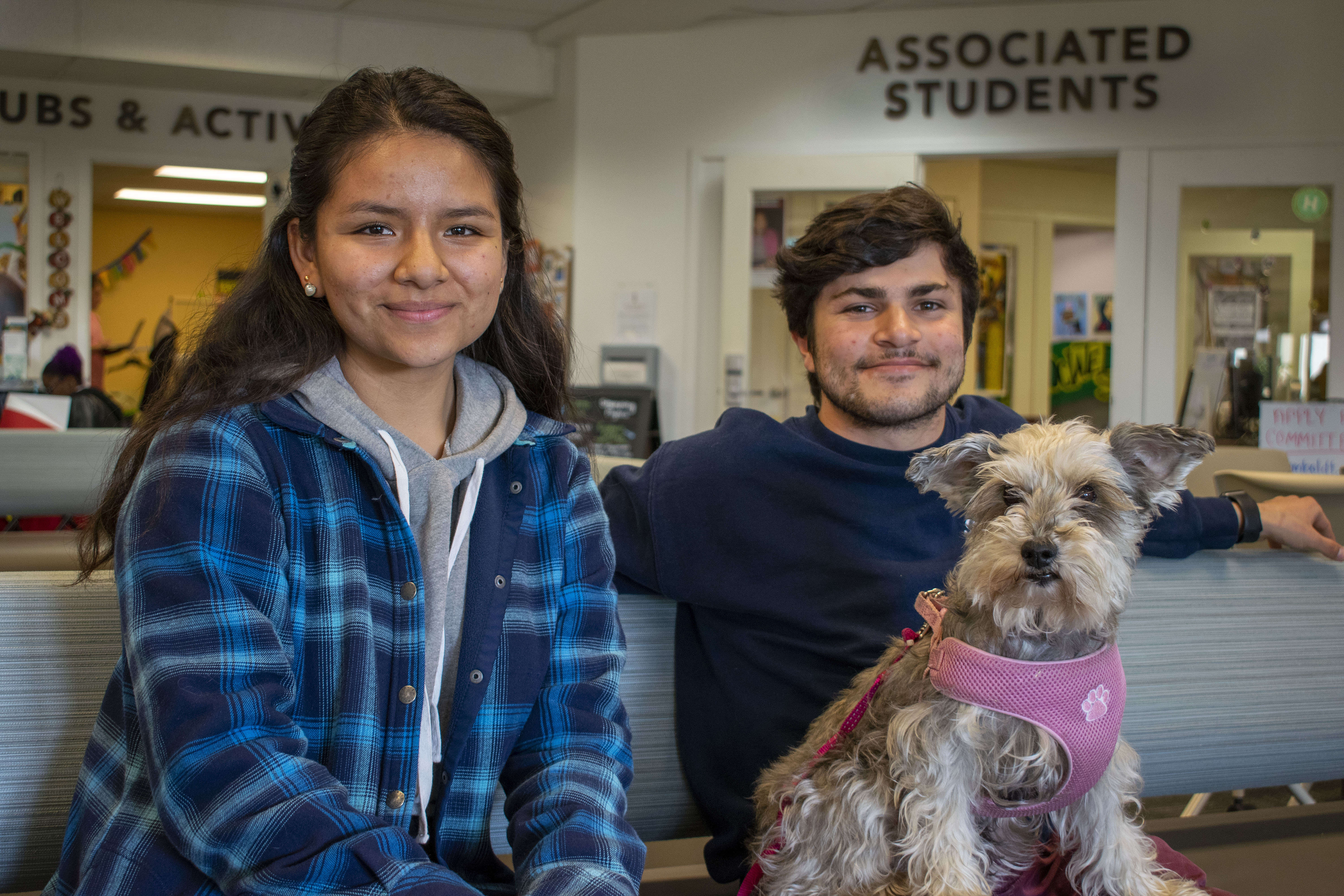
    Only four students attended the first University Resources and Planning Committee’s public budget forum, according to Associated Students President Yadira Cruz.

    Around 50 faculty, staff and community members were in attendance as well, according to Art Education Assistant Professor and URPC Co-Chair James Woglom.

    Woglom said the URPC’s presentation, which can be found online at budget.humboldt.edu, focused on the URPC’s work toward creating a scalable budget model, or a budget that can be altered periodically to represent changing values.

    “It ends up bringing more people into the process of decision-making, and thus hopefully reflecting more people’s feeling of what we want this organism to do,” Woglom said of the URPC’s new model.

    James Woglom, art education assistant professor and University Resources and Planning Committee co-chair, checking his laptop in the Humboldt State Univeristy library on Nov. 14. Woglom said the URPC has created a new scalable budget model that allows for more flexibilty and input from the HSU community. | Photo by James Wilde

    URPC has been meeting over the course of the semester to form a three-year budget for Humboldt State. Woglom said the first step for deciding where to allocate funds is to clarify which values HSU should prioritize.

    Besides the forum, the URPC is taking feedback online through an online submission form, a Google survey designed to scale which campus values are most important and a pie chart budget simulator that allows proposals of how HSU should divide funds. Woglom said he’d also be happy to take suggestions through direct emails.

    While Cruz said she appreciated the existence of the online feedback forms, she said they can be obscure due to budgetary jargon.

    “Although it’s available, it might not be accessible in that way,” Cruz said.

    The Google survey, which is not yet released, lists a series of California State University values and asks the respondent to rate how much they agree with each one.

    “It’s not saying that we want to devalue any of them, but it’s trying to get a quantitative sense of where the University’s priorities are in terms of allocation of resources based across a series of ideas,” Woglom said. “And then hopefully with that quantification we can make decisions based on where we can make things happen.”

    The URPC’s current projections show a $5.4 million budget gap by the 2021-2022 school year, which reflects the impact of reduced tuition due to declining enrollment. According to the presentation, every 100 students generate about $560,000 in tuition.

    The University Resources and Planning Committee pointed to declining tuition numbers as the cause of HSU’s current projected $5.4 million budget gap.

    Joseph Reed, a political science and economics double major and a student representative on the URPC, said the key challenge has been ramping down the budget with the declining student body.

    “It’s kind of been hard to keep this budget for about 8,000 students when we don’t have 8,000 students anymore,” Reed said.

    Cruz said the budget should focus on the students HSU has now, and not the students it had in the past.

    “Being in that cutting mindset is potentially jarring for morale. I mean, you’re coming from a space where you’re like, ‘Alright, what do we have to not do this year?’”

    James Woglom

    “I think every campus goes through these sorts of financial challenges, but I think how we move forward is centering students,” Cruz said.

    Reed said the URPC has no plans to cut whole departments. Instead, Reed said cuts are more likely to be smaller and broader across the board.

    “Every department is being affected, but each one has its own budget, so each one has its own certain amount that it’s being reduced by,” Reed said.

    Over the past three years, URPC reduced the budget by $11.5 million. However, Woglom emphasized a difference between past and future cuts due to the new scalable budget model.

    “[In the past] we’ve cut what we’ve determined to be at the fringe of the project of the University—so maybe not in direct agreement with the strategic plan of the University or the general values of the University,” Woglom said. “Being in that cutting mindset is potentially jarring for morale. I mean, you’re coming from a space where you’re like, ‘Alright, what do we have to not do this year?’”

    The University Resources and Planning Committee showed three possible enrollment and budget scenarios in its Nov. 7 public forum presentation.

    With the new model, Woglom said HSU can start with a specific budget number and then distribute it to the things HSU values most. Woglom said the budget can be continually changed, which allows HSU to scale back up or down if monetary realities change.

    “We don’t want to make hurried and necessary decisions every year,” Woglom said.

    The URPC uses Financial Information Reporting Management System codes, which are used in higher education to categorize expenses by their function, to compare HSU’s spending to other CSUs.

    FIRMS codes break down HSU’s spending into five categories: instruction ($56.6 million in the current budget), institutional support ($21.6 million), operations and maintenance of plant ($16.3 million), academic support ($15.6 million) and student services ($12 million). Each of these categories represent a FIRMS program, and the budget determines what percent of the total amount of funding goes to each category.

    Using these categories, the URPC also compares HSU’s spending to other CSUs. According to the presentation, spending at HSU in comparison to similar-sized campuses for the 2017-2018 school year was 17% higher at HSU for instruction, 24% higher for academic support, 3% higher for student services, 10% higher for institutional support and 1% higher for operations and maintenance of plant.

    The presentation also showed three possible scenarios for the future of enrollment and its effects on the budget. The best case scenario, called the growth scenario, shows a leveling off of the enrollment decline and a budget gap in the $4 million range by the 2021-2022 school year.

    The current scenario, upon which URPC’s projections are based, shows a continued decline that leads to the budget gap of $5.4 million. The worst-case scenario shows further decline and a budget gap of up to $7 million by the 2021-2022 school year.

    The URPC’s current budget plans are based on the middle scenario of a $5.4 million gap.

    Woglom said the URPC still has to figure out how to allocate its funding to keep current programs intact.

    Budget projections from the University Resources and Planning Committee’s Nov. 7 public forum presentation show a $5.4 million budget gap by the 2021-2022 school year.

    “It raises interesting questions about where you can move within that,” Woglom said.

    Just one day after the URPC’s public forum, HSU released a campus announcement detailing the process for filling staff vacancies during the current enrollment decline and budget deficit. The announcement said that while current staff positions will not be eliminated, positions deemed “non-critical” by the vice president of the relevant division won’t be backfilled when a person leaves that position.

    Woglom confirmed that announcement.

    “The intention of the University at this point is to work to determine where attrition will happen and backfill positions in that manner,” Woglom said.

    This backfiring process does not apply to faculty, according to the announcement.

    The URPC’s next and final public forum is scheduled for Dec. 3 at 11:30 a.m. in the Goodwin Forum, during which the public can review the URPC’s draft plan before it is sent to the University president for review. Woglom urges everyone to give their input.

    “Any ideas that people have that they’d like to share with us, the better our decision-making process can be,” Woglom said.

    “I think [student input is] a challenge in itself,” Cruz said. “But I think that just because it’s challenging doesn’t mean it shouldn’t be pursued.”

    Yadira Cruz

    Reed and Cruz said they don’t think two public forums are enough to gather sufficient student input.

    “I think overall we should be making a stronger effort to connect with students and get their overall opinions,” Reed said.

    Reed suggested that the URPC should seek to get input not just from some students, but from the majority of students. Cruz agreed.

    “I think that’s a challenge in itself,” Cruz said. “But I think that just because it’s challenging doesn’t mean it shouldn’t be pursued.”

  • Report Details HSU’s Impacts

    Report Details HSU’s Impacts

    Looking into ICF International’s report on HSU’s economic impact

    According to a recent ICF International report, Humboldt State University generates over $567 million in annual industry activity.

    ICF International, a global consulting firm based in Virginia, previously studied California State Universities in 2010. ICF uses a model that tracks HSU institutional, student and alumni spending and then calculates the resultant impact.

    The report splits HSU spending into three categories: operational, auxiliary and capital.

    HSU spent $166 million in the 2017-2018 fiscal year on operational expenses, which includes instruction, research, public service, academic support and student services.

    HSU spent $26 million on auxiliary expenses, which includes the bookstore, campus restaurants and research institutes. $16 million went to dining services while about $10 million was spent on parking and housing.

    HSU spent $5.5 million on capital expenses, which includes construction and renovations. The report said HSU expects to spend $33 million on capital projects over the next two years.

    “University expenditures supported a total of 3,920 jobs in Humboldt County, as well as over $96 million in labor income and more than $293 million in industry activity,” the report said.

    To reach the final figure of $567 million of industry activity, the report includes $70 million of student spending and $207 million of regional alumni impact.

    “ICF used the average “Cost of Attendance” estimates from the HSU Financial Aid Office to calculate the total student spending impact,” the report said.

    The report calls the alumni impact figure conservative, as it does not account for California’s relatively high wages in comparison with the rest of the country.

    “California wages tend to be higher than the national average,” the report said. “In 2017, California real per capita income was approximately $2,650 dollars higher than the U.S. national average.”

    The report says 58,000 HSU alumni are still in the workforce, while 23% of alumni live in Humboldt County.

    “In 2017-18, HSU degree holders living in Humboldt County earned $973 million in wages,” the report said. “HSU degree holders statewide earned more than $3 billion.”

    The most comparable CSUs in terms of student population are CSU Channel Islands, CSU Monterey Bay and Sonoma State University. While the locations of each of these universities makes them significantly different, HSU appears on par when compared.

    In terms of regional impact, HSU placed second out of the four aforementioned CSUs of comparable student population size.

    The CSU website lists summaries of each CSU’s economic impact, as recorded in the previous 2010 ICF analysis.

    In terms of regional impact, HSU placed second out of the four aforementioned CSUs of comparable student population size.

    In 2010, CSU Channel Islands generated $114 million of regional impact from $135.5 million of spending. CSU Monterey Bay generated $133 million of regional impact from $155 million of spending. HSU generated $190 million of regional impact from $232 million of spending. Sonoma State generated $330 million of regional impact from $213 million of spending.

    The new ICF report was conducted only on HSU, so it’s not known whether HSU remains on pace with other CSUs.

    “It should be noted that the previous study’s methodology is not directly comparable to the current study,” the report said.

    The report includes benefits beyond direct economic impacts, such as research, small business development and contributions to the community and local education.

    Most of the report’s findings in these extra-economic areas appear to have data behind them. However, the report includes public radio station KHSU as one of HSU’s contributions to the community.

    “Through its innovative, high quality programming, KHSU hopes to educate, enrich, enlighten, and entertain its listeners on local, national, and international issues,” the report said.

    HSU abruptly fired all seven KHSU employees last April, citing a need for reorganization and streamlining. KHSU is run by one employee under a short-term agreement lasting until the end of October.

    Nevertheless, HSU’s impact on the surrounding community appears significant, even in the midst of an enrollment decline.