The Lumberjack


Students Serving The Cal Poly Humboldt Campus and Community Since 1929

Tag: Chemistry

  • Cal Poly Humboldt lab safety under scrutiny

    by Ollie Hancock

    From admin to student, everyone on campus has responsibility for the dangers of working with hazardous waste and materials. Spills, breaks, and general accidents are expected in any lab. No one can prevent a beaker from breaking, but the university should give students and employees the tools, equipment, and training to react appropriately. Instead, departments create patchwork standards without direction from the administration. A messy lab can indicate a campus-wide issue. 

    “I know that beakers break pretty often, and spills are common too. It’s eventful in there. I don’t think they filed reports for those or anything,” said Clara Lanesskog, a Cal Poly Humboldt student in a chemistry class. “We just clean it up and go on with the day.” 

    Beyond safety oversight and training in case of accidents, students need quality lab safety education. Lanesskog has seen classroom accidents escalate due to lack of risk management. Students see lab accidents frequently and don’t know how to report them.

    “Our instructor disappears a lot,” Lanesskog said. “So if we were to spill acid or something, we don’t know where to find him unless he came back.” This was the case when Lanesskog spilled acid on her leg during a lab.

    “You’re on a time limit, so you feel rushed. There’s not enough space for you to work. Everyone is bumping into each other, trying to rush, and that is how I ended up spilling,” Lanesskog said. She didn’t submit a report.

    “My professor wasn’t there, and he’s not usually there towards the end of our lab,” Lanesskog said. “Honestly, it didn’t seem like too big of a deal to me because other people have done it too.”

    On the University of California Santa Barbara EH&SS website there are public reports of every school chemistry accident and date, including near misses where no one was injured. Their transparency shows awareness and rigor regarding preventative measures. They treat each incident seriously, regardless of scale. At Humboldt, incidents have gone unreported. Only recently has the EH&SS reevaluated how professors are trained to react to incidents. According to our standard operating procedures, any incident should be reported in 24 hours. On Humboldt’s EH&SS website, there is no obvious link to the incident report form.

    Terrilyn Stoflet worked as a hazardous materials technician at Humboldt during the pandemic. In the course of their job, they often felt unsafe.

    “I don’t think we have a very good safety culture on campus,” Stoflet said. “It just never gets talked about until something bad happens.”

    They felt the campus didn’t have enough staff or administrative support to be accountable for environmental health and safety.

     In 2019, Humboldt underwent a Health and Safety audit as part of a CSU-wide investigation. The completed audit cited 21 violations, reflecting a lack of rigor in campus safety regulations. This campus is not alone. A state audit of the CSU system found that Sonoma State and Sacramento State also cited limited resources as explanation for their violations. The story was similar across CSU campuses; the state concluded that the CSU chancellor’s office was responsible. 

    “For over two decades, the University Audit has repeatedly recommended that the CSU Chancellor’s Office increase its oversight of employee and student health and safety training and inspections of laboratory equipment and workplace hazards,” read the audit report by state auditor Elaine Howle. 

    Training programs failed to check if all employees and students who handled hazardous materials and waste were certified. There was no record of which employees worked with hazardous materials, and in the stockroom, waste wasn’t consistently labeled. No self-assessments for safety were conducted in labs, and lab techs didn’t dispose of waste in a timely manner. The list of issues goes on. No serious incidents have occurred as a result, but the audit reveals a looming threat to the campus and community. 

    Sabrina Zink is the Environmental Health & Safety Services (EH&SS) coordinator and the only admin charged with attending to these issues. Zink says she was relieved when the audit brought attention to the problems.  After the audit in 2019, EH&SS planned to meet the regulations set by the CSU. Three years later, progress is unclear.

    “Before we just had a paper reporting system,” Zink said. “We worked out a new incident reporting process so we can keep track of if it was a training issue or operator error, or an issue with oversight. And reiterated to faculty that [incidents] do need to be reported.”

     Funding made available by the polytechnic transition along with an increase in the administration’s willingness to address these issues made way for some progress in Fall 2022. More administrative staff and on-the-ground technicians have since been hired by EH&SS. However, many solutions are still waiting to be rolled out. 

    “Now we have another coordinator in the EH&SS to help with implementing all the audit findings,” Zink said. “And we’re looking for another person for occupational safety to address incident follow up.” 

    After the 2019 audit of campus health and safety, the EH&SS office made a plan to introduce new training and support to address the violations found. Then, the COVID-19 pandemic shifted the EH&SS office’s priorities to managing the spread of the virus on campus. The small team was tasked with writing the trainings, mandates, and regulations that defined campus life for two years. Corrections to every-day safety policy based on the audit were left behind in the shuffle. EH&SS struggled, lacking the bandwidth and support to solve these issues on top of managing COVID-19 concerns.

    “A few years back, before this audit, I had been screaming from the mountain tops,” Zink said. “Please, someone take this seriously.”  

    Due to the fragmented nature of campus departments, there was no consistency in the content or frequency of safety training. The audit found no record of who is certified to handle hazardous materials and waste. Zink wrote trainings that were never assigned. New trainings will roll out in the spring 2023 semester, Zink says. 

     Aside from organizational problems, the campus has inadequate facilities that made some employees feel unsafe.

    “This shed, which is at facility management’s place, it’s unsafe,” Stofelt said. “What my partners and I have had to do in that shed is so stupid, and it’s dangerous. There’s a bunch of rat excrement everywhere.” Beside the rats, the shed itself has structural hazards. A set of detachable stairs leads to racks on the second level, where lab techs carry 15-gallon drums of chemicals and hazardous waste up and down.

    Hazardous waste jugs from various departments are processed in the shed, which is also full of personal protective equipment (PPE) and supplies for HAZMAT technicians. According to Zink, the shed is already outdated for campus needs. 

    “We need something more fit for our needs, especially as we grow and potentially would be generating more hazardous waste,” Zink said. “We’re going to need more space and something that doesn’t leak during the winter.” 

    There are plans to build a new shed, but no location has been chosen.

    Safety standards and regulations vary from department to department. This inconsistent system lets minor infractions slip through the cracks. Facilities often don’t relay the message to techs when bins need disposal. In the darkroom, bins of used chemicals sat full for weeks, nearly overflowing. 

    As the campus grows with polytechnic status and an emphasis on STEM classes, these issues will only grow. The EH&SS has made some progress toward addressing the issues brought up in the audit, but there is still much work to be done.

  • Chemistry Professor Picks Up $100,000 Award

    Chemistry Professor Picks Up $100,000 Award

    Claire Till of HSU receives lucrative award to aid her research and academics

    Humboldt State University’s top-ranked chemistry program is home to a professor researching how plankton in the ocean interacts with heavy metals in the water.

    “There are lots of people who are doing fantastic research and have awesome awards and grants on campus. So I’m glad for the opportunity to highlight some of the work that we’re doing at HSU and lots of people are doing lots of great work at HSU.”

    Claire Till

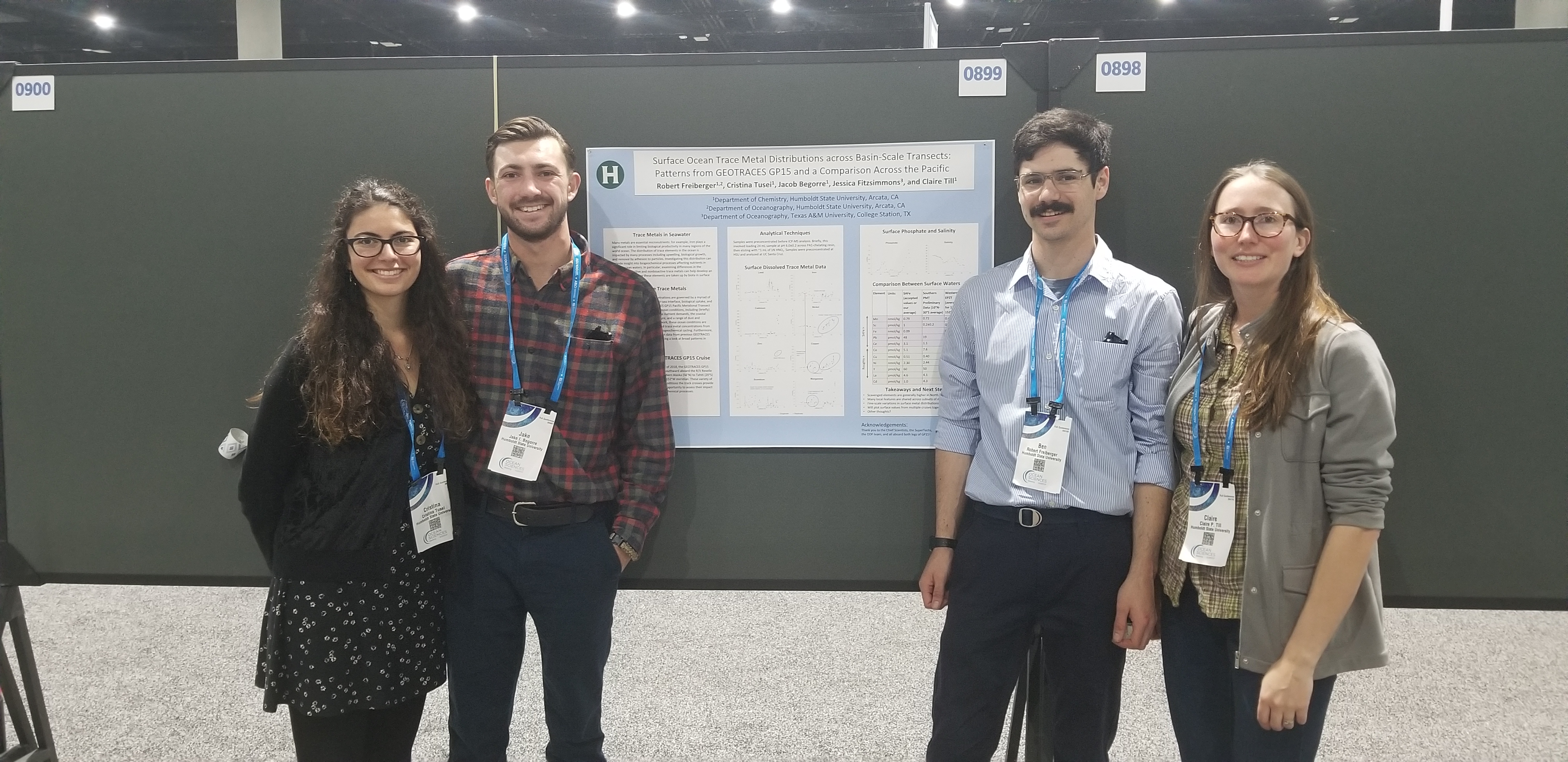
    Assistant Professor of Chemistry Claire Till recently won the Cottrell Scholar Award, a $100,000 award honoring trailblazing science professors or researchers who have made large strides in their respective fields.

    “There are lots of people who are doing fantastic research and have awesome awards and grants on campus,” Till said. “So I’m glad for the opportunity to highlight some of the work that we’re doing at HSU and lots of people are doing lots of great work at HSU.”

    Till looks forward to allocating the funds toward her personal research and her classroom. She’s using the funds to support field trips to gather more data and to hire student researchers.

    “We’re going to go sample some rivers this summer,” Till said. “And then we’re going to do a couple of day trips on the research vessel, the Coral Sea, next summer, and some students will be hired throughout that.”

    Till’s research is about iron, a vital nutrient for humans and phytoplankton in the ocean. Unfortunately, in the ocean, there are extremely low concentrations of iron, and as a result, phytoplankton are not growing as much.

    “It’s really interesting—I think at least—to study how the iron gets there and how the phytoplankton uses it,” Till said. “What I proposed, and the work that we’re going to be working on, is to study iron using a new tool, which is another element called scandium.”

    Till elaborated on the relationship between scandium and iron and what she hopes will come out of her research in relation to that.

    “Scandium and iron have some parallels in chemical reactivity,” Till said. “There’s no real reason to expect them to behave similarly based on their chemical properties, and so I’m really interested in figuring out exactly in what ways are they similar and in what ways are they different.”

    The second area Till will be putting funding toward is academics, specifically in her own classroom.

    Ben Freiberger, a senior research student for Claire Till, has worked under her for a considerable amount of time.

    “The money is now helping us to be able to get more accurate numbers and be able to determine more about scandium.”

    Yasmin Zambrano

    “We collect seawater samples, pre-concentrate them, and then measure them,” Freiberger said. “We just finished measuring all these samples from a cruise that went from Alaska to Tahiti. I started measuring those samples at the beginning of summer and I’m just getting finished with a couple hundred of those.”

    He also went on a cruise last summer and is measuring samples he collected on the trip. His research may benefit from Till’s award.

    “It’s good for the research group and it’s great that Claire can get money to keep doing this,” he said.

    Yasmin Zambrano, a junior undergraduate research student for Till, was recently hired to work with her on her iron research.

    “Right now, we’re just reading a lot of articles and trying to find how the treatments change within the different temperatures to see when it’s the best time to do the experiments and stuff,” Zambrano said.

    Zambrano, too, is hopeful for the outlook of the chemistry program with the arrival of the award and subsequent funding.

    “The money is now helping us to be able to get more accurate numbers and be able to determine more about scandium,” Zambrano said. “And again it’s going to be for at least three more years, so that’s three more years that she can do stuff, especially during the summer when students want to work in this field —and it looks good.”

  • Getting ready for finals

    Getting ready for finals

    By | Charlotte Rutigliano

    With finals right around the corner, students like Stephanie Toste and Ellen O’Hare are starting to prepare for them now.

    Toste who is a senior business marketing major said that she has a final in all four of her classes and is starting to study for them now.

    “I normally review my notes and the book for that class,” Toste said, “along with any study guide the teacher provides.”

    According to Angelica Huerta who has been a Chemistry tutor in the Library’s Learning Center for about three years she notices that as it gets closer to finals there are fewer students that come into the library.

    “When it is finally finals week they come in swarms for last-minute study sessions,” Huerta said.

    Huerta said that personally, she starts preparing for finals by studying by herself and with a group of peers. She said she also likes reading through chapters she didn’t fully understand, redoing past exams, and rereading her notes.

    Wildlife major O’Hare said even though she has never used the Library’s Learning Center to help study for her finals, she is still an avid studier in the weeks leading up to her exams.

    “Normally I start by making flash cards or study guides of the material,” O’Hare said, “things I can go over later and quiz myself on.”

    O’Hare who has already taken one final before the fall break is still preparing for her final two exams, one of which is this upcoming week for a lab course.

    Toste who has one more semester of school said that she is looking forward to having a break before next semester and not having to stress as much.

    In an ending piece of advice for students, Huerta said for students preparing for finals should relax, be organized, and be confident.

  • Interdisciplinary innovation

    Interdisciplinary innovation

    By | Bryan Donoghue

    When the disciplines of Physics, Chemistry and Geology combine it creates a greater understanding of how the sciences are interconnected. Humboldt State’s professors and faculty understand that, and continue to operate their interdisciplinary program, Stars to Rocks.

    The program is modeled after Humboldt State’s successful pilot program, the Klamath Connection. Katlin Overeem, the HSI STEM lead coordinator said Stars to Rocks is for first time freshman in the Chemistry, Geology or Physics departments. Aside from showing the relations between the three majors, Overeem said Stars to Rocks teaches time management, how to take notes, and introduces students to various resources on campus like the learning center, multicultural centers, and the peer mentoring program.

    StarstoRocks_Web-1.jpg
    Taken from Humboldt State HSI Stem Flickr

    “Students have the tools that they need to know how to succeed as a student at HSU,” Overeem said. “This interdisciplinary strategy creates a more cohesive approach to learning for the student.”


    The ability to articulate your science is a crucial skill. Kevin Boston, a Forestry professor with Stars to Rocks is a believer in, “we learn better when we write about it.”

    “I’m teaching this material in critical thinking really about how to think and reply critically to Environmental Science kind of problems in general, that was sort of the approach I was going to take for the class,” Boston said. “We learn to be better writers by being better readers.”

    This is a sentiment shared among other faculty members, like Overeem. Overeem explains one of the components of the program is block scheduling, which means that their courses are already set up for them. Freshmen in the Stars to Rocks programs get to be in the same sections of their courses together, and that allows the faculty of the program to show how a variety of disciplines is needed in order to be a successful scientist. The set of courses are all GE courses.

    “Even if a student decides at some point that Chemistry isn’t right for them, all the courses that we put them into will count towards another degree at HSU,” Overeem said. “The ability to properly communicate your science is a really important component of being a scientist as well. So we’re able to work with these other departments like English and Communication and build these bridges across campus between departments that don’t typically interact.”

    Zane Comden, a senior Physics major at Humboldt State sees benefit in the public outreach the program is involved in, and finds it to be a great way to show how all these disciplines are interconnected.

    “There’s a lot of openings in the field for public outreach and stuff like that, Especially considering that people want to know where their tax dollars are going when it comes to things like publicly funded research,” Comden said. “When it comes to sciences like that, you can’t really have Geology without Chemistry and you can’t really have Chemistry without Physics, and underneath all that you can’t really have Physics without Math.”

    StarstoRocks_Web-3.jpg
    Taken from Humboldt State HSI Stem Flickr

    Aside from the interdisciplinary aspect, Boston finds the program to be a great way for students to stay on a good path.

    “You would see a number of students that’d struggle in their first year. Good students get into bad habits,” Boston said. “The first year experience from high school to college, and the freedom associated with college can effect students differently. Good students in high school can struggle mightily in college.”

    Boston said drugs and alcohol uses can become common in certain students, and that can contribute to performance problems.

    “I think this is an interesting opportunity to address some of those issues for students and make the first year more valuable to them. It’s a very interesting pedagogical approach,” Boston said.

    The program continues to be a success according to Overeem, and will continue next year. For those looking to join Humboldt State University next semester, Overeem will be communicating with Oceanography and Marine Biology professors to pilot Rising Tides, a new interdisciplinary program.

  • Compassionate Bonds — New HSU Chem Prof Goes Above and Beyond

    Compassionate Bonds — New HSU Chem Prof Goes Above and Beyond

    By Bryan Donoghue

    For many students at Humboldt State University, any chemistry class is on a list of the hardest courses a student can take. Humboldt State has taken on a new temporary chemistry professor whom students are dubbing “passionate,” “exuberant,” “enthusiastic,” and “caring.” Walking into his office, some may mistake him for a student. He’s listening to Selena Gomez, One Direction and country music. But it’s his demeanor, not his music preference, that makes Puminan Punthasee so approachable.

    punthasee
    Puminan Punthasee | Photo Credit: Humboldt State University Chemistry Department

    “I’m not afraid to approach Pete, which I sometimes am with other professors,” said Kathryn Buzanski, 29-year-old student and Marine Corps veteran. “With Pete, I can email him, I can approach him, talk to him face-to-face, and have no worries.”

    Punthasee’s approachability follows into his relationships with colleagues in the chemistry department. Joshua R. Smith, chair of the Department of Chemistry, recalls that the first time he met Punthasee. He found him to be funny and deeply empathetic. But it was his passion for teaching that struck Smith the most in the hiring process.

    “He clearly had a passion for teaching, based on what he wrote in his application, and he clearly got that across during the interview as well,” Smith said.

    This enthusiasm and commitment Punthasee brings to teaching chemistry blossomed long before Humboldt State. Dating back to his high school years in Thailand, Punthasee had to take science courses every semester in high school. Thailand’s education system requires six science courses in order to graduate.

    “I wasn’t really a smart kid, I was slow, and couldn’t grab anything that the teacher taught us,” Punthasee said. “My grades were okay but weren’t as high as I wanted them to be.”

    Before graduating high school, Punthasee discovered his passion for learning, as he found a role model at his tutoring school.

    “This chemistry teacher at my tutoring school made chemistry understandable,” Punthasee said. “And that was the starting point that made me realize that if I could understand chemistry, maybe there’s some other stuff that I can understand as well.”

    Following high school, Punthasee graduated from the University of Thailand, and continued to expand his horizons by enrolling in University of Missouri’s Ph.D. program for chemistry.

    “I was in a Ph.D. program at the University of Missouri, and I hated the program,” Punthasee said. “It’s the nature of the Ph.D. program that makes you do a bunch of research, but I don’t like doing the research, so I found myself looking at the clock every five minutes.”

    Although he isn’t passionate about research, Punthasee found his calling as a teacher. He’s won three awards for being a teaching assistant through his graduate program. He’s been awarded with the Number One T.A. Choice award twice, and has also accepted the Green Chalk award for being an excellent teaching assistant.

    “I bet you that no science teacher does things like I do, not in this state,” Punthasee said. “Only two people follow my “Pete” style. Me, and my role model in Thailand.”

    His efforts to reach out to students outside of the classroom further solidifies their appreciation for Punthasee as well. As a professor, he will send three emails each day on average, all for varying, but positive reasons.

    “Pete really likes to send out encouraging emails,” said chemistry student Kate Panebianco.

    Brooke Holdren, a 20-year-old science and art major at Humboldt State, also expressed how much the emails help her.

    “I’ve gotten both general and personal encouragement emails. He’s really taking the time out to say specifically, ‘You’ve done this really well today’,” Holdren said.

    “He sends the most emails out of any teacher I’ve ever had. It’s really great and encouraging, sometimes a bit over the top, but that just shows how involved he is in comparison to the other teachers I’ve had.”

    What makes Punthasee such a well-liked professor boils down to how relatable he is. He’s just like any regular college student, and he likes to keep things simple because simplicity is easier to understand.

    “It’s just human nature,” he said. “We don’t like complicated stuff, we like fun stuff.”

    Attributing his best quality to being a “tremendously freaking hard worker,” Punthasee said his talent lies in his ability to simplify and socialize.


    Buzanski explained this in a way that many of Punthasee’s students can empathize with. “He does want to be our friend, but more importantly, he wants to be our friend while we know he’s our teacher,” she said.