The Lumberjack


Students Serving The Cal Poly Humboldt Campus and Community Since 1929

Tag: Climate Change

  • Sea level rise threatens Humboldt, local government stalls

    Sea level rise threatens Humboldt, local government stalls

    by August Linton

    The edges of Humboldt Bay are on the verge of being overrun by the sea. It laps at the boundaries of Highway 101, surrounds the Arcata Marsh, and sneaks around the corners of low-lying industrial areas in Eureka. 

    SINKING SHORELINE

    Humboldt’s location at the end of the Cascadia Subduction Zone makes the area more vulnerable to sea level rise than any other location on the California coast. Due to its position in a very active tectonic area and the specific activity of the surrounding plates, the Humboldt County region is steadily sinking, or subsiding. 

    The Humboldt Bay Vertical Reference System Working Group is a research group focused on identifying geology’s role in Humboldt Bay sea level rise. In a 2017 report, they found that land subsidence contributes to sea level rise 2 to 3 times more in Humboldt County than anywhere else in California. Of the 18 inch rise in sea levels that has occurred locally in the past century, an estimated 50% is due to tectonic subsidence.

    “The ocean isn’t rising any faster off of our coast than it is down in San Francisco, but we have subsidence that the rest of California doesn’t have,” said environmental planning consultant Aldaron Laird. 

    Laird has been an essential part of local sea level rise risk assessment and adaptation planning over the last decade, consulting with Humboldt County and various local districts. 

    ADAPTATION PLANNING

    Humboldt County has commissioned many reports which assess the risk that sea level rise poses to infrastructure and communities. These contextualize what different levels of sea level rise will mean, and suggest possible adaptation measures. However, the reports do not implement the adaptation measures.

    The most recent grant-funded project to tackle this issue concluded in 2019, yet none of the recommendations from that, or any other report, have been implemented. 

    An area that the reports do not touch on is the potential for industrial contamination in the bay as sea level rise reaches new areas.

    In her career as an environmental advocate, Jennifer Kalt has observed the local government’s lackluster reaction to the threat of sea level rise for years. 

    “What I have seen as a repeating theme is a lot of local jurisdictions getting grant money to develop plans and then there isn’t a plan,” said Kalt. “It’s a little depressing to see so much planning lead to nothing.”

    Michael Richardson is a supervising planner of long range planning in the Humboldt County Planning and Building Department, which is responsible for sea level rise adaptation planning. He said that the county would like to decide on terms of collaboration with other local jurisdictions before they plan to implement any sea level rise adaptation measures. Simply put, they don’t have immediate plans to do anything specific.

    “There would be a different process to go forward with getting the cities and the county on the same page and whatever agreements need to be made,” said Richardson. “What that plan looks like is what we’re still figuring out.”

    Kalt doesn’t think that the pace at which the government is moving on this issue will make a difference in time. In addition to protecting residential areas, she said that their focus should be on relocating key infrastructure. 

    “I’m concerned that a lot of the agencies that need to address these problems, there’s not a lot of political will to do what needs to be done,” said Kalt.

    There are many organizations with an interest in adapting Humboldt Bay to meet the challenge of sea level rise. The Coastal Commission, CalTrans, Humboldt County, local city governments, and even the state government of California all hold potential responsibility for the threatened areas. Kalt doesn’t see any of them doing anything to prepare.

    “It’s a Humboldt County pastime to finger-point,” said Kalt.

    A recent report released as part of the county’s Humboldt Bay Sea Level Rise Regional Planning Feasibility Study extensively details what theoretical responsibility a variety of local, state, and federal jurisdictions would have to combat sea level rise, but does not lay out a plan for collaboration. A further report is expected to be published before the end of 2022, recommending a strategy for collaboration.

    If nothing is done to adapt to the changing coastline, life around Humboldt Bay will look very different in 50 years. Infrastructure-rich areas will be reclaimed by the tide, and local government and utilities companies alike will have to find ways to work with the new bay. It is also worth considering that any adaptation measures will likely take significant time and resources to complete given their cost and scale.

    KING SALMON

    One of the first areas in Humboldt to be substantially impacted by sea level rise is the unincorporated community of King Salmon. This oceanside community is located across from the mouth of Humboldt Bay just south of Eureka, exposing it to the full brunt of tidal forces. Sunbleached houses, mobile homes, and a few small businesses line canals. It is located only 3 feet above sea level. 

    In early January 2022, there was a flooding event in King Salmon caused by king tides coinciding with the rain and high winds from a storm. Photos depict residents kayaking down the street or wading shin-deep in water. Little structural damage was done, but it was obvious that King Salmon is at extreme risk as sea levels continue to rise. 

    Parts of the community are only accessible via a single bridge on King Salmon avenue. Any tide which overtook this could leave residents with no method of escape. In a 2022 Humboldt County Civil Grand Jury report, this is predicted to occur within 3 feet of sea level rise, possible as soon as 2070.

    INFRASTRUCTURE

    Other significant infrastructure endangered by the amount of sea level rise listed in the report include PG&E’s Humboldt Bay Power Plant (HBPP) complex, Highway 101 as it traverses the bay, and water and electrical transmission lines. Several sites contaminated with industrial waste will also be reached by tides at this level.. 

    According to a report authored by Laird, 1.6 feet of sea level rise, possible by 2040, will put King Salmon underwater during king tides. Sea level rise of 3.3 feet, predicted to occur by 2065, will cause the tides to overtake most of the area daily. 

    According to Laird, the most pressing threat to King Salmon is whether utilities will continue to be available to its residents. “It only takes one utility to stop providing service and you wouldn’t be able to live there anymore,” he said. 

    PG&E’s Humboldt Bay Generating Station, located in King Salmon, supplies power to around 67,000 people. It is predicted to be threatened by king tides by 2065. The plant will have to be relocated or otherwise protected from the tides in the near future if it is to continue supplying power to Humboldt County.

    The Humboldt Bay Independent Spent Fuel Storage Installation, a nuclear waste storage facility, is located on the HBPP campus. It houses the spent fuel from the Bay Generating Station’s nuclear predecessor. There are currently no plans to relocate the spent nuclear fuel stored there.

    HERE AND NOW

    Participants in the Humboldt Baykeeper’s King Tides Photo Initiative have found evidence of high water levels affecting Humboldt County here and now. Founded in 2004, Humboldt Baykeeper is an advocacy organization which focuses on preserving coastal resources around the bay. They monitor levels of contaminants present in the bay, assess new industrial developments, and catalog the effects of sea level rise. 

    The King Tides Photo Initiative encourages members of the community to document areas inundated by high tide levels. In many of  these photos, residential areas around the bay are actively being overrun by the sea. Some of the images aggregated on Baykeeper’s Facebook page show the Highway 255 bridge over Mad River Slough nearly overtopped, Jackson Ranch Road in the Arcata Bottoms covered with water, and waves crashing over a parking lot at the Arcata Marsh.

    The Highway 101 corridor is one of the areas where tidal inundation is starkly visible. Despite the bay’s encroachment, there are ongoing plans to extend the Humboldt Bay Trail along that same strip to reach Eureka. 

    DIKED SHORELINE

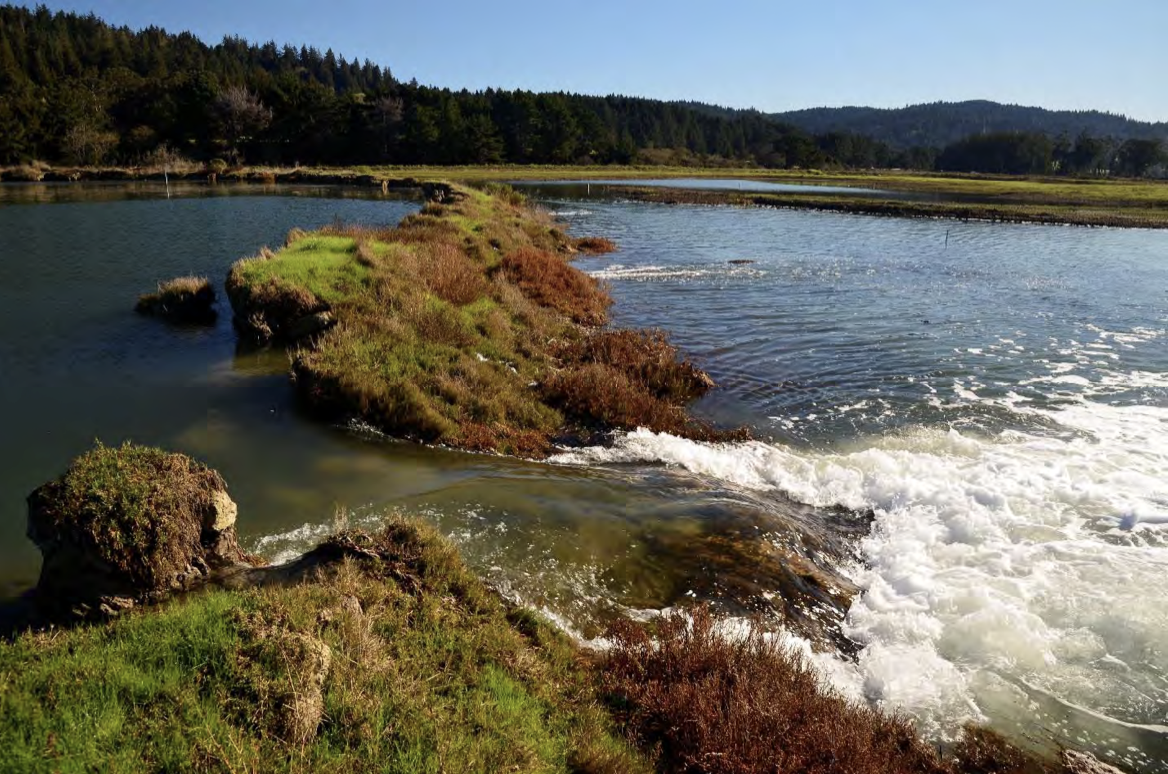
    Humboldt County and the Eel River Delta are uniquely vulnerable to sea level rise. The historical legacy of diking the shoreline in order to create more usable land has led to a large concentration of critical infrastructure in former salt marsh lands, according to Laird.

    A large portion of Humboldt County’s critical infrastructure is concentrated in former salt marsh lands. This land is made accessible and flood-proofed by a system of dikes which will not stand up to sea level rise.

    “Highway 101, Highway 255, municipal water lines, wastewater treatment lines, natural gas lines, optical fiber lines; all of this infrastructure is built on that former tideland which is prevented from saltwater inundation only by the diked shoreline,” said Laird. 

    The location of this infrastructure in former tidelands means that a breach in any one dike could result in the entire area being flooded. “We don’t have to wait for sea level rise to see the impacts of reclaiming the diked former tidelands,” said Laird. 

    Even if every dike around the bay holds against today’s water levels, they will be overtopped by 2 to 3 feet of sea level rise by 2040 at the earliest, and 2060 at the latest. Additionally, there is no bay-wide district in charge of maintaining the dikes. Instead, over 100 shoreline parcels are individually managed by local jurisdictions. 

    It costs millions of dollars to rebuild even one mile of diked shoreline, and the raw materials to rebuild are not readily available in the quantities that would be needed.

    “If we can’t address these and do anything about it, I think the first thing that’s going to happen is the dikes…they’re going to fail,” said Laird. “They’re going to breach and the bay is going to reclaim the 7 to 9 thousand acres of tide lands that used to be part of it. It’s the areas that we gobbled up from the bay over a century ago, those are the ones that are most vulnerable.”

  • CAP 2.0: The plan to make Cal Poly Humboldt carbon-free

    by Liam Gwynn

    On Jan. 28, Cal Poly Humboldt released an ambitious draft updating the Climate Action Plan. This updated plan promises to have the school completely carbon neutral by 2045. If CAP 2.0 is accepted, the school will implement changes to reduce carbon output and create an ecologically healthier environment.

    Changes would include phasing out gas and replacing it with electric power, implementing new carbon offset projects, introducing a zero-waste plan, and making several changes to transportation on campus. The final draft of the plan will be submitted this April. The budget is not yet finalized, however, if the plan is signed off, it will cost anywhere from 4.4 million to 5.5 million.

    The Climate Action Plan started in 2016 to lower greenhouse gas emissions to levels last seen in the ’90s. They succeeded at that plan in 2020 and started their planning for Cal Poly Humboldt’s next goal, complete carbon neutrality by 2045. This plan came about after The 100 Percent Clean Energy Act of 2018 passed in California, requiring all California businesses to have 100 percent clean energy by 2045.

    Morgan King is a climate analyst at Cal Poly Humboldt and the author of CAP 2.0. For him, this new plan is about more than just meeting the requirements set by the state.

    “We are in the midst of a climate crisis and we understand that climate change events and disasters are already having an impact on our communities, our ecosystems, and our infrastructures,” King said.

    Graphics courtesy of Facilities and Management

    According to King, the main climate threats Humboldt faces are rising ocean levels, wildfires, and extreme weather conditions. These threats are daunting and King is under no illusion that the school has the ability to singlehandedly stop them.

    “Even if humanity took big steps today to curb our burning of fossil fuels, we’re still going to see these climate impacts for many years to come,” King said. ”So we need to start planning and preparing now.”

    Despite the ominous threat of climate change looming in the distance, plans like CAP 2.0 show that there are still people willing to make drastic changes to soften the damage humanity has caused.

    “We are starting to see that resilience and climate protection are becoming part of the culture at this campus,” King said ”We are seeing a greater level than ever before of engagement around these issues.”

  • Does a new presidency bring new environmental hope?

    Does a new presidency bring new environmental hope?

    A new presidency brings new beginnings, but what does that mean for the environment?

    Professor Nicola Walters has taught environmental policies for the last three semesters at HSU.

    “Right now the big focus is on the executive orders that have been signed in addition to Biden announcing our rejoining the Paris Climate Agreement,” Walters said.

    When Biden and Harris ran for the presidency against former President Donald Trump, they made clear that Biden had a plan for the environment with the Biden Plan.

    Biden’s official website expressed what the plan entails, similar to the Green New Deal.

    The Biden Plan includes zero emissions by 2050, working with the world toward change, confronting polluters who harm communities of low income or of color, and leave no workers behind.

    Not only that, but within his first few days of presidency he also revoked the permit for the Keystone XL pipeline, which is a big deal for environmentalists. This was the beginning of efforts made toward climate change.

    “We’re past the tipping point for taking care of a lot of our habitats and thinking about what would actually maintain the survival for humans on this planet,” Walters said.

    Biden also plans to reverse actions President Trump made against the environment regulations, including to “place a temporary moratorium on oil and gas leasing in the Arctic National Wildlife Refuge,” according to NPR.

    But the Biden and Harris team have made very clear they won’t be ending or putting a ban on fracking, something that progressives have been pushing for.

    Biden has made the announcement that by 2050, his zero emission plan will have led the U.S to achieve a 100% clean energy economy and reach net-zero emissions, a very difficult task as is. But according to UN climate data the 1.5 degrees Celsius limit requires a faster curb in emissions with 45% cut within the decade. Biden also now has control of large polluters like the military, policy toward large corporations, and more which all have large impacts on the environment as well. Will his plan be enough?

    “If we’re thinking about environmentalism on a global level, every single step that is taken to protect an animal species or to protect a habitat is therefore connected to our global health and is necessary at this point if we have any hope at all of reversing the trends of global greenhouse emissions, of the climate change that we are now experiencing at such a catastrophic level,” Walters said.

    “One thing that is central to our area is the removal of the northern spotted owl from the endangered species list,” Walters said about President Trump’s actions of removing 3.4 million acres of land from the federal protections.

    With new plans for the environment, it’s important to hold the new team accountable.

    “I don’t think [Biden is] as environmentally conscious as more far left or more liberal leaning people would like him to be,” Aaron Larkins, second year political science major, said.

    Like Walters, Larkins believes action is critical, but just our leaders won’t be enough.

    “We only get one Earth, we only get one shot at keeping the planet healthy,” Larkins said. “The more we start killing off plants and animals, I mean it’s only so long before we’re the only things left, or we’re not even left.”

    While a new presidency brings new expectations and hope, it’s important to remember they are no cure all.

    “I believe that it’s really important that we not get too fixated on what Biden and Harris are going to do on a federal level,” Walters said. “We have to be involved with that on the state and local level so it’s not just one person attempting to change the shape of environment policy but rather we have investment and involvement all the way down to our local levels.”

    Like Walters said, we cannot just depend on a team of people to create a global change. Some believe it’s a step in the right direction, others believe it’s not enough. So what are students at Humboldt State to do? Walters believes it’s HSU’s job to educate and make the students aware.

    “A lot of times it’s important that we don’t allow us to be sort of enticed by the dream of what this administration will deliver to us but make sure we aren’t masking the realities of what’s happening on the ground,” Walters said.

  • How to Communicate With A Science Skeptic

    How to Communicate With A Science Skeptic

    The year 2020 proved to be the year of difficult and uncomfortable conversations. Topics about politics, race, and inequality in the United States have come to the forefront of daily conversations on a much wider scale than before. Some may see this as an awakening that spread across America, leading to positive political and social reform. Therefore we, as Americans, must keep these conversations going.

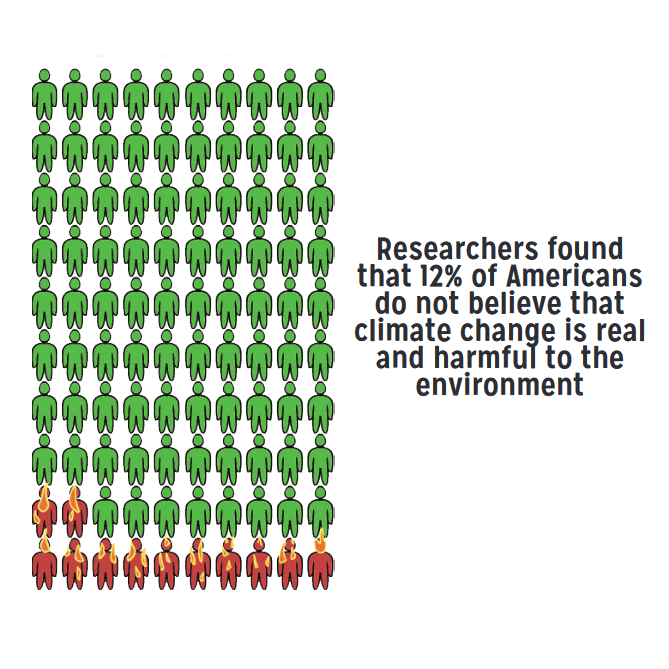
    In a nationally representative survey conducted in 2019 by the Yale Program on Climate Change Communication and the George Mason University Center for Climate Change Communication called “Climate Change in the American Mind” researchers found that 12% of Americans do not believe that climate change is real and harmful to the environment. While this seems like a fairly small percentage of people, it comes to a grand total of about 39 million people.

    Thirty-nine million people who disregard accurate data, ignore signs of environmental degradation, and refuse to believe the world’s leading climate scientists. The world can no longer afford science skepticism. How do we persuade this many people– more than the entire population of Canada– to change their worldviews?

    Environmental Communication Professor Jennifer Ortega believes that the solution may lie in a shift in the way we communicate with climate change skeptics.

    “Climate change is so big,” Ortega said. “In every community it looks very different as to how they are supposed to address it. If we talk about how there is, say, a disruption in this hydrological process, people are more inclined to be like, ‘Oh, what does that mean?’”

    The problem with the constant preaching of “we need to solve climate change” is that people do not know where to begin with that sentiment. The destruction of the Earth is often seen as an insurmountable problem which often leads to either complacency or outright denial. This is because, well, it is hardly possible to wrap our human minds around something as colossal as an entire planet in need of help.

    Creating viable, tangible solutions to smaller scale issues has the potential to both give people hope and convince skeptics that these problems are truly occurring. Ortega suggests that leaving the term climate change completely out of the conversation when trying to convince people to take action may be an effective route. People become turned off by the phrase, so keeping them engaged with local issues such as disruptions in a hydrological process or the benefits of electric cars in a city may be more constructive. Language is key.

    Environmental Studies Alumnus Miles Kinman agrees with this sentiment.

    “It is important to show people how climate change would impact their lives and the area in which they live,” Kinman said. “Sometimes the effects of climate change don’t seem real because the conversation often revolves around far off places such as the Amazon forest. Reframing the conversation in a way that makes people feel more connected to the problem of definitely a necessary step in trying to help people understand climate change is real.”

    Environmental studies student Emily Dreyer believes that climate change skepticism is one of the most pressing issues in the United States.

    “I think it’s an issue because it can disrupt the dominant narrative of environmental education,” Dreyer said. “Therefore, pressing issues aren’t supported enough and no change occurs. We are running out of time to save our planet and move towards total sustainability and any skepticism disrupts that process.”

  • The dangers behind marine debris

    The dangers behind marine debris

    Along the coast, you can free your feet in the sand and enjoy the beautiful sounds of the ocean. But enter the water and you, like many marine creatures, may find yourself entangled in fishing gear or waste plastic.

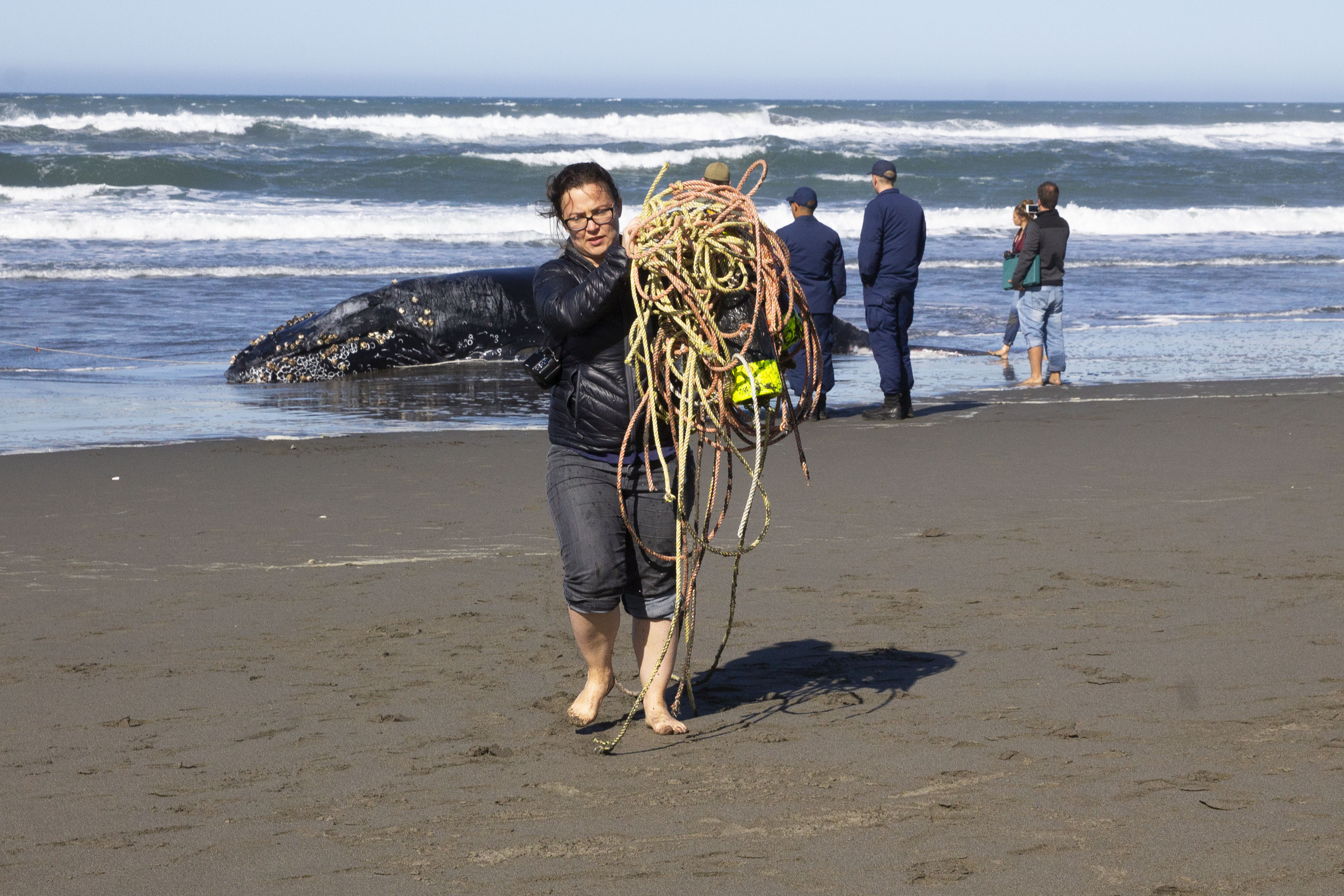
    As many may remember, a whale near Crescent City was found tangled in fishing equipment on shore. Two of HSU’s very own Marine Mammal Program went down to help. Despite efforts, the whale was unable to make it.

    This experience is like many others globally.

    According to NOAA Fisheries’ website, “Entangled animals may drown or starve because they are restricted by fishing gear, or they may suffer physical trauma and infections from the gear cutting into their flesh.”

    The reason this is such a killer? Fishing gear counts for the largest percentage of plastic in the oceans.

    Sea Shepherd Global wrote on their website, “Approximately 46% of the 79 thousand tons of ocean plastic in the Great Pacific Garbage Patch is made up of fishing nets, some as large as football fields, according to the study published in March 2018 in Scientific Reports, which shocked the researchers themselves who expected the percentage to be closer to 20%.”

    Ghost nets are nets that have stranded from their boats and continue catching marine life, tangling them and often creating mass bundles of nets.

    On Humboldt State’s Marine Debris webpage, a study they mention called “A Comparison of Plastic and Plankton in the North Pacific Central Gyre” by C.J Moorea, S.L Moorea, M.K Leecaster, and S.B Weisberg, explains that “in the North Pacific Gyre the mass of plastic out-weighted the mass of plankton (small marine organisms) by six times, despite the fact that the number of individual organisms was five times higher than the number of plastic pieces.”

    But it gets worse.

    “The same study found that 98% of plastics found were polypropylene/monofilament line (fishing lines), thin films and unidentified plastic fragments,” The HSU Marine Biology website says.

    “Lost/broken fishing gear such as netting and fishing string can entangle and kill large marine life such as sea turtles, dolphins, sharks, etc.,” Anna Caro, a third-year marine biology major at HSU, said in an email. “Most get trapped and struggle to escape, which usually makes the entanglement worse killing the marine life.”

    This means that while there is a demand for seafood, there is a risk of fishing gear becoming lost and potentially causing harm.

    “Scientists have still struggled to figure out the extent of the microplastics problem. Microplastics are being eaten by marine life and poisoning them, but not only is it terrible for the fish it is terrible for anything eating the fish including humans,” Caro said.

    Caro was able to learn more regarding marine debris through education at HSU in biology seminars and classes.

    Humboldt State also works closely with NOAA Fisheries to keep the oceans healthy and research them. Students can work with the Office of Response and Restoration’s Marine Debris Program to reduce waste and learn how to keep the oceans clean.

    Pacific Northwest Regional Coordinator Andrew Mason from NOAA expressed the issues of marine debris, especially fishing gear. Not only is this a marine loss, but an economic loss as well.

    350 species found entangled in marine debris, including all 7 species of sea turtle, 27.4% of seabird, and 39.8% of marine mammals, according to Mason.

    “It’s reaIly only these moments where we have our large sea life that are tangled up and it really brings awareness to the issue… it’s heartbreaking,” Mason said.

    Mason says that the problem itself stems from humans and extends beyond just lost fishing gear.

    “The scope of the issue is global, and for people to understand not just what they do on a boat, but it’s all of the waste we generate,” he said.

    But the issue can be worked on, and hopefully fixed. People can participate in cleaning events, as well as picking up debris if it is safe for them to do so.

    If debris is too large, like a ghost net, you can call the Department of Fish and Wildlife and inform them of the debris so it can be professionally handled. As well, if you find an entangled animal, call for help instead of handling it alone, as you or the animal may get hurt.

    But just picking up trash isn’t enough.

    “Stop use of single-use plastics and find ways to reuse our waste, recycling should not be the first choice since many plastics do not get recycled,” Caro said. It starts with striving for a zero-waste lifestyle and being aware of your waste and trying to find uses for it before trashing it.”

    NOAA also funds grants to clean up the marine debris.

    “Removal is treating a symptom, prevention is treating the root cause,” Mason said.

    For Mason, education is the key, providing people the sources to understand how to properly use fishing equipment as well as giving the general public information about how to discard their waste correctly.

    “The number one best way to address this problem and to help is to prevent these items from ending up in our marine environment,” Mason said.

    Education can teach people who may not live directly in contact with the ocean how they are affecting the ocean.

    “The ocean is key to our way of life and messing with the ecosystem can have unexpected impacts we are not yet fully aware of,” said Caro.

    “Everything is connected,” Mason said. “Everything we do has an impact.”

  • Update on HSU’s Climate Action Plan

    Update on HSU’s Climate Action Plan

    As Humboldt State students prepare to graduate, they take a pledge before they walk across the stage and receive their diplomas.

    “I pledge to explore and take into account the social and environmental consequences of any job I consider and will try to improve these aspects of any organizations for which I work.”

    The university makes it clear they want all students to take sustainability into account throughout their careers, but does the school itself practice what it preaches?

    The answer to this question by many standards is yes.

    In 2017, a Climate Action Plan (CAP) was put forth by HSU in order to integrate climate change and sustainability into the curriculum, conduct more research on climate change and resiliency, and reduce the direct and indirect greenhouse gas emissions of the school.

    The plan also includes strategies to curb emissions from energy and utilities, transportation, and waste. This is just a small fragment of what the 26 page plan aims to achieve.

    The most ambitious aspect of the CAP was to reduce the university’s emissions to complete carbon neutrality by 2030, and begin on a carbon negative path thereafter. This course of action comes with progress reports that include an update on the implementation of the CAP’s 55 strategies used to lower greenhouse gas emissions.

    The last report was released in November of 2019, and it states that out of the strategies, 45% were completed, 18% are in implementation, 22% are in development, and 15% are not yet started. While the school is making significant progress, the ambitious goal of reaching carbon neutrality was pushed back to 2045.

    The university budget cuts caused by the COVID-19 pandemic have not had a significant impact on the progress of the CAP.

    “Many of those initial strategies that were completed [in the CAP] were zero to moderate cost (e.g., policy or procedural changes or non-construction related),” Morgan King, climate action analyst for HSU, said. “But some projects requiring a large initial capital outlay (e.g., solar, electric vehicle charging) did not move beyond an initial exploratory phase in part because of funding, but that was an issue before the pandemic.”

    Some of the goals in the 2019 progress report include a reduction in facility and fleet greenhouse gas emissions to 1990 levels by the end of 2020, a further reduction in emissions to 80% below 1990 levels by 2040, and an achievement of carbon neutrality by 2045.

    King is drafting an update to the CAP which the university is calling the CAP 2.0. “We currently have leadership actively engaging with sustainability into all facets of the university,” King said. “So I am optimistic that we will be able to push forward some of the more capital intensive strategies in the CAP 2.0. For example, the campus is already pursuing a microgrid with solar and battery storage, which is a critical element to building resilience and drawing down emissions.”

    The university practices sustainability throughout its curriculum as well. Environmental Studies Associate Professor and Department Chair Dr. Sarah Ray emphasizes the importance of environmental awareness in a social justice based interdisciplinary curriculum.

    “The work of Katie [Koscielak] and Morgan [King] in sustainability is cross-cutting; they go beyond the facilities box and are doing what has to happen on all campuses of merging academics and facilities much more intensely,” Ray said. “The biggest thing we can do to achieve this even better is to continue to center the conversation around social and racial justice– how might those lenses shape what we do environmentally? What and whose traditions are we hoping to sustain, and how do we know what approaches are best for the environment?”

    Environmental studies student August Andrews says that he sees various ways in which environmental awareness is presented by the university outside of the classroom.

    “I definitely see HSU doing so outside of the courses they offer,” Andrews said. “HSU is not only known for its environmental curriculums but, simultaneously, it seems to be rapidly striving to be as ‘green’ of a university as possible, which is inspiring.”

  • How the Redwoods are Battling Climate Change

    How the Redwoods are Battling Climate Change

    While the rest of the planet suffers, what will become of the Redwood Forests?

    While climate change continues to cause destruction around the globe, scientists are finding hope in a local tree: The Giant Redwood, or Sequoiadendron giganteum.

    The trees are currently in the midst of a growth spurt, producing more wood in the past century than any other time in their lives, according to Save The Redwoods League, a nonprofit organization who protect and restore the California redwood forests. Researchers from Humboldt State University, UC Berkeley, Natureserve, United States Geological Survey and Colorado State University are working alongside Save The Redwoods League to understand the growing trees and how they will continue to respond to climate change.

    The Save The Redwoods League and HSU published findings concerning the impact of climate change in the recent research paper Aboveground biomass dynamics and growth efficiency of Sequoia sempervirens forests. They found that within the redwood forests, there are massive amounts of carbon sequestration. “Sequoia forests may be the most effective to [sequester carbon], because they accumulate more above ground biomass than any other vegetation, sustain higher rates of productivity than any other forest, and protect biomass produced via superlative fire- and decay-resistance.”

    Carbon sequestration is “the capture and secure storage of carbon that would otherwise be emitted to, or remain, in the atmosphere,” according to Encyclopedia of Energy, 2004. This means carbon is trapped in forests, soil, or oceans for long periods of time instead of entering the atmosphere. It can be done naturally or artificially, and is becoming a researched effort to delay global warming which is caused by increase of greenhouse gases, such as carbon dioxide.

    This is why scientists are so interested in the natural carbon sequestration of the redwood forests. While this seems to be good news, there is still much research to be done.

    NASA scientists have started to create a global map of where carbon is being stored, and how much carbon is being released through deforestation. The redwood forest is only a tiny part of that map.

    Humboldt State University Professor Steve Sillett has worked on the research with Save the Redwoods League.

    “Redwoods can do little to fight climate change as they occupy a TINY proportion of the landscape,” Sillett said in an email. “Even though they are impressive in many respects, too little of the landscape is covered by them to make much difference at the global scale.”

    While the redwoods alone cannot create a global change, scientists are continuing to research the storage of carbon in forests and what this means for the future of the planet.

  • Indigenous Environmentalists Connect Environment and People

    Indigenous Environmentalists Connect Environment and People

    Campus discussion touches on importance of traditional knowledge

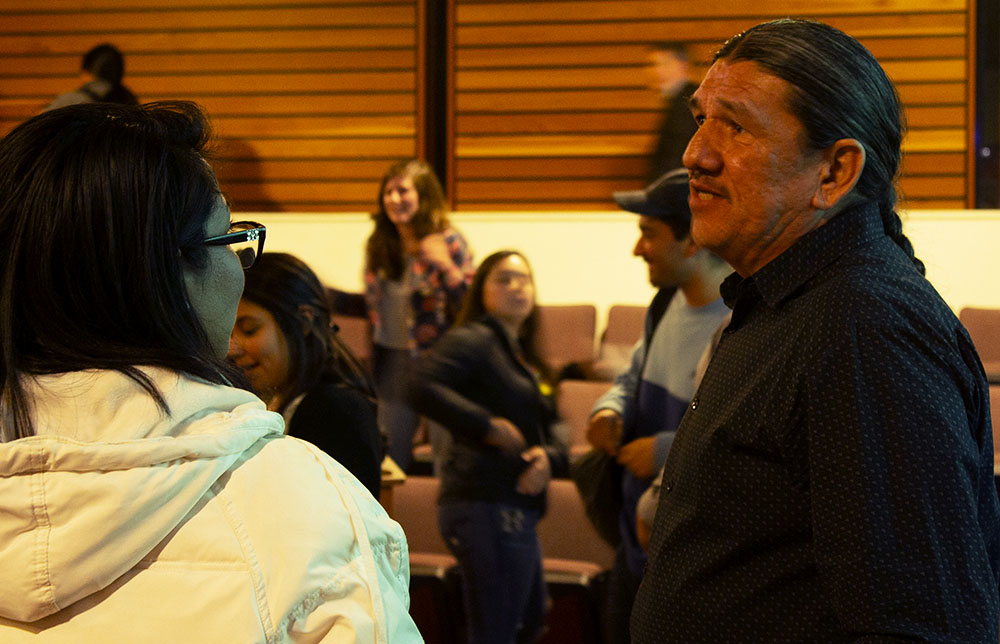
    Students, faculty, friends and family packed the Native American Forum March 5 to listen to author Kari Norgaard and Karuk environmentalist Ron Reed discuss Norgaard’s most recent book, “Salmon and Acorns Feed our People: Colonialism, Nature, and Social Action.”

    Before the speakers began, Cutcha Risling Baldy, assistant professor of Native American studies, announced the NAS department’s 25th anniversary at Humboldt State University.

    An introduction followed, led by Reed’s son, Charlie. Charlie Reed, a recent alumni from HSU’s NAS program, has continued as an environmentalist to help battle climate change. Before the talk began, Reed said it was important to give proper acknowledgement to the lands of Indigenous peoples. HSU sits on ancestral Wiyot land, and recognizing the land’s history is of utmost importance.

    “There is a symbiotic relationship between our environment and our people.”

    Charlie Reed

    “Whether you are a faculty member or student or just a community member, it starts with a conversation,” Charlie Reed said. “You never know who is in the room who has something to offer or give back the things that have been taken from Indigenous people.”

    Growing up with his father, Reed learned about his culture and the traditional ceremonies that tied in not just physically, but spiritually with the environment.

    “There is a symbiotic relationship between our environment and our people,” Charlie Reed said.

    With a warm thank you to the Reed family and the community, the floor was given to author Norgaard and Ron Reed. Reed introduced himself and what he learned as a child. Reed said learning the traditional ways of his people at a young age taught him how to sustain the environment.

    “That’s where it all begins, ladies and gentlemen, when you have the ability to be taught things that you don’t even know you’re being taught,” Ron Reed said. “That will stay with you the rest of your life.”

    In one of Norgaard’s chapters, she mentions an Indigenous tradition of using fire to cleanse or manage the land. Western science has given us the narrative that fire is dangerous and destructive. Thanks to “Smokey the Bear” and other forms of wildfire prevention advertisements, fire is seen as something to fear.

    Even though fire can be seen as scary, Norgaard argued it’s also a way to help manage landscapes by getting rid of invasive species and even enhancing plant growth. Indigenous peoples used fire to help the environments they lived on, not to destroy or cause damage. Reed stressed the importance of bringing that narrative to our attention.

    “We’re trying to get back to an intact world. Climate change can be a vehicle for that because of the awareness it brings to so many.”

    Kari Norgaard

    “We Native Americans—we the family—cannot let that narrative go,” Ron Reed said. “I don’t need some lone ranger to tell me the way. I know the way.”

    With Indigenous knowledge and science being pushed to the side when it comes to environmental issues, Norgaard said settler colonialism is still causing misinformation about the knowledge base of Indigenous peoples. Norgaard said this is changing.

    “Indigenous concepts and ideas have been making their way into academic spaces,” Norgaard said.

    Climate change is perhaps the most pressing modern issue, but Norgaard and Ron Reed agreed it would help bring more awareness in our communities.

    “We’re trying to get back to an intact world,” Norgaard said. “Climate change can be a vehicle for that because of the awareness it brings to so many.”

    The consensus of the talk was that combining Indigenous knowledge with western science can change the way we view the world as well as how we take care of it. Coming together and working with each other on both sides of science can also help combat climate change. From the ways of the rivers to the fires of the forests, Indigenous knowledge can teach us more about our world.

    “We need all the community on the river, but don’t forget us,” Ron Reed said. “Don’t forget the first people on this nation, on this ground that has created the environment that we’re trying to reestablish in this world today.”

  • An Update on HSU’s Climate Action Plan

    An Update on HSU’s Climate Action Plan

    The Humboldt Office of Sustainability reports good news for HSU’s Climate Action Plan

    Humboldt State University’s 2019 Climate Action Plan Progress Report revealed positive impacts for the Climate Action Plan.

    Morgan King, HSU’s Climate Action Analyst, explained how the Climate Action Plan divides campus emissions into three scopes, each categorized by how much control HSU has over reducing them.

    “We’re striving towards reducing our scopes one and two,” King said. “Scope one, the majority of that is natural gas so what we need to do is start weaning ourselves off natural gas.”

    “We’ve completed almost half of our strategies. But the most expensive ones that also have the greatest impact are the ones that we’re still lagging a little bit behind on.”

    Morgan king, HSU’s climate action analyst

    Scope one emissions are from burning natural gas on campus and the fuels fleet vehicles use. Scope two emissions are from electricity use. Scope three emissions are from commuting, business air travel and solid waste management.

    The report said we are on track to meet the 2020 emissions reduction goal. The Climate Action Plan set a course for the campus to reduce greenhouse gas emissions to 1990 levels by 2020, to 80% below 1990 levels by 2040, and to become carbon neutral by 2050.

    To accomplish these emissions goals, the CAP includes 55 strategies that lay out the short and long-term goals necessary to achieve these goals. According to the progress report, 45% of the strategies have been completed.

    “We’ve completed almost half of our strategies,” King said. “But the most expensive ones that also have the greatest impact are the ones that we’re still lagging a little bit behind on.”

    There are three projects in the works for 2020. First is a faculty learning program intended to teach professors how to incorporate sustainability in their lesson plans. Second, over spring break, King is co-facilitating a student leadership institute in climate resilience. King is also developing a sustainability minor to enable students to better understand the methods behind creating a sustainable environment.

    “Within our initial climate action plan we saw it was critical to have an engaged campus population that are making decisions and engaged in actions to improve sustainability for the campus,” King said. “That’s potentially as important as changing out all the lights.”

  • Sea Level Raises Risks in Humboldt Bay

    Sea Level Raises Risks in Humboldt Bay

    Humboldt is experiencing the fastest rate of water elevation on the West Coast

    Humboldt Bay is ground zero for sea level rise. In the last 100 years, the sea level rose 18 inches. This the most rapid rate of sea level rise on the West Coast.

    Humboldt County Environmental planner Aldaron Laird has 30 years of experience and spent ten years mapping and analyzing Humboldt Bay through a series of vulnerability assessments to help prepare our community for the inevitable impacts of sea level rise.

    “All the damage is going to occur with two and three feet of sea level rise,” Laird said. “It doesn’t really matter when that’s going to occur. We basically have to prepare for that now.”

    Laird reported that the rate of rise will continue to increase. A two or three foot increase in the average elevation of high water will breach the miles of diked shoreline as early as 2030.

    “All the damage is going to occur with two and three feet of sea level rise. It doesn’t really matter when that’s going to occur. We basically have to prepare for that now.”

    Aldaron Laird, Humboldt County Environmental Planner

    “When we go from two feet to three feet of water elevation change, it’s the tipping point in Humboldt Bay,” Laird said. “The 23 diked hydro logic units that we have on the Bay, all of them will be over topped when we go from 2 to 3 feet. So everything behind that will be impacted.”

    The land behind the dikes is privately owned agriculture, residential areas, business parks and industrial assets, not to mention municipal water lines, PG&E gas lines, waste-water treatment lines and electrical transmission towers. The threat is legitimate and significant.

    “The major urban areas that are most at risk are King Salmon and Fields Landing,” Laird said. “They are at risk straight from sea level rise. Half a meter to a meter, and those areas will be underwater. They aren’t behind dikes.”

    Linda Gill is the manager of Gill’s by the Bay, a restaurant located on the King Salmon waterfront. Gill said she hadn’t thought too much about the threat her restaurant faced as sea levels continue to rise.

    Projected Inundation Area (Stillwater) on Humboldt Bay for Mean Monthly Maximum Tide with 6.6 feet (2.0 meters) of Sea Level Rise. | Photo from Humboldt Bay Area Sea Level Rise Vulnerability Assessment

    “Right now we are just going with the flow,” she said in a phone interview.

    Wave energy had been diverted by the north and south jetties to an area called Booner Point, the site of an old PG&E nuclear power plant. There are still nuclear fuel rods stored there.

    “They decommissioned it, and they stored all the nuclear fuel rods 115 feet back from the bluff on their property with all that wave energy focused on that bluff,” Laird said. “It’s experiencing the highest rate of erosion anywhere on Humboldt Bay, and those nuclear fuel rods are going to be there forever. It’s probably the stupidest place on Humboldt Bay to locate a nuclear fuel storage site.”

    Jennifer Kalt, the director of Humboldt Baykeeper, said the county needs to be prioritizing protection rather than considering potential hazards.

    “Instead of fighting, local governments and state agencies need to work together to make a plan,” Kalt said.

    “Instead of fighting, local governments and state agencies need to work together to make a plan.”

    Jennifer Kalt, Director of Humboldt Baykeeper

    Kalt said the planning process seems to have reached a stalemate as local and state jurisdictions fail to agree on a comprehensive plan. The unique issue about Humboldt Bay is that the California Coastal Commission has first and final say on improvements to the shoreline.

    “So we have this conundrum on Humboldt Bay that I think the Coastal Commission has really never faced anywhere else in California,” Laird said. “The entire shoreline of Humboldt Bay is in state jurisdiction. If the county said they wanted to rebuild all the dikes, they couldn’t. They would have to ask the Coastal Commission and the Coastal Commission could say no.”

    Laird has submitted the final sea level vulnerability assessments. Now the individual actors need to come together in unison to take action and move beyond the planning phase and into the action phase.

    “Anything that can be moved should be moved,” Laird said. “Anything that can be hardened, redone or redesigned so that it can accommodate being submerged in saltwater should happen.”

  • Dying for a Climate Cause

    Dying for a Climate Cause

    Die-in protest advocates for action on climate change

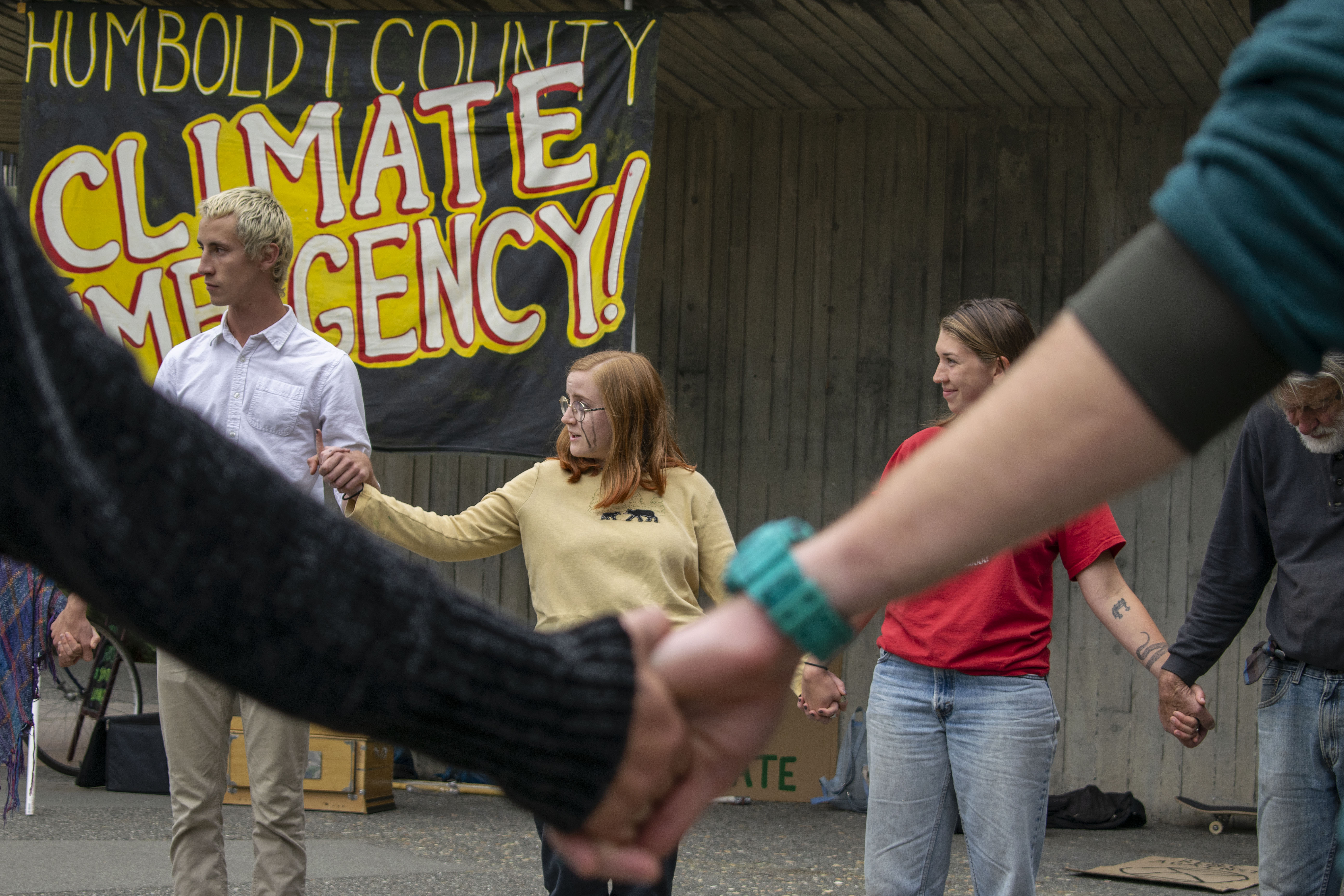
    Motionless bodies lay in the Humboldt State University quad on Friday.

    Junior wildlife major Olivia Brock joined a die-in protest put on by Extinction Rebellion with help from Earth First.

    “We want to show them that if they’re gonna kill us, then they have to see us,” Brock said.

    A variety of HSU students pretended to be dead on the ground, with many holding flowers in their hands and some wearing face paint.

    Extinction Rebellion and Earth First advocate and protest for governmental action on climate change and environmental issues.

    Junior forestry major Arvel Reeves joined the protest despite not knowing about it beforehand.

    “Climate change is something I really worry about,” Reeves said. “It’s only going to get worse.”

    Lily Price, HSU botany student, played a morose tune over the protesters’ bodies on a harmonium, an organ instrument that sounds similar to an accordion.

    The protest came one week after a global climate strike that saw thousands of protests around the world, including one in Arcata.

    Ellis Hanson, a junior wildlife biology major, wanted to help stand for the earth.

    “I did this to do a demonstration,” Hanson said. “To make sure everyone remembers the crisis we’re in.”

    Students passing by showed mixed reactions to the protesters. Some stopped and watched. Others took photos on their phones. Others scurried along without a second glance.

    Brock hoped the visual nature of the protest would draw attention.

    “We want to make the people of Humboldt County see the future we’re being handed,” Brock said.

    Heri Hawthorn, a local activist, helped create some of the signs and banners for the protest. Hawthorn held a sign above the protesters while they lay still.

    “There’s nothing else to do except support others and curb what’s happening,” Hawthorn said.

    Early on, when a University Center employee took down an unpermitted protest banner. Brock took notice.

    “Don’t you care about your children?” Brock asked the employee. “The earth is dying!”

  • Protesting Climate Change

    Protesting Climate Change

    AHS and HSU students strike to advocate for climate action

    Video by James Wilde & Collin Slavey | Editing by Chelsea Wood

    Anxious and irritated with the lack of governmental action against climate change, masses of young people and students from Arcata High School and Humboldt State University took to the streets surrounding the Arcata Plaza on Friday as part of the Global Climate Strike.

    Inspired by the International Youth for Climate Action, the Humboldt Sunrise Movement in association with the Extinction Rebellion and students of AHS organized and executed the local school strike protesting climate change.

    Students were excited to show how strong their voices could be when used in unison. Maddie Marriott, a member of Extinction Rebellion, said the organization was aimed at gathering people for peaceful protest and that is what they hoped to achieve.

    “We dance, yell, sing and chant to show our energy,” Marriott said. “This shows we are cheerful and hopeful and happy in the face of this threat. It is rejuvenating and these friends are empowering. Now we have to wait and see if our voice is being heard.”

    Marriott ended up agreeing to hold a sign that said “Protect Rainbow Ridge, our forests and our climate.” Ecological protection is one of the main goals of the movement, but Extinction Rebellion as a national organization demands governments tell the truth about climate change and act now to prevent species loss and lower greenhouse gas emissions.

    Vanessa Argonza, a Humboldt State student and member of the Extinction Rebellion, said speaking out and advocating for action is important. Change requires people to care and be passionate about an issue, while also realizing we can come together to create change.

    “In moments of injustice you must speak out because if you do not, you are part of the problem,” Argonza said. “The youth is well aware and willing to be part of the change because it affects them. We can come together and make change. You just have to be aware of your footprint and educate yourself before you speak out.”

    The protest did run into some technical issues as it spilled out into the Arcata Plaza. Unfortunately, the strike organizers failed to bring a speaker system that was loud enough for all of the attendees to hear, causing the message to fall flat. Joanne McGarry, a local supporter of the Environmental Advocacy and self-prescribed ‘gadfly’ suggested better planning in the future for a more impactful demonstration.

    Jene L. McCovey delivers a powerful, emotional speech about the threats to the Earth faces. | Photo by Collin Slavey

    “I am more than happy to let young people lead, they just have to lead well,” McGarry said. “Having music is important when you’re walking into the plaza, during the demonstration and as you exit the plaza. Having a speaker that is loud enough for the entire crowd to hear is unbelievably important.”

    The Sunrise movement was originally created as a youth advocacy group to show support for the Green New Deal, a stimulus package proposed by politician and activist Alexandria Ocasio-Cortez in February of this year. The Sunrise Movement intends to work within ‘the system’ while actively changing the system, in pursuit of environmental and social justice through nonviolent and direct action. They are building an army of young people to stop climate change and create millions of good jobs in the process.

    Tribal elder Jene L. McCovey began the rally in the plaza with a song called “Feeling Sorry for My Womenfolk,” a somber tune that spoke of hate and woe. She went on to tell stories and sing more songs to give purpose to the actions of the demonstrators.

    “The stumps are really big- that is all we have left of the old forest,” McCovey said. “Clear cutters, defilers, denude the land down to the earth and they burn it. Wherever you find your trials, be that healer. Be that person that walks with people in that good way. Be the water protectors.”

  • Redwoods Growing at Remarkable Rates

    Redwoods Growing at Remarkable Rates

    Some coastal redwoods are growing faster than expected and scientists aren’t certain why

    Many redwoods in Northern California are growing at unexpected—even record-breaking—rates. While redwoods only remain in a tiny portion of the world, they appear to be in good health.

    “People talk about saving the redwoods,” Humboldt State University Professor of Forest Ecology Steve Sillett said. “The redwoods, as long as we don’t cut them down, are doing just fine. The question is, can they help save us?”

    The answer is complicated.

    “The Redwoods and Climate Change Initiative found that one Del Norte County redwood put on 2,811 pounds in 2014, a record-breaking annual growth.”

    Many coastal redwoods are growing faster today than they have in the last thousand years, according to a 2019 report from the ongoing Redwoods and Climate Change Initiative.

    The RCCI, a research partnership studying redwood health since 2013, found surprising growth in redwoods located away from dry forest fringes or recent fires.

    By estimating tree weight based on the tree’s measured width, height and volume, the RCCI found one Del Norte County redwood put on 2,811 pounds in 2014, a record-breaking annual growth.

    The cause of the increased growth is uncertain. Sillett, who sat in his lab beside tree rings which he used to measure age and growth, said climate change may or may not play a role in the increased growth. Sillett said the Clean Air Act of 1970 may have cleaned the air enough to allow more sunlight on the trees.

    “What happened is, the air cleared,” Sillett said. “And with clear air, you get more light, and so it could very well be that this increase in growth rate that we see very strikingly in some of these trees, starting in the late 60s and early 70s to present, is just because of increasing air quality.”

    Beyond climate and air quality, Sillett said multiple factors likely contribute to increased growth. Sillett also said the growth won’t necessarily last.

    “I think that there’s very much a limit to what redwoods or any vegetation can achieve,” Sillett said.

    A redwood tree ring in HSU Professor Stephen Sillett’s lab Aug. 28. | Photo by James Wilde

    A sudden spread of redwood forest also seems unlikely, Lucy Kerhoulas, an assistant professor of forest physiology, said. Kerhoulas said redwoods already have to work hard to reproduce via seed. Climate change might make reproduction even more difficult.

    “Successful seedling germination and establishment might be really challenging under a warming and drying climate,” Kerhoulas said.

    In other words, redwoods are doing well, but they’re not about to reclaim their lost forests.

    Sillett emphasized that many living redwoods are maintaining their normal growth despite less successful reproduction.

    “It’s not the case that they’re responding uniformly,” Sillett said. “But what we do see is that in the prime parts of their range, which is, say, north of San Francisco and relatively close to the coast, the rates of wood production are higher than they were in the not-too-distant past.”

    Redwoods store large amounts of carbon, especially in their prime ranges, but Sillett said that won’t offset the carbon dioxide produced by humans.

    “There’s not enough land in the world to plant with redwood forest,” Sillett said, “that would allow them to save us from what we’re doing to the atmosphere’s chemistry.”

  • Pollinator Predicaments

    Pollinator Predicaments

    Climate change affects the lives of birds, butterflies and bees

    Pollinators matter! Right under our noses a huge community of ants, butterflies and bees are hard at work to make sure the world gets fed. The climate crisis is turning up the heat on these poor guys, and our many-legged friends are at risk. Here’s some information on how pollinators are still doing their best to help us out.

    A solitary silver bee perches on a yellow flower to drink nectar. Notice the yellow pollen on its legs which it will bring to the next flower it drinks from. | Photo by Rand Rudland

    Flowering plants and pollinators have a unique relationship with one another. Ecologists and biologists pay attention to special events in these organisms’ lives which mark growth and development. The science of studying life events is called phenology.

    Ideally a pollinator will hatch from its egg or develop from its pupa and leave the hive around the same time its flower of choice blooms. The timing of these life events is important because if a bug emerges too early or late, it may miss a plant’s flowering completely. No flower equals no food, and that’s no good.

    After emerging, the pollinator goes searching for nectar. The sweet liquid is energy-packed food for bugs. When a pollinator lands on a flower, it picks up pollen. As it continues to look for nectar, the pollen is shaken off and sticks to other flower’s pistils, the female organ of the plant. Pollen travels down a shaft to fertilize the ovary, which begins to go through mitosis and eventually produces fruit.

    Tayloranne Finch and Melanie Honda are two farmers working on the Bayside Park Farm in Sunny Brae who get to interact with pollinators every day. Without pollinators, their farm would be a bunch of fruitless bushes.

    Finch said the farm was working with the City of Arcata to build a permanent solution, a perennial native pollinator garden. The garden would have year-round plants that local pollinators prefer, supporting the local habitat organically.

    Tayloranne Finch, left, and Melanie Honda, right, are farmers at Bayside Park Farm. They spent a sunny afternoon pollinating corn by walking through the rows, swaying their arms back and forth. Every week is a volunteer friday at Bayside Park Farm on Old Arcata Road in Arcata, CA 95521. | Photo by Collin Slavey

    “We’re installing plants that will be there forever. It makes it easier for pollinators to establish themselves on the farm and it is mutually beneficial for us,” Finch said.

    Small changes in abiotic, or physical non-living factors, can alter life events. There are many changes in an ecosystem that can affect how a plant or pollinator does its job. Dr. Rachael L. Olliff-Yang and Dr. Michael R. Mesler published a paper in 2018 titled The potential for phenological mismatch between a perennial herb and its ground-nesting bee pollinator.

    In the paper they investigate how temperature affects the phenology of the silky beach pea (Lathyrus littoralis) and its main pollinator, the ground-nesting solitary silver bee (Habropoda miserabilis).

    “Temperature best predicted both flowering and bee activity, although soil moisture influenced the timing as well,” the paper said.

    Their findings imply that in the face of the climate crisis, an average increase in temperature may cause the silky beach pea and the solitary silver bee to fall out of sync.

    “Comparison of linear regression slopes of phenology against temperature suggests that bee nesting time is more sensitive to differences in seasonal maximum temperatures, and may advance more rapidly than flowering with temperature increases,” the paper said.

    A bumblebee looking for lunch landed on this flower to get a drink of nectar. The bee will help pollinate nearby flowers as it continues on its flight. | Photo by Collin Slavey

    Olliff-Yang and Mesler said that it’s important to understand what factors influence flowering and pollinator activity. Their investigation into the bee and the pea is just an example of a broader issue in the world.

    Building habitat is invaluable to local animal communities, as shelter, food and water are critical needs for every living organism. The most simple thing to do is to plant native plants in the front yard, as this will attract local pollinators.

    Local nurseries like Mad River Gardens will be more than happy to teach you about native plants and how you can attract and support our flying friends. As active members of the ecosystem, we all need to do our part.

  • Studying dinosaurs is dino-mite

    Studying dinosaurs is dino-mite

    Humans can learn from dinosaurs’ experiences with climate change

    Humans can learn from dinosaurs’ experience with global warming. Elliot Dabill, president of the board of directors for Friends of the Arcata Marsh, gave a lecture on Friday Feb. 15 on the topic, “What Could Dinosaurs Teach Us About Global Warming?”

    “Of course the answer is a lot,” Dabill said.

    Elliot said that during this time, the continents were crashing into one another to create Pangea. Volcanoes then began erupting. The lava produced was enough to cover Europe.

    Elliot said the heat from the lava cooked limestone and coal which then threw carbon dioxide and sulfur into the atmosphere. The large amount of gases, carbon dioxide and methane specifically, absorbed heat from the sun. Permafrost would then melt, which threw more methane into the atmosphere. During this time, oxygen was being sucked out of the air.

    Dabill referenced statistics that there was only 12 percent to 16 percent oxygen in the air, compared to 21 percent today. This lack of air would make it very difficult to breath at higher elevations.

    “You couldn’t go to Willow Creek,” Dabill said.

    According to Dabill, this is when dinosaurs began to evolve. This is also when Pangea began to break apart. Oxygen levels had just started to recover only to crash again. Volcanoes and poison gas again began to spew into the air.

    “Huge volumes of lava coming out,” Dabill said.

    The Earth started to heat up and oxygen levels were crashing quickly.

    “Volcanoes had to be a factor,” Dabill said.

    Many of the animals during these eras went extinct due to the low oxygen. Thankfully, dinosaurs have special lungs with air sacs. This type of lung system allowed the dinosaurs to absorb more oxygen than the other animals. The air sacs also helped absorb and exhale heat from the air. This allowed dinosaurs to survive while other animals suffered and went extinct.

    [perfectpullquote align=”right” bordertop=”false” cite=”Bill Prescott” link=”” color=”” class=”” size=”17″]“The more you hear about global warming, the more you understand it. The human influence is irrefutable.”[/perfectpullquote]

    Katy Allen, secretary for Friends of the Arcata Marsh board of directors, attended the lecture on Friday.

    “I never knew the reason dinosaurs survived,” Allen said.

    That is when it shifted into the Jurassic era. The dinosaurs began to take over.

    “Dinosaurs end up running the world,” Dabill said.

    Today, the Earth is heating up faster than ever. This is due to the mass of carbon dioxide being emitted across the planet by humans.

    The melting of glaciers and sea level rise are two issues of concern. People across the planet are counting on glaciers to provide water for their rivers. Sea level rise will affect people all across the planet. This will destroy homes and infrastructure for millions of people.

    Bill Prescott is a retired businessman who attended the lecture on Friday.

    “The more you hear about global warming, the more you understand it,” Prescott said. “The human influence is irrefutable.”

    Humans also have a trick to combat these issues. Humans can put their brains together to solve climate change once and for all.

    “This is only the beginning,” Dabill said.

  • Dunes Climate Ready Study gains ground

    Dunes Climate Ready Study gains ground

    In only the second half of the second year of the Dunes Climate Ready Study, the project is already providing researchers with interesting data. This projected five-year study is expected to provide a better understanding of sediment movement along the Eureka littoral cell, a 32-mile stretch of coastline from Little River north of McKinleyville, down to Centerville beach.

    Friends of the Dunes’ director Kim McFarland provided insight into how the project originated and what stage the study is at currently.

    McFarland explained how collecting topographical data in specific locations along the transect will allow researchers to map sand movement through the dunes under different vegetative conditions, and eventually determine how this affects dune structure.

    “They are able to put all of this [data] into a computer and see the actual contour of the dune and how it changes over time,” McFarland said.

    Andrea Pickart, a coastal ecologist with the U.S. Fish and Wildlife Service, and Ian Walker, a geomorphologist teaching at Arizona State University, are leading the Dunes Climate Ready Study.

    They wanted to do “a bigger picture study on dune restoration and the implications of that for climate change, climate variability impacts and resilience of the dune system to ongoing erosion and future sea level rise,” Walker said.

    Pickart and Walker started out by doing a few basic experiments on air flow and sand transport and how those maintain the dune systems. From there, they worked to get funding to expand their studies on dune restoration applying to multiple institutions in the hopes of starting a new in depth study.

    In 2015, the California State Coastal Conservancy awarded Friends of the Dunes a $249,000 grant to fund the first two years of the Dunes Climate Ready Study.

    “The objective was to better understand the effects of climate change and sea level rise on coastal dunes…to assess vulnerabilities arising from the impacts of sea level rise and assist the community in preparing for those impacts,” Pickart said.

    Originally, the main focus was to establish a monitoring system for the regional beach-dune environment. The first step was to determine the placement and setup close to 60 transects along the 32-mile stretch of coast.

    “We are taking these profiles of dunes all along that 32-mile stretch of dunes… we are taking topographic vegetation profiles,” Walker said. “It’s a way of looking at the beach and the foredune…just behind the foredune, the real land-ocean interface and seeing what kind of sand movements or sand exchange happens between the beach and the fordune.”
    At the end of the five-year study the data will be used as a model response to sea level rise under different circumstances.

    The first survey began on Jan. 4, 2016, and will continue for the duration of the study. Measuring the wind flow and sediment transport is one of the main focuses of the study, but examining how the native versus non-native plants interact with the dunes is also extremely important in order to understand the relationship between these two variables in the dunes environment.

    “There’s different components to this research, and one component of it is how native plants versus non-native plants affect the movement of sand from the beach into the foredune and then the backdune,” Pickart said.

    Invasive plants play an interesting role in altering the physical processes of wind flow and sediment transport. Foredunes produced from invasive vegetation are different than foredunes with native vegetation.

    “The primary non-native species we have here is a non-native beachgrass, which grows much more densely than our [California] native dune grass,” Pickart said. “But they are both grasses that trap sand and allow dunes to build.”
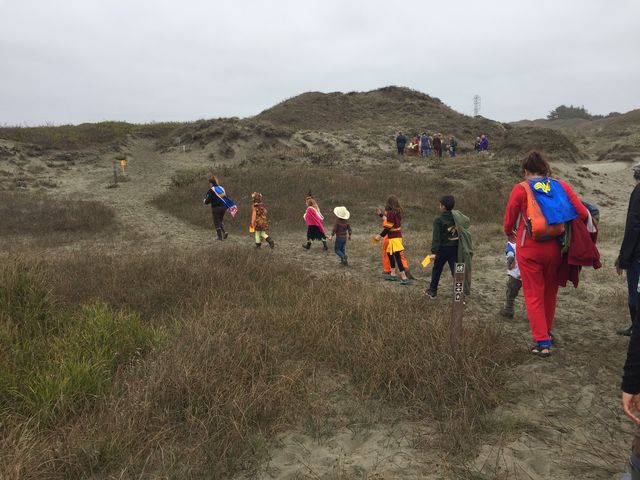
    Data from this study is still being collected and will be a part of the research over the next couple of years.

    “What we’ve seen to date is that after removing the over-stabilizing European beach grass, we have, in fact, observed that the sand budget has been reconnected between the beach and the backdune,” Pickart said.
    “In other words, we’re seeing movement of sand all along the beach and into the back dunes, and that was part of our hypothesis, that native plants would allow for more free movement of sand over the top of the foredune and into the backdune.”

    European beachgrass is the main inhibitor of sand movement. For this reason, Friends of the Dunes works to have volunteers remove the invasive species, allowing sand to move more freely between the beach and the foredune.

    The sands freedom will allow the translation of the foredune: “which is the movement of the foredune inland and up in elevation as sea level rises,” Walker said.

    “Basically, we know that the European beachgrass traps more sand. The experiment is whether having the native plants allow more sand to bypass is going to facilitate this inland translation of the foredune,” Pickart said.

    European beach grass, also known as Ammophila, is a main inhibitor of sand movement. Because of this, Friends of the Dunes works to have volunteers come and remove the invasive species allowing sand to move more freely between the beach and the foredune.

    Another branch of the study has been the creation and monitoring of two different adaptation sites. These sites are meant to help determine the desirable planting composition that allows for sand transport.

    “The experiment is whether having the native plants allow more sand to bypass is going to facilitate this inland translation of the foredune,” Pickart said.

    The sites are often used as to house smaller pilot studies to provide answers to some of the more specific detailed questions, for example, how grain size affects sand movement, the impacts of the upward migration of a foredune, how herbivory affects sand transport and multiple other experiments.

    There are many different collaborators such as the Wildlands Conservancy, students from the University of Victoria and HSU students and staff. The adaptation sites will continue to provide a wealth of information throughout the study, helping to answer specific questions on dune structure and sand movement.

    With the study still less than halfway into their five-year projection, there is still a lot of research to be done. But from the data seen so far, the Dunes Climate Ready Study has the potential to alter how researchers view dune restoration and the impacts of climate change.

    To learn more about the Dunes Climate Ready Study, you can visit the page dedicated to the study on the Friends of the Dunes site HERE! The page contains an archive of quarterly updates on the study if you are interested in learning more about it, or if you simply want to stay updated on the most recent research.

    If you would like to be apart of the dune restoration projects to combat native species and climate change visit the Friends of the Dunes volunteer page, HERE!

    This story was updated on Feb. 1, 2018 from its original publication on Jan. 15, 2018 per request by the author.

  • Goodbye Moonstone, hello rising sea levels

    Goodbye Moonstone, hello rising sea levels

    Picture Moonstone Beach. The sun is setting, creating a silhouette of Camel Rock against a watercolor sky of vibrant pinks and oranges. The ocean is at peace, beautifully calm and picturesque. Now imagine the beach in fifty years or so.

    Moonstone Beach is gone.

    Due to rising sea levels and changing weather patterns, the beach at Moonstone no longer exists.

    Jennifer Savage, the California Policy Manager for Surfrider Foundation, was able to paint a picture of what Moonstone Beach will look like when we fast forward a couple years.

    “It’s not miles and miles of wide open beach on the north side, so I’d imagine that the modeling would predict that the Camel Rock area and the Moonstone area would be the first to disappear,” said Savage. “Then Clam Beach going down toward the Mad River mouth, because it’s wider and broader, may last a little bit longer.”

    moonstone
    Graphic by Kyra Skylark

    A representative for the Surfrider Foundation and an avid surfer and wave lover herself, Savage works to keep the waves clean and preserve the oceans and coastlines worldwide.

    “Essentially, even if we have just a few inches of sea level rise, it’s a vertical. It’s not just the oceans getting closer, it’s that they’re getting taller,” said Savage. “How that affects different places depends on the geography, the weather patterns, the ocean’s current patterns, and a lot of different things.”

    The repercussions of climate change can only be predicted to a certain extent, but there are numerous studies and research constantly happening to determine how our oceans are being influenced and how the could be affected in the future.

    “With Moonstone Beach, we already know that during the King tides the beach is completely covered,” said Savage. “The King tides give us a pretty good preview of what the future will look like.”

    Daniel O’Shea an Oceanography professor specializing in Geological Oceanography was able to provide greater insight on the King tides.

    “The King tides are a play on the words spring tides,” said O’Shea. “Every two weeks, we get what are referred to as spring tides around the new and the full moon, where the tides spring up higher.”

    “Around the winter and summer solstice, we get the highest and the lowest tides of the year, and those are called the King tides,” said O’Shea.

    The King tides show the physical changes to the coastline we can expect in the coming years as climate change continues to alter sea levels.

    “They’re [the King tides] going to be the normal high tide in 15-30 years,” said O’Shea.

    What we currently consider the extreme high tides will become our new normal, and the changes are coming faster than we can anticipate.

    Kim McFarland, the Executive Director of Friends of the Dunes explains how the dunes are being impacted by climate change.

    “We’re doing a climate ready study through the U.S. Fish and Wildlife services, it’s a climate change resiliency study,” said McFarland.

    By measuring how the sand dunes are moving and reacting to changes in the climate, researchers can predict how the environment will change and how far back the dunes will travel.

    “What they’re looking for is how the sand moves through the dunes, because during the winter time when it is wet the sand doesn’t move as much,” said McFarland. “What does happen is we have winter storms, and the storm surges are getting more frequent and more intense and that’s most likely a result of climate change.”

    As the climate changes and sand is continually displaced and moved from the foredune backwards, the dunes themselves will move backwards, potentially displacing buildings and homes near the area.

    As sea levels rise it’s not just the beaches and the local natural environment that will be affected, homes and businesses will be greatly impacted.

    Eventually, individuals with homes and business in the Humboldt Bay will have to be relocated. Homes within the King Salmon area are often flooded during the winter high tide times, so as sea levels rise, those residing within the area and areas nearby will have to move.

    “The key thing is to identify the most vulnerable places and what kind of infrastructure exists in those places and then figuring out what can be moved,” said Savage.

    As we continue to impact the environment, predicting the outcomes of climate change in the ocean and along the coast is very imprecise.

    “What we do know is that the sea is rising and we are not going to be able to stop it, at best we will be able to slow it down,” said Savage. “We’re not preparing for it fast enough.”


  • This week in STEM Oct. 24

    This week in STEM Oct. 24

    By | Bryan Donoghue

    Embed from Getty Images
    One of the things that makes weed worrisome is its impact on developing brains. A new study presented at the World Psychiatric Association found that teens who smoke pot are more likely to suffer from psychosis. The results show that people who used cannabis before 18 developed schizophrenia 10 years earlier than other people who didn’t smoke. For every year the teens smoked weed, symptoms of psychosis rose 21 percent annually.

    Source: Scientific American, Newsweek, Vice

    Embed from Getty Images
    You can really use Google Earth to find anything, even discovering something ancient. Over the past decade, Google Earth has been used to identify thousands of burial sites dispersed around Saudi Arabia. Recently, archaeologists used the application to uncover around 400 stone structures called “gates” in the Arabian desert. The researchers believe it may have been built by nomadic tribes anywhere from 2,000 to 9,000 years ago.

    Source: New York Times, Popular Mechanics, Forbes

    Embed from Getty Images

    Climate change isn’t just affecting sea level, but it’s also harming coffee production. Coffee needs specific temperatures to grow properly and is highly likely to have pests. To combat diminishing coffee production, researchers are cross-breeding coffee plants to create a brand new strain. With most of the coffee around the world grown close to the equator, the newest coffee strain resists climate change and is named after the countries that produce our espresso beans. Out of seven new variety hybrids, Centroamericano is the new breed of coffee bean that can best withstand rising temperatures and decreasing rainfall while still producing a large quantity of quality coffee.

    Source: The Times, The Denver Post, Phys.org

    Embed from Getty Images

    Soldiers stuck in the snow will soon have some high tech underwear made of special fabric to combat the threat of sweat freezing. The light fabric uses nanowires, tiny wires of silver, to form a mesh across cotton. The silver reflects body heat back to someone’s skin helping with insulation. To help with sweat, the underwear also has hydrogel beads, a polymer that absorb up to 40 times their weight in water. This will help keep the troops warm for the winter.

    Source: Science News for Students, Business Insider

  • Recycling isn’t working

    Recycling isn’t working

    Recycling is not as sustainable as you might think. It has become a wasteful movement that was beneficial during the early stages of the environmental movement. Now the cost outweighs the satisfaction we get out of recycling.

    “Recycling has been relentlessly promoted as a goal in and of itself: an unalloyed public good and private virtue that is indoctrinated in students from kindergarten through college,” wrote John Tierney, journalist and self-described “contrarian” for the New York Times. “As a result, otherwise well-informed and educated people have no idea of the relative costs and benefits.”

    To put it in another way, most recycling advocates are unaware of the cost of transportation, labor and production of renewable materials that ultimately defeats the purpose of saving the planet.

    Recyclers are validated by the collective consciousness of fellow believers. They don’t realize the wastefulness that occurs after rolling the recycling bin to the curb. Why did things get worse? The short answer is the success of an ongoing marketing campaign that resonates with a growing population of millennials and aging liberals.

    Since the advent of the “Reduce, Reuse, Recycle” idea, recycling received the most attention. Why? Because there’s barely any money in reducing or reusing. If you think about it, recycling starts its capitalistic cycle from our wallets to the bins or recycling centers, then to the manufacturing plants, the businesses and back to burning a hole in our pockets.

    So, there you have it, reduce consumption and reuse your renewable materials. Buy used products and learn how to repair them if they break. Borrow, rent or share if you can. The point is to reduce the disadvantages of recycling that is practiced by too many people and apply smarter solutions to climate change. If enough of us consume less and reuse more, the act of recycling can reclaim its integrity. It’s all about balance.


  • California Cap and Trade: Climate Problems Solved?

    By | Ciara Emery

    As hundreds of bills sit on Governor Jerry Brown’s Desk for signature at the end of this legislative session, a cap and trade extension prevails as a win…for some.

    A ten-year extension to California’s landmark carbon market was approved in the middle of July this year—four years after its initial passage in 2013.

    California’s carbon market consists of caps on carbon emissions to certain sectors of the economy and includes the ability to trade allowances to meet emissions targets. These targets get smaller every year.

    The idea is simple: industries and businesses that remain under their emissions limits will be awarded with extra income from the sale of their extra allowances. Industries that are not under their emissions limits will be penalized with the extra costs of their pollution.

    This market-method of climate change mitigation is a bipartisan step forward on the path towards sustainability—with a few hiccups that is.

    While several assembly Republicans in California voted for the measure, it was far from bipartisan. No more than one month after the vote, Republicans ousted the Assembly Republican Caucus Leader, Chad Mayes, in an upset party vote. His discretion? Allowing eight caucus members to side with Democrats in favor of the measure.

    Republicans argue that concessions such as these allow Democratic legislators off the hook on tough votes. Three Democrats, including Assemblyman Mark Stone who represents the cities of Santa Cruz and Monterey, were able to vote no and avoid any wrath from tough districts.

    Republicans would also like to fall in line with national GOP stances and oppose the measure for its seemingly anti-business policies and tax-like features.

    While this debate rages on the right, the same amount of conflict has risen on the left.

    Environmental justice advocates largely find this extension a loss for low-income communities and communities of color. These communities are overwhelmingly more impacted by pollution from the sale of extra allowances than more affluent communities in California.

    While several initiatives attempt to respond to this inequality (AB 617 also passed this session, which attempts to address issues of air quality), large scale problems persist.

    California is continuously hailed as a national leader for Climate Change policy. In many cases, we act with fervor where others do not. But we still have significant conflicts to grapple with.

    California Republicans must figure out which side of history their party wants to stand on. Democrats need to commit to environmental justice concerns. The climate should not be better for some, it needs to be better for all.

  • Trump Watch (March 22 to March 28)

    Trump Watch (March 22 to March 28)

    By | Bryan Donoghue

    According to a review of court cases, government and legal documents, and an interview with a former federal prosecutor, Donald Trump and his company repeatedly turned to wealthy Russians from former Soviet republics. Trump, his company, and partners have been linked to at least 10 wealthy former Soviet businessmen with alleged ties to criminal organizations or money laundering.

    Source: USA Today

    President Trump signed an executive order on Tuesday that’s intended to unwind most of President Obama’s climate-change legacy, celebrating the move as a way to promote energy independence and to restore thousands of lost coal industry jobs. The order also covers a suite of narrower but significant Obama-era climate and environmental policies, including lifting a short-term ban on new coal mining on public lands.

    Source: The New York Times

    Summer Zervos, a former contestant on Trump’s reality TV show, “The Apprentice” sued Trump last year before his Jan. 20 inauguration for groping and pressing his privates against her in 2007. President Trump wants to derail the defamation suit by claiming immunity through his job as the nation’s commander-in-chief, according to court papers made public Tuesday.

    Source: New York Post