Every weekend on campus students make birdies fly. Saturdays from 12 p.m. to 2 p.m., badminton lovers can be found at an open gym hosted by the Humboldt Badminton Club. Located at Forbes Gym, badminton is one of the many recreational sports on campus that host drop-ins. Drop-ins are $2 a session for community members, but for students, it’s completely free.
Aaron Muscarello is the president of the badminton club and has been slinging shuttlecocks since middle school. As a senior and a physical education major, Muscarello is passionate about bringing badminton back from the dead.
“This is the first full semester,” Muscarello said. “To see a whole gym full of people, like this, was initially my goal to start. The next goal is to get more competition. I like to see tournaments. It’d be cool to have an intramural league but we just have to get people that are willing to… progress and want to be more competitive.”
With big plans for this club’s rebirth, Muscarello’s big time goal is to travel and compete against other schools. In order to achieve his goals, he must start by recruiting more consistent club members.
“It was kind of a selfish goal,” Muscarello said. “You can’t play badminton by yourself right? So you need other people… I want to play so I’m going to be the one to get all these people together. And that’s why I started honestly. It’s a great opportunity to come down like if you want some exercise on a Saturday, especially when it’s raining.”
Either with friends or on your own, the badminton club is beginner friendly and a good place to socialize. Depending on experience, games range from fast paced one-on-one matches, to slow and steady doubles. Most of the time they don’t keep track of points.
“If you’re somebody that wants to run around and actually meet people that are really cool, that is what the club is for,” Muscarello said. “That’s why drop ins are a sweet opportunity.”
Morgan Lopez, a child development major, was a first-timer on the badminton court. She had hardly played the sport before, and walked away feeling positive about the experience.
“It’s actually really fun,” Lopez said. “It’s way harder than I thought it would be, but I think I’ve got a dub coming up here soon. It’s a cute little game, a cute little racket, cute little birdie. Cute little net.”
More serious about the sport is Clarissa Peyton, a zoology major. Peyton has played badminton since highschool where she competed in the Citrus Belt League and played varsity singles.
“I love badminton because it’s a really satisfying sport, like when you smash it [the birdie] or trip up your competitor with different moves,” Peyton said. “I also just love competing with people and seeing people really give it their all.”
Muscarello attributes the success of the club to the people he works with. This includes club officers, his advisor, recreation sports and the office of student life, his family, and most importantly his team and the people who show up to drop ins.
“I might be the President – or King, Emperor, Firelord – of the Humboldt Badminton Club, but this is a team game and I couldn’t have gotten this club to where it is without the support of [my team],” Muscarello said. “I couldn’t have done it without y’all.”
Imagine this: you’re in your dorm room getting ready for a night out with friends with the cheap vodka your one friend with a fake ID supplied, and nothing but pure 18-year-old confidence. Adrenaline is pumping as you sashay around your roommates makeup bag strewn about your shared bedroom floor, careful to avoid speaking to them as they apply their liquid eyeliner. All of a sudden, your phone that was blasting some 2014 alternative indie throwback is buzzing. The music stops and everyone turns to you, wondering if your DJ rights should be revoked. You scramble to your smartphone, and as you flip it, over there lies an incoming Facetime call from your long-distance boyfriend. Pink heart emojis act as bookends to his contact name as you look at yourself on the screen and contemplate answering this call.
“Oh, it’s (some boring hometown man’s name),” you say to your friends.
They know the weight that generic name holds in that dorm household. It’s 9 p.m. and they already called a cab, which should be there in about two minutes. You look at your phone as it vibrates in your hand, you look at the flock of young girls on your bed giving you the look – you know the one. The bordering Kubrick stare and eyes of disappointment, non-verbally asking, “Are you really gonna answer it right now?” You gaze back at your phone and quickly say “I have to take this,” as you disconnect from the bluetooth speaker and rush out into the dank hallway of your shared living space, hoping to god your name isn’t part of the conversation that’s happening behind the door you just slammed.
I, too, was a victim of the unplanned long-distance boyfriend call. From my freshman year of college to my junior year, I was enraptured in my long-distance relationship. I wouldn’t say it was all bad but I will say it just took way too much energy in the long run. I was fresh out of highschool and still carrying the weight of my highschool boyfriend around. I spent nights having sleepovers over Facetime, or watching some movie that we had to perfectly time to sync over the phone. Long-distance relationships can truly show you love someone, but when does it reach the point of total time consumption?
It was fun in the beginning, when you were excited for each other and the different paths you took, but long-distance success is based on clear communication, and sometimes that isn’t even enough to hold the relationship together. When college and life in your new town away from your partner picks up, lots of factors come into play; jealousy, accessibility, and just the plain old feelings of missing each other.
When your time gets so constrained to the point of only being able to call your partner in your LDR (long-distance relationship) once a week, it can really throw an axe into your dynamic. Even if it’s clearly communicated and you’re transparent with your busy schedules, it can feel hard for your LDR partner to not feel neglected or forgotten about. They aren’t with you – they aren’t seeing your day to day schedule, and when you have to pencil in time to call them and try to keep their attention as you talk to them about your mind numbing statistics lecture, the spark can easily fizzle out.
You can try and keep it alive by doing movie nights for each other or sending care packages, but at the end of the day, it’s hard to feel truly loved and cherished when you’re six hours away from each other and not sure when you’ll see eachother again.
Honestly, I don’t think any 18-20-year-old has the emotional or physical capacity to do that either. These are such developmental ages, and trying to entertain an LDR partner in between it all can feel like a maze of confusion and a tow truck of effort. I’m not saying dump your LDR because it’s gonna ruin your social life. I don’t think I missed out much when I was in my LDR as a baby-faced college freshman, but I will say it caused some baggage in the long run.
Long-distance relationships seem to only be a blanket to hold on to the inevitable factor that you will break up; holding on to the very end until you have to throw in the towel. It usually isn’t pretty, and is the reason why most LDRs end over the phone or text with little-to-no closure at all. That’s gonna cause more pain in the end than just parting ways after highschool for the purpose of doing it for each other’s own benefit. Breakups are never easy, but it can give you a lot more peace of mind. You did it for your partner’s and your own self-preservation.
I can’t speak much on the mid-20s LDRs, but I’d have to say it’s the same. Open communication just isn’t possible without at least some weekly face-to-face conversations. Interaction in the digital world can feel awkward, less genuine and allows more time for feelings of neglect and loneliness to build up. Long distance has its expiration date; I can only see it as a temporary thing of a year max. Anything past that is just a waste of time.
Over a dozen students gathered to attend the Computer Science (CS) Club’s second workshop of the year. The workshop showcased, “Godzilla! The First Person Shooter,” a Godzilla-inspired first-person shooter game developed on the Unity engine.
Hosted in the library, the CS Club provided detailed instructions on the development process of their game. The workshop gave students an opportunity to gain insight into the realm of game development and taught the basics of using the Unity engine.
The game was being developed by the attendees, becoming more fleshed out throughout the course of the workshop. What started as a simple blank terrain transformed into a full city filled with buildings and roads. Godzilla also evolved throughout the event, evolving from two stiff arms unable to move to a fully mobile fire-breathing monster in less than an hour.
Without the assistance of an experienced developer’s coaching, creating a game is a time-consuming task that comes with its fair share of difficulties. One of these challenges that hinders the development process is the lack of a large team and resources. CS club Vice President Anthony Cavuoti discussed the goal of the workshop as well as how they planned to assist students in overcoming these hurdles.
“We’re showing people how to use the Unity engine,” Cavuoti said. “We want to show them how to properly utilize assets to create big games without the need for a big development team.”
The use of both the Unity engine and assets – items used in-game, such as 3D models – help remedy the lack of resources and creates a more accessible introduction into the world of video game creation.
Club president Amy Wguyen shared that apart from the development of their game and the workshops they host, the CS club partakes in many activities and events with both their ICPC event, as well as the annual hackathon coming over the horizon.
“Our ICPC event is coming up soon,” Wguyen said. “Last year, our team placed 12th in the region. We also have the hackathon approaching sometime in April.”
Whether you’re experienced with coding or you’re just at the beginning of your journey, the CS club has room for you. The club provides clear instructions that are suited for all levels. If game development and technology interest you, a discord invite can be found on their website csclubhumboldt.org.
“The CS club has workshops that anyone can do, regardless of their experience with coding,” Wguyen said, “Whether you’re very experienced or not, you can come and learn from the workshops.”
An unusual new guest was spotted on the northern end of Brackish Pond in the Arcata Bird Sanctuary last Friday. Brandishing purple, blue, and green feathers with chicken-like feet, an adult purple gallinule had somehow made its way to the marsh from its native territory in the southeast U.S. There had been no prior documented sightings in northern California, so birders flocked from all different counties to catch a glimpse. Among those birders was Cal Poly Humboldt’s brand-new birding club.
Photo courtesy of Cedrik von Briel. An adult purple gallinule walking among the reeds at Brackish Pond.
Cedrik von Briel, the president of the birding club, arrived at Brackish Pond around 7:30 a.m. last Sunday, in the hopes of spotting the purple gallinule. Describing the bird as a standard chicken on LSD, this was an opportunity he couldn’t miss. Much to his luck, he was the first person to spot it.
“The first thing I spotted was that you know, you see a bunch of reeds, a bunch of green,” von Briel said. “And then, a glint of purple and blue and green — it just all hits you at once. And then you’re like, ‘Yep, that’s the bird.’”
Von Briel recalled the audible gasps from the crowd of around 20 to 30 people as the purple gallinule came into view. The bird emerged from the reeds into an open clearing, then went up into the nearby willows to feed. It was a spectacle in more ways than one.
“It was up in the reeds, the willows, and the leaves, and it just fell at one point,” von Briel said. “You could hear the giggles and the audible gasps as people looked on, horrified. It’s a funny bird. It’s a stupid, stupid, funny bird.”
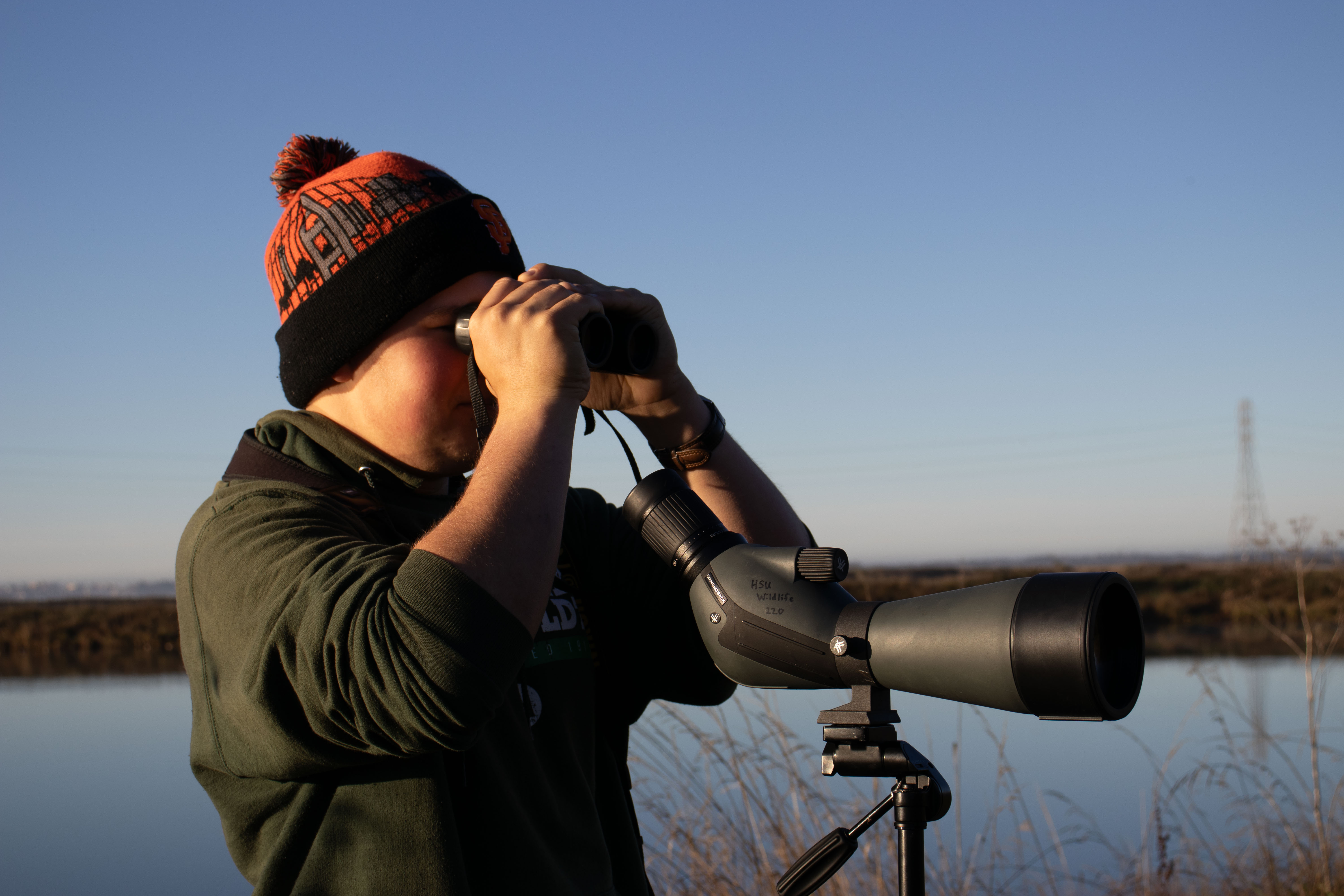
Photo by Griffin Mancuso. Birding Club President Cedrik von Briel watching for birds near Brackish Pond with John Marchwick.
The Origin Story
The birding club, not even two months old, was started out of a pre-established passion for birding. Birders use a variety of tools to spot and document birds, including binoculars, telescopes, cameras, and the naked eye. They also learn to identify and track birds by their calls. Birding is both a hobby and a form of citizen science.
The treasurer of the birding club, Kellen Apuna started his birding journey at a McDonald’s.
“There was a stream that ran kind of adjacent to the parking lot, and I was looking in and I recognized a bird in there. I was like, ‘Hey, that’s one of the birds from the class.’” Apuna said. “I guess from there, it was just a matter of getting a field guide and kind of going through that, and learning what was in the area and then it just snowballed from there.”
Vice President Sasha Cahill’s birding journey started with a western tanager at the Vista Vinita Park in Orange County. He went to his father’s birding book for answers, and his father helped him identify the bird. After that, he couldn’t help noticing the variety of bird species during his trips to the park.
“My dad tried to look up the rare bird hotline, which was a thing in the 90s, but by this point, it had shifted to eBird,” Cahill said. “And using eBird, you can see rare sightings from your area and any area you want. So then we were able to chase rare birds and you know, just spirals from there. You notice things, you see interesting things, and it’s continued to this day for sure.”
All three of the club’s officers were aware of each other through eBird in their freshman year. The popular birding app allows birders to upload their photographs to document sightings, creating a public database for researchers and fellow birders. Von Briel initially messaged Apuna through Facebook and invited him to go look for Allen’s hummingbirds in the bottlebrush plants near Founders Hall. They start pursuing a western flycatcher and try to coax the bird out with pishing.
“Pishing is like a sound you make to imitate an angry call from a bird,” von Briel said. “It kinda locks birds in because they’re attracted to that stuff. And then, down the steps comes Sasha with his friends. He’s like, ‘Did I just hear pishing?’”
Apuna recalled the moment when the two birders recognized each other.
“[Cahill said] ‘Are you Cedrik?’… and Cedrick went, ‘No way, I just pished out a birder,’” Apuna said.
Birding Tools
Along with pishing, there are various tools a birder can use to lure birds into the open. Some birders use playback, where they play a recording of a bird’s call from a speaker to entice the specific bird they’re seeking. However, it is considered unethical to use playback for vagrant birds, birds in their breeding season, or both. Some birders resort to flushing to get a good view, where they make just enough noise (usually by clapping) to drive a bird out of the brush or reeds.
Photo by Griffin Mancuso. A marsh wren resting in the trees near Brackish Pond.
“We’ve definitely had our ethical discussions [for flushing],” Apuna said. “Is it worth it for us to basically disturb the bird into showing itself? And I don’t really think we’ve ever reached a solid resolution.”
“It’s true that a bird doesn’t have an iron trap memory,” Cahill said. “It’s going to hear a slight disturbance, and then it’s going to go back to its busy-birding, but there’s a line you don’t wanna cross.”
The club officers hope to discuss the ethics of birding along with other topics at future club meetings.
“We want to host occasional meetings. We have people present on photography, ethical birding, trying to go out and find stuff, birding by ear — guest speakers or something like that,” von Briel said. “We can definitely make it what our eventual members want it to be, and that’s the beauty of it. We’re just starting; we have a future ahead.”
Birding Trips
The birding club goes looking for new birds almost every weekend. They spend most of their outings at the Arcata marsh or on campus, but they have also traveled to the lagoons, Ferndale, and the Jetty to complete their lists. They have also been lucky enough to go on several pelagic birding trips, where birders get on a boat and travel out to the open sea in search of that needle in a haystack.
“This is the first year in — I think — about 20 years that Humboldt has had regularly scheduled pelagic trips for birding,” Cahill said. “Thanks to Rob Fowler, our local birding legend, and a boat that another fellow birder was able to find, he’s chartered many trips off of there this fall.”
Cahill and Apuna witnessed the fifth documented sighting of Cory’s shearwater in the Pacific region on one of these trips.
“Lots of screaming, lots of freaking out because it was this huge,” Apuna said.
Cahill showed a world map of all documented sightings of Cory’s shearwater on eBird, where almost all sightings were in the Atlantic Ocean, so a sighting in the Pacific was a notable event.
“A lot of people who are usually soft-spoken were losing their minds,” Cahill said.
The officers emphasized the accessibility of birding to beginners. Even if an aspiring birder doesn’t have access to a diverse population of birds in their area or a professional long lens, all they need to start is curiosity and a good eye. Patience and motivation are rewarded in birding.
“It’s like what Ratatouille always said, ‘Anyone can bird,’” von Briel said. “You just gotta get out there and put your own spin on it and see some birds.”
With a strong sense of community, the Student Veterans Association (SVA) have been helping student veterans since 2008.
SVA President James Lamping said that the club is about creating an atmosphere and peer to peer support for veterans, dependents, and active service members on campus.
“We having monthly meetings to help create a community on campus for veterans,” Lamping said. “This kind of club can help with a veterans transitions back to civilian life.”
Navy veteran and Environmental Science major Heather Navle-Stierley said that when she got out of the military in August of 2015, she had very little support.
“The SVA has helped me transition into student life,” Navle-Stierley said. “Military life was all I had ever known since I was 18 years old.”
Navle-Stierley, who is also acting SVA vice-president said that she has always felt welcomed and not judged for being a combat veteran with little civilian life experience.
According to Kim Hall, Veterans Coordinator as of Fall 2017, there are around 740 veteran affiliated students on campus, ranging from veterans, dependents, and active service members.
“We have around 180 veterans, 585 dependents, and a handful of active duty service members,” Hall said.
Air Force veteran and marketing major Myra Hallman is one of 22 registered members of the SVA. She said that being apart of SVA gives her a way to contribute to the community in different ways, and it helps polish her leadership and time management skills.
According to Hallman, the SVA recently ran a supply drive to help the families in need down in Puerto Rico and the Virgin Islands.
“It’s a small way to help those in need,” Hallman said.
Hallman said that she feels very fortunate to have an opportunity to work with some of the best and brightest student veterans at HSU through the SVA.
According to Lamping, the club here on campus is part of a larger national organization called Student Veterans of America.
“Student Veterans of America helps campuses nationwide create community resource centers,” Lamping said. “We’re opening up one here in Library Room 55, within the next few weeks or so.”
According to Lamping, the SVA will be going to San Antonio, Texas during the winter break for the Student Veterans of America conference, which brings together thousands of student veterans from across the country.
“We’ll being driving an RV there and back,” Lamping said. “The RV is gonna have a big HSU and SVA logo on the sides.”
Lamping and Hallman said that they will be documenting the entire trip and sharing the clubs journey on social media as part of a marketing campaign for Student Veterans of America.
“We’ve been talking to the marketing and communications team about taking over the Instagram page for the trip,” Lamping said.
This website uses cookies to improve your experience. We'll assume you're ok with this, but you can opt-out if you wish. Cookie settingsACCEPT
Privacy & Cookies Policy
Privacy Overview
This website uses cookies to improve your experience while you navigate through the website. Out of these cookies, the cookies that are categorized as necessary are stored on your browser as they are essential for the working of basic functionalities of the website. We also use third-party cookies that help us analyze and understand how you use this website. These cookies will be stored in your browser only with your consent. You also have the option to opt-out of these cookies. But opting out of some of these cookies may have an effect on your browsing experience.
Necessary cookies are absolutely essential for the website to function properly. This category only includes cookies that ensures basic functionalities and security features of the website. These cookies do not store any personal information.
Any cookies that may not be particularly necessary for the website to function and is used specifically to collect user personal data via analytics, ads, other embedded contents are termed as non-necessary cookies. It is mandatory to procure user consent prior to running these cookies on your website.