The Lumberjack


Students Serving The Cal Poly Humboldt Campus and Community Since 1929

Tag: Coronavirus Outbreak

  • Lessons from When the Spanish Flu Hit Humboldt in 1918

    Lessons from When the Spanish Flu Hit Humboldt in 1918

    Looking to the past to learn about the present pandemic

    There’s a saying that goes something like, “In order to prevent future mistakes, we should look to the past for guidance.” While this current pandemic may be new to all of us, humans have gone through this before. Some of the more recent pandemics include the SARS virus, the H1N1 virus, Ebola and HIV.

    The term pandemic is defined as something “occurring over a wide geographic area and affecting an exceptionally high proportion of the population.” Obviously, the current COVID-19 virus fits into this category. While some of the aforementioned pandemics did not enact a devastating, history-altering toll on Humboldt County, another pandemic did.

    From 1918 to 1920, the Spanish flu swept across America, resulting in an estimated 675,000 deaths according to the U.S. Department of Health and Human Services. The first official report of the Spanish flu in California was reported Sept. 27, 1918, just two weeks after an outbreak on the East Coast. By November 1918, the total cases throughout the state hit about 115,000—overwhelming doctors and government officials from north to south.

    One of three doctors that helped Spanish flu patients in the Ferndale area.

    Although Humboldt County sits in an isolated area protected by the “Redwood Curtain,” the area was soon amassed in its own troubles combatting the illness. Humboldt County had a population of about 37,000 people with Eureka holding around 12,000. The Spanish flu resulted in around 200 deaths (although it is thought to be much higher) and thousands grew ill.

    In 2012, Humboldt State alumnus and McKinleyville native Jeff Benedetti-Coomber wrote a detailed history of the impact the Spanish flu had on Humboldt County. For it, he was awarded the Charles R. Barnum History Award by HSU’s history department. For his research he scoured through old newspaper clippings for primary source documentation. He read academic analysis on how the Spanish flu affected the entire nation and he cited Matina Kilkenny, a researcher and local author for the Humboldt Historical Society who also wrote about the impacts the Spanish flu had on Humboldt County.

    What prompted Benedetti-Coomber to focus on the Spanish flu was its lack of local research. As his peers decided to look into European history, he decided to focus his attention on the effects locally.

    “I was walking through the graveyard in Arcata and noticed a family of graves, not necessarily related to the [Spanish] influenza but it got me thinking about what effects the flu may have had because it was around the same time,” he told me over the phone from his place in Los Angeles. “Once I started researching it I saw how it did affect the county and I was pretty amazed.”

    Benedetti-Coomber’s senior thesis, titled “Death In the Redwoods: The Effects of the Spanish Influenza on Humboldt County,” spans 30 pages and breaks down how each town dealt with the outbreak. He highlights what preventative measures seem to have worked and where officials, the public and the media went wrong and what they got right.

    “It’s just like today when you tell people to do something and they kind of resist. A lot of people had that with the Spanish influenza and it was a reason a lot of people died, because they didn’t take it seriously.”

    Jeff Benedetti-Coomber

    Some of the highlights from his research that still stand out to him are how Eureka initially closed all schools, which flooded the streets with children. They soon changed their minds and brought the kids back into the school to try to quarantine the children. Another nugget of research that sticks out in his mind has to do with masks and the public’s initial reluctance to wear them.

    “It’s just like today,” Benedetti-Coomber said, “when you tell people to do something and they kind of resist. A lot of people had that with the Spanish influenza and it was a reason a lot of people died, because they didn’t take it seriously.”

    When the Spanish flu hit Humboldt, the United States was in the middle of World War I and young men from Humboldt were signing up to join the war effort. There were war rallies and large gatherings of people throughout the towns in Humboldt in the fall of 1918 as the Spanish flu began to creep in.

    “Although the Great War was still the main focus in Humboldt County, more and more citizens were beginning to take notice of the spreading pandemic,” Benedetti-Coomber wrote.

    Some of the newspapers in Humboldt at that time seem to have downplayed the seriousness of the Spanish flu. Benedetti-Coomber points to an ad that was in the Humboldt Standard by Vicks VapoRub that was “disguised as an article… and it assured readers that the [Spanish flu] was ‘Nothing new simply the Old Grippe and la Grippe that was the epidemic in 1889-90.’”

    Benedetti-Coomber wrote that it is believed the Spanish flu was brought to Humboldt County by locals traveling to other parts of the state to help care for sick family members and then returning before symptoms started to show. By mid-October 1918, reports of the Spanish flu were starting to pop up in the local newspapers.

    “The Humboldt Times also reported that there were roughly 150 cases in Eureka by [Oct. 22] and hospitals were short staffed. Doctors were so busy they did not have the time to report new cases or treat the majority of their patients.”

    Jeff Benedetti-Coomber

    “The Humboldt Times and Humboldt Standard newspapers offered daily accounts of what was happening,” he said, adding that they also seemed to not care about the Spanish flu at first.

    On Oct. 12, 1918, four cases were reported in the Humboldt Times and those infected were quarantined in a “‘safe house’” on 8th Street where they could be quarantined and cared for,” Benedetti-Coomber wrote.

    At first, the mayor of Eureka downplayed the danger to the public, but two days later, five more people were infected. By Oct. 22, 1918 there would be more than 150 cases and one death.

    “According to the Humboldt Times, Mrs. Garber Dahle was the first person in Humboldt County to die from the deadly virus,” Benedetti-Coomber wrote. “The Humboldt Times also reported that there were roughly 150 cases in Eureka by [Oct. 22] and hospitals were short staffed. Doctors were so busy they did not have the time to report new cases or treat the majority of their patients.”

    Action to combat the Spanish flu across the county began to take root. Arcata was the first town to pass a requirement that all residents had to wear a mask while out in public, and by Nov. 7, 1918, the entire county was required to do so. Emergency hospitals were soon established across the county with some residents offering up their homes for the infected.

    Arcata escaped the pandemic with only four deaths, but the same can’t be said for Eureka and especially for the logging camps in the remote areas of the county. The number of cases grew in the urban areas, and by Oct. 23, 1918, the logging camps were left to fend for themselves.

    “Logging camps and small towns were informed by the newspapers and from local physicians that they would have to face the Spanish Influenza on their own as all of the county hospitals were completely full,” Benedetti-Coomber wrote while citing a Humboldt Times article titled “Influenza Increases Alarmingly in Two Days.”

    Young women wearing masks in Humboldt County.

    But one logging camp was able to escape the pandemic with no cases at all. In her article, “Missing Faces,” Matina Kilkenny reported how Carl Munther set up a quarantine system for his workers who decided to go into town. (Kilkenny’s article has a number of great photographs of life in Humboldt County during the Spanish flu.)

    “Munther required every person returning to camp… to stay four days in a tent he’d pitched some distance from the workers’ cabin,” Kilkenny wrote, adding that the returning workers were also required to work and eat separately from their peers. “Thanks to their boss, very few men chose to leave the Barrel Company camp and not one case of influenza occurred there.”

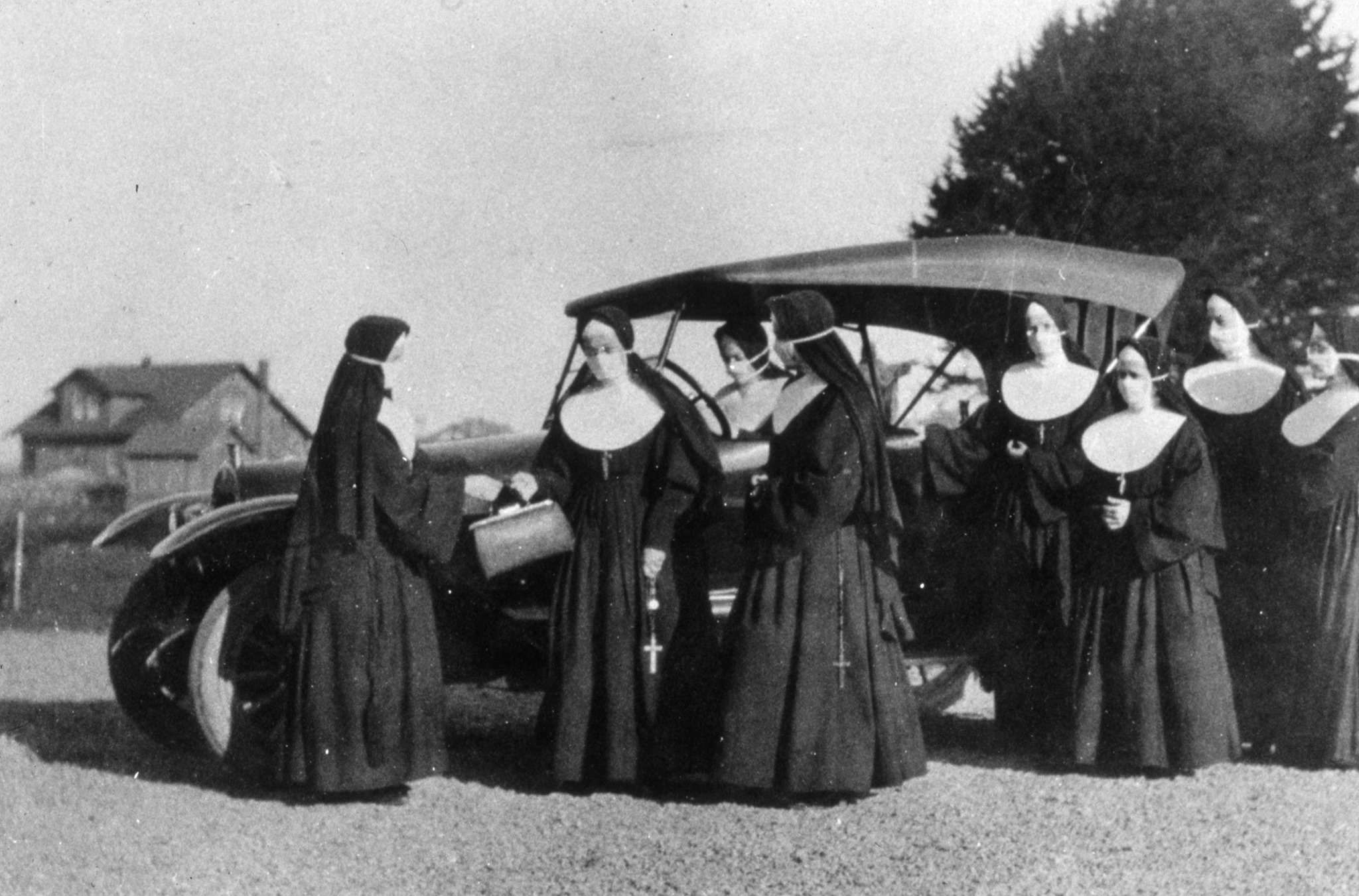
    Sisters of St. Joseph wearing masks during the Spanish flu. The sisters helped many patients in Humboldt from 1918-1920.

    Throughout her research, Kilkenny was able to find where a number of hospitals were set up across Humboldt. There was a Red Cross Hospital in Korbel, Arcata, Blue Lake and Eureka. Kilkenny also came across an interview between a member of the Sisters of St. Joseph of Orange in Eureka and a man named Brad Geagly. Kilkenny wrote the following:

    “[Mother Bernard] sent [the Sisters] out in twos, in cars provided by the Red Cross. She armed each Sister with a kit containing camphor and sweet oil, castor oil, and mustard plasters. Into the homes… the sisters came, arriving at seven o’clock and leaving at the end of a 12-hour shift, to be replaced by two other Sisters. They would attend first to the adults….They would bathe the delirious victims completely, rubbing their chests deeply with the camphorated oil. Mustard plasters would be applied, and then the sisters would wrap the sick tightly in whatever woolen material they could find; then they would tend the children. Once they had been bathed and medicated, the sisters turned to washing linens or cleaning house. They fed their charges warmed milk and broth prepared from the food furnished by the Red Cross.”

    Kilkenny noted that, generally, it was the poor who were admitted into the hospitals, while the more well-off were cared for in their homes. Because of this the actual tally for those infected and the deaths attributed to the Spanish flu is unknown. Kilkenny also points out how the Native American tribes were hit hard by the Spanish Flu as well.

    “Of the [11] Native Americans whose deaths are on record at the County Courthouse, five were from Table Bluff, two from Hoopa, one from Miranda, one from Orleans, one from Requa, and one was a laborer at Korbel,” Kilkenny wrote. She also noted evidence that many Native Americans often refused treatment by White settlers around this time period.

    Kilkenny was also able to find county death records from that time and noted that between Sept. 1, 1918 and April 1919, 175 Humboldt residents died with 91 of them between the ages of 20 and 40.

    And so what can we learn from this history?

    There is evidence that social distancing works by the example set by Carl Munther at his logging camp and how travel throughout the state can spread the virus. We can see how hospitals were eventually inundated with those infected with the Spanish flu and how staff were stretched thin. We can also see how it is important to get ahead of a pandemic and try to prepare as much as possible.

    Humboldt County seems to be doing just that. They have recently distributed around 30,000 pieces of personal protective equipment to first responders and medical staff across the county. Humboldt State chipped in and prepared 1,250 COVID-19 test kits. Also, as I’m sure you are aware, we are in a “shelter in place” order that was enacted to help stop the spread of the virus and to give medical staff the ability to fight the virus without being overwhelmed.

    Towns across Humboldt are also doing their part to help prevent an outbreak. Trinidad passed a moratorium on all short-term rentals and added some pretty forceful consequences to anyone who breaks it.

    “Over the course of the meeting, council members added some teeth to the resolution with language saying that a single violation may result in the City revoking a proprietor’s short-term rental license for up to a year,” the Lost Coast Outpost’s Ryan Burns recently reported, adding that the county may consider a similar measure.

    A stained glass piece by Humboldt artist Colleen Clifford.

    As this thing progresses, we are all going to have to make some sacrifices, but we’ll get through it. Help out the elderly and the immunocompromised if you can. Help out each other by not going out or attending pretty much any gathering of any number of people.

    Let’s all work together — but at least six apart — to help “flatten the curve.”

  • Happy Thoughts and Hot Liquids Won’t Save Us

    Happy Thoughts and Hot Liquids Won’t Save Us

    A reminder of the few things we know that help prevent the spread of COVID-19

    I received a text from a housemate recently recommending we all drink hot liquids and think happy thoughts to get us through the COVID-19 pandemic. Sadly, happy thoughts and hot liquids won’t save us.

    In the midst of a pandemic, it makes sense that people will seek home remedies—they can give you actionable measures to take to try to inoculate yourself against COVID-19. But peddling bunk medicine like a medieval plague doctor only makes things worse.

    Random herbs, hot liquids and happy thoughts do nothing against COVID-19 (neither does weed). What can help stop the spread of COVID-19 are these much less sexy things you’ve probably already heard, adapted from the Centers for Disease Control and Prevention:

    • Social distancing. Hang out with yourself for a while. The crushing introspection may seem scary, but who knows, maybe you could learn something about yourself. The CDC gives suggestions on how to cope in this stressful time.
    • Frequent hygiene. Wash your hands with soap and water for at least 20 seconds. Sanitize doorknobs in your home. Sanitize your debit or credit card if you’re grocery shopping. You might even go so far as to ask to scan your own groceries at the checkout stand.
    • Don’t touch your face. According to disease expert Michael Osterholm, the virus behind COVID-19 chills out in the throat and lungs, and it likes to get in your body through your eyes, nose and mouth. Your hands provide an Uber ride for the virus straight into your system.
    • Also, cover your face. The CDC have shifted course and now recommend people cover their face with a cloth mask in public, especially in high-risk areas like grocery stores or pharmacies. If you have a sewing machine, here’s how to make your own mask. If you don’t have a sewing machine, the CDC provides a video on its site on how to make a mask out of any old cloth and a couple rubber bands.
    • Keep your body healthy. Eating a well-balanced diet, getting enough sleep and exercising all maintain a healthy immune system.
    • Find a new hobby. Don’t allow depression to set in from all the time spent indoors. Netflix is nice, but it’s not a hobby. Try reading, painting, knot-tying or bread-making. Blogger Matt Gilligan compiled a list of 19 inexpensive hobbies for self-quarantining.
    • Connect with your friends and family. Don’t gather with people in person. (No group hugs.) Instead, take advantage of your phone and call up your friends and family. For a more socially stimulating experience, use FaceTime or Zoom to have a video chat. Invite all your pals and make it a virtual party. If you happen to be posted up in a house with a friend, try to hang out with them rather than hiding away in your room.

    We have no cure for COVID-19. A vaccine, by all accounts, remains a long way off. If you end up with the coronavirus, we only have treatments that can relieve symptoms as suggested by the Mayo Clinic, like Tylenol, cough syrups, rest and fluid intake.

    I’m no stranger to distrusting authority or being suspicious of science—I grew up in Southern Humboldt and wasn’t vaccinated until I was a teenager. But for the sake of yourself and the rest of the world, put your suspicions aside and have a little faith in the only proven measures we know against COVID-19.

  • Students Bused Back to HSU Met with Mixed Messages

    Students Bused Back to HSU Met with Mixed Messages

    Locals react to HSU students bused back to Humboldt from coronavirus-afflicted areas

    A bus chartered by the Humboldt State Homeward Bound program picked up 31 HSU students March 21 from San Francisco and Los Angeles—two cities where the coronavirus has become more and more prominent—and brought the students back to Humboldt.

    Lost Coast Outpost posted an article about the bus March 24. The Facebook post for the story has 433 comments as of March 29, many of which are critical of HSU.

    “This is beyond irresponsible of HSU,” one comment reads.

    “And one more reason we feel GREAT about not sending our kids to HSU,” reads another.

    Sarah Ray, an environmental studies professor, defended the students.

    “Quite a few of our students live here and have moved here and have their lives here and they were visiting family,” Ray said. “So, just like we would expect and hope that kids and students who are from Arcata and the area—we would fully respect and appreciate that they would want to come home and be home with their families once their classes got cancelled in this really frightening moment—it’s reasonable that students would want to go where they’re most comfortable and feel at home.”

    She went on:

    “There’s also a lot of research out there about how many students across the nation going through this exact problem are not safe at home, and this might be a safer place for them,” Ray said.

    “I feel like it’s not a simple solution to just say, ‘Go back there,’ because many of these students live here.”

    Xochitl Andrade, HSU English and biology major

    Grant Scott-Goforth, communications specialist for HSU, explained the precautions implemented on the buses returning to HSU.

    “The buses were partially full so that people could have social distancing on the buses while they rode,” Scott-Goforth said. “And then, obviously when they return, we’re asking everyone to shelter-in-place, to quarantine if you’ve been exposed or been to an area with exposure, and to contact the Student Health Center or hospitals with concerns about health.”

    As much as HSU wished it could’ve been in command over which students came and which students left Humboldt, there was no way to do that. Of course, as Scott-Goforth asserted, the coronavirus situation is nothing to sneeze at.

    “I think it’s terribly unfortunate and I’m very sad for them and I feel very protective of students because it’s what I do.”

    Sarah Ray, HSU environmental studies professor

    Xochitl Andrade, an HSU senior majoring in English and biology, said the situation is complicated.

    “I feel like it’s not a simple solution to just say, ‘Go back there,’ because many of these students live here,” Andrade said. “They may have no where else to go if they were told to go back. We don’t know if they were just visiting friends or family. And for those who don’t have any family to go back to, what are they supposed to do?”

    While Andrade agrees that the students should be quarantined, she said she thought HSU knows what it’s doing.

    Ray hoped the harsh words toward HSU students from the Lost Coast Outpost article weren’t representative of the Arcata community.

    “I think it’s terribly unfortunate and I’m very sad for them and I feel very protective of students because it’s what I do,” Ray said. “I would like to think that it’s only an extreme, fringed, vocal, internet types of social media people who are saying those kinds of things. The vast majority of the university, especially the community and many people in the community—that’s not the kind of sentiment I see.”

  • Myths and Truths of Surgical Face Masks

    Myths and Truths of Surgical Face Masks

    Mirage of safety causes mask supply to plummet and xenophobia to reemerge

    The emergence of everyday people using surgical masks amidst the COVID-19 pandemic has caused mass misinformation and the perpetuation of xenophobic ideas.

    Myth: Surgical masks make you immune to COVID-19

    Typically found on hospital workers and sick personnel as a safety barrier, surgical masks are almost regarded as invincibility devices, protecting the body from outside pollutants and threats. The implied purpose of surgical masks is to protect patients from the secretions of a doctor’s mouth or nose during surgical procedures or to protect doctors and nurses from infected patients. Either way, a basic surgical mask prevents the exchange of bodily fluids, not air particles. Surgical masks are often mistaken as invincible shields against all viruses and bacteria.

    Surgical masks show no evidence of prohibiting the inhalation or contraction of the virus that causes COVID-19. The COVID-19 virus particles are too minuscule to be stopped by a surgical mask barrier. According to the Centers for Disease Control and Prevention, “most facemasks do not effectively filter small particles from the air and do not prevent leakage around the edge of the mask when the user inhales.” In no way do surgical masks prevent or obstruct contaminated air.

    While surgical face masks are virtually pointless against COVID-19, N95 filtering facepiece respirators are different. These masks are personally fitted to the face and “filter out at least 95% of very small (0.3 micron) particles, capable of filtering out bacteria and virus particles,” according to the CDC. These masks are typically worn by hospital and treatment personnel that come in direct contact with infected patients. N95 masks prevent the inhalation of micro-particles.

    Truth: Surgical and N95 masks are running low

    Due to the personal fitting of each N95 mask, they begin to degrade overtime depending on their usage, storage and environment. The assigned expiration date and high demand due to the current pandemic has resulted in an unexpected shortage in supply. Doctors are now reusing their masks, but they risk contamination due to degrading components affecting the protection and performance of the mask. Government administrations are requesting N95 donations as well as demanding some occupations to give up their assigned mask for medical workers.

    While N95 masks are needed most, surgical masks are running low as well. Infected patients wearing masks benefit surrounding parties by limiting exposure of emitted particles into the air. The pandemic panic has misinformed the public to go buy surgical masks when patients and medical workers need them most.

    Myth: DIY masks provide reliable protection

    YouTube and social media platforms are advertising do-it-yourself face mask tutorials in response to the shortage in surgical mask supply. The misinformation has continued as people attempt to protect themselves with faulty protection materials. Bras and bonnets to sandals and plain cloths are being cut and trimmed to replicate surgical face masks. But, as previously mentioned, surgical face masks provide no protection against COVID-19 virus particles. Any alteration of store-bought or recycled material will have the same, if not less, protection against COVID-19 than a surgical mask.

    Truth: Mask usage has reignited xenophobic ideas

    Surgical masks provide zero protection from contracting COVID-19, but they have effectively reignited xenophobia. It’s completely normal for the mind to want to assign a face to an infected COVID-19 individual or picture what a threat would look like out of caution. Assuming someone wearing a face mask has the virus and extending that assumption past the mask, to their race or ethnicity, is disgusting, racist profiling. In a time of crisis, people should be exercising neighborly behavior and picking one another up, not perpetuating racist, profile-based assumptions on others in an attempt to accuse others of the chaos. It’s unproductive and invasive.

  • Students Stressed and Frustrated Going into Somber Spring Break

    Students Stressed and Frustrated Going into Somber Spring Break

    Students react to in-person class cancellations due to global pandemic

    As spring break arrived and the COVID-19 pandemic continued its tear across the globe, many Humboldt State University students wondered what to do as HSU canceled face-to-face instruction until at least April 17. Some students stuck around while others went home. The pandemic, directly or not, has affected all students.

    “I feel like it’s a very serious outbreak and people need to take it seriously. I do think it’s getting blown out of proportion in some ways and people are panicking before they need to, but it’s just something I’m kind of trying to roll with, essentially.”

    Ashley Bailey, molecular biology major

    Ashley Bailey, a junior molecular biology major, planned to travel home. She admitted feeling stressed.

    “I feel like it’s a very serious outbreak and people need to take it seriously,” Bailey said. “I do think it’s getting blown out of proportion in some ways and people are panicking before they need to, but it’s just something I’m kind of trying to roll with, essentially.”

    Kiera Price, a junior journalism major, also said she would travel home. She thought both academic and national leaders should be more vigilant.

    “I feel like instead of limiting social interaction, they should do more to prepare for it,” Price said. “Like, for example, the fact that there isn’t more of a stricter way to limit survivors from coming in.”

    Price recognized there isn’t a lot to be done, but still expressed a longing for something more.

    Tim Arceneaux, a senior English major, looked forward to staying in Humboldt. With a sigh, Arceneaux said he understood the measures taken by HSU.

    “I think the precautions that the University is taking here and all around the country make sense, but at the same time, I find them to be really frustrating,” Arceneaux said. “I hope that this issue will bring the global community together and allow people to realize the importance of universal healthcare.”

    Arceneaux said there was one key thing HSU could do to mitigate the spread of the novel coronavirus.

    “They could try to alert students more about the health resources on campus,” Arceneaux said. “Because I feel like at this point, it’s almost an inevitability that someone is going to contract the coronavirus, and I’m not sure exactly what health resources are going to be available to students that contract the disease.”

    Norbert Rodriguez, a junior film major, had planned to travel to Southern California to visit family, but decided to stick around once the coronavirus broke out. He said he thought HSU took too long to respond to the pandemic compared to other universities.

    “At the moment, there aren’t any test kits [in Humboldt], so there’s really no way of knowing that there are any confirmed cases,” Rodriguez said. “I feel like it should’ve been a bit more proactive.”

    Editor’s note: St. Joseph and Redwood Memorial Hospitals have set up screening tents for patients with COVID-19 symptoms.

  • Humboldt County Coronavirus Case Update

    Humboldt County Coronavirus Case Update

    Department of Health and Human Services quells concerns

    The Humboldt County Department of Health and Human Services informed the public Feb. 20 via press release they had received confirmation of one confirmed case of coronavirus in Humboldt County. A close contact of the confirmed patient has symptoms and is also being tested for the disease. 

    Information has come, and will continue to be provided from the California Department of Public Health and the U.S. Centers for Disease Control and Prevention.

    The DHHS has since been fielding questions from the concerned community.

    The Lumberjack spoke with Hava Phillips, the supervising public health nurse at DHHS. If you are concerned that you may have contracted the disease, she asked that you call them before visiting their department.

    For now, the county is not considering this a public outbreak, and the ill individuals are self-isolated and under close watch by the Public Health Communicable Disease Surveillance and Control Unit. This doesn’t mean they’re not prepared for the disease to spread.

    “We are making sure we have the infrastructure in place if this were to become a larger outbreak,” Phillips said.

    Phillips said because it’s also flu season, people should be following basic precautions to prevent the spread of communicable diseases of all varieties, summed up by these tips from the DHHS press release:

    • Stay home when you are sick.

    • If you have a fever, stay home or go home if you are already at work or school, and stay home for at least 24 hours after you no longer have a fever (without the use of fever-reducing medicine).

    • Wash your hands frequently and particularly before eating or drinking.

    • Promote good hand hygiene in your home by educating household members and making sure soap, hand sanitizers and tissues are available.

    • Avoid touching your face, particularly your eyes, nose and mouth.

    • Encourage proper cough etiquette. Cough or sneeze into a tissue, sleeve or arm. Do not use your hands.

    • Perform routine surface cleaning, particularly for items which are frequently touched such as doorknobs, handles, remotes, keyboards and other commonly shared surfaces.

  • First Case of Coronavirus Confirmed in Humboldt

    First Case of Coronavirus Confirmed in Humboldt

    Press release from Humboldt County Department of Health and Human Services Public Health Branch

    Press release:

    The Humboldt County Department of Health & Human Services Public Health Branch has received confirmation from the California Department of Public Health and the U.S. Centers for Disease Control and Prevention (CDC) of one case of COVID-19 in a Humboldt County resident. A close contact who has symptoms is being tested as well.

    This marks the first confirmed case of the novel coronavirus in Humboldt County. Presently, the ill individuals are doing well and self-isolating at home, while being monitored for symptoms by the Public Health Communicable Disease Surveillance and Control Unit.

    Close contacts of these individuals will also be quarantined at home and monitored for symptoms by Public Health staff. With the amount of foreign travel by county residents, including travel to China, it is not surprising that a case has emerged locally. Additional cases may occur either in returning travelers or their close contacts.

    “It’s important to remember that the risk to the general public remains low at this time,” said Humboldt County Health Officer Dr. Teresa Frankovich. “Despite the fact that Humboldt County now has a confirmed case of COVID-19, there is no evidence to suggest that novel coronavirus is circulating in the community at large.”

    Frankovich added that transmission in the U.S. to date has been among close contacts and not among the general public.

    Public Health suggests the following precautions to prevent the spread of COVID-19 and all infectious diseases, including common illnesses like colds and flu:

    • Stay home when you are sick
    • If you have a fever, stay home or go home if you are already at work or school, and stay home for at least 24 hours after you no longer have a fever (without the use of fever-reducing medicine).
    • Wash your hands frequently and particularly before eating or drinking.
    • Promote good hand hygiene in your home by educating household members and making sure soap, hand sanitizers, and tissues are available.
    • Avoid touching your face, particularly your eyes, nose and mouth.
    • Encourage proper cough etiquette. Cough or sneeze into a tissue, sleeve or arm. Do not use your hands.
    • Perform routine surface cleaning, particularly for items which are frequently touched such as doorknobs, handles, remotes, keyboards and other commonly shared surfaces.

    The county’s Communicable Disease Surveillance and Control Unit will continue to provide updated information about COVID-19 to health care providers, hospitals and schools, as well as the general public.

    The county’s Communicable Disease Surveillance and Control Unit will continue to provide updated information about COVID-19 to health care providers, hospitals and schools, as well as the general public.

    For updated information about COVID-19, please continue to check the https://www.cdc.gov/coronavirus/.

    If you are ill and in need of medical care and have been in China within the previous two weeks or have been in contact with an individual who has COVID-19, please contact your health care provider or emergency department before presenting for care. Arrangements will be made to have you evaluated in the safest manner possible for health care staff and other patients.

  • News Recap: Coronavirus Outbreak

    News Recap: Coronavirus Outbreak

    The coronavirus continues to spread across the globe

    What is it?

    A new coronavirus strain has afflicted over 20,000 people across the globe, according to data from Johns Hopkins University. A coronavirus is a type of virus found in mammals and birds. Most coronaviruses are mild, but certain strains can be severe and potentially fatal. Previous notable strains include SARS (severe acute respiratory syndrome) and MERS (Middle East respiratory syndrome).

    The new strain, scientifically called 2019-nCoV, has symptoms including fever, cough and shortness of breath. As of Feb. 4, over 400 people have died from the virus in China, with one reported death in the Philippines and one reported death in Hong Kong.

    Where is it?

    The virus strain began in Wuhan in China’s Hubei province. Eleven people have been confirmed with the coronavirus in the United States, with hundreds being screened. A case has been confirmed in the Bay Area, but no cases are known in Humboldt County.

    Should I be concerned?

    Thus far, those who have died from the disease have had other illnesses that limited their immune system, according to the World Health Organization. The disease is mainly spread through coughing or sneezing. The virus can cause pneumonia.

    The United States State Department raised the threat level of the virus to level four, the highest level, on Jan. 31, meaning that travel to China is no longer advised. Many airlines have since canceled or reduced flights to China.

    The World Health Organization determined coronavirus to be a Public Health Emergency of International Concern on Jan. 30. The virus has spread to at least 27 countries.

    According to a report by The Guardian, the current estimated mortality rate for the coronavirus is around 2% (though this is likely high, as many people without severe symptoms may not have gone to hospitals). Seasonal flus typically have around 1% mortality rates, while SARS has a mortality rate of 10%. Given current evidence, panic doesn’t appear warranted.