The Lumberjack


Students Serving The Cal Poly Humboldt Campus and Community Since 1929

Tag: Counseling and Psychological Services

  • Queer students are afraid to use TimelyMD counseling option

    by August Linton and Camille Delany

    Originally printed April 26, 2023

    Art Wardynski has lost almost all of his adult family members in the past few years, most recently his mother. He reached out to Counseling and Psychological Services (CAPS) for support, and was only offered a telehealth appointment with TimelyMD. 

    This wasn’t acceptable to him. As a queer person, Wardynski wasn’t comfortable with the fact that TimelyMD is a Texas-based company, or that they offer faith-based therapy as an option for universities. 

    “When I’m already going through such a vulnerable time in my life, I don’t want to risk being discriminated against,” Wardynski said. “They told me that my only option was to go through TimelyCare, and that is not an option for me.”

    After the death of his mother, on whose insurance he was dependent, Wardynski wasn’t sure if he had the ability to access off-campus healthcare, either. In the meantime, he’s just been trying to finish the school year.

    “I feel like I’m just chipping away at energy that I don’t even have,” Wardynski said.

    He isn’t alone in his concerns. Many queer students have voiced fears about the safety of the service, according to Landon White, Outreach Director for CPH’s Eric Rofes Multicultural Queer Resource Center (ERC).

    TimelyMD is an online mental health company which markets itself to universities as a stopgap and after-hours counseling service. CPH has contracted with the company, it says to provide students with after-hours healthcare.

    TimelyMD’s location in Texas, a state that is currently considering over 50 bills which limit the rights of transgender people, is one of the main issues that White has with Humboldt’s use of it.

    Other than the objection to university dollars going into Texas, the likelihood of being paired with a non Queer-affirming therapist is too high for many students’ comfort. Even in the relative haven of trans rights that is California, many therapists are transphobic, according to trans students. 

    “There are other telehealth organizations out there,” White said. “We need accessible mental health services that don’t come at the cost of forcing Queer and BIPOC students to play roulette.”

    The ERC advocates for the university to employ more CAPS counselors, especially those familiar with Queer and BIPOC issues. That would take competitive pay, job security, and outreach, said White. They also point out that the accessibility of telehealth is definitely a good thing, but don’t think that TimelyCare is a good option. 

    The use of online therapy services as replacement for in-person treatment by CAPS forces students into a situation that many are not comfortable with, should they need mental healthcare. 

    An open letter to the Associated Students, signed by campus groups including the Students for Quality Education (SQE), Queer Student Union, Black Student Union, and clubs such as the Mycology Club and Critical Race, Gender, and Sexuality (CRGS) Club, took a direct stance against TimelyMD. They asked AS to support the campaign against the service, something the body has not yet done.

    Student Allison Miranda also feels uncomfortable going to TimelyCare for mental health support due to her and her family’s Queer identities.

    “I need support. My tuition is paying for Timely,” Miranda said. “But I know that… LGBT+ students haven’t felt supported by them.”

    Miranda is a transfer student from College of the Redwoods, and said that she feels comparatively unsupported at Humboldt.

    “They [CR] had three different people, licensed therapists, who were trained in addiction counseling and all this stuff,” Miranda said. “Coming to HSU I expected an equivalent, if not better, experience. [Not having therapy] has impacted my studies.”

  • Faculty union challenges TimelyMD

    by Tucker Caraway

    In the print version of this article, Dr. Loren Cannon was referred to as a psychotherapist. He should have been identified as the Cal Poly Humboldt CFA President.

    An Unfair Labor Charge has been filed against the Cal Poly Humboldt Board of Trustees on November 8th due to violations found in their contracting with Timely MD. The Public Employee Relations Board found the University in violation of government codes regarding the failure to notify Unions in contracting decisions. 

    The charge was originally filed back in October 2021 by the California Faculty Association after being made aware a contract was signed with Timely MD without their knowledge.

    “They signed this contract before meeting with CFA, the union that represents counselors, and that’s a big no-no. That’s the basis of our unfair labor practice charge,” said Loren Cannon, president of the Humboldt chapter of the California Faculty Association.

    Timely MD, also known as TimelyCare, is a Texas based counseling provider that works in conjunction with CAPS.  They provide 24/7 counseling support as well as individual counseling sessions during breaks and outside business hours. 

    “I’ve heard when you try to get an in person appointment, they refer you to TimelyCare,” said Chelsea Rios-Gomez, intern for Students for Quality Education. 

    TimelyCare has been available to Cal Poly Humboldt students since March 2022 after switching from the platform ProtoCall due to complaints of long wait times. 

    “If you’re in a mental health crisis, you don’t want to wait online. So they were looking to have something to improve that. But in doing so, they contracted with a company that isn’t just doing emergency counseling, they’re doing regular counseling, which is a union job,” Cannon said. 

    Outsourcing union jobs to out of state entities not only puts faculty at a disadvantage, but also poses a new risk to students engaging with TimelyCare. 

    “You will be finding good counselors. Not all of the counselors there are going to be bad.

    But there are some counselors, some faith based counselors, more specifically Christian counselors, who are perpetrating harm to our students,” said Rios-Gomez.

    Timely MD, while not a Christian organization,  offers faith based counseling services to Christian universities and has a working partnership with the Council for Christian Colleges and Universities. 

    “We’re outsourcing union jobs, and we’re also outsourcing responsibility for our students’ wellbeing,” Cannon said.

    Texas is a state with a reputation for anti LGBTQ+ policies and practices. Five years ago, Gavin Newsom Passed Assembly Bill 1887, which prohibits state-funded travel to Texas and 23 other states with discriminatory LGBTQ+ policies and practices. 

    “We can’t even fly to Texas for an academic conference because we’d be putting money in the Texas economy,” said Cannon. 

    Thanks to legal loopholes in state jurisdiction, students logging into TimelyCare who, for example, would want to file a Title IX lawsuit, would have to do so in Tarrant County, Texas.

    “The Council for Christian Colleges and Universities actively argues that religious colleges should be able to receive federal funding, and to be able to discriminate against LGBTQ+ students, basically saying they are not protected under title 9,” said Cannon. 

    Students for Quality Education, who work in coordination with the California Faculty Union, has been made aware of an array of discriminatory encounters on on the platform. 

    “It’s a lot of invalidating of trans identities and queerness in terms of pushing Christinaity in that way,” said Rios-Gomez.

    When it comes to addressing the needs of the Cal Poly Humboldt community, Cannon said it’s important for unions to be involved in contracting these services, so CAPS can find vetted counselors that actually understand the needs of the community they’re involved in. 

    “What is the most important thing is to value the people doing the important work on our campus,” Cannon said. 

    As of November 8th, the Board of Trustees has 20 days to respond to the complaint charges by proving they didn’t violate labor laws and union members rights. 

    “The fact that it went forward from that initial step is that the people at the PERB must think that our charge has merit, and I’m not a lawyer, but it’s pretty cut and dry without talking to us and without negotiating it,” Cannon said.

  • HSU Student Resources to Get Through the Pandemic

    HSU Student Resources to Get Through the Pandemic

    Student resources for school, finances, food, housing and counseling

    Here is a list of resources Humboldt State is offering for students. Click here for a student-created site of community resources. Click here for the site in Spanish.

    Educational advice:

    Enoch Hale is the director of the Center for Teaching and Learning at Humboldt State University. He provided five tips to help students with online learning during the shelter in place order. His tips revolved around being kind and flexible.

    “Kindness is having the patience and the benefit of the doubt to know that everyone else is struggling,” Hale said. “Be flexible—no one signed up for this and we are going to have to be agile in our expectations in the changing patterns.”

    Five tips to help with online school from Hale:

    1. Don’t ignore feelings—reflect on them so they don’t manage us.
    2. Communicate with professors more, not less.
    3. Log on more frequently. Check your emails and canvas more often. Not all courses will be on Zoom.
    4. Set a schedule, use a study calendar and stick to a routine.
    5. Check the Keep Learning website.

    Finances:

    HSU Coordinator of Student Services for the financial aid office Morgan McBroom provided financial advice to students. McBroom suggested students in a crisis contact the financial aid office.

    For students who are hard-pressed for money, there is a student emergency loan that ranges from $500 to $1000. It is a short-term loan and can come within a few days. Financial services will work to help students pay it back. Students who have not used all of their student loans from the previous semester may also still have access to them.

    Due to the COVID-19 crisis, students’ loan interests are being waived, but the estimated date that it will stop is in June. As of now, the end date hasn’t been established. If you are an HSU graduate, you can have your loans waived for a year with no interest.

    Contact: finaid@humboldt.edu or (707) 826-4321.

    Housing:

    In addition to her advice on financial matters, McBroom also provided housing advice. There is emergency housing available on campus. The off-campus liaison is a resource if you’re struggling with rent.

    Contact: housingliaison@humboldt.edu

    Food:

    1. The recreation room on the first floor of the Jolly Giant Commons offers pre-made bags with food items. This happens twice a week on Wednesday from 10 a.m. until 12 p.m. and Thursday from 1 to 3 p.m. Vegan and vegetarian meal bags are also available.

    If you cannot make those times due to isolation or quarantine, contact mira@humboldt.edu and she can set up a delivery time.

    2. Oh SNAP! can also help you load your student ID card with J points. You need to express a financial need for food support. If you have over $40 in J points, you need to wait until your card is under $40. You can receive $60 every four weeks, but this is subject to change. If there is an increase of funds there could be an increase in the amount given to students. You can also donate your J points to help students in need.

    Contact: ravin.craig@humboldt.edu.

    3. For extra help, try applying for CalFresh, a state-funded program to help pay for food. Students not working 20 hours a week can apply for CalFresh, except for students in the Educational Opportunity Program program, students with specialized grants and work-study students. You can qualify for up to $200 a month for groceries.

    Contact ravin.craig@humboldt.edu if you need help with the application process or would like to see if you qualify.

    Counseling:

    Mira B. Friedman is the lead for health education and clinic support services. She provided information about counseling for students.

    HSU Counseling and Psychological Services is offering virtual appointments.

    Students can call (707) 826-3236 to make an appointment. There’s also a 24/7 hotline for immediate crisis outreach for students to speak with a therapist by phone at (707) 826-3236.

  • HSU Health Center Remains Open

    HSU Health Center Remains Open

    Students on campus can still reach out to medical services

    The Humboldt State University campus is closed to the public, but the Student Health Center expects to remain open for the remainder of the semester to help any students remaining on campus. The health center is limiting face-to-face contact as much as possible, but is still helping students without physical appointments when possible.

    “We’re doing everything we can to help minimize the risk of exposure for students and Student Health and Counseling staff by limiting as much face-to-face contact as possible,” HSU Director of News and Information Aileen Yoo said. “For emotional support, for instance, students can talk to a CAPS counselor over the phone and, in most cases, if preferred, Zoom.”

    The Health Center is still offering other essential services like prescription refills and COVID-19 testing.

    “For those who are sick or suspect they have COVID-19, we have urged them to call before visiting the health center,” Yoo said. “When it comes to COVID-19, our main focus is assessing the student and collecting swab samples if we think that’s necessary.”

    “It is normal to have ebbs and flows with your mood and productivity levels but if you get “stuck” in a dark space for an uncomfortably long time, consider reaching out to get help such as from a counselor at CAPS.”

    Jennifer Sanford, director of Counseling and Psychological Services and associate director of student health and wellbeing

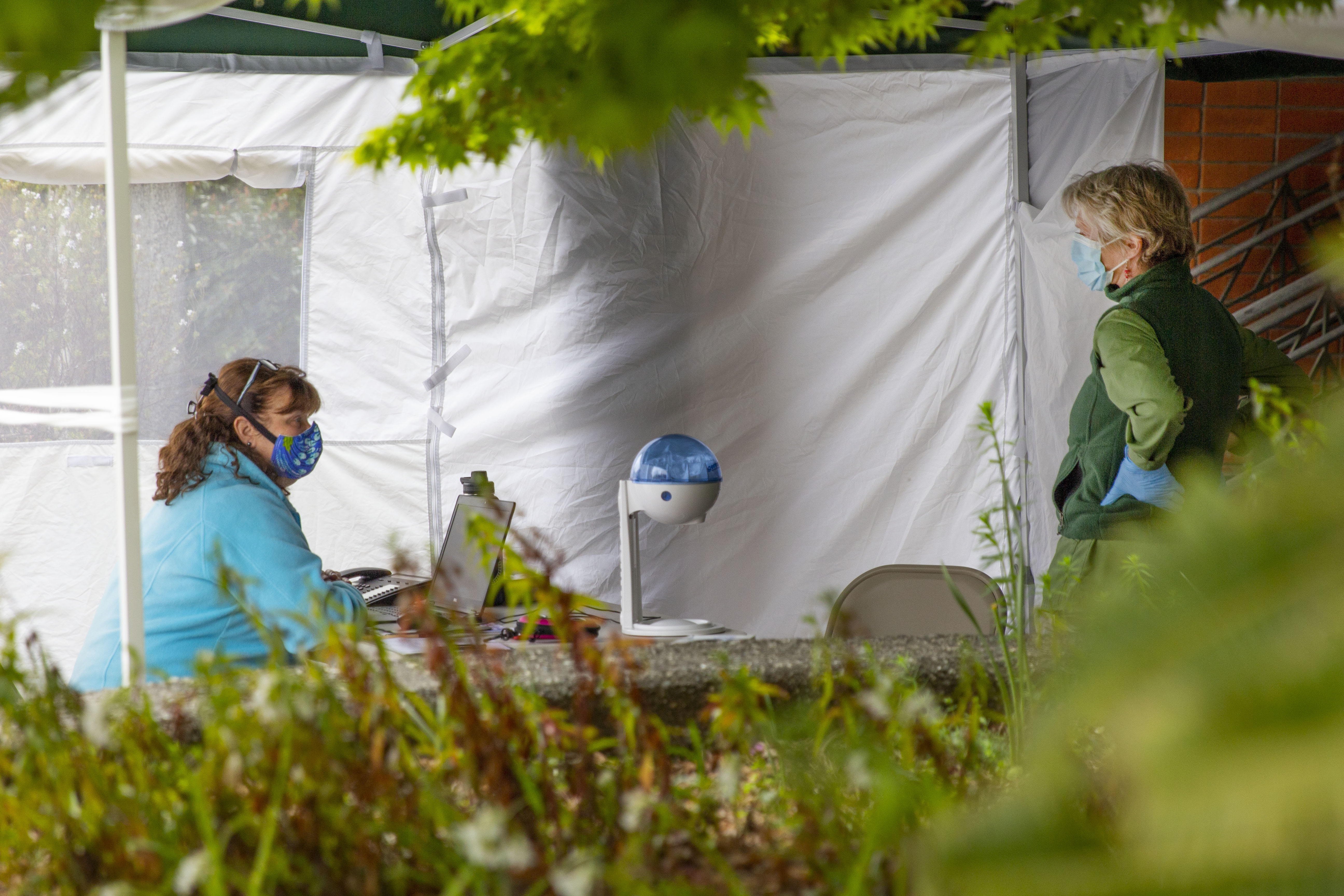
    The Health Center set up white triage tents in front of the building to help students check in and get assessed. If a student tests positive for COVID-19, the Health Center will work with county health services to make sure the student gets the treatment they need.

    During a pandemic, the disease itself isn’t the only medical problem facing students. The Center for Disease Control warns the stress of a pandemic can cause or worsen mental health problems, and recommends calling a health care provider if symptoms persist.

    The Director of Counseling and Psychological Services and Associate Director of Student Health and Wellbeing Jennifer Sanford asked students to consider reaching out to Counseling and Psychological Services if they feel their mental health is deteriorating.

    “Pay attention to how your thoughts and attitudes in any given moment are impacting your mood and overall wellbeing,” Sanford said. “Talk with others, connect. It is normal to have ebbs and flows with your mood and productivity levels but if you get “stuck” in a dark space for an uncomfortably long time, consider reaching out to get help such as from a counselor at CAPS.”

    Sanford said that this can be an uncertain time, but it’s important to see social distancing as community care.

    “The reality is that in our physical distancing, we are displaying compassion and care for our elderly and medically compromised,” Sanford said. “We are allowing our healthcare system to better manage the flow and care of patients, and we are caring for ourselves by lessening our own risk.”

  • New Grant Spurs CAPS Growth

    New Grant Spurs CAPS Growth

    CAPS will provide 36 more appointments per day by next year

    On Jan. 9, the California State University Office of the Chancellor gave Counseling and Psychological Services a grant of $150,000 under the California Budget Act of 2019 to provide Humboldt State University students with more counseling services to combat mental health issues.

    Director of Counseling and Psychological Services and Associate Director of Student Health and Wellbeing Services Jennifer Sanford was closely involved in the acceptance of the grant.

    “I’m most excited about the pilot project to get innovative programs off the ground that’s focused on high-risk students,” Sanford said. “In developing this program we will be doing some specialized training that we’re doing research on now to launch next year.”

    “Mental health doesn’t get the recognition that it should. When you’re not mentally well, your body reacts to that. If you’re stressed out, you’re only going to make it worse. More people should pay attention to it.”

    Danele Quijas

    Lobby areas will be built to hold more students and allow for an increase in counseling appointments. The grant will also fund two new therapy offices in the Behavioral and Social Sciences building, which will allow therapists to extend their hours. More tables and chairs will be added to the waiting areas to eliminate standing-room-only appointments. Construction will begin this summer.

    The funds are expected to help students learn life skills, cope, regulate stress and manage moods. CAPS says improving these areas can improve class attendance, retention in school and promote graduation. With anti-stigma campaigning, CAPS hopes to make students feel comfortable talking about their problems.

    Danele Quijas, a 22-year-old biology major, said students don’t pay enough attention to their mental health.

    “Mental health doesn’t get the recognition that it should,” Quijas said. “When you’re not mentally well, your body reacts to that. If you’re stressed out, you’re only going to make it worse. More people should pay attention to it.”

    A pilot project of $25,000 was also accepted by CAPS and will allow the growth of an intensive treatment program for high-risk students with disabling and chronic mental health issues. This treatment plan will include individual and group therapy as well as the highly-researched dialectical behavior therapy. CAPS hopes to continue this growth by providing other California State Universities with the tools to rebuild their own programs to be as effective as possible.

    Casey Pederson, a senior majoring in business marketing, said HSU should do more to make resources clearly available to students.

    “In a case like this with mental health, there can never be too many resources—so I definitely think it would help,” Pederson said. “I also think a big issue about it is getting people to know. Like I said, I had no knowledge that this was happening, and the big thing with mental health is the lack of knowledge and getting help. And there are resources available.”

  • Mental Health at Humboldt State

    Mental Health at Humboldt State

    HSU’s CAPS is working to combat mental health concerns among HSU students

    Rates of attempted suicide in Humboldt County stand far above national and state averages, according to Humboldt State University Health Center Director Brian Mistler, Ph.D.

    “Suicide attempt rates in Humboldt County are nearly twice the national and California averages,” Mistler said in an email response facilitated by HSU Communication Specialist Grant Scott-Goforth. “And HSU students face greater systemic barriers to access health care than in other more affluent and less isolated parts of the country.”

    An estimated 40% of HSU students felt elevated levels of depression according to a 2016-2017 Healthy Minds Study led by Daniel Eisenberg, Ph.D of the Healthy Minds Network, which performs web-based mental health surveys on college students.

    Eisenberg has been leading an analysis of student mental health at all 23 California State Universities. In the 2016-2017 analysis of HSU, an estimated 42% of students had elevated levels of anxiety, while an estimated 4% of students attempted suicide in the last year.

    Mistler tied Humboldt County’s lack of expert services to mental health.

    “…HSU students face greater systemic barriers to access health care than in other more affluent and less isolated parts of the country.”

    Brian Mistler, Humboldt State University Health Center Director

    “Mental health is a critical basic need and it’s tied to others like having enough food, shelter and physical health care and safety,” Mistler said in the email. “Psychological needs become more important as chronic resource insecurity increases.”

    Mistler clarified that HSU’s relatively high rates of mental health conditions do not appear to be caused by Humboldt itself.

    “From what we know today, the increased needs among students appear to be present on the first day,” Mistler said in the email. “That is, it’s not caused by being here.”

    Mistler added that many HSU students may arrive with a history of limited health care access.

    “It’s also true that many students arrive at HSU having not had access to their fair share of health and counseling services in the past,” Mistler said in the email. “It’s clear from all the data that HSU’s team of health experts do a phenomenal job of helping those students who choose to seek help.”

    Counseling and Psychological Services Staff Psychologist and Outreach Coordinator Dr. Elizabeth McCallion in a CAPS office on Oct. 1. McCallion said most students who visit CAPS report positive experiences. | Photo by James Wilde

    HSU Counseling and Psychological Services Staff Psychologist and Outreach Coordinator Dr. Elizabeth McCallion is one of the experts working to help students.

    McCallion hopes to mitigate the stigma around mental health.

    “Mental health support doesn’t just have to be for when you’re having severe symptoms,” McCallion said. “It can be a way of just generally taking care of yourself. Kind of like preventative health care.”

    McCallion said CAPS is working to meet students where they are, including through library SkillShops and outreach by Multicultural Specialist Cedric Aaron.

    McCallion praised HSU’s mental health services but did acknowledge a lack of services in the surrounding community.

    “I think in terms of the counseling center, the counseling center does a wonderful job with that support,” McCallion said. “In terms of our community, there is a need for additional mental health care. But that’s not just mental health, that’s health care in general because of where we live.”

    Both McCallion and Mistler emphasized that those students who do use HSU’s services see verifiable benefits.

    “Dozens of studies confirm that medical and counseling services reduce the risk for students of catastrophic outcomes, help with anxiety and depression, and increase the chances of students graduating,” Mistler said in the email. “If there’s a message here, it’s to encourage people to use the available resources.”

    Mistler noted that HSU’s outreach efforts have produced an increase in student visits to counseling services of about 5% each year.

    Mistler also pointed out that students that receive counseling show improved retention rates and a higher likelihood of graduating.

    Mistler and Eisenberg plan to prepare a CSU-wide analysis of mental health in spring 2020, which they hope will provide more information on the state of student mental health.


    Per the CAPS website: You can reach a CAPS therapist by phone at all hours at (707) 826-3236. In emergency situations, you should call Humboldt County Mental Health at (707) 445-7715 or dial 911.

    You may also reach the National Suicide Prevention Lifeline at 1-800-273-8255.

  • Mellow out with meditation

    Mellow out with meditation

    By  Morgan Brizee

    Learn to de-stress with the One Breath meditation group class

    HSU staff psychologist with a residential life focus, facilitating the One Breath meditation with students. Photo by Morgan Brizee

    A long light grey table split the Recreation and Wellness Center room in half. Students and a staff member were on one side and the facilitator on the other during the One Breath meditation group class on Feb. 1.

    Every Wednesday at 5 p.m., Craig Beeson teaches those who want to learn to destress and wind down. The group is run by Counseling And Psychological Services and is open to the HSU community including students, staff and faculty.

    Beeson is a staff psychologist with a residential life focus and does workshops like One Breath in the resident halls on HSU campus.

    “I noticed when this [One Breath Meditation workshop] was on my mind, preparing for it, I was getting stressed about it,” Beeson said. “This is counterproductive, I’m getting really stressed about a mindfulness presentation.”

    With a new semester starting up again, and most students being far from home, it can be easy to get overwhelmed.

    Karen Zurdta, a 23-year-old English grad student, talked about how coming to this class has taught her to love herself more.

    “I was going through a tough time with school last semester and I got really sad and emotional,” Zurdta said. “I was having problems showing myself love and that I am worthy of good things.”

    Beeson is using the book, “The Mindful Path to Self-Compassion” by Christopher Gerner, to teach the class about not fighting the feelings you have but instead accepting them. The class goes over how to cope with issues from anxiety to insomnia that many students can relate to.

    Matt Cunningham, a 25-year-old senior English major, has been meditating for five years and even went to the City of Ten Thousand Buddhas in Ukiah, Calif. last spring to help with his practice of mindfulness.

    “It’s kind of taught me to think of my thoughts and feelings as senses and to react to them like I would to any other sort of negative stimuli,” Cunningham said. “Mindfulness has helped me address those things more directly in a lot of ways.”

    The class begins with a group discussion of feelings and how to address them in a positive way. After about 30 minutes, Besson directs the group to close their eyes and focus on their individual breathing. He then moves on to telling the group to focus on one body part at a time, relaxing each body part individually, until the group feels their body and mind is calm. Beeson ends class by checking in with each member of the group on how they feel afterwards.

    “We talk about things like how to connect to yourself and live a more present, relaxed life,” Beeson said.